17 331 résultats
Roma, TipografiaSalviucci, 1858. Lex 8vo. Original printed boards. Upper part of spine replaced, with title written in hand, Wear along upper part of front hinge, otherwise fine, with just a bit of soiling and some fading to the delicate pink colour. Some occasional brownspotting. (12), VI, 216 pp. + 9 plates (depicting sunspots).
WB18616Italy ca mid-18th century. Hardcover. Very Good. 64 leaves 8vo 202 x 135 mm. In Italian. Written in cursive in brown ink on thick paper. With several ink diagrams tables head- and tail-pieces throughout. Some offsetting and a few stains. 18th-century sprinkled calf gilt some staining and repairs. Text opens: La Sfera che si spieghera si divide in Naturale et Artificiale; la Naturale compre de tutto lUniverso lArtificiale e un instrument fatto dallarte comprendere La Sfera Naturale e composta de diversi circoli. Describing the terrestrial sphere time signs of the zodiac the movements of the heavens the cycles of the moon and presenting propositions experiments and corollaries. <br/><br/> hardcover
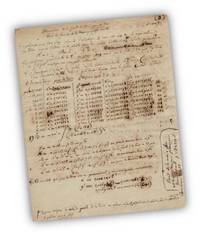
13574Johann Karl Burckhardt 1773-1825 German-born astronomer and mathematician. Burckhardt carried out extensive studies on the orbits of comets and his study of a comet of 1770 now known as Lexell's Comet or D/1770 L1 cemented his professional reputation. This comet is known for passing closer to earth than any other comet in recorded history when it reached only 0.0146 AU from Earth on July 1 1770. Offered here is a 4 page handwritten manuscript of his calculations for that comet of 1770 dated December 1804. Written in French. Burckhardt completed his research in 1807 finding that the comet had an elliptical orbit with a period of 5.57 years. Burckhardt has titled the Manuscript in his hand "Pull of the Comet of 1770 by the Earth from the Formula of the Spatial Mechanics Volume 4." <br/><br/>A small sampling of Burckhardt's extensive calculations and proofs in this manuscript includes the following: <br/><br/>"1 I would take for a constant plane that of the eleptic and for the x axis the vertical radius of Earth. At the moment of the entry of the comet in the field of gravity F; so we will have A1 = 0; B1 = 0; C1 = 0.<br/>2 We will take a day as the limit of t. We will see later on if we could use a smaller interval. <br/>3 I will suppose the point of entry in the field of activity at 273567 this is based on an observation of Mr. Messier The duration of 8 days with the exit on the 5th of July 0.5567. <br/>4 We will therefore have for the Earth Z1 always equal to zero.<br/>6 One sees for the earth generally with great exactitude x=0.000142t2 y=. For the gravitational center of earth.<br/>7 For the Comete one employs the.elements of observation made after the perihelic part of the passage.<br/>N.B. I have neglected to express the precession of the equinoxes.and that the observation requires the movement of a contoured lens."<br/><br/>Burckhardt proceeds to provide detailed calculations of the comets approach and recession from June 27 to July 6 taking extra care to mark the day of its closest approach to earth--July 1.<br/><br/>The comet of 1770 never reappeared and is today considered a "lost comet" but it presented a fascination to astronomers for years afterward. Lexell for whom the comet is named initially calculated the orbit at around 5 and a half years. But the fact that a comet with so short a period had never been previously recorded and that it did not reappear in 1776 threw doubt on Lexell's calculations and induced the Institute of France to establish a prize for whomever could determine its orbit. Burckhardt became the winner when he was able to show through his calculations that the comet's had come within the sphere of Jupiter's attraction in 1767 which swung it into its close 1770 orbit. It did not reappear in 1776 because it was directly in line with the sun rendering it invisible. And why had it never reappeared since Burckhardt determined that in 1779 it had come again within the orbit of Jupiter and from there had been flung off into distant space. He thereby confirmed Lexell's initial calculation and provided a scientific explanation for the comet's very strange activity. Journal of the Franklin Institute Thomas P. Jones M.D. ed. pg. 319-320. Thompson & Homans: Washington D.C. 1832.<br/><br/>Burckhardt's tracing of the orbit of the comet of 1770 cemented his reputation in the scientific community. Today he is remembered in particular for his work in fundamental astronomy and for his lunar theory which was in widespread use for the construction of navigational ephemerides of the Moon for much of the first half of the nineteenth century and for his studies on the orbits of comets. In 1812 he published an improved lunar theory after that of Pierre-Simon Laplace. Burckhardt's lunar tables appear to have been the first to be based on a least squares adjustment of the coefficients to selected lunar observations of which about 4000 were used. They were officially used for computing the lunar ephemerides in the Nautical Almanac from 1821 to 1861. unknown books
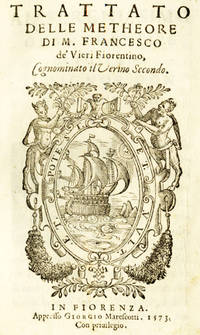
157319816Florence: Appresso Giorgio Marescotti. Very Good. 1573. First Edition; First Printing. Vellum. The first edition of the first comments on the first three books of "Meteorologica" of Aristotle in in the Italian language. Adams V714. Includes index and errata leaf errori occorsi nello stampare. Original limp vellum minor worming and soiling. Spine handlettered; With his commentary on the first three books of Aristotle's "Meteorologica" Francesco de Vieri Professor at the University of Pisa studied not only comets and meteors but also rainbows earthquakes the evaporation of water and the phenomenon of tides. The later edition in 1582 was enhanced with commentary on the fourth book on the inorganic material of the terrestrial sphere; Woodcuts; Small 8vo; 16 166 8 pages . Appresso Giorgio Marescotti hardcover
1972020368San Francisco: W. H. Freeman and Company 1972. First Edition First Printing . Cloth. Near Fine/Near Fine DJ. 491 pp. Touch of wear at corners 1/2" closed tear at top and bottom of front spine edge of DJ small bump to lower spine edge of book indecipherable signature of previous owner hidden under front flap J--- M --- P-----. <br/> <br/> W. H. Freeman and Company hardcover
2 Vols., 4to (250 x 200 mm), mixed editions with vol. I being second edition corrected and Vol. II the first edition, xii, 466, [10]; xv, [1], 568, [8]pp., 78 folding engraved plates, recently expertly bound to style in full calf, covers with a double fillet gilt border, spine with five raised bands and compartments heavily gilt tooled, one compartment with contrasting red morocco label gilt lettered, a very handsome set. Desaguliers was elected to the Royal Society of London in 1714 as experimental assistant to Isaac Newton and he later popularised Newtonian theories and their practical applications in public lectures as well as his written works. By the time of his death he had given over 140 courses on mechanics, hydrostatics, pneumatics, optics and astronomy. "The two-volume set promotes the Newtonian tradition and quotes experiments that confirmed Newton's queries, especially from the Opticks. Desaguliers also describes a number of electrical experiments and contributes to the popularization of the study of electricity. Each volume contains six lectures, richly illustrated by experiments and annotated. The second volume deals mostly with applied science and engineering."?Norman. Norman, Bibliotheca Mechanica, p. 91; DSB, IV, pp. 43-5; Wellcome II, p. 451 (vol. 2 only); Poggendorff I, pp. 553-5.
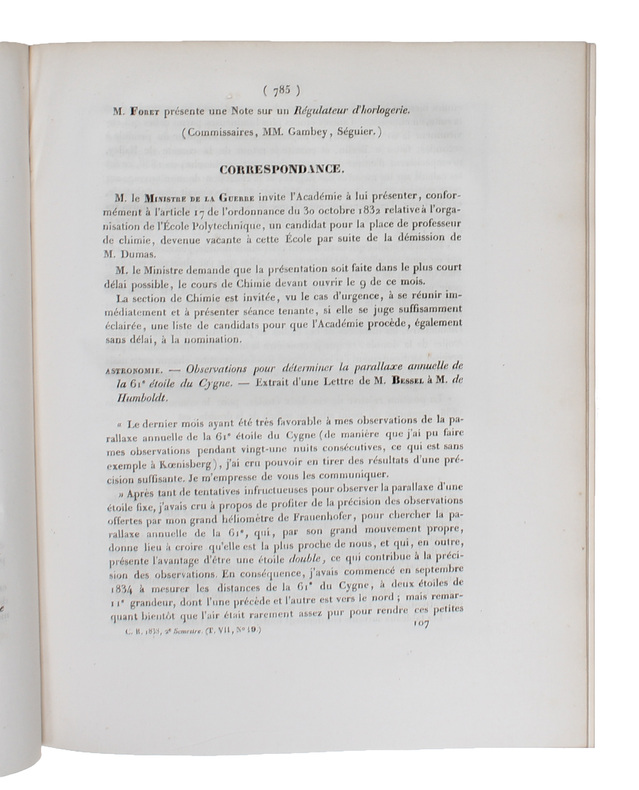
183849473Paris, Bachelier, 1838 a. 1840. 4to. No wrappers. In: ""Comptes Rendus Hebdomadaires des Séances de L'Academie des Sciences"", Tome 7, No 19 and Tome 10, No 17/18. With title-ages to vol. 7 and 10. Pp. (769-) 803 a. pp. (671-) 717. (Entire issues offered). Bessel's papers: pp. 785-793 a. pp. 703-710. Stamp on both titlepages. The second titlepage with a fes brownspots, otherwise clean and fine.
173450434Dresden et Leipzig, Frederik Hekelius, 1734. Folio. Contemp. full mottled calf. Upper half of spine rebacked. Raised bands. Lower part of spine gilt. A crack to leather at lower part of fronthinge, cover not loose. Engraved portrait. (16),452 pp. and 28 engraved plates on 26 sheets. A dampstain in upper part of inner margins throughout, otherwise clean and wide-margined. The plates with some browning.
Paris, Bachelier, 1838 a. 1840. 4to. No wrappers. In: ""Comptes Rendus Hebdomadaires des Séances de L'Academie des Sciences"", Tome 7, No 19 and Tome 10, No 17/18. With title-ages to vol. 7 and 10. Pp. (769-) 803 a. pp. (671-) 717. (Entire issues offered). Bessel's papers: pp. 785-793 a. pp. 703-710. Stamp on both titlepages. The second titlepage with a fes brownspots, otherwise clean and fine.
Dresden et Leipzig, Frederik Hekelius, 1734. Folio. Contemp. full mottled calf. Upper half of spine rebacked. Raised bands. Lower part of spine gilt. A crack to leather at lower part of fronthinge, cover not loose. Engraved portrait. (16),452 pp. and 28 engraved plates on 26 sheets. A dampstain in upper part of inner margins throughout, otherwise clean and wide-margined. The plates with some browning.
Paris, Chez la Veuve Desaint, 1792. 4to. Bound in 3 fine contemp. full sprinckled calf, 5 raised bands, tome-and titlelabels with gilt lettering. Spines gilt. Lower compartments with the Royal Danish coat of arms in gold. Upper compartments with the monogram of the Danish King Christian VII in gold. (4),LXVI,478 (4),727 "(4),737 pp. and 44 folded engraved plates. With ""Tables Astronomiques, calculées sur les Observations les plus nouvelles, Pour servir à la troisieme Édition de l'Astronomie"", (2),378 pp. of Tables and Corrections. This is bound at end of volume one. Broad-margined. A few scattered brownspots. A few leaves in vol. two and three with some faint dampstaining in upper margins, a few in upper right corners.
First offprint in the original wrappers, of Einstein's first conclusive attempt toward creating a unified field theory. - Content: This seminal paper of Einstein marks „a new theory of space with a view to unification of all forms of activity that fall within the sphere of physics, giving them a common explanation" (PMM). The task of unifying nuclear, electromagnetic, and gravitational force is nowadays by many considered the holy grail of theoretical physics. - Condition: Mint. - Rarity: ABPC (1973ff.) and APO (1988ff.) record only 3 copies of this edition at auction (2012, 1994, 1984). - Reference: Boni-Russ-L. 155; Printing and the Mind of Man 416; Schilpp-Shields 196; Weil 147.
Tête de collection (volumes 1 à 23 complet): ensemble plus de 13000 pages, illustré de figures dans le texte et de +/- 400 planches hors texte (dont la plupart dépliantes), 22cm., reliures cart. (plats marbrés, dos en cuir bleu avec titre doré - sauf pour volumes 19,20,21 & 23: reliures plein toile avec titre doré au dos, petit manque au premier plat du 3e vol.), feuilles de garde marbrées, qqs.rousseurs, bon état, rare, [Contient des articles scientifiques en matière d'astronomie, météorologie, géographie et physique du globe], W81879
1880W81879Bruxelles, Institut National de Géographie, puis: Weissenbruch, e.a. 1880-1903 Tête de collection (volumes 1 à 23 complet): ensemble plus de 13000 pages, illustré de figures dans le texte et de +/- 400 planches hors texte (dont la plupart dépliantes), 22cm., reliures cart. (plats marbrés, dos en cuir bleu avec titre doré - sauf pour volumes 19,20,21 & 23: reliures plein toile avec titre doré au dos, petit manque au premier plat du 3e vol.), feuilles de garde marbrées, qqs.rousseurs, bon état, rare, [Contient des articles scientifiques en matière d'astronomie, météorologie, géographie et physique du globe], W81879
17522822A Berlin, chez George Conrad Walther, 1752. In-4 de (28)-404 pp., maroquin brun, dos orné à 5 nerfs, encadrement sur les plats, pièce de titre en maroquin vert (reliure de l'époque).
<p>in 4°, (23x16 cm), ril. coeva in mezza pelle, tit. e fregi in oro al dorso diviso da 3 nervi, tagli spruzzati; c. (16)p. 17-400, (8); marca tipografica al frontespizio (la lupa allatta i gemelli. Motto: Et fovet et nutrit) ; ritratto a piena pagina di F. Pifferi, numerose illustrazioni d'astronomia anche a piena pagina, diagrammi, schemi. Alone all'angolo inferiore che non tocca il testo per circa la metà del volume. Riccardi: (1, 277, n. 2,) dedica una colonna di testo a quest' edizione</p>
In-4°, (10cc), 46pp, 1carta ripiegata; 38pp, 4 carte di tavola, due ripiegate; 55pp, due carte di tavv, 16pp, 12pp, una carta ripiegata; 56pp, una carta ripiegata; 16pp, una carta ripiegata. Prima edizione, buone condizioni, legatura in pergamena con titolo manoscritto al dorso. La prima prefazione è di Dilherr, la seconda dell’autore. Poggendorff, II, col. 1133; Houzeau & Lancaster. Astronomie (1964 ed.), 9322, NUC pre-1956, NT In-4° (10cc), 46pp, 1 folded table; 38pp, 4 tables, two folded; 55pp, two folded tables; (2), 16pp, 12pp, one folded table; 56pp, one folded table; 16pp, one folded table. First edition, good copy, contemporary vellum binding, manuscript title at the spine. The first preface is by Dilherr, the second by the author The initial foreword is by Dilherr, the second one by the author. Poggendorff, II, col. 1133; Houzeau & Lancaster. Astronomie (1964 ed.), 9322, NUC pre-1956, NT"
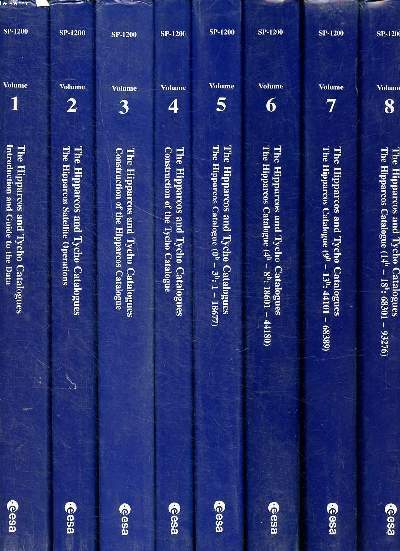
1997R260270377Europa Space Agency. 1997. In-4. Relié. Très bon état, Couv. convenable, Dos satisfaisant, Intérieur frais. 542+ 404 + 524 + 299 + 375 + paginé de 376 à 887 pages, de 888 à 1373, 1374 à 1873, de 1874 à 2377 pages + 500 pages environ + 400 pages environ + 600 pages environ + 450 pages environ + 516 pages + 516 pages + 500 pages environ + 6 CD-Rom.. Avec Jaquette. . . Classification Dewey : 520-Astronomie et sciences connexes
First collected edition, 4 vols., in two, 4to, [16], 308; [4], 309-776, [14, index], [4, publishers adverts]pp., titles to volumes 1 & 2 printed in red and black, divisional titles to volumes 3 & 4, engraved frontispiece portrait of Huygens close-trimmed at top margin, engraved device on title-page, woodcut initials, head- and tailpieces, 56 folding engraved plates, V4 with a clean tear, some light toning and some occasional spotting, later cloth-backed decorated paper boards. Huygens was a Dutch physicist and mathematician. Known for his work in astronomy, his part in developing calculus, his theory that light exists in waves, as well as his horological work, he is considered one of the great scientists of the 2nd half of the 17th century after Newton. Houzeau & Lancaster 3428.
Ms Pluteo 40.52 - Biblioteca Mediceo Laurenziana, Firenze. Scritto da Francesco Stabili di Simeone, noto come Cecco d’Ascoli, nel 1476 in un volgare umbro-marchigiano arcaico, in forma allegorica vengono trattate questioni naturali, come la proprietà degli animali e delle pietre, concetti filosofici, psicologici, etici e teologici. Commentario (83 pagine ; 20,5x29 cm.)in italiano, a cura di Ida Giovanna Rao, funzionario della Biblioteca Medicea, e di Giordana Mariani Canova, docente di Storia dell’Arte Medievale e Storia della Miniatura all’Università degli Studi di Padova. Il Codice e il Commentario sono custoditi in un contenitore a forma di libro. Tiratura limitata a 500 copie.
169412584Paris, de l'Imprimerie Royale, 1694. In-4 de [8]- 202 (chiffrées 302)- [2] pages, pleine basane brune, dos à nerfs orné de filets et fleurons dorés, reliure légèrement frottée, quelques rousseurs. Tampon de possesseur sur la page de garde.
First and very rare offprint in the original wrappers, of this profusely illustrated paper by Doppler, who through the use of spherical mirrors has made a significant contribution to the development of microscopy. Among other things, Doppler in this paper points out the importance of grinding and polishing glasses and metal mirrors. (Cf. Clay: History of the Microscope). - Condition: Spine with five tiny cuttings of former binding, wrappers with some barely seeable spots and wear, overall in good condition. – Rarity: ABPC (1973ff.) and JAP/APO (1988ff.) record no copies at all at auction; no copies in trade. – Reference: Poggendorf I, 595; Schuster: Doppler IV, 42 and 43.
2456Genevae, Bousquet, 1726, 2 VOLUMES IN 4 reliés en demi-basane de l'époque, dos ornés de filets dorés (reliures de l'époque), (habiles restaurations aux coiffes, petit accroc à la partie inférieur du dos au tome 1), 1 FRONTISPICE, (10), 96pp., 427pp. pour le tome 1 ; (1) pp. 429/751, 74pp., (1), 1 TABLEAU DEPLIANT, 48 PLANCHES DEPLIANTES pour le tome 2
3044P., Didot, 1792, 3 fort volumes in 4 reliés en demi-basane, dos orné de filets dorés (reliures de l'époque), (petite déchirure d'origine à un feuillet au tome 3 sans manque de papier et de texte, petite épidermure sans gravité à un mors, petit accroc sans gravité à une coiffe, quelques rousseurs), T.1 : (2), 66pp., 478pp., (1), 378pp., T.2 : (2), 727pp., T.3 : (2), 737pp., 44 planches dépliantes
1915056314Washington: Carnegie Institution 1915. First Edition . Printed Grey Wrappers. Near Fine. Photographs. 99 Pp. Printed On Glossy Paper High Quality Plates. First Printing The Scarce Hardcover Issue 1915. Near Fine Gilt Brilliant No Stains Inscribed By Author To His Friend John Campbell Merriam; Documentation Of Their Relationship May Be Found In The Hale Papers At Caltech And In The Merriam Papers At The Library Of Congress. Per Wikipedia John Campbell Merriam 1869 - 1945 Was An American Paleontologist Educator And Conservationist. The First Vertebrate Paleontologist On The West Coast Of The United States He Is Best Known For His Taxonomy Of Vertebrate Fossils At The La Brea Tar Pits. In 1912 He Was Appointed Chairman Of The Department Of Paleontology At The University Of California. That Same Year He Began His Famous Studies Of Vertebrates At The La Brea Tar Pits. He And His Students Categorized Many Of The Vertebrate Fossils Found At The Site And Many More Were Placed In Storage. The Smilodon Was Later Established As The California State Fossil. In 1918 He Was Elected To The United States National Academy Of Sciences. That Same Year He Co-Founded The Save The Redwoods League Which Began Significant Preservation Efforts After Merriam Traveled The Redwood Areas Of Humboldt County California In 1922 Seeking To Spare Its Old-Growth The Effects Of Logging He Witnessed In Redwood Forests Closer To San Francisco. A Biography Which Details His Efforts To Preserve Wild Lands In California And Throughout The United States Was Published In 2005. In 1919 Merriam Served As President Of The Geological Society Of America. In 1920 He Was Appointed Dean Of Faculty At The University Of California Berkeley But He Left That Same Year To Become President Of The Carnegie Institution In Washington D.C. He Accomplishments As President Included Helping To Advance The Educational Programs Of The National Park Service As Well As Helping To Preserve The California Redwoods. He Was Elected To The American Academy Of Arts And Sciences In 1921. His Published Papers Are Collected In A Four-Volume Set Published In 1938 By The Carnegie Institution. Merriam Was A Founding Member Of The Galton Institute And A Cautious Political Supporter Of Eugenics. His Paternal First Cousin Frank Merriam The Eldest Child Of Civil War Veteran Henry C. Merriam Served As The 28Th Governor Of California Between 1934 And 1939 Having Defeated Upton Sinclair With The Aid Of Vicious Propaganda By Ultra-Conservative Interests. . <br/> <br/> Carnegie Institution unknown