17 329 résultats
1938038618Pasadena 1938. Original Blueprint . No Binding. Near Fine. 17 5/8" x 16 3/4. Original Pencil Mechanical Drawing On Vellum 14" X 11" Initialed By Ejp. <br/> <br/> unknown
Cm. 21,5, pp. (24) 353 (19). Con bell'antiporta allegorica incisa in rame e diverse figure nel testo. Legatura strettamente coeva in piena pergamena semirigida. Esemplare genuino e complessivamente ben conservato, con macchiette esterne e pochi altri segni d'uso. Cfr. Houzeau e Lancaster (9671); Riccardi II, s. VII., 48.
210x150 mm, pp. (30), 130, (2) e 8 tavole al fondo. Legatura coeva in pergamena floscia, con qualche traccia d'uso e lievemente allentata, titolo manoscritto al dorso. Marca tipografica incisa al frontespizio, firma di possesso di Gio. Battista Cima. Esemplare molto genuino di questa riedizione che è una copia materiale della prima edizione giolitiana del 1565. Se ne trovano copie con l'anni 1584, 1586, 1589. Tra le pagine 80 e 89 sarebbe un fascicolo segnato L composto da una tavola ripiegata (assente in questo esemplare). Dopo la carta di registro al fondo segue la segnatura R composta di quattro carte con figure gnomonica, l'altra con segnatura S è composta da una tavola ripiegata. L'unico libro di gnomonica pubblicato dall'impresa di Giolito. Bongi Annali: p. 390; Riccardi Biblioteca: pp. 601-603
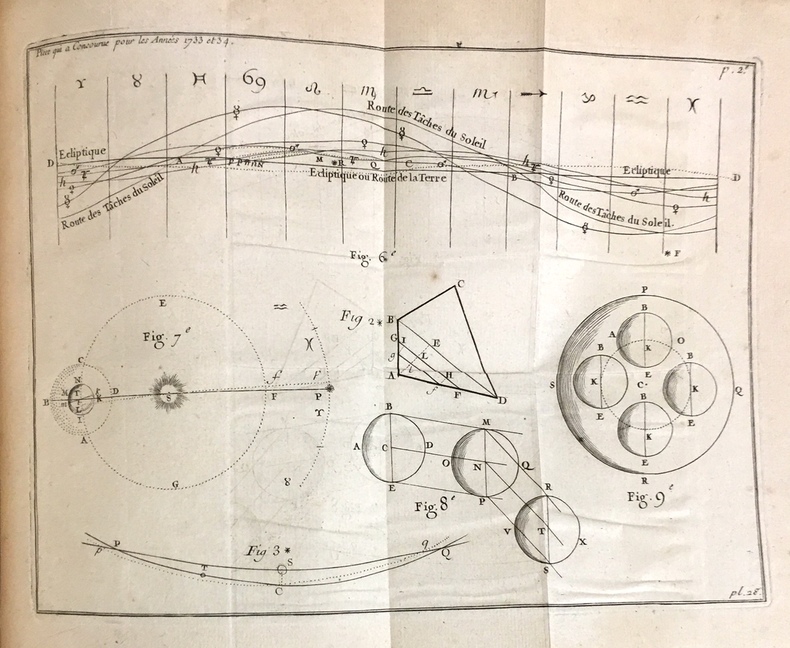
39247aafParis, Imprimerie Royale, 1733, in-4to, 4 ff. + titre avec marque hérald. de l'imprimerie + 281 p. + 15 planches repl. de figures gravées, par Ph. Simonneau, peu de feuilles lég. brunies, grandes marges latér. et infér., non rogné, exlibris ms. sur le titre ‘De Montagny’, reliure en demi-cuir à nerfs et à coins, pièce de titre au dos. Bel exemplaire.
Edizione originale. In-4°; pp. (32), 93, 1 cb, (4) 148 a c. 2 leggero timbro a inchiostro. Primo frontespizio illustrato inciso su rame, il secondo apre il secondo tomo, nel quale si tratta di “malati eccellenti” dei quali si offrono per ciascuno due tabelle, una prima che descrive il loro oroscopo e la seconda la loro posizione astrale al momento della malattia; tra i pontefici Sisto V, Clemente VIII, paolo V, e ancora Enrico II, Odoardo farnese, Ferdianndo Gonzaga, Ranuccio farnese, card. Alessandro Orsini, Scipione Borghese, Federico Borromeo e tanti altri rappresentanti celebri della nobiltà italiaana. legatura in piena pergamena, dorso lacunoso. Qualche foro di tarlo marginale.
381489Chez Les Frères Debure Paris 1775 In-4 ( 265 X 205 mm ) de ( 1 ) f. blanc, titre, XXII pages de "Discours préliminaire", 526 pages, 3 planches dépliantes, veau tabac marbré, dos à nerfs orné de caissons dorés, pièce de titre maroquin grenat, coiffes et coupes filetées d'or, tranches brique ( Reliure de l'époque ). ÉDITION ORIGINALE de cet « ouvrage important et agréable tout à la fois, rempli de dissertations savantes, d'idées lumineuses, de peintures brillantes » ( De Lalande, "Bibliographie Astronomique", page 731 ). « Cet ouvrage, écrit avec élégance, d'un style brillant, quelquefois animé, fut reçu avec une extrême faveur. » ( MICHAUD, II, 644 ). Bien COMPLET des TROIS PLANCHES dépliantes de reproductions de signes zodiacaux dessinés par Fossier et gravés par Y. Le Gouaz. Bel exemplaire.
17484617Paris, Jombert, 1748. 1748 1 vol. in-4° (246 x 194 mm) de : [2] ff. (titre, privilège) ; 140 pp. ; 2 planches dépliantes, culs de lampe, bandeau et vignette sur le titre. Brochage d'époque de papier marbré, dos lisse muet.
1764W88555London, printed for A.Millar, in the Strand 1764 vii + [i] + 252 + [iv] pp.+ 23 folding engraved plates (depicting many scientific and mechanical instruments), 1st edition, 26cm., contemporary full-leather binding (joints with some old profesionnal repairs, back joint slightly broken at lower end), pages with some browning though text is still bright, some occasional foxing, handwritten ex-libris on title page: "de Schuldorff, London 1778", good condition, W88555
vii + [i] + 252 + [iv] pp.+ 23 folding engraved plates (depicting many scientific and mechanical instruments), 1st edition, 26cm., contemporary full-leather binding (joints with some old profesionnal repairs, back joint slightly broken at lower end), pages with some browning though text is still bright, some occasional foxing, handwritten ex-libris on title page: "de Schuldorff, London 1778", good condition, W88555
198130191Frankfurt am Main, Insel Verlag, 1981. Folio. Faksimileband: 48 Bl. (farb. u. teils vergold. Miniaturen-Reproduktionen), 2 Bl. OPgt. mit braunem Deckeltitel. Kommentarband: 119 S. Hellgrau. OLwd. m. braunem mont. RSchild u. gold. Schrift. [2 Warenabbildungen]
in-4 antico (mm 180x130), 1 f. di titolo, ff. 392-460, 2 bianchi; ff. 133, 4 bianchi; ff. 79, numerati e compilati su entrambe le facciate in minuta ma chiara grafia. Piccoli disegni a margine di due pagine e schema del sistema tolemaico in ultima pagina. Legatura in piena pergamena floscia coeva. Ottimo stato. Interessante volume manoscritto di argomento astronomico che si compone di tre parti: "In libros coelo" - "In 1m librum De Generatione" - "In 2m librum De Generatione disput. de Clementis". Il tipo di grafia e l'inchiostro utilizzato ci fanno collocare l'opera in un periodo compreso tra la fine del '600 e l'inizio del '700. . .
First separate printing in the original wrappers of this 2nd and last supplement of a „fundamental paper on nuclear fission which eventually lead to the creation of the atomic bomb.“ (Dibner) – Contents, Edition: The German radio and nuclear chemists Otto Hahn and Fritz Straßmann "bombarding uranium with neutrons (as indicated by Fermi in the mid-1930s), found that treating the bombarded uranium with barium resulted in some strongly radioactive material. By late 1938 they suspected that uranium fission had occurred.“ These epochal findings had been presented by Hahn and Straßmann to the Prussian Academy on May 25th 1939. Their paper indicates in detail „fission of the uranium nucleus into two parts of about equal size with the release of much energy.“ – If the 1st paper from 1939 („Über das Zerplatzen des Urankernes durch langsame Neutronen.“) contains the first comprehensive description of this core nuclear achievement, the following two corresponding papers published by Hahn and Straßmann with support by chemist Hans Götte during the Second World War in 1942 („Einiges über die experimentelle Entwirrung der bei der Spaltung des Urans auftretenden Elemente und Atomarten.“) and the present of 1944 describe experiments to identify the fission fragments. – Alongside the aforementioned an Austrian woman scientist of Jewish descent, Lise Meitner, colleague of the authors at the Berlin Kaiser-Wilhelm-Institute of Chemistry for decades, also contributed heavily to their findings. Meitner had to flee Nazi Germany in 1938 but continued her research in exile, e.g. in Copenhagen, where she worked in the laboratory of Niels Bohr. Through Bohr and Fermi this nuclear energy was to become a reality in the atomic pile and the bomb blasts of 1945 as well as in the nuclear power stations of the following decades. Hahn received the Nobel Prize for Chemistry in 1944, and together with Meitner and Strassmann, the Fermi award in 1966.“ (All quotes Dibner). - Condition: Front cover with margins of former water stains, otherwise very well preserved copy indeed. - Reference: Dibner, Heralds of Science, 168; Norman 963 (paper 1 only); Poggendorff VIIa/2, 355; Scheld 191.
In-8 p. (mm. 202x145), p. pergamena coeva (risg. rifatti), tagli rossi, 10 cc.nn. (frontespizio, dedica, prefazione e proemio), 62 cc.num., con numerose illustrazioni inc. su legno nel t., di carattere astronomico-astrologico; marca tipografica xilografata al frontespizio (una sirena). "Mancano": la c. 63 (di Indice) e l’ultima carta bianca con al recto la stessa marca tipografica del frontespizio. Cfr. Riccardi, I, 272/273: “Credo che la seconda parte non sia stata pubblicata” - Adams,II,1119, p 77 (per la I ediz., 1558) - Cantamessa, “Astrologia”,III,6106 (in nota alla I ediz.): “L’opera rappresenta sostanzialmente un seguito "De la sfera del mondo. De le stelle fisse". Il taglio dell’opera è prevalentemente astronomico, anche se, come ne "La sfera", Piccolomini chiama "astrologi" gli astronomi, a conferma ennesima della commmistione concettuale ed espressiva tra astronomia e astrologia nel XVI secolo. Colloca cioè in uno stesso contesto chi osservava e misurava il cielo e chi da questo traeva predizioni e previsioni. Così Piccolomini tratta fra l’altro anche degli aspetti fra i pianeti (dalla carta 59) e riproduce quelli classici dell’astrologia, accennando anche a quelli benigni e a quelli maligni, e dunque, così scrivendo, miscela due discipline diverse...”. Qualche lieve alone solo margin. ma certamente un buon esemplare.
pp. 14, 16, 14, cb, 12, 20, 1 tav. Le cinque “note” che compongono questo scritto sono di importanza capitale per la storia dell’astronomia: oltre a ipotizzare la lentezza di rotazione di Venere, Schiaparelli conclude che il pianeta sia avvolto costantemente da una coltre di nubi: è il primo scienziato a formulare quest’ipotesi nella storia dell’astronomia, ipotesi che – insieme ad altre – sarà destinata a resistere fino ai nostri giorni. La serie è estratta manualmente dai volumi dei “Rendiconti” del Reale Istituto lombardo di scienze e lettere. Compresa la tavola. In these five “note”, Schiaparelli reports his discoveries about the slow rotation of Venus, and for the first time makes the hypotesis on the blanket of clouds surrounding the planet, that is considered his discovery. The serie is materially taken from the volumes of the “Rendiconti del Reale istituto lombardo di scienze e lettere”, including the plate.
166265350Amsterdam, Joan Blaeu, 1662. 8°. Titel m. Holzschn.-Vignette. 10 Bll., 379 (1) S., 20 Bll., Pgmt. d. Zt. m. handschriftl. Rückentitel (Vorderdeckel m. den schwarzgepr. Initialen ?P B A C?, Rückendeckel mit der Jahreszahl ?1668?), 3 (von 4) Bindebändern u. Rotschnitt.
1903164140Paris, Gauthier-Villars, 1903. 1ere ed. Ci-joint Suite du fascicule B. du Tome IV. CXXXVI, XIII, 126, 156, VIII, 272, 240, 36, III, 107, III, 200, 31, 31, VIII, 220, VIII, 214, XXII, 210, 206 p. 4°, reliure en demi-toile d`epoque. 1924.
Second edition, 8vo, [16], 254, [2]pp., the first leaf and the last leaf are blank, title within elaborate ornamental woodcut border, woodcut initials and head-pieces, illustrations including full-page chart with signs of the zodiac, blank margins of title a little frayed, foremargins of first 12 leaves cut close and just touching text, C5 with part of foremargin torn away, old paper repair missing text added in manuscript, C6 with blank foremargin torn away with partial repair, foremargin of F4 with old paper repair and lacking a couple of letters, pages 99-114 with worm track which affects a few words but without loss on sense, small rust hole to gutter margin of K1-K3, some contemporary ink marginalia in the hand of Thomas Gibbon, contemporary calf, blind tooled, spine split. "This book is the second (first in 1612), enlarged, edition of his popular handbook on astronomical and astrological data. It contains instructions and tables for astrological calculations, finding the time by either the position of the sun or the moon, determining dates of movable Christian feasts, etc. The calendar section is followed by shorter sections on financial advice, tables of historical information and legal matters."?Tomash & Williams. STC, 13779; Tomash & Williams, H163.
Sunning and fading and slight foxing to spines. Volume 1 has different shade cloth boards (as issued? ). Former owner's name to ffep in ink of vol. 1. V1 has tanned endpapers and light bumping along bottom edge. Else volumes have minor Rubbing to boards with Volume 2 and 5 having lightly bumped corners. Light foxing and pencil marginalia. ; Second Edition with Addenda. Lxxv, [1], 125, [1] + xxxi, [1], 138, [1] + xlviii, [2], 78, [1] + xvii, [1], 142, [1] + xlvi, [2], 139 pp. Pp; 5 Volume Set COMPLETE; Marcus Manilius (M Manilii) , 1st century A. D. Roman poet and astrologer. The Astronomicon contains the earliest appearance of astrological systems of Houses. Housman's is considered the authoritative edition. Introduction in English. Latin apparatus.
Minor Sunning to spines. Endpapers tanned. Former owner's name to inner covers in ink (J. H. Day). Lower corners very lightly bumped on a few vols. Faint rubbing to boards. ; Second Edition with Addenda. Lxxv, [1], 125, [1] + xxxi, [1], 138, [1] + xlviii, [2], 78, [1] + xvii, [1], 142, [1] + xlvi, [2], 139 pp. ; 5 Volume Set COMPLETE; Marcus Manilius (M Manilii) , 1st century A. D. Roman poet and astrologer. The Astronomicon contains the earliest appearance of astrological systems of Houses. Housman's is considered the authoritative edition. Introduction in English. Latin apparatus.
Vol. 3 has very small chip along upper edge of rear board. Vol 5 has very light bump to 1 corner. Vols range from VG to NF. ; Second Edition with Addenda. Lxxv, [1], 125, [1] + xxxi, [1], 138, [1] + xlviii, [2], 78, [1] + xvii, [1], 142, [1] + xlvi, [2], 139 pp. ; 5 Volume Set COMPLETE; Marcus Manilius (M Manilii) , 1st century A. D. Roman poet and astrologer. The Astronomicon contains the earliest appearance of astrological systems of Houses. Housman's is considered the authoritative edition. Introduction in English. Latin apparatus.
Minor Sunning to spines of Vols 4-5. Endpapers tanned. Tape stains to ffep of Vol. 3. Scholar's name to ffep of Vol. 4 (M. P. Charlesworth). All volumes mostly clean except Volume 5 which has pencil notes and underlining to some pages. Vol 5 also has notes and marginalia in ink and red ink and pencil to the Appendix with a few corrections. Vols 3-4 boards are a different colour from other volumes. ; Second Edition with Addenda. Lxxv, [1], 125, [1] + xxxi, [1], 138, [1] + xlviii, [2], 78, [1] + xvii, [1], 142, [1] + xlvi, [2], 139 pp. ; 5 Volume Set COMPLETE; Marcus Manilius (M Manilii) , 1st century A. D. Roman poet and astrologer. The Astronomicon contains the earliest appearance of astrological systems of Houses. Housman's is considered the authoritative edition. Introduction in English. Latin apparatus.
1994060062New York: Norton 1994. 1st Edition . Hardcover. Fine/Near Fine. 9 1/4" Tall. Drawings and Photographs Throughout. 619 Pp. Grey Cloth Spine Lettered In Silver Blue Boards. First Printing. A Fragile Binding For Unknown Reasons Often Found Near New But With Front Hinge Cracked Or Broken This Copy Fine Except Hinmge Cracked 1 1/2" At Bottom Of Front Endpapers And 2 1/2" At Top Before Half Title Page. With Near Fine Dust Jacket Priced $30.00. This Copy Signed By Thorne On The Title Page. <br/> <br/> Norton hardcover
First separate printing in the original printed wrappers, of Einstein's attempt to refute Willem De Sitter's wrong cosmological model. - Contents: Einstein here criticizes De Sitter's hypothesis about the structure of the cosmic gravitational field. The De Sitter model, which competes with the Einstein cosmos, was the dominant cosmological model until the 1930s. The Academy's publishing list on the rear cover also announces an offprint of this paper for Reichsmark 0,50. - Condition: Wrappers at margins minimally torn, some pages creased due to reading, otherwise well preserved indeed.- Rarity: ABPC (1973ff.) and APO (1988ff.) records only 1 copy of this edition at auction (2011). - Reference: Alicke, Einstein, 91; Boni-Russ-L. 108; Collected Papers, vol. 7, 1; Schilpp-Shields 120; Weil 98.
104941 Ex-libris au contreplat. P., de l'Imprimerie de Crapelet, chez J. B. M. Duprat, an VII [1799], in-4° de VIII-351 pages, relié pleine basane, dos lisse orné d'une roulette or répétée, titre or sur pièce peau bordeaux, tranches rouges, gardes blanches ; 1er feuillet ébarbé avec manques, taches au faux-titre et au titre, mouillure claire en gouttière des 2 premiers ff., une tache sombre sur 4 lignes pp. 265 à 274 (en forme de planète ?)
In 4° ant. (mm 198x142), entro cartonato settecentesco, con titolo a penna al dorso, cc. (4), 43, (1), con alcune figure incise n. t.; buon esemplare, ben marginoso con pallidissima gora al centro del margine bianco esterno e un poco d’arrossamento delle carte (Choix, 7517; Riccardi, II, 273). Lib / cat 14