Vimercato Giovan BattistaMareMagnum

17 332 résultats
Formato cm. 20x15. Pagine: (4), 171. Rilegatura in piena pergamena coeva con titolo manoscritto al dorso. Lievi bruniture all'interno e macchia di umidità alle prime carte. Stato di conservazione ottimo. Molte figure in xilografia nel testo tra cui una grande tavola più volte ripiegata. Il salto di pagina da 108 a 117 è dovuto alla presenza della tavola sopra menzionata che va a sostituire le carte non presenti. Il libro è completo. Rara edizione originale.
In-4°, (2cc), 176pp, 4cc. Legatura in cartonato, titolo manoscritto al dorso, tagli in oro, marca editoriale sul frontespizio e in fine. Esemplare réglé. La seconda parte inizia con proprio frontespizio. Con 48 figure delle costellazioni e 48 tavole relative ai gradi, in legno. In-4°, (2cc), 176pp, 4cc. Cardboard binding, handwritten title at the back, gilt edges, printer’s mark at the title page and at the end. The second part has its own title page. Réglé copy. With 48 wooden engraved figures of the constellations and their 48 tables of the grades.
8vo (mm 217x161), ff. 57, 1 bianco, (154) che includono le effemeridi del periodo 1552-1562, capilettera xilografici, numerose tabelle e schemi, alcune figure nel testo che illustrano le fasi lunari. Legatura in piena pergamena floscia coeva, traccia di legacci ai piatti. Interessanti numerose annotazioni e calcoli astronomici di mano coeva alle sguardie, al foglio bianco e al frontespizio delle "Ephemeris" per l'anno 1552, in cui l'antico proprietario si era dilettato nel calcolare le posizioni dei pianeti nell'anno di nascita dell'Autore (1494). Al verso dell'ultimo foglio dell'opera altri calcoli astronomici, di mano coeva, con oroscopo riferito probabilmente ad una certa Chiara (Garnoli?). Segue, al recto della sguardia libera posteriore, oroscopo discorsivo in italiano sempre vergato a mano; al verso e al contropiatto posteriore altri calcoli di effemeridi probabilmente riferiti all'anno 1563. Tracce di tarlo al margine inferiore di circa 50 fogli a metà del volume. Piccoli restauri al dorso ma nel complesso ottimo esemplare marginoso. Pitati, astronomo veronese del secolo XVI, diede il suo nome al cratere lunare Pitatus. Fu celebre per aver proseguito le effemeridi di Johannes Stoffler (pubblicate a Tubinga dal 1482 al 1551) fino al 1562; nel 1542 pubblicò l'Almanacco nuovo, che si può considerare come la prima effemeride italiana (per gli anni 1543-1556), ovvero un gruppo di tavole numeriche che forniscono le coordinate degli astri (o altri elementi variabili con il tempo) a intervalli prefissati ed equidistanti fra loro, per es. di giorno in giorno oppure di ora in ora. La presente edizione contiene le effemeridi dal 1552 al 1562. Non comune. Cantamessa parla di una variante della presente edizione con un bifolio in più, ma gli esemplari trovati online nelle biblioteche hanno lo stesso numero di pagine del nostro esemplare. Al contropiatto anteriore ex-libris inciso tardo settecentesco - con stemma marchionale della panoplia con lo scudo con al centro una stella - della famiglia Dionisi, tra le più antiche della nobiltà di Verona: il marchese Gabriele (1719-1808) fu l'artefice della ristrutturazione della villa a Ca' del lago di Cerea nonché del riordino e aggiornamento della biblioteca. La famiglia Dionisi aveva destinato al piano nobile la funzione di libreria e sala di lettura, precoce esempio di centro culturale dove si riunivano artisti e letterati. Dopo la dispersione delle migliaia di volumi del fondo antico, conserva ora i libri sul mobile d'arte contemporaneo della Fondazione Aldo Morelato. . Cantamessa 6179..
1935159310Boston, 1857-1935. M. zahlr. Taf. u. Abb. OBr. Umschl. teils angeschmutzt u. angerissen, einige teils lose, teils m. Fehlstellen. Wenige Bind. etwas gelockert/lose, Buchbl. gebr. Bei 3 Bdn. fehlen teils d. OU. Bd. 3 unten teils m. Wasserrand. Einige S. m. Randläsuren. Unaufgeschn. Ex. Teils m. Rsign. u. St. FEHLEN: Bd. 17 S. 299-304; 41 H. 8-11; 42 H. 12; 58 H. 8; 65 TI., 67 H. 6.
in-4, leg. perg. ant., pp. (8), 134, (2 b.). Fa parte dei "pamphlet" in forma di dialogo in polemica con le teorie esposte dal Riccioli, prima nell'Almagestum novum (Bologna 1651). Padre Degli Angeli era anticopernicano e direttamente coinvolto nella mobilitazione culturale scientifica della Chiesa in difesa della tradizione derivante dalle Scritture e dai Padri. La sua critica si riferiva alle ragioni teoriche che Riccioli portava per dimostrare l'immobilità della terra. L'autore (Venezia 1623 - Padova 1697), gesuita e poi prete secolare, fu illustre geometra e matematico, confratello e collaboratore di Bonav. Cavalieri a Bologna e dal 1662 sino alla morte insegnante sulla cattedra di matematica dello Studio di Padova che era stata di G. Galilei, di cui fu tra i primi a seguirne le teorie.. Cinti 301. RICCARDI I (I), 35-36 ''Di molto pregio scientifico... è raro rinvenire uniti questi quattro libri...''. WALESON, Crerar Library, University of Chicago Lib., p. 6..
In-4°, prima edizione. Alla Centuria problematum mancano il ritratto dell’autore (o del dedicatario Rospigliosi), la carta bianca Ii4, tutto l’index Alphabeticus (8cc, ma accluse a fine volume in riproduzione fotografica); mancante l’antiporta del Centuriae opticae pars altera. Presenti le 2 carte di tavola.Legatura recente in piena pergamena rigida, con nervature al dorso e titolo in oro su tassello. Luogo e data al piede del dorso in oro.
In-4°, (4cc, con ritratto xilografico dell’Autore al verso della c. 3; ritratto supplementare dell’Autore), 116pp, (2cc), iniziali e finalini xilografici; rilegato con Philippi Phinellae De revolutionum annorum, 54pp (ultima bianca); rilegato con Philippi Finellae De duabus conceptionis, et respirationis figuris, et de connexione inter eas, & figuram coelestem, 37pp. Legatura in piena pergamena rigida. Riccardi I, 459; Biblioastrology
In 8 (cm 16 x 21), pp. (8) + 514 + (2). Legatura coeva in piena pergamena con rinforzo in pergamena al dorso. Carte uniformemente brunite, qualche sporadica lieve gora ma nel complesso esemplare in buone condizioni. Annotazioni manoscritte al frontespizio. Stemma della Compagnia di Gesu' impresso al frontespizio e ripetuto all'ultima carta, capilettera, figure geometriche xilografate nel testo, numerose tabelle. Edizione originale del Commento del Clavio a Sphericae (Sphairikon biblia III), l'opera di Teodosio Triopolita (di Bitinia). Clavio non solo spiega compiutamente i tre libri della teoria della sfera dello scienziato tripolita, con sue nuove dimostrazioni e con laggiunta di numerosi scolii, ed espone anche una sua teoria completa della trigonometria piana e sferica.
1839W119389Paris, chez Longuet 1839 Atlas seul (il y manque, comme souvent, un précis in-12 comme indiqué sur le titre), contenant 7 superbes planches en double -page coloriées à la main et gravées par A. Gianni d'après les dessins de S. Visconti & A.-H. Dufour, 54x36cm., reliure cart. d'épqoue en bon état (plats marbrés, dos en cuir vert avec titre doré, étiquette de titre bleue sur le premier plat), "Nouvelle édition revue et considérablement augmentée", rousseurs sur la page de titre, les planches sont frais sauf quelques rares petites taches, bon état, rare, poids: 1.2kg., [Titres des planches: I: Système solaire ou planétaire, II: Orbite de la revolution annuelle de la Terre autour du Soleil avec l'indication des Saisons, III: Planisphère représentant les différentes positions de la Terre relativement au Soleil pendant les douze mois de l'année, IV: Phases de la lune, V: Eclipses de Soleil et de la Lune, VI: Du Flux et Reflux ou Marées, VII: Coupe de la Terre prise sur l'équateur et vue du côté du Pole Arctique], [Rare splendid atlas volume (without the often missing text volume), containing 7 double-page handcoloured plates engraved by A.Gianni from the drawings of Visconti & Dufour, nice and solid contemporary hardcover binding (marbled boards, spine in green leather with gilt title, blue label with title on frontcover), some foxing on title page, the plates are clean and bright except for few marginal stains, good condition, rare, weight: 1.2kg.], W119389
1655bn1541A Rouen chez Jacques Cailloüe, dans la Cour du Palais Relié 1655 Très rare ouvrage, ici bien complet de son frontispice présentant Copernic, Kepler et Galilée. 'L'oeuvre s'adresse au grand public plutôt qu'aux experts sur le sujet, et son but est de populariser la vision de l'univers que l'on doit à Copernic, Kepler et Galilée. Le principal argument est que la Lune n'est pas un disque brillant mais plutôt un monde avec un paysage comme celui de la Terre. Bien sûr Wilkins n'est pas le 1er à avancer une telle théorie ; par exemple Galilée l'a indiqué de manière semblable. De manière peut-être plus surprenante, il pense que la Lune est une planète habitable et prédit qu'un jour le voyage vers elle sera possible. Ici aussi Wilkins n'est pas le 1er à faire cette suggestion mais elle est typique de la manière dont il pense, permettant à son esprit de vagabonder au milieu d'idées que d'autres auraient trouvé trop non conventionnelles pour les considérer.' In-12 relié plein parchemin (relié et lavé en 1861 d'après une note sur la garde). D'après une note figurant au 1er contre-plat, l'ouvrage a été « lavé et relié en 1861 ». Sa couverture est en plein parchemin, probablement de récupération : des restes d'écriture manuscrite sont encore parfaitement visibles. Cette technique, assez usuelle aux XIXe et début du XXe siècle produit parfois des résultats imparfaits. Ici cependant, la reliure a été soigneusement réalisée et ne souffre d'aucun défaut. Pièce de titre : frontispice, 8 pages non paginées contenant le titre et au lecteur, 269 pages pour le texte de la première partie, 3 pages non paginées pour la table, 2 pages non paginées pour le titre, 284 pages pour le texte, 3 pages non paginées pour la table des propositions. Livraison a domicile (La Poste) ou en Mondial Relay sur simple demande.
184619708Prag, Haase, 1846. 26 S. 1 lithograph. Tafel. Kl.-4°. OBrosch. (Rücken mit kl. Läsuren, Knickfalten, etw. gebräunt und bestoßen). [4 Warenabbildungen]
1589354109Heidelberg: in Officina Sanctandreana H. Commelin 1589. Title with woodcut vignette 48 woodcut illustrations. Pp. 2 1-170; 1-302 2 First part in Greek and Latin second in Latin. 1 vols. 8vo. Old vellum spine titled in ink. Note on flyleaf in an early hand "cum notii MSS. Alb. Jac. Conradi" heavily annotated in the second part pages 1-156. Paper flaw with loss of page number at L6 p. 167/8. Very good. Title with woodcut vignette 48 woodcut illustrations. Pp. 2 1-170; 1-302 2 First part in Greek and Latin second in Latin. 1 vols. 8vo. Works by Proclus Aratus and Leontius Mechanicus in Greek with parallel Latin text; works by Aratus Cicero Avienus Germanicus Caesar and Hyginus in Latin. STC German 367 not in VD 16; Adams A-2076; Brunet I 533; Houzeau & Lancaster Bibliographie générale de l'astronomie 782; Schweiger I 353; Zinner 3356 in Officina Sanctandreana (H. Commelin?) unknown
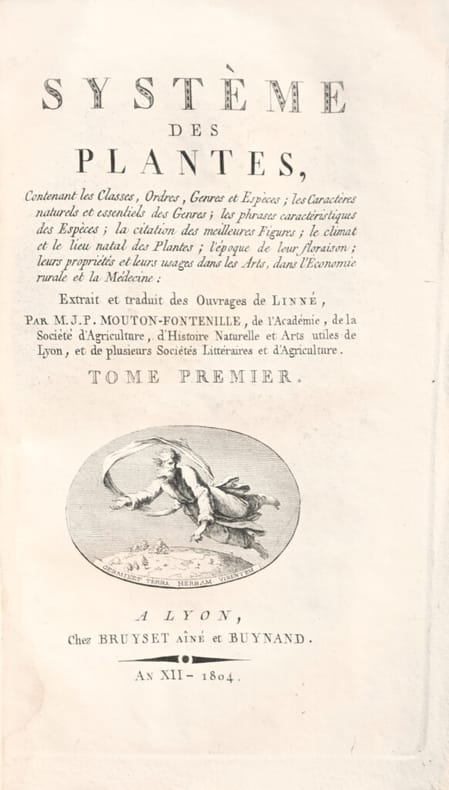
LCS-18156Edition originale de la première traduction de cette importante compilation des textes essentiels de Linné. Lyon, Bruyset Aïné et Buynand, 1804-1805. 5 volumes in-8 de : I/ (2) ff. dont un portrait de Linné et un feuillet de titre, lxxix pp., 532 pp. ; II/ (2) ff., 467 pp. ; III/ (2) ff., 648 pp. ; IV/ (2) ff., 518 pp. ; V/ (2) ff., xviii pp., xviii, xvi, xxxii, xxii, viii, xxxiv, cxiv, xvi, lxiv, vi, xliv, (1) f. Conservés tels que parus, brochés et non rognés.214 x 140 mm.
First edition of Olbers' groundbreaking work on computing the orbit of comets, together with the substantially corrected and enlarged 3rd edition from 1864 as well as a rare offprint of a paper by Ladislaus Weinek from 1904 depicting graphical evidence of Olbers' method. – Contents, Author: With this treatise, the Bremen based physician and astronomer Heinrich Wilhelm Olbers (1758-1840) established his reputation as one of the leading scholars on astronomy of his time. Olbers had discovered a comet in 1796 and developed a new method for calculating his path. This method replaced the tedious and often inaccurate calculations of Euler and La Place. „In a letter to F.X. von Zach, director of the newly founded observatory on the Seeberg, near Gotha, Olbers asked weather his treatise on this method should be printed, and if so, how this could be done. After reading the treatise and using it with excellent results to compute the orbit of the comet of 1779, which had presented great difficulties to many astronomers, von Zach decided to see it through the press himself. It appeared at Weimar 1797.“ (DSB). – Enclosed: (1) 3rd ed., enlarged by J. G. Galle. With Olbers' portrait as frontispiece and 1 folded plate. Leipzig: Voigt & Günther 1864. 8vo. XXXVI, 334 p. Contemporary half leather. (2) L.[adislaus] Weinek: Graphische Nachweise zur Olbersch'schen Methode der Kometenbahnbestimmung (…) Mit 8 Textfiguren. Aus den Sitzungsberichten der kaiserl. Akademie der Wissenschaften in Wien. Mathem.-naturw. Klasse; Bd. CXIII. Abt. IIa. Juli 1904. Vienna: Verlag der Kaiserlichen Akademie der Wissenschaften (in commission at Alfred Hölder [K.-k. Hof- und Staatsdruckerei]) 1904. 8vo. 20 p. Original publisher's wrappers. – Condition: Cover at edges and corners slightly worn, title page with some ink staines and one restored fault at lower right corner, some pages slightly foxy and water-stained, generally a solid copy. Cover of present copy of the 3rd edition (enclosure 1) with some small wear, paper in parts foxy, with owner's stamp on pre-title. Wrappers of the academy paper (enclosure 2) slightly stained, minimally torn at margins, otherwise well preserved. – Rarity: Very hard to find in this set, particularly with the late but important supplement by Weinek, during this period director of the Prague observatory. – Reference: DSB X, 198; Houzeau-L. 11965; Poggendorff II, 320.
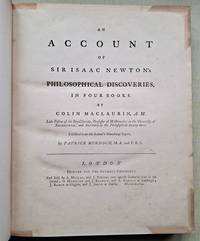
1748023048London: Printed for the Author's Children 1748. Large quarto pp 6 20 page subscriber's list xx 392 with six folding tables the title page with a little toning to the edges a few slight blemishes here and there but a remarkably clean copy overall internally contemporary half calf and marbled boards slightly rubbed and scuffed but a good sound binding. The RARE large paper copy measures 223mm x 290mm. Colin Maclaurin was a Scottish mathematician who made important contributions to geometry and algebra. He is also known for being a child prodigy and holding the record for being the youngest professor. A mathematician and younger contemporary of Newton's Maclaurin believed in Newton's theory of calculus and in the relationship between natural philosophy and mathematics. In this work which was published posthumously by subscription Maclaurin writes on Newton's discoveries and methods of investigation and also includes a long history of natural philosophy. "Though a number of other general expositions of Newton's thought were published during the eighteenth century MacLaurin's Account has long been recognized as the leading authoritative statement of mainstream Newtonianism" DNB. . First Edition. Half Leather. Very Good. Printed for the Author's Children Hardcover
First offprint in the original wrappers, of this important paper by Einstein about electromagnetism. - Condition: Wrappers minimally dusty, otherwise very well preserved copy. - Rarity: According to Weil early offprints of Einstein’s papers may also be qualified as original and also highly collectable editions, however they were printed in a certain, but still small print run for commercial use (mainly to sell them to fellow natural scientists): „No doubt, the first appearance in a periodical is the „original edition“, but I have to leave it open for collectors, librarians and others to decide whether these offprints in wrappers, mostly with a printed title on them (especially in the »Sitzungsberichte der Königlich Preussischen Akademie der Wissenschaften«) are also „original editions“. These offprints are printed from the same setting as the text, but often with new pagination.“ (p. 4). Additionally to offprints like the present, some copies bearing the imprint „Überreicht vom Verfasser“ [Presented by the Author] were printed for the use of the author. ABPC (1973ff.) and APO (1988ff.) record only 2 copies of this edition at auction (2011, 1998). - Reference: Boni-Russ-L. 86; Collected Papers, vol. 6, 27; Schilpp-Shields 97; Weil 79.
First offprint in the original wrappers, of Einstein's important follow-up paper on the field equations in his General Theory of Relativity. - Contents: In present paper Einstein suggests a modification of his field equations to allow for stable elementary particles. According to Pais this text "may be considered Einstein's first attempt at a unified field theory"” (Pais, Subtle is the Lord, p. 287). - Condition: Cover at margins minimally dusty, otherwise very fine indeed, probably unread. - Rarity: According to Weil early offprints of Einstein’s papers may also be qualified as original and also highly collectable editions, however they were printed in a certain, but still small print run for commercial use (mainly to sell them to fellow natural scientists): „No doubt, the first appearance in a periodical is the „original edition“, but I have to leave it open for collectors, librarians and others to decide whether these offprints in wrappers, mostly with a printed title on them (especially in the »Sitzungsberichte der Königlich Preussischen Akademie der Wissenschaften«) are also „original editions“. These offprints are printed from the same setting as the text, but often with new pagination.“ (p. 4). Additionally to offprints like the present, some copies bearing the imprint „Überreicht vom Verfasser“ [Presented by the Author] ABPC (1973ff.) and JAP/APO (1950ff.) record only 1 copy of this edition at auction (2011). - Reference: Boni-Russ-L. 111; Collected Papers, vol. 7, 17; Schilpp 123; Weil 106.
In-4 p. (mm. 302x190), cartoncino rustico antico (con picc. macchie), titolo ms. al dorso, 4 cc.nn., 183 pp.num.; marca tipografica al frontespizio e al verso dell’ultima carta (colophon con la data 1570); ornato da grandi iniziali figurate a vignetta; con un ricco apparato iconografico nel testo: 41 grandi figure con le costellazioni e 7 con i pianeti (tutto inc. su legno) che probabilmente si fondano sulle astronomiche allegorie realizzate da Duerer in un’edizione del 1515. La presente opera si basa sulle traduzioni latine di Cicerone, Rufo Festo Avieno e Giulio Cesare Germanico, e include al fine “Poeticon Astronomicon” di Caio Giulio Igino, che rappresenta un manuale scolastico di astronomia ed espone le storie astronomiche di Arato e di Eratostene con particolare riguardo ai miti australi (così Diz. Opere Bompiani,I, p. 297). “"Fenomeni" è un poema greco di Arato da Soli (prima metà del III sec. a.C.). In 1154 esametri, l’Autore descrive la volta celeste, passando in rassegna le costellazioni, spiegandone i nomi e determinandone la posizione reciproca; dal v. 733 comincia una seconda parte, nota anche col titolo separato di "Pronostici", in cui sono elencati gli indizi che permettono all’intenditore di prevedere il tempo che farà.. L’opera, rispondendo ai gusti del tempo, ha avuto una fortuna singolare; essa fu tra le pochissime sopravvissute alla perdita della poesia ellenistica; se ne interessarono infatti non solo i letterati, ma anche gli scienziati, che dedicarono ad Arato tutta una serie di esposizioni e di commenti. A Roma i "Fenomeni" influirono sulla poesia dotta; Cicerone li tradusse in latino, Giulio Cesare Germanico compose un rifacimento dei "Fenomeni" in 725 esametri: ‘Aratea’.. apportando qua e là soppressioni e aggiunte al testo di Arato. Da ultimo, Rufo Festo Avieno (IV sec. d.C.) renderà ancora una volta in latino il poema arateo”. Così Diz. Opere Bompiani, p. 370. Seconda edizione latina (la prima è di Parigi, 1559). Cfr. Adams,I,1518 - Wellcome,I,366 - Cantamessa “Astrologia”,II,3866 (p. 1303) che cita la ns. opera sotto quelle di C.J. Hyginus - Brunet,I,376 per la prima di Parigi, 1559. Arross. e picc. manc. ai risg.; con bruniture per la qualità della carta.
200084578Hannover, Möhnesee: Steintor Verlag 2000. 16 nn. DoppelBll.; 10 Bll. Beilage mit englischem Text. Gr.4°. Lose Bll. in liniengeriffelter Aluminium-Kassette mit Deckeltitel (40,5 x 40,5 x 4 cm). [3 Warenabbildungen]
In-8 p. (mm. 205x147), 2 opere dello stesso A. in 1 volume, p. pergamena antica (risg. rifatti), dorso con titolo ms., pp.num. (12),252, marca tipografica (Sirena coronata con due code divaricate che si attorcigliano attorno alle braccia) xilografata al frontespizio, ornato da grandi capilettera e con alcune figure astronomiche inc. su legno nel t. Dedica a Mons. M. Antonio Cocco, Arcivescovo di Corfu. Unito, con proprio frontespizio: "De le stelle fisse. Libro uno" Dove di tutte le XLVIII Imagin celesti minutissimamente si tratta; & non solo le Favole loro ordinatamente si narra, ma ancora le Figure di ciascheduna n’apparon così manifeste, & distintamente disposte, & formate, come à punto per il Ciel si distendono.. (Venetia, per Gio. Varisco, & Compagni, s.d.), di 32 cc.num. (in realtà 30, perché le cc. 29 e 30 sono saltate nella numeraz.) + 48 pp. che contengono carte celesti, cui fanno seguito una serie di “tabelle zodiacali” (da c. 25 a c. 93) e al fine 3 cc.nn. relative a “con qual grado del Zodiaco naschino et tramontino le principali Stelle del Cielo”. Al frontesp. marca tipografica (la Sirena), ornato da fregi e grandi capilettera figurati, inc. su legno. Dedicato a Madonna Forteguerri gentildonna senese. L’opera "De le stelle fisse" contiene se non il primo, uno dei primi atlanti stellari e una prima classificazione alfabetica delle stelle, con le lettere latine. Cfr. Cantamessa “Astrologia”,III, 6105, pp. 2063-2067 (in nota alla prima edizione del 1540): “"La Sfera", suddivisa in quattro libri (sarebbero poi divenuti 6 con l’edizione del 1579 o anche prima), è preceduta da alcuni principi elementari di geometria, diretti a intendere il contenuto dell’opera.. Piccolomini tratta infine di astrologia in relazione alla divisione dello Zodiaco in 12 Segni. I libri V e VI trattano rispettivam. di geografia celeste e delle eclissi” - Riccardi,I, p. 270/271: “Buona edizione, senza data” (e per altre ediz. così precisa): La chiarezza, il buon ordine ed il bello stile coi quali sonovi esposte le cognizioni che allora si avevano intorno alla costituzione dell’universo, rendono ragione della straordinaria diffusione di quest’opera”. “Il senese Alessandro Piccolomini (1508-78), letterato, ecclesiastico, insegnò filosofia morale a Padova e a Roma.. Scrisse commedie, sonetti; tradusse dal latino e dal greco. Numerose furono anche le sue opere astronomiche, che ebbero parecchie edizioni e traduzioni”, cosi’ Diz. Treccani,IX, p. 378. Antica frase di apparten. ms. al frontesp.; leggermente corto del margine super., altrimenti esemplare ben conservato.
1723030380Lugduni Batavorum Apud Petrum Vander Aa 1723. 1st Edition 1st Printing. Hardcover. Very Good. Seventeen Folding Plates. Title Page 16 413 Pp 15 Pp Catalogus Librorum Followed By 17 Folding Plates At End Each With Many Figures. Full Vellum Early 18Th Century Blind Stamped Design At Center Of Covers Spine Stamped In Gilt. Hand Marbled Papers On Pastedowns All Edges Colored Red. Text Block 17.5 Cm Tall. Latin Exposition Of Newtonian Philosophy Addressed To Students. A Very Nice Example In Original Vellum Light Wear At Spine Ends A Few Tiny Holes In Bottom Spine Edge Of Rear Cover And In Gutter Edge At Bottom Of Plates 16 And 17 Not Affecting Text Or Illustrations. Red Color Of Edges Of Page Blocks Is Almost Entirely Unfaded And Still Shiny. No Marks Or Bookplates. Per Wikipedia Willem Jacob 'S Gravesande 1688 - 1742 Was A Dutch Lawyer And Natural Philosopher Chiefly Remembered For Developing Experimental Demonstrations Of The Laws Of Classical Mechanics. As Professor Of Mathematics Astronomy And Philosophy At Leiden University He Helped To Propagate Isaac Newton's Ideas In Continental Europe. In 1715 'S Gravesande Visited London As Part Of A Dutch Delegation Sent To Welcome The Hanoverian Succession In Great Britain. In London 'S Gravesande Met Both King George I And Isaac Newton And Was Elected A Fellow Of The Royal Society.In 1717 He Became Professor Of Mathematics And Astronomy In Leiden. From That Position He Was Instrumental In Introducing Newton's Work To The Netherlands. 'S Gravesande's Main Scientific Work Is Physices Elementa Mathematica Experimentis Confirmata Sive Introductio Ad Philosophiam Newtonianam "Mathematical Elements Of Natural Philosophy Confirmed By Experiments; Or An Introduction To Newtonian Philosophy" Published In Leiden In 1720. In That Book He Laid The Foundations For The Teaching Of Newtonian Mechanics Through Experimental Demonstrations. He Presented His Work Before Audiences That Included Voltaire And Albrecht Von Haller. The Book Was Soon Translated Into English By John Theophilus Desaguliers Curator Of Experiments For The Royal Society. In 1722 He Published The Results Of A Series Of Experiments In Which Brass Balls Were Dropped From Varying Heights Onto A Soft Clay Surface. He Found That A Ball With Twice The Speed Of Another Would Leave An Indentation Four Times As Deep From Which He Concluded That The Correct Expression For The "Live Force" Of A Body In Motion What Is Modernly Called Its "Kinetic Energy" Is Proportional To Its Mass And The Square Of Its Velocity. <br/> <br/> Lugduni Batavorum Apud Petrum Vander Aa hardcover
First edition, folio (285 x 190 mm), 3 parts in one, *8, **4, C-F6, G4, Aa-Nn6, Oo2, Pp6, Qq4, Aaa-Qqq6, half-title with privilege to verso, engraved allegorical title with portraits of famous astronomers: Aristarchus of Samos, Hipparchus of Rhodes, Ptolemy, Albategnius (the Islamic astronomer Al Battani), King Alfonso X of Castile, Copernicus, Tycho Brahe and Lansberg himself, full-page engraved portrait of the author by Willem Delff (1580-1638) at *7 recto, separate title to second part, folding table (Canon Sexagenarum) bound in before Oo2, woodcut illustrations to text, printer's woodcut device and colophon at end of Willem Christiaens (Guilielmi Christiani) of Leiden, contents clean, front inner hinge weak, a couple of gatherings sprung, contemporary vellum with yapp fore-edges, spine titled in manuscript in brown ink. Fine copy of the first edition of Lansberg's astronomical tables, published five years after Kepler's Rudolphine Tables, which were based on elliptical orbits. Although a staunch Copernican, Lansberg dismissed Kepler's elliptical model and relied instead on the more traditional epicyclic theory and his own observations of the sun and moon. Lansberg's simpler method was widely adopted in the 1630's until his projections were found to be generally less accurate than Kepler's. The Tabulae were used however by the brilliant young English astronomer Jeremiah Horrocks to observe the Transit of Venus in December 1639, which Lansberg had correctly predicted, leading to a revision of Kepler's own tables. Provenance: early 20th century bookplate of Valentin Ruis-Senen to inside front cover. Poggendorff I, 1373; Houzeau & Lancaster 12758; Dictionary of Scientific Biography VII, 27-28; Not in Honeyman, Macclesfield or Norman.
184718470Paris, Imprimerie Royale, 1843 - 1847. 7 Bde. 1 gefalt. lithograph. Tafel. Kl.-4°. Mod. HLwd. mit aufgeklebtem vorderen OU (kl. Gebrssprn., etw. gebräunt). [5 Warenabbildungen]
in-4 piccolo, ff. (10), 63, (1), legatura coeva in pergamena floscia (macchie e piccoli difetti). Impresa dello stampatore al titolo, varie lettere iniziali istoriate e ornate, 38 diagrammi, principalmente astronomici, a mezza pagina n.t. in litografia. Prima rara edizione di questo trattato cosmologico ed astronomico di Alessandro Piccolomini (Siena 1508-1578), della stessa famiglia di Papa Pio II, uomo di varia e vasta cultura: scrittore eclettico, scienziato e letterato autore, tra l'altro, del celeberrimo trattato ''De la sfera del mondo''. Fu tra i fondatori degli ''Intronati'' col nome di Stordito, insegnò filosofia morale a Padova e poi a Roma; nel 1574 ebbe il titolo di arcivescovo di Patrasso. Precede il testo la dedica a stampa a Cosimo de Medici. L'opera fu concepita come una sorta di completamento ''Della Grandezza della Terra e dell'Acqua'', dello stesso autore, pubblicata nel 1558, relativa a geografia e cartografia. Piccolomini è anche noto per aver pubblicato nel 1540 il primo atlante delle stelle. Di questa edizione sono note due differenti tirature: una con indicazione tipografica dello Ziletti e relativa impresa, come il presente esemplare, l'altra con riferimento a Varisco e sua impresa editoriale, entrambe deo 1558. Buon esemplare. assai genuino.. dams P-1119. Houzeau e Lancaster 2494. Riccardi I (2) 272-73. BMC 514..
Very Good Turkish, Ottoman (1500-1928) Original color manuscript calendar prepared on a fine special paper with 'ahar'. 36x22,5 cm. In Ottoman script (Turkish with Arabic letters). 2 p. Several ink stains on paper, chipped on extremities. A very good manuscript. It shows astronomic situations, locations of planets and stars, and climates in 1324 [AD 1908]. It starts with high praise to Sultan Abdülhamid II with an old style of color moon & crescent icon. Sealed by Mehmed Pasazâde A. Ihsan. On the verso of paper, can be seen detailed calendar and details of 'ruzname'. Written on 'printed' down of the paper, probably it's prepared for the printing, therefore it's understood that Ihsan and Refet were thinking to print this 'taqwim'. Prepared in the year of the Second Constitutional Regime (II. Mesrutiyet) which was Abdul Hamid II's fall came as a result of the 1908 Young Turk Revolution, and the Young Turks put the 1876 Constitution back into effect. It seems, it's prepared before fall of the Sultan, and for the present to the Sultan. The Second Constitutional Period spanned from 1908 until after World War I when the Ottoman Empire was dissolved. "The starting year of the Hijrî calendar (al-taqwim al-hijri), the fundamental Islamic lunar calendar still in use among Muslims until today, is 622 CE. Its beginning corresponds to the Hijra or emigration of Prophet Muhammed and his followers from Mecca to Medina. It is based on the revolution of the moon around the Earth and consists of twelve months of 29 or 30 days: Muharram (30), Safar (29), Rabî' al-awwal (30), Rabi' al-thani (29), Jumâda al-awwal (30), Jumâda al-thani (29), Rajab (30), Sha'ban (29), Ramadhan (30), Shawwal (29), Dhul-'l-qi'da (30) and Dhul-hijja (29 or 30). The lunar year consists of 354 days, which is 11 days less than the solar year, and every 33 years it falls one year behind the Gregorian calendar. The discrepancy with the solar year, which follows the seasons, meant that Muslim countries also used the solar calendar, and some calendars drawn up by astronomers include the dates according to the European Gregorian calendar named after Pope Gregory XIII in 1582. Ottoman Turkey used both the Islamic lunar calendar and a solar calendar known as the Rumî or Roman calendar, which was based on the Julian calendar introduced since the times of Julius Caesar in 46 BC. The Roman calendar was inherited from the Byzantines and was used by the Ottomans for the taxation of agricultural revenues. The year according to the Rumî or Julian calendar began on 1 March, and the Ottomans took the starting year to be that of the Hijra. To make up for the gain of 11 days made by the solar Rumî calendar over the Islamic calendar, a leap year was deducted from the Rumî calendar every 33 years. A rûzname is a set of tables giving the first days of the months in both the Islamic and Rumî calendars, the date on which the sun enters each sign of the zodiac, and eclipses of the sun and moon. Also known as takvîm-i dâimî (perpetual calendar) or takvîm-i devr-i dâim (calendar of perpetual motion), the ruzname were permanently valid whatever the year. There is no evidence that such calendars were produced in pre-Ottoman times, and they may, therefore, be regarded as a type unique to Ottoman Turkey.". (Source: Glances on Calendars and Almanacs in the Islamic Civilisation by Salim Ayduz).