2 471 résultats
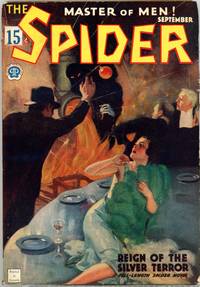
193434721Toronto ON: The Trans-Canada News Company 1934. Mild tanning to text paper mild edge wear bright red spine a nearly fine copy. 34721. Octavo single issue cover by John Howitt pictorial wrappers. Pulp magazine. "Reign of the Silver Terror" with Norvell Page writing as "Grant Stockbridge." The character was established to be a direct competitor to Street and Smith's Shadow magazine. After Doc Savage and The Shadow this was the most popular hero character. The Spider character was considered one of the most brutal and violent of the pulp era. Reference: Cook Mystery Detective and Espionage Magazines pp. 521-527. Tymm and Ashley Science Fiction Fantasy and Weird Fiction Magazines pp. 602-604. The Trans-Canada News Company unknown
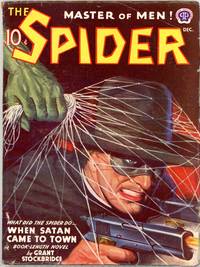
194334830Chicago: Popular Publications Inc. 1943. First edition. Mild tanning to text paper mild edge wear crease at upper right corner a very good to nearly fine copy. 34830. Octavo single issue cover by Rafael DeSoto pictorial wrappers. Pulp magazine. The final issue. "When Satan Came to Town" with Prentice Winchell Stewart Stirling writing as "Grant Stockbridge." Cover illustration has the main character with fangs. The character was established to be a direct competitor to Street and Smith's Shadow magazine. After Doc Savage and The Shadow this was the most popular hero character. The Spider character was considered one of the most brutal and violent of the pulp era. Reference: Cook Mystery Detective and Espionage Magazines pp. 521-527. Tymm and Ashley Science Fiction Fantasy and Weird Fiction Magazines pp. 602-604. Popular Publications, Inc. unknown
51856Paris: JB d�pos�e C. 1930 . Girl with long hair crouching on a rock cradling her knee with stamped 'Bronze garanti Paris JB d�pos�e' mark and signed 'Milo' to base on a marble stand. Weight including base : 1.54kg. Dimensions of bronze: 15.0cm height x 10.5cm length x 6.0cm width . "Milo Martin was a Swiss sculptor and medal-artist. He set up a studio in the Orangerie of Parc Mon-Repos. Most of his sculptures are spread across the Lausanne region. He also travelled to other European countries to exhibit his works in international exhibitions - these included those in Brussels and Amsterdam in 1928 in Paris in 1934 Vienna in 1937 where he won "lauriers d'or" or the golden laurels Cairo and Alexandria in 1938 and New York in 1939-1940. He won first prize in the national competition for medal design at the Swiss National Exhibition in Berne in 1913 and the silver medal for sculpture in the art competitions of the 1928 Olympic Games for his "Athl�te au repos". He won several public commissions and from 1931 to 1936 sat on Switzerland's federal commission for fine arts. He died in Lausanne. Paris: JB d�pos�e, C. 1930 . unknown
23268Apparently the top of the letter has been cut off with presumably his address and the date and name of correspondent. Paper 20 x 11.5cm punch-hole one only the other having been cut off as stated above - perhaps filed formerly. Text: "My name may perhaps be known to you as that of a well-known Scottish poet and essayist author of a number of books on Scottish literary historical sociological economic and political matters. I enclose a leaflet giving some information about my work. I will be glad to write and submit an article along the above lines immediiately if I hear from you that you are willing to consider this." WITH: Leaflet 8vo four pages at some time torn in two and crudely repaired with punch-holes entitled "Speaking for Scotland Tributes Concerning Hugh MacDiarmuid". "199" in red crayon is written on front top right. Scarce: holdings NLS and some American Libraries. Apparently the top of the letter has been cut off (with presumably his address and the date, and name of correspondent). unknown
Very Good French In contemporary 1/3 leather bdg. Small folio. (33 x 26 cm). In French. [10] ,214, [4] p., 'c' numerous b/w plates. La peinture Indienne a l'epoque des Grands Moghols. First Edition. Rare. Sour cadette de la rayonnante miniature persane, la peinture moghole ne fut étudiée qu'à dater du début de ce siècle. Elle n'était considérée jusqu'à ce jour que sous l'aspect d'une branche souvent inférieure des expressions esthétiques iraniennes. Vue sous l'angle de l'art indien, elle retrouve la place importante qui lui était due. Nous avons rendu compte dans les notes bibliographiques de ce Bulletin, M. Parmentier en 1919, nous-même en 1929, d'un ouvrage de M. E. B. Havell intitulé Indian Sculpture and Painting. Cet auteur eut le premier le mérite de placer l'école moghole et l'école néo-indienne à leur rang légitime. M. I. S. rend un juste hommage à M. Havell ainsi qu'à ses successeurs dans l'appréciation des choses sous cet angle nouveau. Il était cependant fort regrettable de constater la pauvreté de la littérature française sur cette question. Nous ne pouvons donc que féliciter vivement M. I. S. de nous avoir offert un important volume sur un sujet à peu près neuf dans notre langue. La nouveauté de ce dernier exigeait la méthode rigoureuse qui a présidé à l'élaboration de ce travail. Dans une première partie historique, M. I. S. étudie la filiation des traditions anciennes avec l'école moghole et néo-indienne. L'auteur insiste sur la continuité de la tradition artistique indienne. Les moyens d'expression des formes picturales de l'homme, puis de la nature, leur définition et leur classement font l'objet d'une seconde partie analytique. Enfin, l'auteur entreprend de déterminer la formation esthétique de la peinture moghole dans une dernière partie, où il étudie, synthétiquement, le rythme de la composition et de la couleur, II est un fait certain : c'est la peinture qui s'est le moins bien conservée au cours des siècles. Cependant, quelques épaves ont miraculeusement survécu aux intempéries, aux invasions et aux guerres. Comme, d'autre part, de nombreuses allusions littéraires font mention de peintures, nous avons en mains les données suffisantes pour que l'historien d'art puisse reconstituer les étapes de l'évolution de cet art. Quoique notre connaissance des débuts soit nécessairement déformée par la légende, la peinture semble avoir tenu à cette époque lointaine une grande place dans la pensée indienne. Elle était le délassement préféré des princes, et la bibliographie amoureuse y trouve largement son compte. Toute personne cultivée avait chez elle le matériel nécessaire à l'exécution d'un portrait, et ceux-ci étaient, paraît-il, fort ressemblants. Mais le caractère profane de la représentation des personnages fut tel qu'au début il était interdit aux moines bouddhiques de séjourner dans les lieux où de pareilles images étaient exposées. Cette interdiction ne dura d'ailleurs pas et l'Eglise bouddhique comprit rapidement la nécessité d'user à son tour de ce puissant moyen de favoriser sa propagande. La connaissance de ces interdictions suffit à déterminer l'origine laïque de la peinture indienne. Les canons aux règles impérieuses ne font leur apparition que vers le VIIe siècle et superposent la formule d'école à l'inspiration directe de la nature. Ces lois enrayeront ainsi graduellement l'évolution de cette forme d'art. En ce qui concerne la décoration des monuments, les plus anciennes fresques sont celles delà grotte Jogimarâ (Orissâ) datant du début de notre ère et celles d'Ajantâ qui remontent, pour certaines «caves», aux deux premiers siècles. Ces représentations, dont le thème est emprunté aux Jàtakas, révèlent une technique en possession de moyens très développés. Notons en passant que les différents auteurs qui ont traité de ce sujet ne sont pas parfaitement d'accord sur les différents moyens mis en ouvre par cette technique. La symétrie des volumes, la sécheresse, une raideur générale, sont les
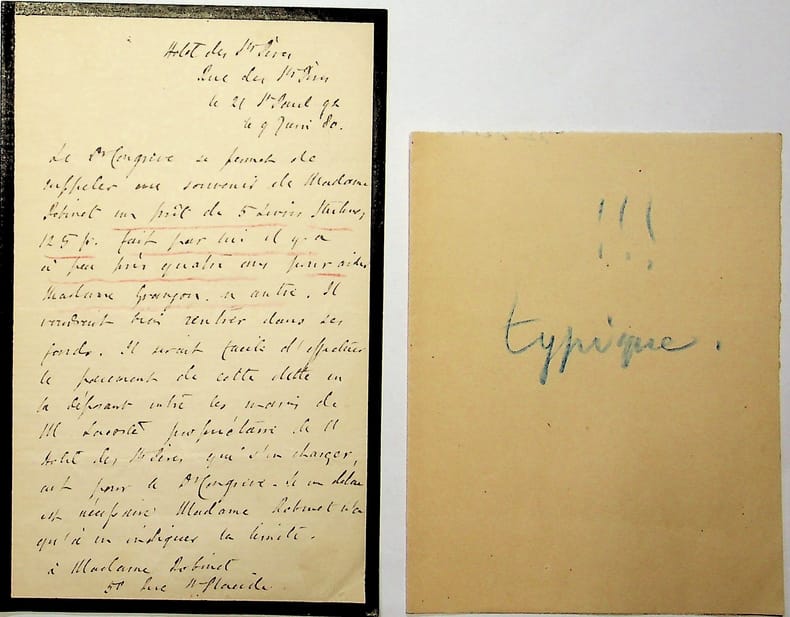
018957[Positivisme] Richard Congreve (1818-1899), philosophe anglais, figure de proue du positivisme en Angleterre, à l'origine du schisme en 1878. L.A.S. en français et à la troisième personne, 21 Saint Paul 92 [9 juin 1880], 1p in-8. A Marie Weyer (1827-1881), épouse du docteur Jean-François Robinet (1825-1899), médecin d'Auguste Comte et important positiviste français. « Le Dr Congreve se permet de rappeler au souvenir de Madame Robinet un prêt de 5 livres sterling fait par lui il y a à peu près quatre ans pour aider madame Granjon ou autre. Il voudrait bien rentrer dans ses fonds. Il serait surtout facile d'effectuer le paiement de cette dette en la déposant entre les mains de M. Lacoste propriétaire de l'hôtel des Saints Pères qui s'en chargerait pour le Dr Congreve. Si un délai est nécessaire, Madame Robinet n'a qu'à en indiquer la limite ». Léopold Auguste Granjon (1845-1875) est un ouvrier, militant ouvrier, franc-maçon et positiviste, membre du cercle des prolétaires positivistes. Il meurt donc en laissant son épouse Constance Friant (1843-?) qui avait donc été aidée par les positivistes. Les lettres entre positivistes sont rares. [443]
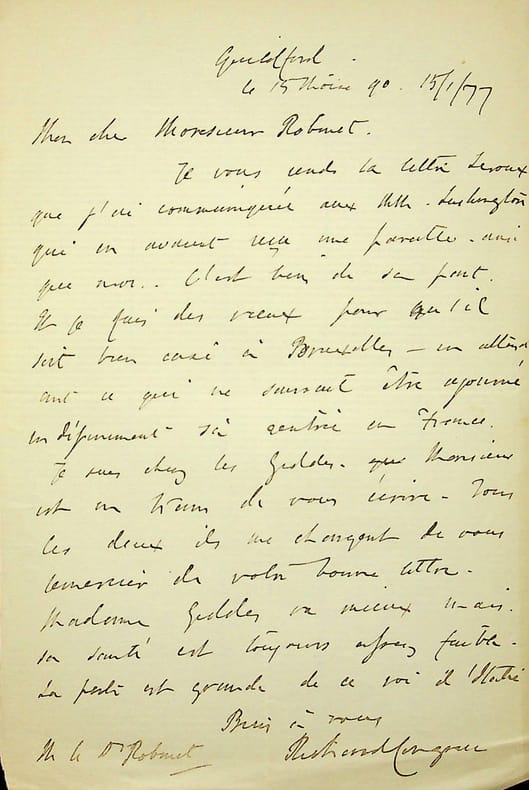
018961[Positivisme] Richard Congreve (1818-1899), philosophe anglais, figure de proue du positivisme en Angleterre, à l'origine du schisme en 1878. L.A.S. en français, Guildford, 15 Moïse 90 [15 janvier 1877 sic! 1878], 1p in-8. Au docteur Jean-François Robinet (1825-1899), médecin d'Auguste Comte et important positiviste français. « Mon cher Monsieur Robinet, Je vous rends la lettre de Leroux que j'ai communiquées aux MMrs. Lushigton qui en avaient reçu une pareille, ainsi que moi. c'est bien de sa part. Et je fais des voeux pour qu'il soit bien casé à Bruxelles - en attendant ce qui ne saurait être ajourné indéfiniement sa rentrée en France. je suis chez les Geddes. Monsieur est en train de vous écrire. Tous les deux ils me chargent de vous remercier de votre bonne lettre. Madame Geddes va mieux mais sa santé est toujours assez faible. La perte est grande de ce roi d'Italie. Bien à vous. Richard Congreve ». Godfrey Lushington (1832-1907) était un haut fonctionnaire anglais. Emily Geddes (1840-1929) et son mari James Geddes (1841-1880) sont la belle-soeur et le beau-frère de Congreve. Le roi d'Italie est Victor-Emmanuel II, mort le 9 janvier 1878. Leroux est probablement Ernest Leroux (1845-1917) qui publia des ouvrages positivistes dont les Lettres d'Auguste Comte à John Stuart Mill (1877). Les lettres entre positivistes sont rares. [444]
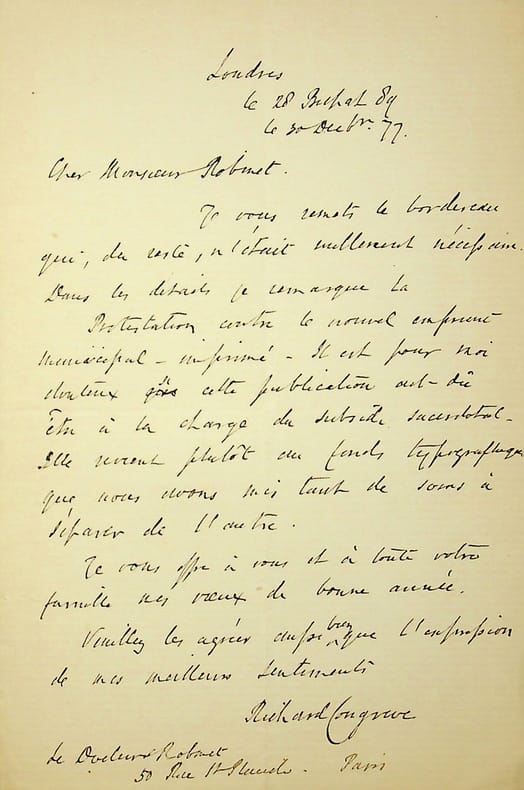
018966[Positivisme] Richard Congreve (1818-1899), philosophe anglais, figure de proue du positivisme en Angleterre, à l'origine du schisme en 1878. L.A.S. en français, Londres, 28 Bichat 89 [30 décembre 1877], 1p in-8. Au docteur Jean-François Robinet (1825-1899), médecin d'Auguste Comte et important positiviste français. « Cher Monsieur Robinet, Je remets le bordereau qui, du reste, n'était nullement nécessaire. Dans les détails, je remarque la protestation contre le nouvel emprunt municipal - imprimé. Il est pour moi douteux si cette publication ait dû être à la charge du subside sacerdotal. Elle revient plutôt au fonds typographique que nous avons mis tant de soins à séparer de l'autre. Je vous offre à vous et à toute votre famille mes voeux de bonne année. Veuillez les agréer aussi bien que l'expression de mes meilleurs sentiments. Richard Congreve ». Les lettres entre positivistes sont rares. [445]
BARBERI GIULIO Composizione per un piatto in maiolica. Due putti reggono nastri e rami di alloro per omaggiare lo scudo araldico centrale: un'aquila con banda trasversa. Attorno festoni con frutta, a contorno cornicetta doppia con nastri. , , Disegno originale, china e acquarello, con forma arrotondata, probabilmente a grandezza naturale, sulla parte sinistra. A destra dicitura e firma autografa dell'A., con data 25 - 4 - 1908. Giulio Barberi, figlio di Enrico, fu anch'egli valente scultore e ceramista, nato e vissuto, come il padre, a Bologna di lui rimangono sculture particolarmente alla Certosa Buono (Good) . <br> <br> <br>
LA MOLDAVIE, LA VALAKIE ET LA TRANSILVANIE Avec partie de la Bulgarie, de la Hongrie et de la Pologne. Venise, Paolo Santini 1777, Grande carta di cm 56,5 x 42,7 allo schiaccio + margini. Delimitazione dei confini in colore coevo, piegata al mezzo, piccola ripresa al margine superiore ma ottimo esemplare fresco e pulito Buono (Good) . <br> <br> <br>
MOYREAU JEAN (INCISORE) - WOUVERMENS PH. (PITTORE) Le colombier du Mareschal. Gravé d'apres le Tableau original de P.Wouvermens de vingt pouces six lignes de large sur dix sept poces de haus qui est du Cabinet de Monsieur D'Argenville Maitre des Comptes (n° 26). Paris, chez Moyreau Graveur du Roy, Rue Gallande vis a vis S.t Blaise 1737, Bella incisione in rame all'acquaforte, in orizzontale, mm 460 x 345 + buoni margini. Molti animali e personaggi in primo piano. Pulita e nitida. A sinistra il ritorno di un pastore con il suo gregge, a destra un maniscalco con l'aiutante sistemano i ferri, mentre due cavalieri attendono. In cornice in legno chiaro, a becco convesso eseguita negli anni 1930/40 Buono (Good) . <br> <br> <br>
SCORZONI ALESSANDRO (SANDRO) Calcara 1858 - Bologna 1833. Fu allievo prediletto di Antonio Puccinelli dell'Accademia di Belle Arti di Bologna. Artista versatile riuscì ad elaborare la sua arte con le più diverse tecniche: olio, acquarello, pastello, tempera ... , , Fu valido collaboratore di Alfonso Rubbiani nel restauro del Castello dei Manzoli. Con il suo ingresso al Circolo Artistico di Bologna si dedicherà anche alla illustrazione e alla decorazione, capacità che, in seguito, svilupperà anche nella Manifattura Minghetti. Questo grande spolvero, più volte ripiegato, fa parte di una serie di due arazzi (Amor calmo - Amor ardente) che produsse per la Famiglia Corni di Modena. Con firma dell'A. e descrizione: "Spolvero dell'arazzo della Signora Rina Accame Corni esistente questo e un secondo nel Palazzo Corni di Modena" Buono (Good) . <br> <br> <br>
Numerous black and white photographs. "...Framed with the object of producing an account of the great contest now in progress, which shall be at once popular and authoritative... An account written by men of great experience in political, military, and naval matters... Will contain a great deal of first-hand material which will be really valuable to historians of the future." - From Preface. Contents: Chapter XCVIII - The Dardanelles Campaign (III) - Two Months' Land Fighting in Gallipoli. Unmarked. Average wear. Binding intact. Magazine
The special issue is extra large and contains 122 pages. Dozens of fantastic vintage photo-illustrated ads. Features: Fantastic Shorts one-page ad includes photos of their massive flying boats; Illustrated article on the first rocket motor built in Britain, the De Havilland Sprite; J.W. Dunne - Obituary; Rocket Fighters for Home Defense; Indian Ocean Survey - The first full story, told by J. Cowan, of a long-range survey flight from Australia to South Africa undertaiken by a Quantas Empire Airways' Lancastrian which left Sydney on November 14, 1948; Air Transport Affairs; Nice 4-page color ad for the Hawker Siddeley Group; Great color ad for the Apollo passenger aircraft; Nice one-page color ad for the Fairey Gyrodyne; The War Against Winter; Nice photo-illustraed Handley Page ad presents aircraft they have produced, past to present; For the Aeronautical Engineer; Flight Assessments During 1948-9; Magnificent 8-page colour illustrated ad for De Havilland's planes; A Review of Britain's Aircraft Industry; and much, much more. Average wear. Unmarked. A sound copy of this extraordinary issue. Magazine
132 pages. Generously illustrated with sepia-tone photographic plates. A reprint of lectures delivered in the season of 1915-16 in Isis Theater, San Diego. Bookplate inside front cover. Various markings to contents. Initials atop front cover. Above-average wear. Binding intact. A worthy reference copy. Book
80 pages. Features: Sikorsky ad illustrates their S-62, S-61 and S-64; Two-page illustrated ad for gun ordnance products by the Hughes Tool Company; Meet the Assult Support Helicopter; Combat Leadership - the greatest single or prolonged acts of combat leadership experienced by four experts - assult and capture of Guam, assault and capture of Buna, Schweinfurt-Regensburg Raid, Battle of Guadalcanal; Marine! - a special anniversary 16-page supplement; The Life of LtGen Lewis B. (Chesty) Puller, USMC (Ret.) - major photo-illustrated article (part 1); Over the Hill - a case for reverse slope defense; No Need for Despair - part II of Hanson W. Baldwin's analysis of WWI; Bois de Belleau - the Battle of Belleau; 2nd Lieutenant - the 44th man; Russian Small Arms and Tactics (part 2 of 2); Small Unit Operations - Counterguerrilla War - part 6 of a series; Transfers and Promotions; Color ad for the McDonnell Phantom II fighter on back cover; and more. Average wear. Unmarked. A sound vintage copy. Magazine
68 pages. Features: Two-page photo ad for the Lockheed GV-1 refueling a fighter; Small Unit Operations - Conterguerrilla War - Part 3 of a series; Great illustrated two-page ad for the M113 troop carrier by FMC illustrates seven of their fascinating military vehicles; "Red Mide" Edson and his story from Tulagi Island in 1942 - photo-illustrated article; Paper Tigers Cost Money; Tips on how an LPH delivers machines, men and gear - with photos; Pacific Strategy 1792-1945 - Part 1 - major article by Samuel Eliot MOrison, Rear Admiral USNR (Ret.); Vo Nguyen Giap on Guerrilla War - Tactics, Soldiers and People - Part 5 of 5; Keep Strong - Keep Fighting; SOPAC Revisited - nostalgic photos from the South Pacific where action took place in WWII; Transfers and Promotions; and more. Average wear. Unmarked. A sound vintage copy. Magazine
Signed and inscribed by Toller Cranston upon title page. 131 pages. Profusely illustrated, primarily in black and white. "Defying tradition, Toller Cranston has single-handedly changed the face of figure skating, bringing to the ice a lyricism and artistry never before experienced. In a unique collection of photographs, interviews, poems, and sketches Elva Oglanby has caught Toller's personality - the moods and nuances that come together in one of Canada's most dynamic performers." - from dust jacket. Reprint of the 1975 First edition. Moderate wear. Dust jacket in protective cover, neatly taped to book. Prior owner's name atop front free endpaper. A wonderful memento of this singularly talented athlete and artist. Book
Approximately 100 glossy black and white pages gloriously illustrated with black and white photography and supporting text in English and French. This special issue presents the work of thirty-two photographers. Unmarked. Binding intact. Average wear. Book
68 pages. Features: Use Your Rifle - For Strength - 12 exercises using your rifle; Hughes gun ordnance 2-page ad; Small Unit Operations - Counterguerrilla War - Part 7 of 7; Illustrated ad for the new 'winged' LVHX2 LCA by FMC; KKo - Indonesia's Marines; Guerrilla War Factors and Reflections - Its Theory and Practice from Clausewitz to Castro; Syllabus Training for the Infantry Battalion; Hit or Miss - putting on a green suit does not make Marines into expert marksmen; The Life of LtGen Lewis B. (Chesty) Puller, USMC (Ret.) (part 2 of 2); CHICOM - small arms and tactics - photo-illustrated article; The Evolution of Firearms; Photos of helicopter activity in Vietnam; Transfers and Promotions; and more. Average wear. Unmarked. A sound vintage copy. Magazine
Lovely period advertisements including Del Monte, Campbell's Soup, Hupmobile, De Soto six, Auburn, Nash 400, Graham-Paige, Hammermill Bond, Hudson Super-six, Plymouth, Dodge Standard Six, Buick (Lovely Colour Centerfold), Oldsmobile, Weyerhauser, Steinway, Cycle Trades of America, A&P, Frigidaire, Pioneer Suspenders, Stewart Trucks, Harley Davidson Package Truck; Pro-phy-lac-tic Toothbrush. Contributors include: Eddie Cantor, Louise Kennedy Mabie, Anne Morgan, Frederick Hazlitt Brennan, Clarence Budington Kelland, Dorothy Black, Leonard H. Nason, Garet Garrett. Average wear. Articles include: The Corn Belt, US Air Mail, The Soul of New York, Bulgarian Visit, Flying the Canadian Frontier. Advertising coupon clipped from back cover. Lower 1/3 of page 61 missing - missing piece contained part of a fictional story and part of a Dupont paint advertisement. Average wear. Solid copy. Book
140 pages. Contributors include: Henry Ford (The Fear of Overproduction), Ben Hecht, Leonard H. Nason, Margaret Culkin Banning, Captain Charles B. Scully, Katherine M. Schmitt, Joseph Hergesheimer. Nice contemporary advertisements from Del Monte, Coke, Camay, Campbell's Soup, Sunbrite Cleanser, Cord Auto, Graham Auto, Dodge Six, Essex Auto, Edison Mazda Lamps, Fordor Sedan (by Ford), Cellophane, Buick, Reo Speed Wagon, Valspar, Northern Pacific Rail Line, White Trucks, McCormick-Deering Industrial Power (*wonderful black and white photographs*), The Knapp-Felt Hat, A&P. Articles include: Why Drown? by Charles Scully, The Story of an Early Switchboard Operator, Tears to periphery of cover otherwise a solid copy with average wear. Book
84 pages. Features: Cowboy poetry and the Bates Motel; She Wore Pink Satin Slippers, by Jan Meissner; Intimate trust; How to Play God; The Kindness of Strangers; The Unabomber's Cabin; and more. Average external wear and soiling. Binding intact. A sound copy. Book
120 pages plus 38 pages of wonderful contemporary advertisements plus a two-page advertisement by Scottish Provident Institution and four detailed pages of advertising content by Kilby Pears & Son. Numerous black and white illustrations and photos. Contents include Ten Years of Cycling - a wonderful vintage view of bicycles, including alternatives to chain drive - plus a great article entitled Birmingham and Its Jewellery, which includes 16 excellent black and white photos plus considerable text. Binding intact. Name atop front cover else unmarked. Somewhat above-average wear. A quality copy of this charming and informative issue. Book
98 pages. Printed upon glossy stock. Average wear. Infrequent markings to contents. Binding intact. A sound copy. Book