2 471 résultats
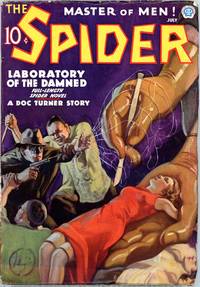
193634746Chicago: Popular Publications Inc. 1936. First edition. Mild tanning to text paper slight edge wear slight wear to spine ends a bright fine copy. 34746. Octavo single issue cover by John Howitt pictorial wrappers. Pulp magazine. "Laboratory of the Damned" with Norvell Page writing as "Grant Stockbridge." The character was established to be a direct competitor to Street and Smith's Shadow magazine. After Doc Savage and The Shadow this was the most popular hero character. The Spider character was considered one of the most brutal and violent of the pulp era. Reference: Cook Mystery Detective and Espionage Magazines pp. 521-527. Tymm and Ashley Science Fiction Fantasy and Weird Fiction Magazines pp. 602-604. Popular Publications, Inc. unknown
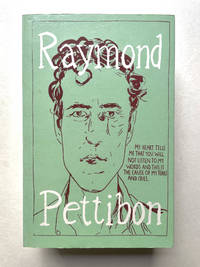
2015<p>First English Language Edition. 897 pp. offset in stiff wrappers chiefly illustrated in black and white. 4to. Very good. 2015</p><p><em>Catalogue raisonné of the artist's books of Raymond Pettibon. From the library of translator and onetime member of the Situationist International Donald Nicholson-Smith inscribed to Nicholson-Smith by Pettibon at half-title page and additionally by editor Ohrt at title page. A nice association copy which suggests an affinity between Pettibon's illustrations and the graphic work of the Situationist International.</em></p> D.A.P.
Due volumi rilegati in uno in 8° (mm. 260x170), pp. 282, 270, due incisioni all'antiporta + 50 inc. in acciaio finemente dipinte a mano d'epoca. Legatura originale in percallina verde con dorso a nervi decorato in oro. Buon esemplare della più riuscita opera del celebre illustratore francese, stampata nel 1847 per la prima volta. Le belle tavole raffigurano fiori in sembianza di figure femminili, delineate con grande eleganza. Qualche abrasione al dorso.
192610952Paris, NRF Gallimard, 1926 ; 4 tomes, petit in-8 ; cartonnage rigide de papier gauffré à grand décor polychrome sur les deux plats et le dos (les quatre décors sont différents), vignette lithographiée en camaïeu au centre des plats, titre et tomaison dorés au dos, étui doré avec large ruban (reliure de l'éditeur) ; 57 ; 60 ; 48 ; 65 pp. ; et au total 24 illustrations gravées à l'eau-forte, 6 par volume (les 8 en-têtes et les 8 lettrines sont gravés sur les mêmes cuivres) par J. Rosoy, G. Labaye et H. David.
128 pages. Great cover art by H.J. Ward. Stories include: Peril's Highway; Jackaroo; Bayou Madness; Rubies of Empire; Diana Daw; Graveyard of Missing Ships; She-Sheriff Barbara; Dangerous Bequest. Clean and unmarked with moderate wear. Binding intact. A sound vintage copy. Magazine
RATTA CESARE (CURATORE) Acquafortisti italiani. Volume I raccolta di acqueforti, acquetinte, puntesecche, maniera nera, di 150 artisti. Volume II con 160 incisioni di 45 artisti. Volume III ed ultimo con 172 incisioni di 55 artisti. Bologna, Ratta s.d., Volumi 3 in 4° massimo/folio, brossure originali con immagine ai piatti anteriori, solo una minuscola ripresa ad una cuffia superiore. Volume primo: cc. 169 n.n. delle quali 2 in velina. Come spiegato dall'editore in una nota inserita al vol. II, le tavole n. 114 e 116 di C. Casanova sono state inserite per errore essendo in litografia anziché acquaforte come invece indicato. Commenti di Raffaello Biordi e Alfredo Petrucci. Volume secondo: cc. 165 n.n. con la detta iconografia - Volume terzo: cc. 162 n.n. con la detta iconografia. Tiratura di 500 esemplari numerati (344 - 191 - 276). Esemplari in stato di conservazione molto buona, solamente una mancanza all'ang. inf. della tav. 98, lontano dall'immagine. Monumento tipografico del grande Cesare Ratta Buono (Good) . <br> <br> <br>
China e matita misure: mm 112 x 141 Pittore, disegnatore, bibliofilo, letterato, collezionista, poeta, critico e storico dell’arte. A soli quindici anni è accolto nell'Accademia dell’Arcadia per i suoi componimenti poetici. Successivamente segue a Brera i corsi di Traballesi, Knoller e Appiani. Nel 1795 è a Roma dove stringe amicizia con Felice Giani , Angelika Kauffmann e soprattutto con Antonio Canova, di cui diventa amico fraterno. Nel 1801, a soli ventiquattro anni, è nominato Segretario dell’Accademia di Brera. Grazie anche al sostegno della Repubblica Cisalpina egli imprime una svolta radicale alla suddetta istituzione, redigendo i nuovi statuti, ampliando la collezione della Pinacoteca (si ricorda fra tutti l’acquisto dello “Sposalizio della Vergine” di Raffaello) e raccogliendo svariato materiale didattico; dalle stampe ai gessi ai libri. Viaggia intanto a Roma, Napoli e Parigi, dove fa la conoscenza di David. Nel 1802 vince il concorso bandito dalla repubblica Cisalpina con il dipinto “La Riconoscenza della Repubblica italiana a Napoleone”. Nel 1807 da le dimissioni dall'Accademia a causa dei contrasti col governo e la nuova politica- da lui giudicata troppo severa- di Napoleone. Nello stesso anno, su incarico del Viceré Eugenio di Beauharnais realizza una copia del Cenacolo vinciano. Per questa occasione pubblica nel 1810 il saggio “Del Cenacolo di Leonardo da Vinci”, che riscuote un immediato successo ed è ancora oggi considerato un testo fondamentale per lo studio del pittore toscano. Bossi muore prematuramente nel 1815 lasciando incompiuta la commissione per gli affreschi di Villa Melzi a Bellagio. Giuseppe Bossi fu un infaticabile ed eccelso disegnatore. Egli utilizzava il disegno come momento di studio ed elaborazione delle proprie idee figurative. Dotato di un segno veloce, sicuro ed energico; era inoltre in grado di realizzare, grazie all'uso di sapienti campiture acquerellate, opere di grande atmosfera. Nel foglio si vedono tre figure a penna. A sinistra l'abbraccio tra una figura seduta, probabilmente un uomo, caratterizzato da morbidi ciuffi di capelli e da un abito panneggiato, che sostiene una bimba dal lungo abito in piedi davanti a lui. Sulla destra viene raffigurato un bambino, il suo corpo e il suo volto sono costruiti mediante la linea di contorno, apparentemente sovradimensionato rispetto alle altre due figure. Fitte linee parallele danno profondità e creano le zone in ombra. Esemplare grafico elegante, studio preparatorio. Ottimo stato di conservazione. Bibliografia: AA.VV. “Giuseppe Bossi Pittore”, Busto Arsizio, 1965; L.T.Brunetto “Giuseppe Bossi. L’Uomo e L’opera”, Busto Arsizio, Pianezza Editore, 1983. F. Leone & F. Mazzocca (a cura di)“L’officina neoclassica”, Silvana editoriale, Faenza, 2009; G. Fusconi (a cura di) L’Artista e il suo atelier. I disegni dell’acquisizione Osio all’Istituto Nazionale per la Grafica”, Palombi editori, Roma, 2006.
017-Eo.J. Bleistift, mit Bleistiftlinie voneinander abgesetzt, auf Velin. 26,4:18,3 cm. Oben, links und unten leichter Lichtrand; verso oben und links Reste alter Verklebung.
168815606Paris, Etienne Michallet (Imprimerie Estienne Chardon), 1688 ; in-8 ; plein veau havane marbré, dos à nerfs décoré et doré, titre doré, roulette dorée sur les coupes, tranches mouchetées de rouge (reliure de l'époque) ; 138 pp., (1) f. blanc, nombreuses figures dans le texte et 2 planches hors-texte gravées "Figure du Compas de proportion faite par Chapotot".
71 pages. Book clean and unmarked with lean to spine and moderate wear. Short openings and sunning at each end of backstrip. Dust jacket in protective mylar is sunned at spine and missing chips at spine ends. Jacket bears several short tears and appears to have a hairline opening the length of backstrip at backboard. Overall, a worthy copy of this precious work. Book
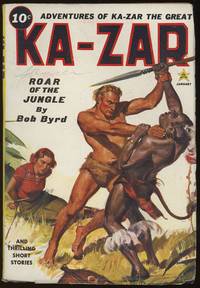
193732685Chicago: Manvis Publications Inc. 1937. Mild tanning to text paper slight wear to yapp edges light pencil name to upper front cover a fine copy. 32685. Octavo single issue cover by J.W. Scott pictorial wrappers. Pulp magazine. All Ka-Zar stories written by Bob Byrd a house pseudonym here Thomson Burtis. A Tarzan pastiche. Reference: Tymn and Ashley eds Science Fiction Fantasy and Weird Fiction Magazines pp. 368-69. Manvis Publications, Inc. unknown
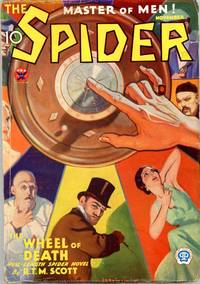
193334708Chicago: Popular Publications Inc. 1933. Mild tanning to text paper mild edge wear with a few tiny tears reading crease at spine rear cover re-glued with several chips to left edge mild color fade to spine a very good to nearly fine copy. 34708. Octavo single issue cover by John Howitt pictorial wrappers. Pulp magazine. The second issue. "The Wheel of Death" by R. T. M. Scott. This is the last to be written by Scott starting with the next third issue a house pseudonym was used. The character was established to be a direct competitor to Street and Smith's Shadow magazine. After Doc Savage and The Shadow this was the most popular hero character. The Spider character was considered one of the most brutal and violent of the pulp era. Reference: Cook Mystery Detective and Espionage Magazines pp. 521-527. Tymm and Ashley Science Fiction Fantasy and Weird Fiction Magazines pp. 602-604. Popular Publications, Inc. unknown
200328617BECKETT C56980 AUTHENTICATED STICKER ON BACK OF 13 1/2 IN. RULER. 2003. PROMOTIONAL MOVIE RULER HAND SIGNED BY VAL KILMER and BECKETT AUTHENTICATION SERVICES BAS AUTHENTICATED 13 1/2" x 1" The John Holmes Big Boy Promotional Ruler. The ruler is in BRAND NEW/NEVER BEFORE DISPLAYED condition This signed ruler is in BRAND NEW/NEVER BEFORE DISPLAYED CONDITION. There are no defects of any kind. Signed by Author. 1st Edition. Unbound. BECKETT C56980 AUTHENTICATED STICKER ON BACK OF 13 1/2 IN. RULER.
CERVELLATI ALESSANDRO Acquarello originale: Cinema Fulgor. La Felsina Film presenta: Bianco e Nero con Lia Miari, 12 febbraio 1918. Disegno a quattro colori, di cm 23 x 29,5 in cornice. , , Il disegno, rappresenta l'intera figura di una donna in atteggiamento elegante, in abito lungo con guanti e ampio cappello. Come sempre, con pochi segni, Cervellati ci regala l'immaginario. Firmato e datato '974, in basso a sinistra, quindi una delle ultime opere dell'Artista. ALESSANDRO CERVELLATI viene considerato uno degli artisti bolognesi più rappresentativi del secondo '900, eppure proprio proprio bolognese non era essendo nato a Bertinoro di Romagna (l'8 marzo 1892). Bolognese, però, lo fu veramente ed appassionatamente con tutto il suo cuore e con tutta la sua splendida arte dove il segno, così immediato e netto, deciso e decisivo, toglie quasi l'utilità alle parole: ed è così per questo, tardo, ma efficacissimo disegno. Pochi segni, morbidi e sicuri ed ecco un'atmosfera si crea ed una immagine si forma. Così fu anche per le sue esperienze di scrittore, particolarmente in quelle del dopoguerra, i suoi disegni escono protagonisti dalle pagine, dalle pubblicità e dai tanti lavori che lo videro grande artefice della storia libraria bolognese di quegli anni. Bellissima la definizione che di lui diede Franco Solmi: "Immagini totali sono i libri di Cervellati": un Artista totale di parola e di segno. Morì nella "sua" Bologna il 29 dicembre 1974 Buono (Good) . <br> <br> <br>
Telephone Talk was the glossy bimonthly publication of the British Columbia Telephone Company. It was written by employees for employees to present information of interest to those engaged in the plant, traffic, commercial, operating, accounting and other departments of the service. Each issue is replete with black and white photos and information on topics such as: company, industry and technological news, traffic levels, expansion plans, personnel announcements, publicity and social events, deaths, weddings, lists of exchanges, and more. As such, these issues serve as a vital preserve of rare and fascinating British Columbia history. This volume covers topics including: Photo inside the Nelson exchange; Satisfactory growth in past year; Four-page article with photos on prospects for the Kaslo area; 6-page article with photos on 'Modern treatment of the Insane' - the establishment of Colony Farm by the Provincial Government; Photo of enormous fallen tree near Westholme; Table ranking exchanges in order of per cent good toll calls; Statement of Development - la table listing number of phones operating per exchange as at 1 December 1913; Photo montage of three Vancouver Island telephone officials; Company has caught up with its construction work; 7-page feature on Victoria, 'The Pride of the Last West' with great photos; Photo of 'Vancouver's Newest Skyscraper' - a 15-story building under construction at the corner of Hastings and Richards; Telephone Service Excellent; 7-page article with excellent photos of the Britannia Mine; Telephone Cables Underground (in Vancouver); photo of company vehicle; Photo of Port Alberni Exchange; Large photo of the Seymour Exchange under construction (Steel frame erected); 5-page illustrated feature of Port Alberni - the magnetic city on the west coast; The giving of good telephone service; Some transmission problems of the B.C. Telephone Co.; Photo inside Port Alberni Exchange; First teleautograph west of Chicago - at the new Hotel Vancouver; 5-page feature of towns that silver put on map - New Denver, Silverton, Sandon, surrounding which is the Slocan District, in which is located the Standard Mine - photos; Recent developments in telephone transmission; April trouble record in Seymour office; Wonderful photo-montage of Vancouver's business district; First Telephone Switchboard in use in Vancouver, 1885; Before and after photos of Point Grey Road and Powell St.; View of Granville St. from the C.P.R. Depot; Photo of the almost completed Hudson's Bay store; Two great panoramic photos of the Vancouver Harbour, from the water and from the land; Photo of Hastings St. West, looking east; photo of the new Hotel Vancouver; Photo montage of some of Vancouver's fine homes; Photo of English Bay Bathing Beach; large photo of Second Beach, Stanley Park; Photo of the Interurban Depot B.C.E.R.Co.; View of Grand Forks looking west; Photo of the Granby smelter, largest in the British Empire; 5-page feature on Grand Forks; What are the duties of a Wire Chief?; Photos of the B.C. Tel. float as appeared in the Vancouver Pageant; Interior Telephone Extensions - exchanges of Kootenay, Boundary and Slocan to be connected; 1899 Vernon and Nelson Telephone Co. Ltd. phone directory; Operator School photo; Nice photo of the 6 chief operators of the Kootenay District; Where operators are trained - illustrated multi-page article; Personnel of Plant Organization; Marketing Telephone Poles - 2 page article with 2 photos; Operator's School Equipment; Cover photo of public telephone booths at the C.P.R. Depot, Vancouver; Nice photo of the Seymour general public office, Vancouver; Work of the Commercial Department - 6 pages with many photos of personnel; Printing a Telephone Directory; Getting out the Monthly Accounts - 2 photos; Telephony on the battlefield - use in the Russian-Japanese War; Photo in head office in Vancouver; Making the Telephone Valuable; photo portraits of executives William Farrell, George Halse, and o Book
1994208906Springer Verlag, Berlin / New York 1994. XIII/309 pp., 4°,
1999__0750306165Inst of Physics Pub Inc 1999. Hardcover. New. 1st edition. 192 pages. 9.00x6.00x1.25 inches. Inst of Physics Pub Inc hardcover
1636A Amstelredam, Chez Aletinosgraphe de Clearetimelee, & Graphexechon de Pistariste, sans date. 2 tomes en 1 volume in-folio de [8]-535 + [8]-463 pages, pleine basane marron, dos à nerfs orné. Plats et dos frottés et épidermés, petits accrocs aux coiffes, charnière du 1er plat fendue, rousseurs, accrocs sur l’angle inf. gauche du 1er plat. Traces d’humidité.
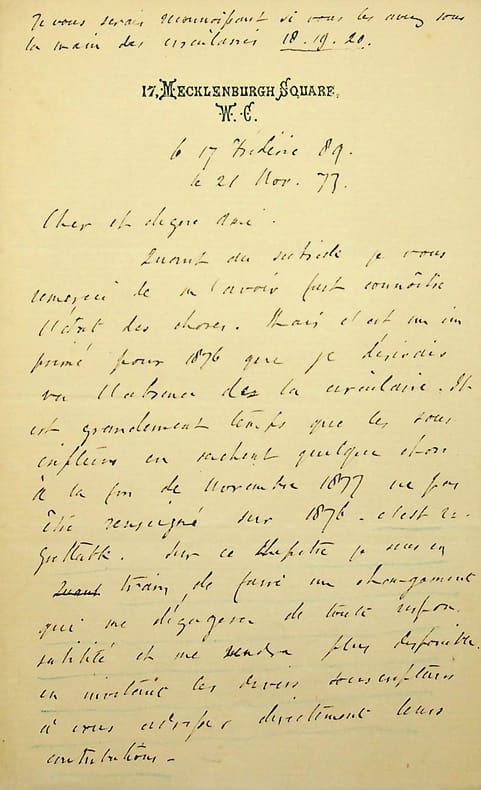
018958[Positivisme] Richard Congreve (1818-1899), philosophe anglais, figure de proue du positivisme en Angleterre, à l'origine du schisme en 1878. L.A.S. en français, 17 Frédéric 89 [21 novembre 1877], 4p in-8. Au docteur Jean-François Robinet (1825-1899), médecin d'Auguste Comte et important positiviste français. « Cher et digne ami, Quant au subside, je vous remercie de m'avoir fait connaître l'état des choses. Mais c'est un imprimé pour 1876 que je désirais vu l'absence de la circulaire. Il est grandement temps que les souscripteurs en sachent quelque chose. A la fin de novembre 1877, ne pas être renseigné sur 1876, c'est regrettable. Sur ce chapitre, je suis en train de faire un changement qui me dégagera de toute responsabilité et me rendra plus disponible, en invitant les divers souscripteurs à vous adresser directement leurs contributions. Quant à [Pierre] Laffitte, je vous croyais au courant. J'extrais de votre lettre du 28 octobre cette phrase : "Quoiqu'il en [mot illisible], M. Laffitte m'a déclaré vouloir vous écrire de tout cela (le soulignement est de vous) : nous verrons". D'après cela, j'ai attendu. Il ne m'a pas écrit, quoiqu'il ait écrit à d'autres. Je vous remercie d'avoir transmis ma communication. Quant à la petite pointe que me lance M. Sémérie dans sa lettre à M. Laffitte, qu'il m'a communiquée, ainsi que celle de M. Laffitte, je l'ai vue avec un certain amusement. Mais sans y attacher d'importance. Je suis habitué à me voir regardé comme homme qui se berce d'illusions, sans esprit pratique &c &c. Pour la lettre elle-même, je l'ai trouvée juste forte. Mais depuis longtemps, j'ai remarqué dans mes fréquentations que vous vous parlez plus librement que nous ne le supposions et que cela ne tient à pas conséquence. Dans la choses publique, je crois que vous attachez trop d'importance à certaines considérations relative au noyau positiviste parisien. Autant que personne, je me suis efforcé de le maintenir et de le soutenir. Vous me rendrez cette justice. Si je me décide à agit autrement que je n'aie agi jusqu'ici, ce sera pas les considérations d'un ordre supérieur. Je dois relever une phrase de votre lettre - "mal poupé et mal renseigné". Ce coup sûr vous avez une large part à l'impulsion - et plus qu'une large part aux renseignements. N'est-ce pas vrai ? Il faut tâcher de voir d'autres périls que ceux du schisme, qui vaut mieux que le marasme. Mais le schisme est un grand mal. Seulement il existe de fait. Il ne faut pas fermer les yeux sur cela. Pour la question personnelle, il m'est bien difficile d'en parle. Et mieux vaut, selon moi, laisser agir le temps que d'en parler, où un mot déplacé pourrait faire tant de mal. Et, où n'écrivant pas en anglais , il me serait si facile de laisser échapper un mot déplacé. Il est constant que nous avons une grande cause à soutenir, un grand maître à suivre ; vous croyez soutenir l'un et suivre l'autre en vous attachant à un directeur que je juge incompétent. Ce n'est qu'un dissentiment sur une question concrète de personnes. Malheureusement, d'après la tournure qu'a prise l'affaire, cela implique mon élimination. Vous verriez en ma présence une rivalité et un danger. Enfin, c'est une séparation, il n'y a pas à dire autrement. Mais voilà que je me laisse aller. Croyez toujours, dans cette séparation, provisoire espérons-le, à ma sincère affection pour vous et les vôtres. Richard Congreve. Inutile, j'ajoute, après avoir écrit ma lettre, de dire combien j'ai été peiné des incidents de la crise et surtout en ce qui nous affecte. Je n'ai qu'une consolation, c'est de ne pas l'avoir provoquée. [et en tête de la première page] Je vous serais reconnaissant si vous les avez sous la main des circulaires 18-19-20 ». Eugène Sémérie (1832-1884) était un médecin, positiviste, proche du docteur Robinet. Les lettres entre positivistes sont rares. [443]
First and only edition. THE UNIQUE COPY PRINTED ON FINE JAPON NACRE PAPER of this long puppet play by expatriate intellectual and dilettante Henry Church. 183 pp. A total of 101 copies were printed, all for private distribution: 100 copies on Arches wove paper and a unique copy on Japon nacrÈ (a luminous Japanese paper, often translated as "pearl Japan"). THIS IS THE COPY ON JAPON NACRE, and it is affectionately inscribed by Ernest Aulard, the printer, for his daughter Blanchette. Huge margins. 8vo. Original printed wraps. Uncut and unopened. FINE AND BRIGHT. Pristine and unique.
Truly a rare and special item! The first ever issue of 'The Wide World' magazine. "From the late nineteenth century to the swinging sixties, this publication was the bestselling magazine for men craving adventure. Each issue was filled with amazing-but-true-tales of survival, catastrophe and derring-do gathered from around the world... Written in the muscular prose of true heroes and accompanied throughout by photographs and adverts of sublime absurdity, 'The Wide World' was a thrilling testament to an age when men kept their upper lips stiff for a reason and the truth was more dangerous than fiction." - from dust jacket of the book 'The Wide World', published by Macmillan in 2004. Condition: Small chips missing from each end of spine. Binding sound. Modest foxing to front cover else clean and unmarked. Moderate wear. Staples rusty inside front cover. Surprisingly good condition for an item of this vintage. Contents of this issue include: The Romance of Seal Hunting - an interview with Sir Geo. Baden-Powell; Down the Perak River; Houses in Air and in Water (Papua New Guinea); Tragedies of Mont Blanc; The Most Remarkable Newspaper in the World - Michigan State Prison, Jackson City; Memories of Navarino; How the North Pole will be reached, by Dr. Fridtjof Nansen; The New Route to the Klondike; The Cruise of the Slaver 'Carl'; Castaways in the Frozen North; and more. Numerous wonderful black and white photos. A marvelous gift for fans of this most entertaining of magazines. Book
69 pages. Charming colour illustrations. Book clean and unmarked with light wear. Average wear to price-clipped dust jacket which is now preserved in mylar. Three taped repairs to reverse of dust jacket's top edge with minor bit of discolouration at head of backstrip. A quality copy of this treasured work. Book
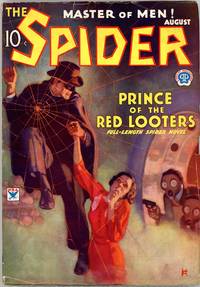
193434719Chicago: Popular Publications Inc. 1934. Mild tanning to text paper slight color fade at spine to orange slight edge wear a nearly fine copy. 34719. Octavo single issue cover by John Howitt pictorial wrappers. Pulp magazine. "Prince of the Red Looters" with Norvell Page writing as "Grant Stockbridge." The character was established to be a direct competitor to Street and Smith's Shadow magazine. After Doc Savage and The Shadow this was the most popular hero character. The Spider character was considered one of the most brutal and violent of the pulp era. Reference: Cook Mystery Detective and Espionage Magazines pp. 521-527. Tymm and Ashley Science Fiction Fantasy and Weird Fiction Magazines pp. 602-604. Popular Publications, Inc. unknown
1991208911Springer Verlag, Berlin / New York 1991. XIV/316 pp., 4°,
186021616Paris, Bohné ; Bruxelles, Van Meenen, 1860 ; in-16, bradel de percaline rouge vif, pièce de titre vert foncé, chiffre couronné doré Philibert de Lombard de Buffières, comte de Rambuteau en pied du dos, date en queue (reliure de l’époque) ; XII-494 pp.