2 471 résultats
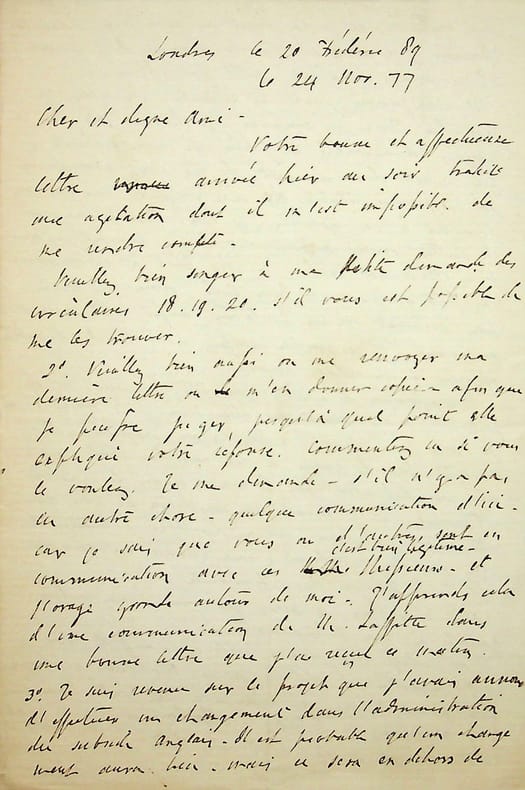
018959[Positivisme] Richard Congreve (1818-1899), philosophe anglais, figure de proue du positivisme en Angleterre, à l'origine du schisme en 1878. L.A.S. en français, Londres, 20 Frédéric 89 [24 novembre 1877], 4p 1/2 in-8. Au docteur Jean-François Robinet (1825-1899), médecin d'Auguste Comte et important positiviste français. « Cher et digne ami, Votre bonne et affectueuse lettre arrivée hier au soir trahit une agitation dont il m'est impossible de me rendre complète[ment]. Veuillez bien songer à ma petite demande des circulaires 18.19.20 s'il vous est possible de me les trouver. 2° Veuillez bien aussi ou me renvoyer ma dernière lettre ou m'en donner copie afin que je puisse juger jusqu'à quel point elle explique votre réponse. Commentez la si vous voulez. Je me demande s'il n'y a pas eu autre chose - quelque communication d'ici - car je sais que vous ou d'autres, c'est bien légitime, sont en communication avec ces Messieurs et l'orage gronde autour de moi. J'apprends cela d'une communication de M. [Pierre] Laffitte dans une bonne lettre que j'ai reçue ce matin. 3° je suis revenu sur le projet que j'avais annoncé d'effectuer un changement dans l'administration du subside anglais. Il est possible qu'un changement aura lieu mais ce sera en dehors de mon initiation[?]. Le projet avait ses avantages mais je reconnais que ce n'est pas le moment d'y penser. 4° Je prends d'abord votre postscriptum. Je n'ai jamais parlé de retraite.Où avez-vous pris cela. Tout au contraire, je cherche par tous les moyens d'agrandir la sphère de mon activité. Si par hasard, il m'arrivait de me voir abandonné par la presque totalité de mes confrères anglais, ou d'avoir à les quitter, je continuerais toujours de lutter comme auparavant. Il y a vingt-deux ans que j'ai commencé seul. Je suis prêt à recommencer non pas seul mais bien isolé, dans un cercle bien restreint mais peut-être aussi utile que celui qui existe. Et je compte réussir avec l'aide de certains appuis à un certain degré. Ma situation à Londres peut être essentielle - honorée peut-être - mais elle sera, je le crains, ébranlée sous peu par l'action de ces messieurs. Mais en tout état de cause, si ma carrière est brisée, cela ne dépendra pas de moi mais de l'action extérieure. et j'aurais la consolation de voir que cette action extérieure aura développé l'énergie de ceux qui la prendront - une énergie en somme utile à la Religion de l'Humanité. Ainsi, cher ami, je pense que vous serez calmé quant à ma détermination. J'ai rédigé une longue lettre à M. Laffitte que je vais soumettre à certains amis. Elle vous expliquera mon point de vue et cela m'a trop coûté pour que j'y revienne en détail. En attendant, je lui ai répondu ce matin. Maintenant je réponds à votre lettre. Vous avez senti un refroidissement - et vous avec eu raison. À quoi tient-il ? Libre à vous de vous ranger du côté de M. Laffitte, de juger que le statu quo amélioré était le seul admissible. Je puis différer mais enfin votre avis avait beaucoup eu sa faveur. Mais, après tout ce qui s'est passé entre nous, j'ai été choqué de la manière dont vous m'avez présenté l'action de M. Laffitte et aussi de la manière dont préoccupé du soin de me détourné de toute opposition, vous avez interprété mon action. Mais c'était long, et peut-être impossible de débrouiller des difficultés pareilles. (Je remarque en passant que la Fête de l'Humanité n'est pas proprement parlant une fête commémorative d'Auguste Comte - encore moins de sa naissance). Si vous m'aviez dit, je le crois de bonne politique de soutenir M. Laffitte, puisque il faut choisir, je n'aurais eu rien à dire. Votre jugement sur lui m'aurait paru peu conciliable, peut-être, avec cette conclusion. Mais voilà tout. Mais l'argumentation m'a déplu. Je vous l'avoue franchement. Ensuite, quant à ma venue, dans les conditions telles que vous les aviez "rêvées", elle devait avoir envie à une époque plus ou moins éloignée de me substituer à M. Laffitte. Mais dans vis der
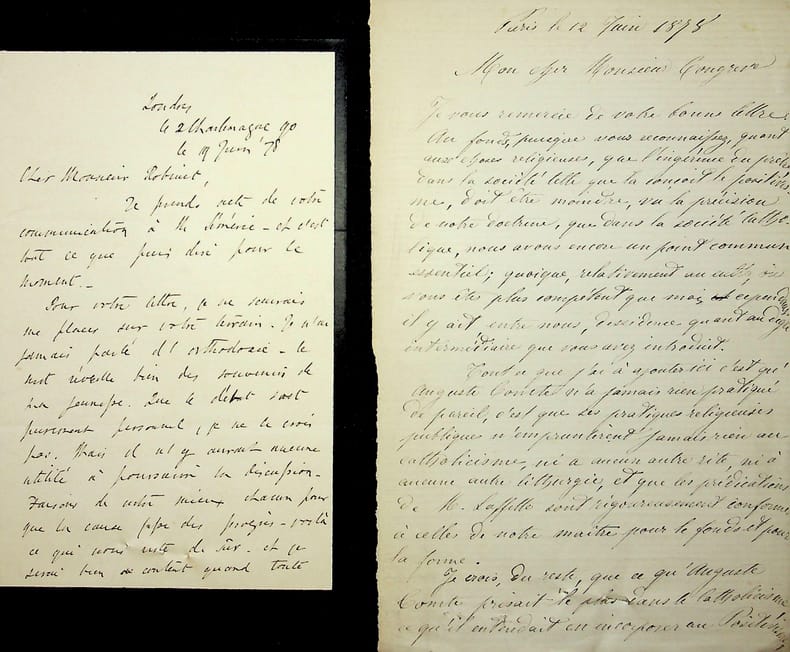
018960[Positivisme] Richard Congreve (1818-1899), philosophe anglais, figure de proue du positivisme en Angleterre, à l'origine du schisme en 1878. L.A.S. en français, Londres, 2 Charlemagne 90 [19 juin 1878], 2p in-8. Au docteur Jean-François Robinet (1825-1899), médecin d'Auguste Comte et important positiviste français. « Cher Monsieur Robinet, Je prends acte de votre communication à M. Sémérie et c'est tout ce que je puis dire pour le moment. Pour votre lettre, je ne saurais me placer sur votre terrai. Je n'ai jamais parlé d'orthodoxie - le mot réveille des souvenirs de ma jeunesse. Que le débat soit purement personnel, je ne le crois pas. Mais il n'y aurait aucune utilité à poursuivre la discussion. Faisons de notre mieux chacun pour que la causse fasse des progrès - voilà ce qui nous reste de sûr. Et je serai bien content quand toute lutte aura cessé - ce qui ne peut guère manquer d'arriver tôt ou tatd. Mais quel chaos actuel. Je vous transmets le premier versement de cette année. C'est à jeudi ou à vendredi qu'en est l'échéance. Et je ne dois pas être en retard. Reste à voir quelle sera l'influence de nos tiraillements sur le subside. Je m'abstiens de toute prévision. Si je pouvais causer avec vous de tout cela à la bonne heure - mais sur le papier )- bah ! Nous nous associons pour vous exprimer nos meilleurs voeux et sentiments ainsi, bien entendu, qu'aux vôtres. Richard Congreve ». Cette lettre répond à une lettre du 12 juin dont nous avons le brouillon (secrétaire) signé : « Mon cher Monsieur Congreve, Je vous remercie de votre bonne lettre. Au fonds, puisque vous reconnaissez quant aux choses religieux, que l'ingérence du prêtre dans la société telle que la conçoit le positivisme, doit être moindre, vu la précision de notre doctrine, que dans la société catholique, nous avons encore un point commun essentiel ; quoique, relativement au culte où vous êtes plus compétent que moi, cependant, il y ait entre nous, dissidence quant au degré intermédiaire que vous avez introduit. Tout ce que j'ai à ajouter ici c'est qu'Auguste Comte n'a jamais rien pratiqué de pareil, c'est que ses pratiques religieuses publiques n'empruntèrent jamais rien au catholicisme, ni à aucun autre rite, ni à aucune autre liturgie, et que les prédications de M. Laffitte sont rigoureusement conformes à celles de notre maître pour le fonds et la forme. Je crois, du reste, que ce qu'Auguste Comte prisait le plus dans le catholicisme, ce qu'il entendait en incorporer au Positivisme, ce n'était ni le dogme, ni même le culte, mais la base morale et surtout l'organisation politique, la division des deux pouvoirs et l'unité hiérarchique du pouvoir spirituel. Cela dépendait de ce qu'il se plaçait toujours et avant tout au point de vue social. Je ne pense donc pas que M. Laffitte et ceux qui le suivent soient hors de l'orthodoxie, même quant au culte. Et comme d'autre part vous reconnaissez que la scission ne porte pas sur le dogme, il s'en suit qu'elle n'a, en réalité, que des motifs personnels. C'est là, en effet, ce qui m'a toujours paru être le noeud de la question. La majorité des Positivistes l'a compris ainsi, et la scission, à ce qu'il me semble, s'est faite sur des noms propres, le votre et celui de Monsieur Laffitte, et non sur les questions politiques, philosophiques, ou religieuses. [Partie barrée par Robinet] Ceci posé, et je suis certain que vous l'acceptez comme moi, il me reste à exprimer, si délicate que soit la chose, le regret que j'éprouve des procédés qui ont été employés pour consommer la séparation. Au lieu d'aggraver des mécontentements, au lieu d'imaginer un partage de la direction, un coadjutariat, qui s'est aussitôt transformé en sommation faites à Mr [Laffite] [Fin de la partie barrée, il manque probablement une petite partie] C'est là, en effet que m'a finalement paru être le noeud de la question. La majorité des Positivistes semble l'avoir compris ainsi, et la scission s'est
1956015760Liège Editions Dynamo - [Pierre Aelberts] 1956 In-12 à l'italienne Broché
Hardcover Like New. Ships directly from publishers. Pls. allow a minimum of 25 business days delivery time being a new book from publisher.
194072114Berkeley and Los Angeles: University of California Press 1940. First edition. Narrow octavo. 14 pp. Publisher's printed wrappers. Together with 274 IBM punch cards each with the same printed title across the top - "Quadratic Character of m" and with Robinson's name and copyright data. Both housed together in the publisher's cloth case with metallic snap and spine lettering in black. Bit of wear to bottom case joint but overall an excellent copy.From the introduction - "Since quadratic congruences play a fundamental role in the theory of numbers it seems very desirable to have a simple way to solve them even when moderately large numbers are involved. The method of exclusion when combined with a suitable mechanical device such as these stencils provides an easy method for solution" Raphael M. Robinson was a leading figure in mathematics and taught at Berkeley from 1937 to 1973."Even among world-renowned mathematicians Robinson was exceptional. In an age of specialization he contributed significantly to six fields: logic set theory geometry complex analysis number theory and combinatorics; and in a subject often considered a young person's game he continued to produce significant mathematics into his eighties. He also anticipated most of the mathematical community by a good 20 years in making use of computers to obtain results in pure mathematics. In 1951 never having seen one of the new computing machines and working only from a manual he coded the first successful program to test very large numbers for primality. “That the code was without error was and still is a remarkable feat†according to the recently published history of the Institute for Numerical Analysis on the UCLA campus. “In an age where most of our journals are filled with papers which even if good exploit theories for their own sake. it is refreshing and stimulating to encounter one of Robinson's papers†one of the foremost number theorists of the century has written. “In each of them he takes a problem old or new which can be stated in simple and intelligible terms and either solves it or at least adds much that is new. His scholarship is impeccable; it is plain that he never writes until he has thought deeply and until he has sought out every relevant piece of existing knowledge.â€Approximately a quarter of Robinson's publications are distributed among seven different topics in logic and the foundations of mathematics. The one to which he gave most attention was that of undecidable theories an interest that he shared with his wife Julia. By way of illustration the mathematical structure consisting of the integers with their operation of addition is said to have a decidable theory. This means it is possible to program a computer so that given any sentence about the structure in a logically defined language the computer will make a finite computation that determines whether the sentence is true or false. Another mathematical structure with a decidable theory is that of all real numbers with their operations of addition and multiplication. This was shown by Alfred Tarski also of Berkeley But a major mathematical discovery of this century was the fact that that the structure of integers with both operations of addition and multiplication has an undecidable structure because there is no computer program that can decide the truth or falsity of every sentence of its language. In several papers Robinson was able to show that a number of other mathematical theories are also undecidable. His most valuable contribution however was devising a theory with a finite number of axioms that is “essentially undecidableâ€--a concept introduced by Tarski. The book Undecidable Theories Mostowski Robinson and Tarski has provided a tool for researchers to identify undecidable theories in all parts of mathematics. " Calisphere. University of California Press hardcover
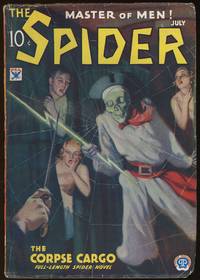
193432337Chicago: Popular Publications Inc. 1934. Creamy paper minimal edge wear tiny loss at lower right corner a nearly fine copy. 32337. Octavo single issue cover by John Howitt pictorial wrappers. Pulp magazine. "THE CORPSE CARGO" by Grant Stockbridge pseudonym. Reference: Cook Mystery Detective and Espionage Magazines pp. 521-527. Tymm and Ashley Science Fiction Fantasy and Weird Fiction Magazines pp. 602-604. Popular Publications, Inc. unknown
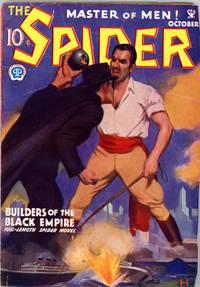
193434722Chicago: Popular Publications Inc. 1934. Mild tanning to text paper small closed tear to upper and lower edges bright red spine a fine copy. 34722. Octavo single issue cover by John Howitt pictorial wrappers. Pulp magazine. "Builders of the Black Empire" with Norvell Page writing as "Grant Stockbridge." The character was established to be a direct competitor to Street and Smith's Shadow magazine. After Doc Savage and The Shadow this was the most popular hero character. The Spider character was considered one of the most brutal and violent of the pulp era. Reference: Cook Mystery Detective and Espionage Magazines pp. 521-527. Tymm and Ashley Science Fiction Fantasy and Weird Fiction Magazines pp. 602-604. Popular Publications, Inc. unknown
(CHIESA CATTOLICA) MISSALE ROMANUM Missale Romanum ex decreto Sacrosancti Concilii Tridentini restitutum, Sancti Pii V. Pontificis Maximi jussu editum, Clementis VIII, et Urbani VIII auctoritate recognitum; nunc denuo cum Missis Sanctorum pro Ecclesia Universali.... Roma, Puccinelli 1809, In folio, pp. XXXVI + 450 + CII alle quali si aggiungono 10 cc. n.n. di tavv. e 31 cc. n.n., 28 delle quali a fine vol., contenenti testi successivi all'edizione; vignetta calc. al front., stampa in rosso e nero su due coll., numerosi passi musicali in notazione quadrata su tetragramma, bei capilettera xilografici. Bella e ricca legatura di gusto ancor settecentesco, in piena pelle riccamente decorata in oro: ai piatti tripla bordura floreale e, all'interno, doppio filetto a greche e cornice vegetale con balaustri, grandi ventagli agli angoli e figura di Santo - Pietro al piatto ant., Paolo a quello post. - al centro, entro ovale circondato da elementi vegetali, con due canestri di frutta agli estremi sup. e inf.; dorso muto a sei nervi, fittamente decorato con filetti o motivi vegetali, fregi in oro anche ai labbri, sguardie marmorizzate; sei cavalieri in seta nocciola e una etichetta di omaggio al contropiatto ant., su carta con fregi floreali in oro al bordo. Il messale è arricchito con 12 belle tavv. incise a piena pag. per la maggior parte su cc. fuori num., in parte anonime e in parte sottoscritte dai contemporanei C. Grandi (Nagler, V, 331; 3 tavv.), A. Ricciani (Nagler, XIII, 117; Le Blanc III, 328) e Luigi Fabri (Nagler IV, 209), in un caso (Natività) da un dipinto di P. Berrettini da Cortona (1596-1669, Benezit 1924, I, 540; Nagler, I, 458) o (Annunciazione) da G. Passeri o Passari (1654-1714, Benezit 1924, III, 434; Diz. Biog. It.); numerose le carte aggiunte posteriormente per adeguarlo alle disposizioni in materia di liturgia, quasi tutte in nero e stampate a Bologna. Minima usura ed una mancanza, non grande, al centro del dorso, angolo inferiore un poco sporco per sfoglio Buono (Good) . <br> <br> <br>
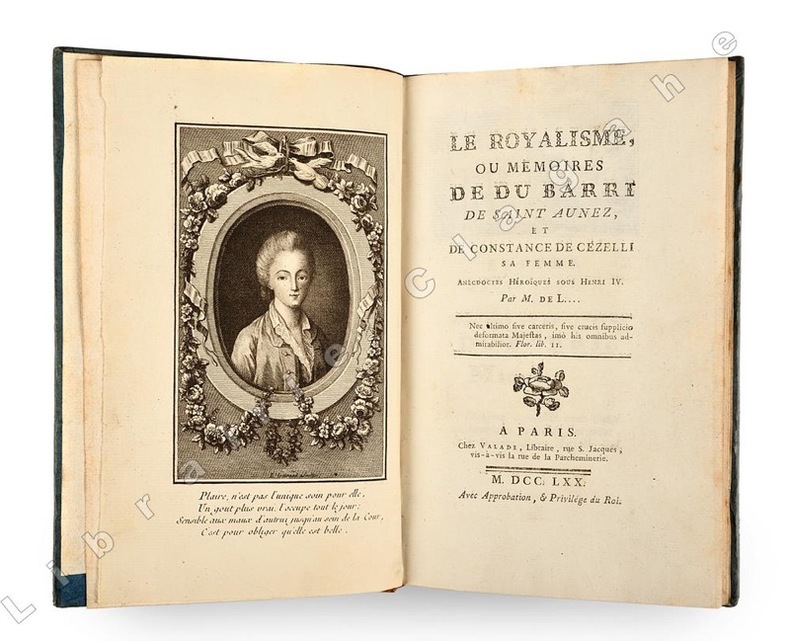
177021433Paris, Valade, 1770 ; in-8 (200 mm), demi-veau fauve, pièces de titre et de date, en queue, grenat (reliure de l’époque) ; VIII, 155 pp., [1]p. Fautes à corriger ; portrait en frontispice, bandeau armorié et cul-de-lampe au chiffre, gravés en taille douce par L. Le Grand.
012-Wo.J. Feder in Grau, grau laviert, mit Deckweiß gehöht, mit Bleistiftlinie umrandet, auf bräunlichem Velin, rechts unten datiert ?10. März 37.? Ca. 17:12,6 cm. Auf Untersatz montiert, dort von alter Hand bezeichnet. In den Rändern ungleich beschnitten, etwas fleckig.
19402110502150414612Nagoya Local Traffic Investigation Committee 1940. Soft Cover. Fine. Volume: 1 Nagoya Local Traffic Investigation Committee paperback
19062111902160200727Toyuridono Castle General High School 1906. Soft Cover. Fine. Volume: 1 Toyuridono Castle General High School paperback
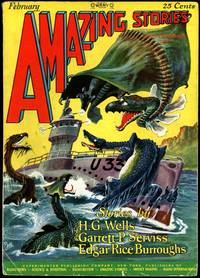
192729018New York: Experimenter Publishing Company 1927. Pages tanned mild edge wear small paper loss base of spine two large chips upper and lower left rear corners. A very good to nearly fine copy with attractive front cover. 29018. Large octavo single issue cover by Frank R. Paul pictorial wrappers. Pulp magazine bedsheet format. Features part one of "The Land That Time Forgot" by Edgar Rice Burroughs. Other authors include H.G. Wells Edwin Balmer and William MacHarg Garrett P. Serviss and others. Reference: Tymm and Ashley Science Fiction Fantasy and Weird Fiction Magazines pp. 14-49. Experimenter Publishing Company unknown
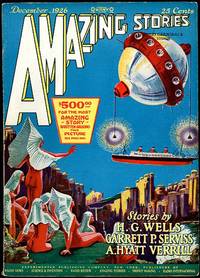
192630572New York: Experimenter Publishing Company 1926. Pages tanned and supple slight edge rubbing a fine copy. 30572. Large octavo single issue cover by Frank R. Paul pictorial wrappers. Pulp magazine bedsheet format. Fiction by H. G. Wells Garrett P. Serviss Fitz-James O'brien Edwin Balmer and William H. MacHarg and others. Reference: Tymm and Ashley Science Fiction Fantasy and Weird Fiction Magazines pp. 14-49. Experimenter Publishing Company unknown
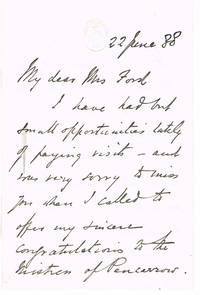
188833058London U.K.: 22 June 1888. 1888. Very good. - Letter: small octavo 7-3/8 inches high by 4-3/4 inches wide. 128 words penned in black ink on all 4 sides of a folded 4-sided sheet of House of Commons letterhead with the Commons seal at the top of the first side. Signed "Yours sincerely / Edward Hamley". There is occasional very light foxing to the letterhead & 2 pieces of mounting tape adhere to the right margin of the 4th side where the letter has been removed from an album. Folded once for mailing. Very good.<p>Manuscript leaf: small quarto 9 inches high by 7 inches wide. 83 words penned in black ink on one side of a sheet of cream watermarked paper. Folded 3 times with slight darkening down the top end of 1 vertical fold. 2 small pieces of tape adhere to the verso of the sheet where it has been removed from an album. Very good. <p>The letter addressed to "My dear Mrs. Ford" expresses his regret that he missed her when he called on her. He congratulates her on becoming "the Mistress of Pencarrow" her family's estate and her childhood home. He goes on to complain about the House of Commons workload though "we are not quite such slaves as we were last year." <p>The manuscript leaf is from Hamley's novel "Lady Lee's Widowhood" and is headed "Chap. II." The page which ends in mid-sentence describes the morning toiletries of two women characters. The first sentence of the extract reads: "Rosa constitutionally an early riser used to be always up before Orelia in the morning until the latter took it into her head to have a shower-bath fitted up in the closet that opened from their room."<p>Sir Edward Bruce Hamley 1824-1893 served in the Crimean War. He was professor of military history at the Staff College Sandhurst from 1858 to 1877 and was Commandant of the College from 1870-1877. He was chief of the commission for the delimitation of the Balkan and Armenian frontiers 1879-80 and commanded a division in the Egyptian war of 1882. He was promoted to General in 1890. Hamley was Member of Parliament for Birkenhead from 1885 until his death in 1893.<p>In addition to works on the Crimean War and his military manual "The Operations of War" Hamley was a short-story writer and poet a translator of French verse and the author of a novel "Lady Lee's Widowhood". He was a valued contributor to Blackwood's Magazine wherein the novel first appeared in 1853. It was subsequently published in two volumes by William Blackwood and Sons in 1854. Sadleir 1103; Wolff 2949.<p>Both the letter and the manuscript come from the autograph collection of Mrs. Mary Ford widow of Richard Ford who wrote the popular "Handbook for Travellers in Spain". The autograph collection known as the Pencarrow Collection was formed from the 1850s onwards largely by Mary Ford in her long period of widowhood. [London, U.K.]: 22 June 1888. unknown
194034799Chicago: Popular Publications Inc. 1940. Mild tanning to text paper slight trim to right edge several tiny tears tiny chip and small closed tear to upper left corner closed tear around upper right corner a nearly fine copy. 34799. Octavo single issue cover by Rafael DeSoto pictorial wrappers. Pulp magazine. "The Spider and the Jewels of Hell" with Norvell Page writing as "Grant Stockbridge." The character was established to be a direct competitor to Street and Smith's Shadow magazine. After Doc Savage and The Shadow this was the most popular hero character. The Spider character was considered one of the most brutal and violent of the pulp era. Reference: Cook Mystery Detective and Espionage Magazines pp. 521-527. Tymm and Ashley Science Fiction Fantasy and Weird Fiction Magazines pp. 602-604. Popular Publications, Inc. unknown
1207T532431Fair. SIGNED #1 of 30 presentation copies: "To My Dear Andrea. TOBIAS DANTZIG." New York: Macmillan 1930. 1st printing. viii 260 p. incl. Index. Illustrations. Spine cover is missing o/w G ha unknown
171420890A Ratisbonne, chez les Héritiers de Mathias Kerner, 1714. 3 volumes in-12 de [6]-XXXII-428-[24]; [6]-474-[34]; [4]-536-[30] pages, plein veau jaspé brun, dos à nerfs ornés de filets et fleurons dorés, étiquette de titre et tomaison rouge et marron, roulette dorée sur les coupes, tranches rouges.
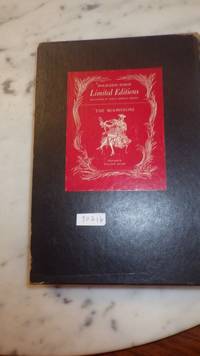
199730257<p>HBNODJ SLIPCASE HAS RED & WHITE ILLIUSTRATION ON FRONT OF GENTLEMAN SEATED SLIPCASE EDGE WEAR SEPARATION clear tape repairs 1944 on Title Pg COPY # 713 LIMITED NUMBERED 1ST EDITION VG/VG- AS-IS EXTREMITIES CHIPS WEAR DJ 1ST EDITION THUS Printed from Plates in Original Limited Edition of 1000 BEIGE CLOTH GREY ILLUSTRATED BOARDS IN WORN SLIPCASE Set in an aristocratic estate in Victorian England pronounced by critics as the oldest full length English mystery novel and to this day the best. Outlandish HORROR During a battle in India a sacred shrine is robbed of a jewel by a British soldier and the curse of the East Indian God follows the gem through generations of English ownership. A group of Fanatical East Indians follow the Moonstone to England where a mysterious death overtakes every heir to the fatal jewel Against the Gentle Background of an Aristocratic Estate in Victorian EnglandMoves a Story so Intriguing in Mystery Fascinating in Character Presentation & Beguiling in the Telling. During a Gory Battle in Far Off India a Sacred Shrine is entered & Robbed of a Jewel by an Adventurous British Soldier & the Curse of the East Indian God follows </p> DORAN DOUBLEDAY & CO LIMITED EDITIONS GARDEN CITY NY hardcover
2024x-3031390776Springer Nature 2024. Hardcover. New. 533 pages. 10.98x8.27x1.38 inches. Springer Nature hardcover
24189Nash’s eight TLsS from between 4 July 1949 and 10 October 1951; all on letterheads of 2 Bristol Court West Marine Parade Brighton. Macqueen-Pope’s carbons from 1949 and 1951. ‘The Tragic Comedians’ undated. Nash made around 70 films between 1912 and 1927 and was a key figure in the creation of Elstree Studios. His career as a film maker was effectively ended following the screening of his 1921 film 'How Kitchener was betrayed'. See Bernard Ince ' “For the Love of the Artâ€: The Life and Work of Percy Nash Film Producer and Director of the Silent Era’ ‘Film History’ September 2007. See also Macqueen-Pope’s entry in the Oxford DNB. The collection of eleven items is in fair overall condition with minor creasing and aging to some items. Nash’s eight letters are all signed ‘Percy Nash’ and the first and longest has a long postscript in autograph. The eight total 9pp: four in 4to and five in 12mo. All are addressed to ‘My dear Popie’. The two men are clearly well acquainted - to one letter Nash adds the autograph note ‘Come & see us soon!!!’. The first letter contains personal information about the 1897 murder of the actor William Terris outside the Adelphi. ‘I was producing a Panto for Charles Denton at the time at the Parkhurst Theatre and I was short of a Chorister Denton phoned to say that he would have one for me the following morning. I called next day at Maiden Lane and he told me that he had a man but as he had a “Wall†eye he sent him away. It was Prince. Terris’s murderer E Dagnall Daggie was a member of the Adelphi Co at that time and he told me that Prince was a small part merchant who was spasmodically engaged there. He considered himself badly treated by the Management.’ He concludes in the same vein. Letter of 3 August 1950 begins: ‘I am under the impression that I am the last living “Acting†Not ‘Walk on’ member of Irvings Lyceum Theatre Company.’ After describing a visit to Irving’s centenary service at St Martin’s in the Fields he adds ‘I am sure that I am the only one left connected with his Stage Management. Lionel Belmore who was with me at the time migrated to America and I am informed passed on a year or two ago.’ On 9 November 1950 he writes intriguingly: ‘Re the G. B. Shaw incident you will be surprised at the undignified pranks that they got up to in the film at the behest of the little Scotchman.’ Letter of 14 December 1950 describes ‘a long queue waiting to book and a slip of a girl solo to do the work . I am often in touch with Emily Norton Freds sister and she says she is very hard up perhaps this revival will healp. Jack Gladwin called in on Tuesday and I showed him the great “Write up†of Chue in “Everybodysâ€.’ On 24 June 1951 he praises Popie’s new book ‘Ghosts and Greasepaint’: ‘Every word and picture takes me back through my whole life from the ‘Fly posting’ inside cover of Drink which we used to call “Lets av some more†to the index pages. I saw Warner first at the Princess in it and I signed the pledge. / My word! as I turn the pages over I see pictures of the “Gone befores†and I feel strangely lonely but when I pass over and it can’t be long now I shall tell them all what a Champion they left behind them to keep their memory green.’ The last letter 10 October 1951 concerns a radio broadcast featuring Popie: ‘What a glorious night you must have had last Sunday. I listened in to the first part and it all seemed to go so slick and the applause was never allowed to “peter†out. I was connected in one way or the other with The Nellie Farren H.I. and Ellen Terry similar shows and they were nothing like I.N’s.’ The carbons of two of Popie’s replies are both unsigned. Each 1p 4to. The first 5 July 1949 discusses of the Terris murder. The second is a response to Nash’s last letter. The final item is a typescript of reminiscences titled ‘The Tragic Comedians / Laughter and Tears.’ 2pp 4to. Whether this is by Popie or Nash or another party is unclear. There is one autograph emendation. Observations on George Formby ‘I have been present at a performance when the audience were screaming with merriment at him during his “Turn†and he was compelled to turn his back on them to conceal his terrible cough which eventually closed his career.’ George Bastow Melville Gideon Leslie Stuart and a final long passage on Dan Leno ‘The greatest tragedy of all was to my thinking that every Panto first night at the Lane Two boxes were reserved for the members of his TWO families. The Boxes were placed one over the other on the same side of the Theatre so that they never knew each other were there or even that they existed. This fact used to worry Sir Augustus Harris and after him Arthur Collins lest they should make the discovery but they never did what a time of anguish it must have been for Dan’. Nash’s eight TLsS from between 4 July 1949 and 10 October 1951; all on letterheads of 2 Bristol Court West, Marine Parade, Bri unknown
194430216A<p>HB NODJ SLIPCASE HAS RED & WHITE ILLIUSTRATION ON FRONT OF GENTLEMAN SEATED SLIPCASE EDGE WEAR SEPARATION 1944 on Title Pg COPY # 571 LIMITED NUMBERED 1ST EDITION VG/VG- AS-IS EXTREMITIES CHIPS WEAR DJ Printed from Plates in Original Limited Edition of 1000 BEIGE CLOTH GREY ILLUSTRATED BOARDS Set in an aristocratic estate in Victorian England pronounced by critics as the oldest full length English mystery novel and to this day the best. Outlandish HORROR During a battle in India a sacred shrine is robbed of a jewel by a British soldier and the curse of the East Indian God follows the gem through generations of English ownership. A group of Fanatical East Indians follow the Moonstone to England where a mysterious death overtakes every heir to the fatal jewel Against the Gentle Background of an Aristocratic Estate in Victorian EnglandMoves a Story so Intriguing in Mystery Fascinating in Character Presentation & Beguiling in the Telling. During a Gory Battle in Far Off India a Sacred Shrine is entered & Robbed of a Jewel by an Adventurous British Soldier & the Curse of the East Indian God follows</p> DORAN DOUBLEDAY & CO LIMITED EDITIONS GARDEN CITY NY hardcover
1917005414Paris Lyre et Palette 1917 In-4 En feuilles, couverture illustrée Edition originale
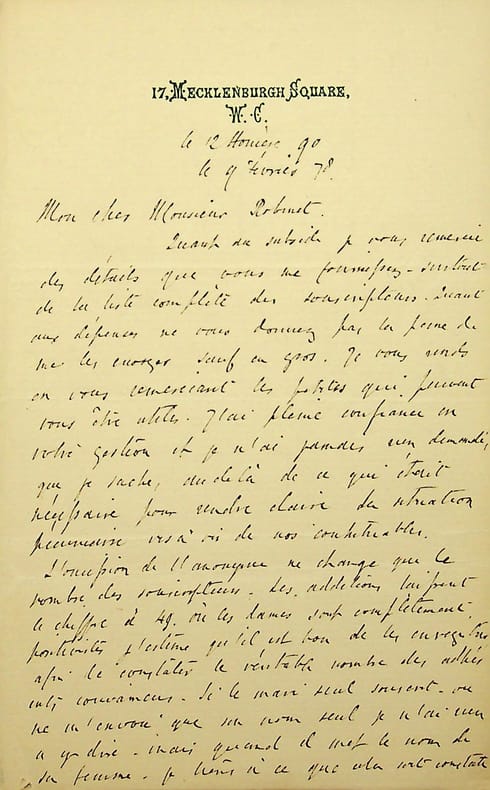
018963[Positivisme] Richard Congreve (1818-1899), philosophe anglais, figure de proue du positivisme en Angleterre, à l'origine du schisme en 1878. L.A.S. en français, 12 Homère 90 [9 février 1878], 4p in-8. Au docteur Jean-François Robinet (1825-1899), médecin d'Auguste Comte et important positiviste français. « Mon cher Monsieur Robinet, Quant au subside, je vous remercie des détails que vous me fournissez - surtout de la liste complète des souscripteurs. Quant aux dépenses, ne vous donnez pas la peine de me les envoyer sauf en gros. Je vous rends en vous remerciant les petites[?] qui peuvent vous être utiles. J'ai pleine confiance en votre gestion et je n'ai jamais demandé, que je sache, au delà de ce qui était nécessaire pour rendre éclairé la situation pécuniaire vis à vis de nos contribuables. l'omission de l'anonyme ne change que le nombre de souscripteurs. Les additions laissent le chiffre à 49. Où les dames sont complètement positivistes, j'estime qu'il est bon de les enregistrer afin de constater le véritable nombre des adhérents convaincus. Si le mari seul souscrit - ou ne m'envoie que son nom seul, je n'ai rien à y dire - mais quand il met le nom de sa femme. Je tiens à ce que cela soit constaté. Rien de plus important, comme vous l'avez toujours senti, que l'adhésion des femmes, et il est utile de le reconnaître partout où une telle reconnaissance n'a rien qui implique des concessions illégitimes. Qu'en pensez-vous ? C'était pour indiquer cette idée que j'ai associé madame Congreve à ma souscription. Merci de vos explications à l'égard de la circulaire. J'ai fait ce que vous me demandez auprès de madame Geddes. Merci aussi de l'envoi du journal contenant le discours de M. Finance. Je l'en félicite malgré certaines erreurs typographiques - et de la réception qu'il a eue. Est-il satisfait du résultat du congrès [fin illisible]. Je ne puis adhérer à votre manière de voir pour M. Hutton. Pour moi, il n'a pas changé puisqu'il y a deux ans ou trois qu'il m'a écrit, dans le même sens de sa récente lettre, [mot illisible] s'applique à la question générale. Je n'ai pas d'indication quant à la revue. Quand je dis tord, je ne dis pas que vous vouliez ou que vous cherchiez le résultat que j'indique. Je n'ai émis aucun soupçon, je n'ai fait aucune accusation de vouloir la chose, j'ai constaté seulement ce qui, pour moi, est un fait, que l'action de vous et d'autres positivistes parisiens en comparaison avec celle de certains de nos confrères ici, à une tendance dans la direction indiquée. Comme je le disais à M. [nom illisible] : "Je ne dis pas, je ne crois pas que c'est voulu, ou même aperçu, mais il n'en est pas moins vrai". M. Pradeau m'assure que je ne me suis pas trompé en employant le verbe tendre en ce sens. En ce qui regarde la correspondance [mot illisible], vous me permettrez de ne pas répondre à votre première question. Je m'abstiens dans l'intérêt de la paix. Mais pour la seconde, je réponds que je n'ai pas fait la même demande. Je n'entre pas dans la question du fond du débat. Je m'en tiens à celle de la forme de votre réponse, qui n'a semblé interdire tout espoir de conciliation. Mais si j'ai été indiscret, permettez moi de retirer une observation qui n'avait pour but que d'amener votre attention sur la lettre en question, et de vous prier de me pardonner mon indiscrétion. Je ne voudrais faire aucune démarche qui fût de nature à empirer l'état actuel - à moins qu'elle ne fût pour moi d'une nécessité absolue. Nous somme en pleine dissolution. Comment arriver à la reconstruction. Du reste c'était inévitable, vu la différence de direction imprimée aux deux noyaux, chose assez notoire. En dehors des personnalité, voilà où je reviens. Veuillez agréer tous mes respects pour vous et toute votre famille. Richard Congreve ». Emily Geddes (1840-1929) est la belle-soeur de Congreve. Isidore Finance (1848-1918) était un ouvrier peintre, militant syndicaliste. Henry Dix Hutton (1824-1907) est un
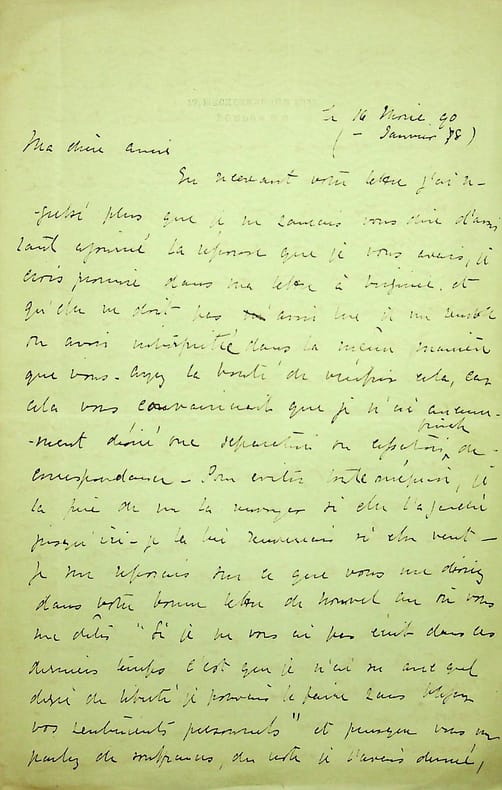
018970[Positivisme] Richard Congreve (1818-1899), philosophe anglais, figure de proue du positivisme en Angleterre, à l'origine du schisme en 1878 ; Mary Bury Congreve (1833-1915), épouse du philosophe ; Emily Bury Geddes (1840-1929), soeur de Mary ; James Geddes (1841-1880), époux d'Emily. L.A.S. de Mary Congreve en français & L.A.S. de Richard Congreve en françaisn contre signée par Emily et James Geddes, 15-16 Moïse 90 [15-16 janvier 1878], 6p in-8. A Mary Weyer Robinet (1827-1881), épouse du docteur Jean-François Robinet (1825-1899), médecin d'Auguste Comte et important positiviste français. « Ma chère amie, En recevant votre lettre, j'ai regretté plus que je ne saurais vous dire d'avoir tant ajourné la réponse que je vous avais, je crois, promise dans une lettre à Virginie, et qu'elle en doit pas avoir lue il me semble ou avoir interprétée dans la même manière que vous. Ayez la bonté de vérifier cela, car cela vous convaincrait que je n'ai aucunement désiré une séparation ou cessation stricte de correspondance. Pour éviter toute méprise, je la prie de me la renvoyer si elle l'a scellée jusqu'ici. Je la lui renverrais si elle veut. Je me reposais sur ce que vous me disiez dans votre bonne lettre de nouvel an où vous me dites : "Si je ne vous ai pas écrit dans ces derniers temps, c'est que je n'ai pas su avec quel désir de liberté je pouvais le faire sans blesser vos sentiments personnes" et puisque vous me parlez de souffrances, du reste je l'avais désiré, vous ne devez pas être surprise que, ne l'étant pas je crois moins, je ressentis de la peine à répondre simplement[?]. Mais je me serais épargné encore une douleur si j'y avais mis plus de promptitude. Ce que j'allais vous dire vous aurait peut-être empêchée de m'écrire sur ce sujet, ce qui eût été mieux pour toutes les deux. Car évidemment, situées comme nous sommes, les mesures étant dans d'autres mains, la meilleure chose que nous avons à faire, c'est de garder le contact[?] autant que possible et de fortifier[?] nos affections sans laisser aveugler notre jugement, voilà ce que j'entendais par mon amitié subjective pour ainsi dire - réelle autant que vous voulez, mais ne se permettant pas de visiter les choses présentes qui nous intéressent - peut-être trop. Et vous me parle de votre projet comme si le but de cette entrevue Boulevard dde la Madeleine n'était pas que M. Robinet nous exposât les raisons d'une démarche qu'il désirait tant, disait-il, pour le positivisme (il n'a presque pas été question de nos personnalités mais de nos devoirs-sacrifices a-t-il dit) et qui me répugnent tant à moi - démarche dont les inconvénients qu'il regrettait en [mot illisible] était surtout pour nous dans le cas que M. Laffitte ne se résignerait pas (ce que vous avez, vous et lui, dit qu'il ferait probablement). Que son affection pour M. Laffitte était profonde, cela se voyait, et qui a ajouté un grand poids à sa désapprobation de la directions, mais c'était comme moyen d'éviter un schisme, que M. Robinet a insisté sur notre venue et c'était en vue de ce schisme, qu'il ne contemplait que dans le cas que M. Congreve se refuserait de venir à Paris que M. Robinet, vous aussi je crois, vous avez dit que vous resteriez du côté de M. Laffitte. C'était nous, au contraire, qui nous sommes alors, comme plus tard, opposés à l'espèce de substitution sourde que vous avez désirée, et qui ne nous a pas parue désirer de mon mari. Aucune déclaration que M. Robinet se rangerait du côté de M. Laffitte si, mon mari venant, les choses [mot illisible] mal, n'a été faite. Il y a eu, je crois, confusion dans votre mémoire entre cette entrevue et la correspondance des dernières semaines de l'an passé. Dans la première, il n'y avait rien qui aurait pu nous blesser ni dans les expressions que je vous cite de la chose que vous avez écrite à M. Congreve beaucoup plus tard - elle est datée le 27 Descartes 89. "Il est pour moi hors de doute que votre présence à Paris serait le salut du Positivisme et la seule