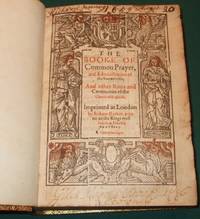
[Book of Common Prayer]Biblio.com

1 082 résultats
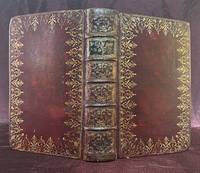
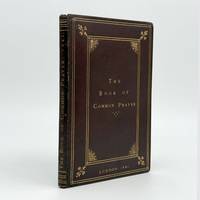
17151067831715. London: printed by John Baskett and by the assigns of Thomas Newcomb and Henry Hills 1715. <br /> <br /> Folio 380 23 3 pp. unpaginated text ends on Aaa4 as per ESTC. Engraved frontispiece by Loggan after Caspars. Title-page printed in red and black ruled in red throughout. Contemporary red morocco covers tooled in gilt with a wide scrolled border central gilt block of the arms of the Duke of Chandos backstrip richly gilt gilt edges a lovely binding of the period in the style of Mearne skillfully restored at head and foot and along joints. Armorial bookplate of John van Hatten.<br /> <br /> § Lovely prayer book bound for James Brydges 1st Duke of Chandos 1674-1744. It once rested on an embroidered cushion in the Duke and Duchess's private pew in his magnificent chapel at Cannons described by the architect Gibbs as "the finest in England." The centerpiece of the elaborately-tooled binding is the Duke's gilt arms supported by two otters beneath a ducal coronet. Four other bindings with the block are recorded by the British Armorial Bindings database. Full description and provenance available on request. ESTC T81463. unknown
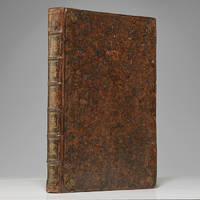
17231197771723. BOOK OF COMMON PRAYER. The Book of Common Prayer and Administration of the Sacraments. London: John Baskett and the Assigns of Thomas Newcomb and Henry Hills 1723. Tall folio 10-1/2 by 16 inches contemporary full mottled calf expertly rebacked with original spine neatly laid down corners and spine panels with gilt device of the crown of King George I raised bands renewed endpapers all edges gilt. $8250.Beautiful early 18th-century tall folio edition of the venerable Book of Common Prayer the treasury of ritual prayer and Scripture that has indelibly shaped the piety and literature of the English-speaking worldwith fine engraved frontispiece handsome in nicely restored contemporary calf featuring the gilt device of King George I in the corners and spine panels.Born of Thomas Cranmer's desire for liturgical texts upon which all of Europe's Protestant English-speaking churches could agree the beautiful and dignified language of the Book of Common Prayer first issued in 1549 has considerably influenced not only ecclesiastical practice but also literature in English. ""The language of the Prayer Book is now part of the whole language and as a source of spiritual inspiration it is for most Englishmen second only to the Bible"" PMM 75. This 1723 London edition is handsomely bound in full mottled calf with King George I's gilt monogram cipher in each corner of the boards as well as in each spine panel. Ornamented with fine engraved frontispiece dated 1710 decorative headpieces and woodcut initials. Griffiths 1723:1. A few ink corrections and marginal annotations.A few short wormtraces; text clean. Evidence of cloth ties corners expertly restored. A very handsome volume. hardcover
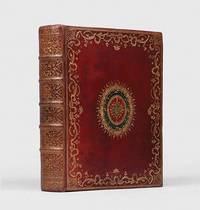
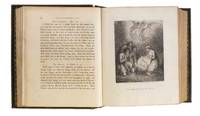
1769160645Oxford: Printed by T. Wright and W. Gill Printers to the University and sold by R. Baldwin and S. Crowder in London; and by W. Jackson in Oxford 1769. Extra-illustrated with a complete suite of engravings A handsome binding made for the Bible trade in contemporary red morocco. This style is sometimes called "Chippendale" acknowledging the contemporary trend towards the use of decorations on bookbindings resembling those popular in other forms of decorative art. This copy has been extra-illustrated with a complete suite of 59 engraved plates The Liturgy of the Church of England London printed by Edward Ryland 1755. The designs are by Samuel Wale 1721-1786 one of the most prolific book illustrators of the 18th century this suite being mentioned in Wale's biography in ODNB though not listed in ESTC. Among the engravers was the eldest of the copperplate printer Edward Ryland's seven sons William Wynne Ryland 1733-1783 a highly skilled engraver who was hanged for issuing two forged bills drawn on the East India Company. Provenance: John William Beaumont Pease Lord Wardington 1936-2019 bookplate; Sotheby's Wardington Library of English Bibles 12 July 2006 lot 126. Large quarto 275 x 210 mm. Extra-illustrated with a suite of 59 plates including title engraved by François Ravenet Charles Grignion Louis Gérard Scotin Walker and William Wynne Ryland after Samuel Wale. Contemporary red morocco spine gilt all over within six compartments between raised bands sides richly decorated in gilt with wide border of rococo scrollwork flowers and insects enclosing a central green morocco onlay enclosing the Sacred Monogram "J.H.S." surrounded by an oval red morocco onlay tooled with stars and dots within an oval onlay of blue morocco tooled with cherubs' heads stars dots and swags the whole surrounded by a gilt gloriole gilt turn-ins marbled endpapers gilt edges. Bookplate of Jeremy & Penny Martin. Small areas of rubbing to joints sig. A4 with marginal tears at upper inner corner and outer edge neatly closed I4 with closed tear at foot entering 10 lines of text but without loss a few minor blemishes still very good overall. ESTC T81296. hardcover
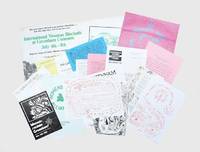
166932Newbury: 1982-c.2000. Positive creative energy will change the world This engaging collection of colourful and optimistic materials encapsulates the camp's ethos of compassion non-violence and female solidarity in its pivotal years of direction action. Included are handouts providing guidance for the "Embrace the Base" demonstration of 13 December 1982 and the "Reflect the Base" event that occurred a year later. The camp at Greenham was founded in 1981 and protested the British government's decision to allow 96 cruise missiles to be stored at the base; it remained at the base for 19 years. Its residents and other temporary attendees engaged in non-violent direction action which one handout describes as "using creative ideas and methods for closing this factory where nuclear warheads are built without threatening or abusing the workforce or the police". The flyers handbills and booklets from Greenham in this collection date between 1982 and 1983 which were the most widely attended years at the camp attracting tens of thousands of women. Greenham was run in a non-hierarchical cooperative manner and its political communications were designed to be accessible. However they contain serious content including advice on how protesters should proceed if arrested. One handout warns that "Non-violence on your part unfortunately does not mean people will treat you non-violently". Several items in the collection demonstrate the movement's importance to mothers and the effort made to be inclusive of them. One poster advertises a children's party on the Common in May 1983. The items in this archive were collected by a peace activist named Andrea. Along with materials from Greenham Common it contains similar communications from later women-centred direct-action movements and letters from peace organizations. There are also several feminist magazines from the 1980s including Lysistrata: A Wimmin's Peace Magazine which focusses on the experiences of Black and Jewish women. Similar material from the Greenham Common Peace Camp are held at the London School of Economics Women's Library. Together over 50 items mostly colour printed containing 26 handbills mixture of single- double-sided and bifolium page size ranging from 208 x 146 to 300 x 210 mm 10 pamphlets 4 posters ranging from 600 x 420 to 210 x 300 mm and other ephemera including white poppies newspaper clipping and bumper sticker. Housed in an archival box. Occasionally lightly damp-stained creased and foxed scattered nicks and short tears to edges: overall in very good condition. unknown
17541216301754. BOOK OF COMMON PRAYER. The Book of Common Prayer Cambridge: Printed by Joseph Bentham printer to the University by whom they are sold and by Benj. Dod in London 1760. Tall folio 10-1/2 by 16-1/2 inches full contemporary dark green morocco rebacked with elaborately gilt-decorated spine laid down with crowned monogram of George II in compartments covers with elaborately gilt-tooled borders and gilt centerpiece featuring the arms of King George II raised bands later marbled endpapers evidence of silk ties. $7500.Splendid folio Cambridge edition of the Book of Common Prayer in a beautiful armorial George II binding with broad gilt-tooled borders elaborate royal cypher in spine panels and splendid gilt centerpiece on each cover featuring the arms of King George II and text hand-ruled in red throughout.Born of Thomas Cranmer's desire for liturgical texts upon which all of Europe's Protestant English-speaking churches could agree the Book of Common Prayer first issued in 1549 with its magisterial liturgical language is ""as a source of spiritual inspiration for most Englishmen second only to the Bible"" PMM 75. This finely printed Cambridge editionset in large type with wide margins and hand-ruled in red throughoutboasts an impressive royal binding bearing the gilt monogram and crown device of King George II in the spine compartments and his gilt embossed armorial design on both boards within an ornate floral border. Griffiths 1754:1. Owner ink signature.Some faint foxing a very few leaves with light edge-wear. Expert restoration to lovely royal binding. hardcover
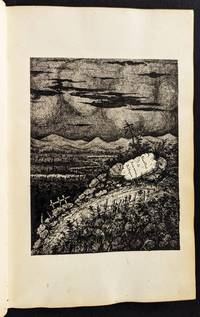
1158<p>8vo. 186x 119 mm. 7 ¼ x 4 ½ inches. 1-14 1 15-19 21-24 1 25-29 1 30-36 1 37-90; folios 74 and 83-90 blank except for page numbers and 4 lines on fol. 85 verso; plus 18 blank leaves at the end followed by 1 leaves containing 3 index pages and 1 final blank leaf. Manuscript section tiles in outline capitals on separate leaves included in foliation. Complete the gap between folios 19 and 21 is a foliation error. Ruled borders throughout. Text in brown ink in a flowing cursive hand varying lines numerous insertions and deletions.                                    </p> <br /> <p>The manuscript on wove paper is illustrated with 20 pen-and-ink drawings of which 7 full-page on rectos with verso blank the first five not included in the foliation and 13 half-page or smaller plus 2 small ornaments.  Bound in black straight-grain morocco covers gilt paneled central panel with arabesque tooling at corners smooth spine with gilt title cartouche lettered “Bluettes†from which extend triple gilt fillets terminating in ornaments at head and tail gilt edges with moiré satin endleaves; binding a bit rubbed with corners bumped.</p> <br /> <p>A manuscript of poems and short prose pieces all in a romantic vein illustrated with quite accomplished pen-and-ink drawings presumably by the author whose name and the date of the manuscript are supplied on the verso of the front free endpaper: “Le Baron Achille de Cholet / Officier á l’Etat-Major / 1836â€.</p> <br /> <p>In the first poem Aux Dames the poet calls himself a “novice Ecolier†implying youthfulness and the date of 1836 on the front fly leaf is probably at the time of writing although some of the many corrections and deletions may have been added later. The titles of the other poems or groups of poems are : Le Rin Le Déserteur L’Isolement L’Impiété Un Croix sur la Montagne La Mère du Prisonnier L’Avenir / á Melle Francine d’Hurbal Rheyms Séparation L’Enfant perdu L’Adieu au Plaisir La Campagne / á Mr le Vicomte Alfred de R. . . Le Cloches du Soir La Neige Les Pauvres and Le Jour des Rois . . .</p> <br /> <p>These stolid sentimental poems and prose impressions reflect the prevailing Romanticism of the period as do the far more skillfully executed pen-and-ink drawings that illustrate them. Somber or dreamlike with dark cross-hatching contrasting with lighter areas the drawings show a dark tunnel under a rocky mountainside a soldier in a garret or prison a cloaked barefoot man an emblematic trophy with musical instruments and weaponry a raven perched on ruined tombstones and columns a domestic scene of father and daughter a women on her knees the façade of Reims Cathedral surrounded by swirling clouds architectural details of cathedrals several surrounded by decaying facades and vignettes of crumbling chateaux pastoral churches and snow-covered gatehouses all of which reflect the vogue for l’ancienne France and the “pittoresque†as notably popularized by Nodier and Taylor in their Voyage pittoresque et romantiques dans l’Ancienne France 23 volumes 1820-1878.</p> <br /> <p>Achille de Cholet was descended from an ancient Anjou noble family according to his obituary in 1888 in the Bulletin héraldique de France vol. 7 235-6. He became an officer in the Légion d’honneur and was well known for his important topographic researches in the south of France. A few of the pieces in the manuscript are dedicated to aristocrats mainly female. It seems likely that the Baron shared his family’s Royalist views: his father had died in exile and his brother whose first name is not given in the obituary was an “ardent champion of the Royalists press†and author of a book title Madame en Vendée relating the attempted coup in 1832 of the duchesse de Berry mother of the Prentender the Comte de Chambord which was pursued and effectively banned by the tribunals indeed the work appears not be recorded in OCLC or other online OPACs. Thanks to Nina Musinsky for this description.</p> . unknown
1553371814London: Thomas Gaultier imprimeur du Roy en la langue francoise i.e. printed by N. Hill 1553. First edition of the translation of the Book of Common Prayer into French. Calendar printed in red and black. Ornamental initials throughout. Collation: a-e4 f2 A-ZZ4 -ZZ1-4 lacks the four leaves of final gathering ZZ. 1 vols. 4to. Eighteenth century brown calf spine with gilt monogram BDM. Some worming at bottom margins. First edition of the translation of the Book of Common Prayer into French. Calendar printed in red and black. Ornamental initials throughout. Collation: a-e4 f2 A-ZZ4 -ZZ1-4 lacks the four leaves of final gathering ZZ. 1 vols. 4to. A translation by François Philippe of the 1552 Book of Common Prayer for use in Calais and the Channel Islands.<br /> <br /> OCLC records only Cambridge and John Carter Brown; Griffiths cites copies at Lambeth and Harvard. ESTC adds Boston Public Huntington U. Liverpool Liverpool Hope Bodleian Keble.<br /> <br /> Though lacking the final gathering this book is uncommon in institutions and RARE in the trade. ESTC: S108734; Griffiths French 36:1. Provenance: Coll. Aqu. Soc. Iesu Cat. Insc. 1659 at head of title; ink stamp on title page of Bibliotheque de Marseille foot of a2 stamped: Vente 1845; armorial bookplate of A.rthur Brölemann Thomas Gaultier, imprimeur du Roy en la langue francoise [i.e., printed by N. Hill] unknown
189351275Printed for the Committee 1893-01-01. Hardcover. Very Good. Folio title-page in red & black. Bound in full vellum over beveled boards with working brass clasps at the fore-edge; elaborate gilt rose designs and title on the spine and front cover designed by B. G. Goodhue; gold-printed rose & thistle design endpapers top-edge gilt silk bookmarker ribbon bound in; deckle-edged paper. With a copy of the 1893 4pp. pamphlet: "On the Decorations of the Limited Edition of the Standard Prayer Book of 1892" by D. B. Updike printed at the De Vinne Press laid in along with original postcard receipt that was supposed to be returned to J. Pierpoint Morgan and never was. This copy with the foliated margins. Tight and very well preserved oversized and overweight. Please email for photos. Printed for the Committee hardcover
17182514The Hague: C. Fritsch 1718. Very good. 8vo. xliv 728 2 pp. text lightly foxed. Collation: a-b⸠cⶠA-2Y⸠2Zⶠ-2Z6 a blank as per the Emory Pitts copy. Bound in 18th-century red morocco boards elaborately gilt à la dentelle spine elaborately gilt with raised bands morocco label a.e.g. spine and extremities somewhat rubbed. Bookplate of the Washington Cathedral Library inside upper cover. Title-page trimmed at top removing the name of an early owner and backed with later paper. Preserved in a protective cloth case. AN ENIGMATIC BINDING AT ONE TIME ATTRIBUTED TO ROBERT AITKEN OF PHILADELPHIA THE MOST FAMOUS OF ALL EARLY AMERICAN BOOKBINDERS. CERTAINLY IT SHARES THE EXTREMELY DISTINCTIVE SPINE TOOL WITH THE NYPL-LENOX COPY OF AITKEN'S 1782 BIBLE WHICH WE EXAMINED PERSONALLY AND YET THE DENTELLE TOOLS ARE SIMILAR TO THOSE EMPLOYED BY RICHARD MONTAGU FOR THOMAS HOLLIS. <br /> <br /> This is the first complete German edition of the Book of Common Prayer including the Lections and Ordinals. It was probably translated into German by J.J. Caesar chaplain to King Frederick I of Prussia who had attempted to united the Lutheran and Reformed churches of Germany into a single episcopal church in communion with the Church of England.<br /> <br /> Published in 1718 our binding belongs certainly to the latter half of the 18th-century; it is therefore this book's second binding. The spine label reads "Prayer Book" and not "Gebet-Buch" and thus it was bound either in America or England and not in Germany or The Netherlands. Based on tool identification our binding may have been made in the same workshop as that which bound the Lenox-NYPL 1782 Aitken Bible. In 1902 the NYPL binding was attributed Aitken's own shop William Loring Andrews Bibliopegy in the United States p. 59 with a poor reproduction on plate XIV. Whereas the Lenox copy is by comparison relatively plain it shares with ours the unmistakable deformed bird / floral ornament in the spine compartments. The repeated tools on the covers have so far resisted identification despite extensive searching over a period of several years through innumerable reference works on early American and British bookbinding printed and online. Concerning the former there is a very serious lack of published scholarship and so we set our sights on the largest collection of unpublished notes on American bookbinding in the world namely Willman Spawn's gargantuan hopelessly disorganized archive of rubbings and files at the American Philosophical Society. We proceeded through Box 28 and yet more than 100 boxes remain to be explored. Whatever his nationality our binder was inspired by the work of Richard Montagu specifically his work for Thomas Hollis ca. 1758-1761 see Howard Nixon's Five Hundred Years of English Bookbinding nos. 68 and 69 although the tools are NOT identical to ours. <br /> <br /> According to a typed note from the American Cathedral Library where the present volume resided for at least 60 years until it was purchased by William Reese it was bound possibly for presentation to William White 1748-1836 the first Bishop of Philadelphia. On this card the identity of the binder is confidently assigned to Robert Aitken himself. Whether or not the binding originated from Aitken's shop or if indeed it is even American there can be no doubt that it was in Philadelphia at a very early date and its provenance is unbroken since that time see below. Certainly William White would have had need for a German language Book of Common Prayer to administer to his already significant German-speaking congregation. White knew well his Philadelphia neighbor Robert Aitken and as one of the Chaplains of the Congress of the United States he examined Aitken's Bible when it was in 1782. White was also the first President of the first Bible Society in the United States founded in Philadelphia in 1808. <br /> <br /> That Aitken printed and published the 1782 Bible does not automatically imply that he was the binder of the Lenox-NYPL copy or any others but the names of several of his former employees are known including James Muir who remained in Philadelphia and William Andrews who relocated to Boston. Another copy of the 1782 Aitken Bible remains unstudied namely that in the John Carter Brown Library which features a similarly decorated spine. <br /> <br /> Our binding was no doubt an expensive commission; that the tooling on it has remained so fresh is perhaps due to a paper or fabric covering that seems to have once surrounded it: inside the boards are traces of adhesive near the gutter margins at the top and bottom precisely where a covering would have been attached. <br /> <br /> Of this first edition of the German Language Book of Common Prayer there are copies at Huntington Lancaster Theological Seminary Colgate Rochester Crozer Divinity United Lutheran Seminary Philadelphia and Emory. <br /> <br /> ¶ PROVENANCE: William White Bishop of Philadelphia -- old presentation inscription excised from title-page no doubt written in English in the 18th century with one remaining word clearly visible: "To" -- Suffrage Episcopal Bishop of Pennsylvania Samuel Bowman 1800-1861 -- by descent to his daughter Ellen Ledlie Bowman married Thomas Hubbard Vail Episcopal Bishop of Kansas -- by descent to their daughter Kellen Sitrgreaves Vail Motter 1870-1952 -- donated to the National Cathedral Library of Washington DC -- purchased by William Reese who sold it to us on behalf of a private collector -- bought back by us in 2023. <br /> <br /> For an account of Robert Aitken's bindery see Willman and Carol Spawn's "The Aitken Shop: Identification of an Eighteenth Century Bindery and its Tools" in: PBSA LVII 1963 pp. 422-437 although the title is misleading as the images are unnecessarily few in number ditto Willman Spawn's "Extra-Gilt Bindings of Robert Aitken 1787-88" in: Proceedings of the AAS pp. 415-417. The dentelle tools on the covers of our binding appear to be reproduced here for the first time. C. Fritsch unknown
1795371094New York: Hugh Gaine 1795. Printed in two columns. 208pp. A-d2 A-3B2. Folio. Contemporary black morocco gilt rebacked marbled endpapers gilt edges. Staining to title and first few leaves losses at lower outer corners of A1-C2 partly supplied in early manuscript Provenance: Christ Church Baltimore in gilt on upper cover. Printed in two columns. 208pp. A-d2 A-3B2. Folio. Very rare first folio edition of the 1789 United States Book of Common Prayer the second standard American prayer book beautifully printed by Gaine and designed for lecturn use. Most extant examples with the leaves containing the morning and evening daily prayers defective from overuse A1-C2 as here. Evans 29362; Griffiths Book of Common Prayer 1795:11; ESTC W29998 Hugh Gaine unknown
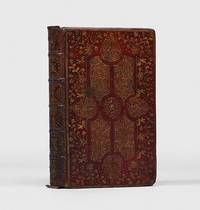
1708164124Oxford: University Printers Psalms: London William Pearson for the Company of Stationers 1709 1708. Contemporary red morocco gilt An attractive Oxford prayer book in a characteristic red morocco binding of the period. A closely related binding is recorded in Davis Gift 143 with a similar overall design and also with small stag stamps which is identified as a London binding from c.1693. The design is similar to those employed by the Spaniel Binder. Two parts in one vol. octavo 197 x 118 mm. Text ruled in red. Contemporary red morocco sides elaborately gilt including stags and small urns with flowering stems spine similarly gilt in compartments marbled endpapers gilt and gauffered edges. Extremities slightly rubbed headcaps pulled at ends; occasional light browning quire S in first work brittle with a few small holes and tears slight loss of text to lower outer corner of sig. S5 a few small marginal tears elsewhere very good. ESTC T87322 & T87301; Griffiths BCP 1708/4. unknown
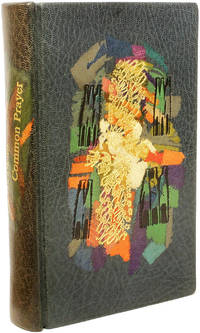
1960002141London: Society for Promoting Christian Knowledge n.d. c.1960 1960. BOUND BY PHILIP SMITH. 1 vol. 5-7/8" x 3-7/8" bound in full blue morocco multi-color morocco onlays to spine and front cover title gilt to spine gilt decoration of people in gilt and blind around gilt stars and suns blue paper pastedowns pastedowns and endpapers with gilt stars all edges gilt housed in an open ended multi colored felt lined slipcase Philip Smith's binders stamp to upper edge of front pastedown dated 1963 inner and outer hinges fine head and foot of spine fine spine slightly darkened internally clean and bright no previous ownership markings inscriptions or bookplate A VERY GOOD COPY. Born in 1928 Philip began his career in bookbinding and book art in 1949 graduating from the Royal College of Art in London with First Class Honours in 1954. He was an internationally renowned designer bookbinder and book artist. He designed and created intricate and fascinating bindings for well over 50 years and was awarded gold and silver medals in several international competitions. In 2000 he was awarded an MBE for services to Art. Philip was a great innovator having invented and pioneered several ground-breaking and influential techniques and structural developments. His work is represented in many private collections and can be seen in several public collections overseas and in the UK including the V&A National Art Library and the British Library. London: Society for Promoting Christian Knowledge, n.d. (c.1960) unknown
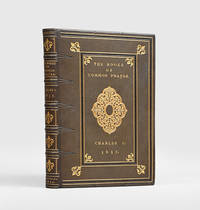
1844187219London: William Pickering 1844. Among the most beautiful specimens of typography that have appeared since the invention of printing First Pickering edition a triumph of Victorian book design; this splendidly bound copy was presented by John Pierpont Morgan to the Church Club of New York. Pickering a champion of the highest standards of typography and design produced a series of six facsimiles of famous Tudor and Stuart prayer books. This is a facsimile of the Scottish edition of 1637 which sought to impose Episcopal liturgy on the Presbyterian Church of Scotland deepening religious tensions and helping to spark the Civil War. It was called by Keynes "a monument of what could be achieved by good taste and craftsmanship" p. 32 and by Warren "among the most beautiful specimens of typography that have appeared since the invention of printing" p. 164. Morgan founder of the Morgan Library in New York ranks among the greatest of all book collectors and was a founder of the Church Club established in 1887 as an Episcopal forum. The Club's bookplate noting presentation is on the front pastedown and their shelf label is on the rear. Folio 338 x 226 mm. Printed in black and red in Old English type by Charles Whittingham of Chiswick on Pouncy's handmade paper. Near-contemporary brown morocco by Riviere endpapers watermarked 1854 spine and front cover lettered in gilt covers panelled in black and gilt with gilt centrepieces gilt turn-ins gilt edges. Light rubbing at extremities toning to endpapers: a very attractive copy. Geoffrey Keynes William Pickering 1969; Arthur Warren The Charles Whittinghams 1896. unknown
19722080202105100034San'ichishobo 1972. Soft Cover. Fine. Volume: 24 volumes San'ichishobo paperback
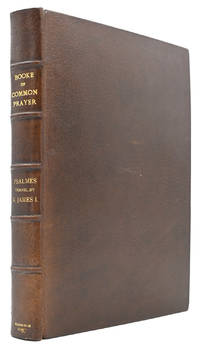
16378201Edinburgh: Printed by Robert Young 1637. Folio pp. 456. Bound with as often: The Psalmes of David: Translated by King Iames. London: Printed by Thomas Harper 1636. Folio pp. ii 147 1. First title-page and Calendar printed in red and black two proof leaves loosely inserted see below. 20th-century crushed brown morocco spine divided by raised bands second and fourth compartments gilt-lettered direct edges gilt. Somewhat soiled and toned waterstaining to corners most prominently at beginning and end first title-page and that of the Psalmes trimmed at fore-edge and renewed at foot proof leaves fragmentary with significant loss from edges. Spine very slightly mellowed. ‘Alexander’ in an early hand to margin of D8 verso that name repeated to one of the proof sheets along with plentiful pen trials and scribbles and ownership inscriptions of James Allan dated 1799 and 1805 more modern bibliographical notes in pencil to pastedown along with a typed slip. The famous Prayer Book imposed on Scotland by Charles I resulting in riots in St Giles’s Edinburgh when first used in a service - the catalyst being a stool thrown at the dean while he read by an anonymous woman traditionally named as ‘Jenny Geddes’. The follow-on effects of this book included the National Covenant of 1638 the Bishops’ Wars Charles I’s downfall and the English Civil War and it ‘provided a model for the American BCP of 1789 and its successors; the prayer books of the Scottish Episcopal Church 1929 & the Province of South Africa 1954’ Griffiths. An impressive as well as an important piece of printing it was produced in considerable numbers thanks to an act mandating two copies in every parish in Scotland though this was only issued after printing had started leading to a frantic process of resetting and reprinting with attendant multiple variations cancels etc. The prose Psalter here is the ‘first edition’ described by Morgan in The Bibliotheck 5 p. 16 with the catchword ‘Certaine’ on kk6 and the Psalter title reading ‘According to the translation.’. Leaf hh3 was cancelled in both editions and a cancellans printed in two separate settings resulting in copies having one of four potential leaves two cancellans two cancellanda; in this case the cancellans with line 1 verso ending ‘he’ is present. Morgan also notes that the 1636 London printing of the Psalms is as here ‘frequently found bound with copies of this Prayer Book and is present in eighteen of the thirty-seven copies examined. Presumably Young the printer ordered a consignment to be sent from London to Edinburgh to be bound with the Prayer Book’ p. 19. This copy additionally preserves almost certainly from an earlier binding two proof sheets both printed on one side only and with textual variants to the pages in the full book. The proof sheets are of aa2 verso and aa7 recto and are different variants to those recorded by Morgan as present in the proof sheets preserved in copies in the NLS and Glasgow. ESTC S101893; Griffiths 1637.9. Printed by Robert Young hardcover
171437200London: Printed by John Baskett. Printer to the Kings most Excellent Majesty and by the assigns of Thomas Newcomb and Henry Hills Deceased 1714. Engraved title page. Printed in black and red ruled in red. 1 vols. Folio. Bound in full red morocco richly gilt spine six panels raised bands gilt dentelles marbled endpapers a.e.g. Engraved title page. Printed in black and red ruled in red. 1 vols. Folio. Printed by John Baskett. Printer to the Kings most Excellent Majesty, and by the assigns of Thomas Newcomb and Henry Hills, Dece unknown
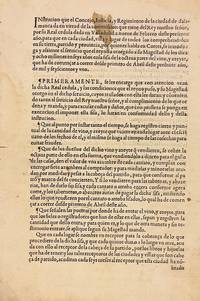
16013683Salamanca: S.n. 1601. First edition. Signed at foot by a municipal officer Diez de la Puente. One-page contemporary manuscript on p. 3 relating to the administration of the tax. Unbound as issued. Pinholes at gutter some edge chipping and small dents brown stain affecting the upper portion throughout. Otherwise a good well-preserved copy. First edition. Signed at foot by a municipal officer Diez de la Puente. One-page contemporary manuscript on p. 3 relating to the administration of the tax. Unbound as issued. 4 last 2 blank p. <p><br /> Unrecorded 1601 ordinance from Salamanca enforcing the Armada-era servicio de millones Spain’s foundational fiscal levy.<br /> <p><p><br /> Printed ordinance issued by the municipal council of Salamanca implementing the royal tax known as the servicio de los dieciocho millones. In accordance with the royal cédula of 9 February 1601 the Concejo Justicia y Regimiento instructs subordinate towns and villages to collect an eighth part of all wine and olive oil sold to be remitted through a chain of local receivers. The text regulates how wine and oil must be measured recorded and taxed forbids additional repartimientos and orders prompt transfer of funds to the city’s main treasury. Dated at Salamanca 10 March 1601 and naming four municipal commissioners appointed for its execution it represents the earliest stage of local enforcement of Philip III’s fiscal scheme transforming the national levy into a functioning municipal excise. A contemporary handwritten endorsement below the text signed by Diez de la Puente attests its execution. Accompanying the printed ordinance is a contemporary manuscript headed on p. 3 “Dudas que se ofrecen en la administración de las sisas†listing practical questions concerning the execution of the tax—registration and measurement of goods roles of administrators and receivers form of payment penalties and conditions of tax farming arrendamiento.<br /> <p><p><br /> The servicio de los dieciocho millones formed part of the broader system of millones taxes created by the Cortes of Castile to meet the Crown’s desperate financial needs after the prolonged wars of Philip II. The servicio de millones had first been introduced by royal request and approved by the Cortes on 4 April 1590 conceived to raise eight million ducats over six years to finance the royal expenditure associated with the Armada campaign against England and other military commitments. Rather than remaining temporary it evolved into a regular levy on six staple items—wine oil vinegar meat soap and tallow candles—collected through local sisas and eventually forming the backbone of Castile’s fiscal structure. By 1600–1601 under Philip III the scheme was renewed and expanded to eighteen million ducats its collection entrusted to municipal governments such as Salamanca’s Concejo Justicia y Regimiento. As described in Bartolomé Yun Casalilla’s Sobre la transición al capitalismo en Castilla this marked a transition from feudal income to a centralized fiscal system financed through municipal taxation embedding local economies within the machinery of the Habsburg war state. The present ordinance captures this process of consolidation—when the monarchy sought tighter control over municipal revenues demanded proper accounting and remittance of surpluses and aimed to prevent arbitrary over-taxation—reflecting both the fiscal strain and administrative centralization characteristic of early-seventeenth-century Spain.<br /> <p><p><br /> Reference: Yun Casalilla B. 1987. Sobre la transición al capitalismo en Castilla: EconomÃa y sociedad en Tierra de Campos 1500–1830. Valladolid: Junta de Castilla y León ConsejerÃa de Educación y Cultura.<br /> <p>. [S.n.] unknown
1051London: Printed by Henry Hills and John Field 1660. Hardcover. Good. London: Printed by Henry Hills and John Field 1660. Octavo. Unpaginated. 744pp. A8-Z8 Aa8-ZZ8 Aaa4. Added engraved title-page lacking. Titles within typographic border & with typographic ornament. Ruled in red. Eighteenth-century green morocco repaired. Darlow & Moule 526; Herbert 669; ESTC B2256. Bound with: The whole book of Psalmes: collected into English meeter by Thomas Sternhold John Hopkins and others. London: printed for the Companie of Stationers 1661. Octavo. iv 78pp. ESTC R204219; STC 2nd ed. B2437aA and The book of common-prayer and administration of the sacraments and other rites and ceremonies of the Church . London: printed by John Bill and Christopher Barker printers to the Kings most excellent Majesty 1662. Octavo. Unpaginated. 128pp. A8-H8. ESTC R35356; STC 2nd ed. B3623. <br/> <br/> London: Printed by Henry Hills and John Field, 1660. hardcover
2166London: printed for the Companie of Stationers 1661. Hardcover. Good. Octavo. iv 78pp. Eighteenth-century green morocco repaired. ESTC R204219; STC 2nd ed. B2437aA. Bound with: The Holy Bible Containing The Old Testament And The New: Newly translated out of the Original Tongues And with the former translations diligently Compared and Revised by His Majesties special Command. Appointed to be read in Churches. London: Printed by Henry Hills and John Field 1660. Octavo. Unpaginated. 744pp. A8-Z8 Aa8--ZZ8 Aaa4. Added engraved title-page lacking. Titles within typographic border & with typographic ornament. Ruled in red. Darlow & Moule 526; Herbert 669; ESTC B2256 and The book of common-prayer and administration of the sacraments and other rites and ceremonies of the Church . London: printed by John Bill and Christopher Barker printers to the Kings most excellent Majesty 1662. Octavo. Unpaginated. 128pp. A8-H8. ESTC R35356; STC 2nd ed. B3623. <br/> <br/> London: printed for the Companie of Stationers, 1661. hardcover
1641371384London: Robert Barker printer to the Kings most excellent Majestie and by the Assignes of John Bill 1641. Title within woodcut border. Text in two columns. 104pp. 8vo. Nineteenth-century full dark red morocco stamped in gilt. Gilt edges. Marbled endpapers with GTS bookplates on first pastedown. Pages cropped. Autograph initials on title page with additional ownership inscription on A3. Title within woodcut border. Text in two columns. 104pp. 8vo. This compact Book of Common Prayer was published during a period of particularly fractious religious tumult just prior to the start of the First English Civil War which was fueled in part by what was seen as King Charles I's pro-Catholic sympathies exemplified by his implementation of a more ceremonial sacramental version of High Anglicanism. Some of these contentious changes - as well the disquiet fomented by them - are alluded to in the Preface and "Of Ceremonies Why Some Be abolished and some retained" all of which follow "An Act for the Uniformitie of Common Prayer" on A2-A3. "Cum privilegio" printed at the foot of the title page.<br /> <br /> A gift to the General Theological Seminary from the then-Dean of Trinity Cathedral George McCormick. ESTC R37432; Griffiths Common Prayer 1641:5; Wing B3612A Robert Barker, printer to the Kings most excellent Majestie, and by the Assignes of John Bill unknown
1794231248New York: Hugh Gaine 1794. hardcover. good. according to the use of the Protestant Episcopal Church in the United States of America: Together with the Psalter or Psalms of David. 364 171 5 pp. Thick 18mo contemporary calf spine and edges of corners worn corners bumped endpapers and title page lightly soiled some pages with very light foxing. New-York: By direction of the General Convention printed by Hugh Gaine 1794.<br/> <br/> In 1789 the Episcopal Church of the United States approved the use of text starting in 1790. It remained in use for the next 102 years. Evans 27577. Ford The Journals of Hugh Gaine Vol. I p. 170.<br/> <br/> Hugh Gaine unknown
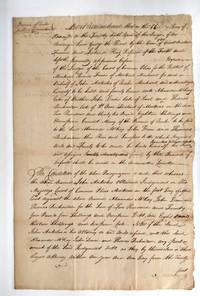
1786151130Montreal 1786-8. Very good. 7 handwritten documents and one printed document with written insertions. Folds staining chips. <br /> <br />1 Printed broadside dated April 1 and April 21 1786 and July 3 1786 with particulars of case written on recto and written text about judgment on verso. Signed by Edward Southouse as judge Edward William Gray as sheriff and T. Walker. Seal on top left corner. Folds. Stains at edges. <br /> <br />2-4 3 Documents attached two written in French. One French document signed by Languinet and the other dated August 27 1788 signed by Corbin. The latter notes receipt of 13 Louis 17 chelins 10 sols from M. Cairns. Document in English signed by Southouse and J. Beeke clerk April 25 1786. Verso dated January 8 1788. Some splitting. Small piece missing at side with no loss of text. <br /> <br />5 Reasons for Jannet McKay's opposition filed 1787. 8 p. Financial statement of the McKay estate signed by A. Davidson July 9 1787. <br /> <br />6-7 2 p. petition to have debtor appear in court. Signed by Walker for the plaintiff and John Fraser as judge March 20 1786. Affixed to this document is a note in French about the place of residene of Alexander McKay and John Davey signed by Jn Rival March 22 1786. <br /> <br />8 2 p. judgment by Southouse May 16 1786. <br/><br/>Judgement in favour of Antrobus for sum of £224 5s 9p plus £8 13s 2p and 5s for the writ. See article from the Quebec Gazette May 18 1786. <br /> <br />Antrobus is probably the merchant and office holder of this name in Trois Rivieres. Baptised July 6 1756 in Cockermouth Cumberland married on March 29 1787 in Trois Rivieres to Catherine Cuthbert died May 8 1820 and is buried in Trois Rivieres. He first appears in Quebec Cty in the 1780s as a grocer engaged in a sizable retail trade and engaged in provisioning fisheries and the West Indies. He and other merchants sent flour bread oats and biscuit to Newfoundland and imported fish seal oil and seal skins. One of the best-known merchants in the colony he was prosperous enough to buy land. unknown
16670625R1APrinted by the Assigns of John Bill and Christopher Barker In the Savoy London: . 1667 Further details - Bound with: The New Testament - In the Savoy London: Printed by the Assigns of John Bill and Christopher Barker 1667 - Bound with: The Whole Book of Psalms: Collected into English Metre by Thomas Sternhold John Hopkins and others. Cambridge: Printed by John Field 1662. Ca. 500 p. Double column text ruled in red throughout. All edges gilt. Small 8vo. 170 x 120 mm. Very good. Contemporary full dark goat skin leather blind tooled English full somber binding. Early marbled endpapers. A very good example of a sombre binding ca. 1667. The covers are blind tooled in a handsome frame and panel design that includes small acorns stars flowers and vines. The same elements appear on the spine compartments between five raised bands. The richness of the tooling on the binding is effectively disguised by this `black on black' work. Some scholars say that these were most popular in Puritan London where ostentation was frowned upon. But most of these sombre bindings appear after the restoration of King Charles II and reflect the royal court's encouragement of public and private displays of mourning for the beheading of his father King Charles I. Their use on liturgical books also accelerates after the Great Plague of 1665; and disastrous London Fire a year later. The timing of its use on this particular example certainly illustrates those influences. References: Wing 2nd ed. B3633AC; Howard Nixon English Restoration Bookbindings; Howard Nixon & Mirjam Foot The History of Decorated Bookbinding in England; Howard Nixon The Oldaker Collection of British Bookbindings in Westminster Abbey; Foot Mirjam M. et al. Eloquent Witnesses Bookbindings and their History; Miller Julia Books Will Speak Plain; A Handbook for Identifying and Describing Historical Bindings; Miner Dorothy. The History of Bookbinding 525-1950 AD; Hobson. Bindings in Cambridge Libraries; Nixon. Catalogue of the Pepys Library at Magdalene College Cambridge; the Henry Davis Gift Catalogue; and other works on historic bindings. The text of this edition of the Book of Common Prayer became the standard for three centuries. SCARCE. CHEST 1/3. Hardcover. Very Good. Printed by the Assigns of John Bill and Christopher Barker, In the Savoy (London): . hardcover
1794C3188<p><b>A splendid copy of the Good and Harding Book of Common Prayer in a striking masonic binding by John Lovejoy.</b><br /></p><p>The London bookbinder John Lovejoy <i>fl.</i> c. 1781–1812 is known by his distinctive Masonic bindings employing an array of Masonic tools often arranged in striking compositions. He was himself a Mason from around 1791 until 1812. His practices as an employer however earned him a certain notoriety among binders and the nickname 'the Tyrant': as a journeyman in 1781 he advocated a reduction in the working day from fourteen to thirteen hours but when a master binder he bitterly opposed such a change and was among the employers who prosecuted the leaders of the 1786 strike. Although it is accepted that Lovejoy was not as previously thought the only binder using Masonic motifs close comparison of the tools with other examples of his work suggests this binding to be his. </p><p>Good and Harding's 1794 Common Prayer appeared in two settings one octavo and the other a splendid large quarto as here. The fine series of stipple-engravings shows both biblical and liturgical scenes including several by Federico Bartolozzi and Luigi Schiavonetti after Thomas Stothard and Silvester Harding. The plates are variously dated between 1791 the date of the dedication and 1794 suggesting the work was several years in progress and perhaps issued in parts; copies are rarely seen with all fifteen engravings. </p><p>ESTC T88819; <i>for Lovejoy see</i> Ramsden <i>London Bookbinders 1780-1840</i> pl. XIX; <i>and </i>Howe & Childe <i>The Society of London Bookbinders 1780-1950</i>. </p><p>Large 4to 278 x 226 mm pp. xxviii 634 2 63 1 blank 176 with engraved dedication dated 23 July 1791 and 15 stipple-engraved plates by various artists; with part-titles stipple-engraved head-piece vignette to p. 1; a few signatures heavily spotted otherwise a very good copy; in contemporary green straight-grained morocco by Lovejoy borders gilt with masonic tools between swags of 3 foliate tools outer borders roll-tooled in gilt spine gilt in compartments lettered directly in one others with central Sun tool winged Asclepian staff as corner-pieces arranged with stars points fleurons and heads board edges turn-ins and morocco hinges roll-tooled in gilt edges gilt endbands sewn in red white and green on 2 cores ribbon place-markers marbled endpapers; a few minor scuffs and marks very short split to upper joint lower corners lightly bumped neatly retouched at extremities nonetheless very well-preserved; early ink ownership inscriptions 'Elizabeth Tynell' to front free endpaper verso and 'John Smith' to front flyleaf.</p> Millar Ritchie for J. Good and E. Harding
1605097215London: Robert Baker 1605. Book measures 7 1/2 x 5 1/2 inches. Titles. The Book of Common Prayer. The Psalter. Both printed by Robert Baker. Printed in the year 1605. First title page printed in red & black second in black. Signatures A1Hh8 in 8s slightly erratic signatures but follow on correct. Bound with The whole booke of Psalmes: collected into English meeter by tho. Sternh. Ioh. Hopkins and others: conferred with the hebrue with apt notes to sing them withall.for the Companie of Stacioners. London. 1606. Signatures A1M8 in 8s. Second edition. Both works printed in black letter. Bound in later full tree calf note on endpaper states 1882 raised bands gilt lines and centre stamp gilt lines on boards leather title label inner dentelles marble endpapers. Calf lightly rubbed on joints and edges. Binding in good clean firm condition. Internally Loss of about 1inch on top margin of a5 including some text loss of part of margin and some text on x5 . Early previous owners name date 16591776 on top and bottom margin of title page. Pages in very good clean condition. A very nice copy in a very attractive binding. . Full-Leather. Very Good. 8vo. Robert Baker Hardcover