Charles EinsteinBiblio.com

2 944 résultats
W-008<p>An appreciation of Willie Mays placed in a historical context signed by Mays. Condition of both book and dust jacket very good plus.</p> hardcover
192043308Berlin: Springer 1920. 15pp. 221 x 146 mm. Original printed wrappers foxed. Minor internal foxing but very good. First edition cover title does not include the date Einstein delivered his lecture; see Weil. "By royal decree of June 24 1920 a special chair in Leiden University was created for Einstein enabling him to come to that university for short periods of his choosing. On October 27 1920 Einstein began his new position with an inaugural address on aether and relativity theory" Pais Subtle is the Lord p. 313. Weil Albert Einstein Bibliography 111. Springer unknown books
1930433061930. Offprint from Mathematische Annalen 102 1930. 685-697pp. Original printed self-wrappers. 233 x 157 mm. Very good apart from small split in lower spine. Weil Albert Einstein Bibliography 171. unknown books
1923374081923. Offprint from S. preuss. Akad. Wiss. Weil 137. unknown books
1923433181923. Offprint from Zeitschrift für Physik 16 1923. Single sheet unpaginated. 230 x 155 mm. One corner creased but very good. First edition offprint issue. Einstein's second response to Friedmann's groudbreaking paper on equations governing the expansion of space which made a valuable contribution to Einstein's theory of relativity and admitted the possibility of an expanding universe. Einstein at first believed that Friedmann's reasoning was incorrect then corrected his own objection in the present brief "Notiz" and called Friedmann's results "clarifying." Pais Subtle is the Lord p. 288. Weil Albert Einstein Bibliography 130. unknown books
08777Np; 1923. First Edition. offprint from Sitzungsberichten der Presussichen Akademie der Wissenschaften Sitzung der physikalishch-mahematischen klasse vom 31 mai XVII. p. 137-140 bound in original orange printied wraps; quarto 254 x 184mm. Einstein's first investigation of Weyl's ideas published in the present work introduced the notion of distant parallelism; however Einstein later rejected Weyl's theory. <br/><br/> paperback books
1923374071923. <p>Einstein Albert 1879-1955. Zur affinen Feldtheorie. Offprint from Sitzungsberichte der preussischen Akademie der Wissenschaften 17 1923. 137-140pp. 256 x 185 mm. Original printed wrappers. Fine.</p> <p>First Edition Offprint Issue. In 1923 Einstein published four short papers of which "Zur affinen Feldtheorie" is the third on Eddington's attempt at a unified field theory marking the beginning of a scientific passion that would dominate the remainder of his career. In 1921 British physicist Arthur Eddington had proposed a unified field theory inspired by the work of Hermann Weyl. "Einstein's own initial reaction was that Eddington had created a beautiful framework without content. Nevertheless he began to examine what would be made of these ideas and finally decided that 'I must absolutely publish since Eddington's idea must be thought through to the end.' That was what he wrote to Weyl. Three days later he wrote to him again about unified field theories: 'Above stands the marble smile of implacable Nature which has endowed us more with longing than with intellectual capacity.' Thus romantically began Einstein's adventures with general connections adventures that were to continue until his final hours" Pais Subtle is the Lord p. 343. This paper is included on Shields's list of Einstein's most significant papers; see Albert Einstein Philosopher-Scientist 1949 p. 758. Shields 175. Weil 132. </p> . unknown books
1929374191929. <p>Einstein Albert 1879-1955. Zur einheitlichen Feldtheorie. Offprint from Sitzungsberichten der preussischen Akademie der Wissenschaften 1 1929. 8vo. 8pp. Berlin: Verlag der Akademie der Wissenschaft 1929. 256 x 183 mm. Original printed wrappers slightly soiled and creased. Very good. </p> <p>First Separate Edition. "In 1928 Einstein embarked on a new approach to a unified field theory . . . involving what he called 'distant parallelism'. . . . By early 1929 he had solved the main problems involved in writing down field equations for his unified theory. On the day of official publication of the third of a formidably technical series of nine articles on the theory . . . excited headlines appeared in foreign newspapers throughout the world. . . . In this frenzied unscientific atmosphere Einstein's new theory was hailed in the press as an outstanding scientific advance. Yet Einstein had stated in his article that it was still tentative; and soon he found he had to abandon it Hoffman Einstein pp. 225-26. This paper is included on Shields's list of Einstein's most significant papers; see Albert Einstein Philosopher-Scientist 1949 p. 758. Weil 165. Pais Subtle is the Lord pp. 344-46. </p> . unknown books
1921433161921. Offprint from Sitzungsberichte der preussischen Akademie der Wissenschaften 1921. Single sheet pp. 882-883. 256 x 184 mm. Minor marginal tears one corner chipped but very good. First ediiton offprint issue. "Since after 1917 Einstein firmly believed that light-quanta were here to stay it is not surprising that he would look for new ways in which the existence of photons might lead to observable devations from the classical picture. In this he did not succeed. At one point in 1921 he thought he had found a new quantum criterion published in the present paper but it soon turned out to be a false lead" Pais Subtle is the Lord pp. 412-413. Weil Albert Einstein Bibliography 118. unknown books
192043308Berlin: Springer 1920. 15pp. 221 x 146 mm. Original printed wrappers foxed. Minor internal foxing but very good. First edition cover title does not include the date Einstein delivered his lecture; see Weil. "By royal decree of June 24 1920 a special chair in Leiden University was created for Einstein enabling him to come to that university for short periods of his choosing. On October 27 1920 Einstein began his new position with an inaugural address on aether and relativity theory" Pais Subtle is the Lord p. 313. Weil Albert Einstein Bibliography 111. Springer unknown
1930433061930. Offprint from Mathematische Annalen 102 1930. 685-697pp. Original printed self-wrappers. 233 x 157 mm. Very good apart from small split in lower spine. Weil Albert Einstein Bibliography 171. unknown
1923374081923. Offprint from S. preuss. Akad. Wiss. Weil 137. unknown
1923433181923. Offprint from Zeitschrift für Physik 16 1923. Single sheet unpaginated. 230 x 155 mm. One corner creased but very good. First edition offprint issue. Einstein's second response to Friedmann's groudbreaking paper on equations governing the expansion of space which made a valuable contribution to Einstein's theory of relativity and admitted the possibility of an expanding universe. Einstein at first believed that Friedmann's reasoning was incorrect then corrected his own objection in the present brief "Notiz" and called Friedmann's results "clarifying." Pais Subtle is the Lord p. 288. Weil Albert Einstein Bibliography 130. unknown
1922BBS-2017749Methuen & Co. Ltd 1922. First Edition. Hardcover. Acceptable/Good. First thus; the first English edition translated by G. B. Jeffery and W. Perrett. Containing 'Ether and Relativity' first delivered as an address on May 5 1920 at the University of Leyden and 'Geometry and Experience' an expanded form of an address to Berlin's Prussian Academy of Sciences on January 27 1921. Blue paneled cloth with black titling with a few small spots of soiling light rubbing to edges gone to slight fraying at spine ends heavy fading to spine and 1-inch diameter stain at spine's center. Spine square. The first signature is loose laid-in; the binding is otherwise strong. No missing pages. In original blue dust jacket about good in Mylar: toned lightly age-soiled rubbed and edgeworn with chipping at spine ends fore-edge corners and an additional chip from the rear fore-edge. Pages lightly and uniformly toned. Text unmarked. Housed protected in modern custom-made navy cloth slipcase with 'E-mc2' stamped in blind to one side. Methuen & Co. Ltd hardcover
1930510131930. <p>Einstein Albert 1879-1955. Théorie unitaire du champ physique. In Annales de l'Institut Henri Poincaré 1 fasc. 1 1930: 1-24. With: Fermi Enrico 1901-54. La théorie du rayonnement. In ibid.: 25-52. Whole number. 2 74 2pp. 285 x 197 mm. uncut and unopened. Original printed wrappers a bit sunned lower corner of front wrapper chipped and creased. Very good.</p> <p> First Edition. This issue of the Annales de l'Institut Henri Poincaré contains the texts of Einstein's lecture on unified field theory and Fermi's lecture on the theory of radiation both delivered at the Institut in 1929. Weil Albert Einstein Bibliography 174. Not in Fermi Collected Papers. </p> . unknown
1923374071923. <p>Einstein Albert 1879-1955. Zur affinen Feldtheorie. Offprint from Sitzungsberichte der preussischen Akademie der Wissenschaften 17 1923. 137-140pp. 256 x 185 mm. Original printed wrappers. Fine.</p> <p>First Edition Offprint Issue. In 1923 Einstein published four short papers of which "Zur affinen Feldtheorie" is the third on Eddington's attempt at a unified field theory marking the beginning of a scientific passion that would dominate the remainder of his career. In 1921 British physicist Arthur Eddington had proposed a unified field theory inspired by the work of Hermann Weyl. "Einstein's own initial reaction was that Eddington had created a beautiful framework without content. Nevertheless he began to examine what would be made of these ideas and finally decided that 'I must absolutely publish since Eddington's idea must be thought through to the end.' That was what he wrote to Weyl. Three days later he wrote to him again about unified field theories: 'Above stands the marble smile of implacable Nature which has endowed us more with longing than with intellectual capacity.' Thus romantically began Einstein's adventures with general connections adventures that were to continue until his final hours" Pais Subtle is the Lord p. 343. This paper is included on Shields's list of Einstein's most significant papers; see Albert Einstein Philosopher-Scientist 1949 p. 758. Shields 175. Weil 132. </p> . unknown
1929374191929. <p>Einstein Albert 1879-1955. Zur einheitlichen Feldtheorie. Offprint from Sitzungsberichten der preussischen Akademie der Wissenschaften 1 1929. 8vo. 8pp. Berlin: Verlag der Akademie der Wissenschaft 1929. 256 x 183 mm. Original printed wrappers slightly soiled and creased. Very good. </p> <p>First Separate Edition. "In 1928 Einstein embarked on a new approach to a unified field theory . . . involving what he called 'distant parallelism'. . . . By early 1929 he had solved the main problems involved in writing down field equations for his unified theory. On the day of official publication of the third of a formidably technical series of nine articles on the theory . . . excited headlines appeared in foreign newspapers throughout the world. . . . In this frenzied unscientific atmosphere Einstein's new theory was hailed in the press as an outstanding scientific advance. Yet Einstein had stated in his article that it was still tentative; and soon he found he had to abandon it Hoffman Einstein pp. 225-26. This paper is included on Shields's list of Einstein's most significant papers; see Albert Einstein Philosopher-Scientist 1949 p. 758. Weil 165. Pais Subtle is the Lord pp. 344-46. </p> . unknown
190750420Leipzig: Johann Ambrosius Barth 1907. Einstein explicitly establishes E=mc2.<p>Einstein Albert 1879-1955. 1 Über die Möglichkeit einer neuen Prüfung des Relativitätsprinzips. In Annalen der Physik 23 6: pp. 197-8. 2 Bemerkungen zu der Notiz von Hrn. Paul Ehrenfest: "Die translation deformierbarer Elektronen und der Flächensatz." In Annalen der Physik 23 6: pp. 206-8. 3 Über die vom relativitätsprinzip geforderte Trägheit der Energie. In Annalen der Physik 23 7: pp. 371-384. 8vo. Red cloth gilt lettering on spine. 214 x 140 mm. Whole volume: viii 1000 pp. 4 plates numbered Taf. I - IV. Tafs. I II and IV are folding Taf. III is b/w silver photograph tipped to sheet. Foot of the spine is repaired. Very good. </p> <br /> <br /> <p>Approximate English translations of titles: 1 "On the possibility of a new test of the principle of relativity." 2 "Remarks on Mr. Paul Ehrenfest's note: 'The translation of deformable electrons and the surface theorem.'" 3 "On the inertia of energy required by the principle of relativity." </p> In "On the inertia of energy required by the relativity principle" May 1907 "Using rather than m V rather than c and 0 rather than E0 Einstein wrote his famous equation for the first time as V2= 0 and he did it in a footnote. At the end of that paper he introduced the symbol E0 to denote energy in the rest frame and wrote the famous expression again this time as =E0/V2." -Eugene Hecht How Einstein confirmed E0 = mc2 </p> <p> In the third paper Einstein explicitly establishes his famous equation E=mc2 although with different symbols. In this paper Einstein discussed the relationship between inertial mass and energy arguing for their complete equivalence namely that every mass has an equivalent energy just as every form of energy has an equivalent mass. This relation says that a photon can convert for the equivalence of mass and energy his celebrated equation E = mc2 Calaprice The Einstein Almanac. </p> <br /> <br /> <p> Weil's Einstein Bibliography nos. 17 18 and 19 respectively. <br> Boni's Einstein Checklist nos. 17 18 and 19 respectively.</p> . Johann Ambrosius Barth unknown
1921433161921. Offprint from Sitzungsberichte der preussischen Akademie der Wissenschaften 1921. Single sheet pp. 882-883. 256 x 184 mm. Minor marginal tears one corner chipped but very good. First ediiton offprint issue. "Since after 1917 Einstein firmly believed that light-quanta were here to stay it is not surprising that he would look for new ways in which the existence of photons might lead to observable devations from the classical picture. In this he did not succeed. At one point in 1921 he thought he had found a new quantum criterion published in the present paper but it soon turned out to be a false lead" Pais Subtle is the Lord pp. 412-413. Weil Albert Einstein Bibliography 118. unknown
192132433Berlin: Akad. Wiss. Berl. 1921 Berichte 51-53 1921. First Edition. Soft cover. First Edition. Soft cover. ALBERT EINSTEIN. Über eine naheliegende Ergänzung des Fundamentes der allgemeinen Relativitätstheorie Berlin 1921 8vo. 26.5 x 18.5 cms Akad. Wiss. Berl. 1921 Berichte 51-53 pp.261-264. Original printed wrappers. NEAR MINT CONDITION. A fine fresh example small pencil mark to upper wrapper of THIS RARE PAPER!! - ."Although Einstein could not accept Weyl's theory as a physical theory he cherished "its courageous mathematical construction" and thought intensively about its conceptual foundation. This becomes clear from his paper "On a complement at hand of the bases of general relativity" of 1921. In it he raised the question whether it would be possible to generate a geometry just from the conformal invariance of Equation without use of the conception "distance" i.e. without using rulers and clocks. He then embarked on conformal invariants and tensors of gauge-weight 0 and gave the one formed from the square of Weyl's conformal curvature tensor" Hubert F.M. Goenner On the History of Unified Field Theories. Reference: Weil N. 116; Schlipp-Shields No.145. Akad. Wiss. Berl., 1921, Berichte 51-53 unknown
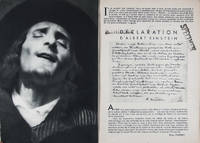
193345000Paris: Société Anonyme Les Illustrés Français 1933. First edition. Softcover. g- to vg. Large quarto 11 1/2 x 8". 105 3pp. Original photo-illustrated wrappers with white lettering to front cover. <br /> <br /> This scarce issue of "Témoignages de Notre Temps" Witness to our Time is a loving and moving tribute to Jewish life and culture that spans ancient times to the early 1930s with the spectre of Hitler and the early persecutions of Jews in Nazi Germany Hitler became chancellor a few months prior on January 30th. <br /> <br /> Includes texts by Albert Einstein Dr. Chaïm Weizmann and others along with hundreds of splendid black-and-white photogravures many full page including Helmar Lerski’s impressive series on Jews in Palestine. <br /> <br /> "Témoignages de Notre Temps" was edited by noted French photographer and publisher Lucien Vogel.<br /> <br /> Wrappers partly creased along edges. Page 5 with four "Spécimen" stamps not affecting lettering. Lower corner of the first 18 pages slightly creased. Lower front corner bumped thus slightly affecting pages throughout. Text in French. Wrappers in overall good- to good interior in good to very good condition. Société Anonyme Les Illustrés Français unknown
W-012<p>The original version published in 1966 signed by Mays. Condition of book and dust jacket very good.</p> hardcover
W-013<p>The revised edition of the book published in 1972. Signed by Mays. Condition of both book and dust jacket very good.</p> hardcover
1950046941New York: Philosophical Library 1950. 1st Edition 1st Printing. Hardcover. Near Fine/Very Good. Frontispiece. 282 Pp. Green Cloth Lettered In Gilt On Front CoverAlso Lettered In Gilt In Spine Stamped On Two Blocks Of Dark Blue Background. Dust Jacket Priced $4.75 With Only 15 Titles On Rear Panel Two First Published In 1950 The Others First Published By Philosophical Library 1942 To 1949. Frontispiece Portrait Of Einstein By Lotte Jacobi. There Are Many Issues With Identical Pagination In Cloth Or Boards Of Various Colors All With Later Post-1950 Publications Indicated On The Rear Panel In Both The Plainer Dust Jacket As On This Copy And In A More Elaborate Jacket; We Believe This Is The First Issue Only By A Process Of Elimination Not Having Seen An Earlier Dust Jacket. Book With Light Wear Gilt Brilliant No Marks. Dust Jacket With Wear Small Losses/Chips At Corners Not Price Clipped Slight Browning To Spine Panel. <br/> <br/> Philosophical Library hardcover
19271324467Paris: The Sign of the Pegasus 1927. First Edition. Hardcover. 16 31 pages; 150 pages; VG; bound in gilt decorated burgundy cloth rebacked with original boards and spine preserved; top edge of text block gilt; mild rubbing and wear; with 150 photographs plus a folded color frontispiece; shelved above front case. 1324467. Shelved Dupont Bookstore. The Sign of the Pegasus hardcover books