Einstein, AlbertBiblio.com
1 506 résultats
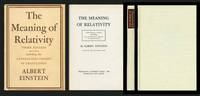
1950409Princeton: Princeton University Press 1950. Third Edition. FIRST PRINTED OF THE THIRD & EXTENDED EDITION COMPLETE WITH ORIGINAL DUST JACKET of four lectures Einstein delivered at Princeton University in May 1921. <br /> <br /> The lectures intended as further explanation of Einstein's famous theory of relativity and its developments were titled 'Space and Time in Pre-Relativity Physics' 'The Theory of Special Relativity' The General Theory of Relativity' 'The General Theory of Relativity II.' "This edition contains both an appendix discussing certain advances in the theory of relativity since 1921 and a new appendix on his generalized theory of gravitation. According to the Weil bibliography of Einstein's works this is Weil 124a. CONDITION & DETAILS: Large 12mo 7.5 x 5.25 inches 187 x 131mm. 8 145 3. The dust-jacket is not price-clipped; small closed tear at the foot of the front wraps and head of rear wraps both small and minor. Very good condition safe in archival mylar. Bound in tan cloth gilt-lettered at the spine; the binding is tight and solid. Bright and very clean inside and out. Very good condition. Princeton University Press paperback
1923108095Princeton University Press 1923. 1st Edition. Hardcover. Very Good/Very Good. First edition with Published 1922 on copyright page and 1923 on title page very good in the very rare dust jacket which has some wear and chips and a big tear at rear panel. Previous owner's bookplate attached to front paste-down. Housed in a custom-made collector's slipcase. Princeton University Press hardcover
19982080502106912160Not Available 1998. Soft Cover. Fine. The book is in fine condition. Not Available paperback
1971186152Princeton N.J.: Princeton University Press 1971. Hardcover. Good/Good Ex-library with stamps and labels on spine inside front and rear covers ffep and block. Overall light shelfwear to boards and block. Binding is tight and pages are otherwise clear. Three volumes bound in burgundy cloth with gilt spine lettering; tan dust jackets with mylar covers. Illustrated title pages bw illustrations throughout each volume. Text in English songs in Italian with English text translations. Vol. 3 contains "Texts of songs revised and translated by Antonio Illiano and Howard E. Smither" and scores of 97 madrigals. Princeton University Press hardcover books
1949044767Princeton: Princeton University Press 1949. Translated by Alexander H. Krappe Roger H. Session and Oliver Strunk. 3 vols. xvi 887 3; xxx 333p. b/w illus. music dj. Princeton University Press unknown books
1971212282Princeton N.J.: Princeton University Press 1971. Hardcover. VG. Jackets and volumes are clean and unmarked. Jackets in mylar. Quarto Hardcover. Three volumes bound in burgundy cloth with gilt spine lettering; tan dust jackets with mylar covers. Illustrated title pages bw illustrations throughout each volume. Text in English songs in Italian with English text translations. Vol. 3 contains "Texts of songs revised and translated by Antonio Illiano and Howard E. Smither" and scores of 97 madrigals. Princeton University Press hardcover
194988051Princeton: Princeton University Press 1949. First English Language Edition. Three quarto volumes. Burgundy cloth hardcovers in publisher's slipcase; xvi1-476; 477-8773; x333pp. A fine set in the original cloth bindings; slipcase is mildly rubbed and sunned with small paper loss to open edge still Very Good. <br /> <br /> Einstein's monumental study was the first scholarly treatise of its kind in any language and remains one of the essential works on early Italian secular music. Volumes I & II provide scholarly background on the history and evolution of madrigal form while the third volume compiles nearly 100 compositions produced between 1470 and 1650 including works by Tromboncino Verdalot De Rare Gabrielli and others. An uncommonly well-preserved set. Princeton University Press unknown
1971186152Princeton N.J.: Princeton University Press 1971. Hardcover. Good/Good Ex-library with stamps and labels on spine inside front and rear covers ffep and block. Overall light shelfwear to boards and block. Binding is tight and pages are otherwise clear. Three volumes bound in burgundy cloth with gilt spine lettering; tan dust jackets with mylar covers. Illustrated title pages bw illustrations throughout each volume. Text in English songs in Italian with English text translations. Vol. 3 contains "Texts of songs revised and translated by Antonio Illiano and Howard E. Smither" and scores of 97 madrigals. Princeton University Press hardcover
1949044767Princeton: Princeton University Press 1949. Translated by Alexander H. Krappe Roger H. Session and Oliver Strunk. 3 vols. xvi 887 3; xxx 333p. b/w illus. music burgundy cloth original publisher's stiff-board slipcase ex libiris Daniel Heartz with his occasional pencilled notes. Princeton University Press unknown
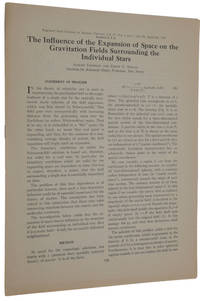
1945180350Lancaster Pennsylvania: American Physical Society 1945 & 1946. His most significant later contribution to cosmology First editions offprint issues of the papers that introduced the Swiss-cheese model of the universe. Einstein and Straus revised the FLRW metric by suggesting that the universe is in fact inhomogeneous. "In two ground-breaking papers Einstein and Straus showed how galaxies fit into a Universe with zero pressure. This model helps to describe the universe observed today" Harwit p. 573. Quarto pp. 5. Disbound wire-stitched as issued. Nicks and creasing to extremities short closed tears to outer margins pp. 120-1 of Influence detached rear blank almost detached: in very good condition. Boni 252 & 252.1; Weil 216. Martin Harwit Astrophysical Concepts 2010. unknown
19455054Lancaster PA: American Physical Society 1945. First edition. <p>First edition extremely rare offprints of Einstein & Straus's introduction of the 'Swiss-cheese' model of the universe. "By the spring of 1945 Einstein and Straus had found a new type of possible universe using Einstein's equations . This was a step towards a more realistic universe in which the matter was not smoothly spread with the same density everywhere but gathered up into lumps like galaxies which were spread about in empty space" Barrow The Book of Universes pp. 106-107.</p>. EINSTEIN'S 'SWISS-CHEESE' MODEL OF THE UNIVERSE - OFFPRINT ISSUE. <p>First edition extremely rare offprints of Einstein & Straus's introduction of the 'Swiss-cheese' model of the universe. "After a decade and a half of sometimes intense work on cosmology Einstein returned to the subject only occasionally in his later years. His most significant later contribution was a discussion of the impact of cosmological expansion on the gravitational field surrounding a star i.e. the offered papers . This was an important first step in understanding the impact of global cosmological expansion on local physics" Janssen & Lehner pp. 257-8. In the 1920s and 1930s a general relativistic model of the universe was developed called the Friedmann-Lemaître-Robertson-Walker FLRW model which correctly described the expansion of the universe discovered by Edwin Hubble. But the FLRW model was 'homogeneous' - it described a universe which looks the same wherever the observer is located. The actual universe however is manifestly inhomogeneous - it contains stars galaxies and clusters of galaxies. Einstein and Straus's papers represent the first serious attempt to model an inhomogeneous universe. "By the spring of 1945 Einstein and Straus had found a new type of possible universe using Einstein's equations. It described a universe which looked largely like one of the simple expanding universes of Friedmann and Lemaître containing material like galaxies which exerted no pressure. But it had spherical regions removed from it like bubbles in a Swiss cheese. Each empty hole then had a mass placed at its centre. The mass was equal in magnitude to what had been excavated to create the hole. This was a step towards a more realistic universe in which the matter was not smoothly spread with the same density everywhere but gathered up into lumps like galaxies which were spread about in empty space" Barrow pp. 106-107. Not on OCLC; no copies in auction records.</p> <br /> <p>In 1916 just a few months after Einstein had formulated his general theory of relativity Karl Schwarzschild had found a solution of Einstein's equations which described the gravitational field in the vicinity of a spherical distribution of mass such as a star or to anticipate later developments a black hole. This was in fact the first exact solution of Einstein's equations to be found - Einstein had earlier calculated an approximate solution which was enough to show that his theory correctly accounted for the advance of Mercury's perihelion. However at great distances from the star Schwarzschild's solution approaches the flat Minkowski spacetime with zero curvature and not the FLRW solution that represented an expanding universe. It seemed therefore that Schwarzschild's solution could not correctly describe the gravitational field of a star in an expanding FLRW universe. If the expansion of the universe meant that Schwarzschild's solution had to be modified this could make it possible to detect and measure the expansion of the universe by making local observations rather than by observing the motion of distant galaxies as Hubble had done. The problem of describing the gravitational field of a star in an expanding FLRW universe was addressed by Einstein and Straus in the offered papers.</p> <br /> <p>"In the early 1930s theorists began to develop a richer account of the evolution of the universe based on expanding models. Hubble's results qualitatively agreed with the redshift effect calculated in these models but the utility of the simple dynamical models depends on whether the universe is approximately uniform. The status of this assumption was the focus of lively debate . Relativistic cosmologists regarded the idealized uniformity of the FLRW models as a simplifying assumption . The unrelenting uniformity built into the FLRW models conflicts with the clear non-uniformity of the stars star clusters and galaxies of the local universe but the models might still serve as a useful approximation if the non-uniformities are negligible at larger scales" Janssen & Lehner p. 256.</p> <br /> <p>"By 1944 Einstein had recruited a new assistant at Princeton. His assistants were always talented young mathematicians who could make up for Einstein's self-confessed weakness in this area. Ernst Straus 1922-1983 was something of a mathematical prodigy . He was born in Munich but after the Nazis came to power in 1933 his family fled to Palestine where he was educated at high school and at the Hebrew University in Jerusalem. Straus didn't stay to take an undergraduate degree and instead while still a teenager moved to New York's Columbia University in 1941 to begin graduate research. In 1944 he found himself recruited as Einstein's new research assistant at the Institute for Advanced Study in Princeton. The young Straus had no background in physics and his mathematical inclinations were towards number theory and 'pure' mathematical topics but he lost no time in filling the gap left by the departures of Nathan Rosen 1935-45 and Leopold Infeld 1936-38" Barrow pp. 105-6.</p> <br /> <p>Einstein and Straus found an exact solution of the equations of general relativity in which a spherical 'hole' is cut out of an FLRW universe and the hole is replaced by a single mass point e.g. a star surrounded by a spherical cavity. The initially homogeneous matter within the cavity can be thought of as having been "condensed into the star". Einstein and Straus found that the interior of the cavity is described by the standard Schwarzschild solution. The radius of the hole is such that at its spherical boundary the outward pull from the cosmological masses is just balanced by the inward pull from the star. The cavity boundary expands according to the Hubble expansion of the whole universe. The universe outside the cavity is described by the standard expanding homogeneous FLRW solution. The possibility of exactly matching the Schwarzschild solution near the star to the FLRW solution outside it showed that it was not in fact possible to detect the expansion of the universe by making observations close to the star. There were similar solutions with more than one hole - Einstein said that this reminded him of the holes in Swiss cheese. The static vacuum region inside the cavity is now called an 'Einstein-Straus vacuole'.</p> <br /> <p>The methods introduced by Einstein and Straus in these papers have been used extensively to model inhomogeneities in the universe. For example in 1968 Martin Rees and Dennis Sciama investigated the effects of large-scale inhomogeneities such as superclusters of galaxies on the cosmic microwave background the so-called 'Rees-Sciama effect'. The Swiss-cheese model has also been used in the study of inflationary models of the early universe. According to this theory the universe expanded exponentially in the first tiny fraction of a second after the big bang with some parts of space-time expanding more quickly than others. This created 'bubbles' in space-time. The Swiss-cheese "embodies a natural way to model physical problems such as describing the boundary between a galaxy and intergalactic space or the relation between bubbles at the end of an inflationary era by taking two different regions where the behaviour is smooth and joining them at a surface of discontinuity" Ellis et al. p. 426.</p> <br /> <p>In the last decade several authors have suggested that Swiss-cheese models might solve a long-standing problem on the rate of expansion of the universe. Distant supernovas have been observed to be dimmer than expected on the basis of standard cosmological theories indicating that the universe is expanding faster than these theories predict. This has been explained by hypothesizing the existence of 'dark energy' although exactly what dark energy might be is a mystery. But if the light from distant supernovas had to cross large vacuoles in reaching an observer on the earth these would act like concave lenses making the supernovas appear dimmer and further away than they really are. Other authors have noted that the Milky Way is near the centre of a region that has fewer galaxies than other parts of the universe and that we might be living near the centre of a particularly large vacuole perhaps more than a billion light years in diameter see for example Bonnor.</p> <br /> <p>Weil 216. Barrow The Book of Universes 2011. Bonnor 'A generalisation of the Einstein-Straus vacuole' Classical and Quantum Gravity 17 2000 pp. 2739-2748. Ellis Maartens & MacCallum Relativistic Cosmology 2012. Janssen & Lehner eds. The Cambridge Companion to Einstein 2014.</p> <br/> <br/> Together two offprints 4to 267 x 200 mm pp. 120-124 & 148-149. Stapled as issued in original self-wrappers. American Physical Society unknown
1979202335New Jersey: Princeton University Press 1979. First Edition; First Printing. Hardcover. Near Fine in a Very Good price clipped dust jacket. Princeton University Press hardcover
195056788New York: Didier 1950. good fair to good. 175 DJ somewhat worn and soiled: edge tears creases and small pieces missing DJ in plastic sleeve. Contributors include Stewart Alsop Robert Bacher Hanson W. Baldwin Hans Bethe David E. Lilienthal Walter Lippman Brien McMahon Hans Morgenthau Leo Szilard Harold Urey and Richard K. Winslow. Topics covered include the political significance of the Hydrogen Bomb the military value of the Hydrogen Bomb the scientific problems of building a Hydrogen Bomb and how those problems may be solved and a bold plan for world atomic peace. Didier unknown
1940180281Princeton: Princeton University Press 1940. Elucidating the Einstein-Infeld-Hoffman equations First edition offprint issue of Einstein's last major contribution to the general theory of relativity. It formed part of his mathematical investigations into the structure of the theory which he spent the latter part of his life refining. "During the development of the general theory Einstein had intended to hold fast to the conservation of energy and momentum in the usual special relativistic sense as far as possible. At the same time he was driven by other considerations toward the idea that the laws should be generally covariant. These two desires proved mutually incompatible. The problem of the equation of motion of bodies is the following. The 1916 theory had a classical structure in the sense that there were both field equations the curvature of space-time is determined by the mass and motion of bodies in space-time and equation of motion of bodies the world line of small mass is a geodesic. Einstein showed that if matter is represented by a point singularity of the metric field these singularities are located on world lines that are geodesics of space time provided its metric satisfies the equation of general relativity" DSB IV p. 329. The first part of the paper was published in 1938. Large octavo pp. 10. Original wrappers wire-stitched as issued front cover printed in black. Wrappers gently toned: a near-fine copy. Boni 236.1; Weil 205. unknown
193846954Baltimore Princeton University Press 1938 a.1940. Royal8vo. Bound in 2 full cloth gilt lettering to spines. In: Annals of Mathematics" Series 2 Vol. 39 and vol. 40. Entire volumes offered. The papers: pp. 65-100 a. pp. 455-464. Clean and fine.også on a generalization. pais p. 496 <br/><br/><em>First appearance of these two importent papers on the General theory of Relativity in which is shown that the equation of motion follows directly from the field equation that defined the geometry."Einstein's last importent contribution to general relativity deals again with the problem of motion. It is the work done with Leopold Indfeld and Banesh Hoffmann on the N-body problem of motion. In these papers the gravitational field is no longer treated as external. Instead it and the motion of its singular sources are treated simultaneously. A new approximation scheme is introduced in which the fields are no longer necessarily weak but in which the source velocities are small compared with the light velocity. These equations are widely used in analyses of planetary orbits in the solar system."Pais "Subtle is the Lord" pp. 290-91.Weil: 202 a. 205 both with an asterix denoting a major paper. - Boni: 236 a. 236.1. </em> hardcover
193846475Princeton NJ. Annals of Mathematics 1938 a. 1940. Both papers in orig. printed wrappers. Offprints from "Annals of Mathematics" Vol. 39 No. 1 january 1938 and Vol. 41 No. 2 April 1940. Pp. 65-100 and pp. 455-464. Both clean and fine. This copy has belonged to Abraham Pais 1918-2000 - the famous Einstein scholar theoretical physicist and Einsteins collegue at Princeton - and having his name on top of both frontwrappers "A Pais". <br/><br/><em>First editions in the scarce offprint versions of Einstein's last and highly important contributions to General relativity and in which is shown that the equation of motion follows directly from the field equation that defined the geometry."Einstein's last importent contribution to general relativity deals again with the problem of motion. It is the work done with Leopold Infeld and Banash Hoffmann on the N-body problem of motion. In these papers the gravitational field is no longer treated as external. Instead it and the motion of its singular sources are treated simultaneously. Anew approximationscheme is introduced in which the fields are no longer necessarily weak but in which the source velocities are small compared with the light velocity . The equations obtained have found use in situations where Newtonian interaction must be included. 'These equations are widely used in analyses of planetary orbits in the solarsystem. For example the Cal Tech Jet Propulsion Laboratory uses them in modified form to calculate ephmerides for high-precision tracking of planets and spacecraft."Pais "Subtle is the Lord" p. 290-91."The problem of the equation of motion of bodies is the following. The 1916 theory had a classical structure in the sense that there were both field equations the curvature of space-time is determined by the mass and motion of bodies in space-time and equations of motion of bodies the world line of small mass is a geodesic. Are these two statements really separate If the field equations were linear they indeed would be. They are not linear however and Einstein showed in the papers offered that if matter is represented by a point singularity of the metric field these singularities are located on world lines that are geodesics of space-time provided its metric satisfies the equation of general relativity."DSB.Weil: 202 a. 295 both with an asterix denoting a major paper. - Boni: 236 a. 236.1. </em> unknown
192425388London:: Methuen 1924. Second edition revised and enlarged. publisher's cloth in dust jacket. . Very good or better in a jacket with an L-shaped closed split at the bottom of the jacket spine a label had been removed from the bottom of the spine which has skinned a few of the letters in the imprint; also there is some splitting along folds. An uncommon book in jacket. . 8vo. With a Preface by Albert Einstein. Methuen, hardcover
195625363Simon and Schuster 1956. Hardcover. Near Fine/Very Good. 11th printing <br/> <br/> Simon and Schuster hardcover
1956057501New York: Simon & Schuster. Very Good in Very Good dust jacket. 1956 1958 1968. Hardcover. Complete 3-volume set hardcovers with jackets the first volume is a 2nd printing it has surface-scuffs on the front cover and scattered fading to the top black page-edge the jacket is price-clipped and has mild surface-wear at the edges Volume 2 is a 4th printing It has a few small areas of edge-wear on the bottom which includes loss at the bottom front corner a personal unsigned bookplate of the Earth as seen from the Moon is present on the first blank end-paper jacket has moderate rubbing to the surface which is common with most glossy jackets and moderate edge-wear mainly confined to the corners the original price 6.50 is present Volume 3 is a 1st printing as stated book has mild tanning near the edges and a tiny edge-crimp to the bottom front corner the jacket is price-clipped and the red coloring is slightly faded on the spine a bit of shallow edge-wear also it isn't very noticeable but the jacket has been laminated all of the books and jackets are clean and presentable with tight bindings and fine contents the jackets remain pleasing to the eye overall and professional removable mylar covers are included . Simon & Schuster hardcover
193332820627<p>Original wrappers. Price neatly blacked out at lower corner. Tiny chip from back wrapper. Very good.</p><p>FIRST EDITION.</p><p>This scarce collection of Einstein's writings on war and peace was published in 1933 the year the Nazis took power in Germany and the year Einstein left Germany for the United States. In his prefatory note Einstein writes "Mr. Lief the editor Alfred Lief has taken great trouble in collecting utterances of mine having pacifistic content and he presents them with my authorization. … I consider it my duty to confess my pacific conviction publicly. May the seriousness of my purpose be transferred to you my readers! A. Einstein."</p> John Day paperback
2000Q-0691070210Princeton University Press 2000-05-30. Hardcover. New. In shrink wrap. Looks like an interesting title! Princeton University Press hardcover
2000DADAX0691070210Princeton University Press 2000-05-30. 2nd. hardcover. New. 4.72x1.18x7.48. Buy with confidence. Excellent Customer Service & Return policy. Princeton University Press hardcover
1938180902007New York: Simon and Schuster 1938. First Edition. Hardcover. Very Good. First edition first printing. Previous owner signature of Albert K. Chapman to front free end paper. Chapman served as the president of the Eastman Kodak Company from 1952-1960 then as chairman until he retired in 1967.Publisher's navy blue cloth binding stamped in gilt. Near Fine with a small scuff to front cover. In a Very Good dust jacket with price intact moderate rubbing and edge wear and a slightly toned spine panel. Simon and Schuster hardcover books
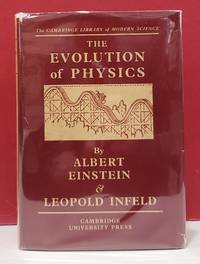
193837<p>First British Edition first printing Cambridge University Press hardcover.</p><p>Blue clothbound covers with minimal wear. Gold titles on the spine and a gold figure of a man's head and shoulders in the center of the front cover.</p><p>Binding firm and tight. No writing to the pages.</p> Cambridge University Press hardcover
19471155106Cambridge University Press 1947. Hardcover. Very good/Very good. 1947 reprint of 1938 text.<br /> <br /> Excellent condition. Jacket edges are worn. Jacket has Mylar Brodart. Binding is tight. Spine is sunned but legibility is not impacted. Cover edges are worn. Inside is clean and unmarked. Cambridge University Press hardcover