Wilson, MitchellAntiquariat.de

1 506 résultats
196913932Hamburg: Rowohlt Taschenbuch Verlag, 1969. 187 Seiten , 19 cm kart.,
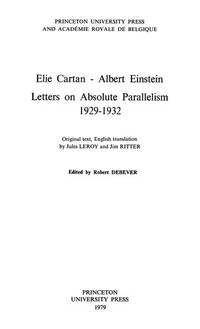
1979030708Princeton NJ: Princeton University Press 1979. Book. Fine. Cloth. First Edition. 8vo - over 7¾" - 9¾" tall. Orange cloth lettered in black. As issued. Dust jacket as issued now in archival mylar. xvii235 pp. Princeton University Press Hardcover
191647015Berlin, Julius Springer, 1916. Royal8vo. Bound in contemporary half calf with gilt lettering to spine. In ""Die Naturwissenschaften"", 4 Jahrgang, 1916. A very nice and clean copy. Pp. 509-510. [Entire volume: XIV, 866 pp.].
191146958Leipzig, Barth, 1911. Plain wrappers. In: ""Annalen der Physik"" Vierte Folge, Bd. 35, No 9. With titlepage to vol. 35. Pp. 617-816 a. 3 plates. (Entire issue offered). Einstein'spaper: pp. 679-694. Clean and fine.
191150316Leipzig: Johann Ambrosius Barth 1911. Einstein Albert 1879-1955. Elementare Betrachtungen über die thermische Molekular bewegung in festen Körpern. In Annalen der Physik 35 9: 679-694 pp. Whole issue disbound from larger volume but still stitched together front wrapper detached chipped with loss and tears else very good. Whole issue: pp. 617-816 3 plates.<br /> <br /> <p>First edition of Einstein's sequel and complement to his 1907 paper on Planck's theory of radiation and heat translated as Elementary Observations on Thermal Molecular Motion in Solids. Einstein tries to improve upon his model of specific heats after realizing the model was inocrrect at very low temperatures. The correct answer would come a year later with the Debye model. </p> <p>"Elementary observations on thermal molecular motion in solids. . . Here Einstein continues the work he had begun in 1907 on the specific heat of solids where the heat agitation of solids was reduced to a monochromatic oscillation of the atom and the specific heat was determined based on the quantum treatment of an oscillator in a radiation field. He explains the discrepancies between his formula and the measurements at low temperatures." p. 291. Calaprice Kennefick & Shulmann. An Einstein Encyclopedia. 2015. </p> <br /> <br /> <p>Weil's Einstein Bibliography no. 42. </p> . Johann Ambrosius Barth unknown
1911003227Leipzig: J. A. Barth 1911. Contemporary three-quarters cloth marbled boards. Discusses bending of light in gravitational field. First Edition. Very Good. J. A. Barth hardcover
191146958Leipzig Barth 1911. Plain wrappers. In: "Annalen der Physik" Vierte Folge Bd. 35 No 9. With titlepage to vol. 35. Pp. 617-816 a. 3 plates. Entire issue offered. Einstein'spaper: pp. 679-694. Clean and fine. <br/><br/><em>First edition. In the paper "Elementary observations concerning the thermal molecular motion in solid bodie" he continues his earlier investigations of the specific heat of solids in which the heat agitation of solids was reduced to a monochromatic oscillation of the atom and the specific heat calculated on the basis of the quantum treatment of an oscillator put in the radiation field. Here he deals with with the discrepancies between his formula of the measurements at low temperature." Cornelius Lanzos.Weil: 42. - Boni: 38. </em> unknown
191647015Berlin Julius Springer 1916. Royal8vo. Bound in contemporary half calf with gilt lettering to spine. In "Die Naturwissenschaften" 4 Jahrgang 1916. A very nice and clean copy. Pp. 509-510. Entire volume: XIV 866 pp. <br/><br/><em>First printing of Einstein's only paper on aircrafts. In it he proposed a new shape for aircraft wings. Disappointed that nobody took up his idea he took it to an airline in Berlin. A prototype was constructed but it performed poorly and it was never put into service. </em> unknown
192514131925. 1st Edition. FIRST EDITION IN ORIGINAL PICTORIAL WRAPPERS. Near fine condition. <br /> <br /> "This paper is an early example of a series of papers - which continued until his death - in which he explored within the confines of general relativity possible pathways in the direction of a unified field theory. Here he discusses whether it is possible to explain why electrons and protons have equal charge but unequal masses. He notes that a more natural solution to the field equations would be particles of opposite sign and equal mass thus anticipating but for unrelated "Select Annotated Biography 114 p. 307. <br /> <br /> ALSO INCLUDED: Zeeman "Lorentz en de Hypothese der Licht-Quanta Bij de Voortplanting Van Licht" pp. 325-330 Lorentz was Zeeman's mentor. <br /> <br /> ALSO INCLUDED: Some of the issue is a memorial to Lorentz. CONDITION DETAILS: Complete issue. Very slight wear at the spine. Bright and clean inside and out. Near fine condition. unknown
1976233935University Park Press 1976 hardback book and dust jacket in very gooD condition.name stamped on top page edges. 1st Edition. Hardcover. Very Good/Fair. University Park Press hardcover
1976233662University Park Press 1976 hardback book and dust jacket in very good to near fine conditionname stamped on page edges3 sideslight edgewear to dj. 1st Edition. Hardcover. Very Good/Very Good. University Park Press hardcover
192478904London: Methuen & Company 1924. First edition of this classic account of Born's analysis and interpretation of Einstein's theory of relativity. Octavo original cloth frontispiece of Einstein. Signed by Max Born on the verso of the frontispiece. Translated by Henry L. Brose. Very good in a very good dust jacket. Housed in a custom half morocco clamshell box. First editions are uncommon signed examples rare. Einstein's Theory of Relativity is a book in which one great mind explains the work of another great mind in terms comprehensible to the layman is a significant achievement. This is such a book. Max Born was awarded the Nobel Prize in 1954 and was one of the world's great physicists: in this work he analyzes and interprets the theory of Einsteinian relativity. The result is undoubtedly the most lucid and insightful of all the books that have been written to explain the revolutionary theory that marked the end of the classical and the beginning of the modern era of physics. Born follows a quasi-historical method of presentation. The book begins with a review of the classical physics covering such topics as origins of space and time measurements geometric axioms Ptolemaic and Copernican astronomy concepts of equilibrium and force laws of motion inertia mass momentum and energy Newtonian world system absolute space and absolute time gravitation celestial mechanics centrifugal forces and absolute space laws of optics the corpuscular and undulatory theories speed of light wave theory Doppler effect convection of light by matter electrodynamics including magnetic induction electromagnetic theory of light electromagnetic ether electromagnetic laws of moving bodies electromagnetic mass and the contraction hypothesis. Born then takes up his exposition of Einstein's special and general theories of relativity discussing the concept of simultaneity kinematics Einstein's mechanics and dynamics relativity of arbitrary motions the principle of equivalence the geometry of curved surfaces and the space-time continuum among other topics. Born then points out some predictions of the theory of relativity and its implications for cosmology and indicates what is being sought in the unified field theory. This work steers a middle course between vague popularizations and complex scientific presentations. This is a careful discussion of principles stated in thoroughly acceptable scientific form yet in a manner that makes it possible for the reader who has no scientific training to understand it. Only high school algebra has been used in explaining the nature of classical physics and relativity and simple experiments and diagrams are used to illustrate each step. The layman and the beginning student in physics will find this an immensely valuable and usable introduction to relativity. Methuen & Company hardcover books
192478904London: Methuen & Company 1924. First edition of this classic account of Born's analysis and interpretation of Einstein's theory of relativity. Octavo original cloth frontispiece of Einstein. Signed by Max Born on the verso of the frontispiece. Translated by Henry L. Brose. Very good in a very good dust jacket. Housed in a custom half morocco clamshell box. First editions are uncommon signed examples rare. Einstein's Theory of Relativity is a book in which one great mind explains the work of another great mind in terms comprehensible to the layman is a significant achievement. This is such a book. Max Born was awarded the Nobel Prize in 1954 and was one of the world's great physicists: in this work he analyzes and interprets the theory of Einsteinian relativity. The result is undoubtedly the most lucid and insightful of all the books that have been written to explain the revolutionary theory that marked the end of the classical and the beginning of the modern era of physics. Born follows a quasi-historical method of presentation. The book begins with a review of the classical physics covering such topics as origins of space and time measurements geometric axioms Ptolemaic and Copernican astronomy concepts of equilibrium and force laws of motion inertia mass momentum and energy Newtonian world system absolute space and absolute time gravitation celestial mechanics centrifugal forces and absolute space laws of optics the corpuscular and undulatory theories speed of light wave theory Doppler effect convection of light by matter electrodynamics including magnetic induction electromagnetic theory of light electromagnetic ether electromagnetic laws of moving bodies electromagnetic mass and the contraction hypothesis. Born then takes up his exposition of Einstein's special and general theories of relativity discussing the concept of simultaneity kinematics Einstein's mechanics and dynamics relativity of arbitrary motions the principle of equivalence the geometry of curved surfaces and the space-time continuum among other topics. Born then points out some predictions of the theory of relativity and its implications for cosmology and indicates what is being sought in the unified field theory. This work steers a middle course between vague popularizations and complex scientific presentations. This is a careful discussion of principles stated in thoroughly acceptable scientific form yet in a manner that makes it possible for the reader who has no scientific training to understand it. Only high school algebra has been used in explaining the nature of classical physics and relativity and simple experiments and diagrams are used to illustrate each step. The layman and the beginning student in physics will find this an immensely valuable and usable introduction to relativity. Methuen & Company hardcover
192516932Amsterdam, Paris, 1925. Gr. 8°, 80 Seiten. Orig.Karton.
19801113503Frankfurt am Main ; Wien ; Zürich : Büchergilde Gutenberg, 1980. 201 S. : Ill., graph. Darst. ; 24 cm. Originalleinen mit illustr. Schutzumschlag.
19804000046ABFrankfurt, Umschau, 1980. 201 S. Orig.-Leinwand mit Orig.-Umschlag.
1993PHI10562Hamburg. Rowohlt. 1993. 190 Seiten. Register. Original-Pappband. Original-Schutzumschlag. Sehr gut erhalten.
1921113306Innsbruck: Tyrolia. 1921.
1921177683Langensalza, Hermann Beyer & Söhne, 1921. 44, XIX S. OBr. Lichtrandig. (Friedrich Mann's Pädagogisches Magazin; H. 823)
199972748Stuttgart: B.G. Teubner, 1999. Illustrationen zum Wechselspiel von Geometrie und Physik 256 S. (24 cm) illustrierter Pappband / gebundene Ausgabe
199719754ABHeidelberg, Berlin, New York, Spektrum Akademischer Verlag, 1997. 24 cm, 198 Seiten, mit vielen Illustrationen und graphischen Darstellungen, kartoniert. Einband mit leichten Gebrauchsspuren, zwei Seiten mit Eckknicken, gute Erhaltung.
199769269Cambridge University Press, 1997. XII, 291 SS. mit vielen Abbildungen. Gr.-8°, Illustrierte Original-Broschur.
198456881New York, Avon Books, 1984. 878 S. Taschenbuch
1979311182Cambridge: Harvard University Press 1979. hardcover. fine/fine. Edited by A.P. French. Illustrated throughout with black and white photographs and diagrams. xx 332 pages. Tall 8vo red cloth d.w. Cambridge: Harvard University Press 1979. A fine copy in a fine dust wrapper.<br/> <br/> Harvard University Press unknown
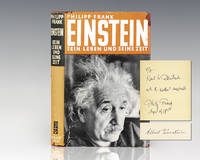
1949133215Munchen: Paul List Verlag 1949. First German edition of this classic work by Frank a famed contemporary of Einstein. Octavo original cloth. Signed by Albert Einstein on the slip to the title page and inscribed by the author on the front free endpaper "To Karl W. Deutsch with the author's compliments Philipp Frank August 10 1950." Philipp Frank was a physicist mathematician and also a philosopher during the first half of the 20th century. He was a logical-positivist and a member of the Vienna Circle. He was influenced by Mach and was one of the Machists criticised by Lenin in Materialism and Empirio-criticism. He studied physics at the University of Vienna and graduated in 1907 with a thesis in theoretical physics under the supervision of Ludwig Boltzmann. Albert Einstein recommended him as his successor for a professorship at the German Charles-Ferdinand University of Prague a position which he held from 1912 until 1938. Very good in a good dust jacket. Much has been written about Albert Einstein technical and biographical but very little remains as valuable as this unique hybrid of a book written by Einstein's colleague and contemporary. Both rich in personal insights and grounded in a deep knowledge of twentieth-century science Phillip Frank's biography anchors the reader with a lucid overview of physics and draws an intimate portrait of the Nobel Prize–winner. Paul List Verlag hardcover