Einstein, AlbertBiblio.com
1 506 résultats
1989DADAX0691085498Princeton University Press 1989-12-01. paperback. New. 7.75x1.00x10.00. Buy with confidence. Excellent Customer Service & Return policy. Princeton University Press paperback
1998DADAX069104841XPrinceton University Press 1998-07-01. paperback. New. 8.00x1.75x10.00. Buy with confidence. Excellent Customer Service & Return policy. Princeton University Press paperback
1993DADAX0691087725Princeton University Press 1993-12-13. First Edition. hardcover. New. 8.00x2.00x10.25. Buy with confidence. Excellent Customer Service & Return policy. Princeton University Press hardcover
1997SONG0691017344Princeton University Press 1997-09-15. Revised ed. paperback. Used: Good. 7.40x1.05x9.80. Buy with confidence. Excellent Customer Service & Return policy. Princeton University Press paperback
1996DADAX0691026106Princeton University Press 1996-08-05. First Edition. paperback. New. 7.90x0.74x9.80. Buy with confidence. Excellent Customer Service & Return policy. Princeton University Press paperback
1997DADAX0691017344Princeton University Press 1997-09-15. Revised ed. paperback. New. 7.40x1.05x9.80. Buy with confidence. Excellent Customer Service & Return policy. Princeton University Press paperback
1998DADAX0691048495Princeton University Press 1998-11-09. hardcover. New. 7.82x1.48x10.32. Buy with confidence. Excellent Customer Service & Return policy. Princeton University Press hardcover
1995DADAX0691037051Princeton University Press 1995-09-01. hardcover. New. 8.00x2.00x10.50. Buy with confidence. Excellent Customer Service & Return policy. Princeton University Press hardcover
1996DADAX0691010862Princeton University Press 1996-07-08. First Edition. hardcover. New. 8.25x1.50x10.50. Buy with confidence. Excellent Customer Service & Return policy. Princeton University Press hardcover
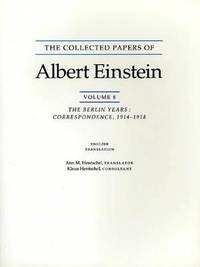
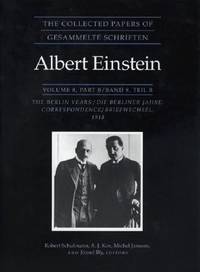
1998HS-51Princeton N.J.: Princeton University Press 1998. This volume opens in spring 1914 when Einstein takes up a research professorship at the Prussian Academy of Sciences in Berlin and closes with the collapse of the German Empire four and one-half years later. A good portion of the documentation which comprises more than 675 letters has only recently been discovered by the editors. The letters touch on all aspects of Einstein's activities and shed new light on his inner life including the breakup of Einstein's first marriage and the divorce are presented here for the first time in all their complexity. New material shows Einstein maintaining a strong sense of moral urgency throughout the war. The scientific correspondence documents Einstein's struggle to find satisfactory field equations for his new gravitational theory--the general theory of relativity--and his continued discussion with leading physicists and mathematicians about the implications and further development of the theory. 714 pgs. Illustrated. Minimal shelfwear. First Edition. Soft Cover. Fine. 4to - over 9¾" - 12" tall. Princeton University Press Paperback
1998158421London: Princeton U. P. 1998. 1st edition. As New. large octavo. hardback with dust jacket xxviii 593-1118pp. appendix bibliog. index Letters are in German but all curated & annotated in ENGLISH Princeton U. P. hardcover
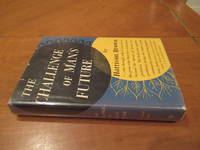
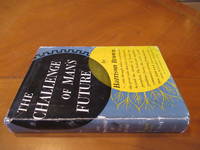
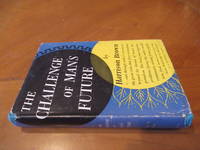
1954052515New York: Viking 1954. 1st Edition 1st Printing. Hardcover. Fine/Very Good Jacket. Xii 290 Pp. Turquoise Cloth Spine Gilt. First Printing Indicated. Fine No Marks Gilt Brilliant. Dust Jacket Priced $3.75 Slight Usage. Dust Jacket Blurbs By William O. Douglas Robert M. Hutchins Paul B. Sears Harold C. Urey Albert Einstein H. J. Muller; Brown Was An Outstanding Scientist Himself; But Few World Politicians Or Business Leaders 1946 To Present Ever Tried To Seriously Address These Issues Apparently Because They're Not There Primarily For The General Welfare. Harrison Scott Brown 1917 - 1986 Was An American Nuclear Chemist And Geochemist. He Was A Political Activist Who Lectured And Wrote On The Issues Of Arms Limitation Natural Resources And World Hunger. During World War Ii Brown Worked At The Manhattan Project's Metallurgical Laboratory And Clinton Engineer Works Where He Worked On Ways To Separate Plutonium From Uranium. The Techniques He Helped Develop Were Used At The Hanford Site To Produce The Plutonium Used In The Fat Man Bomb Dropped On Nagasaki. After The War He Lectured On The Dangers Of Nuclear Weapons. After The War He Worked At The University Of Chicago Where He Pioneered Nuclear Geochemistry. The Study Of Meteorites By Brown And His Students Led To The First Close Approximation Of The Age Of The Earth And The Solar System. In 1948 Brown Was Awarded The American Association For The Advancement Of Science Prize For His Work On Meteorites.Between 1951 And 1977 He Worked At The California Institute Of Technology Caltech Where He Contributed To Advances In Telescopic Instrumentation Jet Propulsion And Infrared Astronomy. While There He Attracted Several Former Colleagues And Highly Regarded Scientists To The Team. Together They Made Advancements In Telescopic Instrumentation Jet Propulsion Contributing To Nasa's Early Planetary Exploration Missions And Infrared Astronomy. In June 1954 He Was One Of Twenty Scientists Under The Age Of Forty Identified By Fortune Magazine As "Top Young Scientists In U. S. Universities And Industry". In The Early 1970S He Began Working More Directly On The Resource/Environment Issues That He Had Been Developing In His Books. In 1977 He Became Director Of The Newly Created Resource Systems Institute Of The East-West Center In Hawaii Where He Turned Full Time To Work On Understanding And Influencing The Interactions Of Energy Mineral And Food Systems In The Asia-Pacific Region Themes He Had Developed In His Books Since The 1950S. <br/> <br/> Viking hardcover
1954052602New York: Viking 1954. 1st Edition 1st Printing. Hardcover. Good/Fair. Xii 290 Pp. Turquoise Cloth Spine Gilt. First Printing Indicated. Light Wear Gilt Brilliant Faint Dampstainig To Cloth. Dust Jacket Priced $3.75 Very Worn Dampstainied Extensive Tape Repairs To Inside Of Jacket Fair Only. Dust Jacket Blurbs By William O. Douglas Robert M. Hutchins Paul B. Sears Harold C. Urey Albert Einstein H. J. Muller; Brown Was An Outstanding Scientist Himself; But Few World Politicians Or Business Leaders 1946-Present Out Of Hundreds Of Thousands Ever Tried To Seriously Address These Issues Apparently Because They're Not There For The General Welfare. Harrison Scott Brown 1917 - 1986 Was An American Nuclear Chemist And Geochemist. He Was A Political Activist Who Lectured And Wrote On The Issues Of Arms Limitation Natural Resources And World Hunger. During World War Ii Brown Worked At The Manhattan Project's Metallurgical Laboratory And Clinton Engineer Works Where He Worked On Ways To Separate Plutonium From Uranium. The Techniques He Helped Develop Were Used At The Hanford Site To Produce The Plutonium Used In The Fat Man Bomb Dropped On Nagasaki. After The War He Lectured On The Dangers Of Nuclear Weapons. After The War He Worked At The University Of Chicago Where He Pioneered Nuclear Geochemistry. The Study Of Meteorites By Brown And His Students Led To The First Close Approximation Of The Age Of The Earth And The Solar System. In 1948 Brown Was Awarded The American Association For The Advancement Of Science Prize For His Work On Meteorites.Between 1951 And 1977 He Worked At The California Institute Of Technology Caltech Where He Contributed To Advances In Telescopic Instrumentation Jet Propulsion And Infrared Astronomy. While There He Attracted Several Former Colleagues And Highly Regarded Scientists To The Team. Together They Made Advancements In Telescopic Instrumentation Jet Propulsion Contributing To Nasa's Early Planetary Exploration Missions And Infrared Astronomy. In June 1954 He Was One Of Twenty Scientists Under The Age Of Forty Identified By Fortune Magazine As "Top Young Scientists In U. S. Universities And Industry". In The Early 1970S He Began Working More Directly On The Resource/Environment Issues That He Had Been Developing In His Books. In 1977 He Became Director Of The Newly Created Resource Systems Institute Of The East-West Center In Hawaii Where He Turned Full Time To Work On Understanding And Influencing The Interactions Of Energy Mineral And Food Systems In The Asia-Pacific Region Themes He Had Developed In His Books Since The 1950S. <br/> <br/> Viking hardcover
1954052601New York: Viking 1954. 1st Edition 1st Printing. Hardcover. Fine/Good. Xii 290 Pp. Turquoise Cloth Spine Gilt. First Printing Indicated. Near Fine No Marks Gilt Brilliant Bumping To Spine Ends. Dust Jacket Priced $3.75 Wear Chipping At Corners Short Edge Tears Good Only. Dust Jacket Blurbs By William O. Douglas Robert M. Hutchins Paul B. Sears Harold C. Urey Albert Einstein H. J. Muller; Brown Was An Outstanding Scientist Himself; But Few World Politicians Or Business Leaders 1946-Present Out Of Hundreds Of Thousands Ever Tried To Seriously Address These Issues Apparently Because They're Not There For Our General Welfare. Per Wikipedia Harrison Scott Brown 1917 - 1986 Was An American Nuclear Chemist And Geochemist. He Was A Political Activist Who Lectured And Wrote On The Issues Of Arms Limitation Natural Resources And World Hunger. During World War Ii Brown Worked At The Manhattan Project's Metallurgical Laboratory And Clinton Engineer Works Where He Worked On Ways To Separate Plutonium From Uranium. The Techniques He Helped Develop Were Used At The Hanford Site To Produce The Plutonium Used In The Fat Man Bomb Dropped On Nagasaki. After The War He Lectured On The Dangers Of Nuclear Weapons. After The War He Worked At The University Of Chicago Where He Pioneered Nuclear Geochemistry. The Study Of Meteorites By Brown And His Students Led To The First Close Approximation Of The Age Of The Earth And The Solar System. In 1948 Brown Was Awarded The American Association For The Advancement Of Science Prize For His Work On Meteorites.Between 1951 And 1977 He Worked At The California Institute Of Technology Caltech Where He Contributed To Advances In Telescopic Instrumentation Jet Propulsion And Infrared Astronomy. While There He Attracted Several Former Colleagues And Highly Regarded Scientists To The Team. Together They Made Advancements In Telescopic Instrumentation Jet Propulsion Contributing To Nasa's Early Planetary Exploration Missions And Infrared Astronomy. In June 1954 He Was One Of Twenty Scientists Under The Age Of Forty Identified By Fortune Magazine As "Top Young Scientists In U. S. Universities And Industry". In The Early 1970S He Began Working More Directly On The Resource/Environment Issues That He Had Been Developing In His Books. In 1977 He Became Director Of The Newly Created Resource Systems Institute Of The East-West Center In Hawaii Where He Turned Full Time To Work On Understanding And Influencing The Interactions Of Energy Mineral And Food Systems In The Asia-Pacific Region Themes He Had Developed In His Books Since The 1950S. <br/> <br/> Viking hardcover
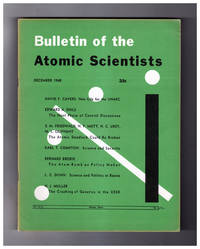
194863618Chicago: Atomic Scientists of Chicago 1948. 1st Edition 1st Printing. Soft cover. Very Good. 4to - over 9¾ - 12" tall. Very Good; see scans and description. Chicago: Atomic Scientists of Chicago 1948. The December1948 issue of The Bulletin of the Atomic Scientists. The famous and historic Doomsday Clock - shown on each cover since 1947 two years after the publication's inception - here shows the time to be eight minutes of midnight as of December1948. Quarto illustrated staple-bound wraps 32 pp. pages 353 through 384 for the annual volume monthly pages then being numbered after the fashion of the time. A strong Very Good; moderate sunning at edges of covers otherwise no notable flaws whatever see scans. Very light inevitable age-toning to the pages. A handsome example; see all scans. Established in 1945 by biophysicist Eugene Rabinowitch and physicist Hyman Goldsmith in response to a correctly-perceived demand for nuclear information at the time by the general public The Bulletin of the Atomic Scientists is without doubt the most historically significant non-technical publication on the subject of "'global security and public policy issues related to the dangers posed by nuclear and other weapons of mass destruction climate change2 and emerging technologies and diseases". Hence over the years BAS has become a geopolitical instrument rather than a nuclear watchdog alone. Feature articles in this vintage 1948 issue: Message from Albert Einstein; UNAEC; International Control Discussions; Crushing of Genetics in the USSR; Atomic Deadlock; Russian Science & Politics. Writers include Albert Einstein; David F. Cavers; Edward A. Shils; E.M. Friedwald N.F. Mott H.C. Urey M.L. Oliphant; L.C. Dunn; H.J. Muller; Sir Alfred Zimmern; Karl T. Compton; Bernard Brodie. See scan of contents. Very very scarce as the original monthly softcover issue. Ships in a new sturdy protective box - not a bag. LPR48 <br/> <br/> Atomic Scientists of Chicago paperback
1971046762New York: Walker & Company 1971. 1st Edition 1st Printing. Hardcover. Near Fine/Very Good. Xi 240 Pp. First Printing. Near Fine Book No Marks. Dj Priced $8.50 Light Wear <br/> <br/> Walker & Company hardcover
1953137755New York: Dell Publishing 1953. First Edition. First Edition a paperback original. Basis for the 1956 film noir "While the City Sleeps" directed by Fritz Lang and starring George Sanders and Dana Andrews. <br/><br/>Near Fine in illustrated wrappers. Dell Publishing unknown books
1980Q-0690018983Lippincott & Crowell 1980-01-01. Hardcover. New. In shrink wrap. Looks like an interesting title! Lippincott & Crowell hardcover
1944556012New York: The American Christian Palestine Committee 1944. Softcover. Very Good. First separate edition. Small octavo. 12pp. Stapled self-wrappers. Slight age-toning on the wrappers and very tiny nicks soiling and light wear very good or better. Two articles jointly written by Einstein and Kahler in response to two articles laying out anti-Zionist testimony given by Dr. Philip Hitti of Princeton before the Committee on Foreign Affairs of the House of Representatives. Both of Hitti's articles and the Einstein and Kahler articles were all published in The Princeton Herald. This publication doesn't include the Hitti articles but summarizes them in the Einstein and Kahler rejoinders. Scarce. The American Christian Palestine Committee unknown
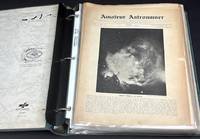
1936H40351New York: Amateur Astronomers Association 1936. Very good. Old cloth 3-ring binder with acetate sheaths containing the issues. This started out as a 4 pp. periodical but expanded in later issues. In 1936 the journal merged with The Sky published by Hayden Planetarium which subsequently merged with The Telescope in 1941 to become Sky & Telescope which is still being published. Condition is mainly very good although the first three issues we have have some damage to fore-edges. The first issue has a supplementary sheet laid in "Professor Einstein Sends Greetings to the Amateur Astronomers Association" reprinting in facsimile the handwritten note with a printed translation and a facsimile of another note from Einstein. We have Vol. I nos. 1 & 2 April and May 1929; Vol. 2 nos. 1 September 1929 - 9 May-June 1930 -- the April 1930 issue has a cover story on the discovery of Pluto then considered the ninth planet. Pluto was first discovered on February 18 1930 by Clyde Tombaugh at the Lowell Observatory in Flagstaff Arizona.The discovery was announced on March 13 1930 in the Astronomical Journal.; Vol. III nos. 1 October-November 1930 - 7/8 May-June 1931; Vol. IV nos. 1 September-October 1931 - 8 Summer 1932; Vol. V nos. 1 September-October 1932 - 3 March 1933 -- these expanded to 6 pp. each; Vol. VI nos. 1 - 3 Winter & Spring 1933-1934 - Summer 1934 -- beginning with Vol. VI these are 16 pp. each; with the Spring issue cover story on Hayden Planetarium; Vol. VII nos. 1 Autumn 1934 - 3 Spring 1935; Vol. VIII nos. 1 Autumn 1935 - 3 Spring 1936. We don't know if we're missing any or not but it's a nice early run of this rare astronomical journal. Amateur Astronomers Association unknown
1986101454Cambridge University Press Malicorne sur Sarthe, 72, Pays de la Loire, France 1986 Book condition, Etat : Bon paperback, editor's red wrappers grand In-8 1 vol. - 362 pages
1944182569London: The Jewish Agency for Palestine 1944. First separate edition of Einstein's appeal for Zionism. Einstein was one of the most prominent international supports of Zionism. He argues Palestine is the only place historically spiritually and culturally tied to the Jewish people. Whereas the Arabs with many homelands the Jews have nowhere else to go. Their claims are rooted not in conquest or nationalism but in justice and survival. The article was originally published in the Princeton Herald earlier that year. This publication prints the article alongside other speeches and letters by Einstein extracted from his 1930 About Zionism. Provenance: Jews' College Library London with their shelf mark to the front wrapper and their stamp to the front wrapper verso. Octavo. Original wrappers. Library markings see note a little creased and spotted. A good copy. unknown
19212545920Madrid. 1921. Hardcover. Cubierta deslucida. Good. 24 cm. 79 p. Encuadernación en tapa dura artesanal con lomo en piel. Einstein Albert 1879-1955. Über die spezielle und die allgemeine Relativitätstheorie. Traducida de la 12ª ed. alemana por F. Lorente de Nó. Imp. de Suc. de S. Peláez. Relatividad Física . Cubierta deslucida. Física.530.12 530 hardcover
19212827000Madrid.: S.n. 1921. Paperback. Good. 24 cm. 79 p. Encuadernación en tapa blanda artesanal. Einstein Albert 1879-1955. Über die spezielle und die allgemeine Relativitätstheorie. Traducida de la 12ª ed. alemana por F. Lorente de Nó. Imp. de Suc. de S. Peláez. Relatividad Física . Física.530.12 530 [S.n.]. paperback
1922R5312Berlin: Slovo 1922. Third edition. Paperback. Good. Original wraps; pp. 152 with frontispiece portrait of the author and his preface to the Russian edition. Front cover and endpaper detached but present; cheap paper tanned along the edges and a bit brittle. <br/><br/> Slovo paperback books