1 506 résultats
197926555ABerlin, 1979. Doppelblatt, 5 (von ursprünglich 8) Original-Grafiken. Ca. 49,5 x 49,5 cm (Blattformat der Grafiken). Original-Halbleinenflügelmappe.
199631980Dietramszell, Ehlers-Verlag, 1996. 4°, 118 S.; mit zahlreichen s/w u. farb. Abb., Zeichnungen, Grafiken, Bezahlung per PayPal möglich, we accept PayPal, Aufkleber a. Vordereinband, Einb. ger. beschabt und angeschmutzt, altersbed. Bräunungen, ger. Gebr.sp., geheftet
1935129649Praha 1935. 101, (3) Seiten und 9 Kunstdrucktafeln mit 16 Abbildungen. Originalbroschur. (Geringere Gebrauchsspuren). 17x11 cm
1964101331Gauthier-Villars, éditeur à Paris Malicorne sur Sarthe, 72, Pays de la Loire, France 1964 Book condition, Etat : Bon broché, sous couverture imprimée éditeur grise grand In-8 1 vol. - 99 pages
1976R160222012Gauthier-villars. 1976. In-8. Broché. Bon état, Couv. convenable, Dos satisfaisant, Intérieur frais. 96 pages.. . . . Classification Dewey : 500-SCIENCES DE LA NATURE ET MATHEMATIQUES
1971RO40230124Gauthier-Villars. 1971. In-8. Broché. Bon état, Couv. convenable, Dos satisfaisant, Intérieur frais. 96 pages.. . . . Classification Dewey : 530-Physique
1945007988Paris: Gauthier-Villars 1945. Small repairs at spine ends; library ink stamp on front flyleaf; embossed stamp on title page. First Edition in French. Original Printed Wrappers. Good Plus. Gauthier-Villars Paperback
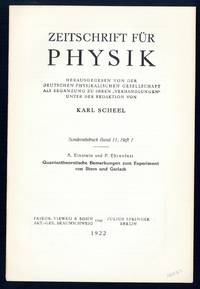
1922432871922. <p>Einstein Albert 1879-1955 and Paul Ehrenfest 1880-1933. Quantentheoretische Bemerkungen zum Experiment von Stern und Gerlach. Offprint from Zeitschrift für Physik 11 1922. 31-34pp. 229 x 155 mm. Original printed self-wrappers. Light toning but fine otherwise. </p> <p>First Edition Offprint Issue. In 1922 the physicists Otto Stern and Walther Gerlach conducted a now-classic experiment in which a beam of silver atoms was streamed through an inharmonious magnetic field in order to observe the atoms' deflection patterns. Rather than a random and continuous distribution as predicted by classical theory the atoms passing through the field were deflected up or down by a specific amount demonstrating that they had intrinsically quantum properties. The Stern-Gerlach experiment corroborated the Bohr-Sommerfeld model of the atom and strongly influenced later developments in 20th century physics. However the experiment also created some serious difficulties for quantum physicists in the period before the rise of the "new" quantum mechanics. </p> <p>Einstein and Ehrenfest addressed one of these difficulties—connected with space quantization—in their joint paper in which </p> <p>"they dealt in particular with the problem of how the orbits of the atom would obtain their discrete directions which they exhibit while passing through the inhomogeneous magnetic field. Under the assumption that the mechanism causing the orientation was provided by the interaction with the radiation field Einstein and Ehrenfest estimated that for a field strength of 10000 G a change in the direction of the orbit would take place in roughly 1011 s; this long time interval would be reduced in the presence of heat radiation at room temperature . . . to about 109 s. How could they asked the experimental situation be explained which implied that the discrete orientations of the orbits in silver atoms were obtained in less than 10-4 s. In order to deal with this evident puzzle Einstein and Ehrenfest proposed two alternatives: first that the silver atoms were always in the states of spatial quantization; second the orientations of the electron orbits arose from an interaction of the atoms with the radiation field which involved much smaller reaction times . . . However they found that both alternatives created considerable difficulties in the understanding of the atomic processes . . . Thus Einstein and Ehrenfest concluded: 'The difficulties mentioned above show how unsatisfactory are both interpretations of the results found by Stern and Gerlach'" Mehra & Rechenberg The Historical Development of Quantum Theory 1 pp. 443-444. </p> <p>Pais Subtle is the Lord p. 328. Weil Albert Einstein Bibliography 121.</p> . unknown books
1922432871922. <p>Einstein Albert 1879-1955 and Paul Ehrenfest 1880-1933. Quantentheoretische Bemerkungen zum Experiment von Stern und Gerlach. Offprint from Zeitschrift für Physik 11 1922. 31-34pp. 229 x 155 mm. Original printed self-wrappers. Light toning but fine otherwise. </p> <p>First Edition Offprint Issue. In 1922 the physicists Otto Stern and Walther Gerlach conducted a now-classic experiment in which a beam of silver atoms was streamed through an inharmonious magnetic field in order to observe the atoms' deflection patterns. Rather than a random and continuous distribution as predicted by classical theory the atoms passing through the field were deflected up or down by a specific amount demonstrating that they had intrinsically quantum properties. The Stern-Gerlach experiment corroborated the Bohr-Sommerfeld model of the atom and strongly influenced later developments in 20th century physics. However the experiment also created some serious difficulties for quantum physicists in the period before the rise of the "new" quantum mechanics. </p> <p>Einstein and Ehrenfest addressed one of these difficulties-connected with space quantization-in their joint paper in which </p> <p>"they dealt in particular with the problem of how the orbits of the atom would obtain their discrete directions which they exhibit while passing through the inhomogeneous magnetic field. Under the assumption that the mechanism causing the orientation was provided by the interaction with the radiation field Einstein and Ehrenfest estimated that for a field strength of 10000 G a change in the direction of the orbit would take place in roughly 1011 s; this long time interval would be reduced in the presence of heat radiation at room temperature . . . to about 109 s. How could they asked the experimental situation be explained which implied that the discrete orientations of the orbits in silver atoms were obtained in less than 10-4 s. In order to deal with this evident puzzle Einstein and Ehrenfest proposed two alternatives: first that the silver atoms were always in the states of spatial quantization; second the orientations of the electron orbits arose from an interaction of the atoms with the radiation field which involved much smaller reaction times . . . However they found that both alternatives created considerable difficulties in the understanding of the atomic processes . . . Thus Einstein and Ehrenfest concluded: 'The difficulties mentioned above show how unsatisfactory are both interpretations of the results found by Stern and Gerlach'" Mehra & Rechenberg The Historical Development of Quantum Theory 1 pp. 443-444. </p> <p>Pais Subtle is the Lord p. 328. Weil Albert Einstein Bibliography 121.</p> . unknown
1996x-0805815368Lawrence Erlbaum Assoc Inc 1996. Hardcover. New. 1st edition. 440 pages. 9.50x6.50x1.25 inches. Lawrence Erlbaum Assoc Inc hardcover
1995Q-0805815368Psychology Press 1995-12-01. Hardcover. New. New. In shrink wrap. Looks like an interesting title! Psychology Press hardcover
193173651-A-64388Berlin: Propyläen 1931. Signed by Johan Dijkstra on the title page. Cloth binding gilted. Many tipped-in ills in color and many ills in b/w. 655 p. -Boards worn around the edges dedication in ink on the fly-leaf but otherwise the book is in very good condition. Johan Dijkstra 1896-1978 was a Dutch artist and one of the foudners of Groninger Kunstkring De Ploeg. Propyläen hardcover
1932623893New York: Frederick A. Stokes 1932. Hardcover. Fine/Very Good. First edition. Introduction by Stanley Walker. Octavo. 261pp. Fine in very good or better dust jacket with modest shallow chipping mostly on the spine ends and several small tears. One of the great accounts of prohibition and law enforcement described on the jacket as "the startling and humorous disclosures of America's most famous prohibition agent." The printed dedication is "To the 4932 persons I arrested hoping they bear me no grudge for having done my duty." Einstein describes himself in the book and on the jacket as a "Former Prohibition Sleuth. Jackie Gleason played Einstein in the 1985 TV movie Izzy & Moe alongside Art Carney in their final screen appearance together as his partner Agent Moe Smith. Exceptionally uncommon in jacket; we've only seen one other copy thus. Frederick A. Stokes hardcover
1981400909Cambridge: Massachusetts Institute of Technology 1981. Hardcover. Very Good/No Jacket. Hardcover; 553 pages. Scarce. Red cloth hardcovers with gilt titles on cover and spine. Minor edgewear. Previous owner's name inked on outside page ends stamp on ffep. Pages white flat unmarked. VERY GOOD <br/> <br/> Massachusetts Institute of Technology hardcover
191840496(Leipzig, Johann Ambrosius Barth, 1918). Without wrappers as extracted from ""Annalen der Physik"", Vierte Folge, Bd. 55, Heft 4. The whole number present, pp. (241)-336. Einsteins paper, pp. (241)-244.
191850342Leipzig 1918. Prinzipielles zur allgemeinen relativitätstheorie. In Annalen der Physik 55 241-244 pp. Red cloth with gilt lettering on the spine. Bookbinder's embossed stamp of ffep. Whole volume: 632 pp. 1 folding plate. Figs. Text-illust. 210 x 130 mm. Very good. Approximate English translation of title: "On the foundations of the general theory of relativity."</p> <br /> <br /> <p> "Here we are given the first new presentation of the foundations of general relativity since the developments of March 1916 when Einstein gave his first systematic exposition." p. 300. Calaprice Kennefick & Shulmann. An Einstein Encyclopedia. 2015. </p> <br /> <br /> <p>Weil's Einstein Bibliography no. 96. <br> Boni's Checklist no. 100.</p> <br /> <br /> <p>Also in this volume: Born Max 1882-1970. Elektronentheorie des Natürlichen optischen Drehungs vermögens isotroper und anisotroper Flüssigkeiten pp. 175-240. Approximate Eng. translation of title: "Electron theory of the natural optical rotation ability of isotropic and anisotropic liquids". Max Born 1882-1970 was a German physicist and mathematician who was instrumental in the development of quantum mechanics. He also made contributions to solid-state physics and optics as well as supervised a number of notable physicists in the 1920s and 1930s. Born won the 1954 Nobel Prize in Physics "for his fundamental research in quantum mechanics especially in the statistical interpretation of the wave function." In 1919 a chance meeting with Fritz Haber 1868-1934 led to the discussion of how an ionic compound is formed when a metal reacts with a halogen - a process now known as the Born-Haber cycle Wikipedia. </p> . unknown
191840496Leipzig Johann Ambrosius Barth 1918. Without wrappers as extracted from "Annalen der Physik" Vierte Folge Bd. 55 Heft 4. The whole number present pp. 241-336. Einsteins paper pp. 241-244. <br/><br/><em>First printing the periodical form. Einstein believed around 1918 "in the relativity of inertia that in 1918 in the paper offered he stated as being on equal footing three principles on which a satisfactory theory of gravitation should rest: 1. The principle of relativity as expressed by general covarianc. 2. The principle of equivalence. 3. Mach's principle the first time this term entered the literature: 'Das G-Feld ist 'restlos' durch die Massen der Körper bestimmt.' that is the g. are completely determined by the mass of bodies more generally bu T."Pais The Science of Albert Einstein p.287. - Weil:96. - Boni: 100. </em> unknown
1918581Leipzig: Johann Ambrosius Barth 1918. 1st Edition. FIRST EDITION OF EINSTEIN'S DISCUSSION OF MACH'S PRINCIPLE a theory Einstein names and one which was historically important to the inspiration that would lead to general relativity. Mach's principle states that "local physical laws are determined by the large-scale structure of the universe" Wikipedia. To Einstein Mach's principle posited the belief that inertia originates in a kind of interaction between bodies. <br /> <br /> "So strongly did Einstein believe at that time in the relativity of inertia that in this paper he stated it as being on equal footing three principles on which a satisfactory theory of gravitation should rest: 1. The principle of relativity as expressed by general covariance. 2. The principle of equivalence. 3. Mach's principle the first time this term entered the literature" Pais The Science of Albert Einstein 287. <br /> <br /> Einstein brought Mach's principle into mainstream physics while working on general relativity. Indeed it was Einstein who first coined the phrase Mach's principle. Weil 96. Boni 100. Collected Papers 1918e. <br /> <br /> ALSO IN THIS VOLUME Max Born's Electron theory of natural optic rotation processes in isotropic and anisotropic liquids pp. 177-240. CONDITION & DETAILS: Leipzig: Johann Ambrosius Barth. 8vo. 8 x 5 inches; 200mm x 125mm; Full volume with front original wrap of each issue 1-8 is bound in the rear. Handsomely rebound in three-quarter calf over marbled paper boards; four raised bands at the spine; gilt-lettered and tooled. Very tightly bound. Ex-libris with five numbers written in a light hand on the title page and a very occasional round stamp within. Very good condition. Johann Ambrosius Barth hardcover
195286694NY:: Dover Publications. Good. 1952. Paperback. With notes by A. Sommerfield. Translated from the German by W. Perrett and G. B. Jeffery. With seven diagrams. First edition thus paperback. Covers are age darkened with a few corner creases else good in printed wraps.; 216 pages . Dover Publications, paperback books
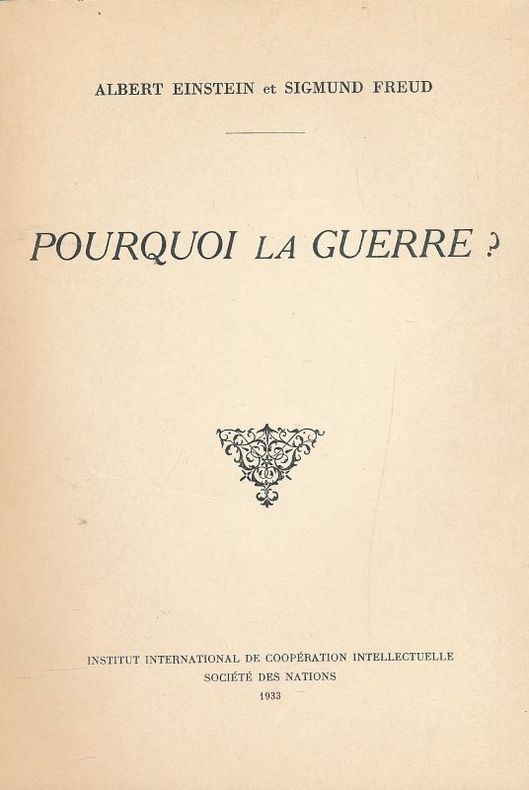
1933316570Paris: Institut International de Cooperation Intellectuelle. Societe des Nations 1933. One of 3000 copies on Chataignier paper. 62 1 1 blank 1 imprint. Printed in Dijon by Darantière. 1 vols. 8vo. Printed wrappers. Loose in binding spine toned and scuffed internally clean. Very good. One of 3000 copies on Chataignier paper. 62 1 1 blank 1 imprint. Printed in Dijon by Darantière. 1 vols. 8vo. Published simultaneously in French English and German. Institut International de Cooperation Intellectuelle. Societe des Nations unknown books
1933144376Société des Nations Institut Société des Nations Institut de Coopération Intellectuelle, 1933. Collection correspondance à tirage limité, In-8 broché, couverture à rabats de 63 pages. Exemplaire N° 113 imprimé sur papier de Châtaignier. Très petite déchirure sans manque à la charnière en queue et infimes salissures sans aucune gravité, corps de l'ouvrage en très bel état, absence totale de taches ou rousseurs.. Correspondance entre les deux grands hommes à la demande de l'Institut de Coopération Intellectuelle pour le dialogue au service de la paix. Le titre de la publication fût choisi par S. Freud. Bel exemplaire, rare dans cette condition
193319458Geneva: Institut International De Cooperation Intellectuelle 1933 French language first edition. This rare and virtually impossible book in hardcover to find is a first edition written by Albert Einstein and Sigmund Freud from a letter exchange they had as a plea for no war again in Europe. It was published in 1933 simultaneously in English Why War French and German for a total printing of 3000 copies. The 2000 copies in German were seized by Adolf Hitler and the Nazis in 1933 and banned for sale and distribution and were burned. This is an extremely rare book and is only seen in a reprint. This is the French first edition published in Geneva Switzerland in 1933. Green woven cloth exterior with small black spine label in near fine unmarked condition. "Einstein-Freud Pourquoi La Guerre" on spine label. This copy was found in a bookstall in 2009 in Rome Italy. This book is copy No 392 /3000. First Edition. Hardcover. Very Good. Institut International De Cooperation Intellectuelle hardcover
19482327Princeton NJ: np 1948. framed. Fine. ONE OF THE MOST CELEBRATED IMAGES OF EINSTEIN SIGNED BY MASTER PHOTOGRAPHER YOUSUF KARSH. On February 11 1948 Yousuf Karsh perhaps the most accomplished portrait photographer of his generation visited The Institute for Advanced Study in Princeton to fulfill a dream of his: to photograph Albert Einstein. As he later explained: "Among the tasks that life as a photographer had set me a portrait of Albert Einstein had always seemed a 'must' - not only because this greatest refugee of our century has been accounted by all the world as the most outstanding scientist since Newton but because his face in all its rough grandeur invited and challenged the camera." Karsh: Beyond the Camera David Travis ed. "At Princeton's Institute for Advanced Study I found Einstein a simple kindly almost childlike man too great for any of the postures of eminence. One did not have to understand his science to feel the power of his mind or the force of his personality" official Karsh website. "Awed before this unique intellect I yet ventured to ask Einstein his views on human immortality. He mused for a moment and then replied 'What I believe of immortality There are two kinds. The first lives in the imagination of people and is thus an illusion. There is a relative immortality which may conserve the memory of an individual for some generations. But there is only one true immortality on a cosmic scale ant that is the immortality of the cosmos itself. There is no other.' "He spoke of these ultimate mysteries as calmly as he might a student's question about mathematics - with such an air of quiet confidence indeed that I found his answer profoundly disturbing to one who held other views. Knowing him to be an accomplished violinist I turned the conversation and asked if there were any connection between music and mathematics. 'In art he said 'and in the higher ranges of science there is a feeling of harmony which underlies all endeavour. There is no true greatness in art or science without that sense of harmony. He who lacks it can never be more than a great technician in either field.' "Was he optimistic about the future harmony of mankind itself He appeared to ponder deeply and remarked in graver tones: 'Optimistic No. But if mankind fails to find a harmonious solution than there will be disaster on a dimension beyond anyone's imagination.' To what source should we look for the hope of the world's future 'To ourselves' said Einstein. He spoke sadly yet serenely as one who had looked into the universe far past mankind's small affairs. In this humor my camera caught him. the portrait of a man who had traveled beyond hope or despair." Yousuf Karsh Regarding Heroes. Opening quote from: Colin Naylor ed. Contemporary Photographers. Silver print. Photo taken Princeton 1948. Printed later. Signed by Karsh in full beneath the image on photographer's mount. With Karsh's original calling "card" - a 4x10 inch cardboard slip - included. Image: 8x9 inches. Framed to an overall size of 12x15 inches. Fine condition. np unknown books
19482327Princeton NJ: np 1948. framed. Fine. ONE OF THE MOST CELEBRATED IMAGES OF EINSTEIN SIGNED BY MASTER PHOTOGRAPHER YOUSUF KARSH. On February 11 1948 Yousuf Karsh perhaps the most accomplished portrait photographer of his generation visited The Institute for Advanced Study in Princeton to fulfill a dream of his: to photograph Albert Einstein. As he later explained: "Among the tasks that life as a photographer had set me a portrait of Albert Einstein had always seemed a 'must' - not only because this greatest refugee of our century has been accounted by all the world as the most outstanding scientist since Newton but because his face in all its rough grandeur invited and challenged the camera." Karsh: Beyond the Camera David Travis ed. "At Princeton's Institute for Advanced Study I found Einstein a simple kindly almost childlike man too great for any of the postures of eminence. One did not have to understand his science to feel the power of his mind or the force of his personality" official Karsh website. "Awed before this unique intellect I yet ventured to ask Einstein his views on human immortality. He mused for a moment and then replied 'What I believe of immortality There are two kinds. The first lives in the imagination of people and is thus an illusion. There is a relative immortality which may conserve the memory of an individual for some generations. But there is only one true immortality on a cosmic scale ant that is the immortality of the cosmos itself. There is no other.' "He spoke of these ultimate mysteries as calmly as he might a student's question about mathematics - with such an air of quiet confidence indeed that I found his answer profoundly disturbing to one who held other views. Knowing him to be an accomplished violinist I turned the conversation and asked if there were any connection between music and mathematics. 'In art he said 'and in the higher ranges of science there is a feeling of harmony which underlies all endeavour. There is no true greatness in art or science without that sense of harmony. He who lacks it can never be more than a great technician in either field.' "Was he optimistic about the future harmony of mankind itself He appeared to ponder deeply and remarked in graver tones: 'Optimistic No. But if mankind fails to find a harmonious solution than there will be disaster on a dimension beyond anyone's imagination.' To what source should we look for the hope of the world's future 'To ourselves' said Einstein. He spoke sadly yet serenely as one who had looked into the universe far past mankind's small affairs. In this humor my camera caught him. the portrait of a man who had traveled beyond hope or despair." Yousuf Karsh Regarding Heroes. Opening quote from: Colin Naylor ed. Contemporary Photographers. Silver print. Photo taken Princeton 1948. Printed later. Signed by Karsh in full beneath the image on photographer's mount. With Karsh's original calling "card" - a 4x10 inch cardboard slip - included. Image: 8x9 inches. Framed to an overall size of 12x15 inches. Fine condition. np unknown