Einstein, AlbertBiblio.com
1 506 résultats
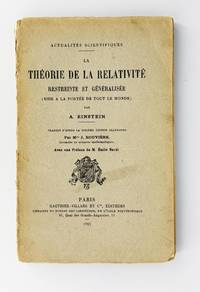
1921009633Paris: Gauthier-Villars 1921 12mo 19 cm XXII 120 pp. Printed wrappers wrappers slightly stained and frayed; small portions of paper missing from the spine; paper toned inside. Early French edition of Einstein's celebrated popular exposition of the theory of relativity intended to make the fundamental ideas of both the special and the general theory accessible to non-specialists. With a preface by the renowned mathematician Émile Borel who emphasizes the scientific importance of Einstein's work and its profound implications for modern physics. Einstein's text explains the essential concepts of space time motion gravitation and the structure of space-time in clear largely non-technical language presenting the empirical and conceptual foundations of relativity to a broad readership. The French translation was prepared by Maurice Solovine one of Einstein's close early collaborators and an important mediator of his ideas to the French-speaking public. Boni-Russ-Laurence 91.B. Gauthier-Villars paperback
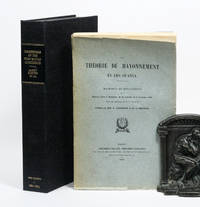
19122508Paris: Gauthier-Villars 1912. First edition. Original wrappers custom box. Very Good. RARE FIRST EDITION IN ORIGINAL WRAPPERS OF THE REPORTS FROM THE HISTORIC FIRST SOLVAY CONFERENCE "THE FIRST INTERNATIONAL CONFERENCE IN PHYSICS EVER ORGANIZED" AND A CRITICAL MOMENT IN THE BIRTH OF QUANTUM PHYSICS. In the short time that followed Planck's hypothesis of the universal constant that would bear his name the greatest minds in physics were largely at a loss about how to deal with the bizarre theoretical results that followed let alone the experimental results which confirmed them!. Much of the focus at the time was on black-body radiation including work by Planck himself as well as Lorentz Rayleigh and Jeans. However shortly before the first Solvay conference a young Einstein had also started investigating the related question of materials' specific heat. Kuhn. "The purpose of the first Solvay Conference was thus two-fold: first there was the need to examine whether classical theories molecular-kinetic theory and electrodynamics could in some undiscovered ways provide an explanation of the problem of black-body radiation and of the specific heat of polyatomic substances at low temperatures; secondly to consider phenomena in which the theory of quanta could be successfully used." Mehra.<br /> <br /> Underlying these questions was the more fundamental mystery of how to interpret the existence of the Planck constant. There were two camps both of which were represented at the conference. Planck's took the constant to indicate some fundamental constraint on the radiative processes of emission and absorption. For example "Sommerfeld introduced a version of the quantum hypothesis which he considered to be compatible with classical electrodynamics. He postulated that in 'every purely molecular process' a quantized quantity of action is exchanged." Staumann. Einstein's camp on the other hand took the quantum of action to represent the physicality of a perhaps pseudo-corpuscular theory of energy exchange - his photons of light.<br /> <br /> Although the debates that followed the lectures included in the proceedings did not rise to the famous heated exchange that Einstein would have with Bohr at the 1927 Solvay conference we do see some of the young Einstein's hotheadedness as he opens the debate following Planck's plenary lecture: "What I find strange about the way Mr. Planck applies Boltzmann's equation is that he introduces a state probability W without giving this quantity a physical definition. If one proceeds in such a way then to begin with Boltzmann's equation does not have a physical meaning." As translated by Straumann.<br /> <br /> It would take another 14 years for quantum mechanics to be fully formalized but the first Solvay conference represents a pivotal point in quantum history:<br /> <br /> "During 1911 the situation changed quickly. Articles that applied the quantum to other topics then outnumbered those on blackbody radiation for the first time and some were backed by impressive experimental evidence. In part because of that evidence physicists like Planck and Lorentz who had previously taken the constant h to be characteristic only of the radiation problem began to consider additional areas in which others had earlier staked quantum claims." Kuhn.<br /> <br /> Albert Einstein and the Solvay Conference:<br /> <br /> Among the most renown scientists of the day - including Ernest Rutherford Marie Curie and Max Planck - Einstein made quite an impression. At age 32 he was the second youngest participant in the conference. The youngest was British physicist Frederick Lindemann later to become scientific adviser to Winston Churchill.<br /> <br /> Although "Einstein had already published so many masterpieces none had actually been put to the test and his theories were looked on rather as tours de force than as definitive additions to knowledge. But his pre-eminence among the twelve greatest theoretical physicists of the day was clear to any unprejudiced observer." Frederick Lindemann quoted in Brian.<br /> <br /> References: Headline quote from the Solvay Institute website. Kuhn T. 1978 Black Body Theory and the Quantum Discontinuity 1894-1912. University of Chicago Press. Mehra J. 1975 The Solvay Conferences on Physics: Aspects of the Development of Physics Since 1911. Straumann N. 2011. On the first Solvay Congress in 1911. The European Physical Journal H 363 379-399. Denis Brian Einstein: A Life p.82.<br /> <br /> Paris: Gauthier-Villars 1912. Octavo original wrappers; custom box. Splits to top and bottom joint of upper wrapper two creases to front wrapper. Text in fine condition largely unopened. <br /> <br /> FIRST PRINTINGS IN ORIGINAL WRAPPERS ARE EXTREMELY SCARCE. Gauthier-Villars unknown
19502946629Buenos Aires.: Emecé. 1950. Hardcover. Cubierta deslucida. Good. 19 cm. 215 p. Encuadernación en tapa dura de editorial. Cubierta deslucida. Física.530.12 530 Emecé. hardcover
192230290Paris: Payot 1922. Fine. Payot Paris 1922 12 x 19 cm broché First edition. A nice copy. Payot unknown
1921009632Paris: Gauthier-Villars 1921 8vo 22.5 cm 16 pp. Uncut in printed wrappers wrappers slightly sunned; ownership entry on the title page. French translation by Maurice Solovine of Einstein's well-known 1920 lecture on the concept of the ether delivered at the University of Leiden. In this brief but influential text Einstein revisits the notion of the ether in light of the general theory of relativity arguing that while the classical mechanical ether must be abandoned the relativistic description of space-time still allows one to speak of a form of 'ether' understood as the physical properties of space itself. A concise and important exposition of Einstein's evolving views on the foundations of relativity. Boni-Russ-Laurence 122.B. Gauthier-Villars paperback
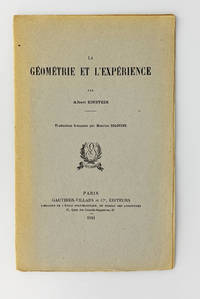
19211014Paris: Gauthier-Villars 1921. 1st Edition. FIRST FRENCH EDITION OF A 1921 LECTURE BY EINSTEIN ON THE "GEOMETRIZATION OF PHYSICS AND RELATIVITY AND THE RELATION OF MATHEMATICS TO THE EXTERNAL WORLD" Dictionary of Scientific Biography 4 330. WEIL 115b. French translation by Maurice Solovince. <br /> <br /> In the same year in which he won the Nobel Prize 1921 Einstein delivered this paper as a lecture at "a commemorative session of the Prussian Academy of Sciences in honor of Frederick the Great" Calaprice Einstein Almanac 65. In "Geometrie und Erfahrung" Geometry and Experience Einstein advances his theory that space conforms to non-Euclidean principles of geometry -- a corollary of the Theory of Relativity - and as stated generally sums up his views on the "geometrization of physics and relativity and the relation of mathematics to the external world" DSB. <br /> <br /> It is in this lecture that Einstein also provides his famous answer to the puzzling question of why mathematics should be so well adapted to describing the external world: "Insofar as the laws of mathematics refer to the external world they are not certain; and insofar as they are certain they do not refer to reality" ibid. Calaprice put it like this: "He questioned whether human reasoning even without direct experience could lead to an understanding of the properties of real things merely through thought" Calaprice 1921. CONDITION & DETAILS: Paris Gauthier-Villars. 8vo. 9 x 5.75 inches; 225 x 143mm 2 19 1. Two in-text illustrations. Very slight soiling to the front wrap. Minor chipping lower right corner. Bright and clean throughout. See photos. Gauthier-Villars unknown
192143310Paris: Gauthier-Villars 1921. 19pp. 228 x 147 mm. Original printed wrappers foxed lower corner chipped. Some toning but very good. French translation by M. Solovine of Einstein's "Geometrie und Erfahrung". Weil 115b. Gauthier-Villars unknown books
192143310Paris: Gauthier-Villars 1921. 19pp. 228 x 147 mm. Original printed wrappers foxed lower corner chipped. Some toning but very good. French translation by M. Solovine of Einstein's "Geometrie und Erfahrung". Weil 115b. Gauthier-Villars unknown
196532713Fayard 1965 in-8°
1924LFA-126720319Une plaquette de 26 pages, format 125 x 200 mm, brochée, publiée en 1924, Payot
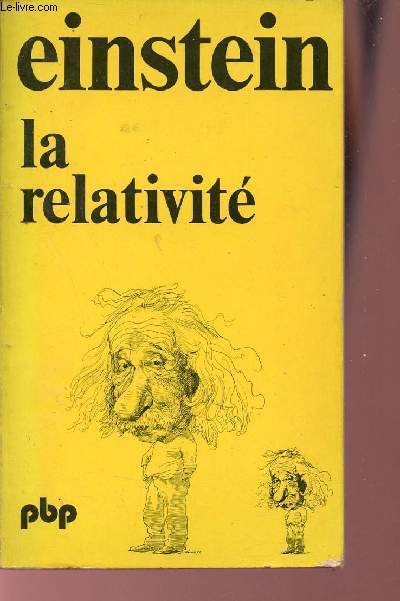
1986R160131050PETITE BIBLIOTHEQUE PAYOT N°62. 17 OCT 1986. In-12. Broché. Bon état, Couv. convenable, Dos satisfaisant, Intérieur acceptable. 179 pages. Quelques calculs en noir et blanc dans le texte.. . . . Classification Dewey : 800-LITTERATURE (BELLES-LETTRES)
1981R160156848PAYOT. 1981. In-12. Broché. Etat passable, Couv. légèrement pliée, Dos satisfaisant, Mouillures. 184 Pages - traces de mouillures sans conséquences pour la lecture. . . . Classification Dewey : 500-SCIENCES DE LA NATURE ET MATHEMATIQUES
1986R160156849PAYOT. 1986. In-12. Broché. Bon état, Couv. convenable, Dos satisfaisant, Intérieur frais. 184 Pages - Quelques formules de calculs dans le texte. . . . Classification Dewey : 500-SCIENCES DE LA NATURE ET MATHEMATIQUES
1965R160157242PAYOT. 1965. In-12. Broché. Bon état, Couv. convenable, Dos satisfaisant, Intérieur frais. 184 Pages. . . . Classification Dewey : 530-Physique
1964R160157244PAYOT. 1964. In-12. Broché. Bon état, Couv. convenable, Dos satisfaisant, Intérieur frais. 184 Pages. . . . Classification Dewey : 530-Physique
1964ROD0137273PETITE BIBLIOTHEQUE PAYOT. 1964. In-12. Broché. Etat d'usage, Plats abîmés, Dos abîmé, Intérieur acceptable. 184 pages - coiffes et coins frottés - mors fendus - plats pliés.. . . . Classification Dewey : 530-Physique
1981R320135431Payot. 1981. In-12. Broché. Etat d'usage, Couv. convenable, Dos satisfaisant, Papier jauni. 184 pages - annotation sur la page de garde.. . . . Classification Dewey : 100-PHILOSOPHIE ET DISCIPLINES CONNEXES
195631310Paris, Gauthier-Villars, 1956, in-8, 179pp, broché, Superbe exemplaire! 179pp
195421146Paris, Gauthier-Villars, 1954. Orig. printed wrappers. VI,180 pp.
1961100125357Losada 1961 in8. 1961. Broché.
196422459Petite Bibliothèque Payot 1964 184 pages in-12. 1964. broché. 184 pages.
1972LFA-126722046Un ouvrage de 220 pages, format 115 x 175 mm, illustré, broché, publié en 1972, Editions Seghers, collection "Nouveaux Horizons", bon état
1989LFA-126721501Un ouvrage de 83 pages, format 160 x 240 mm, broché, réimpression (1989) de l'édition de 1924, Editions Jacques Gabay, collection "Les Grands Classiques Gauthier-Villars", bon état, rare
1933213691933 P., Charpentier,FASQUELLE SEQUANA 1933; . in 8, 217pp., (1), couv. imprimée.Reliure demi chagrin rouge a bandes,dos lisse tete dorée. Edition originale non numerotée -
192198711921 broché (paperback) in-octavo, dos et couverture oranges imprimés (spine and cover printed), tranches non rognées (edges no smoothes), illustrations : 21 figures in-texte (pictures in text), 366 pages, 1921 à Paris Ernest Flammarion Editeur,