496 résultats
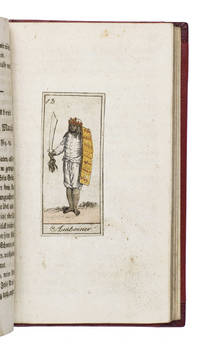
181118884Köln 1811. 12mo. Later gold-tooled half red morocco red paper over boards with the title in gold on the spine. With 24 numbered engravings 7 x 3 cm showing the peoples discussed in their traditional costumes each mounted on a blank leaf. With the engravings coloured as published as indicated on the title page. 170 4 pp. Extremely rare copy of the second edition of an already very rare work presenting the geography and anthropology of the foreign world in the form of a story told in 24 winter evenings by a father to his children. It is divided into 24 chapters each describing the inhabitants of a specific region in Africa the Americas Australia Asia and Europe each with a hand-coloured illustration. The equally rare first edition published by Bieling in Nürnberg in 1810 contains the plates from Johann Sigmund Stoy Bilder-Akademie für die Jugend 1784 while the illustrations in present anonymous edition are printed from new plates implying a possible pirated edition.It treats the Khoikhoi the inhabitants of Guinea the Caribbean Florida and Mexico the Eskimos the inhabitants of Greenland and Patagonia the "Pescherans" from Tierra del Fuego the inhabitants of New Zealand the Australian aboriginies called "New Hollanders" the inhabitants of Java and Amboina & Makassar the Moguls in India the inhabitants of Bukhara and China the Kalmyks Mongols and Buryatians the inhabitants of Tunguska and Kamchatka the Ostyaks the Samoyedic peoples and the Laplanders. Although published as a complete work by itself it was so successful that Bieling published a companion volume covering different regions in 1811: Schilderung der Vornehmsten Völker.The title-page mentions the work is written by the author of Unterhaltende Erzählungen für das erste Kindesalter 1809 apparently the same anonymous author who also wrote Julius merkwürdige Abentheuer 1813-1817 and Das goldene Buch für Kinder 1811 all published by Bieling in Nürnberg.The boards show very minor signs of wear the title-page shows traces of earlier endleaves some very minor occasional spotting. Otherwise in very good condition. An extremely rare copy of an early 19th-century German children's book teaching geography and anthropology.l WorldCat 1082152367 1 copy Universität Frankfurt; cf. GVK 2 copies of the first edition; Wegehaupt 1154 first edition lacking title-page; not in Lipperheide; Sabin etc. ABE CAT Anthropology & Ethnography ABE CAT Costumes & Uniforms hardcover
1899A0491120 volumes plus all indexes and supplements. Royal Octavo 9 1/4" x 6 1/4" and Quarto 11" x 8 1/2" issued in wrappers. Early volumes from the library of George M Foster and bound in green cloth with gilt lettering to spine. Other volumes from the library of Robert V Kemper. First editions.<br /><br />American Anthropologist is the flagship journal of the American Anthropological Association AAA. It is known for publishing a wide range of work in anthropology including articles on cultural biological and linguistic anthropology and archeology. Its first incarnation known as the "Old Series" started in 1888 and was published by the Anthropological Society of Washington the first anthropology association in the United States. The "New Series" began in 1899 under an editorial board that included Franz Boas Daniel G. Brinton and John Wesley Powell and continues to this day. The four fields of Anthropology include cultural linguistic archeology and biological/physical. Sometimes applied anthropology is added as a fifth division. Among the journals published by the AAA The American Anthropologist is the only one that follows the "four field" approach publishing articles from all the subdisciplines of anthropology. Proponents of four-field anthropology see American Anthropologist's broad scope as important to maintaining disciplinary unity while critics have expressed serious reservations about this aim and criticize pressures since the 1970s against editors and works that do not subscribe to four field holism as an ideal for anthropological scholarship.<br /><br />Condition:<br /><br />Because of the quantity of this item shipping will be $500.00 domestic and will require 30 boxes to be shipped. Shipping arrangements will be made with the buyer. American Anthropologist hardcover
1883List406Zuni Pueblo / Washington 1883. Albumen photograph 7 ¼ x 9 ¼ on 8 x 10 inch mount. Very Good. Frank Hamilton Cushing was an ethnologist and anthropologist who helped pioneer the practice of participant observation by living among Zuni in New Mexico. He joined James Stevenson's anthropological expedition to New Mexico undertaken by the United States Bureau of Ethnography in 1879. Enthralled by Zuni culture he lived with the Zuni from 1879 until a scandal related to his advocacy work forced him to return to Washington in 1884. <br /> <br /> John K. Hillers the German-born photographer of the American West was a photographer for the Bureau of American Ethnography from 1879-1881 during which time he took this picture of Cushing in Zuni dress. Cushing - we think - has inscribed the photograph on the verso as follows: "Tenatsali / Medicine Flower of the Spaces / Younger Priesthood of the Bow / War Chief of Zuni / Adopted American Name /Frank Hamilton Cushing. " <br /> <br /> A very good example of an important image with some light fading. Scarce in commerce with no copies in auction records. A very good example with some fading. From the estate of De Lancey W. Gill and Agnes Gill Webster. Gill was a prolific photographer of American Indians who worked for the Bureau of Ethnography in the early part of the twentieth century. unknown books
1826A8132<p>121-91 blank1-63 63 64-162 1 blank i-vi 6 pages lacking the frontispiece plate: Retrato del P. Misionero autor de esta Obra Fr. Miguel Tellechea. Small octavo 7 1/2" x 5 1/4" rebound in quarter leather with marbled boards. "Grammar in Spanish with Tarahumara examples; religious texts in Spanish and Tarahumara in double columns. Book 1: 'Del nombre promombre adverbio y preposicion primeros rudimentos' pp. 6-12; Book 2: 'De las conjugaciones' pp. 13-46; Book 3: prayers and doctrinal texts pp. 47-59; Book 4: sermons pp. 60-122 followed by 'Algunas cosas necesarias para la debida administracion de los Santos Sacramentos' pp. 123-155." Sabin 9461 First edition.<br /><br />The Tarahumara or Rarámuri "runners on foot" or "those who run fastare a Native American people of northwestern Mexico who are renowned for their long-distance running ability. Originally inhabitants of much of the state of Chihuahua the Rarámuri retreated to the high sierras and canyons such as the Copper Canyon in the Sierra Madre Occidental on the arrival of Spanish explorers in the sixteenth century. The area of the Sierra Madre Occidental which they now inhabit is often called the Sierra Tarahumara because of their presence. The Tarahumara language belongs to the Uto-Aztecan family. Although it is in decline under pressure from Spanish it is still widely spoken.<br /><br />Miguel Tellechea was a missionary to the Tarahumara Indians of the northern part of Mexico. His work is not only a grammar of the Tarahumara language but also a collection of sermons talks and a catechism in that language designed for use in the conversion of the Indians.<br /><br /><strong>Condition:</strong><br /><br />Points bumped and rubbed small worm hole at title lacks frontispiece else a very good copy of a scarce item.</p> Imprentade la Federacion en Palacio hardcover
1841BOOKS008231Very good in a near fine binding 1st American Hardbound Large Octavio 2 Volumes 2 volumes. viii 264 pages with folding map and a total of 114 plates including frontispiece plate 23 lacking as called for plates 12 ad 13 bound into volume2 plates 21 and 22 call for but lacking with three additional unnumbered plates and plates number 101 1/2 and errata tipped in; viii 266 pages with 2 maps 312 plates including plate 210 1/2 but lacking 137 142 149 159 and 247 as called for plates 160 27u3 2754 and 275 called for but lacking. Royal octavo 9 1/4" x 6 1/4" recased in half morocco wit five raised spine bands with gilt lettering to spine over marbled boards. Wagner-Camp 84:1. Howes C241. Streeter Sale 1805. Wheat Transmississippi 453 454 455. Clark III:141. Reese Best of the West 77 First edition.<br /><br />The first edition of Catlin's famous book one of the most important works on American Indians published in the 19th century. Besides the description of his travels throughout the West the book contains hundreds of line drawings of southern and western Indians as well as two significant maps showing the locations of Indian tribes. Catlin first went west in 1830 travelling extensively for the next six years accumulating his "Indian Gallery." LETTERS AND NOTES. was published when he brought the exhibition to London.<br /><br />Condition: Title of volume I with a large pale damp stain volume II title and first contents leaf with a couple of pencil marks both titles and most plates with some pale foxing a few plates and the folding map brittle at edges with tiny chips/tears not affecting images the folding map cleanly split at one fold one plate with gutter tear in margin two plates with chipped corners one of which is laid down on paper. A fine decorative binding internally very good. <br />First American edition of Catlin's landmark study of Native Americans. Catlin visited 48 Indian tribes on his tour of the West and executed some 600 paintings. Letters and Notes includes hundreds of engravings which were reduced from the original paintings under Catlin's supervision. The text and illustrations portray diverse aspects of Indian life including village scenes games dances funerals sudatories religious ceremonies buffalo hunting etc. plus detailed descriptions and depictions of native dress and custom. After taking the entire gallery of his paintings to England Catlin published his "Letters & Notes" using text from a series of articles he had written for the New York Commercial Advertiser from 1832 to 1837 and illustrating it with line-cut reductions of his original paintings. The folding map is of the Indian Localities in 1833 a second map in vol. II shows the effects of forced migration after 1840. Howes C24.<br /><br />Condition:<br /><br />Recased in a very attractive binding with gilt lettering to spine and marbled boards new endpapers; lacking 3 plates frontispiece and title of volume I with a large pale damp stain volume II title & first contents leaf with a couple of pencil marks both titles and most plates with some pale foxing a few plates and the folding map brittle at edges with tiny chips/tears not affecting images the folding map cleanly split at one fold and repaired one plate with gutter tear in margin two plates with chipped corners one of which is laid down on paper; a fine decorative binding copy internally in a very good copy. Wiley and Putnam hardcover books
1859100144HBBonn:, Henry und Cohen, 1859. vi, 448 Seiten, III Tafeln (davon eine gefaltet), 130 Seiten (Correspondenzblatt), schlichter moderner HLnbd., 21 x 13,5 cm. [5 Warenabbildungen]
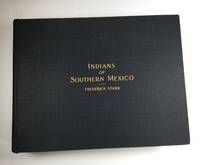
1899026863Chicago Illinois: Printed for the Author by the Lakeside Press 1899. This copy is from the library of and bears the ownership signature of Wilberforce Eames the "Dean of American bibliographers." more about Eames below. This is a remarkably well preserved copy of the 1899 edition limited to 560 copies. Near Fine condition. Square and tight. SEE PHOTOS. Unusual for this very heavy book hinges -- both inner and outer -- remain in excellent condition. Sharp corners. Page are creamy white unmarked with NO foxing. This pioneering anthropological work features 141 collotype plates after photos by Charles B. Lang and Bedros Tartarian. Among the tribes photographed are the Zapotec Mixe Tehauntepecano Juave Otomi Tarascan Aztec Tlaxcalan Mixtec Triqui Chontal and Cuicatec. To obtain these photos Starr traveled throughout the Mexican states of Puebla Tlaxcala Michoacan and Oaxaca measuring modeling sculptures and photographing. The plates feature portraits of each subject front and side views images of typical daily life and activities group shots with full length figures in native dress views of villages and environs etc. The photographic reproductions are full page -- measuring 8.5" tall by 11" wide -- all in FINE condition with exceptional detail and rich tonality. The printed limitation page in this copy is not numbered or author signed. The front free endpaper is signed by Wilberforce Eames as "W. Eames" SEE PHOTOS. Two downloads of his autograph are laid in for authentication. The American bibliographer and librarian Wilberforce Eames 1855 - 1937 is known as the "Dean of American bibliographers." Eames compiled many bibliographies and bibliographical references including major contributions to Joseph Sabin's DICTIONARY OF BOOKS RELATING TO AMERICA. From Wikipedia: "He became an assistant librarian and eventually a full librarian at Lenox and later upon the merging of the Tilden trust Astor and Lenox libraries he was appointed 'Lenox Librarian.' He became Chief of the American History Division at the New York Public Library in 1911 and Bibliographer a position he held until his death there in 1916. In 1924 The New York Times called Eames: "The greatest living scholar of books in America." A. S. W. Rosenbach said of Eames: "Probably the greatest student of books in the whole history of scholarship and book collecting lives quietly in New York worshiped by every collector and scholar and unknown to the world in general - Wilberforce Eames." Bound in the original dark blue almost black cloth. All gilt is still bright and shiny. SEE PHOTOS. Oversize Hardcover. Oblong. 14" wide by 10.75" tall by 2.25" thick. This very large very heavy book nearly 10 pounds before packaging will require SUBSTANTIAL extra postage charged at our cost depending on destination. First Edition Limited to 560 copies. Oversize Hardcover heavy. Near Fine condition. Illus. by Lang Charles B.; & Bedros Tartarian photos by. Unnumbered pages but 300. Great Packaging Fast Shipping. Printed for the Author by the Lakeside Press Hardcover
1889R85962Scheut-lez-Bruxelles, Scheut 1889-1928 Série complète des années 1 à 36 (1889-1928) reliées en 14 volumes, ensemble plus de 10.000 pages avec illustrations en n/bl dans et hors texte et plusieurs plans et cartes dépliantes hors-texte, reliures cart. (plats marbrés, dos en cuir rouge avec titre doré au dos), feuilles de garde marbrées, 29cm. (à partir de 1901: 25cm.), quelques rousseurs dans le texte, quelques vagues taches aux tranches (inférieures) de peu de volumes (pas dans le texte), bon ensemble de cette revue illustrée bien rare sur les missions de Scheut en Congo et en Chine (et aux Philippines, à partir de l'année 20, 1908), poids total de 21kg., R85962
1852BOOKS005759vi1233 pages. Quarto 10 1/2" x 7" Bound in quarter leather with marbled paper boards. Clavijero's History of Baja California which was first published in Italian then in English then a Madrid edition and then the Mexican edition. Handbook of Middle American Indians Volume 13 page 293 First Mexican edition. <br /><br />Clavijero a Mexican native was exiled with the other Jesuits in the 1760s and lived in Italy thereafter. His history of Mexico is considered one of the best of the early histories of the subject. His history of Baja California is the first such and contains passages relating to the foundation of the mission at San Francisco as well as material on Kino and Salvatierra. Translated from the Italian manuscripts by Nicoles Garcia de San Vincente. The Palou volume is essential reading for the early history of Northern California. This is the second edition of the Vida of Serra. First published 1787. Francisco Palou 1723-1789 was a Franciscan missionary administrator and historian on the Baja California peninsula and in Alta California. Father Palou made significant contributions to the Alta California and Baja California mission systems. <br /><br />Condition:<br /><br />Damp stains to end papers and heal edge of title page spine ends and corners professionally repaired Over all a very good copy of a scarce item. De Juan R Navarro hardcover books
1852BOOKS005759<p>vi1233 pages. Quarto 10 1/2" x 7" Bound in quarter leather with marbled paper boards. Clavijero's History of Baja California which was first published in Italian then in English then a Madrid edition and then the Mexican edition. Handbook of Middle American Indians Volume 13 page 293 First Mexican edition. <br /><br />Clavijero a Mexican native was exiled with the other Jesuits in the 1760s and lived in Italy thereafter. His history of Mexico is considered one of the best of the early histories of the subject. His history of Baja California is the first such and contains passages relating to the foundation of the mission at San Francisco as well as material on Kino and Salvatierra. Translated from the Italian manuscripts by Nicoles Garcia de San Vincente. The Palou volume is essential reading for the early history of Northern California. This is the second edition of the Vida of Serra. First published 1787. Francisco Palou 1723-1789 was a Franciscan missionary administrator and historian on the Baja California peninsula and in Alta California. Father Palou made significant contributions to the Alta California and Baja California mission systems. <br /><br /><strong>Condition:</strong><br /><br />Damp stains to end papers and heal edge of title page spine ends and corners professionally repaired Over all a very good copy of a scarce item.</p> De Juan R Navarro hardcover
180418063A Paris, chez Allut, an XIII (1804). Un vol. au format in-8 (197 x 128 mm) de 2 ff. n.fol., 321 pp., 1 f. n.fol. de catalogue éditeur in fine et 1 grande planche dépliante gravée. Reliure de l'époque de demi-basane brune, dos lisse orné de filets dentelés dorés, roulettes dorées, fleurons dorés, pièce de titre de maroquin vieux-rouge, titre doré, toutes tranches mouchetées.
1846r4182London: John Murray. G: in Good condition plus with marbled eps. Rebound. Remnants of label on verso of fep. Lacks half title. Slight soiling to title. Slight edge-block mark. No other significant flaws. 1846. First Edition. Blue/gilt hardback cloth cover. 190mm x 120mm 7" x 5". xviii 285pp 16pp. Frontis map. The first issue of the author's first book page 19 line 1 'Pomarea'. . John Murray hardcover
1862A0183<p>2 Volumes. lii3954 pages; vi427 pages. Octavo 8 1/4" x 5 1/2" volume one rebound in red leather with gilt lettering to spine; volume two original quarter leather with gilt lettering to spine over marbled boards. First editions.<br /><br />The first Mexican linguist worthy of this name is Francisco Pimentel in the second half of the nineteenth century. He attempted to systematize what was known until then about the Indian languages of Mexico. His work is the starting-point for the development of a more scientific approach to linguistic studies on Mesoamerican languages. A scholar versed in European typology and comparative linguistic studies of the nineteenth century Pimentel is clearly indebted to his predecessor the Spaniard Lorenzo Hervas y Panduro as well as Wilhelm von Humboldt Friedrich Schlegel Ernest Renan Jacob Grimm and others. His work on linguistic classification in Mexico unlike that of Orozco y Berra was as up to date as that of any of his North American contemporaries. The second edition of Pimentel 1874 had considerable influence on subsequent opinion concerning the classification of native languages in Mexico and Mesoamerica generally and his work was heeded by Powell and other scholars in North America. Pimentel claimed to be "the first to present a scientific classification of Mexican Indian languages based on comparative philology". He proposed several families that were accurate as well as a few that were not so accurate including Uto-Aztecan with nine subgroup members; Costeno with Mutsun; Mixe with Zoque; Mixtec Zapoteco. Pimentel was relatively successful in his attempt to establish family relationships. Interestingly his methods were those standard in European linguistic studies; in particular he emphasized grammatical evidence but also utilized basic vocabulary. Although Pimentel favored grammatical evidence he rejected the generally held notion of the time maintained by most scholars since Duponeau that all American Indian languages share the same morphological type.<br /><br /><strong>Condition:</strong><br /><br />Volume one. Tape repair to half title rebound and trimmed. Volume two. spine ends and corners chipped rubbing to edges hinges and corners else a good set.</p> Imprenta de Andre Escalante hardcover
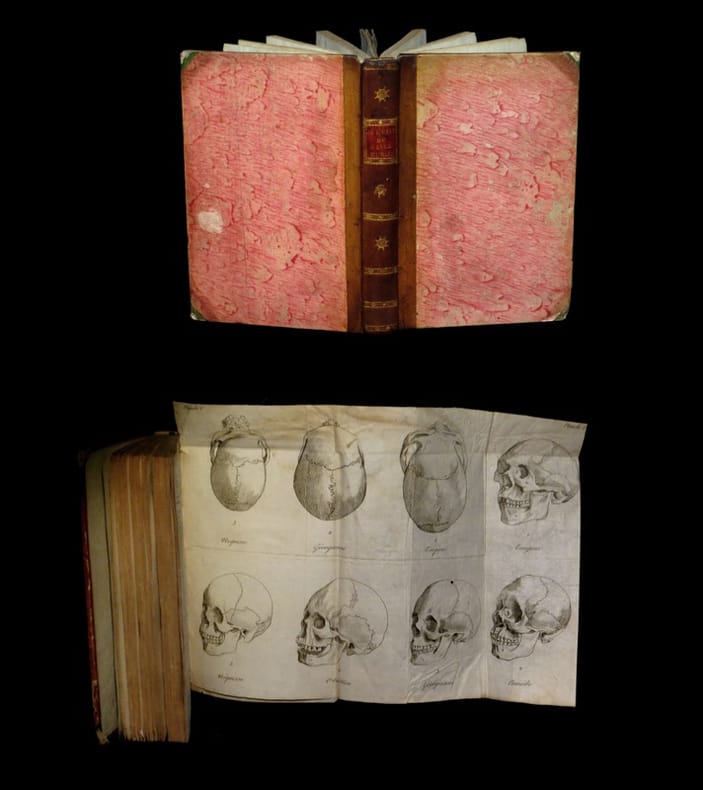
180657490BBParis, Chez Allut. 1806. 8°. Vortitel, Titel, 321 S., 1 S. Errata. Mit 1 mehrfach gefalteten gestochenen Tafel (als pl. I und II bezeichnet). Marmorierter Lederband der Zeit mit rotem goldgeprägtem Rückenschild, mit 2 wiederholten Palmenvignetten und reicher ornamentaler Rückenvergoldung.
180657490BBParis, Chez Allut., 1806. 8°. Vortitel, Titel, 321 S., 1 S. Errata. Mit 1 mehrfach gefalteten gestochenen Tafel (als pl. I und II bezeichnet). Marmorierter Lederband der Zeit mit rotem goldgeprägtem Rückenschild, mit 2 wiederholten Palmenvignetten und reicher ornamentaler Rückenvergoldung.
1821040304Boston MA: Wells and Lilly 1821. Book. Very Good. Full-Leather. First American Edition. 8vo - over 7¾" - 9¾" tall. Original full tree calf gilt on burgundy title label mounted on upper spine. Rubbed along edges some surface cracking/crazing rubbed joints and spine extremities. Foxed endpapers some toning and scattered foxing to interior but otherwise intact with firm binding. Former owner's signature on front flyleaf. viii472 pp. Exceptionally scarce first American edition issued a year after the first British edition of 1820. Wells and Lilly Hardcover
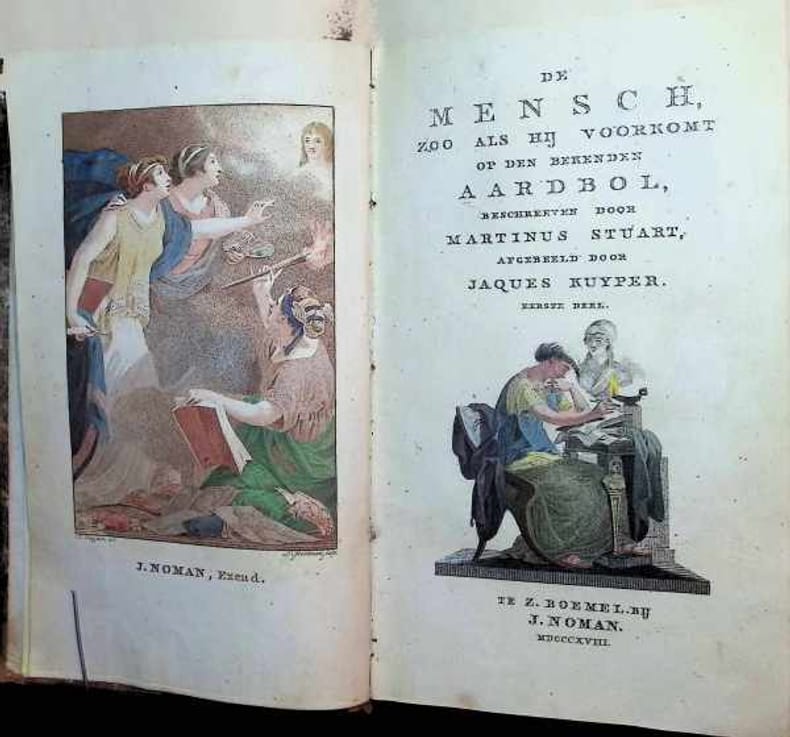
1818029583Z.Boemel 1818 J. Noman Half-Leather (Hardcover) 1st Edition
1871chd05aaLondon: John Murray. G : in Good condition without dust jacket. Rebound with marbled endpapers. Lacking rear advertisements. Cover rubbed with wear to spine and scuffing to leather. Area of wear with loss to marbled paper to front pastedown. Endpapers lightly foxed. March 1871. First Edition second issue. Green gilt embellished hardback half-leather cover. 190mm x 130mm 7" x 5". viii 423pp. B/w vignettes. First edition second issue. Issue points: 'When variations occur. and are transmitted' - first sentence on p.297 rather than 'Transmitted as in first issue'; Use of the term 'evolution' on p.2 - 'Descent' was the first of Darwin's works to utilise this term; both half title and title page are present. This rebound copy lacks the 16pp. advertisements originally present in each volume. . John Murray hardcover
186356334ABLondon, John Murray, 1863. 8°. XII, 520 S., 32 S. Katalog. Mit einem Holzstichfrontispiz, 1 ganzseitigen Tafel und 58 Holzstichillustrationen im Text. Illustrierter Originalleinwandband mit Deckelillustration und goldgeprägtem Rückentitel.
186356334ABLondon, John Murray, 1863. 8°. XII, 520 S., 32 S. Katalog. Mit einem Holzstichfrontispiz, 1 ganzseitigen Tafel und 58 Holzstichillustrationen im Text. Illustrierter Originalleinwandband mit Deckelillustration und goldgeprägtem Rückentitel.
19005342paris Bong et Compagnie 1900 -in-4 cartonnage Art Nouveau in-quarto, tranches rouges, illustrations : front-de-chapitre - in et hors-texte - cul-de-lampe + gravures repliées, 5 volumes, 522 + 575 + 514 + 502 + 454 pages, sans date (1900) Paris Maison dEdition Bong et Compagnie,
1843048787London: Samuel Clarke 1843. First Edition. Hardcover Original Cloth. Very Good Condition. Publisher's green cloth a little soiled and darkened wear at head of spine inner joint a little tender scattered minor foxing. Ownership signature Henry illegible dated 1844 to front endpaper. 172pp 103pp. <br /> <br /> First edition of Johnes' mostly linguistic study of the origins of mankind. An interesting and far ranging study that touches on Celtic Egyptian Native American Jewish Chinese Arabian and other languages the origin of synonyms etc. Size: Octavo 8vo. Quantity Available: 1. Shipped Weight: Under 1 kilo. Category: Anthropology; Inventory No: 048787. Samuel Clarke hardcover
1864A0488<p>241 pages. Octavo 8 1/4" x 5" bound in quarter leather with gilt lettering to spine over stiff boards. First edition.<br /><br />In the mid 1800's Mexico's population was forty percent Indian. Most had a subsistence economy which was out side the nation's main stream and condemned the native population to poverty and malnutrition. The Mexican government began to divide the communal lands of the Indians into farms ejidos which they opposed. Liberals such as Pimentel thought that the Indian was an obstacle to progress of the nation. The Mexican intellectuals thought one of the best ways to integrate the natives was to encourage European immigration and to eliminate the indigenous languages. Pimentel in his <em>Political economy applied to landed property in Mexico</em> 1866 asked "Who is to blame for this laziness improvidence and squandering of our poor class" To which he answered the same day Indian laborer. Two years earlier Pimentel's <em>Report on the causes that have led to the current situation of the indigenous race and the means to remedy the situation</em> gives a concise history of the Indian and discusses solutions to what the intellectuals considered a problem. This is one of the fundamental works which began to frame the ruling establishment's actions toward the indigenous populations and which eventually led them to assist the side with the revolutionists in 1910.<br /><br /><strong>Condition:</strong><br /><br />Previous owner's name on front end paper boards and edges rubbed and chipped corners bumped else a good to very good copy of a scarce item.</p> Imprenta de Andrade y Escalante hardcover
1828A0226Two volumes: 8viii334 pages with engraved dedication in script engraved supplemental pictorial title page and two plates; 639116 pages with engraved supplemental pictorial title page appendix and one engraved plate. Octavo 8" x 6" bound in brown leather with gilt lettering to spine. Plates by J. Amillo. Sabin 51215 Palau 183810 First edition.<br /><br />An important work on the Indians of Mexico especially the Tarascans of Michoacan written in Mexico by Benito Maria de Moxo and printed here by his nephew Juras Reales. "A valuable set of dissertations upon the natives and history of the New World written by Don Benito Maria de Moxo Archbishop of Charcas whose papers fell into the hands of his nephew Luis Maria de Moxo y de Lopez and were printed by the latter under his own name without sufficient acknowledgement" - Sabin. The work contains fourteen essays by Benito Maria Moxo y Francoli written in 1805 in Michoacan where he served as auxiliary bishop from 1803 to 1805. The varied topics include Indian music; human sacrifice; Tarascan pre-Columbian painting; geometry; arithmetic and hieroglyphic writing; Black slavery in the Spanish colonies; and two essays on natural history. The appendix prints Moxo's 1807 speech in response to the British invasion of Buenos Aires. The fine engraved plates by J. Amillo include a scene of missionaries playing music for the Indians; a detailed representation of "Idolo Huitzilopochtli" lively dancing Huitzilopochtli with mask wearing feather headdress and holding a shield; and a stone idol on a broken base. A later edition appeared under the title Cartas Mejicanas in 1837<br /><br />Moxó y de Francoli 1763-1816 a controversial writer of the Spanish-American Enlightenment was accused of collaborating with both monarchists and revolutionaries. His work is also marked by ambiguity due to his loyalty to Spain and his sympathy for the original inhabitants of Mesoamerica resulting in a complicated example of literary colonialism. This work explores Mesoamerican archaeology astronomy pictorial codices human sacrifice mathematics comparative study of suicide among Native Americans and Europeans pre-Columbian music and other unusual anthropological subjects such as the Tarascan painted manuscript discussed by Glass. Dismissed are the claims by Robertson and De Pauw that Amerindian culture is inferior though the author rebukes Voltaire for minimizing the extent of human sacrifice and cannibalism among the Aztecs. He resolutely defends the Spanish conquest. Perhaps the most important result of the work was its contribution to an upsurge in interest in Mesoamerican archaeology and art. The copperplate engravings are handsome and well executed.<br /><br />Condition:<br /><br />Modern rebinding with new end papers. A very good set. En la Imprenta de Jose Torner hardcover
1828A0226Two volumes: 8viii334 pages with engraved dedication in script engraved supplemental pictorial title page and two plates; 639116 pages with engraved supplemental pictorial title page appendix and one engraved plate. Octavo 8" x 6" bound in brown leather with gilt lettering to spine. Plates by J. Amillo. Sabin 51215 Palau 183810 First edition.<br /><br />An important work on the Indians of Mexico especially the Tarascans of Michoacan written in Mexico by Benito Maria de Moxo and printed here by his nephew Juras Reales. "A valuable set of dissertations upon the natives and history of the New World written by Don Benito Maria de Moxo Archbishop of Charcas whose papers fell into the hands of his nephew Luis Maria de Moxo y de Lopez and were printed by the latter under his own name without sufficient acknowledgement" - Sabin. The work contains fourteen essays by Benito Maria Moxo y Francoli written in 1805 in Michoacan where he served as auxiliary bishop from 1803 to 1805. The varied topics include Indian music; human sacrifice; Tarascan pre-Columbian painting; geometry; arithmetic and hieroglyphic writing; Black slavery in the Spanish colonies; and two essays on natural history. The appendix prints Moxo's 1807 speech in response to the British invasion of Buenos Aires. The fine engraved plates by J. Amillo include a scene of missionaries playing music for the Indians; a detailed representation of "Idolo Huitzilopochtli" lively dancing Huitzilopochtli with mask wearing feather headdress and holding a shield; and a stone idol on a broken base. A later edition appeared under the title Cartas Mejicanas in 1837<br /><br />Moxó y de Francoli 1763-1816 a controversial writer of the Spanish-American Enlightenment was accused of collaborating with both monarchists and revolutionaries. His work is also marked by ambiguity due to his loyalty to Spain and his sympathy for the original inhabitants of Mesoamerica resulting in a complicated example of literary colonialism. This work explores Mesoamerican archaeology astronomy pictorial codices human sacrifice mathematics comparative study of suicide among Native Americans and Europeans pre-Columbian music and other unusual anthropological subjects such as the Tarascan painted manuscript discussed by Glass. Dismissed are the claims by Robertson and De Pauw that Amerindian culture is inferior though the author rebukes Voltaire for minimizing the extent of human sacrifice and cannibalism among the Aztecs. He resolutely defends the Spanish conquest. Perhaps the most important result of the work was its contribution to an upsurge in interest in Mesoamerican archaeology and art. The copperplate engravings are handsome and well executed.<br /><br />Condition:<br /><br />Modern rebinding with new end papers. A very good set. En la Imprenta de Jose Torner hardcover books