98 842 résultats
180452659Milano, Genio, 1804. Lex 8vo. Large-paper copy, completely uncut, on extra-thick paper, in the original wrappers of hand-blocked patterned paper. With a few contemporary hand-written annotations/corrections and marginal markings. An extraordinarily fine copy with minimal wear. 78 pp. + 1 f. errata. Frontispiece portrait and two engraved plates (one - with the famous sheep - folded).
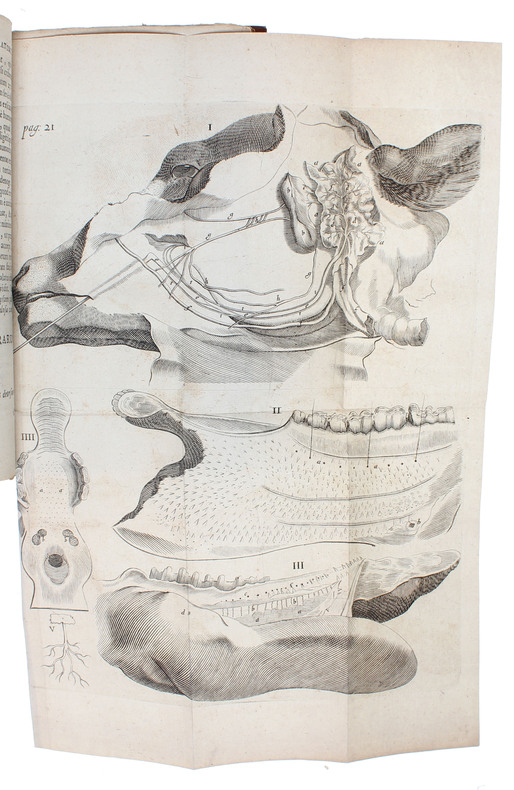
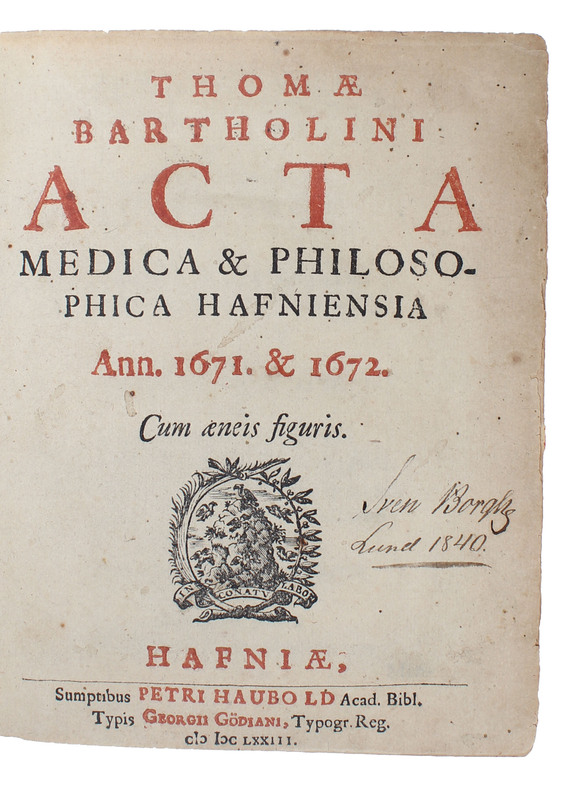
167353613Copenhagen, Peter Haubold, 1673-80. 4to. A very nice recent full calf pastiche binding with four raised bands and gilt red title-label to spine. blindstamped borders to boards. Old owner's inscription (""Sven Borgh/Lund 1840"") to title-page. A very nice and clean copy with only a bit of brownspotting and some evenly browned leaves. A tear (with no loss) to one leaf and one leaf (vol. V, L3) with a neat marginal restoration, far from affacting text. The following two leaves with minor loss to blank upper margin (far from affecting text). The large double-page folded plate with Stensen's lymphatic glands (vol. II, p. 240) with a neat restoration to verso, no loss. Annotations and corrections in the same early, neat hand throughout. Woodcut vignettes and initials. All four title-pages (part III & IV have a joint title-page) printed in red and black. (16), 316" (20), 376 (16), 174, 216" (8), 342 pp. With ab. 60 woodcut illustrations in the text, many of them quite large, two of them full-page, and all 62 engraved plates (of which two are on a folded leaf), four of which are folded. A truly excellent, fully complete copy with all five volumes and all 62 plates.
Milano, Genio, 1804. Lex 8vo. Large-paper copy, completely uncut, on extra-thick paper, in the original wrappers of hand-blocked patterned paper. With a few contemporary hand-written annotations/corrections and marginal markings. An extraordinarily fine copy with minimal wear. 78 pp. + 1 f. errata. Frontispiece portrait and two engraved plates (one - with the famous sheep - folded).
Copenhagen, Peter Haubold, 1673-80. 4to. A very nice recent full calf pastiche binding with four raised bands and gilt red title-label to spine. blindstamped borders to boards. Old owner's inscription (""Sven Borgh/Lund 1840"") to title-page. A very nice and clean copy with only a bit of brownspotting and some evenly browned leaves. A tear (with no loss) to one leaf and one leaf (vol. V, L3) with a neat marginal restoration, far from affacting text. The following two leaves with minor loss to blank upper margin (far from affecting text). The large double-page folded plate with Stensen's lymphatic glands (vol. II, p. 240) with a neat restoration to verso, no loss. Annotations and corrections in the same early, neat hand throughout. Woodcut vignettes and initials. All four title-pages (part III & IV have a joint title-page) printed in red and black. (16), 316" (20), 376 (16), 174, 216 " (8), 342 pp. With ab. 60 woodcut illustrations in the text, many of them quite large, two of them full-page, and all 62 engraved plates (of which two are on a folded leaf), four of which are folded. A truly excellent, fully complete copy with all five volumes and all 62 plates.
in-4, ff. 60 non numerati, (segn. a-p4), legatura posteriore piena pergamena rigida, tit. ms. al dorso. Sul foglio di titolo magnifica grande silografia (mm 101x121) entro bordura ornata, raffig. un medico seduto in cattedra con libri e strumenti professionali, ed un discepolo in piedi davanti lui. . Testo in nitido car. romano racchiuso dal commento in car. leggermente più piccolo. Rara edizione (una delle varie impresse da Bernardino de Vitalibus senza data, ma tutte intorno al 1500) della celebre opera commentata da Arnaldo da Villa Nova, medico ed alchimista. Com'è noto il "Flos medicinae o Regimen sanitatis salernitanum", poemetto di 362 versi latini, è il più famoso testo medico-letterario lasciatoci dalla gloriosa Scuola Medica Salernitana (IX-XIV sec.), impresso in molte edizioni e tradotto in varie lingue. Oltre nozioni di medicina, contiene massime e suggerimenti per l'igiene e la buona salute personale, oltre che consigli dietetici e curiosità gastronomiche. Arnaldo, nato a Villa Nova, in Linguadoca, o più probabilmente in Catalogna, nel 1240, viene ricordato nella storia della medicina soprattutto per le acute osservazioni espresse in questo vasto Commento. Dopo aver studiato teologia, medicina e scienze a Parigi ed a Montpellier, insegnò medicina in questa città, ma, sospettato di eresia, dovette fuggire e subire l'ostracismo di parte della Chiesa. Mentre era medico ordinario di re Federico II di Sicilia fu chiamato da Clemente V alla corte papale di Avignone, ma morì durante il viaggio. Esempl. assai puro e marginoso.. Goff R-80 . Klebs 830.16. Reicling 708. Essling 610. Sander III, 6389. IGI IV, n. 8305, note. ..
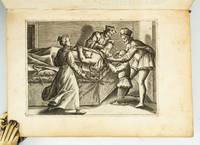
1584ST20779Rome: Bartolomeo Bonfadino & Tito Diani 1584. FIRST EDITION. 215 x 150 mm. 8 1/2 x 6". 6 p.l. 106 pp 1 leaf errata. <br/> 17th century sprinkled vellum raised bands leather spine panels with gilt lion ornaments red morocco label. Engraved title page woodcut initials and headpieces and 11 engraved plates of bloodletting. Title page with ink owner inscription of "Joann De Ville Chirurgo Lugdunesse 1629"; a couple of neat marginal annotations in Italian apparently by the same hand; four ink numbers on lower cover. Wellcome I 3959; EDIT16 CNCE 46661; Mortimer Italian II 267 second edition; USTC 839623. Boards a bit splayed gilt on spine a little rubbed moderate wear and soiling to the vellum text slightly browned at edges and with occasional minor foxing half a dozen leaves slightly browned but still an excellent unrestored copy quite fresh internally the engravings sharp and the binding completely solid.<br/> <br/> This is a 17th century surgeon's copy of a strikingly illustrated and centrally important 16th century treatise on bloodletting. Piacenza physician Pietro Paolo Magni's detailed discussion of the use of leeches and cupping-glasses long served as the standard work on the topic. Its 11 well-executed engravings are visually compelling as well as providing a rich source of information on the details of 16th century medical practice. There is some debate about their creator: Wellcome and Hirsch attribute them to Adamo Ghisi also Scultori ca. 1530-85 who executed the illustrated title page of this edition; Graesse and Mortimer on the other hand assign them to Cherubino Alberti 1553–1615 who was responsible for the engraved title in the second edition. Either way they are as evocative to modern-day viewers as they must have once been useful to surgeons and physicians of the 16th century. The dramatically lit scenes feature focused doctors armed with lancets and bowls to catch the blood attending to patients who grimace wilt or look away in stoic resignation. Our former owner Jean de Ville identifies himself as a Lyonnaise surgeon on the title page in an inscription dated 1629. His occasional notes on the text and illustrations indicate he was consulting this book as a reference for his own practice he writes above one illustration for example that "this operation should be performed on the left arm". This seems to be a rare work in institutional collections USTC finding only one copy in North America. Bartolomeo Bonfadino & Tito Diani unknown
166253846Lugduni [Leiden], Jacobum Chouët, 1662. 12mo. Partly uncut in a nice later full calf binding (19th century?) with five raised bands and gilt lettering to spine. Hinges with a bit of wear and small piece of leather lacking on top of spine. Vague previous owner's name in contemporary hand to lower part of title-page. Ex-libris pasted on to pasted down front end-paper. Vague traces after stamp on p. 108. A fine copy. (12), 108 pp. + 3 folded plates.
Lugduni [Leiden], Jacobum Chouët, 1662. 12mo. Partly uncut in a nice later full calf binding (19th century?) with five raised bands and gilt lettering to spine. Hinges with a bit of wear and small piece of leather lacking on top of spine. Vague previous owner's name in contemporary hand to lower part of title-page. Ex-libris pasted on to pasted down front end-paper. Vague traces after stamp on p. 108. A fine copy. (12), 108 pp. + 3 folded plates.
1833557691833. Contemporary morocco. Very good. Two parts octavo 24.2 by 14.3 cm. 280 unnumbered leaves. Manuscript on polished cream paper. Persian text recto and verso in black and red ink; triple-ruled inner text borders 15.4 by 7.9 cm in red and blue single-ruled outer border 21.7 by 11.3 cm in blue. The second part of the manuscript opens with an illuminated full-page double suite composition Arab. unwan in polychrome and gilt; marginal illumination appears on two other leaves in this section. Contemporary paneled tan morocco lightly rubbed at extremities elaborately tooled in blind. Some marginal annotations in black ink at several early leaves. Intermittent mild smudges mostly marginal; bottom corner of first leaf excised resulting in loss of several words. Very good.<br /> <br /> Compendium of medical tracts used by prominent physicians of the Muslim world written in superb Persian calligraphy by 'Ali Muhammad in A.H. 1249 = 1833. Much of the work deals with herbal remedies used by famous Persian physicians including Avicenna 980-1037. A treatise on anatomy is included along with commentaries penned between the two sets of borders which discuss various matters including diagnosis from urine; hygienic practices drawn from the treatises of famous physicians; prescriptions and recipes derived from the book Tuhfat al-mu'minin a work on materia medica by Muhammad Muʼmin Husayni d.1698 dedicated to the Safavid ShÄh SulaymÄn. Husayni was considered the greatest herbalist of the Mazandaran region of Persia. Four pages in the second part present various alphabets in black ink; comments and correspondences with the Arabic/Persian alphabet are noted in red ink. <br /> <br /> Provenance: Stamps of "Mohd. Halim Salimi Library Kandahar-Afghanistan" in blue ink at opening and closing leaves. In the late 1950s Mohammed Halim Salimi of Kandahar worked in an administrative capacity for the International Cooperation Administration a United States government agency and precursor of the U.S. Agency for International Development USAID. A smaller elliptical owner's stamp in red with text beneath at blank recto of the opening leaf. unknown
In-folio (cm. 52), cc. (70). Con bell'antiporta allegorica e 119 tavole, il tutto finemente inciso in rame. Solida ed elegante legatura ottocentesca in piena pelle verde, dorso a nervi con titoli in oro. Decorazioni geometriche ai comparti del dorso ed ai piatti. Tagli dorati. Solo qualche lieve brunitura alle carte di testo, poche macchiette sparse, peraltro esemplare fresco ed in eccellente stato di conservazione. Copia di dono, come appare dalla grande dicitura impressa al piatto anteriore: "Au docteur Espallac - son ami J. de V.". Si tratta della seconda edizione latina di questa celebre opera in cui William Cowper compie una sorta di plagio nei confronti di Bidloo. Di quest'ultimo utilizza infatti la maggior parte delle tavole qui presenti, aggiungendo note esplicative e solo una piccola sezione iconografica (in tutto solo 14 tavole sono opera sua). Probabilmente una della più affascinanti pubblicazioni mai apparse in campo medico in cui la raffigurazione medica si sposa con un'ispirazione artistica assai appropriata. Raro, soprattutto in tale stato di freschezza e di conservazione.
Lugduni Batavorum (Leyden), Apud Franciscum Moyardum & Petrum Leffen, 1662. 4to. Bound in a magnificent later full red morocco binding with triple gilt line-borders to boards, inside which another ""frame"" of triple gilt lines with gilt ornamentations to corners. Richly gilt spine with five raised bands. All edges of boards gilt and with inner gilt dentelles. The binder, Marc Olivier, has written his name in pencil on the front free end-paper. With the bookplate of Theodore Besterman to inside of front board and the entire leaf-book-plate of Arnoud de Vitry bound before the title-page. 18th or 19th century inscription to title-page: ""Draycot House/Wilts(hire)"". Title-page slightly dusty and with a bit of light spotting. Occasional light brownspotting throughout. Last leaf a little browned. (O4) with a neat, barely visible re-enforement to outer blank margin, not affecting text. All in all a truly excellent copy, fully complete, even with all the tiny moveable parts. (36), 121, (1) pp. + 10 plates. Complete with all 56 woodcut and engraved text-illustrations (many of which are full-page) and the 10 full-page engraved plates (some folded), one of which is the heart-plate with the 6 moveable parts, the Cardiac-flaps (of which all are present, which is extremely rare). The tiny moveable part on the plate with Fig. LIV (at fol. 118) is also present, which is almost never the case.
2 volumi in-4 grande (315x218 mm.), di ff.(6), 122, (2) il primo; di pp.698 il secondo. Splendida legatura del tempo in pieno marocchino rosso a grana lunga, piatti finemente ornati da cinque bordure floreali o a filetti oro, dorsi riccamente ornati e con doppio tassello verde per il titolo, armi araldiche del cardinale Bartolomeo Pacca (1756 - 1844) impresse in oro al centro dei piatti, tagli dorati. Testo manoscritto in inchiostro bistro scuro su carta forte, in calligrafia assai differente per ogni volume: il primo, autografo, vergato in lettere corsive, con dedica su tre pagine ''A Sua Em.za Ecc.ma il Cardinal Bartolomeo Pacca Camerlengo di S.Chiesa...Roma li 15 Agosto 1823''. Il secondo scritto in calligrafia retta, con la dedica autografa posta in basso dell'ultima pagina, firmata ''...Cavalier D.Camillo Dottor Trasmondi''. Esemplare unico di un interessante trattato manoscritto di medicina rimasto inedito. Anche dell'autore non si reperiscono notizie biografiche. Nel titolo della parte prima si dichiara ''Camillo Trasmondi Romano dei Marchesi d'Introdacqua Patrizi Solmontini, dottore in filosofia, e medicina, matricolato ad honorem in chirurgia, chirurgo prim.o sopranumero nel r.o Ospedale de' Spagnuoli. sostituto nell'Arcispedale della Consolazione...''. Opera interessante per la materia e le conoscenze mediche all'inizio del secolo XIX, in artistica legatura alle armi, in perfetto stato di conservazione.. .
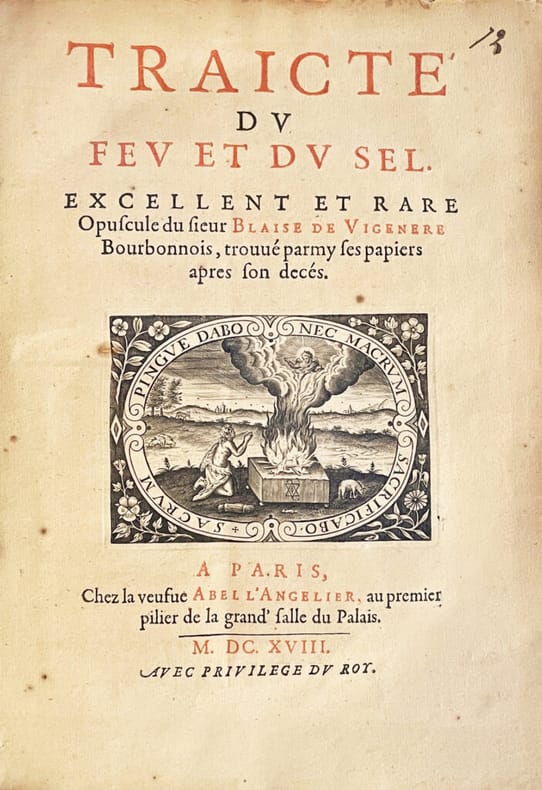
LCS-17899Rarissime édition originale de ce « traité recherché, mélange curieux d’alchimie, de Kabbale, de mysticisme, et où l’on trouve la manière de fabriquer de l’or » (Caillet, III, 11161). Paris, chez la Veuve Abel L’Angelier, 1618. In-4 de (2) ff., 267 pp., qq. brunissures et piqûres. Vélin souple de l’époque, restes de liens, dos lisse avec le titre manuscrit. Reliure de l’époque. 231 x 165 mm.
161958791BBOppenheim, Hieronymus Galler für Johann Theodor de Bry, 1619. 20x15 cm. 175 (recte 186) S., 5 n.n. Bl.; 172 (recte 170) S., 4 n.n. Bl., 1 w. Bl.; 67 S., 5 n.n S. Mit einem ganzseitigen gestochenen Porträt von Balthasar Schwan und 12 (11 ganzseitigen) Kupfern von Matthias Merian. Pergamentband der Zeit. In neuerem Pappschuber. 3 Teile in 1 Band. [2 Warenabbildungen]
4to (180 x 256 mm). 5 issues, 222 pp. altogether. Extracts bound together in a single volume without original wrappers. Modern red cloth with giltstamped cover title. All the five issues of "Nature" in which, between February and October 1953, the crucial papers were published that revealed to the world the double-helix structure of DNA. Some of the various authors were collaborators, others competitors, and while the credit for the discovery is today almost entirely attached to the names of Crick and Watson, their breakthrough depended on experimental work done by all the other scientists whose relevant papers were published in the same journal and are also here included. - The papers comprise, individually: - a) Pauling, L. and Corey, R. B. Structure of the Nucleic Acids (Nature 171, No. 4347, 21 Feb. 1953, p. 346). - b) Watson, J. D. and Crick, F. H. C. Molecular Structure of Nucleic Acids: A Structure for Deoxyribose Nucleic Acid (No. 4356, 25 April 1953; p. 737f.). - c) Wilkins, M. H. F., Stokes, A. R. and Wilson, H. R. Molecular Structure of Deoxypentose Nucleic Acids (p. 738-740). - d) Franklin, R. E. and Gosling, R. E. Molecular Configuration in Sodium Thymonucleate (p. 740f.). - e) Watson, J. D. and Crick, F. H. C. Genetical Implications of the Structure of Deoxyribonucleic Acid (No. 4361, 30 May 1953, p. 964-967). - f) Franklin, R. E. and Gosling, R. G. Evidence for 2-Chain Helix in Crystalline Structure of Sodium Deoxyribonucleate (Vol. 172, No. 4369, 25 July 1953, p. 156f.). - g) Wilkins, M. H. F., Seeds, W. E., Stokes, A. R. and Wilson, H. R. Helical Structure of Crystalline Deoxypentose Nucleic Acid (No. 4382, 24 Oct. 1953, p. 759-762). - Together these papers provide the single most important advance in biology since Darwin's theory. The first, by America's leading chemist of his age, Linus Pauling, ultimately contributed least because Pauling's theory erroneously suggested a triple-helix structure. "Instead, victory fell to an unlikely quartet of scientists in England who didn't work as a team, often weren't on speaking terms, and were for the most part novices in the field" (Bryson, A Short History of Nearly Everything, p. 487f.). These were the American wunderkind James Watson and his older colleage Francis Crick at Cambridge; the brilliant but often overlooked Rosalind Franklin (with her student Raymond Gosling), working at King's College London; and the New Zealand-born Maurice Wilkins, also at King's but who communicated to the competition at Cambridge Franklin's key findings - particularly, an X-ray photograph showing the DNA molecule's basic shape and dimensions, which provided Watson and Crick with the crucial clue. It was by then known that "DNA had four chemical components - called adenine, guanine, cytosine and thiamine - and that these paired up in particular ways. By playing with pieces of cardboard cut into the shapes of molecules, Watson and Crick were able to work out how the pieces fit together. From this they made a Meccano-like model - perhaps the most famous in modern science - consisting of metal plates bolted together in a spiral, and invited Wilkins, Franklin and the rest of the world to have a look. Any informed person could see at once that they had solved the problem. It was without question a brilliant piece of detective work" (Bryson, p. 491f.). Less than two months later, their paper, "Molecular Structure of Nucleic Acids: A Structure for Deoxyribose Nucleic Acid", appeared in "Nature". Franklin's own paper, in the same issue, shows the now-famous X-ray diffraction image of DNA fiber and pointedly concedes that "our general ideas are not inconsistent with the model proposed by Watson and Crick in the preceding communication" (vol. 171, p. 741). - For the discovery of the DNA double helix, Crick, Watson, and Wilkins shared the 1962 Nobel Prize in Physiology. Franklin had passed away four year earlier at the age of 37, a victim of the X-rays to which she had over-exposed herself in her work. - Tightly bound and in excellent condition throughout.
33 original black-and-white NASA photographs (gelatin silver prints), ca. 255 x 203 mm each, with extensive official captions and NASA logo printed on the back in purple ink. Stored within black cardboard binder, photographs in individual transparent sleeves. A collection of original gelatin silver prints showing the surface of the planet Mars, taken by the American robotic space probes Mariner 6, 7, and 9: five photographs taken by Mariner 6 and seven taken by Mariner 7 (1969); the remaining 21 taken by Mariner 9 in 1971-72. All are extensively annotated on the reverse with NASA's printed official photo captions. - Mariner 6 and 7 flew over Mars' equator and south polar regions, analysing the atmosphere and the surface with remote sensors and relaying to Earth hundreds of grayscale pictures. The mission goals were to study the surface and atmosphere of Mars in close flybys, so as to establish the basis for future investigations and to demonstrate and develop technologies required for future Mars missions. Two years later, NASA launched Mariner 8 and 9 - the former crashing into the Atlantic immediately, leaving the single surviving orbiter to perform a mission designed for two. Upon its arrival, NASA scientists were further dismayed to find the planet obscured by thick dust storms. Nevertheless, the mission turned out a complete success: after the dust had settled, the probe managed to send back excellent pictures of the surface. After 349 days in orbit, Mariner 9 had transmitted no fewer than 7329 images, covering 85% of Mars' surface. The images revealed river beds, craters, massive extinct volcanoes (such as Olympus Mons, the largest known volcano in the Solar System), canyons, evidence of wind and water erosion and deposition, weather fronts, and fogs. Mars' moons, Phobos and Deimos, were also photographed. The findings from the mission underpinned the later Viking program. - The exploration of Mars continues: the summer 2020 launch window saw the United Arab Emirates send an orbiter on the Al Amal (Hope) Mars Mission. It arrived in February 2021 to study the Martian atmosphere and weather.
2 volumi in folio, pp. (20), 690; (2), 462, (38). Frontespizio inciso, ritratto dell'arciduca Leopoldo, entrambi su disegno di J.P. Schor, e 21 tavole numerate a 23, di cui 4 ripiegate. Numerose illustrazioni xilografiche, di cui tre a piena pagine. Foglio di Errata alla fine del vol. II. Legatura coeva in piena pergamena rigida con titolo su tassello al dorso. Piccolo strappo alla cuffia superiore
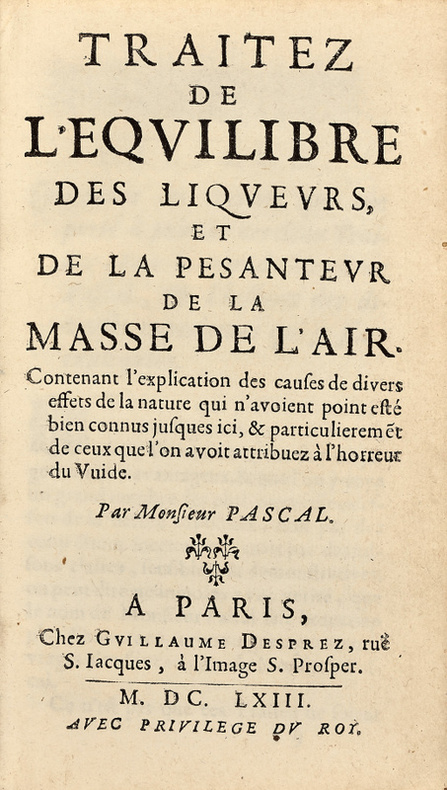
LCS-17938Edition originale du Traité de l’équilibre des liqueurs de Pascal parue six ans avant Les Pensées chez le même imprimeur, conservée dans sa reliure parisienne de l’époque. Paris, Guillaume Desprez, 1663. In-12 de (14) ff., 232 pp., (4) ff. et 2 planches hors texte repliées. Plein veau brun granité, dos à nerfs orné, coiffes anciennement restaurées, coupes décorées, tranches jaspées. Reliure de l'époque. 144 x 91 mm.
Oblong 4to (220 x 167 mm). Plate volume only (without the text). 84 engraved plates (13 folding) in original hand colour and gilt throughout. Contemporary half calf with giltstamped red spine label; spine attractively gilt. First edition. - A sumptuous copy in luxuriant and meticulous original colour, in nuanced hues with all the stars splendidly gilt. The plates show astronomical instruments, diagrams of cosmological theories, armillary spheres, celestial and terrestrial globes, a compass rose, a sundial, two maps of the moon, a map of Salzburg, and (in 54 engravings) the constellations of both hemispheres, including the zodiac. The plates are engraved by A. C. Fleischmann, J. C. Bernd, and J. Hering. Their Baroque iconography, mirroring the splendour of the absolutist prince in that of the celestial orb, places the work in the tradition of earlier astronomers such as Johannes Hevelius: Thomas situates a pair of stag's antlers, the armorial crest of the dedicatee, the prince-archbishop Leopold von Firmian, in the constellation of the Corona Borealis (Northern Garland), rechristening it "Corona Firmiana" in his honour. The frontispiece (fol. 2) shows Firmian's portrait. - The Benedictine monk Thomas (1694-1767) was an astronomer and mathematician, professor (in 1721), later librarian and vice-rector of the University of Salzburg. He taught Exegesis, Biblical Hermeneutics, rhetoric as well as Hebrew. - Covers rubbed; corners and spine professionally repaired using most of the original material, resewn. Endpapers somewhat soiled; handwritten ownership of Alfons Olsson (dated 7 March 1909) to front pastedown. Occasional fingerstaining to margins and a few small edge flaws; repaired tears to the folding "Tabula synoptica" and to the Virgo plate; a corner repair to fol. 12. Altogether very appealingly preserved. Cf. Wurzbach XLIV, 252. Lalande 392. Poggendorff II, 1096. Zinner (Instrumente) 535 (all citing the 1731 second edition).
Folio (260 x 382 mm). (6), X, 244 pp. With engraved title vignette, 4 engravings in the text, and 8 folding engraved plates (all in original hand colour, some raised with mineral dust). Contemporary marbled boards with green spine label. All edges red. First edition of this famous, splendidly illustrated monograph on mining; also the first geological study of Germany's Harz region. Contains details on mineralogy, fossils, lodes, and mines, as well as "some excellent early observations on chemical geology; obviously inclined to afford those slow and inconspicuous changes in the earth crust the importance that they really deserve" (ADB). Also remarkable for the fine vignettes, engraved by G. M. Kraus after drawings by F. H. Spoerer. These vignettes, as well as Goethe's contributions to the entire work, are discussed extensively in Schmid, "Goethe und die Naturwissenschaften", no. 414f. Trebra (1740-1819) accompanied Goethe on his journey over the Harz and remained his advisor in mineralogical matters throughout his life. The plates, some of which are raised with ore dust, are based on drawings now in the Goethe-Nationalmuseum in Weimar. - Binding slightly rubbed and bumped along the raised bands; otherwise a very clean, crisp copy on superior paper. Includes the second illustration to plate V (Vb, mounted); the window in plate 2, providing a view of the lode in plate 3, lacks the flap as usual. Provenance: from the library of Pfannberg castle in Styria, bearing the stamp of the Austrian industrialist Franz Baron Mayr von Melnhof (1810-89, owner of the Donawitz ironworks and the Kapfenberg steel foundry) on pastedown and title. Hoover 796. DSB XI, 455. Reichardt I, 136. Poggendorff II, 1127. Ferchl 541. Kippenberg 5736. ADB LIV, 708f.
167357048Copenhagen, Peter Haubold, 1673-80. 4to. Bound in four full mottled calf bindings from ab. 1800 with five raised bands to richly gilt spines. All edges of baords gilt. Bindings with some wear, especially to capitals, hinges, and corners. Old owner's inscription ""AEM Schleisveig/ Paris 1 Juli 1889"" to front free end-papers. Some brownspotting and browned leaves. Woodcut vignettes and initials. All four title-pages (part III & IV have a joint title-page) printed in red and black. (16), 316" (20), 376 (16), 174, 216" (8), 342 pp. With ab. 60 woodcut illustrations in the text, many of them quite large, two of them full-page, and all 62 engraved plates (of which two are on a folded leaf), four of which are folded. Fully complete, with all five volumes and all 62 plates.
Copenhagen, Peter Haubold, 1673-80. 4to. Bound in four full mottled calf bindings from ab. 1800 with five raised bands to richly gilt spines. All edges of baords gilt. Bindings with some wear, especially to capitals, hinges, and corners. Old owner's inscription ""AEM Schleisveig/ Paris 1 Juli 1889"" to front free end-papers. Some brownspotting and browned leaves. Woodcut vignettes and initials. All four title-pages (part III & IV have a joint title-page) printed in red and black. (16), 316" (20), 376 (16), 174, 216 " (8), 342 pp. With ab. 60 woodcut illustrations in the text, many of them quite large, two of them full-page, and all 62 engraved plates (of which two are on a folded leaf), four of which are folded. Fully complete, with all five volumes and all 62 plates.
voll. 2 in Folio piena pergamena coeva, pp. (166), con ritratto dell'autore entro ovale in bella bordura di stile rinascimentale, 672; 673, 527, (12). Marca tipogr. ai frontesp., capilettera xilogr. I due volumi sono arricchiti da circa 1000 grandi xilografie raffig. piante, frutti, animali, minerali ed in fine apparecchi per la distillazione dei liquidi. Stimata e non comune edizione volgare, tra le più complete pubblicate. Il Mattioli (Siena 1500 - Trento 1577) medico senese e insigne fitologo, traducendo il Dioscoride, ne colmò le lacune, integrò l'opera con un vasto commento, raccolse ed aggiunse centinaia di nuove piante medicinali...". Nissen, 1304. Pritzel 5988. Graesse, IV-4420. Legat. allentate, frontesp. del 1° vol. appl. su carta antica e mancante dei margini, 6 cc. d'indice con rinforzi al marg. bianco, alcune lettere mancanti manoscritte anticamente, mancano 2 cc. prima della tavola dei rimedi di tutti i morbi del corpo umano. ultima carta del 2° vol. con restauro, senza perdite. Discreto esempl. con usuali tracce d'uso e fioriture. Alla sguardia nota manoscritta dell'antico possessore: Di me dr. Francesco Puccinelli di Camajore pagato L. 26.
180330335DBLeipzig, Heinrich Gräff, 1803. Gr.-folio. (7) Bl., 216 S., (24) Bl. Mit gestochener Titelvignette, 2 Anfangsvignetten, 46 gestochenen Kupfertafeln und 21 Vignetten im Text. Halblederband um 1840 mit rotem, goldgeprägtem Rückenschild und wenig Rückenvergoldung. + Wichtig: Für unsere Kunden in der EU erfolgt der Versand alle 14 Tage verzollt ab Deutschland / Postbank-Konto in Deutschland vorhanden +, A|B 2 Teile in 1 Band. [2 Warenabbildungen]
155754333Københaffn, (Hans Vingaard), 1557. 4to. Indbundet samlet i et senere enkelt hldrbd. fra omkr. 1850. Med brugsspor men repareret. Ad. 1: Titelblad trykt i sort/rød med sammensat træskåren ramme. (8),160,(1) blade - 2. Titelblad med træskåren ramme. (3),48 blade. - 3. Titelblad med træskåren ramme. (4),32,(12) blade (heraf de sidste 12 blade Apoteckerfortegnelsen). - 4. Titelblad med sammensat træskåren ramme. (7),20 blade. - 5. Titelblad med træskåren ramme. (5),10,(1) blade. Gennemgående i god stand, men her og der med brunpletter, brugspletter særligt på de første blade. Nogle af trykkene har et blankt blad til slut, disse er ikke tilstede i samlingen.