MareMagnum

98 842 résultats
in-4 (207x148 mm), pp. (12 su 16 mancando il ritratto di Eustachio Divini e il suo corrispettivo bianco), 268, (4); legatura di cartone rustico. Vignetta silogr. sul tit., 17 diagrammi e figure silogr. n.t. (strumenti ottici, torni, meccanismi per il taglio e la mola del vetro e la prima macchia per la gradazione delle lenti). Prima edizione della prima opera che tratti l'ottica dal punto di vista della pratica, e in particolare la progettazione e la manifattura di lenti e telescopi in maniera dettagliata: ''una delle prime istruzioni dettagliate sulla molatura e la rifinitura delle lenti'' (Becker Catalogue). Il primo capitolo tratta dell'invenzione degli occhiali da vista e del telescopio (specialmente quelli di Galileo); i capitoli secondo-quinto trattano l'ottica, l'anatomia dell'occhio, la vista ed i suoi difetti; i capitoli successivi sono dedicati alla fabbricazione delle lenti e degli occhiali, alle loro forme e miglior uso, ai materiali ed ai macchinari utilizzati, ecc. ''Important and probably the earliest practical account of the contemporary methods grinding and polishing glasses for spectacles and telescopes. One of the most interesting early works on the manufacture of optical instruments...'' (cfr. Source book of Ophthalmology). Poco si sa della vita del bolognese C.A. Manzini (1599-1677), se non che fu Accademico Apatista di Firenze e Gelato di Bologna, detto l'Errante ed autore degli ''Incentivi alla vita solitaria e beata (1674) e de ''Il duello schernito'' (1680). Esemplare di eccezionale provenienza: al titolo nota di possesso manoscritta di Eustachio Divini (di S. Severino Marche, ritenuto il primo costruttore di occhiali) ) e iniziali intrecciate ''OK'', correzioni manoscritte alle pp.B1v, E4v, M1r,S1v, Y2v, Ff1v, Hh2v and Hh4v probabilmente del Divini stesso. La stretta relazione tra il Divini e l'a. è documentata da due lettere del 1663 e 1666, nelle quali Divini narra al Manzini della costruzione del suo ''occhialone'' di 52 spanne e delle scoperte rese possibili dal suo telescopio. In questo esemplare l'assenza del ritratto, stampato su carta differente e rilegato dopo la stampa, è comprensibile se si considera il Divini come correttore delle bozze. Esemplare con lievi arrossature marginali ad alcuni fogli.. Source Book of Ophthalmology n. 1475. Michel-Michel V, 100. BMC XVII s. 530. NLM/KRIVATSY 7389; RICCARDI II, 96; WELLCOME II, p. 48; V. ILARDI, Reinassance Vision from Spectacles to Telescope, Philadelphia, 2007, p. 229..
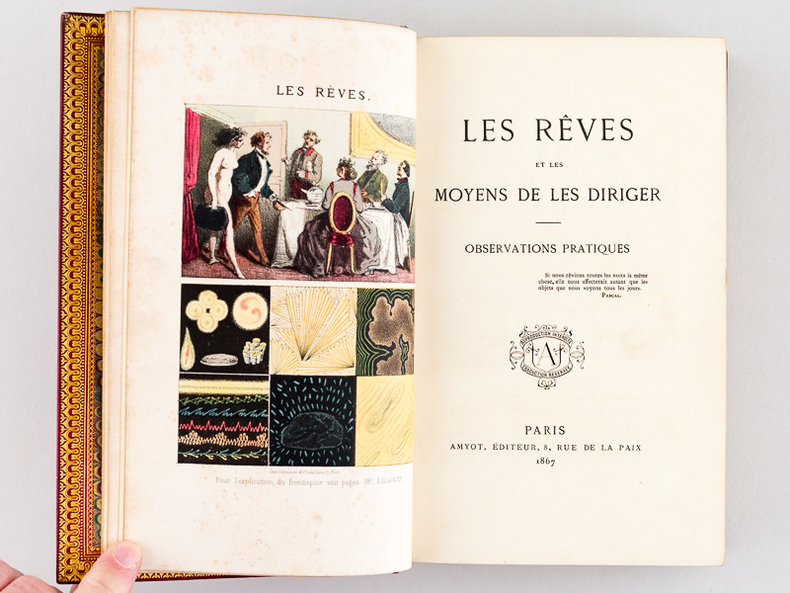
1867582711 vol. fort in-8 reliure plein maroquin rouge, dos à 5 nerfs orné (au chiffre HSD surmonté d'une couronne de marquis et d'un hercule), toutes tranches dorées, chasses et coupes ornées, couvertures conservées, reliure signée de Trautz-Bauzonnet, Amyot, Paris, 1867, 2 ff., 496 pp. avec frontispice lithographié en couleurs, et 9 dessins originaux ou tirages d'essais du frontispice ou des couvertures
1 vol. fort in-8 reliure plein maroquin rouge, dos à 5 nerfs orné (au chiffre HSD surmonté d'une couronne de marquis et d'un hercule), toutes tranches dorées, chasses et coupes ornées, couvertures conservées, reliure signée de Trautz-Bauzonnet, Amyot, Paris, 1867, 2 ff., 496 pp. avec frontispice lithographié en couleurs, et 9 dessins originaux ou tirages d'essais du frontispice ou des couvertures Exemplaire unique de cet ouvrage très rare, dont Freud fut incapable de se proposer le moindre exemplaire, malgré tous ses efforts, comme il l'indique en note dans l'Interprétation des Rêves ! Un des 10 exemplaires sur grand papier ("sur papier espagnol" comme l'indique une note manuscrite de l'auteur dans un autre exemplaire), celui-ci manifestement celui de l'auteur (avec son chiffre couronné "HSD" répété en dos), contenant en sus : les deux couvertures (absentes du seul autre exemplaire répertorié du tirage sur grand papier), le croquis original de la couverture par Henri Alfred Darjou, un tirage de la couverture avant mise en couleur, un dessin original à la plume (étude pour le frontispice, dont un dessin non retenu), un tirage d'ébauche du frontispice, un tirage en noir du frontispice, trois tirages d'essais de mise en couleurs du frontispice, un tirage d'épreuve avant la lettre du second plat. Le sinologue Léon d'Hervey de Saint-Denys avait recueilli les rêves de 1946 de ses nuits, lesquels servirent de matière à cette étonnante étude, pionnière dans l'analyse des rêves d'un point de vue "moderne". L'ouvrage se conclut sur un appendice intitulé : "Un rêve après avoir pris du hatchich" (sic). Havelock Ellis ou André Breton évoquent la rareté de l'ouvrage (l'éditeur Amyot fit faillite peu de temps après sa publication). Bon état (petites fentes en mors en tête, signet usé presque coupé, petits frott. et petits accroc à un plat, très bel exemplaire par ailleurs). Unique copy of this scarce work, of which Freud was unable to offer himself the slightest copy, despite all his efforts, as he indicates in a note in his "Interpretation of Dreams" ! One of the 10 copies on large paper ("on Spanish paper" as indicated by a handwritten note from the author in another copy), this one obviously that of the author (with his number crowned "HSD" repeated on the back ), containing in addition: the two covers (absent from the only other listed copy of the print on large paper), an original sketch of the cover by Henri Alfred Darjou, a print of the cover before coloring, an original pen drawing (study for the frontispiece, including one drawing not retained), a drawing of a sketch of the frontispiece, a black print of the frontispiece, three prints of color trials of the frontispiece, a proof print before the letter of the second cover. The sinologist Léon d'Hervey de Saint-Denys had collected the dreams of 1946 from his nights, which served as material for this astonishing study, a pioneer in the analysis of dreams from a "modern" point of view. The work ends with an appendix entitled: "A dream after having taken hatchich" (sic). Havelock Ellis or André Breton evoke the rarity of the work (the publisher Amyot went bankrupt shortly after its publication). In a note in his "Traumdeutung", Freud evokes this work which he did not manage to obtain despite his efforts. : "[ ... ] ich mir trotz aller Bemühung nicht verschaffen konnte" ("d'Hervey, whose book I could not lay hands on in spite of all my efforts"). Français
Folio (228 x 330 mm). (36), 415, (1) pp. Title-page printed in red and black. With hundreds of geometric figures in the text. - (Bound after) II: Coenders van Helpen, Barent. Thresor de la philosophie des anciens où l'on conduit le lecteur par degrez à la connaissance de tous les metaux & mineraux [...]. "Cologne" (i.e., Groningen), Claude le Jeune, 1693. (6), 240 pp. Title-page printed in red and black. With allegorical frontispiece ("Escalier des Sages"), woodcut ornaments, 12 allegorical plates, and 5 copper engraved plates with alchemical motifs. Contemporary smooth, deep auburn full calf with gilt ornamentation and traces of a label to spine. Editio princeps of books V, VI and VII of the "Conica", the most original part of Apollonius's fundamental work on conic sections. The text survives only in the Arabic manuscript of Abu 'l Fath of Ispahan, purchased by the Medici family in the first half of the 17th century and here translated and edited by Alfonso Borelli. "This was a valuable addition to the mathematical knowledge of the time, for whereas Books I-IV of the Conics dealt with information already known to Apollonius's predecessors, Books V-VII were largely original. Book V discusses normals to conics and contains Apollonius's proof for the construction of the evolute curve; Book VI treats congruent and similar conics and segments of conics; Book VII is concerned with propositions about inequalities between various functions of conjugate diameters" (Norman). "The fifth book is especially important treating of normals as minimum and maximum straight lines drawn from given points to the curve" (Honeyman). "The sixth book is on the similarity of conics. The seventh book is on conjugate diameters" (Cajori). - A fine, wide-margined copy. - Bound first is the final edition of the "Thresor de la philosophie des anciens", a reference treatise for the theory and practice of alchemy, esotericism and hermetic philosophy that draws on Hermes Trismegistus, Paracelsus, and Sendivogius. Couched in the form of a dialogue, the book discusses the ten-step ascent to the single matter via two qualities, three principles, and four elements. The 17 remarkable allegorical plates depict alchemy, chaos, heat, love, the elements, sulphur, mercury, and salt. The Groningen politician Coenders (1601-78) first published this rare work in 1686. - Occasional light browning; title-page trimmed along top edge. Binding a little rubbed at extremeties, spine-end professionally repaired, but an appealing volume. I: Norman 58. Honeyman 119. De Vitry 29. Sarton I, 173-175. DSB I, 179-193 (Apollonius) & II, 308f. (Borelli). Cajori, A History of Mathematics, pp. 40f. DBI XII, 546. Riccardi I, 158 ("bella edizione, ed assai ricercata"). - II: VD 17, 7:651937N. Caillet 2419. Duveen 287. Verginelli 74. Brüning II, 2718. Brunet II, 1052.
181889274In der Realschulbuchhandlung | Berlin 1818 | 54 x 42 cm | En feuilles sous une boîte
192954949London, 1929. 4to. Entire vol. X, 1929, bound in black full cloth with gilt lettering to spine. Hinges a bit weak and end-papers renewed. A few leaves loosening a bit. All in all a good, sound copy. Book plate of Frank J. Farrell to inside of front board. Pp. 226-228, (2 pp. - photographic illustrations), pp. 229-236. [Entire volume: VII, (1), 407 pp.].
London, 1929. 4to. Entire vol. X, 1929, bound in black full cloth with gilt lettering to spine. Hinges a bit weak and end-papers renewed. A few leaves loosening a bit. All in all a good, sound copy. Book plate of Frank J. Farrell to inside of front board. Pp. 226-228, (2 pp. - photographic illustrations), pp. 229-236. [Entire volume: VII, (1), 407 pp.].
Oblong folio (245 x 375 mm). 2 engr. title pages and 22 + 20 engr. plates by Pfeffel after Danreiter. - (Bound with) II: Steingruber, Johann David. Architecture civile. Erster Theil [= all published]. Architecturally engr. title-page, engr. preface (misbound before title-page), and 25 numbered engr. plates by J. D. Ringlin after Steingruber; explanatory text engraved within the plate in German and French. - (Bound with) III: Charmeton, Georges. Plans de divers edifices et corniches choisies. Abriße unterschiedener Gebälcke und Kronwercke. 12 engr. plates, including the title-page. Contemporary German half vellum over paste boards and beige paper covers (a little foxed); slightly faded red stained gilt lettered label tooled directly onto spine. Red speckled edges. A remarkable sammelband of three rare architectural and garden ornament works (the first in two parts), all of which were published by the important Augsburg print publisher Johann Andreas Pfeffel. I: First and only edition of a very scarce ornamental garden pattern book by the newly appointed court gardener and inspector of the Salzburg gardens, Franz Anton Danreiter (1695-1760). In 1728 Danreiter was appointed court gardener and inspector to related buildings by the ducal bishop of Salzburg. He translated Dezallier's "La Theorie et la Pratique du Jardinage" into German and became one of the more important mediators of French garden design to the German-speaking countries. His own designs issued in the present work, in two parts, with the second part particularly rare, show more than 100 ornamental and fanciful planting patterns on 42 plates. This was his first and rarest model book with garden plans for parterres. They show that far from endlessly repeating the strict symmetrical canon of French Baroque garden design, Danreiter developed a never-ending variety in ornamental designs which herald the German rococo. Danreiter served five successive bishops in Salzburg. Between 1727 and 1735 he also engraved a number of large-scale views of the city which represent a unique documentation of Salzburg in its 18th century baroque glory. - II: First edition of Steingruber's first published architectural book, showing designs for town houses and palaces. In total Steingruber shows seven scaled designs from a garden pavilion in an aristocratic park (2), several ever more lavish town houses for the haute bourgeois (4), and finally a ducal residence (1). Each design is shown in as much detail as possible with elevations and plans, but also several sections. The grander houses are shown with views of street and garden elevations; some designs have differently laid out plans. The architect J. D. Steingruber (1702-87) was appointed court architect by the Margrave of Brandenburg-Ansbach in 1734. In the course of his near sixty-year tenure of this position he was able to transform the townscape of Ansbach after his own designs. He is best remembered for his playful "Architektonisches Alphabet" (1773), a remarkable series of designs in which each building has a ground plan based on a different letter in the alphabet. - III: Scarce 18th century copy of Charmeton's rare "Diverses corniches choisies sur l'anticque", originally issued in 30 plates in c. 1670 (cf. Guilmard, 68). Pfeffel decided to issue only a selection of the designs. - Very rare: the only three complete copies of Danhauser's work located in libraries worldwide are at Augsburg (cf. KVK), Dumbarton Oaks (cf. OCLC), and the National Gallery, Washington (cf. Millard, Northern, no. 18). The Bavarian State Library and the British Library have only the first part; Olschki, Choix, 645 offered a copy with the second part, but lacked 2 plates in that part. - First leaf with near-contemporary aristocratic illegible ownership stamp. A fine architectural sammelband in excellent fresh condition with the plates in strong impressions, all printed an thick paper. I: Kat. der Ornamentstichslg. Berlin 3332 (wrong collation). II: Kat. der Ornamentstichslg. Berlin 2006. Cicognara 676. OCLC records copies at Avery and Getty; as well as 4 copies in Germany (including Berlin). III: Kat. der Ornamentstichslg. Berlin 3929.
8vo (154 x 223 mm). (4), 371, (5) pp. Modern full morocco binding with gilt cover rules, spine gilt, leading edges gilt, all edges gilt. First edition of Freud's 'Interpretation of Dreams'. "Unquestionably Freud's greatest single work" (PMM). Here, Freud introduces the idea of the unconscious, and leaves an indelible mark on culture, advancing the idea that dreams have symbolic meaning to the dreamer beyond their literal content. - In perfect condition, preserved in a tasteful modern binding. Garrison/Morton 4980. PMM 389. Grinstein 277. Grolier/Horblitt 32. Grolier (Medicine) 87. Norman F33.
Large folio. (4), 20 pp. With 35 engraved botanical plates (8 folding), 20 drawn by Pierre-Joseph Redouté, 1 each by J. P. and L. J. Redouté, 10 by James Sowerby, 2 by J. G. Bruyière, and 1 by B. Pernotin. Engraved by Fr. Hubert, Maleuvre, Juillet, J. B. Guyard, Stephane Voysard and Milsan. Contemporary half red roan (sheepskin), blue paper sides, green parchment corners. Preserved in custom-made box. Second edition, usually called the second issue, of a flower art book by the French botanist Charles Louis L'Héritier de Brutelle (1746-1800). In this book, L'Héritier describes 35 genera and 124 species of rare plants in Kew Gardens and the herbarium of his fellow botanist Joseph Banks, which he studied in 1786 together with Pierre Joseph Redouté. His text also refers to the 35 plates, which depict some of the flowers. L'Héritier mostly describes horticultural plants, including many exotic plants from South Africa. Most of the plates were provided by the two most gifted botanical artists of the age: the Frenchman Pierre Joseph Redouté and the Englishman James Sowerby. - The "Sertum Anglicum" was published as a token of the author's gratitude for the hospitality shown by Banks and other fellow botanists on his visit to England. Remarkably, 13 genera and 65 species of exotic plants are here described for the first time. Furthermore, no fewer than 31 of the plates are the first published illustrations of the species, and seven remain the only illustration of the species ever published. The book therefore remains an irreplaceable botanical reference work today, beyond its value as a work of botanical art of the highest quality, containing beautiful flower illustrations by two of the greatest masters of all time. - Although the imprint gives 1788 as the year of publication, Stafleu & Cowan call the present version of the "Sertum Anglicum" both a "reprint" and a "reissue", probably published as a whole after L'Héritier's death in 1800. It differs from the earlier version in the number of pages for the main text. The first version was published in five parts with the entire letterpress text in part 1. Its main text occupies 35 pages, while the main text of the present second version occupies 20 pages. But the title-page and the other preliminary leaf are apparently true reissues of the first printing, for both are dated 1788 and have the same imprint (giving the printer as Pierre-François Didot, although he died in 1795, and the same booksellers). While the imprint of the first issue suggests that it was printed and published as a whole in 1788, it was actually published in five parts between 1789 and 1792: in early January 1789 (the complete text and plates 1-2), May 1790 (plates 3-12), April 1792 (plates 13-24 & 15 bis) and late in 1792 (plates 25-34), respectively. Some types on the "1788" title-page were also out of date by 1800. - With a hand-written inscription on the first endleaf. Binding, especially the edges, slightly rubbed; the paper sides are slightly discoloured. With only a few stains and the edges of the paper slightly frayed. Spine professionally reinforced. A large paper copy of a rare work in good condition. Dunthorne 248. Great Flower Books 65. Hunt 692. Nissen (BBI) 1189. Pritzel 5270. Stafleu/Cowan 4492.
4to. (4), 35, (1), 306 pp. With 2 folding tables and 1 folding plate. Contemporary full vellum with 19th century giltstamped red title label pasted to spine. All edges red. First edition of "Bernoulli's most original work [... and his] most famous single writing" (DSB). the "establishment of the fundamental principles of the calculus of probabilities" (Grolier/Horblit). "Jakob Bernoulli's posthumous treatise, edited by his nephew [Nicholas I Bernoulli], (the title literally means "the art of [dice] throwing") was the first significant book on probability theory: it set forth the fundamental principles of the calculus of probabilities and contained the first suggestion that the theory could extend beyond the boundaries of mathematics to apply to civic, moral and economic affairs. The work is divided into four parts, the first a commentary on Huygens's 'De ratiociniis in ludo aleae' (1657), the second a treatise on permutations (a term Bernoulli invented) and combinations, containing the Bernoulli numbers, and the third an application of the theory of combinations to various games of chance. The fourth and most important part contains Bernoulli's philosophical thoughts on probability: probability as a measurable degree of certainty, necessity and chance, moral versus mathematical expectation, a priori and a posteriori probability, etc. It also contains his attempt to prove what is still called Bernoulli's Theorem: that if the number of trials is made large enough, then the probability that the result will lie between certain limits will be as great as desired" (Norman). This was the first statement of the law of large numbers. - Insignificant browning, more noticeable in title-page (with an old edge repair on verso); final leaf a little duststained in the margins. An excellent copy from the library of the Swedish astronomer and statistician Carl Vilhelm Ludwig Charlier (1862-1934) with his bookplate to front pastedown (overpasting an earlier Parisian printed bookseller's label). Charlier played a crucial role in the development of statistics in Swedish academia, and several of his pupils became statisticians. He also translated Newton's "Principia" into Swedish. PMM 179. DSB II, 50. Dibner 110. Evans 8. Grolier/Horblit 12. Sparrow 21. Norman 216. OCLC 10851120. Goldsmiths'-Kress 05090.0.
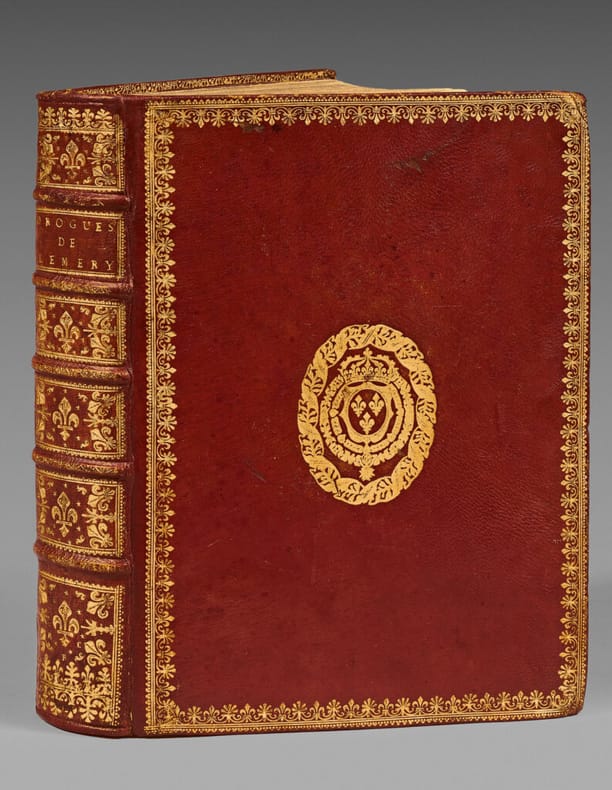
LCS-18157L’exemplaire du roi Louis XIV relié en maroquin à ses armes et pièces d’armes. Paris, Laurent d’Houry, 1698. In-4 de (8) ff., 838 pp., (31) pp. Maroquin rouge, guirlande de fleurs de lys autour des plats, armes au centre, dos à nerfs orné de grosses fleurs de lys dorées, lettres RBC en pied, roulette intérieure et tranches dorées. Reliure de l'époque. 254 x 185 mm.
191083637Zurich 21 juin 1910 | 9 x 14 cm | une carte postale
193788282s.d. (1937-1938) | 20.50 x 26.50 cm | 1 p. manuscrite, 1 p. titre tapuscrite, 19 ff. tapuscrits, 1 ff. bl., 6 pl. + 15 ff. tapuscrits, 1 pl.
4to. (7), "335" [= 332], (6) ff. With a helmed, crested and mantled dedication woodcut of the Contreras coat of arms on the title-page (dexter argent paly of 3 azure, sinister an inverted tower, the whole with a bordure containing 12 X's) repeated at the end of liber I, woodcut device at the end of the text (stork standing on its left foot on a scull and holding a rock in its right foot, holding a banderole in its beak with the word "vigilate"), and a woodcut annunciation (including a banderole with "ave Maria gracia plena") above the colophon, a woodcut tailpiece (plus 5 repeats), and headpieces, tailpieces and factotums built up from arabesque and other typographic ornaments.Tree-pattern tanned sheepskin (ca. 1830), sewn on 3 recessed cords but with 4 false bands on the gold-tooled spine, with the title and author's name on a brown and a black morocco label in the 2nd and 4th of 5 compartments and the owner's initials J.S. (for José Saranderes) in the 5th, marbled endpapers (large blue shell on small brown shell, the form similar to Wolfe 125), headbands in blue and white. Rare first and only early edition, with the text in Spanish but the lists of ingredients in Latin, of by far the most extensive and most detailed early medicinal recipe book in Spanish, with recipes for about 300 medicines arranged in 9 sections for internal medicines followed by 3 sections for external medicines. Each recipe begins with a list of ingredients followed by instructions for the preparation of the medicine and information about its uses and dosage under various circumstances. Liber 1, section V is devoted to opium. The book closes with an appendix on weights and measures and an extensive index. Its only real predecessor, Luis de Oviedo's 1581 Methodo de la coleccion, y reposicion de las medicinas, offers only 49 recipes and gives no clear lists of ingredients. - Almost all we know about Castillo comes from the book itself, where he gives some biographical information. He was born to Spanish parents in Bordeaux, where he studied pharmacology, then worked in the apothecary shop at the Escorial in Madrid where he learned a great deal about chemistry (a remarkably early example of experimental chemistry in pharmacology: López-Pérez, Chymia, 2010, p. 344) and moved about 1610 to Cádiz where he set up his own apothecary shop. He noticed the dangerous lack of good Latin among young people working for apothecaries and provided the present work to remedy the situation. He was still fairly young when he wrote it. On the title-page he calls himself a professor of medicine at Cadíz, but he probably taught on his own account, for there was no faculty of medicine in Cadíz until 1748. The colophon's "en cassa de l autor" suggests the publication was his own venture, without institutional support, and he dedicates it to Juan Ruiz de Contreras y Téllez (ca. 1570-1625), an important councillor to King Phillip III, though he lost some of his influence when the king died in 1621. Although Castillo titles his book Pharmacopoea, and it was widely used and influential in Spain, it appears never to have been officially adopted as a standard, so that it does not fit the strict modern definition of a pharmacopoeia. The content of the book is: liber 1 (internal): I De conditis aut conservis. II De sapis. III De eclegmatis seu loch. IV De pulveribus aromaticis electuariorum. V De opiatis. VI De electuaris. VII De hieris. VIII De pilulis. IX De trochiscis. liber 2 (external): prefacio. I De oleis. II De unguentis. III De emplastris. [Appendix:] Tractado de los pessos, y medidas vivales. - With an owner's inscription of the Madrid pharmacologist José Saranderes, author of a 1837 manuscript on the preparation of opium, on the back of the title-page and his initials J.S. gold-tooled at the foot of the spine. Slightly browned with some foxing, spots and stains, a hole affecting a couple words in Y2 and restored corners in 7 other leaves without loss of text, but still generally in good condition. Binding slightly rubbed but otherwise good. The earliest extensive book of medicinal recipes in Spanish: a pioneering pharmacological work. Bibliographia medica Hispanica II, 140 (p. 63). R.R, Guerrero, Diccinario ... autores farmacéuticos I (1958), pp. 632f. A. Hernández Morejón, Historia bibliográfica de la medicina Española V (1846), 50. Krivatsy 2260 (lacking title-page & 1 text leaf). Palau 47896 & 48131. USTC 5021897. Wellcome I, 1355.
8vo. 453-460 pp. Original wrappers. Stored in custom-made black half morocco case. First printing, offprint from the "Archiv für Anatomie und Physiologie" (1884, 5-6). Inscribed and signed to his schoolfriend, the chemist Josef Herzig, on the upper wrapper cover: "Seinem lieben Freunde Dr. Jozef Herzig | dVerf.". "Freud's full account of his method of staining nerve tissue with gold chloride [...] An English version [...] was published in Brain 7 (1884) [...] under the title 'A new histological method for the study of nerve-tracts in the brain and spinal cord'" (Norman). - Very rare and in quite good condition with insignificant edge wear and traces of handling. Provenance: from the collection of the psychoanalyst and bibliophile Haskell Field Norman (1915-96) with his bookplate on inside front cover; acquired from a Belgian private collection. Grinstein 30. Stanford 6. Norman F 6 (this copy).
8vo. 38 pp. Original wrappers. Stored in custom-made black half morocco case. First edition of this very rare pamphlet: Freud's only fifth own publication, offprint from vol. LXXXV, 3rd Dept., January issue. Inscribed and signed on the upper wrapper cover to his schoolfriend, the chemist Josef Herzig: "Seinem lieben Freunde Dr. Jozef Herzig | dVerf.". - "In this paper on the nerve cells of river crayfish, Freud was the first to demonstrate conclusively that the axes of nerve fibers are without exception fibrillary in structure [...] in this and his earlier researches Freud recognized that nerve cells and fibers were a single unit, thus paving the way for the neuron theory a number of years before Waldeyer-Hartz announced it in 1891. Freud had in fact stated as much in a lecture before the Psychiatric Society in 1882" (Norman). - Wrappers slightly duststained, otherwise a perfect, uncut copy from the collection of the psychoanalyst and bibliophile Haskell Field Norman (1915-96) with his bookplate to inside front cover; acquired from a Belgian private collection. Meyer-Palmedo/Fichtner 79. Grinstein 5. Stanford 5. Norman F5 (this copy).
LCS-17639Très séduisant exemplaire de cette rare édition originale, pur et grand de marges, conservé dans son vélin souple de l’époque à recouvrement, bien complet du frontispice dépliant qui manque souvent. Lugduni Batavorum [Leyde], Iodocum a Colster, 1616. 2 parties reliées en 1 volume in-4 de: I/ (12) ff. y compris le titre imprimé en rouge et noir et le portrait de l’auteur au verso, 270 pp., 1 frontispice dépliant et 34 gravures dans le texte; II/ (1) f. de titre, 128 pp., 2 planches dépliantes et 25 gravures dans le texte. Petit trou de vers dans les pp. 9 à 55 du second texte, 2 ex libris manuscrits sur le titre, note manuscrite ancienne dans la marge de la p. 177. Relié en plein vélin souple à recouvrement de l’époque, restes de liens de cuir, dos lisse avec le titre manuscrit. Reliure de l’époque. 200 x 140 mm.
1977216831Berlin, 1847-1977. Verschieden geb.. u. in Heften. Teils berieben bzw. angeschmutzt. Einige Rücken beschäd. Teils m. Rsign., St. a. Tit. Fehlen: Bd. 219; 241; 242; 55 3 Taf.
Folio. 2 volumes. 66, (4), 67-78; 12 pp. With 24 engraved plates in vol. 1 (numbered 1-24) and 6 engraved plates in vol. 2 (numbered 25-29, 31: all published), all signed by I. Nuszbiegel after originals by the author, except plate 31, which is signed by Johann Stephan Capieux. Blue sprinkled paper over boards (vol. 1) and limp grey paper wrappers, stab-sewn through the wrappers (vol. 2). Both volumes of the first and only edition of Hoffmann's monograph on willows, published in instalments from 1785 to 1791, including the series of 30 engraved plates (numbered as 31) made to accompany them, showing willows, their branches, leaves and flowers. He describes different kinds of willows, their varieties, habitat and sizes. All descriptions refer to the plates, so that readers could use them together. - G. F. Hofmann was a German botanist and physician. He first served as professor of botany in Erlangen, then professor of botany and director of the botanical garden in Göttingen. Finally he went to Moscow, where he continued his botanical studies, taking charge of the Imperial Academy of Science's botanical garden and herbarium. - The two volumes of the "Historia salicum iconibus illustrata", including the engravings, have a turbulent publication history. Volume 1, in 4 instalments, was actually issued in two parts: instalments 1 and 2 (pp. 1-48), together with plates 1-5 and 6-10 respectively, appeared between February and June 1785. Instalments 3 and 4 (pp. 49-78), together with plates 11-16 and 17-24 respectively, probably in September or October 1786, the 4th instalment also including the title-page for the entire vol. I. Volume 2 appeared nearly four years later, between January and June 1791, together with plates 25-29 and 31. Plate 30 is never mentioned in the text or bibliographies, so it was apparently never published or was misnumbered “31”. - With manuscript owner's inscriptions on the title-page of instalment 1 and on the title-page of vol. 1. With the title-page to vol. 1 misbound between instalments 3 and 4. Binding of vol. 1 slightly worn, corners bumped. Paper wrappers of vol. 2 slightly frayed at the corners. With a small professional restoration to the foot of the spine. With some minor stains in each volume, but still in good condition. Both volumes, rarely found together, of a remarkable monograph on willows, with all the plates. Hunt II, 678. Johnston 565. Nissen BBI 893. Pritzel 4127. Stafleu & Cowan II, 2879.
S.-Peterburg, 1897. 8vo. Bound with the original printed front wrapper in a nice 20th century half calf wih four raised bands and gilt lettering to spine. Very nice and clean. Front wrapper re-hinged and with an old ownership signature and date (1915). Private library-stamp to verso of title-page. A very nice, clean, and fresh copy. (6), II, 223 pp.
in-4, pp. (28, le ultime 2 bianche), 301, (1). Bella legatura del tempo in piena. pelle scura (lievi restauri alle cerniere), riquadro a filetto oro sui piatti, armi araldiche impresse in oro al centro (poco leggibili), dorso a nervi con etichetta cartacea per il titolo ms. Impresa tipogr. sul titolo, alcune testatine ed iniz. silogr. Magnifico antiporta allegorico inciso raffig. Giove seduto, con al fianco un'enorme aquila, mentre apre un uovo recante la scritta ''ovo omnia'' dal quale escono piccoli esseri del mondo animale, uomo compreso. Prima edizione di questo fondamentale trattato di Harvey (Folkestone 1578-1658) sull'embriologia, il concepimento, la nascita. "The most important book on the subject to appear during the 17th century. Harvey was among the first to disbelieve the erroneous doctrine of the ''preformation'' of the foetus; he maintained that the organism derives from the ovum by the gradual building up and aggregation of its parts. The chapter on midwifery in this book is the first work on that subject to be written by an Englishman..." (Garrison). Opera di rivoluzionaria importanza per lo sviluppo delle conoscenze scientifiche inerenti l'inizio della vita animale. Harvey si convinse a pubblicarla solo dopo alcuni anni d'insistenti pressioni dell'amico Sir George Ent, il quale vi inserì una lunga dedica ai componenti il Collegio dei Medici di Londra. Il successo fu tale che nello stesso anno furono stampate in Olanda tre edizioni, tutte in formato più piccolo. Esempl. genuino, molto bello (usuali uniformi lievi bruniture dovute al tipo di carta).. Garrison-Morton 467. Wellcome III, p.219. Osler 710. Normann 1011. Krivatsy 5342..
Folio (225 x 370 mm). (4), 50, (2), 500 pp. With engraved title-page, additional title-page printed in red and black, and 48 engraved maps, plans and plates, all but 1 double-page (numb. I-XLV, pl. XXVIII and XXIX with A- & B-number, pl. 24 followed by 24*; 9 folding, some numbers in ms.). Contemporary half calf over marbled boards with handwritten spine-title. First Dutch edition. The standard work on Japan which "was for more than a century the chief source of Western knowledge of the country" (DSB). The first historically and scientifically accurate description of Japan, this major work comprises the first biography of Kaempfer and an account of his journey, a history and description of Japan and its fauna, a description of Nagasaki and Deshima, a report on two embassies to Edo (now Tokyo) including descriptions of the cities visited on the way, and 6 appendices on tea, Japanese paper, acupuncture, moxa, ambergris, and Japan's seclusion policy. The illustrations depict ports and scenery, costumes, characters, temples, ceremonies, Japanese fauna and flora, ships and coins, as well as mythological figures like the Buddhist goddess Quanwon. Furthermore, the work comprises a large folding map of the Empire of Japan, folding city plans of Nagasaki and Edo, and seven regional maps showing Kaempfer's itinerary. - Engelbert Kaempfer (1651-1716) was a professor from Lemgo, Germany, who joined the Dutch East India Company as a physician in 1685. After periods in India and Indonesia he travelled in 1690 to Japan to work as a doctor in Dejima (Deshima), the Dutch trading post and factory in Nagasaki and one of the few places where Western and Japanese people were allowed to interact. During his three-year term of duty, Kaempfer was twice allowed to journey to Edo (Tokyo) in the company of the head of the factory. After his return to Europe he wrote a number of works but did not publish them, leaving them in manuscript at his death. Sir Hans Sloane acquired these manuscripts, along with his drawings and herbarium, and arranged for their translation and publication. The first to appear was "The History of Japan" in 1727, here offered in Dutch translation. This work established Kaempfer's reputation as the 18th century authority on Japan and deeply influenced Japan's image in Europe. - Extremities slightly rubbed. Occasional minor browning; small tear to map of the Japanese Empire rebacked with paper. Small armorial blindstamp to flyleaf and title-page. Old shelfmark label and later small-scale reproduction of the map of the Japanese Empire mounted to pastedown. Tiele 584. Landwehr (VOC) 531. Cordier (Japonica) 417f. DSB VII, 204ff. Howgego 562. Henze III, 3-6. Cat. NHSM 233. Rouffaer/Muller 440. Cf. Wellcome III, 376.
2 parts in 1 volume. Folio. With XII finely hand-coloured numbered engraved plates. Near contemporary half cloth, marbled sides. Very rare first and only edition of an illustrated description of 13 Jamaican plants (13 illustrated with 1 plate each, but only the first 9 described) by the Swedish botanist Olof Peter Swartz (1760-1818), who had drawn some 200 plants during his travels through the West Indies. 71 of these drawings were destroyed in WWII. J.F. Volkart made 13 engravings after some of these drawings for the present publication (all showing Jamaican plants): in the present copy they are delicately hand-coloured with a subtle gradiation of tones. It was intended as part of the first fascicule of a much larger publication that would have contained engravings after all of Swartz's drawings, but the rest still remains unpublished today. - Swartz first published findings from his voyage to the West Indies in his Nova genera & species plantarum seu prodromus descriptionum (1788), which is not illustrated. He enrolled as a medical student at the University of Uppsala in 1778 (the year the elder Linnaeus died), studied under Carl Linnaeus the younger and graduated with a doctoral thesis in 1781. From 1784 to 1786 he traveled via North America to Jamaica, Puerto Rico, Haiti and Cuba and made a special study of the flora of parts of Jamaica that western botanists had not yet visited. On his return voyage, he stopped in London to study the collections of Banks and Linnaeus, comparing them with his own assembled material. After his return to Sweden he became a leading figure in Swedish botanical studies, in charge of the Hortus Botanicus Bergianus and professor of botany. - The title-page, dated 1794, says fascicule 1, and the table of contents, also explicitly described as fascicule 1, lists 25 numbered species, but the present copy contains all that was published: the descriptions for species 1-9 and one plate each for species 1-13. Fascicule 1 was intended for publication in two or more instalments. The first instalment, issued in 1794, includes the title-page (A1) and contents (A2) for the entire fascicule. One might think the first instalment covered species 1-9, and that plates 10-13 (intended for the second instalment) were added when further work was abandoned, even though no descriptions had been printed for them. Stafleu & Cowan, however, cites correspondence indicating that plates 1-6 were issued in 1794 and plates 7-13 in 1801, so it describes the work as two published instalments containing plates 1-6 and 7-13, and an intended third instalment, never published, that would have contained plates 14-25. But the nine descriptions appear on sheet B (pp. 5-8, though B2 is mis-signed "A2"), with the description of species 5 beginning on B1v and concluding on B2r, so the nine descriptions could not have been issued in two separate instalments. In any case, the descriptions of species 10-25 and the 12 plates for species 14-25 never appeared. - Spine slightly discoloured, corners a bit bumped. Minor foxing on the text leaves. Otherwise in very good condition. Hunt 735. Linnaeus and the Linnaeans, p. 155. Nissen (BBI) 1917. Stafleu/Cowan 13529.
Folio. 2 vols. in one. (12) pp. With 325 engraved plates, numbered 1-147, (1), 148-324. 4 plates misbound: 6/7 and 273/274. Contemporary boards. Second expanded edition of "one of the most important of pre-Linnaean works" (Hunt): Dillen's description of plants in the great botanical garden in Eltham (London) of James Sherard, "one of the most richly stocked gardens in the world". - To this second edition the Linnaean binomal names are added on the preliminary leaves and in the present copy a contemporary hand has written these names in ink under each of the plates. The first edition, printed in London 1732 is extremely rare, only 145 copies of the plates and 500 of the original text were printed. The present second Leiden edition is praised for its very fine plates of succulents. - Johann Jakob Dillen (Dillenius) (1684-1749), was one of the important botanists of his time. He was born in Darmstadt and settled in England in 1721. James Sherard (1666-1738) was a weatlhy botanist and apothecary, whose gardens at Eltham, south of London, were famous for their exotic and rare plants from the Cape, Virginia, Mexico, the West Indies and Argentina. Sherard had visited other continental gardens and wanted to have his catalogued according to the highest scientific standard. He was able to persuade Dillen to take up this task. Many of the plants in Sherard's garden were new to science and were never illustrated before. Dillen immortalized the gardens with 325 excellent plates that illustrate 417 plants, drawn and engraved by himself. He complains in one of his letters about the high costs for meeting the demands of James Sherard without receiving any financial support from his side. However, when William Sherard died in 1728 he left a fund to the Oxford University for a professorship of botany, of which Dillen was the first holder. - "Dillen's work was highly respected by Linnaeus ... His Hortus Elthamensis (first edition 1732) may have served as a prototype for the Hortus Cliffortianus(1737)" (Stafleu, Linnaeus). The plates by Dillen were sufficiently accurate to be of considerable service to Linnaeus. In a gesture of appreciation Linnaeus named a genus of trees Dillenia. Dillen offered Linneaus his position as professor of botany at the University of Oxford, but he declined. - Wholly untrimmed with very large margins. Very many handwritten notes at the bottom of the pages, a small brown stain at the bottom of the page. Slightly rubbed and soiled but completely intact and firm. Overall in good condition. Dunthorne 94. Hunt 637. Nissen, BBI 492. Pritzel 2285. Stafleu, Linnaeus, p. 199. Stafleu-Cowan 1471.