98 563 résultats
1973ZB394859Norman House 1973-1993. volumes 1-21. 1973-1993. partly bound library markings textually clean & tight PRICE IS FOR THE LOT. - If you are reading this this item is actually physically in our stock and ready for shipment once ordered. We are not bookjackers. Buyer is responsible for any additional duties taxes or fees required by recipient's country. Photos available upon request. Norman House unknown
156540332ABParis, Frederic Morel, 1565. 8°. 8 n.n. Bl., 267 S., 12 n.n. S. Neuer Halbpergamentband.
156540332DBParis, Frederic Morel, 1565. 8°. (8) Bl., 267 S., (12) S. Neuer Halbpergamentband.
156540332ABParis, Frederic Morel, 1565. 8°. 8 n.n. Bl., 267 S., 12 n.n. S. Neuer Halbpergamentband.
159830361(Lübeck & Rostock, Aswerus Krøgers Arfvinger & Laurentz Albrecht, 1598-99). Lille 8vo. Nær samtidigt helldrbd. over træ med spor af spænder. Ryg med brugsspor, men ganske velbevaret. Fællestitelbladet i rødt/sort med sammensat røskenramme. 2 andre deltitelblade. Del III indbundet før del II. Fol. 169-179 med teksttab i nedre hjørner, repareret og tilskrevet i gl. hånd. Lettere brugsspor, men velbevaret eksemplar. I: (8),243,(3) blade. - II: 76,(4),68,(5),19,(8),34,(1) blade - III: (4),165,(5) blade. (komplet).
Berlin, Alexander Duncker, 1840-46. Bound in 3. 1.-2. Abth. in contemp. hcalf. 3. Abth. in contemp. marbled boards. Titlelabels with lettering. A handwritten paperlabel pasted on lower part of spines. Wear to top of spines. Spines rubbed. Some wear to edges. VIII,856 pp. With general titlepage and 3 part-titles. Titlepages, htitle and some other pages with a stamp. Some scattered brownspots.
(Lübeck & Rostock, Aswerus Krøgers Arfvinger & Laurentz Albrecht, 1598-99). Lille 8vo. Nær samtidigt helldrbd. over træ med spor af spænder. Ryg med brugsspor, men ganske velbevaret. Fællestitelbladet i rødt/sort med sammensat røskenramme. 2 andre deltitelblade. Del III indbundet før del II. Fol. 169-179 med teksttab i nedre hjørner, repareret og tilskrevet i gl. hånd. Lettere brugsspor, men velbevaret eksemplar. I: (8),243,(3) blade. - II: 76,(4),68,(5),19,(8),34,(1) blade - III: (4),165,(5) blade. (komplet).
4to (167 x 215 mm). Persian illuminated manuscript on paper. 31 ff., written on both sides, 11 lines per extensum. Black ink with rubricated titles, written in a thin and very cursive Indian nastaliq style tending already to perform the "shorthand" writing infractions of the shekasteh ("broken") variety. With a coloured headpiece and 10 full-page coloured illustrations. Blindstamped red leather with reinforced spine. A prose work of anecdotal moral tales, most likely from North-Western India (now Pakistan) from the mid or third quarter of the 19th century. Untitled and without a colophon or marginalia, beginning abruptly, it appears to be incomplete, despite the conventional presence of an - apparently overpainted - headpiece of the sarlawh type. - Unlike similar Persian allegorical prose works, whose tales revolve mostly around allegorical animal characters, this narrative, oriented towards moral and spiritual instruction, appears to be inspired on the one hand by Saadi’s gently ironic works such as "Gulestan". Divided into several chapters, or "abvab", it focuses on the moral analysis of human deeds and intentions, informed by Indian Sufi spiritual tradition. - The scene is set in an exquisitely Indian historical context: the text mentions a "raj" (Hindu king), and the Mughal Empire also make an appearance with the protagonist of the final tale, Alamgir Padshah (the "World-Seizing Emperor", likely the Mughal ruler Awrangzeb, who reigned 1658-1707), encountering a certain Mard-i murtaz (a spiritually well-versed man). The manuscript is embellished by full-page miniatures, one depicting a hunting scene, another illustrating a valiant horseman slaying a dragon-like monster. The illustrations are colourful and lively, if conventional in their disposition of the human figures and landscape before a background without depth.
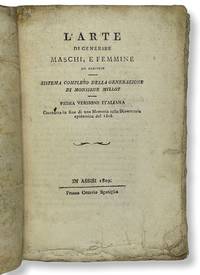
180939<p><strong>Very rare first Italian Edition</strong></p><p><strong>How to choose the gender of a newborn during procreation</strong></p><p><strong>Only 1 know existing copy of this issue recorded in WorldCat Italy</strong></p><p><strong>Untrimmed in its original printer paper binding</strong></p><p>Millot Jacques-André. <em>L'arte di generare maschi e femmine ad arbitrio : sistema completo della generazione / di monsieur Millot. Prima versione italiana corredata in fine di una Memoria sulla Dissenteria epidemica del 1808.</em>In Assisi: presso Ottavio Sgariglia 1809.</p><p>8° 205 x 140 mm contemporary printer paper binding small restorations paper pp. xiv 176 47 1.</p><p><strong>No copy on the market no copy at auction in last 40 years</strong></p><p>First Italian edition of this bizarre treatise dealing with the methods and techniques to choose the gender of the newborn during the procreation and on the formation of the Placenta.</p><p>The original work was translated by the Italian Giovanni Palmieri and dedicated to his friend Antonio Trevisani who was the inspirer of the translation. Upon learning that his friend's wife had given birth to yet another female Palmieri proposed to him the method devised by Jacques-André Millot surgeon-midwife of Marie-Antoinette and the Duchesses of Orleans and Bourbon with which they hypothesized techniques during the conception which would have guided in the choice of the genre of the unborn child and set about the translation with commentary of the work printed in its first absolute edition in Paris in 1800 with the title <em>L'Art de procreÌer les sexes aÌ€ volonteÌ ou SysteÌ€me complet de geÌneÌration par Jacques-AndreÌ Millot</em>.</p><p>The work however is not a mere translation. As stated by Palmieri in the introduction some parts of the original work have been summarized while an extended commentary and some revisions have been implemented.</p><p>In his treatise the author proposes natural methods to choose the gender of the unborn child avoiding the bloody ones suggested in the past such as the removal of a father's testicle before conception. The method in summary theorizes the specialization of the ovaries in the development of one gender rather than another proposing through precise positions during conception to fertilize one ovary or the other according to the desired gender.</p><p>In detail:</p><p>· In the first part of the text the historical theories on generation known at the time are retraced.</p><p>· The second part describes the Placenta its origin and formation the blood circulation in the foetus the phenomenon of superfetation the similarities and dissimilarities between new-borns and parents the ovaries and their functions the uterine tubes.</p><p>· Finally the third part is dedicated to the description of the methods proposed to pre-define the gender of the unborn child. In particular it discusses the way to choose the gender during procreation the experiences and proofs of the functioning of the method ending with the final conclusions.</p><p>The text then continues this is the missing part in the works recorded in WorldCat with the extensive notes and comments of the translator and with the final part dedicated to the<strong> <em>Memoria sulla Dissenteria epidemica del 1808.</em></strong></p><p>"<em>I do not believe I can render a greater service to humanity than to give it the mode of procreating the gender at will; this knowledge would also have its Moral goal: it is I believe the only means of increasing if it is possible the tenderness of the Fathers and Mothers and the attachment of the Children for them because the parents who will have only Children of their choice will see them with continual satisfaction</em> " Millon op. cit.</p><p>Census: University of Chicago Signature 2 xiv 160 pp. Cornell University Library New York Signature 2 xiv 160 pp. Pontificia Università Gregoriana Roma signature xiv 176 47 1.</p><p>World-Cat apparently records only three copies of this title. The two copies present in the United States are however characterized by a different reduced signature compared to the present copy and the one owned by the Gregorian library. The signature of the copies in the US is in fact <strong>pp. 2 xiv 160</strong> with respect to the signature <strong>pp. xiv 176 47 1</strong> of the present copy.</p><p>In fact they are missing the <em>Nota del Traduttore</em> translator's note pp. 161-176 and the first edition of the<strong> <em>Memoria sulla Dissenteria epidemica del 1808 </em>pp. 1-47 of the second part.</strong></p><p><strong>All the other libraries mentioned in WorldCat own an electronic copy of the book.</strong></p><p>Conditions: Small restoration at bindings. Internally an amazing copy with no defect untrimmed.</p> Ottavio Sgariglia
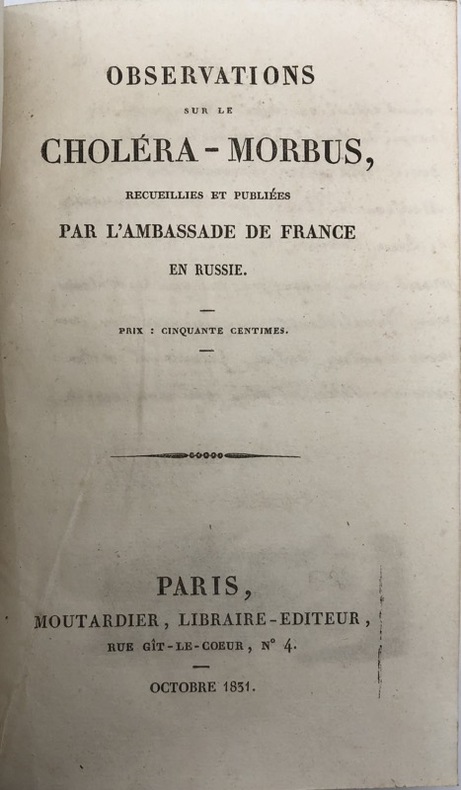
144931Paris, Moutardier, oct. 1831 in-8, basane racinée, dos lisse orné, tranches mouchetées (reliure de l'époque). Galeries de vers avec légères atteintes sur le premier plat, dos frotté
Rara prima edizione cinquecentesca. Qualche restauro alle ultime carte che copre piccole parti di testo, uniforme e leggera brunitura del primo fascicolo, ma esemplare molto buono, marginoso e fresco. Antiche manicule, note e segni di attenzione passim. Trattato attribuito a Alberto Magno, ma probabilmente composto da uno dei suoi discepoli, ebbe fin dal Medioevo un’ampia circolazione (se ne conoscono più di ottanta manoscritti). Muovendo dalle teorie aristoteliche, galeniche e ippocratiche, l’opera tratta della natura femminile sia da un punto di vista medico sia filosofico, e dell’influenza degli astri sulle nascite. Assai raro, non se ne rilevano esemplari nel catalogo SBN. Adams A 533; Cantamessa, Biblioastrology, 98 (in nota)
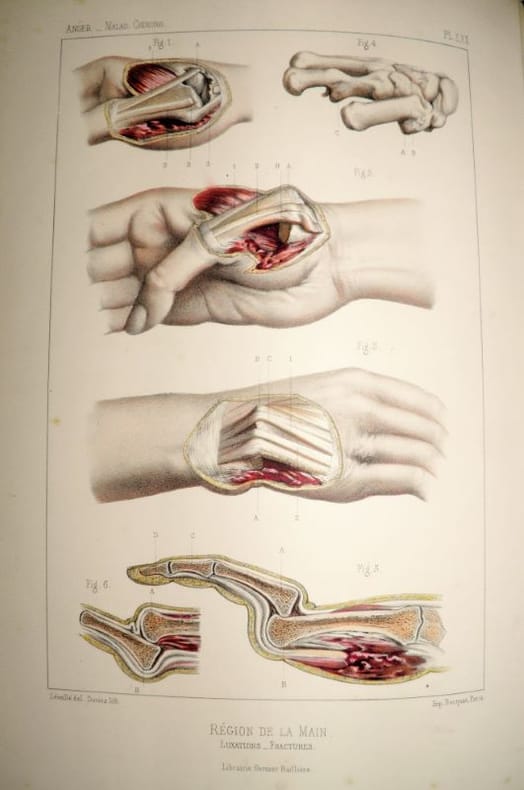
2262Paris, Londres, New-York, Madrid, Germer Baillière, Hippolyte Baillière, Baillière brothers, C. Bailly-Baillière (imprimerie de E. Martinet), 1865. In-4 – 24 x 29 cm. Reliure de l’époque en demi-chagrin rouge à coins, dos à 5 nerfs orné de caissons à froid et à doubles filets dorés, filets à froid sur les plats, tête dorée, ouvrage monté sur onglets. 4 ff, XIV, 398 pp., 100 pl. Rare édition originale de cet ouvrage d'Anger (1838-1908), chirurgien et prospecteur des hôpitaux de Paris, traitant principalement de luxations et de fractures par régions (épaule, bras, coude, poignet, poitrine, maxillaires, ...). Ouvrage illustré de 100 planches rehaussées, certaines en partie gommées, et de nombreuses figures in-texte. Exemplaire complet. Préface du chirurgien Velpeau (1795-1867) sur les progrès de la chirurgie à l'époque.
185789313Arthus Bertrand | Paris s. d. [1857] | 58.5 x 41.2 cm | Relié
1952bf5510Gallimard Coups de coeur de Bernard Broché 1952 BEL ENVOI PLEINE-PAGE AUTOGRAPHE DE CELINE. PAS DE GRAND PAPIER MAIS NOTRE EXEMPLAIRE EST UN SERVICE DE PRESSE. In-12 (12 x 19 cm), broché, 132 pages, réédition de Gallimard en 1952 (l'originale date de 1937), ce texte est en fait la thèse de Céline qu'il a soutenue à Rennes en 1924 ; l'exemplaire est un service de presse sans grand papier ; l'envoi autographe pleine-page de l'auteur fait référence à un confrère: « A notre cher confrere Athimon qui [xxx?] tous les secours de sa science et toute son amitié Bien affectueusement Celine» envoi signé et intéressant, on comprend que le destinataire aurait alors aidé Céline lors de la rédaction de sa thèse; dos et bord du 2eme plat insolés, intérieur frais, très bon état par ailleurs. Notre ouvrage est protégé par une pochette velours. Livraison a domicile (La Poste) ou en Mondial Relay sur simple demande.
16777609BBAmsterdam, Daniel Elsevier, 1677. Kl.-4°. (38) Bl., Titel in Rot und Schwarz mit dem Minerva-Druckerzeichen, 239 S. Mit 53 Holzschnitten (teilw. wiederholt). Späterer Pappband. + Wichtig: Für unsere Kunden in der EU erfolgt der Versand alle 14 Tage verzollt ab Deutschland / Postbank-Konto in Deutschland vorhanden +, A|B [2 Warenabbildungen]
Large 4to. (2), 13, (1), 10 pp. With 85 engraved plates. Contemporary calf with giltstamped label to richly gilt spine. Leading edges gilt. Second edition of this principal work, first published in 1741. Dillenius is considered the founder of scientific investigation of cryptogams, especially mosses (cf. Hirsch/H. II, 271). "The beginning of bryology. The exact descriptions of the species, as well as the excellent illustrations, drawn and engraved by himself, made his 'historia muscorum' a standard work, not superseded for many years" (cf. NDB III, 718). - Binding slightly rubbed and bumped; small defect to spine. A good, wide-margined copy; the engravings printed in good impressions. With signature and heraldic bookplate of Otto Leiner. Nissen BBI 491. Stafleu/C. 1472. Henrey 641. DNB V, 984 ("his greatest work").
In-8 p. (mm. 203x126), 2 volumi, mz. pelle coeva, fregi e tit. oro al dorso (restaur.), pp. XVIII,678 + 32 di catalogo editoriale; (4),864; molto ben illustrati f.t. da 27 tavole inc. in rame di cui l’ultima, più volte ripieg., contiene il “plan de la Maison Royale de Charenton”; le interessanti tavole che raffigurano dei malati di mente sono state incise da Ambroise Tardieu e nel ns. esemplare sono state intercalate nel t. e non raccolte in un Atlante separato. L’opera è divisa in tre parti: nel primo vol. ”Mémoires sur la folie et ses variétés” (de la folie - des hallucinations - des illusions chez les aliénés - de la fureur - de l’aliénation mentale des nouvelles accouchées et des nourrices - de l’épilepsie - terminaisons critiques de la folie - de la lypémanie ou mélancolie - de la démonomanie - du suicide). Nel secondo “Suite des Mémoires sur la folie et ses variétés” (de la monomanie - de la manie, ses symptomes, ses causes physiques et morales - de la démence - de l’idiotie) /// “Mémoires statistiques et hygiéniques sur la folie” (des établissemens consacrés aux aliénés en France, et des moyens de les améliorer - des maisons d’aliénés - mémoirs historique et statistique sur la Maison Royale de Charenton - notices sur le village de Gheel) /// “Mémoires sur l’aliénation mentale, considérée sous le rapport médico-legal”. "Prima edizione". L’autore di questa importante opera - Jean Etienne Dominique Esquirol (1772-1840) - fu l’allievo preferito di Philippe Pinel il grange riformatore della psichiatria. Cfr. Garrison Morton,4929: “Esquirol succeeded Pinel at the Salpetrière, and was the first lecturer on psychiatry. He carried on with Pinel’s good work and founded ten asylums. "Des maladies mentales" is the first modern text-book on psychiatry” - Wellcome,II, p. 531. Testo con fiorit. e lievi uniformi arross., tavole fresche e ben conservate.
(16), 140 SS. Mit 24 Kupfer- und 2 Holzschnitt-Porträts. Halbpergamentband der Zeit. Dreiseitiger Rotschnitt. 8vo. Seltene einzige Ausgabe eines der frühesten Werke über die Semiologie des Auges. "Samuel Fuchs, a native of Koslin in Pomerania, was professor of rhetoric at Königsberg. In this curious and little known work the author suggests a system for the estimation of character based on the shape of the head and eyes [...] Among the finely executed engravings and woodcuts are portraits of Cosimo Medici, Andrea Doria, Christopher Columbus, and Philip II, Duke of Pomerania" (Becker). - Papierbedingt wie stets etwas gebräunt bzw. braunfleckig; einige Blätter der Vorstücke angerändert. Zeitgenöss. Besitzvermerk (mit Verzeichnung des Kaufpreises und der Bindekosten) am vorderen Innendeckel. BM-STC F 1306. Krivatsy 4457. Waller 3303. Wellcome I, 2468. Becker Coll. 95. Hirschberg 483 (III, S. 20, 1). Sabin 26106. Caillet 4248. Graesse, Bibl. mag.-pneum. 104. Rosenthal 953 ("Piece fort rare").
17628Basileae : apud Hieronimum Frobenium et Nicolaum Episcopium, 1549.Basel, Hieronymus Froben & Nikolaus Episcopius (1.), 1549,Fort INFOLIO pleine basane epoque,plats decoré d’un medaillon titre PETRUS,sur les 2 plats,manques important au dos,a restaurer fol.index non pagine titre+406p,non pagine +5] h., 1316 col.soit 674 pages sur 3 colonnes, [1] h. : il. ;37,5 cm.
In-4°; cc. (22), 278, cc. (19), pp. 413, (3), dedica a Carlo Borromeo. COntiene anche De Libriis propriis, De curationibus et praedictionibus, Neronis enconium, Geometria encomium, de uno, Actio in Thessalicum medicum, De secretis, De gemmis et coloribus, Dialogus de morte .... Legatura in piena pergamena coeva con titolo dorato al dorso. All’interno leggermente brunito.restauro alle prime due carte.
Il nostro esemplare di quest'opera, in cui Haller riassume magistralmente le conoscenze fisiologiche della sua epoca, è non solo completo, ma composto quasi esclusivamente di prime edizioni (unica eccezione il t.V, in II edizione). Interni in ottime condizioni. 8 tomi <br/> NOTE: in particolare dei tomi 7 e 8<br/> TITOLO: Elementa Physiologiae Corporis Humani. Auctore Alberto v. Haller. Tomus I-VIII. T.I: Fibra - Vasa - Circuitus sanguinis - Cor. Lausannae, Sumptibus Marci-Michael. Bousquet et Sociorum, 1757, pp.(6),XII,520, ritratto dell'A. inciso all'antiporta, immagine allegorica (due puttini con elementi anatomici) incisa al frontespizio e 2 tavv. incise in
In-8 p. (mm. 230x175), tre parti in 2 volumi, p. pelle coeva (restaurata), dorso a cordoni con decoraz. e titolo oro, tagli rossi, pp. (2),VIII,599; (2),1187 (numeraz. continua), (52 di Indice); frontespizi stampati in rosso e nero con graziosa vignetta calcografica. Il volume è illustrato f.t. da un ritratto dell'autore e 40 tavole (ampiamente descritte), incise in rame da vari artisti e più volte ripieg., che raffigurano numerosissimi strumenti chirurgici, loro uso, e parti anatomiche. Da segnalare quelli che interessano l'odontoiatria, l'oculistica, l'ostetricia. L'opera tratta: “Delle ferite - Delle fratture delle ossa - Delle slogazioni - Delli tumori - Delle ulcere - Delle operazioni chirurgiche che si hanno in diverse parti del corpo, nel capo - Dei vizi del collo, delli precordi, dell'addomine, che si curano colla mano e col coltello - Dei vizi delle mani e piedi - Delle fascie e legature chirurgiche”. Cfr. Castiglioni, p. 635: "Lorenzo Heister (1683-1758), nato a Francoforte, allievo di Boerhaave, è l'autore di un testo di chirurgia che si può considerare come uno dei primi trattati completi" - Morton,5576 cita la I ed. tedesca di Norimberga, 1718: “Heister is the founder of scientific surgery in Germany. His book contains many interesting illustrations and includes an account of tourniquets used in his time; Heister introduced a spinal brace” - Blake, p. 204: “quarta edizione in latino”. Leggerm. corto di margini; la tav. XII con marg. arrossati e restaur. per piccole manc.; con qualche lieve uniforme arross., fiorit. o lievi aloni, ma certam. un buon esempl.
6027"P., Debure l'aîné ; N. Tillard, 1753. In 8 veau marbré de l'époque, tranches rouges, 4 ff. n. ch., XXXV - p. d'errata - 104 pp. et 10 planches gravées. Vignette de dédicace par Cochin."
In-4°; pp. (16), 642, (30), frontespizio illustrato inciso su rame da Matthäus Merian con i ritratti dei principali medici e alchimisti dell’antichità. Prima edizione. Legatura in cartonato con titolo manoscritto al dorso.
in-4 antico, pp. (20), 240, (24), bella leg. settecentesca p. pelle con fregi impressi a secco ai piatti e al d. con nervi. Marca tipogr. in legno al fine. Dedicat. a Cristiana di Lorena Granduchessa di Toscana il cui stemma è inciso in legno al front. al posto della marca tipografica dei Giunti con il giglio fiorentino (variante B). Capilett. xilogr. Ediz. orig. e unica di questo trattato pubblicato per la prima volta in francese tra il 1578 e il 1579 da L. Joubert (1529-1583) medico e chirurgo del Re di Francia: vi sono raccolte molte credenze popolari e superstizioni legate soprattuttto alla sfera sessuale, al parto, alle malattie, al concepimento . Molto curioso è l'ultimo capitolo dedicato all'allattamento ("Perchè il latte di quella che ha fatto un maschio è migliore per allevare un femmina e viceversa", "Chi deve poppar di più ò un maschio ò una femmina"). L'opera ebbe fama in italiana nella traduzione di Alberto Luchi da Colle, medico toscano originario di Colle Val d'Elsa, inviato alla corte di Francia dal Granduca Francesco I de Medici. Camerini 184. Wellcome 3506. Graesse III 485. Qualche brun. molto lieve su alcune pp., freschisssimo e marginoso esempl. in ottimo stato di conservazione. [030]