98 563 résultats
Jena, Friedrich Mauke, 1843. Folio. Cont. hcalf. Back very worn and with tears to leather. Inner hinge broken. IV pp. and 103 mostly lithographed plates, a few engraved. Most of the plates in impressive colouring. The 4 textleaves brownspotted and soiled, some plates with brownspots and some with dampstains to corners and margins.
Cinque parti in quattro volumi di cm. 22, pp. 212; 524 (4); 412 (2); 593 (1). Solida ed elegante legatura coeva in mezza pelle, dorsi lisci con titoli i filetti in oro. Qualche ininfluente e piccola mancanza di carta sulla copertura dei piatti, peraltro esemplare particolarmente genuino, marginoso ed in eccellente stato di conservazione, a carte candide. Opera completa della prima traduzione italiana che contiene anche una quantità di aggiunte dei medici Hartlaub e Trinks in materia omeopatica, tradotte in italiano dal medico napoletano Giuseppe Mauro.
1676D6961Lyons: Sumptibus Joannis Antonii Huguetan 1676. Hardcover. Very Good. 6 vols. in 3 folio 350 x 220mm. Vol. 1: 38 306pp. 6 309-808pp. 32; Vol. 2: 16 363pp. 5 363-786pp. 18; Vol. 3: 12 696pp. 12. Titles in red and black. Woodcut printers device of Huguetan showing Ptolemy left and Euclid right either side of an astronomical device known as an armillary sphere. The text is in Latin with the central motto translating as the universality of things is like dust in the hand of God. The IAH monogram at bottom is for the 17th century French printer Jean-Antoine Huguetan. Complete with the portrait and half-title Vol. 1 and numerous woodcut initials head- and tail- pieces. Contemporary vellum rebacked some browning throughout marginal worming lightly worn. Contemporary ownership inscription by doctor above pictorial wood-engraved ex-libris by Leo Wyatt for Lord Norwich on front endpaper in all volumes. Two contemporary Latin manuscripts laid in after p. 408 one two pages signed by joannes cont on hypochondriacs the other concerning a cure. <br/><br/>Sennerts complete works three volumes in six parts printed by Huguetan. Sennert was an influential German professor notable for his contributions to medicine and atomic theory. Daniel Sennert born in Breslau was a student and the professor of medicine at the University of Wittenberg the intellectual center of Lutheranism. He was a renowned physician and an extremely prolific and influential writer whose popularity in his time is clear from the many editions of his works many of which were translated into English. These are Sennerts complete works in six parts each with a separate dated title page printed in red and black. His Opera was first published in Paris in 1641 and this edition expanded . with the omission of Tabulae institutionum and the addition of Vita Danielis Sennerti Judicia virorum clarissimorum Methodus discendi medicinam De curatione infantium De arthritide Tragopodagra Luciani in Greek and Latin Exoterica Epitome librorum de febribus Epistolarum medicinalium una cum responsorii D. Michaelis Doringei centuriae duae. The Epitome is reprinted from the Epitome edited by Claude Bonnet-- Krivatsy. This edition is regarded as the best. Among Sennerts many achievements he was the first to introduce chemistry as a subject of the medical curriculum and to make a serious effort to harmonize the Galenic doctrines of medicine with those of Paracelsus. Besides giving early accounts of scarlatina and rubella Sennert added to the knowledge of scurvy dysentery and alcoholism. He was an able clinician but a believer in witchcraft.-- Garrison-Morton 61. Scarcely found on the market these volumes are a complete set of Sennerts studies and 17th century medicine. Sennert was known to apply astrology to medicine and the supernatural origins of disease. NLM/Krivatsy 109 Sumptibus Joannis Antonii Huguetan hardcover books
1676D6961Lyons: Sumptibus Joannis Antonii Huguetan 1676. Hardcover. Very Good. 6 vols. in 3 folio 350 x 220mm. Vol. 1: 38 306pp. 6 309-808pp. 32; Vol. 2: 16 363pp. 5 363-786pp. 18; Vol. 3: 12 696pp. 12. Titles in red and black. Woodcut printers device of Huguetan showing Ptolemy left and Euclid right either side of an astronomical device known as an armillary sphere. The text is in Latin with the central motto translating as the universality of things is like dust in the hand of God. The IAH monogram at bottom is for the 17th century French printer Jean-Antoine Huguetan. Complete with the portrait and half-title Vol. 1 and numerous woodcut initials head- and tail- pieces. Contemporary vellum rebacked some browning throughout marginal worming lightly worn. Contemporary ownership inscription by doctor above pictorial wood-engraved ex-libris by Leo Wyatt for Lord Norwich on front endpaper in all volumes. Two contemporary Latin manuscripts laid in after p. 408 one two pages signed by joannes cont on hypochondriacs the other concerning a cure. <br/><br/>Sennerts complete works three volumes in six parts printed by Huguetan. Sennert was an influential German professor notable for his contributions to medicine and atomic theory. Daniel Sennert born in Breslau was a student and the professor of medicine at the University of Wittenberg the intellectual center of Lutheranism. He was a renowned physician and an extremely prolific and influential writer whose popularity in his time is clear from the many editions of his works many of which were translated into English. These are Sennerts complete works in six parts each with a separate dated title page printed in red and black. His Opera was first published in Paris in 1641 and this edition expanded . with the omission of Tabulae institutionum and the addition of Vita Danielis Sennerti Judicia virorum clarissimorum Methodus discendi medicinam De curatione infantium De arthritide Tragopodagra Luciani in Greek and Latin Exoterica Epitome librorum de febribus Epistolarum medicinalium una cum responsorii D. Michaelis Doringei centuriae duae. The Epitome is reprinted from the Epitome edited by Claude Bonnet-- Krivatsy. This edition is regarded as the best. Among Sennerts many achievements he was the first to introduce chemistry as a subject of the medical curriculum and to make a serious effort to harmonize the Galenic doctrines of medicine with those of Paracelsus. Besides giving early accounts of scarlatina and rubella Sennert added to the knowledge of scurvy dysentery and alcoholism. He was an able clinician but a believer in witchcraft.-- Garrison-Morton 61. Scarcely found on the market these volumes are a complete set of Sennerts studies and 17th century medicine. Sennert was known to apply astrology to medicine and the supernatural origins of disease. NLM/Krivatsy 109 Sumptibus Joannis Antonii Huguetan hardcover
Very Good Turkish, Ottoman (1500-1928) Original autograph manuscript letter signed by Khedive Abbas Hilmi Pasha II of Egypt. 20,5x16,5 cm. In Ottoman script. 1 p. 6 lines. Sent to an unknown recipient who he called 'Efendim hazretleri' in elqab of the letter. He mentions that he received a telegraph of the recipient. He celebrated 'eid' ('Iyd-i said'). Abbas II Helmy Bey, was the last Khedive (Ottoman viceroy) of Egypt and Sudan, ruling from 8 January 1892 to 19 December 1914. In 1914, after the Ottoman Empire joined the Central Powers in World War I, the nationalist Khedive was removed by the British, then ruling Egypt, in favor of his more pro-British uncle, Hussein Kamel, marking the de jure end of Egypt's four-century era as a province of the Ottoman Empire, which had begun in 1517. Abbas Hilmy, the great-great-grandson of Muhammad Ali, was born in Alexandria, Egypt on 14 July 1874.[4] He succeeded his father, Tewfik Pasha, as Khedive of Egypt and Sudan on 8 January 1892. In 1887 he was ceremonially circumcised together with his younger brother Mohammed Ali Tewfik. The festivities lasted for three weeks and were carried out under great pomp. As a boy, he visited the United Kingdom, and he had a number of British tutors in Cairo including a governess who taught him English.[5] In a profile of Abbas II, the boys' annual, Chums, gives a lengthy account of his education. His father established a small school near the Abdin Palace in Cairo where European, Arab and Ottoman masters taught Abbas and his brother Mohammed Ali Tewfik. An American officer in the Egyptian army took charge of his military training. He attended school at Lausanne, Switzerland; then, at the age of twelve, he was sent to the Haxius School in Geneva, in preparation for his entry into the Theresianum in Vienna. In addition to Arabic and Ottoman Turkish, he had good conversational knowledge of English, French, and German. He was still in college in Vienna when he assumed the throne of the Khedivate of Egypt upon the sudden death of his father, 8 January 1892. He was bare of age according to Egyptian law; normally, eighteen in cases of succession to the throne. For some time he did not cooperate very cordially with the British, whose army had occupied Egypt in 1882. As he was young and eager to exercise his new power, he resented the interference of the British Agent and Consul General in Cairo, Sir Evelyn Baring, later made Lord Cromer. At the outset of his reign, Khedive Abbas II surrounded himself with a coterie of European advisers who opposed the British occupation of Egypt and Sudan and encouraged the young khedive to challenge Cromer by replacing his ailing prime minister with an Egyptian nationalist. At Cromer's behest, Lord Rosebery, the British foreign secretary, sent Abbas II a letter stating that the Khedive was obliged to consult the British consul on such issues as cabinet appointments. In January 1894 Abbas II made an inspection tour of Sudanese and Egyptian frontier troops stationed near the southern border, the Mahdists being at the time still in control of Sudan itself. At Wadi Halfa the Khedive made public remarks disparaging the Egyptian army units commanded by British officers. The British commander of the Egyptian army, Sir Herbert Kitchener, immediately threatened to resign. Kitchener further insisted on the dismissal of a nationalist under-secretary of war appointed by Abbas II and that an apology be made for the Khedive's criticism of the army and its officers. By 1899 he had come to accept British counsels. Also in 1899 British diplomat, Alfred Mitchell-Innes was appointed Under-Secretary of State for Finance in Egypt, and in 1900 Abbas II paid a second visit to Britain, during which he said he thought the British had done good work in Egypt and declared himself ready to cooperate with the British officials administering Egypt and Sudan. He gave his formal approval for the establishment of a sound system of justice for Egyptian nationals, a great reduction in taxation...
Very Good Turkish, Ottoman (1500-1928) Contemporary cloth bdg. Roy. 8vo. (23 x 16 cm). In Ottoman script (Old Turkish with Arabic letters). [4], [4], 454 p., 21 folded plates including numerous 288 b/w plates. Minor wear on extremities of boards and spine. Dark blue endpapers. A tear on the last plate, not missing. A minor chip on the head page. Several plates are missing. A plate was repaired in its period with a good Ottoman blind-stamped paper. Fading on boards. Otherwise a good copy. Extremely rare first edition of this first physics textbook ever published in the Ottoman Empire, including 32 modern physical subjects in 21 chapters with two articles, by early physics and math teachers in the Mühendishâne [i.e. Ottoman Engineering School] Mehmed Emin Dervish Pasha. This work, prepared to be taught in engineering schools, is valuable for its plain expression, variety of the first subjects in the period it deals with, and its content enriched with illustrations. This rare book is very important to be the first textbook to cover the following topics: Ratio of forces to velocities and their effects on objects, centripetal force, lever, pulley, inclined plane, weight, the pressure of liquids, the balance of gases, barometer, manometer, theoretical views on some musical instruments, heat dissipation force of objects, heat increase forces, thermometer, etc. Dervish Pasha also included in his book the pioneering experiments that he had done in Muhendishane, which attracted a lot of attention during his time in the Ottoman scientific society. (Sources: The First Physics Textbook in Ottoman State: Usûl-ü Hikmet-i Tabiiye (Introduction to the Philosophy of Nature), Akagündüz, S. Y.). Hegira 1281 = Gregorian 1865. Only two institutional copies in OCLC 49368193.; Özege 22161.
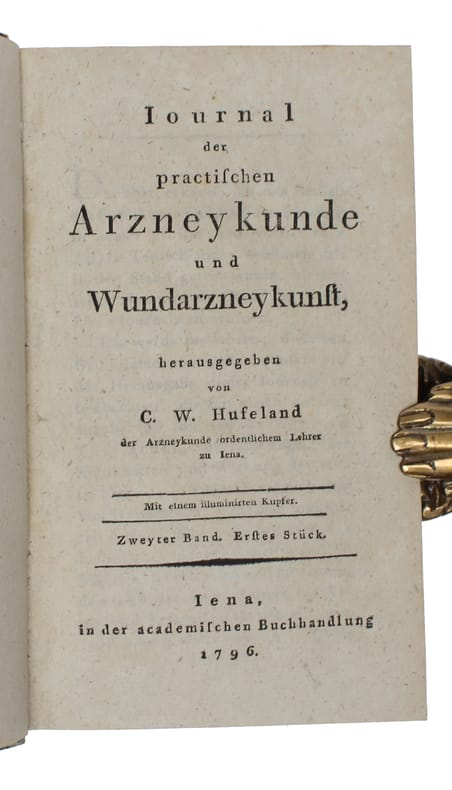
180160844Iena, Academischen Buchhandlung, 1795 - 1801. 8vo. Uniformly bound in 12 contemporary marbled paper-covered boards with black title-labels with gilt lettering to spines. Capitals with wear, otherwise a nice and clean set.
177852470Paris, 1778. 8vo. Contemporary full mottled calf with five raised bads to gilt spine. Old paper label to top of spine. Overall wear to extremities, especially top capital. Light brownspotting. XII, 582, (2) pp.
Paris, 1778. 8vo. Contemporary full mottled calf with five raised bads to gilt spine. Old paper label to top of spine. Overall wear to extremities, especially top capital. Light brownspotting. XII, 582, (2) pp.
Lugduni, (Lyon), Marci & Joan. Henr. Huguetain, 1684. Cont. full vellum. Engraved pictorial frontispiece (dated 1677 after the original), title in red and black with engraved vignette. Engraved portrait. (30),805,(19) pp. and 120 anatomical engravings as plates and in the text, some folded.
Twenty-six parts in one volume. Paginated consecutively. Crown quarto. Pp. (iv), 638. Some 101 text figures. Hardcover, bound in contemporary three-quarters brown calf and matching pebbled boards, spine gilt, extremities bit rubbed, name clipped-off first blank leaf and corner of title-page, back inner hinge slightly cracked. In a very good condition. ~ First edition. Of utmost rarity. The extremely rare first edition which reproduces lithographically the entire original manuscript of notes taken during these lectures by Charcot himself, Blin, and Holin, "being a transcription of Charcot's famous Tuesday morning clinical lectures." (Norman 451). Comprising of 26 individual lessons delivered between 1887 and 1888. A second edition, set in type, appeared in 1892, co-published with Babé but without the participation of Adrien Delahaye & Emile Lecrosnier. The eminent French neurologist Jean-Martin Charcot (1825-1893), one of the greatest of all neurologists, created at the Pitié-Salpêtrière Hospital in Paris the greatest neurological clinic of modern times. There, he delivered his renowned clinical lectures and demonstrations to postgraduate students and invited practitioners. He was a pioneer of psychotherapy and left many memorable descriptions of nervous disorders. An excellent idea of his work is gained by perusal of these lectures. It is said that Sigmund Freud owned a small lithographic reproduction of the famous painting "A Clinical Lesson at the Salpêtrière" by André Brouillet (1857-1914) which depicts Charcot delivering a lecture to a group of students, of whom many of them became later renowned physicians. Freud himself translated Charcot's work into German and added a preface.
In-16 p. (mm. 152 x 98), p. pergam. coeva (risg. rifatti), titolo ms. al dorso, cc.nn. 392, cornice figurata al frontesp., con bella xilografia a p. pag. al verso della terza carta; ornato da grandi iniz. figur. a vignetta inc. su legno.<br> Di questo celebre trattato, che ebbe numerosiss. edizioni a partire dal XV secolo, cosi' precisa Gamba,374: "Il Crescenzio scrisse quest'opera in latino tra il 1307 e il 1311, ed è stata opinione di Leonardo Salviati, che'l volgarizzamento siasi fatto verso il 1350. Egli notò che dee riguardarsi come una delle principali scritture del volgar nostro, si' per li nomi specialissimi degli affari della villa, e talora anche di astrologia e di medicina e di altre arti, e si' perchè in genere di buone voci e di pura lingua è ripiena..".<br> Cfr. anche Sander,I,2240: “Page du titre, encadrement orné à la grotesque; dans le haut, le chat des Sessa. Bois de page, portrait de l’auteur assis in cathedra” - Ceresoli, p. 184.<br> Esemplare corto del margine sup., peraltro ben conservato.
Ferrara, Appresso, Giulio Cefare Cagnacini, & Fratelli 1586, 8° legatura in piena pergamena antica (rimontata), tassello con fregi e titoli dorati al dorso, titolo manoscritto, ormai sbiadito, al piede, cc. (8)-107-(1), marca tipografica in xilografia (salamandra incoronata tra le fiamme con il motto: "Illaesa Extinguo") al frontespizio e all’ultima carta, testatine e capolettere xilografici. Ex libris “Loris Premuda” al contropiatto anteriore. Edizione originale pubblicata simultaneamente a Venezia, Ferrara e Piacenza; tratta di varie forme di malattie psicologiche nel corso dei secoli. Esempi di personaggi storici sono riferiti a diverse forme di psicosi. Interessanti le descrizioni separate, per malattie identiche, previste per le donne. Il libro osserva che, anche se i sintomi sono simili, se non uguali, le donne nel corso della storia hanno avuto meno speranza di essere curate. Piatti leggermente deformati; leggera rifilatura in alto; ma volume molto ben conservato. BMC STC, p. 191; Wellcome, I, 2689.
1632025990Nicolas Rousset, Paris 1632. Pergament Gut
Ad Illustriss. et Sapientiss. Anhaltinum Principem CHRISTIANUM, Comitem Ascaniae, Dynasten Servestae, ac Bemburgi Dominum, &cc. Dominum & Patronum suum clementissimum, Osvaldi Crollii Epist. Dedicatoria - Iho Hartmannus Med. D. et CHymiatriae in Academia Marpurgensi Professor Ordinarius, Lectori S. (Anno Gratiae MDCXI) - Pauli Melissi Franci... Ode Alcaica ad Osvaldum Crollium - PRAEFATIO Admonitoria 1 21x17 cm., legatura in piena pergamena rigida, titolo in oro su tassella al dorso, tagli in grigio scuro, pp. (16), 283 (25 Index), Frontespizio con grande marca figurata del " Osvaldi Crolii Tractatus de Signaturis Interni rerum, seu de vera e viva Anatomia majoris & minoris mundi" pp. (14 Epistola Nuncupatoria ad ...Petrum Wok Ursinum Dominum Rosenberg...), 80 (14 Index ), Frontespizio con marca "Elegia De Vera Antiqua Philosophica Medicina scripta da M. Ulrico Bollingero ad Osvalum Crollium...e Frontespizio "Encomium ..."24; pagine con filetto di contorno e uno spazio di circa 2 cm. al lato esterno dedicato a numerose annotazioni, testate, capilettera e finalini importanti, 2 tavole nel testo. In lingua latina. In apertura importante e interessante Frontespizio generale pieno di simboli, emblemi, stemmi, personaggi ecc, relativi alla materia. Difetti: Frontespizio sbiadito e macchiato, ma completo; pagine tutte pi? o meno brunite e con gore sparse. Buon esemplare.
91117Frankfurt am Mayin, Ben Zacharia Palthenio/in Berlung Peter Fischers G. Erbe, 1650, 1 volume in-folio de 355x210 mm environ, 1 feuillet blanc non chiffré, 8 feuillets non chiffrés (titre en noir et rouge avec belle gravée) 1239 pages chiffrées, 8 feuillets non chiffrés (register), reliure sur ais de bois biseautés recouverts de peau de truie décorée à froid sur les plats, dos à nerfs, traces des liens de fermeture sur les plats (liens absents). Manques de papier avec manque de texte sur les 4 premiers et les 2 derniers feuillets et p. 1063 et 1093, des mouillures, des défauts de marge, manque de cuir sur le dos, et trous de ver sur le dernier plat et le dos sur le cuir et le bois, ouvrage rare. Contient des illustrations des instruments et techniques de chirurgie+autres nombreuses figures dans le texte.
In-16 gr. (mm. 197x137 e 1 vol.: mm. 204x136), 7 volumi, mz. pelle coeva (un dorso restaur.), fregi e titolo oro su tassello al dorso, tagli rossi, contenuti in un astuccio mod. Questa pregevole ediz. è ornata da testate e grandi iniz. figurate a vignetta, inc. in rame; è illustrata sia nel t. (12 tavole) che fuori testo da belliss. inc. in rame di cui: 1 ritratto del Vallisneri e 1 del Redi, 4 pregevoli antiporte (2 per i "Consulti medici", 1 per l'"Arianna", 1 per le "Lettere"), 1 tav. ripieg. con il ritratto del Redi copiato da tre medaglie fatte coniare da Cosimo III in suo onore (nelle quali è celebrato come medico, come filosofo e come poeta) e complessive 62 tavole relative alla zoologia. Nel ns. esemplare i primi 3 rarissimi volumi sono in "edizione originale" e datati 1712. Introdotti da una “Vita del Redi” di S. Salvini e da una orazione funebre, sono così composti: vol. I: “Esperienze intorno alla generazione degli insetti. Osservazioni intorno agli Animali Viventi. Osservazioni intorno a' pellicelli del corpo umano. Lettera di G. Cestoni al Vallisneri. Miglioramenti e correzioni” - vol. II: “Esperienze intorno ad alcune cose naturali. Osservazioni intorno alle vipere. Lettera sopra alcune opposizioni ecc. Osservazioni intorno alle gocciole ecc. Esperienza intorno all'acqua che stagna. Lettera sull'invenzione degli occhiali. Esperienze intorno a' sali fittizi. Lettera di T. Platt. Lettere. Etimologie italiane” - vol. III: “Bacco in Toscana con le annotazioni, Sonetti, Giunta ai sonetti, Giunta di varie poesie”. La raccolta delle opere è completata da altri 4 volumi (1728-30): sono una ristampa di Gabriello Hertz delle ediz. fiorentine del Manni e contengono le "Lettere familiari" (volumi IV e V) e i "Consulti medici" (volumi VI e VII). Cfr. Prandi "Bibliogr. opere di F. Redi", pp. 32-34: "Difficilmente si trovano tutti i volumi insieme e gli esemplare completi sono rari" - Gamba,836 - Choix de Olschki,VII,9379 cita un'ediz. dell'Hertz, 1742. Una c. restaur. per strappo margin., altrimenti fresco esemplare, molto ben conservato.
in-4, pp. 91 (compreso occhietto e frontespizio), (4 con approvazioni ed errata), legatura coeva in cartonato, sguardie in carta blu. Titolo in rosso e nero con impresa del frullone dell'Accademia della Crusca incisa in rame, ripetuta al verso di p. 91 in legno. Edizione originale con le varianti, tirata in un numero molto limitato di esemplari (la tiratura più comune ha l'impresa al titolo incisa in legno e il nome dell'a. è accompagnato dalla dicitura ''Accademico della Crusca''). Lunga dissertazione sulle vipere, il loro veleno, sulle leggende e sulle qualità terapeutiche e farmaceutiche. Magnifico esemplare in barbe, estremamente fresco e genuino (all'occhietto antiche note di possesso ms.).. Vinciana 1742. Gamba 818. Razzolini 286. Prandi 1. Brunet IV 1174. Graesse VI, 58. Garrison morton, 2102..
in folio, pp. (30), 287, belliss. leg. p. pelle alle armi con gr. stemma araldico (Federico Cristiano Re di Polonia) impresso in oro ai piatti, decoraz. oro, fregi e tass. al d. con nervi. Tagli color. Risguardi in carta dec. Front. a due colori con graziosa vignetta in rame inc. da Daudet. Magnifico antip. in rame inc. da M. Antonio Dal Re su dis. di F. Monti. Con due belliss. ritr. di F. Cristiano e F. Roncalli inc. in rame rispettivamente da Orsolini e Zucchi. Eleganti capilett. e testat. Prima ed unica ediz. impreziosita dalle eleganti inc. Picc. mancanza alla cuffia sup. e qualche spellatura ai piatti, ma splendido esempl. su carta forte.
in-folio, pp. (32), 462, (2), legatura coeva p. perg. (restauri al dorso). Frontesp. a stampa rossa e nera con grande impresa tipogr., superbo ritratto dell'autore all'età di 70 anni finem. inc. in rame f.t., iniz. silogr., testo su due colonne in car. tondo. Le pp. 451-462 contengono il breve scritto polemico ''Io. Franc. Rosselli censura ad censuram vocata'', il cui frontespizio trovasi posposto, col quale opuscolo il Santorelli oppone la propria censura a quella fattagli dal medico ed autore spagnolo Juan Francisco Rossell (1593-1632). Terza edizione (la prima 1622, la seconda 1633) di opera medica in cui si esamina a fondo l'eziologia di numerose malattie, fornendone la diagnosi. Di notevole interesse i libri XV e XVI (pp. 270-309), sfuggiti agli autori di bibliografie gastronomiche, concernenti la dietetica ed il corretto uso di cibi e bevande durante le malattie. Trattasi dell'opera più importante del celebre medico di Nola (1583-1653), professore all'Università di Napoli, medico personale del conte di Onatte e protomedico generale del Regno di Napoli dal 1648. Bell'esempl. genuino e marginoso (piccolo lavoro di tarlo nel margine esterno di una decina di ff.)... Krivatsy n. 10231. Hirsch V, 177. De Renzi IV, 203, 350, 374. Non riscontrato nelle varie bibliografie gastronomiche. Paleari p. 666 registra opera poster..
Pavia, Dalla Tipografia di Pietro Bizzoni, 1817. PRIMA EDIZIONE. In 4to grande (cm. 34); cartoncino coevo; pp. VII, (1), 136. Garrison Morton, 2940. Piccola traccia di tarlo (restaurata) alle ultime tre carte e piccole mancanze al dorso ma bella copia con barbe. Axs
in-4, pp. (8), 188, (4), leg. coeva p. perg. Marca tip. sul tit., fregi ed iniz. silogr., testo in car. cors. Dedica a Cesare Giustiniani, ambasciatore della Rep. di Genova, fratello di quella Costanza Giustiniani, il cui caso è oggetto della controversia (''Donna C.G. vergine sacra nel Monasterio di Santa Marta di Genova dell'Ordine di S. Benedeto, d'anni vintitre di temperamento colerico... ha sputato tre volte il sangue con tosse''). Prima edizione di questo trattatello d'interesse medico, in risposta a quello di Silvestro Facio apparso a Firenze l'anno precedente. Il cap. 6 (pp. 37-42) contiene due lettere di Gir. Mercuriale, dell'agosto e settembre 1595. In fine (pp. 141-188) vi sono lettere, testimonianze e contributi di Orazio Augenio, Andrea Cesalpino, Giov. Costeo ed altri. Bell'esempl. (antica firma sul tit., qualche lieve traccia d'umido).. Manca a Wellcome. Durling 4567. STC 714..
Due volumi di cm. 30,5, pp. xv (1) 192; vii (1) 151 (1). Belle vignette ai frontespizi, testate, capolettera e tre tavole fuori testo: Raffigurazione di un bagno di vario uso Medico; Pianta generale ed alzati di tutte le fabbriche per uso di alloggio e di bagno della Villa di Abano, con campagna ed altre fabbriche adjacenti (grande carta ripiegata di cm. 55 x 74), Pianta generale ed alzato di tutte le fabbriche per uso di alloggio e di bagno e della altre principali della Villa di Monte Ortone, con campagna ed altre fabbriche adjacenti (grande carta ripiegata di cm. 55 x 74). Legatura coeva in cart. azzurrino con dorsi ricoperti. Ex libris nobiliare ad uno dei due volumi, esemplare verosimilmente composito. Fresco, molto marginoso (in barbe) e ben conservato. Le tavole sono impresse su carta particolarmente forte. Come è noto nel 1804 apparve un terzo volume che manca al presente esemplare. Edizione originale, non comune di quest'opera che tratta in modo assai esauriente la storia dei Bagni d'Abano e le sue caratteristiche medico curative. Cfr. Lozzi (2) il quale, citando Bocca, elenca un esemplare costituito dai primi due volume, come il presente.
Hardcover. No jacket. Boards, leading corners, edges and spine ends are worn, bumped and chipped. Page block is grubby. Ink writing on FEP. Name inked on title page. Title page is chipped on corners, but repaired with paper. Pages are marked and foxed. Bookworm damage on rear pastedown. Pencil notes on several pages. One early page has chip on leading edge. Stains on leading edges of several pages. Several nicks and creases on some pages. Binding remains intact, contents are clear. AM Used
in-12, pp. (48, compr. tit. inc.), 423, (19). Leg. coeva p. perg., tit. ms. al dorso a nervi. Con grazioso antiporta inc. raffig. un animatissimo teatro anatomico e aula di dissezione, 2 tavole inc. in rame ripieg. f.t. raffig. il fegato, alcune figure silogr. nel testo. Rara edizione (la prima era apparsa a Londra nel 1654) di interessante e rara opera sull'anatomia del fegato, di cui viene data ampia e dettagliata descrizione. La prima parte del volume espone nozioni di anatomia generale. L'autore (1597-1677) fu celebre medico inglese che ha dato, tra l'altro, il nome allo sfintere del dotto biliare. Esempl. perfetto.. Krivatsy 4820..