DOLAUS Johann.MareMagnum

98 563 résultats
gr. vol. in folio, pp. (4), 616, (32), 92, leg. p. perg. coeva con tracce di tit. mss al d. Front. a due colori con vignetta inc. in rame, e altra bella incis. in rame come testat. all'inizio del testo dove però l'antico possessore ha ritenuto di apporre una censura cassando ad inchiostro le nudità della figura femminile. Iniziali xilogr. Testo su due colonne. Dopo l'opera principale, segue un ampio indice e, con propria numerazione, il "Tractatus varii id est De Theriaca Coelestis, Observationes rariores & curiosae. Commercium Epistolare cum... Jacobo Waldschmidio... Accessit Authoris Vita a Christiano Francisco Paullini descripta", con una gr. incis. in rame a pag.69 raffigurante esempi di calcoli. Rara opera medica. Manca a Norma Library e Wellcome che cita altra ediz. Ex libris. Qualche brun. e occasionali gore marginali. [189]
In-folio (37 cm) XXXVI 360. Frontepizio stampato in rosso e nero con fregio xilografato. Capolettera, testatine e finalini incisi. Numerose incisioni nel testo. Piena pergamena coeva con tassello al dorso. Dopo l'"Avviso ai lettori" dell'editore, la "Vita dell'autore", avviso ai lettori dell'autore, la dedica dell'autore a G. Battista Capuccio, è stato inserito il "Catalogo ovvero Calendario dei Santi Medici", e l'"Indice delle piante native del suolo romano ..." ed infine il "Trattato delle droghe, del celebre signor Giambatista Capello". Tra le varie ricette, è descritta la preparazione chimica della Teriaca. Edizione corretta e arricchita rispetto alle precedenti. Gora insistente su tutte la parte inferiore del volume. Parte inferiore del dorso restaurata con pergamena più chiara. Abrasioni alla legatura. Nel complesso buon esemplare.
2008chez la Vefs Dominique Salis A PARIS, chez la Vefs Dominique Salis, rue saint Jean de Latran, au Lis Blanc, 25 ff, 252 ff in12 en plein veau, Edition originale de cet essais philosophique sur la veille le sommeil, les rêves la vie et la mort. Les deux plats sont ornés d'un médaillon et de filets d'encadrement, dos plat orné de fleurons et filets d’encadrement, mors légèrement usés, doré sur tranches.Exemplaire réglé tiré sur papier finAvec Ex Dono de l'auteur sur la page de titre " Monsieur, Dupleix ma faict presan de ce luivre quil menvoia Aparis au mois de may. 1606
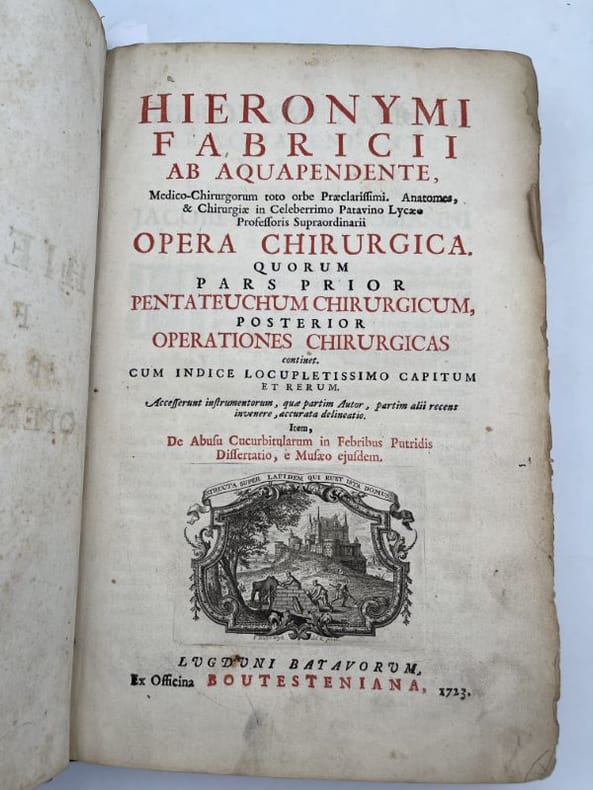
1723173092Boutesteniana Lugduni Batavorum, ex officina Boutesteniana, 1723. In-folio relié plein vélin estampé, dos à nerfs et pièce de titre.Texte sur deux colonnes, soit 744 colonnes + 24 pages pour l'Index rerum notabilium, In Pentateucho et in Operationibus Chirurgicis contentarum Locupletissimus. Cum indice locupletissimo capitum et rerum. Accesserunt instrumentorum, quae partim Autor, partim alii recens invenere, accurata delineatio. Item, De Abusu Cycurbitularum in Febribus Putridis Dissertatio, è Musaeo ejusdem. Exemplaire bien complet des 9 grandes planches dépliantes. Quelques pages sont brunies, les planches sont en bel état, mors du premier plat partiellement fendu mais encore solide et bien attaché. Exemplaire au cachet sec du Docteur M. Bourrillon de Mende en Lozère, et portant sa signature manuscrite. Il était médecin, et inspecteur des Eaux de Bagnols les Bains, homme politique et auteur de plusieurs ouvrages notamment sur la convalescence et les soins des mutilés. Bon exemplaire.
Rarissimo trattato del 1633 del medico bolognese Fabrizio Bartoletti (1576-1630). Bartoletti fu un sostenitore del nuovo metodo clinico che confrontava l'esame del paziente con la dissezione anatomopatologica. Questa è la sua principale opera medica, un trattato di patologia respiratoria rimasto indiscusso per oltre due secoli. Bartoletti fu il primo a distinguere le alterazioni respiratorie in organiche e funzionali e a scoprire il lattosio "Manna seu nitrum seri lactis" (p. 400). Numrosi rimedi descritti tra cui l’utilizzo del mercurio legato agli influssi lunari. All'interno planche ripiegata che mostra uno strumento diagnostico e numerose tabelle ripiegate. Antiche sottolineature e note manoscritte. Frontespizio figurato inciso da Jerome David (1605-1670). Ex libris al contropiatto anteriore. In ottime condizioni. Copertina in mezza pelle coeva con titolo manoscritto al dorso in buone condizioni generali con lievi usure ai margini e dorso. Legatura in buone condizioni. All'interno le pagine si presentano in ottime condizioni con rare fioriture. Lievissima gora d'umidità marginale. In 8. Dim. 22x17,5 cm. Pp. (4)+561+(31).Very scarce treaty of 1633 of the physician from Bologna Fabrizio Bartoletti (1576-1630). Bartoletti was a supporter of the new clinical method which compared the examination of patient with anatomopathological dissection. this is his main work, a treaty of breathing pathology, unsurpassed for more than 200 years. Bartoletti was the first one to distinguish breathing alterations in organic and functional and to discover lactosium "Manna seu nitrum seri lactis" (p. 400). Folded planche showing a diagnostic instrument and different folded charts. Antique underlinings and handwritten note. Figurated title page enfraved by Jerome David (1605-1670). Ex libris in the front counterplate. In very good conditions. Half leather coeval cover with handwritten title in the spine in good general conditions slightly worn in the edges and spine. Binding in good conditions. Inside pages are in very good conditions with occasional foxings. Slight dump stains inside. In 8. Dim. 22x17,5 cm. Pp. (4)+561+(31).
Large 4to. XII, 260 pp. With folding lithographed plate. Contemporary red half calf with giltstamped label to gilt spine. Marbled endpapers. First edition. - Principal work of the Leipzig physicist G. T. Fechner (1801-87), who mainly worked in the areas of optics and Galvanism and who experimentally proved Ohm's Law. His present work compares electromotoric forces based on the measurement of electric currents. - Very attractive, unbrowned copy in a decorative contemporary binding. Darmstaedter 392. Wheeler Gift 859. Roller/Goodman 389. Poggendorff I, 728. Not in Ronalds.
19782Venise, Vincent Valgrisium, 1562 in-folio de 40ff. (signatures a8-e8); 376ff. (signatures A8-Z8, AA8-ZZ8, AAa8) Reliure frottée avec quelques accrocs
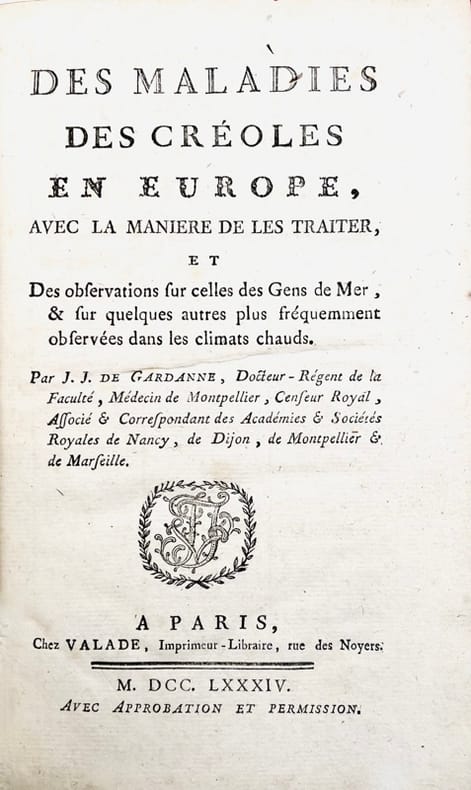
178444382Paris, Valade, 1784. 1 vol. In-8 de XV-(1)-215-(1) pp., veau havane marbré, dos lisse orné, pièce de titre en maroquin rouge, tranches rouges, filet doré sur les coupes, signet de soie verte (reliure de l'époque).
17378529Édition originale de ce rare traité, l'un des premiers en France. L'ouvrage a été broché au XVIIIè siècle avec celui de Lecluse, extrêmement rare également : Éclaircissemens essentiels pour parvenir à préserver les dents de la carie, & à les conserver jusqu'à l'extrême vieillesse Paris, Duchesne, 1755). Broché sous couverture muette Bon Paris L'auteur et Le Mercier 1737 1 volume in-12°
....opus postumum in duas partes divisum. --Un volume in 4to piccolo (19x25 cm) di (4)-XXVIII-219 pagine, con 8 tavole incise ft (7 ripiegate in fine). Frontespizio in rosso e nero, con vignetta incisa da B. de Grado. Pagine un po' brunite, come spesso in queste opere stampate a Napoli, per le caratteristiche di carta e inchiostri. Legatura in piena pergamena coeva con titolo manoscritto al dorso (piccolo strappo al dorso). Seconda edizione, dopo quella romana del 1728, di questo fondamentale trattato del Lancisi sul sistema circolatorio e sul cuore. Famoso anche per le sue belle tavole incise.
1719STLB0043Nürnberg, Lochner 1719. Fol. Schmutztitel, rot/schwarz-gedr. Tit., 1 Bl. (Vorrede), 1223 S., 39 nn. S. Mit gestoch. Tit., 32 (von 34) Kupfertaf. (davon 1 gefalt.) und einigem Holzschnitt-Zierrat. Lederband der Zeit auf 6 Bünden m. dekorative Rückengoldpräg., umseit. marmor. Schnitt, Stehkantenpräg. u. farb. Kleisterpapier-Vorsätzen. An den Kapitalen tlw. größere Fehlstellen durch Wurmfraß, an den Kanten beschabt, Schnitt verstaubt, Vorsatzfalze rissig, stockfleck., tlw. fingerfleck. Weiss 1254; Wimmer/Lauterbach 168. Band 2 der zweiten, durch Georg Philipp Platz neu herausgegebene Ausgabe des erstmals von 1699-1700 erschienenen umfangreichen Hausvaterbuches, das 1701 noch durch eine Continuation erweitert wurde. - Der vorliegende Band beinhaltet einen umfangreichen medizinischen Teil, sowie Abhandlungen über Hebewerkzeuge, Pumpen, Feldmessen, Rechnungswesen, das Recht der Bürger und Bauern, das Wasserrecht, Jagdrecht, Ehe- und Familienrecht, Testament, usw.. Die Kupfer zeigen und a. die Aderlaßpunkte, Feuerwerkskörper, Flaschenzüge, Pumpen, Mikroskope u. ähnliches. - Der medizinische Teil reicht bis S. 279, der Teil über Schriftverkehr geht von S. 429 bis 675 (mit kulturhistorisch höchst interessanten Briefmustern), der juristische Teil geht von S. 676 - 1136.
Venezia e Losanna, 1757 - 1760. SETTE volumi in 4to (cm. 23,5); pergamena rigida coeva con eleganti tasselli in pelle rossa e verde con fregi e titoli in oro, tagli rossi; pp. (4), 639, (2) + due tavole incise; (2), 704 + 4 tavole incise ripiegate; (2) , 652 + 6 tavole incise; (2), 814 + 15 Tavole incise ; (2), 784; (2), 848 + 3 Tavole incise; (2) 878 + 4 tavole incise. Bellissima copia. Axs
"Eugene Arnprior is one of a few thousand survivors after an uncontrolled plague strikes Canada and the United States. His family becomes a modern Swiss Family Robinson in northern Quebec, then becomes a pawn in a dramatic confrontation between Britain and Russia." - dust jacket. 224 pages. 8" x 5". Very light wear to clean and unmarked book which is tight and square. Light foxing to edges with slight related scent. Moderate wear to dust jacket which is now preserved in archival-grade Brodart. An uncommon hardcover edition of this work which was much sought even prior to the outbreak of Covid 19. Book
188091306Librairie universelle de Louis Legros J. Seppré | Anvers Paris 1880 | 14 x 23 cm | Relié
4to. (4), 120 pp. With 82 engravings in the text. Early 19th c. full calf with green labels to gilt spine. Marbled endpapers. First printing of this Latin edition, based on Federico Commandino's translation. Includes Giambattista Aleotti's "Quatuor theoremata spiritualia" (in Latin translation). A very prettily illustrated work showing the fountains, water-powered machines, and hydraulic organs described by the Greek mathematician and engineer Hero of Alexandria in the first century A.D. - Well-preserved. Hoffmann II, 217. Graesse III, 258.
In 16 (cm 11 x 16), pp. (24) + 367 + (1 bianca). Gora alle prime 16 pagine, alcune bruniture sparse alle pagine. Annotazioni manoscritte con grafia antica alla prima carta di sguardia. Piena pergamena. Seconda edizione italiana, nella traduzione di Camillo Camilli, curata da Nicolo' Manassi, il cui nome figura in calce alla dedica datata 1582, dell'opera spagnola di Juan Huarte dal titolo "Examen de ingenios para las sciencias" (1575). La prima edizione italiana, stampata da Manuzio, e' del 1582, ne seguirono altre 5 (la seconda di Venezia del 1586 e la terza del 1590, poi Cremona, 1588, Venezia, presso Barezzi, nel 1600, e Venezia, Valentini, nel 1603). Il libro fu poi proibito con decreto del 1604. Si tratta di una sorta di manuale di orientamento atto alla formazione dei giovani come chiarisce anche il sottotitolo che recita: "...nel quale, scoprendosi le varieta' delle nature, si mostra a che professione sia atto ciascuno, a quanto profitto abbia fatto in essa". L'A. collegava l'ingegno, identificato con l'attitudine alla conoscenza, all'atto della generazione e alla trasmissione fisica delle sostanze da parte di madre e padre. Gli ingegni degli uomini sono diversi e "nessuno di loro e' riuscito a riepilogare in se' un ingegno multiforme dotato di molte qualita' ed attitudini". Dopo una disamina della combinazione degli umori e del percorso pedagogico necessario a far progredire quello che chiama ingegno (ma che nei dizionari di fine Settecento sarebbe stato definito talento) conclude il suo trattato con un capitolo significativamente dedicato alle "attenzioni e [al]le regole che i padri, se vogliono generare figli saggi e dotati di un ingegno adatto agli studi, devono seguire". "Queste istruzioni comprendevano i temperamenti naturali che dovevano possedere madre e padre, le norme da seguire al momento del coito per generare bambini intelligenti e infine le cure per mantenere e accrescere l'ingegno della prole. Rispetto ai pensatori precedenti, Huarte spostava la questione sulla trasmissione delle caratteristiche dei genitori al momento della generazione, pur non svalutando il ruolo divino del dono di capacita' eccezionali" (B. Borello, "Il posto di ciascuno. Fratelli, sorelle e fratellanze XVI-XIX secolo", 2016). Renouard, p. 237: ( Voyez le titre de l'edition de 1582, dont celle-ci est un reimpression, mais bien executee, et augmentee d'une second table, ainsi qu'il est indique sur le titre ce qui porte les preliminaires a 12 feuillets au lieu de 8). Durling, 2501.
182290556Causette | Paris 1822 | 13 x 21 cm | Broché
Folio. With 32 (of 33) mostly numbered plates showing the metamorphosis of butterflies, moths and other flying insects. Mounted in passe partouts and kept in a half cloth clamshell box. 32 (of 33) plates depicting the metamorphosis of 67 (of 70) sorts of butterflies, moths and other flying insects in their natural surroundings, the specimens collected, drawn, and here in all but the first ten plates also etched and engraved, by Jacob l'Admiral (1700-70), first published in 1740 with only 25 plates and in 1774 with 33 plates. The first 10 plates in the present set are 18th-century copies that we have not found recorded in the literature. They were apparently copied from the first (1740) edition, for plate VII includes l'Admiral's name as in that edition, removed before the second (1774) edition. Most plates show the species as egg, larva, pupa and adult, both male and female, placed on the plants they frequent in their natural habitat. Scientifically they were a great advance over all that went before, including the pioneering work of Maria Sibylla Merian. L'Admiral began studying butterflies at the age of ten. He collected the specimens during 30 years of travel and intended the first edition with 25 plates to be one of 4 parts for a total of 100 plates. He finished only 8 additional plates before his death in 1770 and had not yet published them or his descriptions. After l'Admiral's death the bookseller Sluyter bought all the copperplates at auction and produced the second edition, including the 8 additional plates. Plate XII depicts a tulip. - Plate 30, though printed from the original copper plate, has one butterfly additional to those in the 1774 edition. Plate II is unnumbered. Although the first 10 plates are copies, all 32 may have been printed on the same mix of paper stocks. There are at least three different paper stocks, but in many cases the watermarks are mostly obscured by the image: Strasbourg arms above 4 & WR, Strasbourg arms with nothing below it, and Strasbourg bend, and countermarks "IV" and "I Villedary". At least some of the Strasbourg arms have a crown similar to Heawood 1819 and 1828, possibly the watermark of the 1774 edition (with countermark IV). Watermarks in all three general styles were already in use before 1740, so a close dating would require a detailed study. - An unscrupulous dealer changed the plate number XXXIII to XXVIII to suggest a complete set of 32 rather than a set of 33 with one plate lacking. The margins have been trimmed close to the plate edge and the paper stock with the "I Villedary" countermark is slightly browned, but the plates are still in good condition. Cf. Nissen, ZBI 2357-2358 (1740 & 1774 eds.). Horn/Schenkling 52-53 (1740 & 1774 eds.). Hunt 514 (1740 ed.). Landwehr, Coloured Plates 104-105 (1740 & 1774).
177212016A Paris, De l'Imprimerie de L. Cellot, 1772. In-4 broché de 23-(1) pp., couverture muette.
Pagine: (XXXVI+260+2 tav) + (XII+265+27+3+VII Tav) . Illustrazioni: DUE carte geografiche di cui una su Ostiense e Laurentina e Una sulle paludi dell'Agro Pontino. UNDICI tavole a piena pagina incise riguardanti cuore e altro. . Formato: 4° . Rilegatura: Cartonato coevo grigio grezzo originale. . Stato: Buono . Caratteristiche: Dimensioni pagine cm. 37 per cm. 24. Bruniture. Primo frontespizio in rosso e nero, il secondo solo in nero. Interessante opera del Lancisi inerente tra l'altro alla malaria e alla bonifica dell'Agro Pontino. Molto interessanti le due carte geografiche e le UNDICI tavole illustrate, principalmente sul CUORE. Rarissimo a trovarsi veramente completo. .
1764000594Lipsiae Gleditsch 1764
in-8 picc., pp. (8), 124, (1), leg. coeva in p. pergam., tassello al dorso. Impresa dello stampatore al titolo, iniziali istoriate. Prima edizione della traduzione italiana di questo trattato di psico-fisiologia, apparso per la prima volta in latino nel 1561 , "De habitu et constitutione corporis", in cui Lemnius (medico olandese, 1505-1568) studia l'influenza dei fattori esterni (climatici, alimentari, astrologici) e dell'educazione sulla formazione della psicologia e della personalità ("temperamento"). Levinus Lemnius fu allievo di Vesalio e amico di Gesner e Dodoens. Buon esempl. (margine superiore corto).. Durling 2769. Wellcome Cat. non elenca questa traduz. italiana..
8vo. (30), 296 pp. With an engraved frontispiece and 5 numbered engraved plates, folded. Title printed in red and black. Contemporary full calf with giltstamped spine and traces of a spine label. Red marbled endpapers. A scientific work giving practical advice on how to use terrestrial and celestial globes. Apart from remarks on longitude, latitude and on how to locate various points on a globe, the author also writes about time and climate zones as well as navigation at sea. The shorter part on celestial globes includes information on various types of stars, their position, movement and size and provides lists of constellations for the Northern and Southern hemispheres. The plates show the Ptolemaic, the Tychonic and the heliocentric model as well as different kinds of sundials. - Modern pencil ownership to flyleaf ("Heinz"). Slight waterstaining to margins, otherwise well preserved. From the library of Werner Habel, with his ownership stamp (dated 1982) to flyleaf. Bibl. Dt. Mus., Libri rari 173. Houzeau/L. 9746. Zinner, Instrumente 428. Not in Ebert.
183990884Ferra | Paris 1839 | 13.8 x 21.5 cm | 2 volumes brochés
8vo. IV, 240, (8) pp. With coloured engr. t. p. and 12 coloured engr. plates by Teillard and Bessa. Contemp. orange boards with giltstamped red spine label. Second edition. Includes an eight-page calendar for 1820. Pages 89-90 and 161-162 misbound; somewhat brownstained. Untrimmed copy from the library of Duke Max in Bavaria (1808-88), father of Empress Elizabeth of Austria. Stock 1731. Cf. Werger-Burton 674. Nissen 1266 (1818 ed.).