McGraw-Hill EducationBiblio.com

73 293 résultats
0078778328New. Brand new and still unused unknown
0078306167New. Brand new and still unused unknown
002150606XNew. Brand new and still unused unknown
0071848967New. Brand new and still unused unknown
0176504206New. Brand new and still unused unknown
0205187714New. Brand new and still unused unknown
0205216986New. Brand new and still unused unknown
013341695XNew. Brand new and still unused unknown
0205007953New. Brand new and still unused unknown
013366712XNew. Brand new and still unused unknown
0137057881New. Brand new and still unused unknown
013457740XNew. Brand new and still unused unknown
1635301629New. Brand new and still unused unknown
087891787XNew. Brand new and still unused unknown
002152369XNew. Brand new and still unused unknown
1556370113New. Brand new and still unused unknown
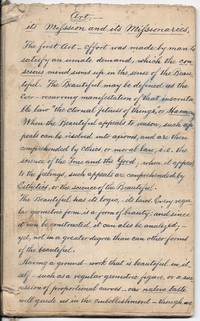
188075319N.p.: N.p. 1880-1925. This impressive and important archive consists of over 1500 manuscript pages and more than 850 hand-drawn illustrations by Rossi-Diehl between the 1880s and 1925. Included are complete manuscripts drafts of manuscripts lesson plans and notes designs teachers’ aids and miscellaneous papers relating to art education especially what Rossi-Diehl called Form – Language along with geometric designs the art of Nature for instance the Acanthus leaf and other rather esoteric art-related subjects. Rossi-Diehl often quotes Goethe and other philosophers and cites biblical references as he attempts to explain his concept of art and its meaningfulness to mankind and his belief that Nature is art’s pure form. Also included in the collection are four writings by Rossi-Diehl regarding social issues war and politics and two interesting “letters†addressed to Samuel L. Clemens and the director of the Leopold Schepp Foundation both listed below under Miscellaneous. Contents;Conrad Rossi-Diehl 1842-1933 was born in Bavaria but came to the United States as a young boy with his parents in 1848 where the family settled in Philadelphia. His artistic talents were recognized early and resulted in his studying art in Germany and Paris where he concentrated on fresco painting and elements of design. Returning to the United States around 1868 Rossi-Diehl taught at the Chicago Academy of Design and later at the St. Louis Art School. From 1879 to 1885 he taught art at the Missouri State University. He relocated to New York in 1886 where he taught at the Hebrew Technical Institute and perfected his course in freehand work. He and John Ward Stimson established the Artist Artisan Institute New-York Institute for Artist-Artisans where Rossi-Diehl directed the drawing and design classes and taught craft as an artform. He was a strong believer in the notion that manufactured products should contain an artistic nature. He prepared drafts for numerous books manuals and articles on design ornament and anatomy for artists and how to teach art. However no copies of his published work were located. Perhaps they were intended to be used at the various institutions where he taught. He also found time to obtain two patents on devices for teaching drawing. His own artwork seemed to be focused on allegorical and literary subjects such as scenes from Shakespeare. See the on-line article on Rossi-Diehl by the Graphic Arts Collection of Princeton and a biography under his name on WorthPoint.The illustrations included in the collection were drawn or cut-out for illustrating Rossi-Diehl’s various drafts of art education texts. They consist primarily of designs floral and geometric diagrams and charts. Several sketches are also included.Incidentally the only records for Conrad Rossi-Deihl to be found on OCLC are 18 original works of art. Sadly this means that all of his real contributions to art and art history and education were lost to history until this archive reared its interesting head. Perhaps there are publishable manuscripts among all of the many to be found in this archive but at the very least this archive would provide students a much clearer picture of art education and thought in the 19th century. The following is a brief listing of the various manuscripts in the Rossi-Diehl collection being offered here.ART & ART EDUCATIONAdvisement Obsolete Dic. Seven-page manuscript relating in part to “the only teachable Form-System thus far known… Geometry or that part of the Science of Learning called Mathematics…†Written on 7 x 9 inch lined paper.Art – Its Mission and its Missionaries. Twenty-seven 27 page manuscript written in ink on 5 x 8 inch pager tied together with string through two punched holes on the left side. The manuscripts ends abruptly in mid-sentence at the end of page 27. Rossi-Diehl begins this essay “The first Art – Effort was made by man to satisfy an innate demand which the conscious mind sums up in the sense of the Beautiful. The Beautiful may be defined as the ever-recurring manifestation of that inscrutable law ‘the eternal fitness of things’ or Harmony.â€Art – Industry and Manual Training. Eight-page manuscript written on 7 x 9 inch paper tied together with string. “Art – Industry is either a misleading denomination or it is an entirely meaningless compound term… Manual Training is the natural concomitant of Art – Education where discipine in the Acquirement of Skill must go hand in hand with firm grounding in Art – Knowledge.â€Art Exercises w/Drawings. Two separate multi-page art exercises with geometric drawings. totaling 15 8 pp twenty-three 23 pages.Design or Form Composition. Thirty-two 32 page manuscript including illustrations. Text written in ink on 5.5 x 9 inch paper. The manuscript starts out “All the forms of the Universe known to man enter into Design: sun moon and star; cloud wave and cristal sic; leaf flower and fruit; fish fowl and beast; and last – but not least – the human form divine. All these subjects must be studied from nature – not from Text-Books; unless this be done in order to learn what man has recorded about them. The Text-Book must be a reliable guide to the student for the study of nature… A Design is an arrangement of Forms; or of Colors; or of both Forms and Colors. It is made to be executed in hard substances such as wood stone metal &c; in pliable materials such as leather linen silk &c; or to be applied to a fabric or a surface for its embellishment.â€Divine Art as Reflected by Human Art; or Universal Form – Utterance and Human Languages Contrasted / An Appeal to the American People on behalf of their Material and Educational Interests. One-hundred-twenty-six 126 page manuscript written in Rossi-Diehl’s hand but with “By Philo Rackstone… 1911†on a cover board. We find no reference to a Philo Rackstone so this may be a non de plume Written on 7 x 9 inch paper stock.Elementary Course in the Art of Perspective – Drawing or Space – Construction without the use of Vanishing – Points. One hundred 100 page manuscript including over 30 pages with illustrations signed by Conrad Rossi-Diehl and datelined Hoboken N.J. August 8 1903. The title page has a note “This booklet is the property of Mignon / Hoboken September 7 1903â€. Written on 6 x 9 inch sheets of paper. The loose pages are inserted into an envelope titled “Elementary Course in Perspective / Original Text. 46 Cuts to be insertedâ€. A Few Words of Interest Encouragement and Assurance. Forty-one 41 page manuscript with additional writing on the back of several pages. Written on lined paper measuring approximately 8 x 10 inches tied together with string. The manuscript begins “Free-Hand Construction develops skill in the practice of those processes that are the carriers of all free handiwork whilst imparting that particular knowledge which underlies the practical performance of any useful task whatever.†Form – Construction and Geometry Compared. An Epitomized General Form – Treatise. A three-page plus title sheet treatise on 8 x 10.5 inch paper held together with string and a brass fastener.Form Language. Grammar of Design / Form – Composition 1888. Seventy-one 71 page manuscript of text and many original illustrations. Signed by Rossi-Diehl and datelined New York City October 3rd 1888. Written in ink on 8 x 9.75 inch paper with the illustrations cut out and laid down. His Introduction begins “Ornamentation is the most primitive as well as the most exalted expression of the innate sense of the Beautiful. It is that branch of the Fine Arts in which man is purely creative.â€Form Language 1895. Fifty-five 55 page manuscript with additional writing on the backs of several pages written on 8 x 12.5 inch paper tied together with string. Signed by Rossi-Diehl and date-lined New York City July 16 1895 with a note: “The drawings should be greatly enlargedâ€. The drawings referenced are not included within the tied bundle. The document contains eight parts following a one-page Introduction: Form – Study pp 2-15; The Germ – Element pp 16-21; Secondary Ellipses pp 22-24; Focal Activity in Living Mechanics – The Movement of the Arm pp 24-28; The Volute or Vital Form – Element pp 28-30; Constructive Geometry – The Circle and Hexagony pp 31-40; Geometric Facts and Operations pp 41-53; and Warped Surfaces pp 54-55.Form Language 1908. Thirty-three 33 page manuscript written in pencil on 7 x 9 inch lined paper. Signed by Rossi-Diehl and datelined Glen Ridge N.J. July 21 1908. Contains an introduction X pp; a section titled The Structural Sphere 6 pp; and Chapters 1 & 2 17 pp. This version begins “Form – Language is the Universal Utterance of Nature in whose vocabulary Man – single or collective; physically mentally and spiritually stands recorded in a single Form – Word.â€Form Language Synopsis of Contents. Ten-page table of contents for one edition of Rossi-Diehl’s Form – Language. The title sheet states “Synopsis of Contents presenting an Epitomized Generalization in the Particular of what is Comprehended by Form – Language as applied to the Arts useful and refining.†Written on 7 x 9 inch ruled paper tied at the top through two punched holes with ribbon.“Geometryâ€. Twenty-five 25 page manuscript plus four various drafts of portions of the text for a total of 47 pages. With original titled envelope.Grammar of Form – Language. For the use of Teachers and for Self-Instruction. Manuscript draft of approximately 100 pages signed by “Conrad Diehl. Columbia Mo.†held together with thread through holes on the left side margin. Rossi-Diehl states “It is the design of this work to formulate and clearly to define a system by which the Language of Form may be made comprehensible to the mind of the child so that it may learn to interpret Nature and Art for itself and thereby attain to the power of consciously performing tasks till now unconscious by performed by many who labor in the domains of Industry and Art.†Includes four additional pages pp 47-50 that differ slightly from those same pages in the draft.Illustrated Design Booklet. Twenty-four pages measuring 12 x 8.75 inches of which 13 have design illustrations laid down. The pages are numbered 1 through 24. Most likely these illustrations relate to Rossi-Diehl’s various versions of Form – Language or other writings that call for figures.Illustrated Design Booklets # 4 5 6 7 & 8 pp 21-119 1. Total of 100 pages. Arranged by Conrad Rossi-Deihl. Each booklet measures 7.75 x 10.5 inches; stiff brown paper wraps except for # 4 pages 21-40 which has no covers. Designs laid down on each page. Most likely these illustrations relate to Rossi-Diehl’s various versions of Form – Language or other writings that call for figures.Normals – Tangency. Six pages of manuscript notes written in pencil on 6 x 9 inch paper held together with a straight pin. Concerns notes on angles reflections and the like.Notes Designs & Partial Documents. Over one-hundred-twenty 120 pages of manuscript notes drawings and partial documents written and drawn by Rossi-Diehl. Some appear to be draft portions of his writings for art education classroom and art teacher use.The Portent of Human Art and Art-Forms. Supplemented by a Treatise of The Single Acanthus Leaf. Nineteen-page manuscript written on 8 x 12.5 inch lined paper tied together with string. The essay begins “Human Art-Activity is a reflex of Divine Creative Power. Thus human Art is the sum total of man’s productiveness in all that is useful and refining; or true and good beautiful and elevating.â€Refining Art: Its Nature and Essentials. One hundred-eleven pages plus 8 signed by Rossi-Diehl and datelined Glen Ridge N.J. 1914. A note on the top of an old folder cover sheet states Outgrowth of the so-called “Single Acanthus – Leafâ€. Written on 8.25 x 12.5 inch sheets of paper. Illustrations laid down throughout.The Refining Arts: Their Scope and Limitations. Eleven-page manuscript written on 7 x 9 inch paper held together with string through two holes at the top. Partial defense of manual arts as part of the whole of Art.Revised Course in Manual Training New York City Schools. Four pages outlining six years of course work including free-hand drawing imaginative drawing design constructive and cut work figure sketching modeling color shop work and drafting.The Single Acanthus Leaf in Particular and Art – Foliation in General with Due Regard to Generic Art – Forms and the All-Governing Law of Harmony. Seventy-nine 79 pages some with illustrations laid down signed by Rossi-Diehl and datelined Glen Ridge N.J. 1913. Written on 8.25 x 12.5 inch sheets of paper.The Single so-called Acanthus Leaf in Particular and Art – Foliage in General with Due Regard to the All-Governing Law of Harmony. Ninety-eight 98 pages several with illustrations laid down signed by Conrad Rossi-Diehl and datelined Glen Ridge N.J. 1913. A cover sheet has a note above the title “Translated from the Germanâ€. Written on 8 x 12.5 inch sheets of paper.Skeletal drawings Figures 5 & 6. Two 9.25 x 22 inch printed renditions of the human skeleton originally hand-drawn by Conrad Rossi-Diehl in 1887 and printed in 1888. Figure 5 has a split along the middle horizontal fold; Figure 6 has been separated along that middle horizontal fold. “Syllabusâ€. Form – Study Art Drawing: Primary Schools – Grades 1A to 8B. Forty-five 45 cursive 8 typed pages outlining Rossi-Diehl’s course of art and drawing study for young folks. With original titled envelope.Text to Course in Free-Hand Construction / A Few Words of Encouragement and Assurance. Fifty-two 52 page manuscript that was in an envelope with the penciled note on the outside “Course – Free Hand Construction / Original Text VOIDâ€. This draft most likely was updated by the 101-page manuscript in the following entry.Text to Course in Free Hand Form – Construction / A Few Words of Encouragement and Assurance. One-hundred-one 101 page manuscript with illustrations laid down throughout. Written on one side of 8 x 10 inch sheets of paper. This manuscript was housed in a brown envelope with a penciled “Text to Course in Free-Hand Form Construction 101 Pages. Complete.†written on the outside.“Treaties on Form Constructionâ€. Thirty-five 35 page handwritten manuscript with a few drawings by Rossi-Diehl datelined “X-Mas Day Glen Ridge N.J.â€. Page 1 is titled Part II Practical Requirements and starts out “Anyone who can make a lineal drawing fairly well – Freehand is in position to do the same accurately with the aid of instruments; and in this connection Mechanical Drawing is barely worthy of mention.†With original titled envelope.Untitled re Form – Study and Art. Eight handwritten pages written on 5.5 x 9 inch paper signed by Conrad Rossi-Diehl at the end with this note “These pages are dedicated to the Teacher and Student of Form-Study and Art. July 29 – 1901â€. This document is numbered IV through XI so apparently the first three pages are missing although page IV starts up with the beginning of a premise.SOCIAL ISSUES WAR & POLITICSAmerican Preparedness: Its Essential Ways and Means. Four-page manuscript written on lined 8.5 x 14 inch. paper. This essay explores the notion that “a sane mind in a sound body†is the answer to efficient preparedness and promotes the need for a properly educated populous. The Greatest of Social Evils Whose Clear Unfolding Implies its Own Remedy. Twenty-three 23 page manuscript written on 7 x 9 inch sheets of paper held together with string. The essay starts out “Self-constituted authority to Rule or Ruin based upon arbitrary standards of valuation and where hereditary nobility or titular sublimated respectability primarily rest with the power to destroy life and property and a total disregard for all that is sacred is at the bottom of all Social affliction.†The Lay of the Land. Two-page manuscript incomplete written in ink on both sides of a single 8 x 9.75 inch sheet. It begins “In the present hour of dire need where after the most fiendish atrocious and devastating war that has ever been waged by Man’s inhumanity to Man: on land and under the soil on the waters and in their depths – and even in the very air we breathe; - and where Treachery Fraud and utter Irresponsibility have fairly run riot…â€Untitled re Critical of John D. Rockefeller. Written in pencil on both sides of a 6.25 x 26 inch sample ballot for the 1916 Democratic Primary Ticket for the Borough of Glen Ridge N.J.MISCELLANYPartial Letter Addressed to the American humorist “Mr. Samuel L. Clemens†the undated “letter†consists of two handwritten pages on 8 x 12.5 inch lined paper of content that seemingly end prior to completion without any closing salutation or signature. It appears that it may never have been meant as a real letter but only Rossi-Diehl’s attempt at satire. The text refers to a youthful Stephen Crane; woman’s wile; rich men who with money made on the backs of others become benefactors; reference to “Innocents at Homeâ€; and other rather scathing remarks. The second page ends with the following “To throw our lady into a conniption fit one needs but to mention a broom a wash-dish or tub and a clothes-line; all of which in her buxom days she handledâ€. Letter to Philip Ritter Leopold Schepp Foundation Long handwritten letter written on both sides of thin paper pasted together to form an 8 x 18.5 inch single sheet addressed to “Mr. Philip Ritter Director of the Leopold Schepp Foundation 185 Madison Av. New York City†datelined “42 Hawthorne Av. Glen Ridge N.J. July 30 1925†and signed “Most Cordial Yours Conrad Rossi-Diehlâ€. The letter is in response to a newspaper article announcing that Schepp the uneducated son of German immigrants who became the “Coconut King†and one of the wealthiest men in New York City had just created a multi-million-dollar foundation to assist young students with their education based in part on the students’ life goals to benefit mankind. Rossi-Diehl’s response is one based on his own interest in education philosophy religious beliefs and art-logic.Overall the archive is in VG to VG condition. N.p. paperback
1598955341598. 1598. Fair. - An original holograph document attractively penned in an unknown hand on 13-1/4 inch high by 15-5/8 inch wide cream paper. Fifteen lines boldly penned with several flourishes signed "Christophorus Popel Barro a Lobcowicz" by Christoph Popel Baron of Lobkowicz who was Chief Steward of Bohemia under the Holy Roman Emperor Rudolf II. The document is further annotated with 8 lines penned across the center of the verso with an unidentified signature and another 8 lines penned vertically on the verso above the center panel also with an unidentified signature. The faint remnants and outline of a red wax seal are centered at the top and bottom edges of the verso. Folded twice vertically and four times horizontally with several tears along the folds. There is some foxing present especially at the top and bottom. Good. <p>The Chief Steward of Bohemia under Emperor Rudolf II Christoph Popel Baron of Lobkowicz 1549-1609 was a close friend of the celebrated court painter Hans von Aachen. Lobkowicz who was known for his language and diplomatic skills was tasked with welcoming visitors from within and without the Holy Roman Empire to the Emperor's Court and for negotiating alliances in the war against the Turks. Lobkowicz was responsible for the peace negotiations with the Polish King Sigismund. Lobkowicz spent considerable sums on art work for his residence and commissioned jewelry precious watches and valuable objects. He was buried in the chapel in the Prague Cathedral. [1598]. unknown
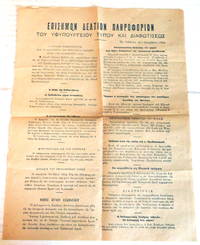
194498904Athens Greece: Deputy Ministry of Press and Information December 5 1944. 1944. Very good. - Folio a 12-3/4 inch high by 9-1/2 inch wide broadside printed on newsprint. A two-line banner title centered at the top is followed by two columns of text with the contents justified left below centered headings. The publication info and the date are printed above the second column. The broadside is toned and folded both vertically and horizontally with minor pinprick holes. Very good. <p>The text is in Greek and our translations may be subject to some corrections.<p>During the late hours of December 4 1944 and the early hours of December 5 Lieut.-General Scobie GOC British Forces in Greece proclaimed martial law in Athens and in Piraeus the port of Athens following violence on December 3rd and the declaration of a general strike. The broadside publishes Winston Churchill's statement supporting his General. "The Prime Minister wishes to make known that the announcement of the 1st December by General Scobie to the Greek people stressing the need for unity and expressing our full support for the current Greek Government was made with the knowledge and full approval of the Government of her Majesty."<p>Following this is a statement concerning order: ".General Scobie has taken all recommended measures to fully reestablish order. .English troops guard Public Facilities and simultaneously the reclamation of Police Departments has begun. The Greek people should be certain that order will be completely enforced."<p>There is a statement that "In yesterday's first court day of the Special Collaborators' Court the S.S. associate and member of the 'BUND' the infamous Giannopoulos was sentenced to death." The BUND organization and its leader Aginor Giannopoulos trained a battalion of Greek volunteers who fought in SS and Brandenburgers units. According to the broadside 200 members of ELAS in the suburb of Nea Ionia were disarmed as were 1200 near Psychiko.<p>There is a brief report on the events leading up to martial law: "In the march on the day before yesterday organized by the Communist Party protesters threw a grenade and shot at the house of the Prime Minister George Papandreou on Kifisias street. The leader of the protesters officer of ELAS and known communist Architect Provellegios was arrested."<p>Finally there is a statement on food shortages. ".due to the three-day labor strike the steamboats full of food meant to be distributed to the Greek People anchored in Piraeus harbor remains unloaded."<p>RARE. Athens, Greece: Deputy Ministry of Press and Information, December 5, 1944. unknown
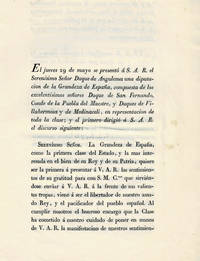
182399089<p>Madrid: Imprenta de D. Miguel de Burgos 1823. 1823. Very good. - Small folio 11-3/4 inches high by 8-1/4 inches wide. Softcover bound in plain brown wrappers. There is a short tear to the tail of the spine and the corners of the covers are creased. 6 unnumbered pages followed by a blank leaf. There are a couple of light spots to the front margin of the first leaf. A clean & bright pamphlet.</p><p>RARE First only edition.</p><p>When King Ferdinand VII of Spain returned to power in 1814 he repealed the liberal constitution of 1812 the Constitution of Cadiz. In 1820 soldiers preparing for an expedition to reclaim Spanish colonies in South America pledged loyalty to the 1812 Constitution and led by Rafael del Riego revolted against the King's absolute rule. On March 9 1820 Ferdinand accepted the constitution and gave power to the liberal ministers. The 3-year period that followed is known as the "Trienio Liberal". This period of liberal rule in Spain was marked by instability and a faltering Spanish economy. In January of 1823 a secret treaty was signed at the Congress of Verona by the United Kingdom France Russia Prussia and Austria. The treaty gave authority to France to invade Spain and restore Ferdinand VII as the absolute monarch. The King of France Louis XVIII put the Duke of Angouleme in charge of the Army of the Pyrenees also known as the "Hundred Thousand Sons of Saint Louis". It was his mission to overthrow the Constitutional government of Spain and restore Ferdinand VII to his full powers as was agreed to at the Congress of Verona. Angouleme and his army entered the capital of Spain on May 23 1823. There he formed a royalist regency presided over by Carlos Maria Isidro de Borbon the Infante of Spain. The pamphlet at hand is an exposition addressed to the Duke of Angouleme by the Grandee of Spain represented by 36 members of the Spanish nobility who have signed at the end. It is worthy of note that the Grandee's statement is dated May 27 the day after the regency was installed. The statement praises Angouleme and calls for him to quickly unite the King with the nations of Europe. "Ahora la oportunidad de desahogar nuestros pechos oprimidos y de reunir nuestros deseos y nuestras fuerzas para lograr la suspirada restauracion era el dia venturoso en que un hijo por el amor y heredero por la sangre del poderoso rey cristianisimo de Francia ha aparecido en esta capital misma rodeado de tantos miles de valientes anunciando el grandioso designio de poner en libertad a nuestro Rey y de hacer que reine de nuevo entre nosotros el orden la paz y la justicia.Acabad senor pronta y felizmente el desempeno de vuestro noble encargo; juntad la libertad de un Rey de vuestra sangre a las justas esperanzas de una nacion amiga de la Francia; que de los esfuerzos reunidos de estos dos pueblos generosos resulte el bien Comun y un nuevo y duradero lazo de amistad y de alianza; que ahuyentadas las mezquinas y funestas pasiones para hacer lugar a la benefica concordia formada una sola familia con un solo espiritu en rededor del regio trono; puestos enfin los Espanoles en honrosa y sabia armonia con las naciones cultas de la Europa tan lejos de las intrigas de la arbitrariedad precursora siempre de desastres como de la inquieta y destructora anarquia podamos un dia mas dichoso y puedan nuestros hijos decir con inefable y permanente jubilo."</p> Madrid: Imprenta de D. Miguel de Burgos, 1823. paperback
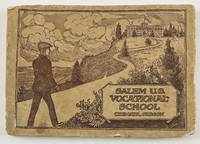
191912733Salem Or. 1919. 90pp. Oblong octavo. Original illustrated tan wrappers printed in darker tan. Moderate edge wear and minor toning to wrappers. Occasional minor foxing or thumb-soiling to text. Overall very good condition. A very rare promotional pamphlet illustrating the opportunities awaiting Native American youth at the Salem Indian Training School in Chemawa Oregon. The wrapper title is Salem U.S. Vocational School Chemawa Oregon. The Salem Indian Training School opened in early 1880 as one of the first Native American boarding schools in the country of course intended to be an instrument of assimilation for local indigenous peoples. Opened as an elementary school Salem was a fully-accredited high school by 1927. The school is still open and has been for some time known as the Chemawa Indian School named for the Chemawa band of the Kalapuya people of the Willamette Valley; its own website describes the school as "the oldest continuously operated boarding school for Native American students in the United States."<br /> <br /> The present work includes a title leaf and four pages of explanatory text about the school with the remainder of the contents comprised of full-page photographs illustrating a wide variety of subjects at the institution. The work opens with photographic portraits of four white government officials including the superintendent of the Salem school Harwood Hall. This is followed by the explanatory text describing the general area around Chemawa as well as various aspects of the school such as its academics boys and girls "industries" farm social life newspaper The Chemawa American and more. The most striking photograph is a folding "Panoramic View of Chemawa Indian School" which is present here in its entirety measuring 5.5 x 21.5 inches. Other photographs picture various landmarks around Oregon but mostly center on the school's campus and activities. These include photos of campus buildings and spaces dormitories hospital auditorium academic building girls' industrial building greenhouse prune orchard the "piggery" classrooms and other interiors sewing blacksmith shop gymnasium dormitory rooms and parlors dressmaking carpentry shop bakery "fruit room" boiler room tailor shop science lab clubs and sports teams boys' and girls' basketball boys' football track baseball Sigma Phi Delta Society and three other literary societies Mandolin and Guitar Club Boys Battalion Excelsior Literary Society group photographs of the 1918 and 1919 graduating class the latter showing twenty students holding a pennant reading "Excellence Means Labor" and more. A small card is affixed to the title leaf stating that "This booklet was printed entirely within our own shop" so very likely by Native American students whose print shop is also illustrated within. The work is very similar to another publication for the Sherman Institute in California produced around the same time.<br /> <br /> OCLC records just two copies both in Oregon at the State Library and the University of Oregon. unknown
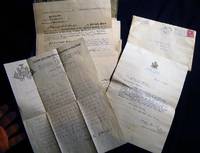
191323286Farmingdale Nassau Co. L.I. N.Y.: Not Published 1913. Archive consists of 8 documents including: Aug. 7 1913 typed letter signed on State of NY Executive Chamber letterhead to Edward H.L. Smith St. James L.I. ".establishment of the New York State School of Agriculture on Long Island is a work of which New York State should be justly proud.it affords me great pleasure to appoint you as a Trustee.Very sincerely your friend signed in pen Wm. Sulzer" William Sulzer 1863 - 1941 Governor of NY at the time first and only NY governor to be impeached - this with the original mailing envelope; August 19 1913 on printed New York State School of Agriculture on Long Island letterhead TL signed by the board member from Brooklyn Franklin H. Hooper inquiring about the appointment of Smith and further explaining that Smith was to take the place of Ezra A. Tuttle of Eastport and asking him of all this directly ".because of the complicated situation which exists at present in Albany." F.H. Hooper 1851 - 1914 considered one of the main proponents of the founding of the school and a prominent Brooklyn NY & national educator; with a copy of the Aug. 23rd 1913 completed and signed Oath of Office of Smith witnessed and notarized; and the Aug. 26 letter regarding the office signed by Mitchell May the Sec. of State of NY; On Aug. 28 Franklin Hooper acknowledges the receipt of the letter of appointment & oath & gives notification of the next Board meeting with mailing envelope; with the October 15th 1913 8-page typed document signed "Estimate of Money Needed for Running Expenses of the New York State School of Agriculture on Long Island from January 1st 1914 to January 1st 1915" prepared by A.A. Johnson and signed by him in ink at the introductory passage and which gives a detailed budget for the school various departments salaries the demonstration farm and more in the original blue paper over-folder; a December 16 1913 typed letter 2 pages signed by Hooper writing to all the Board which declares that ".on Thursday December 11 representatives of the State Comptroller and of the State Attorney General went to Farmingdale and that Messrs. Mott Smith and Ruland were on that day paid by the State Comptroller for their three farms respectively in pursuance of the contract as made by the Board of Trustees of the school and the three vendors.thereby completing the transaction for the purchase of lands for the school. It is now possible for members of the Board of Trustees to enter upon the lands and to prepare to use them for the purposes of the school." and with further information regarding the surveying of the property and a February 5 1914 TLS by Hooper to Smith regarding information to be sent to Lathrop Brown; the letters with old fold lines light wear and in very good condition; envelopes worn stained used; overall in very good condition and an excellent group of letters regarding the historical foundation of the school at Farmingdale the oldest public institution of higher education on Long Island. Manuscript. Not Bound. Very Good. Not Published Paperback books
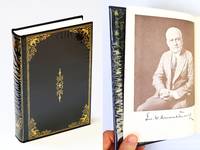
1958215j1610U.S.A.: Mary C. Armstrong. Fine. 1958. First Edition. Hardcover. "The story of the life of Judge George W. Armstrong 1866-1954 is a picture of America at her best. During the last half of the nineteenth century and for about thirty years of the present century our Republic was generally governed by individuals of the character and blood of those stalwart leaders who conceived and organized it. Judge Armstrong belonged to that courageous lineage. He studied thoroughly the plans of those who would destroy our Nation took an active part in exposing their treason and assisted patriots who battled to save us. He wrote extensively to expose administrations infiltrated by governmental appointees planning our destruction. So powerful were these individuals that they exercised great control over the national press and by skillful propaganda had poisoned the minds of our citizenry. To attack them took character and courage all of which Judge Armstrong possessed in abundance." - George Van Horn Moseley Major General U.S. Army Ret'd. Armstrong's books include: High Treason The March of Bolshevism The Rothschild Money Trust The Corruption of America and many more. xviii 414 pp. Index. Tissue-protected black and white frontis portrait of George Armstrong. Black and white reproductions of archival photos and illustrations. Stored since publication this book is unread and literally as new. A magnificent example of this proud and lavishly produced life story. ; 8vo . Mary C. Armstrong hardcover
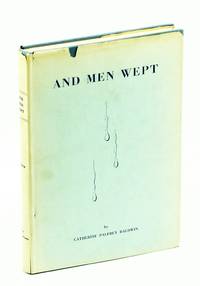
1955227j0678New York: Our Publications. Very Good in Good dust jacket. 1955. First Edition. Hardcover. Neatly signed without inscription by author upon front free endpaper. "In presenting this book of facts the author hopes to arouse a latent patriotism. A patriotism that will demand the return of this country to its intrinsic sovereignty and purity." - dust jacket. "Catherine Palfrey Baldwin 1881-1968 was an American nationalist and in 1934 the founder and president of the Defenders of the Constitution. She was hostile to all things British including the British Israel Movement. She supported Father Charles Coughllin and the efforts of Washington correspondent James True." - Wikipedia. The title describes what happened after the 1952 Republican Convention during which the powers that be determined that General Douglas MacArthur would not win. 8 201 12 pages. Bibliography and extensive index. While copyright page is dated 1955 and title page is dated 1954 we believe this copy to be a first edition. The eighteen chapters include: Nicholas Murray Butler and the Carnegie Endowment for International Peace; British Israel; Churchill; Propaganda; Education & American Youth; League of Nations; World Government; and more. Book clean tight and unmarked with light wear to original Carolina blue cloth. Average wear to dust jacket now in glossy new archival protection. A particularly rare signed hardcover copy of this conspiracy classic.; 8vo; Signed by Author . Our Publications hardcover
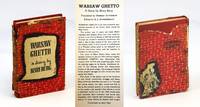
1945124j1585New York: L. B. Fischer. Good in Fair dust jacket. 1945. Special Edition. Hardcover. "The first authentic eyewitness account of the Polish Jews' ordeal by Nazi terror. The author was 15 years old when Hitler marched into Poland. From that time until her arrival in the United States in 1944 she kept a day-to-day record of her four years in the ghetto itself a brief period of confinement in a Warsaw prison prior to her dispatch to a French internment camp and her eventual journey to freedom. As a factual report on the life and death of a people this book ranks with the remarkable documents of the war." - dust jacket. "Mary Berg born Miriam Wattenberg 1924-2013 was active in telling the story of the Warsaw Ghetto through the early 1950s being on radio and making appearances to publicize what we now call the Holocaust. After that she dropped out of public view resolutely refusing to participate publicly in any Holocaust-related events zealously guarding her privacy." - Wikipedia. Special edition sponsored by the National Organization of Polish Jews Inc. 253 pages. Tight and unmarked with moderate wear to original red boards. Very heavy wear to the rare dust jacket now in glossy new archival protection. 20.9 x 13.5 cm. Laska 1445 Kehr & Langmaid 5969 Weiner Library Catalogue Series 7 #1416.; Dust Jacket; 8vo . L. B. Fischer hardcover