Jean GIONOBiblio.com
1 815 résultats
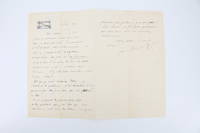
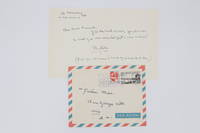
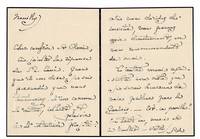
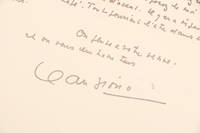
195284966s. l. 1952. Fine. s. l. ca 1952 21 x 27 cm une feuille Autograph letter signed by Jean Giono 14 lines in black ink addressed to Roland Laudenbach who jointly ran the magazine Opéra with his friend Roger Nimier. Fold marks inherent to the mailing. ""Cher Roland j'y pense : Voulez-vous quelque chose pour Opéra de qualité d'assez sensationnel et qui fuisse faire sept à huit numéros peut-être plus à votre gré Le Journal. Le Journal de 1936 à 1949. Si cela vous plait parlez en avec Nimier pensez à un chiffre proposez le moi ça ira sûrement et c'est d'accord. Il y en a déjà pas mal de tapé ! Tout le journal l'être dans un mois. On pense à votre venue et on vous embrasse tous. Jean Giono."" Dear Roland I'm thinking: Would you like something for Opéra Something quality rather sensational that could run for seven to eight issues perhaps more as you wish The Journal. The Journal from 1936 to 1949. If this appeals to you discuss it with Nimier think of a figure propose it to me it will surely work out and we're in agreement. Quite a bit of it is already typed! The entire journal will be ready in a month. We're thinking of your visit and we all embrace you. Jean Giono. A very visual letter bearing Jean Giono's handsome signature. unknown
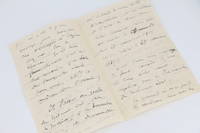
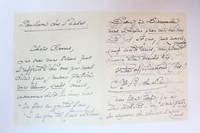
190079398Chaumot Nièvre Chaumot 1900. Fine. Chaumot Nièvre Chaumot 4 juin 1900 13.80 x 21.30 cm une feuille Autograph letter signed by Jules Renard addressed to Gabrielle Réval. One and a half pages written in black ink on letterhead paper from ""Gloriette"" the writer's residence in Nièvre. Transverse fold lines inherent to mailing. Fine letter to this fellow writer alluding to Poil de Carotte: ""Je suis au moins aussi content que vous. Certes je n'avais pas oublié le manuscrit où Poil de Carotte était si bien compris - et aimé - j'avais oublié la signature."" ""I am at least as pleased as you are. Certainly I had not forgotten the manuscript where Poil de Carotte was so well understood - and loved - I had forgotten the signature."" He mentions Gabrielle Réval's book: ""Et tant mieux ; car j'ai lu les Sèvriennes et non le livre d'une amie de Poil de Carotte. L'auteur seul a plu le lecteur seul a été touché. Il y a de belles réussites vous le voyez madame."" ""So much the better; for I read the Sèvriennes and not the book of a friend of Poil de Carotte. The author alone pleased the reader alone was moved. There are beautiful successes you see madam."" Jules Renard already enjoyed considerable success at this time: ""Il me répugnerait de jour au vieux maître sachez pourtant que j'ai déjà reçu bien des livres écrit bien des lettres en quelle proportion par politesse je ne sais plus mais aucune ne fut plus spontanée que celle dont vous me remerciez aimablement."" ""It would repel me to play the old master know however that I have already received many books written many letters in what proportion out of politeness I no longer know but none was more spontaneous than the one for which you thank me kindly."" The highly laudatory letter alluded to here is preserved at the Jean Jaurès Media Library in Nevers and was written by Renard a few days before ours: ""Ce n'est pas l'auteur des Sévriennes que je remercie c'est vous. C'est grâce à vous que j'ai lu par cette froide fin de mai entre la première rose de mon jardin et les dernières flammes de ma cheminée un beau Livre."" ""It is not the author of the Sévriennes that I thank it is you. It is thanks to you that I read during this cold end of May between the first rose of my garden and the last flames of my fireplace a beautiful Book."" Gabrielle Réval was one of the co-founders of the Prix de la Vie heureuse which would later become the Prix Femina. unknown
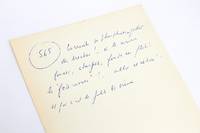
195484046Meudon 1954. Fine. Meudon 1954 20.70 x 26.80 cm une page sur un feuillet Autograph manuscript signed by Louis-Ferdinand Céline written in blue ballpoint pen on a sheet of white paper numbered 565 in the left corner. One transverse fold. Some pin holes in the upper margin evidence of the organization of Céline manuscripts in ""bundles"". « torrents de phosphore jaillir des brèches ! . et les avions foncer charger fendre ces flots ! les ""forteresses"" ! aller et retour ! et que c'est le Jules le crime » ""torrents of phosphorus gushing from the breaches! . and the planes rushing charging cleaving these waves! the ""fortresses""! back and forth! and that it's Jules who's the crime"" The passage on our sheet conforms to the published version. Published in 1954 Normance is a direct sequel to Féérie pour une autre fois which appeared two years earlier. Both parts were written during Céline's years of exile and imprisonment in Denmark. Upon his return to France in 1951 Céline undertook a work of ""polishing"" and published these two titanic texts independently originally conceived as one. ""Céline while working on it thought of this novel as a second Voyage au bout de la nuit capable twenty years later of astonishing the public as much as the 1932 novel."" Henri Godard unknown
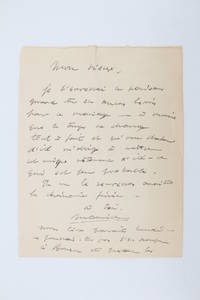
190080760s. l. 1900. Fine. s. l. s. d. ca 1900 14.70 x 18.90 cm Une page et 1/2 sur un feuillet Autograph letter signed by Maurice Leblanc to an unknown recipient whom he addresses as ""Mon vieux""; one and a half pages written in black ink on a sheet. Transverse folds inherent to mailing. The letter concerns the loan of a garment: ""Je t'enverrai ce pardessus quand tu en auras besoin pour ce mariage - à moins que le temps ne change tout à fait et qu'une chaleur d'été m'oblige à mettre cet unique vêtement d'été - ce qui est peu probable. Tu me le renverras aussitôt la cérémonie finie."" ""I'll send you this overcoat when you need it for this wedding - unless the weather changes completely and summer heat forces me to wear this only summer garment - which is unlikely. You'll send it back to me as soon as the ceremony is over."" Maurice Leblanc also mentions the release of one of his works ""Mon livre paraît lundi - ne pourrais-tu pas t'en occuper à Rouen et presser les libraires de faire leurs commandes et de t'arranger pour n'en point manquer "" ""My book comes out Monday - couldn't you take care of it in Rouen and press the booksellers to place their orders and arrange not to run out"" before concluding his letter: ""Tout le monde va bien. Chez Geo c'est affolant. On s'en va à Bordeaux du 21 avril au 4 mai."" ""Everyone is well. At Geo's it's frantic. We're going to Bordeaux from April 21 to May 4."" unknown
190586168s. l. 1905. Fine. s. l. s. d. ca 1905 11.50 x 18 cm 5 pages sur un double feuillet Autograph letter signed by Maurice Leblanc to a friend from Rouen named Louis asking him to perform several services as he lacks the time to handle them himself. Maurice Leblanc entrusts his friend with two commissions: first to collect some furniture reserved by one of his friends at an antique dealer's: ""Go to a man named Chassaigne antique dealer 20 rue St Romain.He sold 6 chairs to the Prats two months ago. . apparently he refused to accept a deposit. No response. Let him say frankly that he has sold everything. The bench was for me 40 francs and I would very much like to have it."" the second concerning an administrative matter: ""Go to the registry of the civil court. and request an extract of my birth certificate and an extract of my parents' death certificates. It's for a marriage."" unknown
196678869Paris 1966. Fine. Paris 17 novembre 1966 20.70 x 13.50 cm une page sur un feuillet enveloppe jointe Handwritten signed letter addressed to Docteur Francis Mars: ""j'ai du mal à vous pardonner le mal que vous vous êtes fait à vous-même ! I find it difficult to forgive you for the harm you have done to yourself! Paris 17 November 1966 20.7 x 13.5 cm one page on a leaf envelope attached Handwritten letter signed by Natalie Clifford Barney addressed to Doctor Francis Mars a few lines written in black in on a leaf of headed paper from 20 rue Jacob Paris VIe envelope attached. Central fold from having been sent. ""Cher ami Francis j'ai du mal à vous pardonner le mal que vous vous êtes fait à vous-même ! Natalie PS: Je ne serai à Nice que vers le 5 déc. My dear friend Francis I find it difficult to forgive you for the harm you have done to yourself! Natalie PS: I will not be in Nice until around 5 Dec. Francis Mars from Nice was a mutual friend of Natalie Clifford Barney and her companion the artist-painter Romaine Brooks. The two women who had been in a relationship for almost fifty years did not live together: Natalie lived in Paris and only joined Romaine in Nice for the winter. unknown
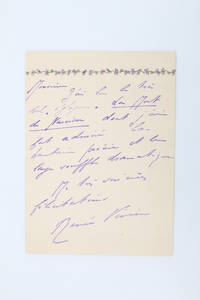
190479913s. l. Paris 1904. Fine. s. l. Paris s. d. ca 1904 11.50 x 16 cm une page sur un double feuillet Handwritten signed letter addressed to the poet Jean-Marc Bernard: I read the very beautiful eclogue La Mort de Narcisse whose haughty poetry and dramatic breath I admired very much. Paris ca 1904 11.5 x 16 cm one page on a double leafHandwritten signed letter from Renée Vivien addressed to Jean-Marc Bernard written in violet ink on a double leaf of paper decorated at the head with a border of violets. Transverse folds from having been sent. Monsieur J'ai lu le très bel ""églogue"" La Mort de Narcisse dont j'ai fort admiré la hautaine poésie et le large souffle dramatique. Mes très sincères félicitations. Renée Vivien. Monsieur I read the very beautiful eclogue La Mort de Narcisse whose haughty poetry and dramatic breath I admired very much. My very sincere congratulations. Renée Vivien. Jean-Marc Bernard was one of the founders of the poetic satirical and monarchist magazine Les Guêpes which welcomed contributions from Paul-Jean Toulet and Francis Carco among others. Together with the latter two he was part of the École fantaisiste a collective of young poets eager to break with the Parnassians and symbolists and whose ambitions were soon to be swept away by the arrival of the Great War. Jean-Marc Bernard lost his life on the front line destroyed by a shell at the age of thirty-three. unknown
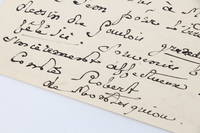
190783363New York: S. n. 1907. Fine. S. n. New York 4 février 1903 13.50 x 17.50 cm deux feuillets recto-verso Autograph letter signed by the dandy count 54 lines written in black ink on two leaves recto-verso addressed to his friend and bibliographer the critic Henri Lapauze: ""4 février Westminster hôtel New-York Cher monsieur et ami j'ai le plaisir de vous adresser ci-joint une copie manuscrite du salut d'ouverture qui servira de prélude de bienvenue à la première de mes conférences dont la date est fixée à demain. J'espère que vous ferez bon accueil à cet envoi de l'absent et le publierez en bonne place. Les documents ci-joints vous aideront à faire rédiger les lignes explicatives dont je vous demande d'accompagner l'article. Merci à vous à Mr Galdemar et à Sem pour son irrésistible dessin du Gaulois grandement fêté ici. Souvenir bien sincèrement affectueux. Comte Robert de Montesquiou. Je tiens à ajouter que je suis heureux de vous donner la primeur de ce document en témoignage et souvenir de nos bons rapports. J'ajoute que tout semble se disposer pour le succès de mon entreprise. Et vous connaissez assez les lois humaines mondaines et polémiques pour savoir que le tapage de presse accueillant ici les étrangers un peu notables ajoute à la curiosité de l'auditoire. J'espère ne pas trop la décevoir et ceci est le secret de demain. J'ai énuméré dans les pages que je vous adresse les raisons qui m'ont dicté le choix du sujet de ma première conférence. Je n'y reviens pas."" ""February 4th Westminster hotel New-York Dear Sir and friend I have the pleasure of sending you herewith a manuscript copy of the opening greeting which will serve as a welcome prelude to the first of my lectures the date of which is set for tomorrow. I hope you will give a good reception to this missive from the absent one and publish it in a prominent place. The enclosed documents will help you have written the explanatory lines I ask you to accompany the article with. Thank you to Mr Galdemar and to Sem for his irresistible drawing of the Gaulois greatly celebrated here. Most sincerely affectionate regards. Count Robert de Montesquiou. I want to add that I am happy to give you the exclusive rights to this document as testimony and remembrance of our good relations. I add that everything seems to be arranged for the success of my enterprise. And you know well enough the human worldly and polemical laws to know that the press commotion welcoming rather notable foreigners here adds to the audience's curiosity. I hope not to disappoint it too much and this is tomorrow's secret. I have enumerated in the pages I am sending you the reasons that dictated my choice of subject for my first lecture. I will not return to this."" Small pin holes that held the two leaves together. S. n. unknown
190574262s. l.: S. n. 1905. Fine. S. n. s. l. s. d. circa 1905 15 x 19 cm trois pages sur une double feuille Autograph letter signed by the dandy count three pages 27 lines written in black ink to his friends the Lapauzes that he is delighted to see them again soon even if they impose upon him the presence of a certain Sarah who is not among the people the poet seems to appreciate: ""Dear friends I will not do you the affront of not telling you that I would have preferred just the two of you alone"" words underlined but as the beautiful verse says: You do what you do / What you do is right."" For this meeting arranged at the Petit Palais of which Henry Lapauze becomes curator in 1905 after having been assistant director for the four preceding years Robert de Montesquiou ""a late riser who has the cowardice - or if you prefer the wisdom to choose the afternoon"" timidly expresses in a surge of wounded pride and revenge that he already regrets the possibility of his absence: "".only a throat irritation carelessly treated and unexpectedly could keep me away at the last moment. But I don't want to believe it. Let us arrange ourselves around Sarah!"" Henry Lapauze 1867-1925 was a journalist art critic then in 1905 curator of the Petit Palais converted four years earlier into a museum and whose collections he considerably enriched by acquiring notably the Courbet Henner Falguière collections with at the twilight of his life a marked predilection for the Decorative Arts of which he was one of the ardent promoters. S. n. unknown
189574321s. l.: S. n. 1895. Fine. S. n. s. l. s. d. circa 1895 12.50 x 17 cm deux pages et demie sur une feuille rempliée Autograph letter signed by the dandy count of two and a half pages 27 lines written in black ink insisting to his friend Henry Lapauze then journalist at Le Gaulois to see published a note he had sent him as well as the project of an interview with a certain Monsieur Lavé and the related arrangements: "". je suis persuadé que vous trouverez l'un comme l'autre intérêt et plaisir à l'entretien projeté. Vous pouvez agir directement en vous recommandant de moi."" "". I am persuaded that you will both find interest and pleasure in the projected interview. You can act directly recommending yourself through me."" Finally Robert de Montesquiou wishes to discuss with Madame Lapauze: "". un bien précieux recueil dont je veux lui parler comme il le mérite à savoir posément et passionnément."" "". a very precious collection of which I want to speak to her as it deserves that is to say calmly and passionately."" that she had sent him. Henry Lapauze 1867-1925 was a journalist art critic then in 1905 curator of the Petit Palais converted four years earlier into a museum and whose collections he considerably enriched by acquiring notably the Courbet Henner Falguière collections with at the twilight of his life a clear predilection for the Decorative Arts of which he was an ardent promoter. S. n. unknown
195662720s. l. 1956. Fine. s. l. 2 juin 1956 21 x 27.10 cm 2 pages sur un feuillet Autograph letter signed by Roland Barthes written in blue ink. Date at the top of the letter and signature at the bottom of the letter. Folds caused by mailing.Roland Barthes sends this letter to his correspondent to warn him that he has decided to give ""three pages of his intervention"" to Hollerer founder of the German magazine Akzente and that following his refusal of an article addressed to the addressee he afraid that it will upset him. He explains in the letter saying that these pages are not really developed but also that it ""dreads the German audience less"". 1956 is the year of the writing of the Mythologies of Barthes which appear at Seuil in 1957. unknown
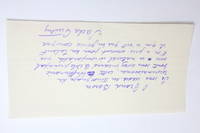
191073656s. l. 1910. Fine. s. l. s. d. 20.70 x 10.60 cm une feuille Autograph note signed by Sacha Guitry to the actor Louis Bouchené known as Baron fils. 7 lines in blue ink on ""Basseau Strong"" watermarked paper. ""O Grand Baron. Je vous dédie en témoignage de reconnaissance cette bouffonnerie dont vous avez incarné le rôle principal avec ce naturel incomparable que l'on a pris souvent pour du talent et qui n'est que du génie comique"". ""O Great Baron. I dedicate to you in token of gratitude this buffoonery in which you embodied the leading role with that incomparable naturalness which has often been mistaken for talent and which is nothing but comic genius"" The actor Baron fils embodied numerous roles in Sacha Guitry's plays notably La Prise de Berg-op-Zoom La Pèlerine écossaise L'Illusionniste Deburau Le Mari la Femme et l'Amant Nono and Faisons un rêve. unknown
28345Confidant of Missouri pioneer Jonathan Bryan 1759-1846 of the noted St. Charles family whose relatives included their neighbor Daniel Boone. DS 1p 7½" X 12" St. Charles County MO 1847 February 2. Near fine. Acknowledgment that Tuter who signs himself as "Administrator of the Estate of Johnathan Bryan" has had a writ of replevin made out and issued to the St. Charles sheriff Edward C. Cunningham 1809-65 for delivery to an unnamed offender. The writ seeks to recover the following property apparently wrongfully taken from Jonathan Bryan's estate: "one negro man a Slave named Heney one Two horse waggon and one pair of Briches Two Black horses one Lorrel horse with bold face one walnut Cupboard one clock one Bureau one bedstead and bedding one walnut Table one Trunk one Bible." In other words everything but the kitchen sink. Signed at the conclusion by Tater in his definitely untutored hand. Tales of slaves are found in the Bryan family lore such as: "Mrs. Jonathan Bryan a kinswoman of Daniel Boone was working in her yard with a slave woman when a boy slave screamed. She saw an Indian warrior heading for them with a tomahawk in one hand and a gun in the other. The women ran for the house. Just as they were slamming the door they caught the warrior's head and right arm between the door and facing. The slave woman grabbed the hatchet from his hand and killed him with a sharp blow. The women had barely recovered from their fright when the boy shouted again." Could the slave boy in this old family legend by none less than the "Slave named Heney" whose return is demanded in this replevin suit Quite unusual slavery item with an intriguing history. unknown
39656This Russian-born American composer ended up in France after the Russian Revolution where he performed and composed prolifically -- symphonies orchestral pieces piano concertos operas ballet and choral music; post-WW2 he emigrated to Chicago where he taught and composed. Remarkably beautiful ALS 1p 6" X 11" Vanves France n.y. likely early 1930s. Near fine. On a lovely heavy tannish tissue paper Tcherepnine pens in his usual miniscule script and black ink a note to unidentified "Cher ami" in French referring to the first performance of his new work "Suite georgienne" and the Salle de l'ancienne Conservatoire in Paris; he switches to English briefly near the close when noting trying to reach someone by telephone "but was unsuccessfull!" This handsome note occupies only a small central portion at the right margin much of this sheet being filled with an extraordinary partly hand-drawn and partly inkstamped color drawing presumably Japanese depicting a monkey descending the branches of a tree bearing numerous orange flowers against a pale blue background. Wonderfully executed in pale soft colors. At lower right and lower left are small inkstamped insignias that we assume indicate the artist. A truly exceptional letter from the young composer. unknown
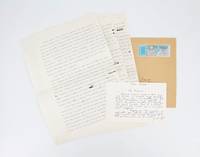
198583170Paris 1985. Fine. Paris 24 octobre 1985 14.50 x 10.50 cm quatre feuilles une enveloppe Autograph letter signed on a Bristol card by Julien Gracq 15 lines in black ink addressed to journalist Jean-Claude Lamy regarding the text of an article for which he gives his approval and an album of photographs concerning another writer. Apart from a few modifications he intends to make notably on the fact of not being photographed even by Robert Doisneau he authorizes the publication of this interview. We include the envelope addressed by Julien Gracq from his Parisian home. We also include the text of three pages of the article with corrections and crossings-out by Jean-Claude Lamy and four modifications and corrections in Julien Gracq's hand. A few letters have smudged without consequence a handsome copy. ""Paris 24 octobre Cher monsieur. Merci de m'avoir soumis le texte que je vous retourne : il correspond en gros aux propos tenus et je ne vois à vous soumettre que deux ou trois formulations un peu différentes. Je regarde avec plaisir les photos de l'album que vous l'aimable pensée de m'adresser : il s'agit là d'un écrivain qui ne m'a jamais laissé indifférent. Rappelez vous notre conversation : une seule photo pour illustrer votre texte j'aurais préféré"" aucune ! malgré le talent très grand de Robert Doisneau Avec mon bon souvenir. J. Gracq."" ""Paris 24 October Dear sir. Thank you for submitting the text which I return to you: it corresponds roughly to the remarks made and I see only two or three slightly different formulations to submit to you. I look with pleasure at the photos in the album which you had the kind thought to send me: this concerns a writer who has never left me indifferent. Remember our conversation: only one photo to illustrate your text I would have preferred none! despite Robert Doisneau's very great talent With my kind regards. J. Gracq."" unknown
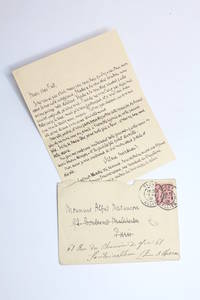
190673674Vichy 1906. Fine. Vichy 10 août 1906 11.60 x 18 cm une feuille Moving autograph letter signed by Octave Mirbeau addressed to the playwright and founder of the Revue Blanche Alfred Natanson when he had just lost his father. 18 lines in black ink on a folded sheet envelope included. ""Mon cher Fred Je ne vous ai pas écrit ; mais vous savez bien qu'il n'y a pas dans mon cur la moindre indifférence. Thadée a dû vous dire combien nous avions partagé votre douleur. Thadée a dû vous dire souvent quelle amitié profonde j'ai pour vous. Peut-être ne vous l'ai-je pas exprimée telle que je la sens mais je la sens fortement et je voudrais bien que vous la sentiez aussi un peu. C'est un gros chagrin que de ne plus être aimé de ceux qu'on aime véritablement. Vous allez partir ; et vous faîtes bien de quitter cette maison où durant plus de six mois vous avez assisté à l'horrible agonie de votre pauvre père. Tâchez de travailler pour notre joie à tous. et revenez avec une belle uvre."" ""My dear Fred I have not written to you; but you know well that there is not the slightest indifference in my heart. Thadée must have told you how much we shared your grief. Thadée must have told you often what deep friendship I have for you. Perhaps I have not expressed it to you as I feel it but I feel it strongly and I would very much like you to feel it too a little. It is a great sorrow to no longer be loved by those one truly loves. You are going to leave; and you do well to quit this house where for more than six months you witnessed the horrible agony of your poor father. Try to work for all our joy. and return with a beautiful work."". Mirbeau was particularly close to the group of the Revue Blanche since its launch in Paris in 1891. But it was since the Dreyfus affair that his intimate and lasting friendship with the Natanson brothers Thadée Alexandre and Alfred was strengthened. After aesthetic disagreements about Art Nouveau and the Nabis Mirbeau finally reunited with Thadée around 1900 in a now common inclination for the young Nabis painters of the Revue Blanche Bonnard Vallotton and Vuillard. The Revue Blanche played an essential role in France as confirmed by historian Paul-Henri Bourrelier: ""Most of the most prominent writers painters musicians politicians and intellectuals of the late 19th and early 20th centuries collaborated with it or were associated with it. Created financed and directed by the three Natanson brothers young Polish Jews with the enthusiastic complicity of their classmates from the Condorcet lycée La Revue blanche quickly became a place of debate on all subjects that stirred France. It waged political battles under the impulse of anarchists like Fénéon Mirbeau; socialists such as Blum G. Moch Péguy; Dreyfusards and founders of the League of Human Rights like Reinach and Pressensé."" unknown
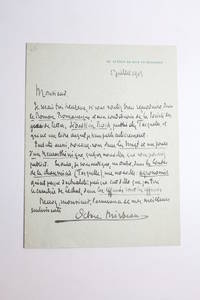
190373704s. l. Paris 1903. Fine. s. l. Paris 1er Juillet 1903 13.80 x 18.30 cm une feuille Autograph letter signed by Octave Mirbeau addressed presumably to Léon Tonnelle director of the review Le Roman Romanesque. 12 lines in black ink on a folded sheet grey paper with letterhead ""68 avenue du bois de Boulogne"". ""Monsieur je serais très heureux si vous vouliez bien reproduire dans Le Roman Romanesque et aux conditions de la Société des gens de lettres Sébastien Roch publié chez Fasquelle et qui est un livre auquel je tiens particulièrement. Peut-être aussi trouverez-vous dans Les vingt et un jours d'un neurasthénique quelques nouvelles que vous pourriez publier. En outre je vous indique en outre dans Les Contes de la Chaumière Fasquelle une nouvelle : Agronomie qui est presque d'actualité puisque c'est d'elle que j'ai tiré le caractère de Lechat dans Les Affaires sont les affaires. ."" ""Sir I would be very happy if you would kindly reproduce in Le Roman Romanesque and under the conditions of the Société des gens de lettres Sébastien Roch published by Fasquelle and which is a book to which I am particularly attached. Perhaps also you will find in Les vingt et un jours d'un neurasthénique some short stories that you could publish. Furthermore I also indicate to you in Les Contes de la Chaumière Fasquelle a short story: Agronomie which is almost topical since it is from this that I drew the character of Lechat in Les Affaires sont les affaires. ."". Octave Mirbeau published his novel Le Calvaire in issue 8 of the review le Roman Romanesque published in December 1903. The titles mentioned in the letter were ultimately not published. unknown
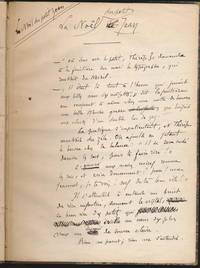
34183This well-known French poet novelist and playwright was elected member of the Académie française in 1909; his home at La Garde on the French Riviera is now a museum. AMS 20pp rectos only. 8" X 10 3/4" n.p. n.y. ca. 1890. Very good to near fine. Custom bound in half grey cloth with gilt spine lettering and marbled paper over boards. Binding is very good showing mild edgewear. Holograph manuscript for "La Noel du petit Jean" penned boldly in black ink on heavy stock leaves and boldly signed at the conclusion. Clearly a working draft for it contains crossouts insertions and corrections throughout. Apparently this was a novel for the journal "Bulletin Bibliographique" and other scholarly sources of 1890-91 list an Aicard work by this title one even noting 754 pages -- though perhaps these are lists of works in progress for no published novel by this title can be found. To confuse matters further the gilt title of this bound manuscript notes "1909" although this could be an error or simply the year this was bound. After the closing signature on the final leaf Aicard pens the address of the "journal le Figaro" in Paris. An intriguing manuscript worthy of further research. unknown
36383This colorful and legendary steamboat captain pioneered steamboating on the upper Mississippi River in the mid-19th century; he was first president of the Galena Dubuque and Minnesota Packet Company and founded the city of Winona Minnesota. Partly-printed DS 1p 8" X 10" Chicago IL 1871 January 1. Very good. Faint age toning; paper loss approx. 3½" X 2" at upper left corner affecting portion of printed text but not holograph portion. Printed "Judgment Note" promissory note acknowledging that Smith owes Nathan Corwith five thousand dollars at ten percent annual interest. Signed boldly twice by Smith. Verso bears docket penned and signed WILLIAM R. ROWLEY 1824-86 one of Galena's famous nine generals and at this date the circuit clerk; this native New Yorker enlisted as a first lieutenant in Company D of the 45th Illinois Volunteers in 1861 promoted to captain in 1862 and lieutenant colonel in 1864 and finally named brevet general; he fought at Fort Donelson Shiloh and Vicksburg; in 1864 he was named military secretary on General Grant's staff. Accompanied by a second larger 8½" X 14" Partly-printed Document Signed Chicago IL 1871 n.d. Very good. Printed "Narr. and Cognovit" literally Complaint and Confession legal document in which the top two-thirds the Narration portion consists of plaintiff Nathan Corwith referring to the promissory note just described of defendant Orrin Smith and demanding payment signed by Corwith's attorney M.M. Miller and the lower third the Cognovit portion consists of Smith's attorney Edward A. Small acknowledging same -- all couched in delightfully archaic and convoluted legalese of course. Verso of this document too bears a docket penned and signed by William R. Rowley. M.M. MILLER - was a noted Galena Illinois attorney who left Yale University to return home and join the famous Washburne Lead Mine Regiment during the Civil War; he was made commander of a colored regiment the 9th Louisiana Regiment in which every man was wounded or killed in the famous June 7 1863 Battle of Milliken's Bend part of the Vicksburg Campaign. EDWARD A. SMALL 1829-82 was another noted Galena attorney though in 1869 he relocated to Chicago. Plaintiff NATHAN CORWITH 1819-89 was a noted Galena pig lead broker clothier and then head of a prominent banking family that founded the Bank of Galena which he served as president. Why Captain Smith borrowed $5000 a huge sum of money in 1871 from Corwith is unknown though it's a reasonable assumption that it involved river commerce in some way -- perhaps purchase of another packet boat An intriguing and scarce pair in any case involving and signed by a number of prominent northwest Illinoisans. Documents signed by Captain Smith are rarely encountered. unknown
185600JT68France 1856. Large archive of handwritten letters dates ranging from 1848 to 1869 but most in the mid-50s addressed to important French nobleman the Marquis de Beaumont. Most are of a personal nature intimate nature: Leopold de Carayon writes with humour: "If you are lying I will catch you my old friend.and this Pauline who supposedly is holding you back from coming I will make her pay!.Come see me soon." Beaumont's godson writes other nobility and there is one letter of condolence regarding the Marquis' mother's death. A certain concierge in Paris also writes of some intrigue. Very very interesting archive showing an intimate glimpse of French nobility. Autograph. Manuscript. Very Good. 4to - over 9¾" - 12" tall. Paperback
18833787bx123<p>Boston: Lee And Shepard. NY: Charles T Dillingham. Fair/ndj. 1883. First Edition. Hardcover. Brown cloth gilt. Tipped-in b/w photo frontis portrait hand-signed by the author: "Nancie A. W. Priest". With waterstain to boards and top edge of the first 200pp. Pulling at front hinge but holding.; 12mo 7" - 7½" tall; 391 pages; Signed by Author. bx133</p><p>Wikipedia: She was born at Royalston Massachusetts in 1836. She worked in a mill in New Hampshire for several years.2 Her fame rests upon the popular poem "Over the River" published in the <em>Springfield Republican</em> in 1857. According to some accounts she wrote the first draft of the poem while at work in the mill.23</p><p>In 1865 she was married to Lieut. Arlington C. Wakefield. She died at Winchendon Massachusetts in 18704 leaving behind her husband and three children one only an infant.</p><p>Her poems were published 13 years after her death by her mother Mrs. Francis D. Priest with a memoir by the Rev. Abijah Perkins Marvin Boston 1883.</p><p>Her poem entitled "Over The River" carried her name to wherever the English language was read. In the many years since publishing the poem 1857 it has been set to music by six to eight different composers and was included in Volume 111 of "The Worlds Best Poetry" 1904. Upon the death of President Lincoln she wrote a hymn that was sung to the tune of "America" by over 800 at a memorial service held in the Town Hall.<br /><br />A volume of her poems were published by her mother in 1882 entitled "Over the River and other Poems" with forward by A. P. Marvin who said "there are some specimens of poetry in this collection which bear the stamp of genius".</p> Boston: Lee And Shepard. NY: Charles T Dillingham hardcover
31141Austrian-born associate justice of the U.S. Supreme Court 1939-62; helped found American Civil Liberties Union. Partly-printed DS 1p 8½" X 11" Cambridge MA 1919 September 29. Very good. Slight smearing of signature. Small chips at two corners not affecting text. Updating form sent out by "Who's Who in America" for its 1920-21 edition on light orange paper with Frankfurter's 3" X 1½" biographical entry from the previous edition affixed onto the blank center area. Frankfurter has written in two small additions "assistant to the Secretary of Labor" and "appt'd. chmn. War Labor Policies Bd. June 1918" signing and dating it at the bottom. Several editor's marks and corrections in purple ink. Comes with a fine -- and itself scarce -- 1947 news agency photograph International News Photo of a seated Frankfurter feet not touching the floor! along with Bernard Baruch and others receiving an honorary degree from City College of New York. Original mimeographed caption sheet present. unknown
32194This English-born American bookseller and publisher was controversial during the American Revolution for his suspected Tory sympathies especially since he published the "New York Gazetteer" even returning to England briefly early during the war; but it's believed he was actually a spy for the Americans and smuggled messages to General Washington printed on thin paper bound into the covers of books. ADS 2pp separate leaves 7 3/4" X 6" and 7 3/4" X 7½" New York NY 1789 September 10-11. Very good. Mild bit of age toning slight bit of soiling. First leaf in Rivington's hand records a real estate transaction verbatim with line breaks included: "James Rivington & wife / to / Benj: Moore / deed & Release Sept: 10 & 11 1789. / Recd. -- Lib:45. p529 -- & Lib:46. p221. -- / 16 ac. 2 roads & 32 paas.-- Between Green- / -wich Road & the River -- South of / Mary Clarke's land. --" The second leaf in another and neater hand notes: "Abstract of Title to two Lots of Ground on the North-Easterly side of Twenty first Street in the 12th Ward of the City of New York distinguished on the plot beneath by the numbers 1 & 2." Below this is a well-drafted plat map showing land parcels between "9th Av." at left "8th Ave." at right "22d St" at top and "21. St." at bottom -- with the two lots in question here neatly marked "1" and "2" in the lower right area of this block. The purchaser here was Bishop BENJAMIN MOORE 1748-1816 the second bishop of the Episcopal Diocese of New York and president of Columbia College -- best remembered as the father of Clement C. Moore 1779-1863 the scholar who penned the immortal poem "A Visit from St. Nicholas" in 1823. Bishop Moore and his son owned a number of properties in this area mostly in the Chelsea Historic District slightly north of the two lots he purchased from Rivington. A scarce document with interesting connections. Accompanied by a superb and itself scarce vintage steel-engraved portrait heavy stock 7" X 10½" n.p. n.y. mid-19th century. Fine. A bold and handsome head-and-shoulders portrait of Rivington gazing intently at the viewer looking rather like Washington himself engraved by A.H. Ritchie. unknown
18720British composer. AMuQS 3½pp 13" X 9½" Frankfort Germany 1853 July 31. Inscribed "to his friend Kapel Meister Schlösser by the Author" at the conclusion and signed on the first page. Very good. Large picturesque extract from "Romance pour le Piano" Opus 23. unknown
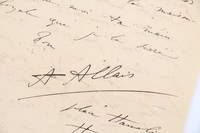
189588099Honfleur: s. n. 1895. Fine. s. n. Honfleur s.d. ca 1895 14 x 22 cm une page recto verso Autograph letter signed addressed to a journalist friend at Figaro illustré 28 lines in black ink. Fold mark inherent to envelope insertion a lack to upper corner of the letter without any damage to the text. Alphonse Allais must do a favor for his friend: ""Un peu de patience mon cher Abel un peu de patience. Sitôt rentré à Paris ma première démarche sera pour ton parapluie que je choisirai en soir gorge-pigeon et manche d'argent."" A little patience my dear Abel a little patience. As soon as I return to Paris my first errand will be for your umbrella which I will choose in pigeon-throat evening silk with a silver handle.; he therefore also allows himself to solicit the kindness of his correspondent: ""Et bien envoie-moi le n° du Figaro illustré d'il y a un mois ou deux où il y avait des choses de Toulouse-Lautrec."" Well then send me the issue of Figaro illustré from a month or two ago where there were things by Toulouse-Lautrec. He concludes his letter with a sententious: ""Donne-moi ta main loyale que je la serre. Ton Alphonse Allais. Bonjour aux amis."" Give me your loyal hand so I may shake it. Your Alphonse Allais. Greetings to friends. s. n. unknown