Antoine Augustin PARMENTIERBiblio.com
1 815 résultats
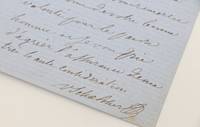
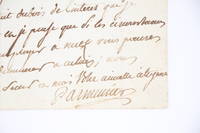
179577420Paris 1795. Fine. Paris 3ème frimaire an 4ème de la République 24 novembre 1795 17.20 x 22.70 cm une page sur un double feuillet Autograph letter signed by Antoine Augustin Parmentier addressed to citizen Chely chief pharmacist of the military hospital of Calais. Transverse folds inherent to the mailing and small paper loss due to the unsealing of the missive. ""Je suis fâché mon cher camarade que le Cen Citoyen Lavoisier m'ait envoyé un pâté sans doute dans l'intention de m'intéresser en faveur de son fils ; mais je dois vous assurer que les présents me tiédissent plutôt encore sur le compte de ceux qui m'en font au reste j'enverrais au jeune homme des livres pour la valeur du pâté ."" ""I am sorry my dear comrade that Citizen Lavoisier sent me a pâté undoubtedly with the intention of interesting me in favor of his son; but I must assure you that gifts rather cool me towards those who give them to me moreover I would send the young man books for the value of the pâté ."" An amusing letter evoking a namesake of the great physicist executed the previous year without having left any descendants. unknown
1826774711826. Fine. 1826 18.50 x 24 cm une feuille rempliée Autograph letter signed addressed to the painter Jean-Pierre Granger and dated April 24 1826 one page written in black ink with the correspondent's address on the verso. 15 lines in a beautiful slanted handwriting on a folded sheet. The celebrated Empire painter recommends to his colleague: ""a young man who seems very interesting to me and too young to enter my studio. Dear Grand Diable please do me the favor of taking good care of him in yours and when he has spent some time copying if it does not inconvenience you I will take him back with pleasure and well on his way."" Jean-Pierre Granger was first a pupil of Jean-Baptiste Regnault before joining Antoine-Jean Gros in Jacques-Louis David's studio. In 1800 he became laureate of the first Rome Prize for history painting with Antiochus renvoie son fils à Scipion Paris École nationale supérieure des beaux-arts while his fellow student Jean-Dominique Ingres received the second prize. unknown
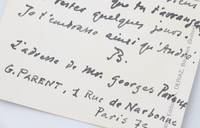
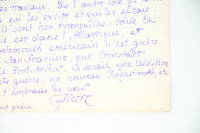
195383261Chassy 1953. Fine. Chassy 30 décembre 1953 9 x 14.50 cm une feuille Signed autograph postcard from Balthus addressed to gallerist Henriette Gomès 17 lines in black ink. A clear dampstain in the upper right margin of the postcard depicting a ski slope. ""Chassy le 30 XII 53 Ma petite Henriette comme il n'est pas impossible que mon petit mot de Rome ait été englouti par la pgrève je préfère pour plus de sûreté t'envoyer une nouvelle litanie de souhaits et de bons voeux d'ici où je suis rentré hier - Quand viens-tu J'espère que tu t'arrangeras popur rester quelques jours. Je t'embrasse ainsi qu'André. B. L'adresse de Georges Parent G. Parent 1 rue de Narbonne Paris 7e."""" ""Chassy December 30th 53 / My dear little Henriette / as it's not impossible that my little note from Rome was swallowed up by the strike I prefer for greater safety to send you a new litany of wishes and good wishes from here where I returned yesterday - When are you coming I hope you'll arrange to stay a few days. I embrace you as well as André. B. Georges Parent's address G. Parent 1 rue de Narbonne Paris 7th."" ""During the summer of 1952 Balthus found a château in the Nièvre between Autun and Avallon which he decided to rent and where he settled in the spring of the following year. The means were provided by his dealers Henriette Gomès Pierre Matisse and with them a group of collectors including Maurice Rheims Alix de Rothschild and Claude Hersent. They paid him a pension in exchange for his latest paintings which they divided among themselves. The château was severely deteriorated and Balthus lived there modestly in continual restoration work. He had for company to help him settle in and ensure a presence when he went to Paris the poet Léna Leclercq met through Giacometti. She remained until spring 1955. Meanwhile Balthus had begun a love affair with his niece by marriage Frédérique Tison daughter of a previous union of his brother Pierre's wife."" Fondation Balthus unknown
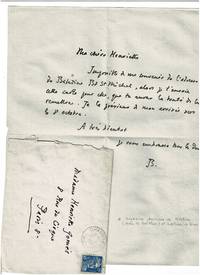
195375938Chaumard 1953. Fine. Chaumard juillet 1953 21.80 x 27.90 cm une page sur un feuillet Signed autograph letter from Balthus addressed to gallerist Henriette Gomès. One page written in black ink on a sheet envelope attached. Transverse fold marks inherent to mailing. ""Impossible to remember Baladine's address on Bd St Michel."" Baladine is the nickname of Merline Klossowska Balthus's mother who was also Rilke's mistress. ""During the summer of 1952 Balthus found a château in the Nièvre between Autun and Avallon which he decided to rent and where he settled in the spring of the following year. The means were provided by his dealers Henriette Gomès Pierre Matisse and with them a collective of collectors including Maurice Rheims Alix de Rotschild and Claude Hersent. They paid him a pension in exchange for his latest paintings which they distributed among themselves. The château was severely deteriorated and Balthus lived there modestly in a continual renovation site. He had for company to help him settle in and ensure a presence when he went to Paris the poet Léna Leclercq met through Giacometti. The latter remained until spring 1955. Meanwhile Balthus had begun a romantic relationship with his niece by marriage Frédérique Tison daughter of a previous union of his brother Pierre's wife."" Fondation Balthus unknown
196183260Rome Rome 1961. Fine. Rome Rome s. d. circa 1961 22 x 27.50 cm une page sur un feuillet Signed autograph letter from Balthus addressed to gallerist Henriette Gomès. One page written in black ink on letterhead of the Académie de France in Rome of which Balthus was appointed director by André Malraux in 1961 13 lines. Transverse folds inherent to mailing two small tears in left and right margins of the letter not touching the text pin marks in upper left margin of the letter the ink of certain words having faded. ""Ma petite Henriette imossible de me souvenir de l'adresse de Claude Hersent ni de celle de Lefebvre dont je ne trouve plus l'enveloppe. C'est donc à toi que j'envoie le papier ci-joint à remettre au personnage en question. - Quant aux dégats subis par mon tableau une fois la toile montée il n'y parait plus. Donc inutile de se lancer dans des correspondances à n'en plus finir. Je t'embrasse. B."" ""My dear little Henriette / impossible to remember Claude Hersent's address or that of Lefebvre whose envelope I can no longer find. So it's to you that I'm sending the enclosed paper to give to the person in question. - As for the damage suffered by my painting once the canvas is mounted it no longer shows. So no need to launch into endless correspondence. I embrace you. B."" ""During the summer of 1952 Balthus found a château in the Nièvre between Autun and Avallon which he decided to rent and where he settled in the spring of the following year. The means were provided by his dealers Henriette Gomès Pierre Matisse and with them a group of collectors including Maurice Rheims Alix de Rothschild and Claude Hersent. They paid him a pension in exchange for his latest paintings which they divided among themselves. The château was severely deteriorated and Balthus lived there modestly in continual restoration work. He had for company to help him settle in and ensure a presence when he went to Paris the poet Léna Leclercq met through Giacometti. She remained until spring 1955. Meanwhile Balthus had begun a love affair with his niece by marriage Frédérique Tison daughter of a previous union of his brother Pierre's wife."" Fondation Balthus unknown
190885175Toulon 1908. Fine. Toulon 4 Août1908 13.50 x 21.50 cm 16 pages sur quatre doubles feuillets une enveloppe Very long autograph letter signed by Claude Farrère approximately 260 lines in blue ink 16 pages on four double sheets to his friend Pierre Louÿs. Fold marks inherent to postal dispatch envelope included. Claude Farrère mentions the letter he received from his friend and the one he has just sent him: ""I was writing to you on that same Friday a blood-colored letter. a glowing letter devoid of all composure."" He returns with humor to the quarrel between Pierre Louÿs and a certain Augusto probably Auguste Babut de Rosan for which he thought himself responsible: ""Note well dear friend that I was persuaded deep down despite your mutual denials of my personal influence in your quarrel. Human vanity never misses such opportunities. And it is with some shame that I confess to having believed myself for two good days to be the pivot of the world."" Claude Farrère castigates his own candor and lack of discernment: ""Although I am as prudent as you know me to be I am constantly caught red-handed. . the young divorced woman I once showed you at the cinema had the imprudence to arrange to meet me in deserted streets. the child's father a senior officer as befits encountered us there."" sensing that this naivety will eventually play tricks on him: "". it will end badly. I practice fencing every time I think about it."" Since he has just received his friend Pierre Louÿs's missive he continues writing his letter to respond to him and is astonished by what he has just read: ""So when four or five days later I find your first telegram 'am quarreling' with - for a reason you can guess."" I remain stupefied and rack my brain in vain. Having not guessed I suppose. I suppose wrongly. Bewilderment. I received last week seventy-five letters of which about twenty concerned you closely or distantly."" In this tangle of bruised and torn friendships Claude Farrère also describes the great dismay of another of their mutual friends a certain V who finally enlightens the writer about the misunderstanding opposing Louÿs and Babut de Rosan: ""Thereupon sudden change in V. He was more than struck. I saw him on the verge of suicide. He immediately pulls himself together regains his composure jumps on a train. And while waiting for departure time he resumes his account. and I understand."" Here Claude Farrère is almost relieved and reassured: ""Now I believe I have understood. Not quite everything. That I meddled in what did not concern me. I ask your pardon for it my friend and beg you to forget it. Your affection is so dear to me that I would be abominably unhappy to feel it cooled even by a single degree! Tell me if I must fear this and tell me so in earnest."" but still as sad for Augusto: ""Augusto is at this moment almost mad with grief because he believes your friendship lost to him. I deeply pity this poor child."" A very fine letter symbolizing the torments of the tumultuous friendships in Pierre Louÿs and Claude Farrère's circle. unknown
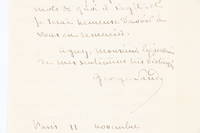
186478465Paris 1864. Fine. Paris s. d. entre 1864 et 1868 13.40 x 20.70 cm 2 pages sur un double feuillet Autograph letter signed addressed to an unknown correspondent written in black ink on a double leaf with dry stamp bearing the writer's initials. This letter probably unpublished was written on ""November 11th"" between 1864 and 1868 according to the address at the bottom: ""rue des feuillantines 97"". ""Une amie commune et pleine de confiance en votre bonté me fait espérer monsieur que vous m'accorderez un peu de sympathie. Si je suis indiscrète d'y croire ne vous en prenez qu'à elle comme elle est de ces personnes à qui l'on ne peut en vouloir je ne crains pas de vous la dénoncer. Vous pouvez vendre un immense service au fils de mon ami d'enfance. Le voudrez-vous quelque difficile que la chose puisse être Elle ne l'est peut-être pas je ne sais pas. Mais si elle l'est j'espère quand même depuis ce que Madame de Voisins me dit de vous. ."" ""A mutual friend full of confidence in your kindness gives me hope sir that you will grant me some sympathy. If I am indiscreet to believe it blame only her as she is one of those persons one cannot hold a grudge against I do not fear to denounce her to you. You can render an immense service to the son of my childhood friend. Will you do so however difficult the matter may be Perhaps it is not difficult I do not know. But if it is I still hope so from what Madame de Voisins tells me about you. ."" unknown
195064369s. l. 1950. Fine. s. l. s. d. 18 x 21.50 cm un feuillet Signed autograph letter of Gus Bofa to one of his acquaintances 16 lines in purple ink accompanied by a pencil drawing. Folding inherent in the enveloping tear without lack in the drawing. Addressed to a friend of Gus Bofa and his wife who seems to have suffered "" a long journey in the storm! ""The letter is imbued with the humor of its author:"" we add two good warm kisses to finish drying you off "". The missive is enriched with an original drawing of Gus Bofa representing two birds on a radiator one of which is written ""Spring has come! "" unknown
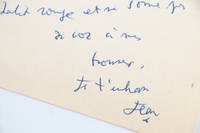
195388024Saint-Jean-Cap-Ferrat 1953. Fine. Saint-Jean-Cap-Ferrat 29 Août 1953 21 x 27 cm une page Autograph letter dated and signed by Jean Cocteau 26 lines in blue ink to Olivier Quéant editor of the magazine Plaisir de France sent from villa Santo-Sospir. Fold marks inherent to postal handling. Quéant journalist and notably editor of the magazine Plaisir de France maintained a fine friendly and literary correspondence with the writer. He notably delivered a glowing review of Antigone at its premiere in 1944: ""depuis Racine l'on avait rien écrit d'aussi beau d'aussi grand et d'aussi profondément humain"" since Racine nothing so beautiful so great and so profoundly human had been written L'Illustration. Jean Cocteau at the twilight of his life rebels and complains about his diminished and merely symbolic role in French theater of the 1950s. The second sentence of this letter will be taken up almost word for word in the famous verses of his longest poem Requiem 1962: ""Il est juste qu'on m'envisage / Après m'avoir dévisagé"" It is right that I should be considered / After having been stared at which will also serve as his epitaph. Despite official recognition Cocteau felt until his death ""méconnu inconnu invisible"" misunderstood unknown invisible Jean Cocteau sur le fil du siècle 2003 - a malaise masterfully expressed through these lines. ""Voilà plusieurs années que j'accepte d'être en secret mis à ma place et publiquement remis à ma place. Bref de n'être pas envisagé mais dévisagé. Il est beau de recevoir des lettres ""retournées"" où Anouilh me dit ""Sans vos pièces je n'aurais pas écrit une ligne des miennes"" et Giraudoux ""Rilke avait raison. Nos figures blanches à côté du hâle de tes séjours dans l'antiquité."" Il est beau d'être comme le Pisanelle - enterré sous les roses ."" For several years I have accepted being secretly put in my place and publicly put back in my place. In short not being considered but stared at. It is beautiful to receive ""returned"" letters where Anouilh tells me ""Without your plays I would not have written a line of mine"" and Giraudoux ""Rilke was right. Our pale faces beside the tan of your sojourns in antiquity."" It is beautiful to be like Pisanello - buried under roses . Interesting and touching missive from Cocteau with disordered and furious handwriting twisting and stretching in the manner of a calligram. unknown
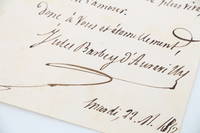
185284884s. l. 1852. Fine. s. l. 22 Mars 1852 13.50 x 20.50 cm une feuille Fine autograph letter dated and signed by Jules Barbey d'Aurevilly addressed to historian Jean-Marie Dargaud 13 lines in black ink. Creases inherent to folding for posting. Jules Barbey d'Aurevilly shows great tact towards his friend also expressing all his affection: ""Je veux vous épargner en allant sous peu de jours vous voir chez vous une course longue et peut-être inutile. On ne me voit que le matin et encore les trois premiers jours de la semaine. J'irai donc vous voir."" ""I want to spare you by going to see you at your home in a few days a long and perhaps unnecessary journey. I can only be seen in the morning and only on the first three days of the week. I will therefore come to see you."" unknown
191475566Grandcamp-les-Bains Grandcamp-Maisy 1914. Fine. Grandcamp-les-Bains Grandcamp-Maisy s. d. ca 1914-1920 13.50 x 21 cm une page sur un feuillet remplié Autograph letter signed addressed to a correspondent whom we have not been able to identify. Written from the Grand Hôtel de Grandcamp-les-Bains Calvados in blue ink on a folded sheet of white paper. A transverse fold inherent to the posting of the letter and four small perforations affecting the text but not impeding its reading. The mention of Grandcamp-les-Bains - where Aragon seems to have been only once during the summer of his seventeenth year - and the signature - of an early form - lead us to think that the letter could have been written in the summer of 1914. Philippe Forest in his biography of Aragon confirms that it was indeed at Grandcamp-les-Bains where his family had rented fifty rooms in a large seaside hotel to accommodate family and friends that the future poet learned the news of mobilization. The handwriting less rounded than on manuscripts prior to the 1920s however seems to us later and we are therefore not in a position to confirm the date of 1914. unknown
195483967Meudon 1954. Fine. Meudon 1954 21.20 x 26.10 cm une page sur un feuillet Autograph manuscript signed by Louis-Ferdinand Céline written in blue ballpoint pen on a sheet of white paper numbered 237 in the left corner. Some stains as well as a central fold of no consequence. Some pinholes in the upper margin evidence of the organization of Céline's manuscripts in ""bundles"". ""Y'en a un charlatant là-haut ! et terrible ! et vous le connaissez !. donc de dessous là ! de dessous la table je regarde le moulin. pas loin. peut-être deux cents mètres. et dans quel air éblouissant !. eh bien je vous dis comme je l'ai vu."" ""There's a charlatan up there! and terrible! and you know him!. so from underneath there! from under the table I look at the windmill. not far. maybe two hundred meters. and in what dazzling air!. well I tell you as I saw it."" The passage from our sheet conforms to the published version. Published in 1954 Normance is a direct sequel to Féérie pour une autre fois published two years earlier. The two parts were written during Céline's years of exile and imprisonment in Denmark. Upon his return to France in 1951 Céline undertook a work of ""polishing"" and published these two titanic texts independently originally conceived as one. ""Céline while working on it thought of this novel as a second Voyage au bout de la nuit capable twenty years later of astonishing the public as much as the 1932 novel."" Henri Godard unknown
184264434Italie Italy 1842. Fine. Italie Italy circa 1842 13.50 x 20.50 cm 4 feuillets rempliés Set of four letters from Napoleon-Jerome Bonaparte to the painter Geniole two are dated August 21 and December 12 1842 6 pages in brown ink recipient address on the back of the sheets two seals of the sender in part preserved. Folds inherent in envelopes. Some tiny tasks without affecting the text. unknown
189778160Paris 1897. Fine. Paris s. d. après 1897 13.80 x 9 cm une carte autographe recto et verso Autograph card by Pierre Louÿs signed with his initial addressed to Georges Louis and written in violet ink on both sides. Note addressed to his brother Georges Louis with whom Pierre Louÿs maintained a very intimate relationship and whom he considered as his own father. The question of Pierre Louÿs's real paternal identity still fascinates biographers today: ""His father Pierre Philippe Louis . had married in 1842 Jeanne Constance Blanchin who died ten years later after giving him two children Lucie and Georges. In 1855 he remarried Claire Céline Maldan and from this union was born in 1857 a son Paul; then in 1870 our writer who received the given names Pierre Félix. This late birth the differences in character between father and son the former's disaffection toward the latter the profound intimacy that always reigned between Louÿs and his brother Georges all this has led certain biographers and critics to suspect that the latter was in reality the writer's father. The exceptionally intimate and constant relationship that Pierre and Georges maintained between themselves throughout their lives could be an argument in this direction. Of course no irrefutable proof has been discovered and probably never will be. Nevertheless certain letters . are quite troubling. In 1895 for example Louÿs writes seriously to his brother that he knows the answer to 'the most poignant question' he could ask him a question he has had 'on his lips for ten years.' The following year in the full triumph of Aphrodite he thanks Georges effusively and ends his letter with this sentence: 'Not one of my friends has a FATHER who is for him what you are for me.' Arguing from the close intimacy of Georges and Claire Céline during the year 1870 and the jealousy that the father never ceased to show toward his younger son Claude Farrère did not hesitate to conclude in favor of Georges Louis. And what to think of this dedication by Louÿs to his brother on a Japan paper copy of the first edition of Pausole: To Georges his eldest son / Pierre."" Jean-Paul Goujon Pierre Louÿs Pierre Louÿs revolutionizes his living conditions: ""I am taking serious care of myself. For two days now I have been going to bed at half past midnight to wake up between 9 and 10. Today after a day that has already lasted 11 hours I have only smoked half a pack of cigarettes. That's a quarter of my usual consumption during the same time. Moreover I walked more than a league on foot I took the air as much as I could.Well with all that I feel quite unwell or rather as if I were the day after a long and serious illness. Neither strength nor nerves. I have trouble listening speaking following an idea. Should this be attributed to my cigarette rationing It's possible. But honestly I don't think I have felt so low since '97 since the month when you came to see me in Algiers."" Amusing note from the most tobacco-addicted of writers nearly 60 cigarettes per day.! who wrote in Une volupté nouvelle: ""One night as I found myself there in silent conversation with two blue porcelain cats crouched on a white table I hesitated to choose between two pastimes of solitude: write a regular sonnet while smoking cigarettes or smoke cigarettes while looking at the ceiling carpet. The important thing is to always have a cigarette in hand; one must envelop objects in a celestial and fine cloud that bathes lights and shadows erases material angles and by a perfumed spell imposes on the agitated mind a variable balance from which it can fall into reverie."" unknown
190777513Tamaris Tamaris-sur-mer 1907. Fine. Tamaris Tamaris-sur-mer 19 juin 1907 13.50 x 20.50 cm 4 pages sur un double feuillet Autograph letter signed by Pierre Louÿs addressed to Georges Louis. Four pages written in purple ink on a double sheet. Envelope included. Fine letter addressed to his brother Georges Louis with whom Pierre Louÿs maintained a very intimate relationship and whom he considered as his own father. The question of Pierre Louÿs's real paternal identity still fascinates biographers today: ""His father Pierre Philippe Louis . had married in 1842 Jeanne Constance Blanchin who died ten years later after giving him two children Lucie and Georges. In 1855 he remarried Claire Céline Maldan and from this union was born in 1857 a son Paul; then in 1870 our writer who received the first names Pierre Félix. This late birth the differences in character between father and son the first's disaffection toward the second the profound intimacy that always reigned between Louÿs and his brother Georges all this has led certain biographers and critics to suspect that the latter was in reality the writer's father. The exceptionally intimate and constant relationship that Pierre and Georges maintained between them throughout their lives could be an argument in this sense. Of course no irrefutable proof has been discovered and none will probably ever be discovered. Nevertheless certain letters . are quite troubling. In 1895 for example Louÿs writes seriously to his brother that he knows the answer to 'the most poignant question' he could ask him a question he has had 'on his lips for ten years.' The following year in the midst of Aphrodite's triumph he thanks Georges effusively and ends his letter with this sentence: 'Not one of my friends has a FATHER who is to him what you are to me.' Arguing from the close intimacy of Georges and Claire Céline during the year 1870 and from the jealousy that the father never ceased to show toward his younger son Claude Farrère did not hesitate to conclude in favor of Georges Louis. And what to think of this dedication by Louÿs to his brother on a Japan paper copy of the first edition of Pausole: To Georges his eldest son / Pierre."" Jean-Paul Goujon Pierre Louÿs Written from Tamaris where the writer is on vacation and attempting to buy Psyché this fine letter forms a veritable ode to literature and bibliophilia. Louÿs ""fills two pages of letter on this question"" and indeed writes: ""When I leave I always lock everything up so that my maids don't browse through my books in my absence which would be disastrous. I unfortunately have book titles that could sometimes tempt them. . What to do Leave you the keys I would certainly do so if I were leaving for six months but for a short absence. . I don't have duplicates and . the key to my study locks up my desk which is the soul of the house."" Georges very quickly transmitted to his brother the love of books and texts and the latter recalls here this profound spiritual communion: ""When I look at my library I constantly regret that you don't benefit from it more. I would always like to unite it with yours and that the day when your life is free you would only have to leave your bedroom to take from my place what you desire."" Although happy to take some leave he misses his brother: ""That's somewhat what prevents me from loving Biarritz it's that I see there a threat of such complete separation for us both. . I couldn't follow you there and I would only see you one or two months a year; that frightens me. My wish would be that we choose two small adjoining houses near Paris. . But it's not time to speak of it."" This sentimental reverie of a future together quickly gives way to a long passage concerning international politics and the game of European alliances. Georges is then Director of Political Affairs at the Quai d'Orsay and the two brothers naturally discuss this subject: ""The circle of alliances built in recent unknown
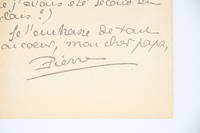
188977511Paris 1889. Fine. Paris jeudi 4 avril 1889 12.50 x 20 cm 4 pages sur un double feuillet Autograph letter signed by Pierre Louÿs addressed to his father four pages written in black ink on a double sheet of white paper. Transverse folds inherent to folding for mailing. This letter was sent by the young Pierre Louÿs while he was studying at the Janson-de-Sailly lycée Paris - 16th arrondissement. This is very likely one of Pierre Louÿs's last letters to his father ten days before the latter's death: ""Do you know that in less than two weeks I will be beside you . May I hope that by then you will have regained some strength"" The question of Pierre Louÿs's real paternal identity still fascinates biographers today: ""His father Pierre Philippe Louis . had married in 1842 Jeanne Constance Blanchin who died ten years later after giving him two children Lucie and Georges. In 1855 he remarried Claire Céline Maldan and from this union was born in 1857 a son Paul; then in 1870 our writer who received the first names Pierre Félix. This late birth the differences in character between father and son the first's disaffection toward the second the profound intimacy that always reigned between Louÿs and his brother Georges all this has led certain biographers and critics to suspect that the latter was in reality the writer's father. The exceptionally intimate and constant relationship that Pierre and Georges maintained between them throughout their lives could be an argument in this sense. Of course no irrefutable proof has been discovered and none will probably ever be discovered. Nevertheless certain letters . are quite troubling. In 1895 for example Louÿs writes seriously to his brother that he knows the answer to 'the most poignant question' he could ask him a question he has had 'on his lips for ten years.' The following year in the midst of Aphrodite's triumph he thanks Georges effusively and ends his letter with this sentence: 'Not one of my friends has a FATHER who is to him what you are to me.' Arguing from the close intimacy of Georges and Claire Céline during the year 1870 and from the jealousy that the father never ceased to show toward his younger son Claude Farrère did not hesitate to conclude in favor of Georges Louis. And what to think of this dedication by Louÿs to his brother on a Japan paper copy of the first edition of Pausole: To Georges his eldest son / Pierre."" Jean-Paul Goujon Pierre Louÿs Pierre Louÿs was only nine years old when his mother died suddenly. The father from then on entrusted his education to his brother Georges twenty years his senior and Pierre then joined him in Paris where he attended the École Alsacienne then the Janson-de-Sailly lycée. Despite the little affection shown to him the young man writes every week to his ""dear papa"" residing at Dizy-Magenta near Épernay. The young man inquires about his poor health: ""May I hope that by then you will have regained some strength No doubt. Your eczema we hope will not have worsened; and the green leaves that are beginning to appear will perhaps give you hope yourself for improvement next summer."" The ""improvement"" would sadly never come and Pierre Philippe Louis would breathe his last on April 14 1889. In the meantime Pierre Louÿs gives family news more precisely about Germaine his sister Lucie's daughter: ""Today I went to rue de la Santé to get news of Germaine. I found the little one who had been operated on in very good condition very cheerful and in good health. She was up and playing on the floor. . Finally I ended my day by going to my aunt Marie's and to Elisabeth's. Everyone is well in both houses."" As usual always anxious not to disappoint his father he finally transmits his school results: ""I return to the lycée tomorrow did Georges tell you that I was second in English"" unknown
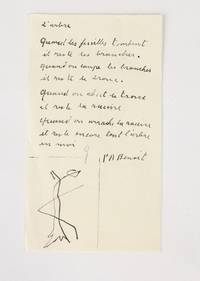
195064370s. l. 1950. Fine. s. l. s. d. 6 x 10.50 cm un feuillet Unpublished autograph poem signed by Pierre-André Benoit entitled « L'arbre » 9 lines in black ink with a drawing of a tree. unknown
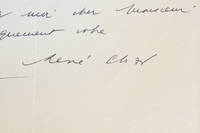
194762727L'Isle-sur-la-Sorgue 1947. Fine. L'Isle-sur-la-Sorgue 2 novembre 1947 21 x 26.90 cm 1 page sur une feuille Autograph letter signed by René Char of 11 lines written in black ink. Folds inherent to the mailing. René Char wrote this letter to René Wintzen editor-in-chief of the magazine Documents from 1929 to 1931. René Wintzen then began to publish a literary magazine Vent debout from which he sent Char a copy. The poet encourages him and tells him to persevere while ""discriminating the wheat from the chaff . "" René Char apologizes for not having a finished text to provide: ""I regret it. I write little and am only an accessory poet! "". This highlighting of a rare writing corresponds to René Char's idea of poetry and opposes the work advocated by Valéry. René Char writes little and submits to the demands of poetry: ""I never cheat. I have spent six months waiting for a word or a formula . This is the requirement of poetry. An absolute requirement. No words are free. Interview between René Char and Édith Mora Nouvelles littéraires 1965. The author also shows a distancing from poetry at the end of the decade. In fact Char experimented with new genres: he tried ballet with La Conjuration in April 1947 but also at the theater with Le Soleil des eaux music with Boulez and finally with the cinema. However he never leaves poetry and publishes the same year Poem sprayed . Char's modesty as to his status as a poet expresses the artist's subjection to the demand for poetry. unknown
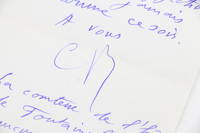
190779804s. l. Paris 1907. Fine. s. l. Paris s. d. ca. 1907-1908 11.50 x 16 cm 2 pages 1/2 sur un double feuillet Autograph letter signed by Renée Vivien addressed to Marcelle Tinayre written in black ink on a double sheet of headed paper decorated with a border of violets. Transverse creases inherent to mailing. Also a writer Marcelle Tinayre was close to Renée Vivien who entrusted her first verses to her to read. Upon Vivien's death Tinayre paid tribute to her through several texts notably a very beautiful tribute article published in the review Schéhérazade in 1910 entitled ""Trois images de Renée Vivien"". ""Chère grande amie Votre si bonne carte de souvenir m'a réjouie et touchée. De tout coeur un remerciement chaleureux. Malgré les inévitables petits malaises que nous inflige ce temps abominable je vais mieux beaucoup mieux. Aussi serais-je très heureuse si vous et Monsieur Tinayre étiez libres le 12 et pouviez venir dîner chez moi. J'aurai le plaisir de vous présenter ma soeur et mon beau-frère qui seront à Paris. Vous devinez quelle joie me causera leur présence ! Croyez à toute mon admiration à toute ma sympthie. Renée Vivien."" ""Dear great friend Your so kind remembrance card delighted and touched me. A warm thank you from the heart. Despite the inevitable small ailments this abominable weather inflicts upon us I am better much better. So I would be very happy if you and Monsieur Tinayre were free on the 12th and could come dine at my home. I will have the pleasure of introducing my sister and brother-in-law who will be in Paris. You can imagine what joy their presence will bring me! Believe in all my admiration all my sympathy. Renée Vivien."" The Muse of violets was indeed very close to Toinette her younger sister who lived in London with her husband Francis. Renée Vivien was moreover the godmother of their son Paul a very rare name then in England in honor of his aunt and in 1911 Toinette would give birth to a daughter whom she would name Renée in tribute to her deceased sister. Very beautiful testimony to the friendship that Renée Vivien bore toward Marcelle Tinayre a writer friend who contributed to perpetuating the memory of Sappho 1900. unknown
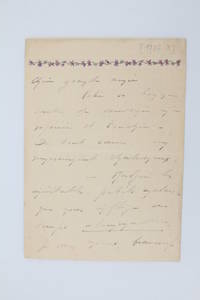
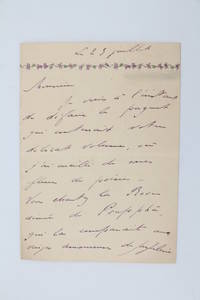
190779815s. l. Paris 1907. Fine. s. l. Paris Le 23 juillet ca. 1907-1908 11.50 x 16 cm 2 pages sur un double feuillet Handwritten signed letter addressed to a poet: You sing the rose loved by Psapphâ who compared it to the loving virgins of Mitilini Paris 23 July ca1907-1908 11.5 x 16 cm 2 pages on a double leafHandwritten signed letter from Renée Vivien addressed to a poet written in violet ink on a double leaf of paper decorated at the head with a border of violets. Transverse folds from having been sent. Monsieur Je viens à l'instant de défaire le paquet qui contenait votre délicat volume où j'ai cueilli de rares fleurs de poésie. Vous chantez la rose aimée de Psapphâ qui la comparait aux vierges amoureuses de Mytilène. Parmi vos poèmes je préfère : ''Sa Voix"" ""Sa Grâce"" et ""Les Mains et l'Apothéose"" . Renée Vivien Monsieur I have just this minute undone the package that contained your delicate volume where I picked rare flowers of poetry. You sing the rose loved by Psapphâ who compared it to the loving virgins of Mitilini. Among your poems I prefer: Sa Voix"" ""Sa Grâce"" and ""Les Mains et l'Apothéose"" . Renée Vivien Despite the precision of the titles mentioned it has not been possible for us to identify the poet to whom Vivien sent this letter of thanks. These titles are reminiscent of the poems of the Muse aux violettes herself. unknown
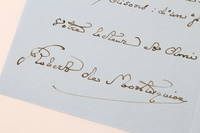
191183367s. l.: S. n. 1911. Fine. S. n. s. l. 1911 27 x 21 cm 6 feuillets recto Signed autograph letter from the dandy count 68 lines written in black ink on six recto leaves probably addressed to his friend and bibliographer the critic Henri Lapauze to whom he almost orders him to review his latest work in one of his upcoming chronicles. The proud Robert de Montesquiou also evokes with complete immodesty his intellectual height and depth qualities cruelly lacking in some of his contemporaries: ""Cher ami avec plaisir je consens à faire partie de votre comité avec d'autant plus de plaisir que sans le vouloir ou peut-être intentionnellement je préfère le croire vous donnez raison à mon dernier livre. Voir page 143 : ""nulle ne serait mieux qualifiée pour ce titre de Présidente. On n'en saurait trouver de plus affable"". Oui cher ami j'en profite pour vous le redire sans plaisanterie - aussi bien que sans amertume vous vous êtes trop de fois montré efficacement sympathique pour que j'en perde si vite ni même jamais le souvenir. - vraiment je ne suis pas du tout de votre avis sur l'impossibilité de parler de mon dernier livre dans votre chronique. Je suis même de l'avis entièrement contraire. D'abord je ne voudrais pas si j'étais critique littéraire qu'il fût dit un jour qu'un tel livre a paru vous savez que je ne suis pas modeste sans que j'en ai fait mention d'une manière ou de l'autre. En outre c'est trop lui donner raison que d'en agir ainsi. Vous voyez que si je suis modeste je ne suis pas moins juste. Oui à votre place j'aurais fait la part de l'auteur et celle du lecteur même récalcitrant comme l'ont fait Robin dans le Herald et Glaser dans le Figaro comme l'ont fait et le feront d'autres. - Quant au bel article de Lucien Daudet dans le Gil Blas je pense que vous l'avez lu. Des personnes d'esprit et d'art comme vous deux ne peuvent se méprendre sur le côté réactionnaire et aristocratique d'un tel écrit dans la bonne acception de ces deux qualificatifs. L'aristocratie ce n'est tout de même pas madame Moore madame Porgès et Mam ""zell"" Gutman ; pas plus que la littérature n'est Mam ""zell"" Vacaresco et Monsieur de Pomairols. A un borgne bien intentionné qui me disait : ""vous attaquez le monde ! "". j'ai répondu : ""Pardon ! je range le salon de ma grand-mère"" Aussi quand je lis dans quelque de vos jolis commentaires trop incertains à certains à propos de je ne sais quel plus ou moins vague bouquin que ""l'auteur"" manie supérieurement l'ironie je m'écris furieusement : ""Eh bien ! et moi ! ."" Alors pour me dédommager et un peu me venger je relis votre carte du 10 octobre : ""Envoyez moi tout de suite cher ami votre insupportable héroïne"". Henry et moi nous voulons la connaître l'aimer la faire aimer. A quoi pensez vous de nous mettre ""l'eau à la bouche pour retirer ensuite ce fruit. que nous espérons défendu."" De ce moment-là je me sens mieux. Et pour vous le prouvre cher ami et que je suis sincère je vous annonce mon intention de publier à l'occasion de votre exposition un nouvel essai sur Ingres lequel vous sera dédié si tel est votre bon plaisir comme il est le mien. Si vous connaissez un coin de revue qui s'accommode de ça faites-le moi savoir et recevez mes amitiés bien dessinées. Robert de Montesquiou Janv. 911."" ""Dear friend with pleasure I consent to be part of your committee with all the more pleasure since without wanting to or perhaps intentionally I prefer to believe so you vindicate my latest book. See page 143: 'none would be better qualified for this title of President. One could not find a more affable one.' Yes dear friend I take this opportunity to tell you again without jest - as well as without bitterness you have shown yourself efficiently sympathetic too many times for me to lose the memory of it so quickly or even ever. - truly I am not at all of your opinion on the impossibility of speaking about my latest book in your chronicle. I am even S. n. unknown
196775618n. l.: s. n. 1967. Fine. s. n. n. l. 17 février 1967 21.50 x 27 cm une page sur un feuillet Handwritten letter signed by Samuel Beckett addressed to Alain Bosquet. Some lines written in black ink on watermarked paper. I do not have the slightest novelty to offer you . I very much regret. s. n. unknown
1879841641879. Fine. 12 mars 1879 10.20 x 13.30 cm une page sur un bifeuillet et une enveloppe Autograph letter signed by Victor Schoelcher one page written in black ink on a bifolium of blue paper bearing the monogram and address of the politician addressed to minister Alfred Boucher-Cadart director of the general security service at the Ministry of the Interior. The envelope containing this letter has been pasted onto the second leaf. Central fold inherent to the mailing. ""There is nothing more to be done for the worker Cauchare. He was forced to serve his 10 days in prison while the Ministry of Justice was changing his sentence. I nonetheless thank you for your goodwill toward the poor man and I ask you to accept the assurance of my highest consideration."" unknown
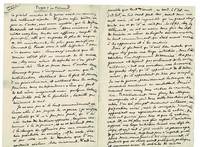
1911761441911. Fine. 29 juin 1911 13.50 x 21 cm 2 pages sur un feuillet double Signed autograph manuscript by Alain bearing the title ""Propos d'un Normand"" and the mention ""sans retard"" in the upper left of the first leaf two pages written in black ink on a double sheet. This text was published in the Propos d'un Normand de 1911. Interesting manuscript written following the appointment of Adolphe Messimy to the post of Minister of War: ""Ce général ministre avait en somme très noblement répondu. Il faudra enfin décider un jour ou l'autre sans aucun mystère que la Défense Nationale est républicaine."" ""This general minister had in sum responded very nobly. We must finally decide one day or another without any mystery that National Defense is republican."" Indeed the newly elected minister sought to redefine relations between political power and military authorities. Alain reproaches the military world for its opacity ""Comment la France sera-t-elle défendue Nous n'en savons rien. . chez nous même les députés ne s'en font aucune idée."" ""How will France be defended We know nothing about it. . even our deputies have no idea."" before proposing solutions: ""Donc il faudrait qu'il soit bien entendu que chaque chef garde une large initiative dans l'exécution d'un programme déterminé. Et ce programme ne dépend pas seulement de la science militaire ; c'est aux ministres avec le conseil des grands chefs qu'il appartient de le déterminer."" ""Therefore it should be well understood that each leader retains broad initiative in executing a determined program. And this program does not depend solely on military science; it is up to ministers with the counsel of senior leaders to determine it."" From 1903 Alain published weekly chronicles titled ""Propos"" in La Dépêche de Rouen et de Normandie. More than 3000 of these ""Propos"" concise articles inspired by daily current events would appear from February 1906 to September 1914. unknown
191183347s. l.: S. n. 1911. Fine. S. n. s. l. 16 mai 1911 31 x 19.50 cm 3 feuilles Autograph letter signed by the dandy count 56 lines written in black ink on three sheets addressed to his friend and bibliographer the critic Henri Lapauze notably mentioning a work by Ingres in his possession also thanking his correspondent for his always lucid and benevolent critiques regarding him. ""16 mai 911 Cher ami merci pour le magnifique volume au sujet duquel je me félicite sans trop insister. que votre catégorique réponse de l'autre jour sur la non-participation des non-contemporains à votre index me permette de n'avoir pas à vous adresser le beau reproche que j'avais préparé non sur ""Phidias absent"" puisqu'il y est. mais sur moi-même oublié. Quand donc vous en serez à l'index en vie je suis bien sûr que dans votre équité non moins que dans votre estime méritée vous croirez justement devoir faire une part à l'homme qui a publié il y a quinze années cet essai qu'il juge mui-même aujourd'hui insuffisamment respectueux à l'heure où les jeunes gens ont trouvé ce titre pour Ingres ""un maître sans génie"". Tout de même je ne doute pas que sous l'enveloppe insuffisamment libérée du style n'oubliez pas qu'il y a quinze ans la documentation ne vous semble assez forte et le jugement assez expressif pour un temps où vous ne nous aviez pas facilité la chose avec tant de révélations qui sont votre gloire. Je le répète mon cher Lapauze le mot ne me semble pas trop fort pour l'admirable monument élevé par vous au génie des génies dans votre ouvrage si noblement animé mieux que de la ferveur d'un compatriote d'un concitoyen disons le si joli titre disons d'un ""pays"". Votre lecteur et ami Robert de Montesquiou. et voici que Jacques Blanche vient de s'y mettre - quinze ans trop tard ! Quel dommage qu'il ne m'ait pas consulté sur l'institut. Je l'aurais trouvé car mon génie à moi il ne faut pas le défier. Dominique jugé par Jacquot. "" ""16 May 911 Dear friend thank you for the magnificent volume about which I congratulate myself without insisting too much. that your categorical response the other day on the non-participation of non-contemporaries in your index allows me not to have to address to you the fine reproach I had prepared not about 'Phidias absent' since he is there. but about myself forgotten. When therefore you get to the index of the living I am quite sure that in your equity no less than in your deserved esteem you will believe justly that you should make a place for the man who published fifteen years ago this essay which he himself judges today insufficiently respectful at a time when young people have found this title for Ingres 'a master without genius'. All the same I do not doubt that under the insufficiently liberated envelope of style don't forget that it was fifteen years ago the documentation will seem strong enough to you and the judgment expressive enough for a time when you had not made things easy for us with so many revelations which are your glory. I repeat my dear Lapauze the word does not seem too strong to me for the admirable monument erected by you to the genius of geniuses in your work so nobly animated better than with the fervor of a compatriot of a fellow citizen let us say the lovely title let us say of a 'countryman'. Your reader and friend Robert de Montesquiou. and here Jacques Blanche has just started on it - fifteen years too late! What a pity he didn't consult me about the institute. I would have found it for my genius one must not defy it. Dominique judged by Jacquot."" Fold marks inherent to postal delivery. S. n. unknown