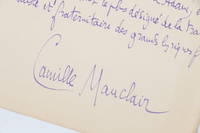
Camille MAUCLAIRBiblio.com
1 815 résultats
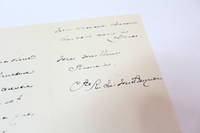
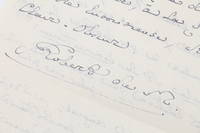
189983424s. l.: S. n. 1899. Fine. S. n. s. l. s. d. 1899 15 x 19.50 cm 8 feuillets Autograph manuscript signed entitled ""La force et la destruction"" about Paul Adam's novel La Force which has just been published 8 leaves in blue ink with some corrections. The article was certainly published in the Revue Blanche. In this laudatory critique of the novel La Force published by Paul Ollendorff: "". c'est un très grand poème épique."" "". it is a very great epic poem."" as well as of Paul Adam's already prolific work: ""Un écrivain qui à trente-cinq ans avant ce livre en a signé vingt-trois autres dont aucun n'est médiocre et dont dix sont de premier ordre."" "". un inépuisable agitateur d'idées d'aperçus de rêves et de beautés."" ""A writer who at thirty-five before this book had signed twenty-three others none of which is mediocre and ten of which are first-rate."" "". an inexhaustible agitator of ideas insights dreams and beauties."" Camille Mauclair demonstrates to the readers of the Revue Blanche of socialist and anarchist allegiance that Paul Adam is one of them: ""Mais le peuple ne sait peut-être pas combien ce romancier cet artiste de style est près de lui dévoué à sa cause véritablement son apôtre en face de la bourgeoisie. c'est en luttant de front contre les iniquités les laideurs et les égoïsmes de la classe possédante que M. Adam a imposé son nom."" ""But the people perhaps do not know how close this novelist this artist of style is to them devoted to their cause truly their apostle in the face of the bourgeoisie. it is by fighting head-on against the iniquities ugliness and selfishness of the possessing class that Mr. Adam has established his name."" Despite success and unlike many of his fellow poets and novelists Paul Adam has not gone astray: "". un mandarin des lettres refugié dans des rêves compliqués et indifférents à l'époque aux souffrances et aux injustices."" "". les autres décadents égotistes ou symbolistes. se réfugiaient prudemment dans la tour d'ivoire ou dans les honteux culte du moi en attendant l'académisme ou le suffrage des snobs."" "". a literary mandarin taking refuge in complicated dreams and indifferent to the times to suffering and injustices."" "". the other decadents egoists or symbolists. prudently took refuge in the ivory tower or in the shameful cult of the self awaiting academicism or the approval of snobs."" and is animated by an acute political and social consciousness: "". sa voix fut une des plus éloquentes parmi celles qui saluèrent dans l'anarchisme les beaux côtés de sa morale civique l'idéal internationaliste la haine des castes le relèvement de l'individu considéré comme unité et commune mesure de la société."" "". Au moment où la panique multipliait autant les dénonciateurs que les poltrons M. Paul Adam signa résolument un magnifique éloge de Ravachol.""' "". his voice was one of the most eloquent among those who greeted in anarchism the beautiful aspects of its civic morality the internationalist ideal the hatred of castes the elevation of the individual considered as unit and common measure of society."" "". At the moment when panic multiplied denouncers as much as cowards Mr. Paul Adam resolutely signed a magnificent eulogy of Ravachol.""' Finally Camille Mauclair precisely analyzes the significance of ""La force"": Avec une frappante justesse Paul Adam oppose la force véritable la hauteur d'esprit à la suprématie de l'épée."" ""M. Paul Adam nous montre l'éternel symbole de Prométhée de l'intelligence créatrice enchaîné entre la Force et la Violence."" "". étant adversaire du chauvinisme et du militarisme. de mettre en lumière tous leurs motifs de gloire pour mieux en montrer l'écoeurant non-sens la nullité la débilité devant la vie pensante et l'action féconde."" ""With striking accuracy Paul Adam opposes true force elevation of spirit to the supremacy of the sword."" ""Mr. Paul Adam shows us the eternal symbol of S. n. unknown
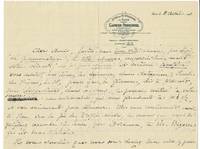
190885189Toulon 1908. Fine. Toulon 30 Mars 1908 13.50 x 21.50 cm 8 pages sur deux doubles feuillets une enveloppe Long autograph letter signed by Claude Farrère approximately 160 lines in blue ink 8 pages on two double leaves to his friend Pierre Louÿs thanking him notably for his thoughtfulness. Traces of folds inherent to being placed in an envelope envelope included. Claude Farrère praises his friend's thoughtfulness towards him: ""Thank you for your letter. not only because it is exquisite - six times more than you can believe - but much more because I know very well that you told it to me so as 'not to worry me.' as you say."" and is amazed by the problems raised by these recent articles: ""Said in parentheses I am quite stunned by the one relating to controversial articles. Not only have I not written any."" He is more concerned about the suspicions he arouses regarding his alleged opium consumption: ""I was informed by my own commander that the ministry based on my first book supposed that opium was not foreign to me. The same commander protested arguing that for so many months that I had served under his orders he had absolute certainty that I had not committed the slightest sin! But I doubt that his word is very appreciated in Paris."" and about the hatred that an officer bears him. Despite these problems Claude Farrère wants to reassure his friend: ""I want my dear friend for you to be absolutely at peace about me. I absolutely don't care myself."" while lamenting that the latter is abandoning the south of France this year: ""Tamaris without you how do you expect the celestial mechanism to continue turning And me You would systematically push me to suicide. Don't forget that I'm writing a quite bloody book and that I live in the iniquitous society of people who for a half-yes or a quarter-no disembowel themselves!"" He concludes his letter with new rumors concerning him: ""Of course Madame de X has gratuitously supposed horrible things: I am not the lover of the other lady from the milliner's. Come now! how could a young man such as myself decent and too well brought up cf. Madame P.L.'s opinion etc."" unknown
185075710Paris 1850. Fine. Paris 23 décembre 1850 11 x 16.80 cm une page sur un double feuillet Autograph letter signed by David d'Angers to the painter Armand-Tranquille Vastine one page written in black ink on a double sheet. Transverse folds inherent to mailing. ""Je ne puis résister au plaisir de vous dire que je viens de voir votre tableau à l'exposition et que la puissante impression qu'il avait produit sur moi lorsque je l'ai vu dans votre atelier n'a fait que s'accroître j'espère bien qu'il sera remarqué comme il le mérite et qu'il vous ouvrira un avenir heureux et brillant."" ""I cannot resist the pleasure of telling you that I have just seen your painting at the exhibition and that the powerful impression it made on me when I saw it in your studio has only grown stronger I do hope it will be noticed as it deserves and that it will open a happy and brilliant future for you."" Armand Vastine was a student of Paul Delaroche. unknown
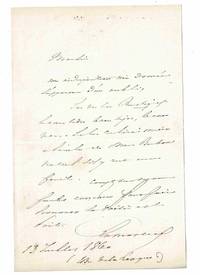
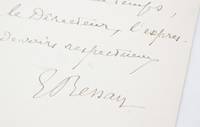
188486688Bellevue Meudon 1884. Fine. Bellevue Meudon 17 Octobre 1884 13 x 20.50 cm une page sur un double feuillet Autograph letter dated and signed by Ernest Renan to Louis Liard then director of higher education at the Ministry of Public Instruction 14 lines in black ink and on letterhead of the Collège de France of which he has been administrator since the previous year. Postal fold mark inherent to mailing a small tear at the head of the letter at the date level. Ernest Renan requests a meeting in order to discuss with his correspondent the future of the Collège de France: ""Oserai-je vous prier de me fixer l'heure et le jour où je pourrai sans vous déranger vous entretenir de quelques affaires très importantes pour le Collège de France et qui sont assez pressées ."" ""Dare I ask you to set the time and day when I could without disturbing you discuss with you some very important matters for the Collège de France which are rather urgent."" Louis Liard noted in pencil in the upper left corner of the letter: La 1ere lettre que j'ai reçu de Renan. The first letter I received from Renan. unknown
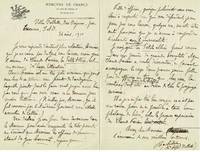
189886539Maillane Bouches du Rhône Maillane 1898. Fine. Maillane Bouches du Rhône Maillane 28 Février 1898 11.50 x 17.50 cm trois pages sur un double feuillet Autograph letter dated and signed by Frédéric Mistral addressed to Anatole France 44 lines in black ink regarding the publication of his work ""Les mannequins d'osier"" which he has just sent him with a dedication. Fold marks inherent to postal delivery a vertical shadow on the first leaf. Frédéric Mistral has just received ""Les mannequins d'osier"" and gives a glowing portrait of his correspondent's style: "". ce livre qui m'a donné tous les plaisirs de la lecture. Je suis de ceux que le roman n'intéresse guère lorsqu'ils ne sont que prétentieux tableaux de la vie contemporaine. . mais il y a dans les vôtres une si fine quintessence d'érudition et d'observation agréablement mêlées et une si joyeuse fleur d'optimisme tolérant qu'on s'y retrouve sans rechercher dans la façon gauloise omnisciente et libre de Maître Rabelais."" this book which has given me all the pleasures of reading. I am one of those whom novels hardly interest when they are merely pretentious tableaux of contemporary life. . but there is in yours such a fine quintessence of erudition and observation agreeably mixed and such a joyful flower of tolerant optimism that one finds oneself in it without seeking in the Gallic omniscient and free manner of Master Rabelais. The félibrige loves equally the characters created by his illustrious and charming master ""Tous vos personnages sont si naturels si bien en situation si logiques que ma foi on les aime tous et quoique tout cela provienne d'un aimable et indulgent scepticisme on y a là l'explication de ce phénomène étrange que si loin si injuste si douloureux que soit le monde chacun pourtant y pousse volontiers sa brouette avec la conviction en le réconfort d'avoir raison."" All your characters are so natural so well placed in their situations so logical that my faith one loves them all and although all this comes from an amiable and indulgent skepticism there one has the explanation of this strange phenomenon that however distant unjust painful the world may be each person nevertheless willingly pushes his wheelbarrow with the conviction and comfort of being right. as the spirit that breathes and animates his books: "". la sympathie du reste vraiment universelle qui accueille tous vos écrits doit vous prouver combien vous êtes humain et sage dans l'antique sens de ces mots."" the truly universal sympathy that welcomes all your writings must prove to you how human and wise you are in the ancient sense of these words. unknown
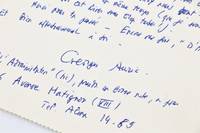
196583133Paris: S. n. 1965. Fine. S. n. Paris 17 octobre 1965 14 x 19.50 cm une feuille Autograph letter dated and signed by Georges Auric addressed to his friend Carlo Rim 23 lines in blue ink on letterhead of the Réunion des théâtres lyriques nationaux et du théâtre de l'Opéra de Paris in which he asks for his friend's indulgence as he is overwhelmed with work: ""Pardonne-moi si je ne t'ai pas répondu encore : tu peux imaginer sans trop de peine ce qu'est devenue mon existence ! . je viens d'avoir à préparer la reprise d'Iphigénie en Tauride - opéra des plus nobles et que ""notre"" public n'avait pas eu l'occasion d'écouter depuis 1931 "" ""Forgive me if I haven't answered you yet: you can imagine without too much trouble what my existence has become! . I have just had to prepare the revival of Iphigénie en Tauride - one of the noblest operas and one that ""our"" public has not had the opportunity to hear since 1931""; a revival in which Georges Auric places great hope: "". En tout cas je veux espérer que nous dépasserons les deux répétitions de 1931. "". In any case I want to hope that we will exceed the two performances of 1931."" He also rejoices in the diversity of projects that occupy him thus transcending styles and periods: ""Glück Iphigénie : nous sommes fichtrement loin de Vincent Scotto. Mais je franchis allégrement siècles et styles pour te dire combien je suis heureux de me trouver dans ce ""comité d'honneur"" associé aux respectables et déjà vieux amis dont tu connais les noms ! "" ""Gluck Iphigénie: we are damn far from Vincent Scotto. But I cheerfully leap across centuries and styles to tell you how happy I am to find myself in this 'honorary committee' associated with the respectable and already old friends whose names you know!"" Folds inherent to mailing. Carlo Rim was a Provençal writer author notably of ""Ma belle Marseille"" a caricaturist a filmmaker: ""Justin de Marseille"" ""L'armoire volante"" ""La maison Bonnadieu"" and was notably the friend of Fernandel Raimu and Marcel Pagnol but also of Max Jacob and André Salmon whom he met in Sanary. S. n. unknown
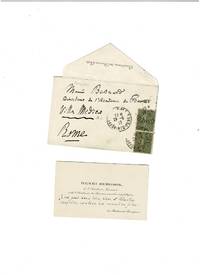
191775483Paris 1917. Fine. Paris 29 mai 1917 10 x 6 cm une carte de visite enveloppe jointe Autograph calling card signed by Henri Bergson and addressed to Alain Besnard director of the Villa Medici. ""Je ne puis vous dire cher et illustre confrère combien vos aimables félicitations me touchent. Merci et de tout coeur à vous H.B."" unknown
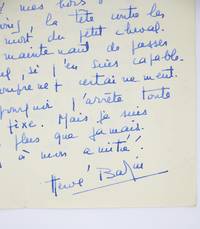
195084016Villenauxe-la-Grande Aube: S. n. 1950. Fine. S. n. Villenauxe-la-Grande Aube 1950 13.50 x 20.50 cm une feuille Autograph letter dated and signed by Hervé Bazin 49 lines in blue ink from his home in Aube La belle Angerie in Villenauxe-la-Grande in which he apologizes for his late reply: "". vous devez me trouver bien silencieux et m'en vouloir quelque peu."" ""you must find me very silent and hold it against me somewhat."" Hervé Bazin confides his apprehensions and psychological torments related to the political climate tinted with anti-communism : "" Depuis des semaines je traverse une sorte de crise assez pénible. je suis inquiet de voir se transformer peu à peu l'anti stalinisme et anti marxisme."" ""For weeks I have been going through a kind of crisis quite painful. I am worried to see the gradual transformation of anti-Stalinism and anti-Marxism."" and remains lucid about the minimal impact of his journalistic interventions : ""ma voix est mince mal assurée inefficiente."" ""my voice is thin unsteady ineffective."" preferring what his talent is recognized for : ""mieux vaut pour elle cet autre genre d'éloquence où je suis plus à l'aise : le roman."" ""better for it this other kind of eloquence where I am more at ease: the novel."" This is why he prefers to devote himself solely to writing his novels and suspends his collaboration with Georges Altmann to whom he had been providing some articles on current political events which he judges insufficient and too concise to express all that he would like to develop further: ""Pour tout vous dire je me lance dans un grand travail. qui m'oblige à quitter le forum. Il s'agit maintetant de passer à l'essentiel. C'est pourquoi j'arrête toute chronique fixe. Mais je suis avec vous plus que jamais."" ""To tell you everything I am embarking on a great work. which obliges me to leave the forum. It is now a matter of moving on to the essential. This is why I am stopping all regular chronicles. But I am with you more than ever."" Fold marks inherent to mailing. Georges Altmann began his great career as a journalist in 1922 at L'Humanité then directed by Henri Barbusse who entrusted him in 1927 with the La vie littéraire section. He was dismissed the following year from the communist daily while continuing to collaborate with Henri Barbusse on the review Monde. In 1932 he joined the Parisian editorial staff of Le Progrès de Lyon through which he made contact with the Resistance group Franc-Tireur. In March 1942 he went underground and became one of the principal editors of the review Franc-Tireur. He was arrested by the Germans in July 1944 then freed on August 18 the day before the Parisian insurrection. After the war he was involved in various journalistic and editorial activities. He then managed the press service of culture minister André Malraux. S. n. unknown
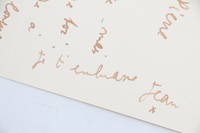
195486537Saint-Jean-Cap-Ferrat 1954. Fine. Saint-Jean-Cap-Ferrat 10 Mai 1954 13.50 x 21 cm une page Autograph letter dated and signed by Jean Cocteau 17 lines in black ink to a friend describing his Sevillian sojourn. Fold marks inherent to being placed in an envelope. Jean Cocteau explains his silence: his patron and very close friend Francine Weisweiller had been ill: ""Excuse ce long silence. mais on parle souvent de toi. Francine a été très très malade à Kitzbühel en Autriche et longue à reprendre des forces."" Excuse this long silence but we often speak of you. Francine was very very ill in Kitzbühel in Austria and slow to regain her strength. But to cut short his bad news he prefers to recount the enchantment of Seville: ""Nous revenons de Séville. Il pleuvait sur les calèches et les gitanes - mais dans le vieux Séville pareil à Pompéi les orangers embaument."" We are returning from Seville. It was raining on the carriages and the gypsies - but in old Seville like Pompeii the orange trees are fragrant. unknown
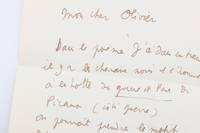
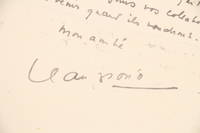
195485159Kietzbühel Kitzbühel 1954. Fine. Kietzbühel Kitzbühel 8 Février 1954 13.50 x 21 cm une page une enveloppe Autograph letter signed by Jean Cocteau addressed from the Grand Hotel Kietzbühel 16 lines in black ink to Olivier Quéant. Fold marks inherent to mailing envelope included. ""Grd Hotel Kietzbühel 8 Feb. 1954 my dear Olivier dans le poème ""J'ai dans un train"" il y a les chevaux noirs et l'homme le lotte du guerre et paix de Picasso isti guerre on pourrait prendre le motif séparé du livre qui flambe sous le pied d'un cheval noir. Il ferait une belle image. Si tu ne l'as pas demande le catalogue illustré de Rome . Eugenio Réale 3 rue Mangili Rome."" in the poem ""J'ai dans un train"" there are the black horses and the man the lotte of Picasso's guerre et paix isti guerre we could take the separate motif of the book that burns under the foot of a black horse. It would make a beautiful image. If you don't have it ask for the illustrated catalogue from Rome . Eugenio Réale 3 rue Mangili Rome. unknown
195284964s. l. 1952. Fine. s. l. ca 1952 21 x 27 cm une feuille Autograph letter signed by Jean Giono 9 lines in black ink addressed to Roger Nimier. Fold mark inherent to postal handling. ""Dear Nimier thank you for your letter; and for letting me hope for your visit. I should point out right away that I will be absent Monday 9th and Tuesday 10th. Apart from those two days your collaborators can come whenever they wish. My friendship. Jean Giono."" Very visual letter bearing the beautiful signature of Jean Giono. unknown
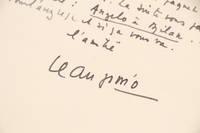
195284965s. l. 1952. Fine. s. l. ca 1952 21 x 27 cm une feuille Autograph letter signed by Jean Giono 8 lines in black ink addressed to Roger Nimier. Fold marks inherent to the mailing. ""Cher Nimier votre lettre expresse me surprend. On vous a adressé un texte par paquet recommandé il y a quelques jours. La suite vous parviendra. C'est intitulé : Angelo à Milan. Dites moi si vous l'avez reçu et si ça vous va. L'amitié. Jean Giono."" Dear Nimier your express letter surprises me. We sent you a text by registered parcel a few days ago. The continuation will reach you. It's entitled: Angelo à Milan. Tell me if you received it and if it suits you. In friendship. Jean Giono. A very visual letter bearing Jean Giono's handsome signature. unknown
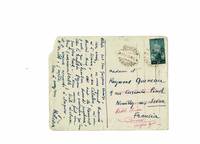
194975708Venise Venice 1949. Fine. Venise Venice 13 septembre 1949 17.40 x 13.80 cm une carte postale Autograph postcard signed by Jean Hélion addressed to Raymond Queneau written in blue ink on the verso of a color reproduction of an old engraving depicting the Palio race on the Piazza del Campo in Siena. Marginal lacks and creases. ""Ne vous ayant trouvés ni à Sienna ni en Calabre ni au Harris-Bar ce sont les Rousset je crois que je ramène samedi prochain ! . Nous avons fait un tour invraisemblable Sicile incluse et je reviens remonté à claquer."" ""Not having found you either in Siena nor in Calabria nor at the Harris-Bar I think it's the Roussets that I'm bringing back next Saturday! . We took an incredible trip Sicily included and I'm coming back bursting with energy."" unknown
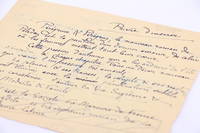
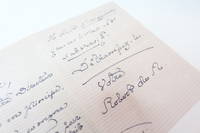
193286589Paris: S. n. Mercure de France 1932. Fine. S. n. Mercure de France Paris 22 Mai 1932 21.50 x 17.50 cm une feuille Manuscript publisher's slip written by Sar Péladan for the publication of his Pérégrine & Pérégrin at Mercure de France. Fold mark inherent to mailing. Manuscript with corrections. ""Prière d'insérer Pérégrine & Pérégrin le nouveau roman de Péladan est la peinture d'un dernier amour de celui où les femmes mettent tout leur coeur. Cette passion d'automne qui a les ardeurs de l'été s'encadre à chaque chapitre dans un décor nouveau quii varie l'impression des amants. La jalousie & les transes la volupté & ses réactions sont étudiées avec la même crossed out word pénétratiion subtile qui caractérise l'autuer du Vice suprême& la modestie & vanité. C'est la société du Mercure de France qui édite le dixseptième roman de la décadence latine this sentence having been crossed out."" S. n. [Mercure de France] unknown
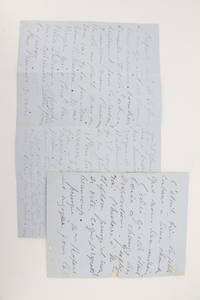
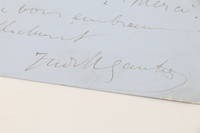
191480879Alger Algiers 1914. Fine. Alger Algiers s. d. ca 1914 13.70 x 18 cm 6 pages sur un double feuillet et un feuillet simple Autograph letter signed by Judith Gautier addressed to Céleste Chrétien her maid. Four pages written in black ink on a double sheet. Transverse folds inherent to mailing. Judith Gautier here evokes the visit of her friend the musician Chalmers Clifton - whom she liked to nickname Charmeur - to Dinard: ""Mr Clifton received yesterday Sunday a telegram which told him to book Villa Mitsou for August and September in the name of Ni Liao."" She also asks Celeste for additional information about a maid she recommended to her: ""Tell me again about the cleaning woman. Is she . a good cook how much does she ask for Is it only for the season"" A lover of animals she then gives some advice on how to pamper them: ""For the blackbirds you must crush the hemp seed very fine and crush in the same manner bread crust. This is the foundation of their diet but they eat almost everything bread in milk minced meat cooked or raw cherries strawberries grapes a little bit of young snail cut in pieces flies and especially mealworms and ant eggs fresh they adore them plenty of water always something to bathe in."" She also mentions one of her pets: ""My bat is still doing well. I am searching in vain for a little female for it."" ""A poor bat found itself one summer day stuck in a ""fly-catcher"" . The poor creature was struggling desperately. Judith unstuck it with cologne water put it in a small pantry and it lived there eighteen months. It lost its bat habits slept at night awake during the day it drank water from a shell lapping it like a little horse."" Anne Danclos La Vie de Judith Gautier : égérie de Victor Hugo et de Richard Wagner unknown
191080835Alger Algiers 1910. Fine. Alger Algiers s. d. ca 1910 13.70 x 18 cm 4 pages sur un double feuillet Autograph letter signed by Judith Gautier addressed to Céleste Chrétien her housekeeper. Four pages written in black ink on a double sheet. Transverse folds inherent to mailing. Judith Gautier here discusses the visit of her friend the musician Chalmers Clifton - whom she liked to nickname Charmeur - to Dinard: ""Voici les dernières instructions : le voyageur arrivera dimanche soir à 7 heures 20. Il faudra le prendre à la gare vous ou Francis et le conduire tout droit à la maison qu'il ne connait pas. Il apporte des draps au cas où il n'y en aurait pas. Il les donnera pour qu'on fasse le lit et on le conduira tout de suite à Michelet pour dîner il faudra prévenir pour qu'on garde un dîner. . Mr Clifton est un très jeune américain tout à fait charmant et qui a l'air d'une demoiselle. Soignez-le bien."" ""Here are the final instructions: the traveler will arrive Sunday evening at 7:20. You or Francis will need to meet him at the station and take him straight to the house which he doesn't know. He is bringing sheets in case there aren't any. He will give them so the bed can be made and he will be taken immediately to Michelet for dinner you must warn them to save a dinner. . Mr. Clifton is a very young American who is quite charming and looks like a young lady. Take good care of him."" unknown
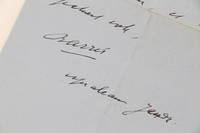
190583471s. l.: S. n. 1905. Fine. S. n. s. l. s. d. 1905 13.50 x 21.50 cm un feuillet recto-verso Autograph letter signed by Maurice Barrès addressed to Madame Léon Daudet 39 lines in black ink on a four-page folio. Fold marks inherent to postal mailing. ""Chère madame J'avais espéré voir Léon et peut-être aussi vous-même en Provence et ce que je rêve vous faire connaître ce beau site de Mirabeau. Du moins j'y ai votre conversation écrite si claire rapide souple intéressante ces pages pas fabriquées mais jaillissantes et si aimables ! Je vois que je ne vous déplairais en vous disant que je vous apparente à celle de madame Millet. Robinel que j'ai tant lue quand j'étais enfant parce qu'elle était un des livres de notre maison et que je vous tiens pour sa cousine mais une dame de Paris auprès d'une importante fermière et puis aussi mais cette fois je vous choquerai. Je vous rapproche des livres de Michelet dont la ""mare-polémiste"" sait bien les élans et le goût. Au milieu de ses foules il a bien marqué comment l'homme d'action a besoin de la campagne française. Nul doute que vous n'ayez guère le petit malade mais comment vous a-t-il surpris si brusquement et réduit à une intervention chirurgicale dans les deux heures vous qui surveillez et qui défiez dans vos flots d'eau chaude et savonneuse les microbes farouches Excusez moi cette taquinerie que je regrettais bien profondément si je ne pensais si je n'étais pas sûr que vous êtes hors de souci. Au revoir chère madame amitiés de ma femme pour vous et pour Léon et bien respectueusement vôtre Barrès. Mirabeau jeudi."" ""Dear Madam I had hoped to see Léon and perhaps you as well in Provence and what I dream of to introduce you to that beautiful site of Mirabeau. At least I have your written conversation there so clear rapid supple interesting these pages not manufactured but springing forth and so amiable! I see that I would not displease you in saying that I relate you to that of Madame Millet. Robinel whom I read so much when I was a child because it was one of the books of our house and whom I consider you her cousin but a Parisian lady beside an important farmer's wife and then also but this time I will shock you. I bring you close to Michelet's books whose ""mare-polemicist"" well knows the impulses and taste. In the midst of his crowds he clearly marked how the man of action needs the French countryside. No doubt that you hardly have the little patient but how did he surprise you so suddenly and reduce you to surgical intervention within two hours you who monitor and defy in your streams of hot soapy water the fierce microbes Excuse me this teasing that I would deeply regret if I did not think if I were not sure that you are beyond worry. Goodbye dear madam regards from my wife to you and to Léon and most respectfully yours Barrès. Mirabeau Thursday."" S. n. unknown
191076250Bas-Vignons 1910. Fine. Bas-Vignons 24 août 1910 13.70 x 21 cm 2 pages sur un double feuillet Unpublished autograph letter signed by Rachilde two pages written in black ink on a double sheet with Mercure de France letterhead. Interesting letter addressed to an unknown recipient perhaps a ""naval officer"". Rachilde defends Les Petites Alliées by Claude Farrère and his style in general: ""Je ne veux pas du tout vous laisser croire que l'oeuvre de Claude Farrère les Petites Alliées est un ouvrage de basse littérature . Claude Farrère est un très joli écrivain qui joint aux becs de sa plume une pointe de dandysme laquelle pointe peut le faire mal juger aussi bien par vous que par moi mais n'en demeure pas moins littéraire."" ""I do not want you to believe at all that Claude Farrère's work les Petites Alliées is a work of low literature . Claude Farrère is a very fine writer who adds to his pen's nibs a touch of dandyism which touch may make him badly judged by you as well as by me but nonetheless remains literary."" This ""touch of dandyism"" led to an amusing misunderstanding as highlighted by Henri Troyat Farrère's successor at the French Academy in his reception speech: ""As for the feminist Rachilde deceived by the first name Claude she had led a fierce campaign for Farrère taking him for a fellow woman writer."" unknown
197284434Paris 1972. Fine. Paris 26 Avril 1972 21 x 27 cm une page Autograph letter dated and signed by Raymond Queneau 17 lines in black ink addressed to Monsieur Lauwaert. Raymond Queneau and his wife Janine are sorry they cannot spend a few days with their friends: "" Ma femme doit entrer en clinique ces jours-ci pour un traitement de radiothérapie souffrant d'une sciatique aiguë"" ""My wife must enter the clinic these days for radiotherapy treatment suffering from acute sciatica"" hoping this is only a postponement: "". nous espérons bien venir en septembre et pouvoir récupérer longuement une meilleure santé car la meilleure non plus n'a pas été brillante cet hiver."" "". we very much hope to come in September and be able to recover better health for a long time as mine hasn't been brilliant this winter either."" A touching letter from Raymond Queneau about his wife's fragile health she being destined to pass away a few months later on July 18 1972. unknown
191174318s. l.: S. n. 1911. Fine. S. n. s. l. 8 Avril 1911 27 x 21.50 cm deux pages sur une feuille Autograph letter dated April 8 1911 and signed by the dandy count of two pages on one recto-verso sheet 19 lines written in black ink inviting his friend Henri Lapauze and his wife for an Easter luncheon on the 18th of the current month at his property in the Landes near Vic-Bigorre. Robert de Montesquiou in order to secure his invited friend's decision and to facilitate his travel offers to put a vehicle at his disposal. But before this proposed Easter meal the poet plans to visit his friend very soon. Henry Lapauze 1867-1925 was a journalist art critic then in 1905 curator of the Petit Palais converted four years earlier into a museum and whose collections he considerably enriched by acquiring notably the Courbet Henner Falguière collections with at the twilight of his life a clear predilection for the Decorative Arts of which he was one of the ardent promoters. S. n. unknown
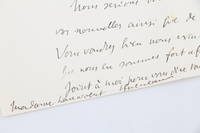
189574263s. l.: S. n. 1895. Fine. S. n. s. l. s. d. circa 1895 12.50 x 17 cm une page et demie sur une feuille Autograph letter signed by the dandy count of a page and a half 13 lines written in black ink to his friend the journalist from Le Gaulois Henry Lapauze so that he might use his decisive influence in the publication of a text: ""Il doit s'imaginer que ce texte est subversif. Détrompez-le."" ""He must imagine that this text is subversive. Disabuse him of this notion."" initially validated by Arthur Meyer but which Robert de Montesquiou wants to ensure through his friend will indeed be printed: ""J'ai vu votre directeur qui accepte en principe. Cependant comme votre intervention pour faire est déterminante j'insiste auprès de vous."" ""I have seen your director who accepts in principle. However as your intervention to make it happen is decisive I insist upon you."" Henry Lapauze 1867-1925 was a journalist art critic then in 1905 curator of the Petit Palais converted four years earlier into a museum and whose collections he considerably enriched by acquiring notably the Courbet Henner Falguière collections with in the twilight of his life a marked predilection for the Decorative Arts of which he was one of the ardent promoters. S. n. unknown
189074255s. l. Paris: S. n. 1890. Fine. S. n. s. l. Paris s. d. circa 1890 26.50 x 20.50 cm une page et demie sur une feuille Autograph letter signed by the dandy count one and a half pages 15 lines written in black ink to Henri Lapauze offering him several appointment options at his home: "". I shall be delighted to receive you on Friday at 10 o'clock or at 2 o'clock as you prefer. We are charmed to have you in Douai."" A black ink stain in the margin on the verso of the letter. Henry Lapauze 1867-1925 was a journalist and art critic who became in 1905 curator of the Petit Palais converted four years earlier into a museum whose collections he considerably enriched by acquiring notably the Courbet Henner and Falguière collections with in the twilight of his life a marked predilection for the Decorative Arts of which he was one of the ardent promoters. S. n. unknown
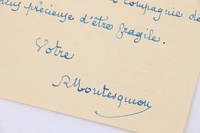
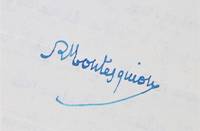
192183149s. l.: S. n. 1921. Fine. S. n. s. l. 26 octobre 1921 18 x 21 cm une page Grateful autograph letter dated and signed by the dandy count 14 lines written in blue ink probably addressed to his friend the critic Henri Lapauze. ""Mon cher ami ne doutez pas que je ne sache dans cet aimable spirituel et bienveillant article faire la part du critique intelligent qui l'a rédigé et celle du fidèle ami qui l'a inspiré. L'acte de donation en faveur de votre musée vous portera mon remerciement. La statuette est de cire. je l'espère cependant durable et l'avalanche de roses que vient décrire si poétiquement Alexandre lui promet une compagnie délicate elle aussi plus précieuse d'être fragile. Votre RMontesquiou. 26 Octobre 1921."" ""My dear friend do not doubt that I know how in this amiable witty and benevolent article to distinguish between the part of the intelligent critic who wrote it and that of the faithful friend who inspired it. The deed of donation in favor of your museum will bear my thanks. The statuette is made of wax. I hope however that it will be durable and the avalanche of roses which Alexandre describes so poetically promises it delicate company also more precious for being fragile. Yours RMontesquiou. 26 October 1921."" Fold marks inherent to envelope insertion three letters having slightly smudged. S. n. unknown
192183348s. l.: S. n. 1921. Fine. S. n. s. l. 11 octobre 1921 17.50 x 21 cm une feuille Autograph letter signed by the dandy count 14 lines written in blue ink addressed to his friend and bibliographer the critic Henri Lapauze notably mentioning a work by Ingres in his possession also thanking his correspondent for his always lucid and benevolent critiques regarding him. ""Cher ami envoyez-moi je vous en prie comme nous en sommes convenus le schéma de ma donation au Petit-Palais de ma grande statuette par TroubetzKoÿ et du portrait par Arthur Chaplin de Mademoiselle Ehrmann artiste lorraine élève d'Hébert morte en 1918 ayant légué le portrait par elle de sa mère au Musée de Nancy et dont le portrait pareillement dû à son pinceau de Mademoiselle Favart figure au Foyer de la Comédie Française. Vous me ferez aussi grand plaisir en m'adressant votre bel article sur d'Annunzio et si vous la retrouvez la note des journaux sur mon don à la Bibliothèque de Versailles. Cher ami j'ai été heureux de vous revoir. RMontesquiou. 11 oct 1921."" ""Dear friend please send me as we agreed the outline of my donation to the Petit-Palais of my large statuette by TroubetzKoÿ and of the portrait by Arthur Chaplin of Mademoiselle Ehrmann Lorraine artist and student of Hébert who died in 1918 having bequeathed the portrait she painted of her mother to the Museum of Nancy and whose portrait similarly by her brush of Mademoiselle Favart is displayed in the Foyer of the Comédie Française. You would also give me great pleasure by sending me your beautiful article on d'Annunzio and if you find it the newspaper note about my gift to the Library of Versailles. Dear friend I was happy to see you again. RMontesquiou. 11 Oct 1921."" Fold marks inherent to postal delivery. S. n. unknown
190883360s. l.: S. n. 1908. Fine. S. n. s. l. 4 février 1908 21.50 x 28 cm une feuille Autograph letter signed by the dandy count 22 lines written in black ink addressed to his friend and bibliographer the critic Henri Lapauze: ""Neuilly Indeed dear friend you would give me great pleasure by continuing to point out to your readers the faithfulness of word & the good conduct of this edition which encounters more and more the serious reception to which I hope it is entitled by showing more clearly what those titles that have become famous contained a little confidence and which want to deserve to be so after a more mature examination. And if you insist on the poor passiflora of which your wife speaks to me so eloquently and elegantly in a letter that would be a very beautiful 'art criticism' this will delight at the same time a luminous shadow and my chiaroscuro. Robert de M. 4 February 08."" Fold marks inherent to envelope placement. S. n. unknown