Roland BARTHESBiblio.com

1 815 résultats
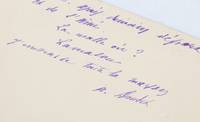
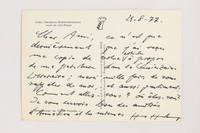
195662733s. l. 1956. Fine. s. l. Mercredi n.d. circa 1956 13.40 x 10.50 cm une carte recto verso Signed autograph card of Roland Barthes written in blue ink. Date at the top of the letter and signature at the bottom of the letter. Folds caused by mailing and 2 perforations. Roland Barthes sends this letter to accompany the autograph dedication of the author of a text. He states that he ""measures to see black and white all the drought"" of his text and insists that the recipient specifies the character ""spoken presentative non-exhaustive"" of it in his presentation. unknown
195562732s. l. 1955. Fine. s. l. 19 janvier 1955 13.50 x 10.50 cm une carte recto verso Autograph letter signed Roland Barthes written in black ink. Date at the top of the letter and signature at the bottom of the letter. Folds caused by mailing and 2 perforations. Roland Barthes sends this letter to thank his correspondent who sent him a signed book. He also thanks him for the meetings of writers he was able to do thanks to him and who countered the ""skepticism that we always have on the threshold of these talkies of writers"". He writes his support for the upcoming efforts. 1955 is the year in which Barthes begins the writing of Mythologies which appear at Seuil in 1957. unknown
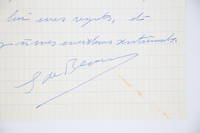
1980770661980. Fine. 2 Juillet 1980 14.50 x 20.50 cm 1 page 1 enveloppe Autograph letter signed by Simone de Beauvoir consisting of 9 lines addressed to Antoinette Boulesteix with envelope enclosed. A central fold inherent to the mailing and an envelope mark at the foot of the letter the envelope and letter having been glued together then separated. ""Chère mademoiselle je suis très touchée de cette lettre mais je n'ai pas le temps de rencontrer votre mère. Je quitte Paris pour aller me reposer à la campagne. Dites lui mes regrets et croyez à mes meilleurs sentiments. Simone de Beauvoir."" ""Dear Mademoiselle I am very touched by this letter but I do not have time to meet your mother. I am leaving Paris to go rest in the countryside. Give her my regrets and believe in my best sentiments. Simone de Beauvoir."" unknown
62179Hamburg ca. 1875. . Eine "Weihnachtsspende" der Schriftstellerin Christiane Friederika Auguste Werlich 1822-1892 mit deren zweistrophigem Sechszeiler dat. am 24. Dezember 1877. - Eintragungen überwiegend in deutscher Schrift u. Sprache tls. spanisch tls. lateinisch meist von Freunden u. Schulkameraden darunter prominent gewordene Hamburger Namen wie J. Ballin ! Rodrigo de Castro Mackeprang Bertha u. Otto. - Die feine kunstfertige Kohlestiftzeichnung "nach Liezen Mayr" recte Alexander L.-Mayer - "Zum Andenken an Ihren Sie achtenden & liebenden Freund L. Dorner" - zeigt Faust u. Margarete in Marthens Garten auf einer Bank sitzend die gegenüberlieg. mit kalligraphischem Ziertitel ausgestaltete Szene Faust I Verse 3414-3468 illustrierend in der Gretchen ihre berühmte Frage stellt . Weitere Einträge stammen von Albert Epstein L. Philippson ! J. Fraenckel Heinrich Meyer Leopold Salomon ! Oscar Manowsky Emilie Saski Gustavo Heyer Hamburg den 30. Apr. 1881; nachträgl. Bemerk. von fremder Hand: "gest. in Amalpa am 13 Dec.1881 am Klimafieber" . Pastor Dr. Hüpeden u. a. - Bindung lose stellenw. fingerfleckig; im Ganzen gut. [Hamburg], [ca. 1875]. unknown
1923003175New York 1923: Harcourt Brace & Co. 1923. First American Edition . Blue Cloth. Very Good. 314 Pp. First Printing. This Is Andrade's First Book Originally Published In England In 1923 Intended As An Introduction To Atomic Structure For The "Serious Student". Andrade Was Quain Professor Of Physics At The University Of London 1928-1950 And A Highly Honored Historian Of The Physical Sciences. This Copy Signed By Robert F. Bacher And Dated In April 1925 While Bacher Was A Student. Bacher Later Followed Hans Bethe To Cornell In 1935 Where He Started Doing Experimental Work In Nuclear Physics With Bethe And Left Theoretical Work Behind. He Was Quickly Promoted To Full Professor And Director Of The Laboratory Of Nuclear Studies. Early On He Had Felt That The United States Needed To Start Doing War Work And When Lee Dubridge Head Of The Radiation Lab Working On Radar At Mit Summoned Him There In 1941 He Went. Then Late In 1942 Oppenheimer Who Had Been One Of Bacher's Instructors Earlier At Caltech Approached Bacher About A New Lab For Nuclear Weapons Work That Was Just Starting Up And The Following Spring Asked Him To Join The Manhattan Project. Bacher Declined Initially Telling Oppenheimer That What He Needed Was Engineers. Ultimately When Oppenheimer Made A Commitment To Hiring More Engineers And Made Him Head Of The Experimental Physics Division Bacher Signed On. From The Beginning Bacher Was Firmly Opposed To Making Los Alamos A Military Lab And Persuaded Oppenheimer Who Had Agreed To Take A Commission As Lieutenant Colonel And Had Already Ordered His Uniforms To Keep It Under Civilian Control At Least Until They Had Enough Fissionable Material For A Bomb. When The Project Was Reorganized In July 1944 To Speed Work On Implosion Bacher'S Experimental Physics Division Was Split And He Was Put In Charge Of The G For "Gadget" The Code Name For The Bomb Division. Bacher Personally Escorted The First Bomb To The Test Site In July Of 1945. In 1946 He Was Awarded The President'S Medal For Merit For His Work On The Manhattan Project. Bacher Returned To Cornell Hoping To Get Back To High-Energy Physics But The Bomb'S Aftermath Continued To Involve Him. He Felt Strongly That There Should Be Some Sort Of International Control Of Atomic Weapons And Worked Hard On Negotiations With The Soviet Union. He Admitted In His Oral History That This Was Perhaps Idealistic But Thought That Getting This Technology Out In The Open Might Have Avoided The Subsequent Cold War. When The Atomic Energy Commission Was Established Bacher Served As The Only Scientist Among Its Members; He Had Tried To Decline The Post But Took It On When He Learned That There Would Be No Scientist At All If He Didn'T Accept. While A Member Of The Aec He Pushed For The Development Of Nuclear Submarines And Breeder Reactors For Commercial Power. In The Meantime Lee Dubridge Now President Of Caltech Offered Him A Position As Chairman Of The Division Of Physics Mathematics And Astronomy Or As Just A Professor Whichever He Preferred. "The Decision I Came To Was A Fateful One And Probably Illustrates A Major Failing In My Makeup" Bacher Said In The Oral History. What He Saw As A Major Failing In His Makeup Was In Fact A Superb Talent For Envisioning The Future And Leading The Institute Into It. After Getting A Commitment That The Institute Would Support A Program In High-Energy Physics Both Theoretical And Experimental Bacher Arrived In 1949. One Of His First Hires In High-Energy Physics Was Robert Walker Whom He Had Known At Los Alamos And Cornell. Another Of Bacher'S Early Recruits Was Richard Feynman Who Was Reportedly Feeling "Unsettled" At Cornell; Bacher Persuaded Him To Sign On At Caltech With A Sabbatical Year In Brazil In Between. Feynman Then Settled In Pasadena In 1951 For The Rest Of His Career. Now With Feynman And Robert Christy Who Had Come In 1946 Bacher Felt He Had The Two Most Outstanding Theorists From Los Alamos. Then In 1955 He Also Hired Murray Gell-Mann. <br/> <br/> Harcourt Brace & Co. hardcover
15314The banker who founded Jay Cooke & Co. proved remarkably successful as a fiscal agent for the U.S. Treasury selling far more government bonds than was thought possible; later he financed western railroad construction such as the Northern Pacific and mines in Utah. ANS 1p 5 3/4" X 7 3/4" Philadelphia PA 1902 January 27. Very good. On his "Fourth & Library Streets" letterhead Cooke complies with an autograph request in his large bold flamboyant script. A very handsome piece. unknown
19294720bx123<p>NY: Columbia University. Very Good in Poor dust jacket. 1929. First Edition; First Printing. Hardcover. Slate Blue cloth gilt both bright.</p><p>Signed and inscribed ffep by the author "Miss Alice Morrow/From an admiring/friend/Mary Mills Patrick/New York City/October 12 1929."</p><p>Erratum slip bound in p215. Tattered unclipped 4.50 dj; 8vo; 339 pages; Signed by Author. bx133</p> Columbia University hardcover
25089French composer. Rare ALS in French 2pp 8¼" X 10½" n.p. n.y. September 4. Near fine. Long chatty letter with much musical content. In part: "I finished a new collection of songs. It is made up of Two Sonnets of Mallarme that I will show you when I get back if you so desire. Obviously I will be very happy if someone plays my cantata for chorus because it is an important work and I would love very much to hear it." Having died at age twenty-six Cartan's autograph is quite scarce and good music content letters rare. Comes with a TLS in French from what may have been Cartan's agent dated 21 April 1932 just after Cartan's death presenting this Cartan letter to music critic Irving Schwerke 1893-1975. unknown
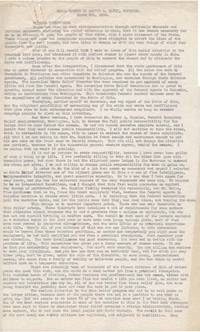
18072This Ohio democratic politician served that state as congressman 1918-21 and as their 53rd governor 1935-39. TMS 4pp onion skin sheets 8½" X 13 3/4" n.p. 1935 March 9. Very good. Small paper clip rust mark at upper left of first page. Original single-spaced typescript of the Ohio governor's irate speech titled "Radio Speech of Martin L. Davey Governor March 9th 1935" on the Federal Emergency Relief Administration programs within Ohio and his inability to exert any control over it. In part: "Many of you will recall that I made an issue of this relief situation in the campaign last year. I made a solemn promise to the people of Ohio to correct the abuses and to eliminate the waste and inefficiency. / .neither myself as Governor nor any agent of the State of Ohio has the slightest possibility of correcting any of the evils and waste and inefficiency that give rise to such wide-spread complaints. I am wholly unable to keep an earnest campaign promise to clean up this situation. / It is not my purpose to evade responsibility. I was perfectly willing to take all the blame that goes with executive power but when there is not the slightest power lodged in the Governor to correct the abuse and waste I am not willing to assume public responsibility for what is going on." A lengthy denunciation of the way in which New Deal programs were being carried out on the state level. Interestingly Davey's pre-gubernatorial business the Davey Tree Expert Company was one of the earliest to sponsor network radio programs -- thus Davey was well versed in the power of radio waves to influence constituents. Within weeks of taking office Davey -- whose tenure has been described as "one of the most extraordinary and bizarre periods in the annals of the Ohio governorship" -- began feuding with President Roosevelt. He accused the federal administration of relief in Ohio with being "cruel inhuman and wasteful" -- to which FDR accused Davey with corrupting relief efforts in Ohio. Roosevelt quoted federal relief administrator Harry L. Hopkins who maintained that Davey's campaign committee had solicited contributions to finance his inaugural ball from persons working with the Federal Relief Administration. Davey sought to have Hopkins arrested for criminal libel. Before the Ohio legislature Davey called Hopkins a coward and a liar and dared him to enter Ohio. This typescript clearly precedes this name-calling brouhaha for in it Davey discusses Hopkins and his agency in civil if not cordial terms. Chronologically this speech likely falls some time shortly after the beginning of the Davey-FDR feud and the FDR countercharges. Boldly signed by Davey at the conclusion. Fascinating and most unusual -- an important relic from this memorable Ohio political squabble. unknown
25041Italian composer whose ten verismo style operas include "Andrea Chenier" 1896 "Fedora" 1898 and "Siberia" 1903. ALS "Giordano" in Italian in bold purple pencil 2pp 1st and 2nd leaves ideal for display 5¼" X 8¼" Baveno Italy 1914 July 17. Addressed to "Honored Maestro." Very good. On his "Villa Fedora" letterhead. Giordano's new four-act opera "Madame Sans Gene" was soon to be premiered around this time he wrote to Maria Farneti on 22 July 1914 to ask her to sing in it so although this letter is not translated its contents appear to concern music and scheduling matters perhaps related to this premiere. unknown
40516This unusual British politician and writer spurned his upper class upbringing and became the first to expound the ideas of Karl Marx in England; he founded the country's first socialist political party the Social Democratic Federation in 1881 and later the National Socialist Party. Good content ALS 2pp 1st and 4th leaves 5" X 8" Westminster England 1884 April 2. Addressed to "My dear Sir." Very good. On letterhead of "The Democratic Federation" Hyndman thanks the unnamed recipient "for your contributions which no doubt we shall be able to make use of advantageously." He continues: "I am very glad to hear you are getting 'enthused' on Socialism. It is to my mind the only chance of our living to be something better than this miserable cut-throat society. The Bradlaugh Dilute has given us a great lift." Charles Bradlaugh 1833-91 was a controversial British politician and atheist who refused to take the oath of office which assumed Christianity but refused to forfeit his seat in Parliament. Hyndman letters are rather scarce especially from this seminal period in his life. unknown
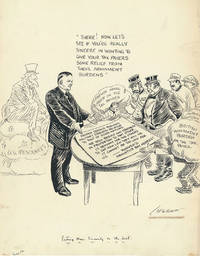
19208Pulitzer prize-winning editorial cartoonist with the "Chicago Tribune" 1903-45. Signed ink drawing 14¼" X 18" n.p. 1929. Very good. Slightest bit of edgewear and mild soiling. Labeled "Putting their Sincerity to the Test" by McCutcheon along the lower margin this single-panel cartoon depicts President Herbert Hoover full length front and center and facing right wonderfully executed as he stands in front of a circular table. With his arms he presents a large scroll laid out on this table which reads in full: "Proper defense requires military strength relative to that of other nations. We will reduce our strength in proportion to any other. It remains for the others to say how low they will go. It cannot be too low for us. Hoover's Armistic Day address." Hoover is saying "There! Now let's see if you're really sincere in wanting to give your tax payers some relief from their armament burdens." Behind Hoover at the left of the drawing a sketchy figure of a worried-looking Uncle Sam sits astride huge sacks of money labeled "U.S. Resources." In front of Hoover at the right of the drawing stand six attentive listeners: A portly "Britain" in Edwardian getup sports a Union Jack vest while alongside him a shadowy figure is hunched by the huge sack he hoists labeled "British Armament Burden on the Tax Payer"; "France" in military uniform scratches his bewhiskered chin while a similar hunched figure strains under a sack labeled "French Naval Burden on the Tax Payers"; behind these figures stand "Japan" in military uniform a "Japanese Burden" sack just visible at his side and "Italy" in military uniform sack at his side. On November 11 1929 Hoover had expressed these Armistice Day sentiments in a speech given before the Annual Convention of the Mississippi Valley Association. This drawing which McCutcheon dates "Nov. 13" at lower left is a superb and provocative example of McCutcheon's ability to humanize political concepts to make abstract notions concrete. And artistically this rendering of Hoover is among his very best. Signed simply "McCutcheon" at lower right as usual. unknown
15044Pulitzer prize-winning editorial cartoonist with the "Chicago Tribune" 1903-45. Original signed ink drawing 14½" X 18½" n.p. 1930. Very good. Slight edgewear and minor soiling. Labeled "The Inquiring Reporter. He asks the question 'Do you think the London Naval Treaty insures parity in American and British naval strength'" in cursive by McCutcheon on the lower margin. This text-heavy six-panel piece depicts the inquiring reporter notepad in hand listening to six persons all male of course some of them obviously in Chicago surroundings respond to this question. Upper left panel: dapper gent in old-time golf duds gold buddies behind him replies "No not so long as the British fleet has the Rodney and the Nelson." Upper right panel: Fellow in small boat on the Chicago River answers "Not so long as Britain has a great preponderance of fast merchant ships capable of being quickly converted into 6 inch auxiliary cruisers and commerce destroyers." Middle left panel: Stodgy executive-type seated behind impressive desk and bookcases offers: "No but we may in 1938 -- if the U.S. builds up to the limit allowed by the treaty -- and if Britain waits till we catch up." Middle right panel: Pudgy wader in old-time swimsuit on crowded Chicago beach front observes "We get parity in submarines destroyers and aircraft carriers -- and possibly in 8 inch cruisers six years from now -- inferiority in capital ships and 6 inch cruisers." Lower left panel: Driver stuck in bumper-to-bumper traffic some things in Chicago never change opines "Possibly in American waters eventually but not on our distant trade routes." Lower right panel: Pedestrian clinging to Chicago River street bridge as it rises up shouts to reporter clinging to other side "Not so long as we are hopelessly inferior in naval bases." Unlike contemporary editorial cartoons which would never get away with so much text earlier editorial cartoons such as this prime example often took more than a few seconds to grasp and assumed a firm understanding of detailed political topics of the day. Signed simply "McCutcheon" at lower right as usual. unknown
15046Pulitzer prize-winning editorial cartoonist with the "Chicago Tribune" 1903-45. Original signed ink drawing 14½" X 18" n.p. n.d. Very good. Slight edgewear and minor soiling. Untitled six-panel cartoon whose theme seems to be the improvement of cities. Each of the three left-side panels contrasts its right-side counterpart. Top left panel addresses unsanitary conditions by depicting an early "horseless carriage" under repair while a team of horses watches in amusement; top right panel shows a surprised horse reading a notice outside a city limits that reads "Notice! Horses sheep cattle and hogs not allowed within the city limits." Middle left panel addresses temperance by depicting a busy street filled with bars and men entering each while middle right panel shows a street with a gas station soft drink stand and movie theatre. Bottom left panel addresses proper housing by depicting a freight train chugging along on weedy ugly tracks while the bottom right panel shows the same boxcars transformed into cute little homes and their tracks quaint little front yards being tended by proud homeowners. A charming piece of social commentary. Signed simply "McCutcheon" at lower right as usual. unknown
15459Renowned Italian soprano often remembered as "la dinvina Claudia" and "The Duse of Opera." IPS Van Riel 8½" X 11" n.p. 1924. Near fine. A dramatic head shot of a very flapper-looking Muzio in beaded head scarf inscribed big and bold to a Chicago pianist and music school founder: "To John Leiser / Sincerely / Claudio Muzio / 1924." Scarce and choice. This item has been archivally framed in a single cream matte UV-filtering glass and 3/4" antiqued silver frame overall dimensions 11½" X 14". Bit of damage to top frame edge. The finest Muzio imaginable. unknown
40530This noted architect and sculptor of Cleveland Ohio -- the first Cleveland architect to join the American Institute of Architects -- built many important public buildings and monuments in that city; he served with the 103rd Regiment Ohio Volunteers and authored the 1909 study of the Franklin campaign "The Retreat from Pulaski to Nashville Tennessee." Partly-printed ADS 1p 17" X 11" n.p. 1863 December 1. Near fine. Form for obtaining payment for servants filled out and signed by Scofield who adds rank and title "1st Lieut. & Act. Topographical Engineer / 3d. Division 23d. A.C." He checks various columns to claim one months' pay and subsistence for his servant "John" whose complexion eyes and hair he all notes as "Black." He also notes payment coming from U.S. Army Paymaster John Coon -- his uncle by the way -- and Coon also signs. One of Scofield's most notable monuments is his Civil War monument "These Are My Jewels" -- a document from the 21-year-old future architect from his Civil War period is extremely unusual and desireable. unknown
27019The younger brother of Johann Jr. "The Waltz King" Strauss and Josef Strauss with whom he formed the renowned Strauss Orchestra that dominated Vienna's light music scene for decades and child of Johann Strauss Sr. "The Father of the Waltz" was himself a noted conductor and respected composer. AMuQS 1p 3½" X 2½" n.p. n.y. 1901. Very good. Faintly age toned; barely visible mounting trace at corners. Strauss was apparently asked for a snippet from an original composition for at the center of this heavy card he has affixed a 2¼" X 1" slip bearing three small neatly penned measures from an unidentified composition -- likely a waltz as it notes 3/4 time. Below this slip Strauss signs large and bold. An unusual most attractive item. unknown
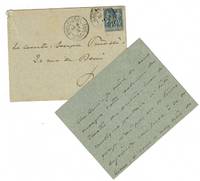
189475854Marly-le-Roi 1894. Fine. Marly-le-Roi 1894 11.30 x 8.90 cm une carte recto-verso Autograph letter signed by Alexandre Dumas Fils addressed to Count Joseph Primoli. Envelope included. A charming letter in which Dumas Fils thanks his friend for lending him a volume and invites him to visit during the week. It was at Princess Mathilde's salon mentioned in this letter: ""Tendresses respectueuses à la Princesse"" ""Respectful affection to the Princess"" that Dumas Fils and Joseph Primoli first met. unknown
188984470s. l.: S. n. 1889. Fine. S. n. s. l. 5 Mai 1889 10.50 x 6 cm une feuille une enveloppe Autograph signed carte de visite from Alphonse Daudet 13 lines written in blue ink addressed to journalist and librettist Philippe Gille sending his thanks and congratulations for a recent performance. Envelope included. S. n. unknown
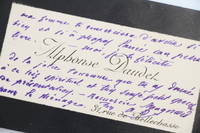
188986970Paris 1889. Fine. Paris 10 Avril 1889 10 x 6 cm une carte de visite une enveloppe Printed visiting card of Alphonse Daudet on which he added these few words for his friend the journalist Philippe Gille regarding his benevolent publicity that he devoted to his wife Julia's recently published work: ""Ma femme te remercie d'avoir si bien et si à propos lancé son petit livre. Moi je te félicite de la jolie tournure que tu as donné à ce très spirituel et bien sensé petit spectacle de présentation. Remercie Magnard pour le ménage. Ton A.D."" My wife thanks you for having so well and so aptly launched her little book. As for me I congratulate you on the nice turn you gave to this very witty and sensible little presentation show. Thank Magnard for the household. Yours A.D. Envelope enclosed with a tear due to the opening of the postal fold a date inscribed in margin on verso of the card probably that of the card's reception. unknown
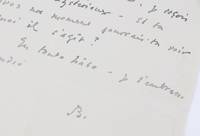
195483349Chassy 1954. Fine. Chassy 4 Janvier 1954 21 x 27 cm une feuille une enveloppe Autograph letter signed by Balthus addressed to gallery owner Henriette Gomès. 7 lines envelope included. Cross folds inherent to mailing a small tear to left margin of the letter not touching text the ink having faded. ""Chassy mardi the r and d having smudged Ma petite Henriette je reçois ce papier mystérieux - si tu trouves un moment pourrais-tu voir de quoi il s'agit En toute hâte - Je t'embrasse et André. B."" ""My little Henriette I receive this mysterious paper - if you find a moment could you see what it's about In great haste - I embrace you and André. B."" ""During the summer of 1952 Balthus found a château in the Nièvre between Autun and Avallon which he decided to rent and where he settled in the spring of the following year. The means were provided by his dealers Henriette Gomès Pierre Matisse and with them a collective of collectors including Maurice Rheims Alix de Rotschild and Claude Hersent. They paid him a pension in exchange for his latest paintings which they divided among themselves. The château was severely deteriorated and Balthus lived there modestly in continual restoration work. He had for company to help him settle in and ensure a presence when he went to Paris the poet Léna Leclercq met through Giacometti. The latter remained until spring 1955. Meanwhile Balthus had begun a love affair with his niece by marriage Frédérique Tison daughter from a previous union of his brother Pierre's wife."" Fondation Balthus unknown
193086491Paris: S. n. 1930. Fine. S. n. Paris s. d. ca 1930 14 x 21.50 cm une page recto verso Autograph letter by François Mauriac signed with his initials 28 lines in blue ink on letterhead from his Parisian residence on avenue Théophile Gautier addressed to Abbé Casy Rivière. Fold mark inherent to envelope insertion. François Mauriac discusses his upcoming summer travels: "". je pars le 20 en auto pour les Pyrénées et ne serai à Malagar que vers le 1 sept. Regrets ! ."" "". I leave on the 20th by car for the Pyrenees and will only be at Malagar around September 1st. Regrets! ."" but also literary activity and certain religious allegiances attributed to the magazine La Table ronde: ""Le Léautaud a paru pendant mon séjour à Florence et je l'ai beaucoup regretté. Cela ne se renouvellera plus. Mais n'allez pas croire que le T.R. soit une revue catholique. Je suis à peu près le seul à l'être dans la rédaction. Et c'est bien pourquoi je ne souhaite nullement qu'un vicaire la lise."" ""Léautaud was published during my stay in Florence and I greatly regretted it. This will not happen again. But don't think that T.R. is a Catholic magazine. I am about the only one to be so on the editorial staff. And that's exactly why I do not wish at all for a vicar to read it."" He ends the missive with this revelation concerning his productivity as a vacationer: ""Je lutte désespérément pour mon travail personnel contre tout ce qui m'en détourne surtout lorsque je suis loin de Paris."" ""I desperately struggle for my personal work against everything that distracts me from it especially when I am away from Paris."" S. n. unknown
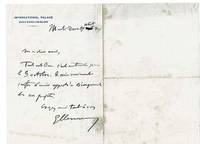
190976082Mont-Dore-Les-Bains Le Mont-Dore 1909. Fine. Mont-Dore-Les-Bains Le Mont-Dore 29 août 1909 13.60 x 21 cm 1 page sur un double feuillet Signed autograph letter from Georges Clémenceau addressed to a friend. One page written in black ink on a double sheet with letterhead from the International Palace of Mont-Dore-Les-Bains. Central fold inherent to mailing. Clemenceau then taking the thermal cure at Mont-Dore-les-Bains writes: ""All is well. It is agreed for October 9th. I am truly embarrassed to have brought this disruption to your plans."" unknown
190977465Mont-Dore-Les-Bains Le Mont-Dore 1909. Fine. Mont-Dore-Les-Bains Le Mont-Dore 29 août 1909 13.60 x 21 cm 1 page sur un double feuillet Autograph letter signed by Georges Clémenceau addressed to a friend. One and a quarter pages written in black ink on a double sheet with letterhead from the International Palace of Mont-Dore-Les-Bains dated August 25 1909. Folds inherent to mailing. Clemenceau then taking thermal baths at Mont-Dore-les-Bains writes: ""Quand votre aimable invitation m'est arrivée à Carlsbad j'avais un engagement déjà pris."" ""When your kind invitation reached me in Carlsbad I already had a prior engagement."" Charming and very aesthetic missive. unknown
1977671001977. Fine. 29 août 1977 15 x 10.50 cm une carte postale Postcard autograph of Hans Hartung addressed to Georges Raillad. Nine lines in black ink on the back of a blue monochrome postcard captioned ""Mediterranean holidays under a blue sky"". unknown