Édouard HerriotLivre Rare Book
66 615 résultats
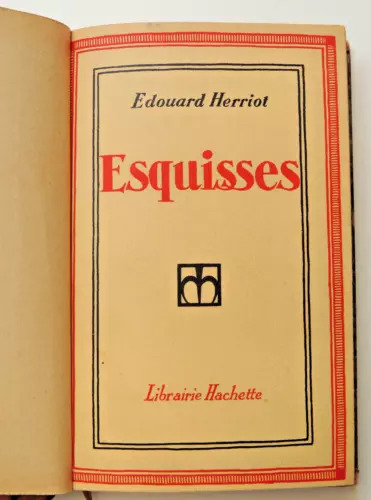
CZC-11858Bel envoi autographe: " c'est le privilège incomparable et comme sacré, de la musique dépareillée de tous les éléments périssables, qu'elle échappe à toute atteinte de la mort ". Édouard Herriot, né le 5 juillet 1872 à Troyes (Aube) et mort le 26 mars 1957 à Saint-Genis-Laval (Rhône), est un académicien et homme d'État français. Membre du Parti radical, il est une figure centrale de la IIIe République. Ministre au sein de nombreux gouvernements, il préside la Chambre des députés sous la IIIe République, puis l'Assemblée nationale sous la IVe République. Président du Conseil des ministres à trois reprises, il est l'un des chefs du Cartel des gauches, coalition gouvernementale et parlementaire des années 1920. Il est aussi le maire de Lyon de 1905 à 1940, puis de 1945 à sa mort. En 1946, il est élu à l'Académie française. vol in8, 190x125, reliure demi cuir, 240pp, couvertures d'origines conservées, parfait état intérieur. Paris, Hachette 1928. Édition Originale. ref/155
CZC-11858Bel envoi autographe: " c'est le privilège incomparable et comme sacré, de la musique dépareillée de tous les éléments périssables, qu'elle échappe à toute atteinte de la mort ". Édouard Herriot, né le 5 juillet 1872 à Troyes (Aube) et mort le 26 mars 1957 à Saint-Genis-Laval (Rhône), est un académicien et homme d'État français. Membre du Parti radical, il est une figure centrale de la IIIe République. Ministre au sein de nombreux gouvernements, il préside la Chambre des députés sous la IIIe République, puis l'Assemblée nationale sous la IVe République. Président du Conseil des ministres à trois reprises, il est l'un des chefs du Cartel des gauches, coalition gouvernementale et parlementaire des années 1920. Il est aussi le maire de Lyon de 1905 à 1940, puis de 1945 à sa mort. En 1946, il est élu à l'Académie française. vol in8, 190x125, reliure demi cuir, 240pp, couvertures d'origines conservées, parfait état intérieur. Paris, Hachette 1928. Édition Originale. ref/155
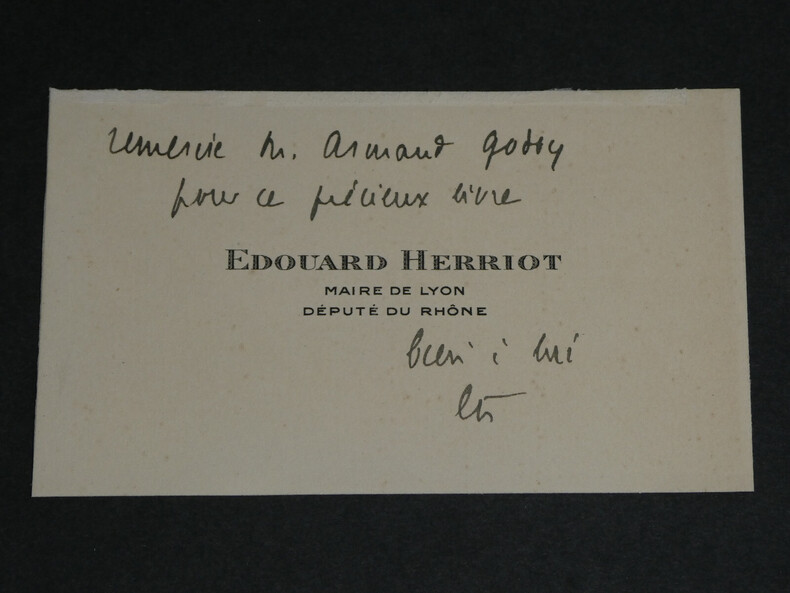
boz_003599Édouard Herriot. Carte de visite autographe signée à A. Godoy Carte de visite autographe signée d'Édouard Herriot, adressée à Armand Godoy. "remercie M. Armand Godoy pour ce précieux livre Bien à lui" Dimensions : 10,5 x 6,5 cm État : Traces d'onglet au dos de la carte. Nombre de pages : 1 page
boz_005026Édouard HERRIOT. Carte de visite autographe signée. Dimensions : 10,2 x 6,2 cm État : Voir photos pour plus de détails. Nombre de pages : 1 page Édouard HERRIOT Édouard Herriot, né le 5 juillet 1872 à Troyes et mort le 26 mars 1957 à Saint-Genis-Laval, est un académicien et homme d'État français. Membre du Parti radical, il est une figure centrale de la IIIᵉ République.
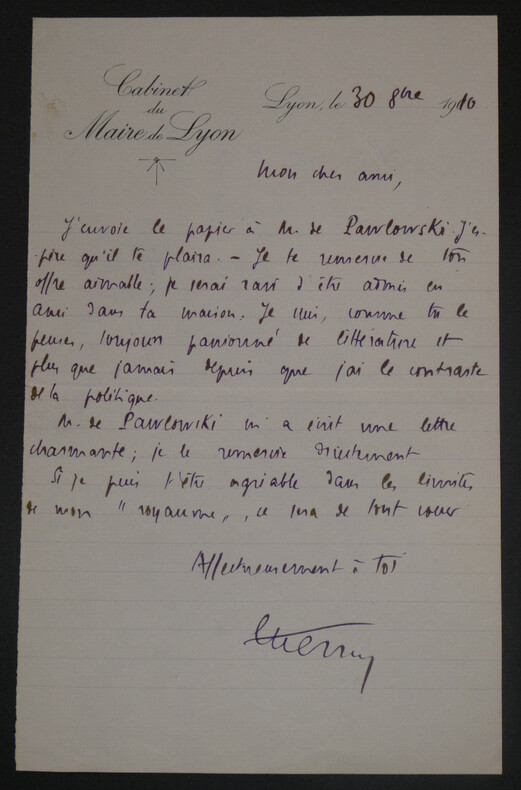
boz_005183Édouard HERRIOT. Carte lettre autographe signée. Homme d’État français et ancien maire de Lyon Description : Carte-lettre sur papier à en-tête "Cabinet du Maire de Lyon" Dimensions : 14,6 x 11,8 cm État : Voir photos pour plus de détails. Nombre de pages : 1 page Édouard HERRIOT Édouard Herriot, né le 5 juillet 1872 à Troyes et mort le 26 mars 1957 à Saint-Genis-Laval, est un académicien et homme d'État français. Membre du Parti radical, il est une figure centrale de la IIIᵉ République. Wikipédia Contactez-nous Lettres autographes, vieux papiers, livres anciens, photographies, gravures, timbres?? Nous expertisons et/ou rachetons dans toute la France vos lettres, collections de lettres et livres anciens. Paiement Sont acceptés les paiements par eBay, par PayPal, par virement ou par chèque. Envoi Envoi soigné dans un emballage rigide et étanche sous trois jours. Prévoir les délais postaux habituels en plus. Retour Satisfait ou remboursé. Si vous n'êtes pas entièrement satisfait, retour à la charge du vendeur pour l'Europe. À la charge de l'acheteur pour le reste du monde.
1910boz_002860Édouard HERRIOT. Lettre autographe signée en date du 30 août 1910, à Lyon. Dimensions : 13,3 x 21,2 cm État : Voir photos pour plus de détails. Nombre de pages : 1 page Édouard HERRIOT Édouard Herriot, né le 5 juillet 1872 à Troyes et mort le 26 mars 1957 à Saint-Genis-Laval, est un académicien et homme d'État français. Membre du Parti radical, il est une figure centrale de la IIIᵉ République.
boz_005045Édouard HERRIOT. Lettre autographe signée. Dimensions : 12,8 x 10,2 cm Nombre de pages : 1 page
1929boz_002086ÉLOGE FUNEBRE AUTOGRAPHE SIGNÉE de Georges Clémenceau, par Édouard GARNIER, 1929. Dimensions : 32 x 16,1 cm. Nombre de pages : 6 pages.
1956boz_002450Édouard FER - LETTRE AUTOGRAPHE SIGNÉE, de 1956 à Nice Artiste Peintre Édouard FER - LETTRE AUTOGRAPHE SIGNÉE de remerciement, de 1956 à Nice, pour des vers reçus et grandement appréciés. Dimensions : 21,2 X 13,6 État : Voir photos pour plus de détails. Nombre de pages : 1 page.
189164384s. l. 3 avril 1891 | 10 x 13 cm | un feuillet remplié
1854boz_002274Édouard DROUYN de LHUYS. Lettre autographe signée, 1854 Dimensions : 13,5 x 20,7 cm Nombre de pages : 2 pages
1877boz_002858Édouard Drouyn de Lhuys. Lettre autographe signée, 1877 Lettre autographe signée d'Édouard Drouyn de Lhuys, datée du 30 mars 1877, rédigée à l'encre brune sur un double feuillet de papier vergé. Dimensions : 10,3 x 13,1 cm Nombre de pages : 1 page Édouard Drouyn de Lhuys
1898boz_004432Édouard CÉALIS. Carte de visite autographe de félicitations - 1898 Carte de visite autographe d'Édouard Céalis, datée du mois de septembre 1898. Céalis et sa femme félicitent leur correspondant pour son succès personnel dans la pièce de théâtre "Louis XI". Dimensions : 10,1 x 6 cm État : Voir photos pour plus de détails. Nombre de pages : 2 pages
1871boz_002586Édouard charton. Lettre autographe signée à un ministre, 1871 Lettre autographe signée d'Édouard Charton, adressée à un ministre, datée du 1 septembre 1871, écrite à l'encre sur un double feuillet de papier vélin, avec entête "Assemblée Nationale". Dimensions : 13,1 x 20,4 cm Nombre de pages : 1 page
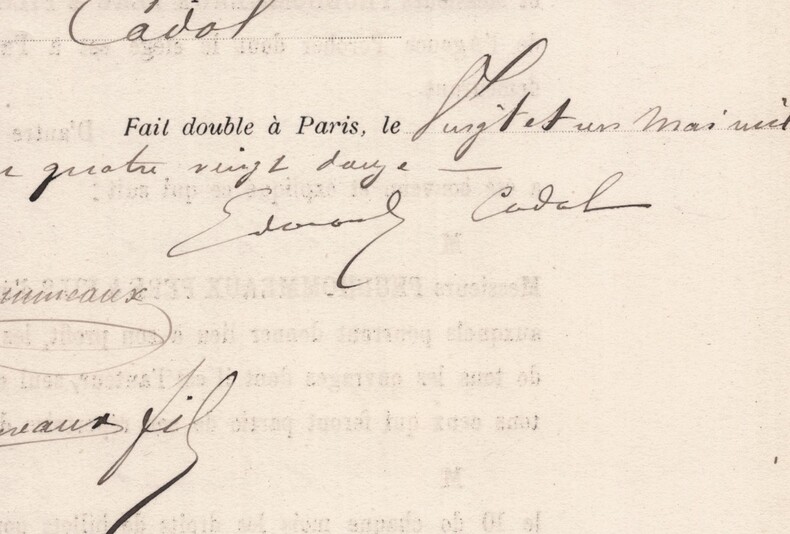
boz_004847Édouard Cadol Pouvoir signé par Édouard Cadol, dramaturge et romancier français. Dimensions : 24 x 17 cm.
boz_003130Édouard Cadol Pouvoir signé par Édouard Cadol, dramaturge et romancier français. Dimensions : 24 x 17 cm.
19980402Paris, L'Ambassade de France à Kuala Lumpur, 1998. Seule et unique édition. Bilingue français et anglais. Signé par Sergio Telles en portugais sur la page de garde. In-8 quasi carré de 23,8 x 22 cm, 49 pp. avec 40 illustrations couleur. Relié avec jaquette. Rabats exceptionnellement grands avec un mot d'Édouard Braine en français à l'avant et en anglais à l'arrière. Envoi autographe de Telles à Rio de Janeiro sur la garde blanche, en revers de la page de titre. Nombreuses peintures de l'auteur, la plupart à Paris, commentées par E. Braide, avec un mot de Pierre Seghers et quelques peintures réalisées en Malaisie à la fin. Né en 1936 au Brésil, Sergio Telles apprend la peinture dès l'âge de 9 ans, au zoo de Rio de Janeiro, dans un atelier en plein air. Après un court passage à l'école des beaux-arts, puis il intègre le lycée militaire avant de faire des études de droit. Il travailla dans les ateliers de Rodolfo Chambellant et Marie Nivouliès, entre autres, avant de réussir un concours qui le fera entrer au Ministère des Affaires Étrangères et, par là, dans la diplomatie. "Il peint surtout des huiles. Du figuratif et de l'abstrait. Des scènes de rues, sa principale source d'inspiration." (L'Orient-Le Jour, 1999) ************************************** Paris, The French Embassy at Kuala Lumpur, 1998. First and only edition. Text in French and English. Signed by Sergio Telles in Portuguese on the flyleaf. An almost square octavo book of 23.8 x 22 cm, 49 pp. with 40 color illustrations. Bound with dust jacket. Exceptionally large flaps with a word from Édouard Braine in French on the front and in English on the back. Autograph dedication from Telles at Rio de Janeiro on the white flyleaf, facing the title page. Many paintings by the author, mostly in Paris, commented by E. Braide with a word by editor Pierre Seghers and some paintings done in Malaysia at the end. Born in 1936 in Brazil, Sergio Telles learned painting from the age of 9, at the Rio de Janeiro zoo, in an open-air studio. After a short stint at the school of fine arts, he then joined the military high school before studying law. He worked in the studios of Rodolfo Chambellant and Marie Nivouliès, among others, before passing a competitive exam that would allow him to enter the Ministry of Foreign Affairs and, through it, into diplomacy. "He mainly painted oils. Figurative and abstract. Street scenes, his main source of inspiration." (L'Orient-Le Jour, 1999)
boz_002181Edouard BOURDET - Lettre Autographe Signée "Recette du Lièvre à Royale" Auteur : Edouard BOURDET Dimensions : 21,4 x 17,7 cm Nombre de pages : 1 page État : Voir photos pour plus de détails.
1876boz_002123Édouard Antoine Sidoine de Fitz-James. Lettre autographe signée, 1876 Lettre autographe de recommandation signée d'Édouard Antoine Sidoine de Fitz-James, 8ème Duc de Fitz-James, datée du 1er juin 1876 à Paris. Dimensions : 10,2 x 12,7 cm Nombre de pages : 3 pages
Very Good Turkish, Ottoman (1500-1928) Contemporary (early 19th century) quarter brown cloth with marbled boards, "Yahudi ebrûsu" end-papers. Roy. 8vo. (23 x 16 cm). In Ottoman script (Old Turkish with Arabic letters). 90 p., numbered with Arabic numeric system in pencil, around seven illustrated schemes of magical diagrams. Written on a probably 17th-18th century European paper with "Crescent" watermark, naskh script with "harakât", black and red ink. Early and a rare posthumous manuscript copy of this 18th-century Islamic majmua, containing the treatment methods and drug compositions against physical and spiritual diseases, with material and magical suggestions, copied 32 years after the author's death by a "Hafiz" with an addendum of new drugs and treatments compiled from older annotations of this work. "In the first part of the work on spiritual medicine, verses, prayers, talismans, and magic formulas in the Islamic culture like "wafqs" that are believed to be treated; in the second part, on physical medicine, drug formulas from various material objects for physiological diseases are shown." (Çagrici). Harputî was an 18th-century poet and prose from Harput (Kharberd). In the introduction to the manuscript, he stated that he is not a doctor, but that he writes practices that can heal patients due to his experiences. Despite this, the text was widely used in Ottoman medicine in the 18th and 19th centuries.
Folio and 4to. Altogether 5 pp. Together with the copy of an order by King Philip II of Spain and the copy of a petition to the governor of Milan. Collection of documents from Álvarez de Toledo's brief term as governor of the Duchy of Milan (1555-56). The earliest document concerns the repayment of a loan to the Duchy of Milan by Roger de Taxis, Imperial Postmaster in Venice. The original order by the future King of Spain, Philip II, then King of Naples and of England and Duke of Milan, is attached in copy. It had been issued in Hampton Court Palace on 20 May 1555, whereas Álvarez de Toledo signed his order in Milan on 23 July 1555. Roger de Taxis was a great-nephew of Francesco I de Taxis (originally de Tasso), the Imperial Postmaster General who is seen as the founder of the European postal system and the powerful Thurn and Taxis dynasty. - Two documents concern fortification works at the Castello Visconti in Pavia that had been heavily damaged by French troops in 1527 (military camp, 8 September 1555, and Milan, 24 October 1555). A copy of the original request from the registry of Pavia is attached to the second letter. - On 28 October 1555, Álvarez de Toledo signed a contract with the Novarese nobleman Giovanni Battista Caccia over a significant loan of 15,000 scudi, detailing interest rates and the mode of repayment. - An order signed in Milan on 20 November 1555 concerns the payment of two soldiers guarding the "porta de Briona in Domodossola". With 2 pp. of notes from 27 November 1555, naming the two soldiers. - The latest document in the collection is an exemption from a "grave extraordinary tribute" for the "house, family and possessions" of captain Giovanni Maria Ogliato: "Essendo mente nra che il Cap.no Gio Maria Olgiato sia preservato da qualonq. grave e estraordinarie per la casa, famiglia, et possess.ni sue: vi dicemo & comittemo debbiati proveder, che cosi gli sia osservato integrame.te. [...]". Olgiato was a military engineer in the army of emperor Charles V; from 1554 to 1557 he was responsible for the refurbishment of the Genovese fortress near Portofino. Known today as "Castello Brown", the building featured prominently in Elizabeth von Arnim's 1922 novel "The Enchanted April". - Fernando Álvarez de Toledo was arguably the most important Spanish general of the 16th century, serving Charles V and Philip II in the highest commands. He first distinguished himself as a general in the conquest of Tunis in 1535. With the relief of Perpignan in 1542, Alba delivered a decisive victory over the French; five years later he played an important role in the Battle of Mühlberg. In 1555 Charles V appointed his best general as commander in chief of the Spanish-Habsburg army in Italy and governor of Milan. Alba led a successful military campain against Pope Paul IV and his French allies. The Peace of Cateau-Cambrésis that ended the Italian War of 1551-59 is considered a Spanish diplomatic success. Today, the Duke of Alba is best remembered and infamous as governor of the Spanish Netherlands (1567-1573). His harsh repression of the Dutch revolt earned him the nickname "Iron Duke". Despite several military victories and countless executions of insurgents, Alba was not able to quell the revolt and was relieved of his command in 1573. His final victory in the Battle of Alcântara near Lisbon on 25 August 1580 led to the establishment of the Iberian Union. - All documents with papered seals and annotations. Five of the six documents (excepting the contract from 28 October 1555) counter-signed by two high ranking officials. The two documents from November 1555 show several minor tears and stronger browning to the upper and right borders. The contract shows some browning to the upper and lower borders.
1½ SS. Gr.-4to. An Herrn Lechner: "[...] Mein Sohn teilte mit etwas verspätet von Deinem Anruf mit. Er sagte mir, dass es sich um den keramischen Fries 'Brigittakirtag' handelt und um eine Ausstellung desselben u. a. m. Er hätte Dich auch nicht deutlich gehört, wie das manchmal im Telefon vorkommt. Ich bitte Dich daher wenn möglich um kurze schriftliche Nachricht, da ich jetzt längere Zeit nicht nach Wien komme. Ich bin ab 5. Jänner wieder in Unken bei Lofer (Kaffee Wimmer) Salzburg, weil ich dort einen dringenden Auftrag von der N. S. V. zu erledigen habe. Den Fries habe ich vor einigen Monaten bei den Wienerbergern fertiggestellt. Die Wienerberger wollten ihn auch auf der Messe ausstellen und wenn er jetzt nicht an Ort und Stelle, wo er hingehört montiert werden kann, glaube ich, ist nichts gegen eine vorherige Ausstellung desselben einzuwenden [...]". - Franz von Zülow war seit 1908 Mitglied der Klimt-Gruppe, trat 1933 der Secession und 1939 dem Künstlerhaus bei und wurde 1946 Ehrenmitglied der (neuen) Secession. Sein Werk umfaßt Ölbilder, Entwürfe für Tapeten und Stoffe, Holz- und Linolschnitte sowie Wand- und Möbelmalereien. Vgl. Thieme/B. 36 583f.
Oblong 8vo (postcard). 1 page. Inscribed to the German dermatologist Alwin Scharlau. - A son of the animal painter Heinrich von Zügel, Willy Zügel attended his father's painting class at the Munich Academy before turning towards sculpture in 1903. He produced popular animal figurines for the porcelain manufactures Rosenthal, Nymphenburg and Meißen, as well as publicly commissioned monuments, including a war memorial in Murrhardt. - A few small ink spots. Self-addressed by the collector on the reverse. The Mecklenburg physician Scharlau (b. 1888) assembled a collection of artists' autographs by personal application.
1 S. 8vo. Neujahrswünsche an den Maler Maximilian Liebenwein (1869-1926) in Wien. - Der Sohn eines Schäfereibesitzers war von 1895 bis 1922 Professor an der Münchner Akademie und "gilt als der bedeutendste deutsche Tiermaler der Jahrhundertwende, der der Tierdarstellung mit Hilfe der impressionistischen Malerei neue Wege wies" (DBE).
1 S. auf Doppelblatt. Qu.-8vo. Mit rotem Rundstempel der "J. K. Riess Handschriftensammlung", Inv.-Nr. "1189" und Lochspur von alter Heftung. Doppelblatt entlang des Querfalzes durchtrennt.