Louise MICHELBiblio.com
1 815 résultats
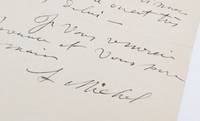
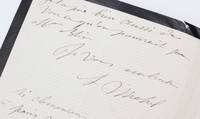
188583961s. l. Paris 1885. Fine. s. l. Paris 15 août 1885 13.40 x 21.10 cm 1 page 1/2 sur un bifeuillet Autograph letter signed by Louise Michel addressed to Lucien Barrois; one and a half pages written in black ink on a bifolium of white paper with black border. Transverse folds inherent to mailing. Tears to lower margin without loss at the fold. Louise Michel requests help for one of her friends: ""Vous savez que le père Blin ne peut plus travailler depuis deux mois passés voici maintenant la mère Blin qui vient de tomber très malade. Voyez ce qu'on pourrait faire vous savez tous les services qu'ils ont rendus en 70-71. Mon petit cousin . aidera le père Blin à tenir son kioske sic mais cela ne donne pas de secours à la maladie de Mme Blin. Mme Barrois devait revenir demain samedi ici qu'elle ne l'oublie pas mais je la prie bien aussi de voir ce qu'on pourrait pour Mme Blin."" ""You know that father Blin has been unable to work for the past two months and now mother Blin has just fallen very ill. See what could be done you know all the services they rendered in 70-71. My little cousin . will help father Blin run his kiosk but that doesn't provide relief for Mme Blin's illness. Mme Barrois was supposed to return here tomorrow Saturday may she not forget it but I also earnestly ask her to see what could be done for Mme Blin."" Mme Blin actively participated in the Paris Commune alongside Louise Michel; with other Parisian women they created the Women's Vigilance Committee and asked Louise Michel to take charge of it. Moving letter testimony to the unfailing devotion of the former Communard. unknown
188683952s. l. Paris 1886. Fine. Letter to the Tiger: ""Before returning to the cage"" s. l. Paris 7 août 1886 13.20 x 19.20 cm 3 pages sur un bifeuillet Autograph signed letter from Louise Michel addressed to Georges Clemenceau; three pages written in black ink on a bifolium of white paper. Transverse creases inherent to posting. Fine letter from Louise Michel to Clemenceau one of her most important supporters before yet another incarceration: « Il faut avant de rentrer en cage . que je vous demande le grand service de faire entrer à l'hospice mon cousin le petit Dacheux à qui vous avez bien voulu faire avoir sa dispense d'âge. » ""Before returning to the cage . I must ask you the great favor of having my cousin little Dacheux admitted to the hospice for whom you were kind enough to obtain his age exemption."" The former communard has indeed just been sentenced to four months in prison for having given a speech in favor of the Decazeville miners alongside Jules Guesde Paul Lafargue and Étienne Susini. But for now it is the condition of her cousin Lucien Dacheux that concerns her: « Son genou étant de plus en plus malade on l'envoie en congé de deux mois mais il faut qu'il entre à l'hospice s'il ne veut pas rester estropié. De plus on n'a pu lui donner une mécanique pour son genou et en même temps le médecin lui disait que c'était indispensable - peut-être pourra-t-il en avoir une au Val de Grâce - je le recommande bien à vous et au citoyen Lafont - J'irai vous voir pour cela et une autre chose du même genre avant le 12 mais s'il était possible de faire entrer avant à l'hospice le petit Lucien Dacheux je serais bien heureuse car il sera tout à fait estropié et incapable de continuer son service où on est très content de lui. » ""His knee being increasingly ill they are sending him on two months' leave but he must be admitted to the hospice if he doesn't want to remain crippled. Moreover they couldn't give him a mechanism for his knee while at the same time the doctor told him it was indispensable - perhaps he could get one at Val de Grâce - I recommend him highly to you and to citizen Lafont - I will come to see you about this and another matter of the same kind before the 12th but if it were possible to have little Lucien Dacheux admitted to the hospice beforehand I would be very happy because he will be completely crippled and unable to continue his service where they are very pleased with him."" Louise Michel met Clemenceau in October 1870 when he was mayor of Montmartre and she was assistant schoolmistress. From their first meeting was born a strong friendship that lasted until Louise Michel's death. Clemenceau never ceased to support her particularly during her banishment to Nouméa and they maintained an extensive correspondence. A moving letter testimony to the unwavering devotion of the former communard and to the great friendship that united Louise Michel to Georges Clemenceau. unknown
195080910s. l. Klarskovgaard 1950. Fine. s. l. Klarskovgaard 17 novembre 1950 21 x 34 cm 2 pages sur un feuillet Autograph letter signed with the initials of Louis-Ferdinand Céline addressed to his lawyer Master Thorvald Mikkelsen. Two pages written in blue ink on a large sheet of white paper; number ""568"" in Céline's hand in red pencil at the top left. Transversal folds inherent to mailing. This letter was very partially transcribed in Année Céline 2005. Early November 1950 Gaby Paul had come to visit Céline and Lucette at Klarskovgaard: ""Oh mille mercis à Mme Christensen pour son aimable repas qui réchauffé fit nos délices ! Et puis aussi gratitudes pour tout le soin qu'elle a pris de Mme Gen Paul !. Laquelle ne donne aucune nouvelle. Quelle vacherie encore . Comme c'est amusant ! Je crois qu'elle avait des projets ""journalistiques"" mais que mon attitude l'a désenchantée. """"Oh a thousand thanks to Madame Christensen for her kind meal which reheated was our delight! And also gratitude for all the care she took of Mme Gen Paul!. Who gives no news. What nastiness again. How amusing! I believe she had 'journalistic' projects but my attitude disenchanted her."" Céline also mentions the Swedish writer Ernst Bendz one of the few to defend Céline alongside Paraz: ""Une lettre amusante de Bendz ! Bendz appartient vraiment à l'aristocratie des esprits ! La preuve ! La façon qu'il ""m'estime""!!!""""An amusing letter from Bendz! Bendz truly belongs to the aristocracy of minds! The proof! The way he 'esteems me'!!!"" In 1947 Céline pursued by French justice for his collaborationist involvement was confined in Denmark. It was in May 1948 accompanied by Lucette and Bébert that he arrived at his lawyer Master Thorvald Mikkelsen's home at Klarskovgaard. The latter owned a large property by the Baltic Sea and invited the exile to stay there. On February 21 1950 as part of the épuration the writer was definitively sentenced in absentia by the civic chamber of the Paris Court of Justice for collaboration to one year of imprisonment which he had already served in Denmark. The Swedish Consul General in Paris Raoul Nordling intervened on his behalf with Gustav Rasmussen Danish Foreign Minister and managed to delay his extradition. On April 20 1951 Jean-Louis Tixier-Vignancour his lawyer since 1948 obtained Céline's amnesty under the title of ""severely disabled veteran of the Great War"" by presenting his file under the name Louis-Ferdinand Destouches without any magistrate making the connection. Céline would leave Denmark the following summer after three years spent at his lawyer's home. unknown
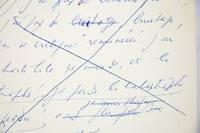
195484046Meudon 1954. Fine. Meudon 1954 20.70 x 26.80 cm une page sur un feuillet Autograph manuscript signed by Louis-Ferdinand Céline written in blue ballpoint pen on a sheet of white paper numbered 565 in the left corner. One transverse fold. Some pin holes in the upper margin evidence of the organization of Céline manuscripts in ""bundles"". « torrents de phosphore jaillir des brèches ! . et les avions foncer charger fendre ces flots ! les ""forteresses"" ! aller et retour ! et que c'est le Jules le crime » ""torrents of phosphorus gushing from the breaches! . and the planes rushing charging cleaving these waves! the ""fortresses""! back and forth! and that it's Jules who's the crime"" The passage on our sheet conforms to the published version. Published in 1954 Normance is a direct sequel to Féérie pour une autre fois which appeared two years earlier. Both parts were written during Céline's years of exile and imprisonment in Denmark. Upon his return to France in 1951 Céline undertook a work of ""polishing"" and published these two titanic texts independently originally conceived as one. ""Céline while working on it thought of this novel as a second Voyage au bout de la nuit capable twenty years later of astonishing the public as much as the 1932 novel."" Henri Godard unknown
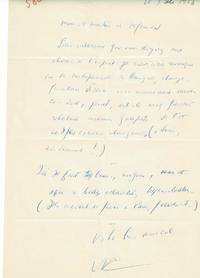
195076186s. l. Klarskovgaard 1950. Fine. s. l. Klarskovgaard 7 octobre 1950 21 x 34 cm 2 pages sur 2 feuillets Partly unpublished autograph letter signed by Louis-Ferdinand Céline addressed to his ""dear Master and defender"" Maître Thorvald Mikkelsen. Two pages written in blue ink on two large sheets of white paper; numbers ""580"" and ""581"" in Céline's hand in the upper left corner in red pencil. Transverse folds inherent to the mailing. This letter was very partially transcribed in the Année Céline 2005. Autograph letter signed by Louis-Ferdinand Céline addressed to his ""dear Master and defender"" Maître Thorvald Mikkelsen. Two pages written in blue ink on two large sheets of white paper; numbers ""580"" and ""581"" in Céline's hand in the upper left corner in red pencil. Transverse folds inherent to the mailing. Céline sends Mikkelsen an article: ""Pour intéressé que vous soyez aux choses de l'esprit je crois avoir remarqué que les turlupinades des banques changes fricoteries diverses vous amusaient aussi. Ci-donc joint article assez farceur relatant certaines galipettes de l'or et ses escrocs changeurs à Paris évidemment !"" ""However interested you may be in matters of the mind I believe I have noticed that the buffooneries of banks exchanges and various swindles also amuse you. Here therefore attached is a rather farcical article relating certain antics of gold and its swindling money-changers in Paris obviously!"" The writer attached to his letter another sheet whose numerous underlinings bear witness to the persecution he felt victim to: ""Maintenant qu'on remonte la Ligne Maginot qu'on recrée une Légion Anti Bolchéviques une armée franco-allemande il paraît qu'il est question de me poursuivre à nouveau d'après les Beaux Draps mais cette fois pour antigermanisme et sabotage de l'Europe Nouvelle et irrespect pour Hitler ! Oh je n'en mène pas large !"" ""Now that they're rebuilding the Maginot Line recreating an Anti-Bolshevik Legion a Franco-German army it seems they're planning to prosecute me again based on Les Beaux Draps but this time for anti-Germanism and sabotage of the New Europe and disrespect for Hitler! Oh I'm not feeling very confident!"" In 1947 Céline pursued by French justice for his collaborationist involvement was confined in Denmark. It was in May 1948 accompanied by Lucette and Bébert that he arrived at his lawyer Maître Thorvald Mikkelsen's home in Klarskovgaard. The latter owned a large property by the Baltic Sea and invited the exile to stay there. On February 21 1950 as part of the purge the writer was definitively condemned in absentia by the civic chamber of the Paris Court of Justice for collaboration to one year of imprisonment which he had already served in Denmark. The Swedish Consul General in Paris Raoul Nordling intervened on his behalf with Gustav Rasmussen the Danish Foreign Minister and managed to delay his extradition. On April 20 1951 Jean-Louis Tixier-Vignancour his lawyer since 1948 obtained Céline's amnesty as a ""severely disabled veteran of the Great War"" by presenting his file under the name of Louis-Ferdinand Destouches without any magistrate making the connection. Céline would leave Denmark the following summer after three years spent at his lawyer's home. In 1947 Céline pursued by French justice for his collaborationist involvement was confined in Denmark. It was in May 1948 accompanied by Lucette and Bébert that he arrived at his lawyer Maître Thorvald Mikkelsen's home in Klarskovgaard. The latter owned a large property by the Baltic Sea and invited the exile to stay there. On February 21 1950 as part of the purge the writer was definitively condemned in absentia by the civic chamber of the Paris Court of Justice for collaboration to one year of imprisonment which he had already served in Denmark. The Swedish Consul General in Paris Raoul Nordling intervened on his behalf with Gustav Rasmussen the Danish Foreign Minister and managed to delay his extradition. On unknown
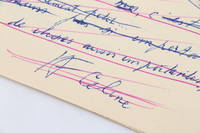
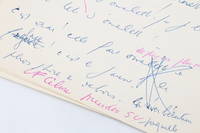
195484027Meudon 1954. Fine. Meudon 1954 20.70 x 26.80 cm une page sur un feuillet Autograph manuscript signed by Louis-Ferdinand Céline written in blue and pink ballpoint pens on a white paper sheet numbered 507 in the left corner. One transverse fold. Some pin holes in the upper margin stigmata of the organization of Céline manuscripts in ""bundles"". « j'ai pas de cinéma personnel j'ai pas de bruitage j'ai pas de critiques ""rémunérés"" j'ai que l'hostilité du monde et la catastrophe ! je perds la catastrophe je suis perdu ! . chienlit ! charlatan ! barbeau mou ! Comme ça vous m'intitulez si vous me trouvez pas dans la loge en plein enragement d'éléments ! je veux pas que vous. » The passage in our sheet presents some variations from the published version. Published in 1954 Normance is a direct sequel to Féérie pour une autre fois published two years earlier. Both parts were written during Céline's years of exile and imprisonment in Denmark. Upon his return to France in 1951 Céline undertook a work of ""polishing"" and published independently these two titanic texts originally envisioned as one. ""Céline while working on it thought of this novel as a second Voyage au bout de la nuit capable twenty years later of astonishing the public as much as the 1932 novel."" Henri Godard unknown
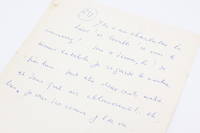
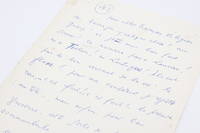
195080911s. l. Klarskovgaard 1950. Fine. s. l. Klarskovgaard 17 novembre 1950 21 x 34 cm 1 page sur un feuillet Autograph letter signed with the paraph of Louis-Ferdinand Céline addressed to his lawyer Master Thorvald Mikkelsen. One page written in blue ink on a large sheet of white paper; number ""566"" in Céline's hand in red pencil at the top left. Transversal folds inherent to mailing. This letter was very partially transcribed in Année Céline 2005. Early November 1950 Gaby Paul had come to visit Céline and Lucette at Klarskovgaard: ""Mme Gen Paul a repris la route de Montmartre toute ravie de votre accueil ! A moi de vous remercier chaleureusement car enfin j'espère que votre généreuse réception me sera comptée ""à indulgence""."" ""Mme Gen Paul has taken the road back to Montmartre delighted with your welcome! It is for me to thank you warmly because I finally hope that your generous reception will be counted in my favor as 'indulgence'."" Through her intermediary Céline evidently received news of his former Montmartre companions: ""Je ne sais pas quels crimes j'ai commis mais pour ces fourbes canailles du 18eme Arrt. ma légende de bistrot en bistrot est devenue un Super Niebelung d'horreurs ! C'est rigolo. Au point qu'aucun n'ose me venir voir ici !"" ""I don't know what crimes I committed but for these deceitful scoundrels of the 18th district my legend from bistro to bistro has become a Super Niebelung of horrors! It's amusing. To the point that none dare come to see me here!"" In 1947 Céline pursued by French justice for his collaborationist involvement was confined in Denmark. It was in May 1948 accompanied by Lucette and Bébert that he arrived at his lawyer Master Thorvald Mikkelsen's home at Klarskovgaard. The latter owned a large property by the Baltic Sea and invited the exile to stay there. On February 21 1950 as part of the épuration the writer was definitively sentenced in absentia by the civic chamber of the Paris Court of Justice for collaboration to one year of imprisonment which he had already served in Denmark. The Swedish Consul General in Paris Raoul Nordling intervened on his behalf with Gustav Rasmussen Danish Foreign Minister and managed to delay his extradition. On April 20 1951 Jean-Louis Tixier-Vignancour his lawyer since 1948 obtained Céline's amnesty under the title of ""severely disabled veteran of the Great War"" by presenting his file under the name Louis-Ferdinand Destouches without any magistrate making the connection. Céline would leave Denmark the following summer after three years spent at his lawyer's home. unknown
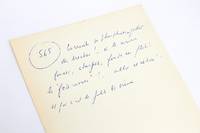
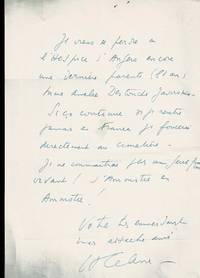
195076172s. l. Klarskovgaard 1950. Fine. s. l. Klarskovgaard 8 décembre 1950 21 x 34 cm 2 pages sur un feuillet Autograph letter signed partly unpublished by Louis-Ferdinand Céline addressed to his lawyer Maître Thorvald Mikkelsen. Two pages written in blue ink on a large sheet of white paper; numbered 575 in Célines hand in red pencil at the top left corner. Fold marks from mailing. This letter was only partially transcribed in Année Céline 2005 p. 64. A moving and bitter letter by Céline who had just lost his aunt Amélie the Aunt Hélène of Death on Credit and witnesses the slow disappearance of the world he once knew. The writer finds solace in the memoirs of Élisabeth de Gramont another witness to a bygone era. From his Danish exile Céline learns with sorrow of the death of his Aunt Amélie the last surviving member of the Destouches family: Je viens de perdre à l'hospice d'Angers encore une dernière parente. Although he had not spared his alter ego in Death on Creditthe scandalous Aunt Hélène meets a shameful end trailed by suitors lovers or clientshe recalls: À Saint-Pétersbourg elle est devenue grue. . Elle est venue nous voir au Passage deux fois de suite frusquée superbe comme une princesse et heureuse et tout. Elle a terminé très tragiquement sous les balles dun officier. The real Aunt Amélie had settled in Romania married to a diplomat Zenon Zawirski. Unfortunately reality caught up with fiction: she returned to Paris in utter destitution at the age of 80. Céline arranged for her transfer from the hospice of the Little Sisters of the Poor in Breteuil to the hospital in Angers where she died in December 1950 Que la pauvre femme meure gentiment. Assez de fins tragiques dans la famille ! he had written to Dr. Camus on 11 July 1949. His secretary Marie Canavaggia met her before her arrival in Angers: elle avait par moments des gestes et des expressions qui en éclairs me rappelaient son neveu 13 July 1949. With the last of his family gone Céline reflects on his own end: si ça continue si je rentre jamais en France je foncerai directement au cimetière. Devouring the books his lawyer sent to ease the burden of exile Céline describes his current readings: Le Temps des équipages by Élisabeth de Gramont est un des livres fameux parus vers 1920 ! Lun des « Guides des Snobs » les mieux réussis de lÉpoque. It is striking to imagine Céline delighting in this aristocrats social chronicle so alien to his world: Javais un ami Carré de Rennes étudiant en droit qui lavait appris par cur ! . il sen est établi marchand de tableaux. As a young medical student Céline had indeed crossed paths with Louis Carré later a successful Parisian art dealer who exhibited Paul Klee Juan Gris Le Corbusier and Picasso: il y a fait 10 fois fortune ! Preuve que tous les livres ne sont pas déprimants ! In 1947 pursued by French justice for his collaborationist stance Céline took refuge in Denmark. In May 1948 accompanied by Lucette and Bébert he arrived at the home of his lawyer Maître Thorvald Mikkelsen in Klarskovgaard. Mikkelsen owned a large estate on the Baltic Sea and welcomed the exiled writer to stay. On 21 February 1950 as part of the post-war purge Céline was definitively sentenced in absentia by the Civic Chamber of the Paris Court of Justice to one year in prison for collaboration a sentence already served in Denmark. Raoul Nordling the Swedish consul general in Paris intervened on his behalf with Gustav Rasmussen the Danish Foreign Minister successfully delaying his extradition. On 20 April 1951 Jean-Louis Tixier-Vignancour his lawyer since 1948 obtained Célines amnesty as a severely disabled veteran of the Great War submitting the case under the name Louis-Ferdinand Destouches without the magistrates making the connection. Céline left Denmark that summer after three years spent in his lawyers home. unknown
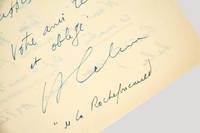
195075963s. l. Klarskovgaard 1950. Fine. s. l. Klarskovgaard 12 octobre 1950 21 x 34 cm 2 pages sur un feuillet Partly unpublished autograph letter signed by Louis-Ferdinand Céline ""ami tenace et obligé"" addressed to his lawyer Maître Thorvald Mikkelsen. Two pages written in blue ink on a large sheet of white paper; number ""579"" in Céline's hand in red pencil at top left. Transverse folds inherent to posting. This letter was very partially transcribed in the Année Céline 2005. Very enigmatic letter: ""Aladin avait déjà une très jolie lampe - avec celle là vous allez voir un peu les trésors que je vais découvrir. Vous avez raison du reste - Carpe Diem ! Mais vous savez la moitié au moins du destin : c'est le PASSEPORT. Le passeport français est moche et moch. mais il vaut mieux que rien."" ""Aladdin already had a very pretty lamp - with this one you're going to see the treasures I'm going to discover. You're right besides - Carpe Diem! But you know at least half of destiny: it's the PASSPORT. The French passport is ugly and ugly. but it's better than nothing."" Note in passing the play on words with the name of Jules Moch vice-president of the council from 1949 to 1950. He informs Mikkelsen: ""J'ai aussi merde ! un cadeau à vous offrir et que vous accepterez nom de dieu ! parce que c'est un livre en Suédois ! donc scandinave ! donc divin ! donc touchable acceptable recevable non puant."" ""I also have damn! a gift to offer you and which you will accept by God! because it's a book in Swedish! therefore Scandinavian! therefore divine! therefore touchable acceptable receivable non-stinking."" In 1947 Céline pursued by French justice for his collaborationist involvement is confined in Denmark. It is in May 1948 accompanied by Lucette and Bébert that he arrives at his lawyer Maître Thorvald Mikkelsen's home in Klarskovgaard. The latter owns a large property by the Baltic Sea and invites the exile to stay there. On February 21 1950 as part of the purification process the writer is definitively sentenced in absentia by the civic chamber of the Paris Court of Justice for collaboration to one year's imprisonment which he had already served in Denmark. The Swedish consul general in Paris Raoul Nordling intervenes on his behalf with Gustav Rasmussen Danish Minister of Foreign Affairs and manages to delay his extradition. On April 20 1951 Jean-Louis Tixier-Vignancour his lawyer since 1948 obtains Céline's amnesty as a ""severely disabled veteran of the Great War"" by presenting his file under the name Louis-Ferdinand Destouches without any magistrate making the connection. Céline would leave Denmark the following summer after three years spent at his lawyer's home. unknown
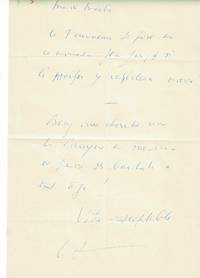
195076185s. l. Klarskovgaard 1950. Fine. s. l. Klarskovgaard 28 octobre 1950 21 x 34 cm 1 pages sur un feuillet Partly unpublished autograph letter signed by ""your touchy LF"" Louis-Ferdinand Céline addressed to his lawyer Maître Thorvald Mikkelsen. One page written in blue ink on a large sheet of white paper; number ""563"" in Céline's hand in the upper left corner in red pencil. Transverse folds inherent to the mailing. This letter was very partially transcribed in the Année Céline 2005. Céline after days of suffering from the cold is delighted to announce to his friend that he has received heating: ""Le fourneau se pose en ce moment. Je ne sais pas si la maison y résistera l'on verra !"" ""The stove is being installed right now. I don't know if the house will withstand it we shall see!"" This letter also mentions his Swedish friend Ernst Bendz like him a doctor and writer: ""Benz sic vous cherche un La Bruyère en suédois - on passe des bachots à tout âge !"" ""Bendz is looking for a La Bruyère in Swedish for you - one takes exams at any age!"" In 1947 Céline pursued by French justice for his collaborationist involvement was confined in Denmark. It was in May 1948 accompanied by Lucette and Bébert that he arrived at his lawyer Maître Thorvald Mikkelsen's home in Klarskovgaard. The latter owned a large property by the Baltic Sea and invited the exile to stay there. On February 21 1950 as part of the purge the writer was definitively condemned in absentia by the civic chamber of the Paris Court of Justice for collaboration to one year of imprisonment which he had already served in Denmark. The Swedish Consul General in Paris Raoul Nordling intervened on his behalf with Gustav Rasmussen the Danish Foreign Minister and managed to delay his extradition. On April 20 1951 Jean-Louis Tixier-Vignancour his lawyer since 1948 obtained Céline's amnesty as a ""severely disabled veteran of the Great War"" by presenting his file under the name of Louis-Ferdinand Destouches without any magistrate making the connection. Céline would leave Denmark the following summer after three years spent at his lawyer's home. unknown
195483967Meudon 1954. Fine. Meudon 1954 21.20 x 26.10 cm une page sur un feuillet Autograph manuscript signed by Louis-Ferdinand Céline written in blue ballpoint pen on a sheet of white paper numbered 237 in the left corner. Some stains as well as a central fold of no consequence. Some pinholes in the upper margin evidence of the organization of Céline's manuscripts in ""bundles"". ""Y'en a un charlatant là-haut ! et terrible ! et vous le connaissez !. donc de dessous là ! de dessous la table je regarde le moulin. pas loin. peut-être deux cents mètres. et dans quel air éblouissant !. eh bien je vous dis comme je l'ai vu."" ""There's a charlatan up there! and terrible! and you know him!. so from underneath there! from under the table I look at the windmill. not far. maybe two hundred meters. and in what dazzling air!. well I tell you as I saw it."" The passage from our sheet conforms to the published version. Published in 1954 Normance is a direct sequel to Féérie pour une autre fois published two years earlier. The two parts were written during Céline's years of exile and imprisonment in Denmark. Upon his return to France in 1951 Céline undertook a work of ""polishing"" and published these two titanic texts independently originally conceived as one. ""Céline while working on it thought of this novel as a second Voyage au bout de la nuit capable twenty years later of astonishing the public as much as the 1932 novel."" Henri Godard unknown
195483743s. l. Meudon 1954. Fine. Céline's Ars Poetica: ""I capture all the emotion on the surface! I cram it into my metro! s. l. Meudon s. d. 1954 10 x 21 cm 34 feuillets Manuscript pages from Conversations with Professor Y' n.p. Meudon n.d. 1954 various sizes from 10x21 cm to 27x21 cm 34 sheets. Autograph manuscript by Louis-Ferdinand Céline 34 sheets of various sizes written in blue and sometimes pink ballpoint pen. Some of the pages are numbered by Céline at top left. The last folio numbered 159 is signed by the writer at the bottom. Two leaves contain previously unpublished passages: the first a few lines long refers to the Professeur. The second leaf numbered 136 features another full-page text on the verso which we did not find in the Professeur Y' or in any of the published works of Céline. Céline refers in this unpublished passage to article 75 of the penal code condemning to the death penalty any French citizen found guilty of intelligence with the enemy. It also mentions a certain ""Me Johann Niels Borggensen"" no doubt a pseudonym for his lawyer Thorvald Mikkelsen: "".supposedly to protect me from police curiosity! holy cow! he was having a ball.when you've got the warrant up your arse crossed out: article 75 anyone can do what they like with you! what a joke! we can do what we like with you.it wouldn't have been Borggensen perhaps someone else would have been worse.give me article 75 and I'll put the whole of France in a Mouse hole for you! and Germany with it! and England such a nag and Europe with it! no bomb needed! H ! Y ! Z ! I'll make you fit the atom into a."" Important set of working manuscripts bearing witness to the writing of Conversations with Professor Y' Céline's true Ars poetica. Since the first part of Féerie pour une autre fois' Fable for Another Time was not as successful as expected Céline wanted to give the release of the second part - Normance - as much publicity as possible and restore his reputation after his years of exile in Germany and Denmark. Instead of writing the usual promotional note prière d'insérer he suggested to publisher Gaston Gallimard this eulogy written in the style of an imaginary interview between himself and Professor Y alias Colonel Réséda a prostatic old man. This zany ""interviouwe"" was published in several parts in the Nouvelle Revue française in 1954 and the finished work through Éditions Gallimard the following year. Céline speaks fervently of his style and his conception of literature and vehemently criticizes the world of letters and public taste. Unlike Céline's other works the genesis of this text crucial to the understanding of his oeuvre is poorly documented and its manuscripts are rare. The Pléiade edition of Celinian novels contains only a few pages of an earlier version very close to the published text. This set of pages covering every passage of the text contains both heavily crossed-out sheets and neatly rewritten notes. It bears witness to the different stages of the writer's work: drafting an initial sheet crossing out and rewriting on the same page then transcribing short passages on separate notes. The last page of the text is extensively crossed out and rewritten resulting in a slightly different version of the published version. The manuscript also contains the famous metaphor of the metro typical of the writer's emotive style compared here to the ""dry language"" of his peers: ""Did you see Have you noticed All caught up in my metro!. what do I leave on the surface. the worst rubbish in cinema!. foreign languages then!. translations!. retranslations of our worst rubbish that they use for their ""parlants"" talking pictures superb foreign languages!. in addition to the psychology! the psychological mumbo jumbo!. all the crap. . Me it's something else! me I'm much more brutal! me I capture all the emotion!. all the emotion on the surface! all at once! I decide! I stick it in the metro! my metro! all t unknown
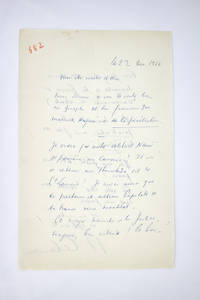
195075962s. l. Klarskovgaard 1950. Fine. s. l. Klarskovgaard 22 octobre 1950 21 x 34 cm 2 pages sur un feuillet Signed autograph letter partly unpublished by Louis-Ferdinand Céline addressed to his lawyer Maître Thorvald Mikkelsen. Two pages written in blue ink on a large sheet of white paper; number ""582"" in Céline's hand in red pencil at top left. Cross-folds inherent to mailing. This letter was very partially transcribed in Année Céline 2005. Fine letter mentioning Marcel Aymé: ""We will say if you please in simple and good French that Marcel Aymé has: penetration. . And if Marcel has penetration I have vision."" We will not revisit the friendship that united Céline and Aymé - the latter even visited him at Klarskovgaard in March 1951 - but we will content ourselves with quoting a passage from the text that the Montmartre writer composed in homage to his sulphurous friend: ""I knew him twenty-five years ago before the war when he was celebrated everywhere admired - but rarely understood - and after his return from Denmark during the nine years of suffering that led him to death. Before as after the storm his conversation revealed the idealist whose sarcasms denounced the hundred thousand miseries of a cruel vain bulimic humanity bent on its own destruction. 'Before' his indictments against man's murderous and suicidal follies against the injustices and snares of society had the joyful force of a fighter bursting forth with inexhaustible verbal invention that amazed his listeners."" Ecrits sur la politique 1933-1967 Céline also speaks in this letter of Albert Naud his lawyer between 1947 and 1951 who ""is strolling in Canada"" and ""is going to get himself a Thénardière on the St Lawrence"". This is followed by a very Célinian consideration: ""I also believe that the next and ultimate Capital of France will be Montreal."" The Danish exile then fantasizes about a world government to be established: ""And René Meyer sic minister of Justice always of course! over there! You will then yourself be minister of War in Denmark in retirement."" In 1947 Céline pursued by French justice for his collaborationist commitment is confined in Denmark. It is in May 1948 accompanied by Lucette and Bébert that he arrives at his lawyer Maître Thorvald Mikkelsen's home at Klarskovgaard. The latter owns a large property by the Baltic Sea and invites the exile to stay there. On February 21 1950 as part of the purge the writer is definitively condemned in absentia by the civic chamber of the Paris Court of Justice for collaboration to one year's imprisonment which he had already served in Denmark. The consul general of Sweden in Paris Raoul Nordling intervenes on his behalf with Gustav Rasmussen Danish minister of Foreign Affairs and manages to delay his extradition. On April 20 1951 Jean-Louis Tixier-Vignancour his lawyer since 1948 obtains Céline's amnesty under the title of ""grand invalide de la grande guerre"" by presenting his file under the name Louis-Ferdinand Destouches without any magistrate making the connection. Céline will leave Denmark the following summer after three years spent at his lawyer's home. unknown
193463409Paris 1934. Fine. Paris 3 mai 1934 21 x 27 cm 2 pages sur un feuillet une enveloppe jointe Autograph letter signed ""LF Destouches"" addressed to the journalist Léon Deffoux. 24 lines written in black ink several underlines and erasures of Celine's hand. Envelope attached. Folds inherent to the enveloping of the mail as well as some very tiny pinholes in the right margin of the leaflet. unknown
194763242s. l. Copenhague Copenhagen 1947. Fine. s. l. Copenhague Copenhagen 23 avril 1947 22.50 x 28.40 cm 6 pp. in-folio Signed autograph letter of Céline to Henri Mahé and his wife dated April 23 1947 in Copenhagen lines in black ink on three sheets of lined paper. unknown
194764327Copenhage Copenhagen 1947. Fine. Copenhage Copenhagen 10 avril 1947 22.50 x 28.40 cm 6 pages sur 3 feuillets Very long autograph letter signed ""Dest"" to Doctor Tuset and Henri Mahé dated April 10 unknown
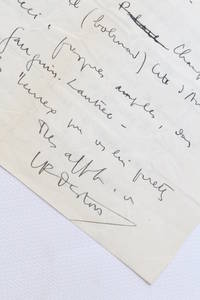
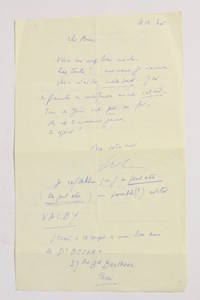
194962588Korsør Danemark Korsør 1949. Fine. Korsør Danemark Korsør 12 Novembre 1949 21 x 34 cm deux pages sur un feuillet Letter autograph signed by Louis-Ferdinand Céline two pages envelope attached to Charles Deshayes 25 lines in blue ink dated November 12 1949 and written since his Danish exile Korsor. Traces of central folds inherent to a letter slipped into an envelope that we enclose to the letter. Louis-Ferdinand Céline begins his letter in the grip of doubts and insults: ""It's a very ugly shot what to try I can not avoid myself nowhere I have complaints of counterfeiting That's all all these people are basically afraid they'll never admit it. Then in postscript he thinks that he may have found a publisher ""very possibly"" a possible Publisher Valby and that he will pass through a Parisian friend for the contact ""I write about it to my good friend Dr. Becart"" and recommend to his correspondent to also write to him. He continues his letter by evoking concerns of writing: ""I changed your title.By the love of God leave the night quiet! And surtoutr the end! It is a nightmare"" and ends with a scathing paranoid and all Céline remarks : ""The Celine affair seems to me the best like the Dreyfus Affair"" unknown
195483744Meudon 1954. Fine. ""What is Normance "" Meudon 1954 20 x 27 cm 16 feuillets 9 pour le premier manuscrit 7 pour le second Two unpublished autograph manuscripts signed by Louis-Ferdinand Céline in blue and red ballpoint pen: the first contains 9 pages numbered in the left-hand corner from 1480 to 1488; the second contains 7 pages numbered from 1498 to 1504. Each text is signed by Céline in red ink at the bottom margin with the words ""Meudon 54"" also in his hand ff. 1485 and 1505. There are numerous variants lines and words crossed out modified and repeated. Traces of pinholes in the upper left-hand margin of every sheet as Céline organized his manuscripts in ""bundles"". Normance was published in 1954 as a sequel to 'Fable for Another Time' published two years earlier. Both parts were written during Céline's years of exile and imprisonment in Denmark. Upon his return to France in 1951 Céline began ""polishing"" his writings and published these two monumental texts initially envisaged as a single book. ""Céline while he was working on it thought of this novel as a second Journey to the End of the Night' twenty years later capable to astonish the public as much as the 1932 novel"" Henri Godard. This set of manuscript pages corresponds to two passages from the second half of the novel Romans Pléiade IV p. 371 to 375 significantly different from the published text. This is an earlier version unknown to scholar Henri Godard as evidenced by a note in the Pléiade edition where he explains the difficulties encountered by Céline's secretary Marie Canavaggia when translating the word ""planqaouzeuze"" - appearing here on one of the manuscript leaves. Her transcription ""plaquouseuze"" eventually remained in the published text. Godard further stated he had no knowledge of this part of the manuscript i.e. our manuscript not appearing in the intermediate versions transcribed and published in the Pléiade edition. The first of the manuscripts recounts the ransacking and looting of psychic Armelle's apartment: ""How many decks did Armelle have Her fortune-telling cards were taking the air! . Ah seeress! Something she hadn't guessed was how her trembles would be tarred! They'd rip open her armchairs crush her fine hiding places! ah Pythonisse! ah the quilt now! the inside of the pillows flies! flies away!"" Céline also evokes Madame Toiselle the building's concierge: ""- It's a mess Madame Toiselle. I yell it at her. she was a maniac! . moron! she's looking now! she's looking good! ah I see her consternation.she's there in front of me on all fours. I can see her head! Her hoe! - Omelette head!"" I shout to her Omelette head'! The second focuses on Raymond in the grip of a delirious crisis thinking he's a donkey: ""Raymond Raymond! but it's your wife you're looking for! it's true he was looking for his wife.! well maybe five minutes ago he was looking for his wife! Denise! . now he's looking for himself. . - Hiian! hiiian! he answers me! There's also a comical settling of scores between Mimi and Rodolphe: ""There goes Mimi then there goes Rodolphe! Rodolphe! they're coming! and how they're treating each other! where were they on the threshold the two of them! they're taking advantage of the lull in the bombs! - Pig! Pimp! - Cabotine! coureuse! and they attack their costumes. "" Remarkable manuscripts bearing witness to Céline's tireless pursuit in finding the right word and his willingness to place himself as a direct witness to events both historical and autobiographical. These unpublished manuscript lines are typical of the Celinian style of this ambitious novel: ""The story style and tone of Normance set it apart from the rest. It is nothing more than the long account of a night of bombing in Montmartre told in his own way by Céline who had been deeply impressed by the spectacle of the bombing of the Renault automobile factories in Boulogne-Billancourt which he had witnessed from the windows of his apart unknown
195483969Meudon 1954. Fine. Meudon 1954 21.20 x 26.10 cm une page sur un feuillet Autograph manuscript signed by Louis-Ferdinand Céline written in blue ballpoint pen on a sheet of white paper numbered 243 in the left corner. Some stains as well as a central fold of no consequence. A tiny lack of paper at the lower right margin of the sheet. Some pinholes in the upper margin evidence of the organization of Céline's manuscripts in ""bundles"". ""pour aller traverser les lignes des barrages quelque chose !. au galop ! et je me suis bien fait sonner ! ça arrivera pas à Lauriac ! ni à Tartron ! ni Larengue !. Ils ont pris le bon versant de la vie : le flan !. pour ma concerne je regrette rien . c'est fait ! c'est fait ! la preuve ma tête. mais enfin pour la griserie cette sorte de bravoure somnambule j'admire les doués. je les respecte. j'arrive moi que par le stoïcisme le sang froid là ! hop !"" ""to go cross the lines barricades something!. at a gallop! and I really got myself beaten up! that won't happen to Lauriac! nor to Tartron! nor Larengue!. They took the right side of life: the flank!. as for me I regret nothing. it's done! it's done! the proof my head. but finally for the intoxication this sort of sleepwalking bravery I admire the gifted ones. I respect them. I only achieve it through stoicism cold blood there! hop!"" The passage from our sheet referring to Mauriac Sartre and Aragon conforms to the published version. Published in 1954 Normance is a direct sequel to Féérie pour une autre fois published two years earlier. The two parts were written during Céline's years of exile and imprisonment in Denmark. Upon his return to France in 1951 Céline undertook a work of ""polishing"" and published these two titanic texts independently originally conceived as one. ""Céline while working on it thought of this novel as a second Voyage au bout de la nuit capable twenty years later of astonishing the public as much as the 1932 novel."" Henri Godard unknown
179167693s. l. Londres London Paris Toulon. 1791. Fine. s. l. Londres London Paris Toulon. 1791-1832 12 000 feuillets de divers formats en feuilles Unpublished political scientific and historical archives The complete manuscript unpublished papers of Louis Chevalier de Sade 1753-1832 author of the Lexicon politique and cousin of the famous Marquis. The important geopolitical historical and scientific archives of a learned aristocrat a privileged witness of the end of the Ancien Régime the French Revolution the Consulate Empire and Restoration. A unique fund of research on the implementation of a constitutional monarchy. Exceptional collection of the Chevalier Louis de Sade's personal archives the cousin of the Marquis de Sade representing 12000 handwritten pages including several thousand unpublished and written by his hand. The Chevalier shows a thought system that he describes as «holistic» including historical political and scientific reflections. Louis Chevalier de SADE If we take the French Revolution as the birth of an experiment both secular and political the Chevalier de Sade was without doubt one of its early critics. Not only of the Revolution which had many other detractors but of its political ideology which would go on profoundly to impact the two hundred years that followed. What he calls «positive politics» is «based on reasoning and experience». «The theory did have some attractions for me; I studied it with care I savored its principles. Now I see their value only in terms of the impact of their implementation what we've seen them produce in the peoples of which history has given me knowledge. This is my method; I know that it is all in all the opposite of the methods utilized by the men who have governed us and written our constitutions to this very day without deviation. This continuous divergence between what has been done and what should never have been done increased my confidence in the path to be followed and at the same time fortified my determination to keep to the views I had adopted of judging laws by the historic consequences they entail rather than by the lyrical supposedly conclusive metaphysical arguments with which these innovators continually and still to this day assault us.» The Chevalier de Sade who saw the world in terms of his own time and place could be nothing other than a Royalist. There were practically no examples of democracy in the history known to the Chevalier apart from the Classical democracies of Greece and Rome which had been experiments only in very elitist forms of democracy. These were very well known to this political scientist whose papers contain 7000 pages dedicated to the history of the Classical world. The republic ushered in by the Revolution was more than just a political system it was the realization of a philosophical political ideal. And while most of those opposed to the new regime saw in it above all a threat to their personal situations their religious beliefs or even more simply their habits the writings of the Chevalier de Sade show no such dogmatic influence; or at least he never uses dogma to justify his arguments. Louis de Sade a gentleman without a fortune and without significant ties was conservative through philosophical and historical conviction and not out of interest. It is with this perfect intellectual honesty that he studies the essays memoirs and political or theoretical works of his contemporaries. Running counter to Enlightenment thought the Chevalier's view of society owed very little to philosophy. Though he puts together a serious theoretical history of the development of Man from the condition of «savages» to the forging of various societies he does not posit Man's ideal nature as some of his contemporaries did. Rather the Chevalier examines the gap between nature and the civilized being without passing moral or philosophical judgment as was the fashion at the time. «The political error that damned Europe in the 18th unknown
197862584Lyon 1978. Fine. Lyon 5 Mars 1978 21 x 27 cm 2 pages sur un feuillet Letter autograph dated March 5 1978 signed by Louis Calaferte two pages to an unidentified bookseller friend 33 lines in black ink written from Lyon. Usual traces of minor folds of a letter slipped into an envelope. In his missive full of solicitude esteem and respect for the work of writing of his unfortunate correspondent who wishes to publish his manuscript Louis Calaferte apologizes first of all for the delay independent of his will taken for to answer him: ""I waited waited waited - always hoping to be able to bring you a happy news concerning the possible edition of your work of bookstore"" to then confess to him and to criticize ""a certain immobilism at those people who do not take anymore no risk of editing and are more fond of imbecility of the genre ""best-seller"" than books relating to a certain erudition "" . Louis Calaferte unsuccessful intermediary between this writer and the world of Parisian publishers is ""sorry because in my opinion it seems to me that an edition of this type would have been necessary."" He proposes during his next visit to Paris to hand him the manuscript which he has unsuccessfully proposed to the publishing houses and which he calls ""your notebook"" or to bring it to him in his bookstore more later. Enffin Louis Calaferte symbolically concludes his letter with a ""sorry for this failure I beg you to believe in my esteem"". unknown
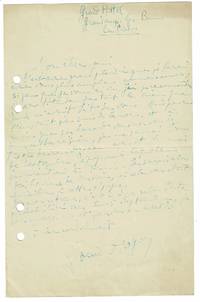
191475566Grandcamp-les-Bains Grandcamp-Maisy 1914. Fine. Grandcamp-les-Bains Grandcamp-Maisy s. d. ca 1914-1920 13.50 x 21 cm une page sur un feuillet remplié Autograph letter signed addressed to a correspondent whom we have not been able to identify. Written from the Grand Hôtel de Grandcamp-les-Bains Calvados in blue ink on a folded sheet of white paper. A transverse fold inherent to the posting of the letter and four small perforations affecting the text but not impeding its reading. The mention of Grandcamp-les-Bains - where Aragon seems to have been only once during the summer of his seventeenth year - and the signature - of an early form - lead us to think that the letter could have been written in the summer of 1914. Philippe Forest in his biography of Aragon confirms that it was indeed at Grandcamp-les-Bains where his family had rented fifty rooms in a large seaside hotel to accommodate family and friends that the future poet learned the news of mobilization. The handwriting less rounded than on manuscripts prior to the 1920s however seems to us later and we are therefore not in a position to confirm the date of 1914. unknown
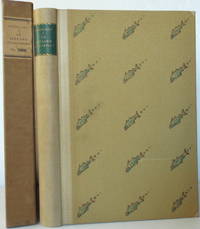
1931009443Stockholm: Limited Editions Club. Signed limited edition. Limited to 1500 copies signed by the artist. Copy number 900. Published Stockholm: Limited Editions Club 1931. 4to. 7 1/2" x 10 3/4" 207pp. illustations by Yngve Berg. Printed on handmade linen rag paper from Van Gelder Zonen by the Royal Printing Office Norstedt & Soner of Sweden. Cream cloth with gilt titles in green block and pictorial paper over boards top edge gilting. Fine in very good plus slipcase that has age toning. . Fine. Hard. 1st. 1931. Limited Editions Club unknown
31088In 1921 this jazz pianist and composer debuted a dance band dance program which made his a household name; later his popular t.v. show "Dinner Date with Lopez" showcased show biz folks and began with his trademark phrase "Hello everybody. Lopez speaking"; among his song hits were "Knock Knock Who's There" and "The World Stands Still." PS 8" X 10" n.p. n.d. Very good. Mounting traces on verso. Handsome Maurice Seymour closeup pose in tuxedo with a hasty "Best Wishes / Vincent Lopez. unknown
37844Three Luftwaffe fighter aces of World War Two all Knight's Cross recipients: Loos flew 66 combat missions and downed 38 enemy aircraft Romm downed 92 enemy aircraft 82 on the Eastern Front 10 on the Western Front and Unger flew 59 combat missions and downed 24 enemy aircraft. PS 5" X 7" n.p. n.y. Fine. Modern high quality black and white print of a WW2-era photograph of a Luftwaffe fighter plane on the ground from the front -- nose and propeller in the upper foreground. At top center above the propeller Loos signs boldly in blue fineline while Romm signs at lower left and Unger at lower right each in black fineline. An interesting trio on an eye-catching image. unknown