Julien GRACQBiblio.com
1 815 résultats
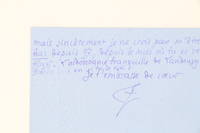
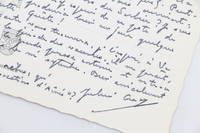
199584395Sion-sur-l'Océan Sion-sur-l'Océan 1995. Fine. Sion-sur-l'Océan Sion-sur-l'Océan s. d. circa 1995 15 x 10.50 cm une carte postale Autograph postcard signed by Julien Gracq of 20 lines addressed to his friend and biographer Ariel Denis written in black felt-tip pen on the verso of a photograph representing the castle of la Flocellière in Vendée not far from his apartment in Sion-sur-l'Océan. Julien Gracq congratulates Ariel Denis on the accuracy of his latest article: "". I find your review excellent and particularly understanding."" although he offers a slight and humorous caveat: "". my only objection being the fashionable adjective pregnant word underlined which seems to me to be absolutely proscribed as soon as it no longer concerns pregnant women"". The author of ""Au château d'Argol"" shows confidence in his friend's future: "". Perhaps reviews of this quality will open access to a door at éditions du Sorbier for you"" while remaining cautious and modest about his own: "".I refuse to hope too much. finally some positive turn of events will occur one day in this quest! "" Finally Julien Gracq evokes the holiday period and concludes his missive with a question mocking the postcard's subtitle ""Seminary of Elder Vocations east facade"": ""this card is also a riddle: what is a seminary of Elder vocations"" unknown
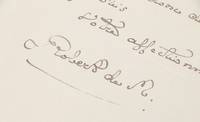
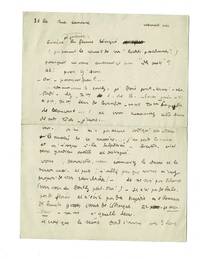
192083256s. l.: S. n. 1920. Fine. S. n. s. l. s. d. 1920 27.50 x 18 cm une page Autograph letter signed by the dandy count 18 lines written in black ink probably addressed to his friend and bibliographer the critic Henri Lapauze thanking him for his vigilance and for having corrected an error concerning one of his texts. Traces of folding inherent to mailing light creases in the left margin of the letter. ""Neuilly Dear friend thank you for your vigilant benevolence. I appreciate it all the more as the same newspaper which brought me a new flood of it represented my client to me elsewhere in the form of a very vast Perrichon! .But my Mont-Blanc described by you regains its proportions! All is in order and I am your affectionate. Robert de M. 27 Nov."" S. n. unknown
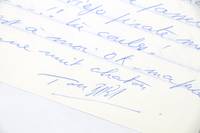
197687298Fleury-Mérogis 1976. Fine. Fleury-Mérogis 21 Septembre 1976 21 x 29.50 cm une page recto verso Autograph letter dated and signed by Jacques Mesrine dated Tuesday September 21 1976 68 lines in blue ink on one recto-verso page addressed to his lover at the time Jeanne Schneider thanks to whom the manuscript ofInstinct de mort was discreetly smuggled out of prison. A horizontal fold inherent to the envelope placement a small tear in the right margin of the letter at the fold level. Jacques Mesrine then incarcerated at Fleury-Mérogis prison arranged with his mother for her to cede upon her departure from the Paris region her Clichy apartment to Jeanne Schneider after his possible provisional release: ""J'ai eu un très agréable parloir avec maman. J'ai au moins une bonne nouvelle à t'annoncer. Pour Clichy c'est d'accord. Comme elle va vivre presque tout le temps à la montagne tu auras l'appartement pour toi. Je paierai le loyer. Elle a tout de suite dit d'accord après mon explication. . Je me doute de ta joie de savoir que tu pourras vivre à Clichy - si près de notre papy. toujours présent de par l'amour que nous avons pour lui. Je suis certain que cette petite nouvelle te remonte le moral."" I had a very pleasant visit with mama. I have at least one good piece of news to tell you. For Clichy it's agreed. Since she's going to live almost all the time in the mountains you'll have the apartment to yourself. I'll pay the rent. She immediately said yes after my explanation. . I can imagine your joy knowing that you'll be able to live in Clichy - so close to our grandpa. always present through the love we have for him. I'm certain this little news will lift your spirits. His daughter Sabrina worries him and he senses that he will have to be severe regarding her behavioral lapses: ""De Sabrina rien ! Il y a une chance pour qu'actuellement elle me prépare un ""douze"" je ne peux t'en parler sur lettre. mais j'ai l'impression que la puce me ment sur certaines choses. elle prend peut-être une route où il va me falloir la plus grande fermeté. J'ai demandé à maman de vérifier si elle va bien à l'école."" Nothing from Sabrina! There's a chance that currently she's preparing a ""twelve"" for me I can't talk about it in a letter. but I have the impression that the kid is lying to me about certain things. she's perhaps taking a path where I'll need the greatest firmness. I asked mama to check if she's doing well in school. News of his ""godson"" the famous robber Jean-Charles Willoquet with whom he organized his escape from La Santé prison where they had met makes him prouder: ""J'ai reçu la photo du plus jeune détenu de France à savoir mon filleul ""Willy Willoquet"" dans sa cour de promenade. c'est émouvant et triste à la fois !"" I received the photo of the youngest prisoner in France namely my godson ""Willy Willoquet"" in his exercise yard. It's moving and sad at the same time! The situation of his young protégé cut off from all contact with his loved ones and the people who love him reminds him of his own personal situation and the indignities of a prisoner's isolated existence: ""Je me demande comment va réagir Martine quand on va lui enlever Enfin c'est le destin qu'elle a choisi et accepté. Elle paie cher le prix de l'amour. Vous le payez toutes ""très cher""."" I wonder how Martine will react when they take him away from her Well it's the destiny she chose and accepted. She pays dearly the price of love. You all pay it ""very dearly"". In order to quickly erase this morose and implacable truth Jacques Mesrine plunges into schoolboy humor and affectionately mocks his lover's physical flaws: ""J'espère que la bonne nouvelle va te rendre ton sourire. eh ! la mémé. boutons sur la gueule. ou pas ! Je t'adore. il ne fallait pas flirter avec ""voyou"" ! C'est lui qui t'as passé cela sic nanou d'amour ton viejo pirate monte à l'abordage de tes lèvres. et. !! tu coules ! "" I hope the good news will bring back yo unknown
189476276Paris 1894. Fine. Paris 11 mars 1894 11.40 x 8.80 cm une carte recto et une enveloppe Autograph card signed by Stéphane Mallarmé addressed to Alidor Delzant written on the recto in black ink. Envelope attached. Alidor Delzant was a lawyer collector and bibliophile. Friend of the Goncourts he devoted a work to them and was the secretary and testamentary legatee of Edmond. Card written upon return from a trip to Oxford during which Mallarmé gave a lecture on aesthetics: "".j'ai du reste à vous parler de M. Dyer."" "".I have moreover to speak to you about M. Dyer."" Louis Dyer friend of Delzant is an Oxford alumnus and was then professor of Greek at Harvard. Through Delzant's intermediary he had offered hospitality to Mallarmé who did not know him before his lecture but this card attests that the two men finally met. unknown
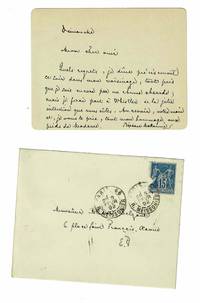
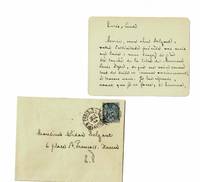
189276345Paris 1892. Fine. Paris 7 février 1892 11.40 x 8.80 cm une carte et une enveloppe Autograph letter signed by Stéphane Mallarmé addressed to Alidor Delzant written on the recto in black ink. Envelope included. Alidor Delzant was a lawyer collector and bibliophile. Friend of the Goncourts he devoted a work to them and was Edmond's secretary and testamentary legatee. ""Quels regrets je dîne précisément ce soir dans mon voisinage tout pris que je sois encore par un rhume absurde ; mais je ferai part à Whistler de la jolie intention que vous eûtes."" ""What regrets I am dining precisely this evening in my neighborhood taken as I still am by an absurd cold; but I will inform Whistler of the lovely intention you had."" unknown
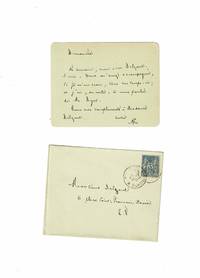
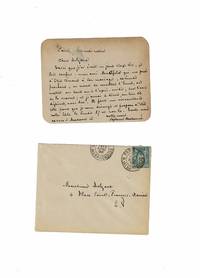
189676279Paris 1896. Fine. Paris 15 avril 1896 11.40 x 8.80 cm une carte recto et une enveloppe Signed autograph card from Stéphane Mallarmé addressed to Alidor Delzant written on the recto in black ink. Envelope included. A small water stain affecting the beginning of the card without hindering readability. Alidor Delzant was a lawyer collector and bibliophile. Friend of the Goncourts he devoted a work to them and was Edmond's secretary and testamentary legatee. ""Voici que j'écris un jour trop tôt je suis confus : mon ami Muhlfeld qui me prie d'être témoin à son mariage ce lundi prochain."" ""Here I am writing a day too early I am confused: my friend Muhlfeld who asks me to be witness at his wedding this coming Monday."" ""On the 20th of this month also spring-like he signs the municipal register as witness at the wedding of Lucien Muhlfeld one of the leading figures of La Revue blanche and all this fine company dines in evening dress at La Tour d'Argent enlivened by the laughter of Misia and the Natanson brothers."" Jean-Luc Steinmetz unknown
1826774711826. Fine. 1826 18.50 x 24 cm une feuille rempliée Autograph letter signed addressed to the painter Jean-Pierre Granger and dated April 24 1826 one page written in black ink with the correspondent's address on the verso. 15 lines in a beautiful slanted handwriting on a folded sheet. The celebrated Empire painter recommends to his colleague: ""a young man who seems very interesting to me and too young to enter my studio. Dear Grand Diable please do me the favor of taking good care of him in yours and when he has spent some time copying if it does not inconvenience you I will take him back with pleasure and well on his way."" Jean-Pierre Granger was first a pupil of Jean-Baptiste Regnault before joining Antoine-Jean Gros in Jacques-Louis David's studio. In 1800 he became laureate of the first Rome Prize for history painting with Antiochus renvoie son fils à Scipion Paris École nationale supérieure des beaux-arts while his fellow student Jean-Dominique Ingres received the second prize. unknown
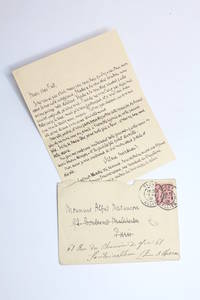
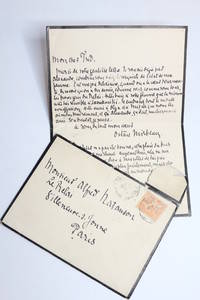
190673674Vichy 1906. Fine. Vichy 10 août 1906 11.60 x 18 cm une feuille Moving autograph letter signed by Octave Mirbeau addressed to the playwright and founder of the Revue Blanche Alfred Natanson when he had just lost his father. 18 lines in black ink on a folded sheet envelope included. ""Mon cher Fred Je ne vous ai pas écrit ; mais vous savez bien qu'il n'y a pas dans mon cur la moindre indifférence. Thadée a dû vous dire combien nous avions partagé votre douleur. Thadée a dû vous dire souvent quelle amitié profonde j'ai pour vous. Peut-être ne vous l'ai-je pas exprimée telle que je la sens mais je la sens fortement et je voudrais bien que vous la sentiez aussi un peu. C'est un gros chagrin que de ne plus être aimé de ceux qu'on aime véritablement. Vous allez partir ; et vous faîtes bien de quitter cette maison où durant plus de six mois vous avez assisté à l'horrible agonie de votre pauvre père. Tâchez de travailler pour notre joie à tous. et revenez avec une belle uvre."" ""My dear Fred I have not written to you; but you know well that there is not the slightest indifference in my heart. Thadée must have told you how much we shared your grief. Thadée must have told you often what deep friendship I have for you. Perhaps I have not expressed it to you as I feel it but I feel it strongly and I would very much like you to feel it too a little. It is a great sorrow to no longer be loved by those one truly loves. You are going to leave; and you do well to quit this house where for more than six months you witnessed the horrible agony of your poor father. Try to work for all our joy. and return with a beautiful work."". Mirbeau was particularly close to the group of the Revue Blanche since its launch in Paris in 1891. But it was since the Dreyfus affair that his intimate and lasting friendship with the Natanson brothers Thadée Alexandre and Alfred was strengthened. After aesthetic disagreements about Art Nouveau and the Nabis Mirbeau finally reunited with Thadée around 1900 in a now common inclination for the young Nabis painters of the Revue Blanche Bonnard Vallotton and Vuillard. The Revue Blanche played an essential role in France as confirmed by historian Paul-Henri Bourrelier: ""Most of the most prominent writers painters musicians politicians and intellectuals of the late 19th and early 20th centuries collaborated with it or were associated with it. Created financed and directed by the three Natanson brothers young Polish Jews with the enthusiastic complicity of their classmates from the Condorcet lycée La Revue blanche quickly became a place of debate on all subjects that stirred France. It waged political battles under the impulse of anarchists like Fénéon Mirbeau; socialists such as Blum G. Moch Péguy; Dreyfusards and founders of the League of Human Rights like Reinach and Pressensé."" unknown
189476272Paris 1894. Fine. Paris 12 février 1894 11.40 x 8.80 cm une carte recto-verso et une enveloppe Autograph letter signed by Stéphane Mallarmé addressed to Alidor Delzant written on both sides in black ink. With envelope. Alidor Delzant was a lawyer collector and bibliophile. A friend of the Goncourts he devoted a work to them and served as secretary and testamentary legatee to Edmond. Mallarmé mentions a future stay in Oxford and thanks Delzant for having recommended him to a friend: "".vous songez si j'ai été touché de la lettre de Monsieur Louis Dyer de qui me voici connu tout de suite et comme anciennement à travers vous. Je lui réponds avant que je ne fasse si heureux sa connaissance. Hôte je ne pourrai l'être M. Powell qui a eu l'initiative de ma conférence m'ayant de longue date offert son toit pendant mon bref séjour à Oxford."" "".you can imagine how touched I was by the letter from Monsieur Louis Dyer through whom I find myself known immediately and as if from long ago through you. I am writing back to him before I have the pleasure of making his acquaintance. I will not be able to be a host as M. Powell who initiated my lecture has long since offered me his roof during my brief stay in Oxford."" Mallarmé would indeed give a lecture on aesthetics on March 1st 1894 at Oxford the text of which was published in 1895 under the title Oxford Cambridge. La musique et les lettres. unknown
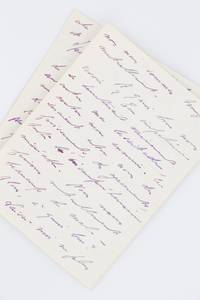
190479022Paris 1904. Fine. Paris s. d. septembre 1904 12.40 x 16.80 cm 8 pages sur 2 doubles feuillets Autograph letter signed ""Pauline"" from Renée Vivien addressed to Natalie Clifford Barney and written in purple ink on two double sheets with violet letterhead and address of 23 avenue du Bois de Boulogne. Transverse folds inherent to posting. A very beautiful and lengthy breakup letter addressed to the Amazon after her impromptu summer 1904 visit to Bayreuth to attempt to win Renée back: "". Les heures passées à Bayreuth étaient de la douceur : et c'est pourquoi je suis revenue."" ""The hours spent in Bayreuth were sweet: and that is why I returned."" The lexical field of death is omnipresent in this missive as if to better emphasize the definitive character of her decision: ""Pourquoi t'acharner à vouloir ranimer vainement les choses mortes Natalie Tu ne l'as point compris : ce que je cherchais auprès de toi c'était le souvenir et rien d'autre. On ne revit point l'autrefois. Tu dois le sentir comme moi-même. . Je souriais à mon passé. Il est doux parce qu'il est mort. Et toi tu veux galvaniser ce cadavre et le rendre odieux."" ""Why persist in trying to vainly revive dead things Natalie You have not understood: what I sought with you was memory and nothing else. One cannot relive the past. You must feel it as I do myself. . I smiled at my past. It is sweet because it is dead. And you you want to galvanize this corpse and make it odious."" The Muse of violets here reveals her suffering and disappointment pleading with Natalie twice: ""Laisse-moi ne plus revenir."" ""Let me not return again."" A veritable funeral oration for extinguished love this letter is very illuminating as to each one's way of loving: ""Nous nous sommes mal comprises. Je voulais un peu de rêve : tu m'offres la réalité."" ""We have misunderstood each other. I wanted a little dream: you offer me reality."" For this is what separates Renée - the dreamy and quasi-platonic poetess - and Natalie - the carnal and fickle lover: ""Ne sens-tu donc pas ne comprends-tu donc pas que je n'ai plus aucun désir d'amour Je suis lasse infiniment ; je ne voulais qu'un peu de douceur. Et tu m'offres la vie et les frissons que sais-je tout dont je ne me soucie point. Les joies charnelles Mais je les possède mon amie me les donne ma chair est satisfaite et au-delà. Je ne cherche point cela : je ne désire point cela. Ces choses m'excèdent venant de toi. J'espérais que assouvie de ton côté tu ne me demanderais que ce que je te demande : un peu de rêve lassé ; un peu de compréhension un peu de regret. Mais nous nous sommes trompées mutuellement. . Cherche un amour de chair chez une autre ."" ""Do you not feel do you not understand that I no longer have any desire for love I am infinitely weary; I wanted only a little sweetness. And you offer me life and thrills what do I know everything I care nothing about. Carnal joys But I possess them my friend gives them to me my flesh is satisfied and beyond. I do not seek that: I do not desire that. These things excess me coming from you. I hoped that satiated on your side you would ask of me only what I ask of you: a little weary dream; a little understanding a little regret. But we have deceived each other mutually. . Seek carnal love with another ."" It was at the end of 1899 and through the intermediary of Violette Shillito that Renée Vivien - then Pauline Tarn - made the acquaintance of Natalie Clifford Barney ""cette Américaine plus souple qu'une écharpe dont l'étincelant visage brille de cheveux d'or de prunelles bleu de mer de dents implacables"" ""this American more supple than a scarf whose sparkling face shines with golden hair sea-blue pupils implacable teeth"" Colette Claudine à Paris. Natalie who had just lived a summer idyll with the scandalous Liane de Pougy who had initiated her into sapphism paid only discrete attention to this new acquaintance. Renée however was totally capt unknown
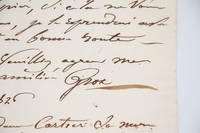
191675947s. l. 1916. Fine. s. l. s. d. vers 1916-1918 12.40 x 17 cm 2 pages sur un feuillet remplié Autograph letter signed by Georges Auric addressed to Bolette Natanson. Two pages written in black ink on a folded sheet. Folds inherent to mailing. Beautiful poetic letter with Rimbaldian influences: ""Alchimistes Rimbaud ! Eclair ouvre le ciel de mon adolescence ! Je me sens poète et c'est bien le moment de m'arrêter !"" ""Alchemists Rimbaud! Lightning opens the sky of my adolescence! I feel like a poet and this is the right moment to stop!"" Auric mentions a concert he must give at Mme Japy de Beaucourt's who held a salon in honor of the review directed by Ricciotto Canudo Montjoie ! : ""Je dois jouer - encore ! vendredi chez Mme J. de B. non point n'est ce pas Mme Jean de B mais Mme Canudo de Beaucourt"" ""I must play - again! Friday at Mme J. de B.'s not isn't it Mme Jean de B but Mme Canudo de Beaucourt"". He adds: ""Montjoie et Canudo gras et bête italboche."" ""Montjoie and Canudo fat and stupid Italian."" Having moved in artistic circles since her earliest childhood - she was the daughter of Alexandre and niece of Thadée Natanson creators of the famous Revue Blanche - Bolette Natanson 1892-1936 became friends with Jean Cocteau Raymond Radiguet Georges Auric Jean Hugo and Colette. Passionate about fashion she left Paris for the United States with Misia Sert close friend of Coco Chanel and was hired at Goodman. With her husband Jean-Charles Moreux they created the gallery Les Cadres on boulevard Saint-Honoré in 1929 and frequented numerous artists and intellectuals. Their success was immediate and they multiplied projects: creating the fireplace for Winnaretta de Polignac decorating the château de Maulny designing Baron de Rothschild's private mansion creating frames for industrialist Bernard Reichenbach and finally creating the storefront for Colette's beauty institute in 1932. Bolette Natanson also framed works by her prestigious painter friends: Bonnard Braque Picasso Vuillard Man Ray André Dunoyer de Segonzac etc. Despite this meteoric rise she took her own life in December 1936 a few months after her father's death. unknown
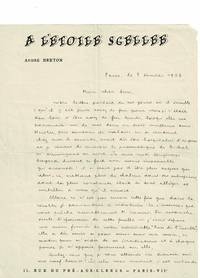
195375729Paris 1953. Fine. Paris 8 janvier 1953 21 x 27 cm 1 pages et quelques lignes sur un feuillet Unpublished handwritten signed letter from André Breton addressed to critic Charles Estienne; one page and a few lines in black ink on a paper from the à l'étoile scellée gallery. Two transverse folds from having been sent a small corner missing in the upper right margin. Very beautiful letter giving an account of the death of one of André Breton's dearest friends and of his quarrel with Albert Camus. Breton tells his friend about the death of the Surrealist Czech artist Jindich Heisler: Your letter spoke of those days where it seemed that there was only just enough fire to live: on Monday there was far from enough fire when it reached me: one of my two or three best friends Heisler taken suddenly unwell on his way to mine on Saturday had to be hospitalised urgently and I had just received the pneumatic from Bichat telling me of his death. The event no less inconceivable than accomplished left me distraught for a long time: there was no-one more exquisite than he putting more warmth into everything he did the most constant of which was to lighten and embellish those whom he loved. The two poets were indeed very close: Heisler participated alongside Breton in the launch of Néon in 1948 and supported him during a period of depression accompanying him with other friends to the Île de Sein. The beginning of 1953 was overshadowed by the death of Jindich Heisler 4 January. Loyal among the faithful he lived entirely for Surrealism according to Breton who pays tribute to his activity as a leader: This is how he was between 1948 and 1950 the soul of Néon and until his last moments the greatest bearer of projects that as if by magic his talent gave him the means to achieve. Henri Béhar André Breton In this letter laden with pain Breton suddenly makes reference to L'Homme révolté by Albert Camus published two years earlier: Come on it is not yet the time in the rebellion that I will succeed in introducing the measure that M. Camus kindly preaches to us. The two writers met in New York at the end of March 1946 when Camus was invited to the United States for a conference tour as a representative of Combat. The two agree on the best way to preserve the testimony of certain men free from ideological distortions. They dream of a kind of pact by which people of their calibre would commit to not join any political party to fight against the death penalty to never claim any credit whatsoever. ibid. With other intellectuals they founded the Rassemblement démocratique révolutionnaire RDR in 1948; but the idyll ended a couple of years later in the autumn of 1951 when Camus published Lautréamont et la banalité an extract from his Homme révolté which was published later. Breton was extremely hurt and responded to him in an article entitled Sucre jaune in Arts: This article . testifies to the part of Camus for the first time for an indefensible moral and intellectual position. . He only wants to see a guilty adolescent in Lautréamont whom he - in his capacity as an adult - must discipline. He goes as far as to find him in the second part of his work: Poésies a deserved punishment. According to Camus Poésies would be but a mass of laborious banalities . It could still be worse if the destitution of these views did not intend to promote the most suspect thesis in the world which is that absolute revolt can generate only the taste for intellectual enslavement. This is a completely gratuitous ultra-defeatist statement which must incur even more contempt than its false demonstration. Thus two years later Breton still holds out against Camus' crime of lese-majesty towards that which Breton constructed as the father of surrealism but even more this allusion to Camus' pacifist philosophy bearing witness to the incompatibility between a thought of moderation and a poetry of revol unknown
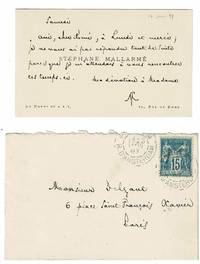
189776333Paris: S. n. 1897. Fine. S. n. Paris 23 janvier 1897 10.20 x 6.30 cm une carte de visite et son enveloppe Signed autograph visiting card from Stéphane Mallarmé addressed to Alidor Delzant. Envelope included. Alidor Delzant was a lawyer collector and bibliophile. Friend of the Goncourts he devoted a work to them and was Edmond's secretary and testamentary legatee. ""Ami cher ami à lundi et merci ; je ne vous ai pas répondu tout de suite parce que je m'attendais à vous rencontrer ces temps-ci."" ""Friend dear friend until Monday and thank you; I did not answer you right away because I expected to meet you these days."" S. n. unknown
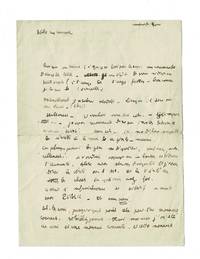
194586737s. l.: S. n. 1945. Fine. S. n. s. l. s. d. ca 1945 9 x 13.50 cm une page recto verso Autograph letter signed by Henri Michaux in two parts 45 lines in black ink on recto and in pencil on verso written over two days Sunday and Monday on bristol paper. Transverse fold in right margin of the bristol. Deletions and corrections in black ink on the recto of the letter Henri Michaux refuses what is asked of him: ""Now you're asking me for 20"" pages. ""It's impossible. I've done 6 which represent 7 or 8 of your magazine. I can do 2 more it seems to me so 10 More I'll think about it. But I cannot promise them to you at all."" and asks some questions to his correspondent: ""You still haven't told me the writers who are collaborating on the 1st issue anthology section. I'm curious and worried about it."" On the verso the writer has completed his work: ""And well there you have it I have 10 pages. but I can no longer write anything about this country - enough to have lived there a year"" in 1928 ""and to have made a book from it. So don't ask me for more. Just having to transcribe my letter ! gives me a headache. In me it refuses."" S. n. unknown
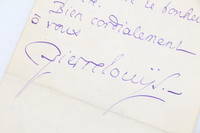
189778160Paris 1897. Fine. Paris s. d. après 1897 13.80 x 9 cm une carte autographe recto et verso Autograph card by Pierre Louÿs signed with his initial addressed to Georges Louis and written in violet ink on both sides. Note addressed to his brother Georges Louis with whom Pierre Louÿs maintained a very intimate relationship and whom he considered as his own father. The question of Pierre Louÿs's real paternal identity still fascinates biographers today: ""His father Pierre Philippe Louis . had married in 1842 Jeanne Constance Blanchin who died ten years later after giving him two children Lucie and Georges. In 1855 he remarried Claire Céline Maldan and from this union was born in 1857 a son Paul; then in 1870 our writer who received the given names Pierre Félix. This late birth the differences in character between father and son the former's disaffection toward the latter the profound intimacy that always reigned between Louÿs and his brother Georges all this has led certain biographers and critics to suspect that the latter was in reality the writer's father. The exceptionally intimate and constant relationship that Pierre and Georges maintained between themselves throughout their lives could be an argument in this direction. Of course no irrefutable proof has been discovered and probably never will be. Nevertheless certain letters . are quite troubling. In 1895 for example Louÿs writes seriously to his brother that he knows the answer to 'the most poignant question' he could ask him a question he has had 'on his lips for ten years.' The following year in the full triumph of Aphrodite he thanks Georges effusively and ends his letter with this sentence: 'Not one of my friends has a FATHER who is for him what you are for me.' Arguing from the close intimacy of Georges and Claire Céline during the year 1870 and the jealousy that the father never ceased to show toward his younger son Claude Farrère did not hesitate to conclude in favor of Georges Louis. And what to think of this dedication by Louÿs to his brother on a Japan paper copy of the first edition of Pausole: To Georges his eldest son / Pierre."" Jean-Paul Goujon Pierre Louÿs Pierre Louÿs revolutionizes his living conditions: ""I am taking serious care of myself. For two days now I have been going to bed at half past midnight to wake up between 9 and 10. Today after a day that has already lasted 11 hours I have only smoked half a pack of cigarettes. That's a quarter of my usual consumption during the same time. Moreover I walked more than a league on foot I took the air as much as I could.Well with all that I feel quite unwell or rather as if I were the day after a long and serious illness. Neither strength nor nerves. I have trouble listening speaking following an idea. Should this be attributed to my cigarette rationing It's possible. But honestly I don't think I have felt so low since '97 since the month when you came to see me in Algiers."" Amusing note from the most tobacco-addicted of writers nearly 60 cigarettes per day.! who wrote in Une volupté nouvelle: ""One night as I found myself there in silent conversation with two blue porcelain cats crouched on a white table I hesitated to choose between two pastimes of solitude: write a regular sonnet while smoking cigarettes or smoke cigarettes while looking at the ceiling carpet. The important thing is to always have a cigarette in hand; one must envelop objects in a celestial and fine cloud that bathes lights and shadows erases material angles and by a perfumed spell imposes on the agitated mind a variable balance from which it can fall into reverie."" unknown
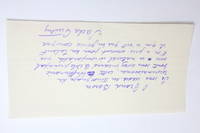
191073656s. l. 1910. Fine. s. l. s. d. 20.70 x 10.60 cm une feuille Autograph note signed by Sacha Guitry to the actor Louis Bouchené known as Baron fils. 7 lines in blue ink on ""Basseau Strong"" watermarked paper. ""O Grand Baron. Je vous dédie en témoignage de reconnaissance cette bouffonnerie dont vous avez incarné le rôle principal avec ce naturel incomparable que l'on a pris souvent pour du talent et qui n'est que du génie comique"". ""O Great Baron. I dedicate to you in token of gratitude this buffoonery in which you embodied the leading role with that incomparable naturalness which has often been mistaken for talent and which is nothing but comic genius"" The actor Baron fils embodied numerous roles in Sacha Guitry's plays notably La Prise de Berg-op-Zoom La Pèlerine écossaise L'Illusionniste Deburau Le Mari la Femme et l'Amant Nono and Faisons un rêve. unknown
190078919s. l. Paris 1900. Fine. s. l. Paris s. d. ca. 1900 12.30 x 16.50 cm 4 pages sur un double feuillet Autograph letter signed ""Pauline"" by Renée Vivien addressed to Natalie Clifford Barney and written in black ink on a double sheet with the poetess's silver monogram letterhead. Very beautiful and poetic love letter from the Muse of violets languishing for her ""dear white Lily"": ""Je n'ai pas pu te demander cet après-midi si je te verrais demain mon doux Avril mais tu as bien compris n'est-ce pas qu'il me serait aussi impossible de vivre un jour sans toi que de me priver des lumières du soleil ou des fleurs. . Avril mon doux petit Avril chaque fois que tu t'en vas tu emportes un peu de mon cur qui ne peut se détacher de toi et te suit tristement. Tu es pour moi la poésie la consolation et le rêve. Tu mets de la beauté dans ma vie et dans mon âme - quand je me réveille chaque jour et je pense à toi c'est la perpétuelle éclosion de quelque miraculeuse amour. Je vis dans un conte de fées un pays où tout est bleu et d'où la tristesse a disparu. Pense à moi ce soir avant d'aller rêver dans l'au-delà et le lointain du sommeil."" ""I could not ask you this afternoon if I would see you tomorrow my sweet April but you understood didn't you that it would be as impossible for me to live a day without you as to deprive myself of light sun or flowers. . April my sweet little April each time you leave you take with you a piece of my heart which cannot detach itself from you and follows you sadly. You are for me poetry consolation and dream. You bring beauty into my life and into my soul - when I wake each day and think of you it is the perpetual blossoming of some miraculous love. I live in a fairy tale a country where everything is blue and from which sadness has disappeared. Think of me tonight before going to dream in the beyond and the distance of sleep."" The letter then takes on a more sensual tone: ""J'aime tes cheveux blonds. Je leur envoie un long baiser. Les lys que j'ai dans ma chambre sont tristes parce que tu n'es plus là. Ils t'envoient leur âme dans un parfum. Ils t'aiment comme moi ; mais moins que moi."" ""I love your blonde hair. I send them a long kiss. The lilies I have in my room are sad because you are no longer there. They send you their soul in a fragrance. They love you like me; but less than me."" During their first night of love Renée had filled her room with lilies transforming it into a ""chapelle ardente"" N.Clifford Barney Je me souviens. Jean-Paul Goujon notes: ""The choice of lilies was very much in the taste of the period: let us remember Mucha's posters Schwabe's paintings Lorrain's poems. But Vivien who certainly remembered certain pages filled with flowers and perfumes from Zola's La Faute de l'abbé Mouret seems to have wanted to celebrate mystical nuptials coupled with a sort of perfumed death."" It was at the end of 1899 and through Violette Shillito that Renée Vivien - then Pauline Tarn - made the acquaintance of Natalie Clifford Barney ""cette Américaine plus souple qu'une écharpe dont l'étincelant visage brille de cheveux d'or de prunelles bleu de mer de dents implacables"" ""this American more supple than a scarf whose sparkling face shines with golden hair sea-blue eyes implacable teeth"" Colette Claudine à Paris. Natalie who had just lived through a summer idyll with the scandalous Liane de Pougy who initiated her into Sapphism paid only discreet attention to this new acquaintance. Renée however was totally captivated by the young American and would relate this coup de foudre in her autobiographical novel Une Femme m'apparut: ""J'évoquai l'heure déjà lointaine où je la vis pour la première fois et le frisson qui me parcourut lorsque mes yeux rencontrèrent ses yeux d'acier mortel ses yeux aigus et bleus comme une lame. J'eus l'obscur prescience que cette femme m'intimait l'ordre du destin que son visage était le visage redouté de mon avenir. Je sentis p unknown
192984821Angers 1929. Fine. Angers 25 Septembre 1929 13.50 x 20.50 cm quatre pages sur un feuillet double Autograph letter dated and signed by Renée Guilloux about friendship that transcends and sublimes human relationships 80 lines written in black ink on four pages. Folds inherent to mailing small tears at foot without any damage to the text. For Renée Guilloux the friendship she feels for her correspondent dominates distance and silence: "". est-ce que les mots ont su dire la joie des coeurs."" ""have words been able to express the joy of hearts."" and momentary disagreements: ""Mais tous ces mois toutes ces années nous pesaient douloureusement. J'avais l'impression que vous vous étiez mis d'un seul coup à parler très vite avec beaucoup d'agitation dans une langue qui m'était étrangère. mais je savais que ce n'était qu'un moment et qu'après nous reprendrions notre conversation rentable."" ""But all these months all these years weighed on us painfully. I had the impression that you had suddenly started speaking very quickly with great agitation in a language that was foreign to me. but I knew it was only a moment and that afterwards we would resume our profitable conversation."" Despite life's vicissitudes Louis Guilloux and his wife have always shown confidence in the brotherhood that unites them above all: ""J'attendais votre retour dans la certitude dans la paix et bien qu'il n'y ait pas de paroles écrites entre nous votre amitié m'apportait toujours sa même force et sa même joie."" ""I awaited your return with certainty in peace and although there were no written words between us your friendship always brought me the same strength and the same joy."" and in the serenity acquired after so many ordeals endured: ""Vous nous avez trouvés transformés dites-vous grandis. cette paix c'est notre conquête la plus belle. après les inquiétudes et les souffrances."" ""You found us transformed you say grown. this peace is our most beautiful conquest. after the anxieties and sufferings."" Renée Guilloux praises this radiating peace that she shares with her friend: ""Cette paix qui est en nous elle est aussi vôtre cher ami et vous avez grandi comme nous. je pense au rêve de Don Quichotte aux paroles qu'il echange avec Dulcinée. Elles sont pleines de cette lumière."" ""This peace that is in us it is also yours dear friend and you have grown like us. I think of Don Quixote's dream of the words he exchanges with Dulcinea. They are full of this light."" Finally she is reassured by her husband's health which is improving and which allows him to return to his writing work. unknown
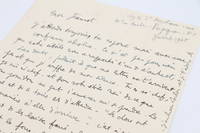
184684820Mâcon 1846. Fine. Mâcon 26 Décembre 1846 13.50 x 20.50 cm une page sur un feuillet Autograph letter dated and signed by Alphonse de Lamartine; one page with his monogram blind-stamped in the upper left corner and written in black ink on one leaf 15 lines. Folds inherent to mailing. In this letter Lamartine shows his happiness to collaborate with their mutual friend's journal and confirms a financial agreement. unknown
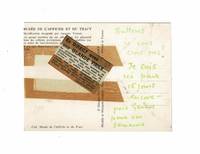
197173355Sommières 1971. Fine. Sommières 12-02-1971 10.50 x 14.50 cm une carte postale et enveloppe Autograph postcard from Lawrence Durrell addressed to Jani Brun written in red felt-tip pen on the reverse of a reproduction of a small poster Mystification conceived by Jacques Yonnet "". Keep your head above water - Prolonged immersion of nose and mouth can cause fatal asphyxia"" with attached press clipping ""direct with a virile gland."" envelope included. The writer informs his young Montpellier lover about his upcoming travels: ""Buttons. Je ne vous crois pas ! je suis ici pour 15 jours encore - puis Genève pour une semaine"" ""Buttons. I don't believe you! I'm here for another 15 days - then Geneva for a week"". After many years spent in Greece Egypt and Rhodes the traveling writer Lawrence Durrell was forced to flee Cyprus following popular uprisings that led the island to independence from the British Crown. Rich only with a shirt and a typewriter but crowned with the success of his novel Bitter Lemons of Cyprus he arrived in France in 1956 and settled in the Languedoc village of Sommières. In the ""Tartès house"" his grand residence surrounded by trees he wrote the second part of his work his monumental Avignon Quintet devoted himself to painting and received his illustrious friends including the couple Henry Miller and Anaïs Nin violinist Yehudi Menuhin London publisher Alan G. Thomas and his two daughters Penelope and Sappho. Among the olive trees and under the Mediterranean sun he met in the mid-1960s the young and sparkling ""Jany"" Janine Brun a woman from Montpellier in her thirties with devastating beauty who worked at the Antiquities department of the Sorbonne in Paris. She was nicknamed ""Buttons"" in memory of their first meeting where the young woman wore a dress covered with buttons. Henry Miller also fell under the charm of ""Buttons"" praising her beauty and eternal youth in exceptional letters that remain unpublished. The three companions spent memorable Parisian evenings of which we retain precious autograph traces through their epistolary exchanges. Recommended by Durrell she made numerous trips particularly to England from where she received extensive correspondence from the writer as well as original works of art signed with his artist pseudonym Oscar Epfs. unknown
191080833Alger Algiers 1910. Fine. Alger Algiers s. d. ca 1910 16.30 x 10.60 cm une carte Autograph card signed by Judith Gautier addressed to Céleste Chrétien her housekeeper written in black ink on both sides of a card with letterhead from 30 rue Washington in Paris. Judith regrets leaving her house in Dinard: ""It was kind of you to send us flowers from the garden. It gave us pleasure and regrets because there must still be beautiful days there."" She expresses here her passion for horticulture: ""Every evening I burn a eucalyptus leaf from your trees to perfume my room. The terrace is full of chrysanthemums in bloom and there were three tomatoes that are ripening on my wardrobe."" unknown
190173686s. l. cachet de Seine-et-Marne 1901. Fine. s. l. cachet de Seine-et-Marne 15 Septembre 1901 12.50 x 17.60 cm une feuille Moving autograph letter signed by Octave Mirbeau addressed to the playwright and founder of the Revue Blanche Alfred Natanson. 15 lines in black ink on a folded sheet mourning paper with black border watermarked ""JDL & cie"" envelope attached. ""Thank you for your kind letter. I already knew from Alexandre Natanson how worried you had been about my wife's condition. It is a delicious joy when one's heart is tormented to know that one has friends like you like all of you the good people of the Relai. Please tell your wife that mine was very touched by her friendship. And embrace everyone with effusion. Also tell Olga Alexandre Natanson's wife and Misia Thadée's wife that we love them tenderly and Alexandre that he is a charming friend."" Long postscript on the poor health of his wife the former actress Alice Régnault: ""Yesterday was not a good day and the wound on her arm presented a nasty appearance. Today it is a little better. But it is something to watch very closely. Movements are made a little more easily but she still suffers extremely at night at the slightest play of the muscles"". Mirbeau had been particularly close to the Revue Blanche group since its launch in Paris in 1891. But it was during the Dreyfus affair that his intimate and lasting friendship with the Natanson brothers Thadée Alexandre and Alfred was strengthened. After aesthetic disagreements over Art Nouveau and the Nabis Mirbeau finally reunited with Thadée around 1900 in a now shared inclination for the young Nabis painters of the Revue Blanche Bonnard Vallotton and Vuillard. The ""Relai"" corresponds to a former coaching inn in Villeneuve-sur-Yonne purchased by Thadée Natanson in 1897 which became a destination for all their writer and artist friends. One could encounter the Nabis painters Vuillard Vallotton Bonnard or Roussel as well as Toulouse-Lautrec. The Revue Blanche played an essential role in France as historian Paul-Henri Bourrelier confirms: ""Most of the most prominent writers painters musicians politicians intellectuals of the late nineteenth and early twentieth centuries collaborated with it or were associated with it. Created financed and directed by the three Natanson brothers young Polish Jews with the enthusiastic complicity of their fellow students from the Condorcet lycée La Revue blanche quickly became a place of debate on all the subjects that stirred France. It led political battles under the impetus of anarchists like Fénéon Mirbeau; socialists such as Blum G. Moch Péguy; Dreyfusards and founders of the League of Human Rights like Reinach and Pressensé."" unknown
189686610Paris 1896. Fine. Paris 1896 13 x 20.50 cm 3 pages sur un double feuillet Autograph letter signed by Pierre Louÿs addressed to his publisher Alfred Vallette 50 lines written in purple ink on a double sheet. Pierre Louÿs responds to his friend and publisher Alfred Vallette after a controversy launched by a journalist from Comoedia a controversy that could damage their friendship: ""Je ne suis pour rien dans l'écho publié par Comoedia. Mais ce que vous en citez suffit à me montrer que le rédacteur s'est mal informé."" ""I had nothing to do with the piece published by Comoedia. But what you quote from it is enough to show me that the writer was misinformed."" and he intends to remind him that they had not been able to agree on the publishing terms for Aphrodite and that he envisioned only a confidential distribution for his latest book: ""L'histoire de notre édition est très simple. Vous m'avez proposé un traité que je n'ai pas trouvé bon ; j'ai préféré le ""compte d'auteur"" et je ne peux pas vous accuser d'avoir mal prévu le succès du livre puisque moi-même j'avais écrit mon roman pour vingt amis et quelques inconnus."" ""The story of our edition is very simple. You offered me a contract that I did not find good; I preferred the 'author's account' and I cannot accuse you of having poorly predicted the book's success since I myself had written my novel for twenty friends and a few strangers."" This is why the father of Aphrodite is astonished by the triumph achieved by the work: ""Si une diseuse de bonne aventure nous avait prédit alors qu'Aphrodite dépasserait un jour le 300e mille nous l'aurions traitée comme une pauvre folle."" ""If a fortune teller had predicted then that Aphrodite would one day exceed 300000 copies we would have treated her as a poor madwoman.""; the latter consecrating his fame and wealth in the literary world: ""J'ai en outre une seconde raison pour ne pas vous en vouloir du traité que j'ai signé avec vous : c'est qu'en préservant mes droits d'autuer sur ce roman j'ai fait sans le savoir ma fortune. C'est à cela seul que je dois mon indépendance littéraire et cette inestimable liberté du silence qui n'est pas l'idéal de tous mais qui me paraît être le bonheur du poëte."" ""I have furthermore a second reason for not resenting the contract I signed with you: it is that by preserving my author's rights on this novel I made my fortune without knowing it. It is to this alone that I owe my literary independence and this invaluable freedom of silence which is not everyone's ideal but which seems to me to be the poet's happiness."" Very fine autograph on Pierre Louÿs's literary triumph. unknown
191675943s. l. 1916. Fine. s. l. s. d. vers 1916-1918 12.40 x 17 cm 2 pages sur un feuillet remplié Signed autograph letter from Georges Auric addressed to Bolette Natanson. Two pages written in black ink on a folded sheet. Deletions and underlinings. Fold marks inherent to mailing. Very fine letter in which the composer dissertates on friendship: ""I simply wanted to tell you this important thing. I recommend that you not invite Florent Schmitt nor any 'artist'. Otherwise I declare myself incapable of resisting the vision of these evil geniuses. For more than ever people disgust me except you naturally. I would like to press a button and destroy Humanity. Then we will be at peace and I will tell you the truth about Art and the truth about all the things in which you have faith."" Auric also evokes music in this letter: ""Only Ravel's waltzes are noble and sentimental."" Having evolved from her earliest childhood in artistic circles - she is the daughter of Alexandre and the niece of Thadée Natanson the creators of the famous Revue Blanche - Bolette Natanson 1892-1936 befriended Jean Cocteau Raymond Radiguet Georges Auric Jean Hugo and Colette. Passionate about couture she left Paris for the United States with Misia Sert great friend of Coco Chanel and was hired at Goodman. With her husband Jean-Charles Moreux they created in 1929 the gallery Les Cadres on boulevard Saint-Honoré and frequented numerous artists and intellectuals. Their success was immediate and they multiplied projects: the creation of Winnaretta de Polignac's fireplace the decoration of the château de Maulny the layout of baron de Rothschild's private mansion the creation of frames for industrialist Bernard Reichenbach and finally the realization of Colette's beauty institute storefront in 1932. Bolette Natanson also framed the works of her prestigious painter friends: Bonnard Braque Picasso Vuillard Man Ray André Dunoyer de Segonzac etc. Despite this meteoric rise she took her own life in December 1936 a few months after her father's death. unknown
194084633Perpignan 1940. Fine. Perpignan juillet 1940 21 x 27 cm deux pages sur un feuillet Autograph letter by Jean Cocteau signed with his famous star addressed to his great love the actor Jean Marais. Dated by the author July 1940. One and a half pages in black ink on a sheet. Two small marginal tears not affecting the text. Traces of transverse folds inherent to posting. Magnificent love letter from Cocteau to Marais who formed one of the most legendary artistic couples of the 20th century. Against the backdrop of defeat and German Occupation their unbreakable bond is embodied in this letter from the writer with its desperate accents. Published in the Lettres à Jean Marais 1987 p. 157. This missive from a love-stricken Cocteau was written shortly after the Armistice of June 22 1940 marking the end of the French defeat. Marais mobilized had joined the front in May 1940 while Cocteau had taken refuge in Perpignan. Communication in these troubled times proved difficult: ""Mon Jeannot j'attends toujours ta réponse mais avec une confiance absolue. Ce n'est pas pour rien que notre étoile nous a rapprochés l'un de l'autre et sans doute fallait-il que mes lettres ne t'arrivent pas et que je souffre de mon silence"" ""My Jeannot I am still waiting for your response but with absolute confidence. It is not for nothing that our star brought us closer to one another and no doubt it was necessary that my letters not reach you and that I suffer from my silence"" ""Tu es né chef je suis né chef. Et sous notre étoile rien de ce que nous . ne peut s'annexer ni se perdre. Le principal est de se taire et d'attendre. entre guillemets : les choses ont une manière à elles d'arriver."" C'est à nous de le savoir et de les laisser faire ."" ""You were born a leader I was born a leader. And under our star nothing of what we . can be annexed or lost. The main thing is to remain silent and wait. in quotation marks: things have their own way of happening."" It is up to us to know this and let them do so ."" The Cocteau - Marais partnership would soon return to Paris and endure the torments of the German occupation which would ban the revival of their scandalous play Les Parents terribles which had enjoyed great success in 1939. unknown