Andre BRETON - Elisa BRETONBiblio.com
1 815 résultats
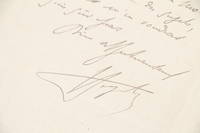
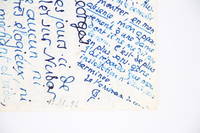
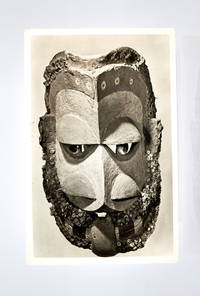
195875712Amsterdam 1958. Fine. Amsterdam 1958 13.90 x 8.90 cm une carte postale Autograph signed postcard addressed to Jean Schuster Amsterdam 1958 13.9 x 8.9 cm a postcard Handwritten postcard signed by André Breton addressed to Jean Schuster written in blue ballpoint pen on the back of a postcard reproducing a black and white photography of a Melanesian mask preserved at the Tropenmuseum in Amsterdam and which André Breton designates under the highly significant qualifier friend responsible for showing his affection to Jean Schuster. This grid pattern of canals and the tulip tiling leaves us in great indecision. . This country is decidedly very beautiful. His wife Elisa Breton added a few lines of a Surrealist tone following the main text: Elisa in Amsterdam comes from a gingerbread tin and a potential twisting from antiquarians. Jean Schuster 1929-1995 joined the Surrealist group in 1947. Close to Benjamin Péret and André Breton he will become Breton's executor. unknown
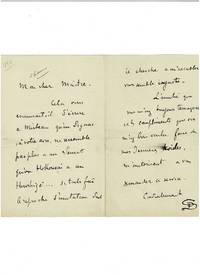
1894755111894. Fine. s. d. 23 janvier 1894 22.60 x 17.50 cm 2 pages sur un double feuillet déplié Autograph letter signed by Paul Signac addressed to Camille Pissarro written in black ink over two pages and signed with the artists monogram. This letter was transcribed in the article by Pierre Michel and Christian Limousin entitled ""Octave Mirbeau et Paul Signac - Une lettre inédite de Signac à Mirbeau"" in Cahiers Octave Mirbeau no. 16 March 2009 pp. 202-210. ""Mon cher Maître Cela vous ennuirait-il sic d'écrire à Mirbeau qu'un Signac à votre avis ne ressemble pas plus à un Seurat qu'un Hokousai à un Hiroshigé. si toutes fois sic le reproche d'imitation dont il cherche à m'accabler vous semble injuste. L'amitié que vous m'avez toujours témoignée et les compliments que vous avez bien voulu faire de mes toiles m'autorisent à vous demander ce service. Cordialement. PS"" A fine letter in which Paul Signac seeks the support of his master Camille Pissarro after a scathing critique published by Octave Mirbeau in L'Echo de Paris. In this article featured on the front page of L'Echo de Paris of 23 January 1894 Octave Mirbeau spares Signac no harshness: « M. Signac a voulu continuer Seurat. Je ne puis me faire à sa peinture. Je ne méconnais pas ses qualités mais elles disparaissent sous l'amoncellement de ses défauts. Ce qu'on admettait de Georges Seurat . on le comprend moins chez M. Signac qui n'en est que l'adepte trop complaisant et trop littéral. Et puis cette continuelle sécheresse me choque. M. Signac fait la nature immobile et figée. Jamais le vent n'a secoué la surface inerte de ses mers ni tordu les branches de ses pins ni animé l'éternelle fixité de ses nuages la raideur cartonnée de ses ciels. Il ignore le mouvement la vie l'âme qui est dans les choses. . Il serait peut-être temps pour notre joie que M. Signac voulût bien nous donner du Signac. Je crois qu'il le peut.» Why this obsession with Seurat « At the beginning of 1894 the position of Mirbeau Geffroy Pissarro and a few others was to consider that Neo-Impressionism had in fact died in 1891 with the passing of Seurat. Their retrospective view of this artistic venture led them to think that it was not a continuation of Impressionism by new scientific means but a reaction against it even a liquidation of the movement.» Cahiers Octave Mirbeau. Pissarros reply to Signac also transcribed by Michel and Limousin was not long in coming: it « l'ennuirait d'écrire ce que vous me demandez à Mirbeau et cela pour plusieurs raisons. . Premièrement parce que je suis en froid avec lui vous le savez bien. Deuxièmement parce que pour vous-même il ne sied pas de discuter l'opinion d'un critique même étant persuadé d'être dans le vrai et si vous voulez franchement ma façon de penser et que je suis heureux d'avoir l'occasion de vous exprimer je trouve que la méthode même est mauvaise. Au lieu de servir l'artiste l'ankylose et le glace. Si je vous ai fait des compliments cette année c'est parce que j'ai trouvé vos dernières toiles mieux que celles que vous aviez exposées aux Indépendants mais je suis loin de trouver que vous êtes dans la voie qui convient à votre tempérament essentiellement peintre et si jusqu'à présent je ne vous ai rien dit à ce sujet c'est parce que j'étais sûr de vous être désagréable et somme toute mes convictions peuvent ne pas être partagées par vous. Réfléchissez mûrement et voyez si le moment n'est pas venu de faire votre évolution vers un art plus de sensation plus libre et qui serait plus conforme à votre nature.» « Disheartened and deprived of the authority of a master revered by the critic Signac was left to devise himself without delay the reply to address to Mirbeau . » ibid. This response took the form of a long letter written the same day as the one offered here and now preserved at the Harry Ransom Center at the University of Austin Texas: « Je reconnais hautement que c'est Seurat qui a insta unknown
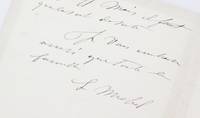
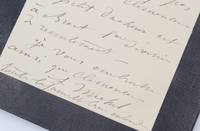
188783960s. l. Paris 1887. Fine. s. l. Paris 19 novembre 1887 11.30 x 17.70 cm 1 pages 1/2 sur un bifeuillet Autograph letter signed by Louise Michel addressed to Lucien Barrois; one and a half pages written in black ink on a bifolium of white paper with black border. Transverse folds inherent to mailing. ""Chauvière et d'autres amis communs vous prient bien de tâcher que Clemenceau recommande au professeur qui a la chaire de Russe au Collège de France et à la Sorbonne notre ami Gregorieff comme aide. Il paraît qu'avec un mot de Rochefort et de Clemenceau il serait immédiatement accepté ."" ""Chauvière and other mutual friends earnestly ask you to try to have Clemenceau recommend our friend Gregorieff as assistant to the professor who holds the Russian chair at the Collège de France and at the Sorbonne. It appears that with a word from Rochefort and Clemenceau he would be immediately accepted ."" The novelist P. Gregorieff had given some Russian lessons to Louise Michel. Moving letter testimony to the unfailing devotion of the former Communard. unknown
188583964s. l. Paris 1885. Fine. s. l. Paris 6 février 1885 11.10 x 17.60 cm 1 page 1/2 sur un bifeuillet Autograph letter signed by Louise Michel addressed to Lucien Barrois; one and a half pages written in black ink on a bifolium of white paper with black border. Transverse folds inherent to mailing. A trace of glue on the second sheet where Louise Michel had probably pasted a letter from her cousin. News of Louise Michel's little cousin Lucien Dacheux: ""Je reçois une lettre de mon petit cousin Dacheux qui me demande de remercier encore pour lui Clemenceau et lui. Je le fais moi-même de tout coeur. N'oubliez pas de le dire à Clemenceau. Le petit Dacheux est à Brest 1ère division de recrutement. . Clemenceau serait en droit de dire que je suis bien ennuyeuse mais montrez lui la lettre du petit si on pouvait obtenir qu'il ait un peu d'instruction. Je ne sais pas s'ils peuvent avoir des leçons. Y a-t-il une école je ne sais rien de tout cela dans la division où il est."" ""I receive a letter from my little cousin Dacheux who asks me to thank Clemenceau and him again on his behalf. I do so myself wholeheartedly. Don't forget to tell Clemenceau. Little Dacheux is in Brest 1st recruitment division. . Clemenceau would have the right to say that I am quite bothersome but show him the little one's letter if we could obtain that he have a little education. I don't know if they can have lessons. Is there a school I know nothing of all that in the division where he is."" Moving letter testimony to the unfailing devotion of the former communard. unknown
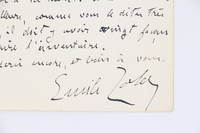
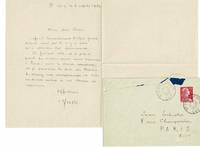
188279111Médan 1882. Fine. Médan 1er décembre 1882 13.60 x 21.40 cm 2 pages sur un double feuillet - enveloppe jointe Autograph letter signed by Emile Zola - apparently unpublished - written in black ink on a double sheet and addressed to Léon Carbonnaux department head at Bon Marché. Folds inherent to mailing. Envelope included. Only two letters from Léon Carbonnaux to Emile Zola are known: they can be consulted in the digitized preparatory file for Au bonheur des dames made available online by the Bibliothèque nationale de France. However we know from this same file which contains a long section entitled ""Notes Carbonnaux"" that this department head at Bon Marché provided Zola with a significant amount of information particularly about employee customs their remuneration and especially inventory techniques. The two men probably met when Emile Zola eager for information about the workings of department stores conducted field research in February and March 1882. Very important unpublished letter shedding new light on the pre-original publication of Au bonheur des dames. In his biography of Emile Zola Henri Mitterrand writes: ""Even before the novel was completed Zola gave an extract to Panurge in November; and on November 23 1882 Gil Blas announced its imminent publication in its columns."" Our letter discussing precisely this alleged pre-publication in Panurge attests that it was simply a joke and thus contradicts Henri Mitterrand: ""But your letter surprises and saddens me somewhat. How could you have been taken in by Panurge's stupid joke Did you not notice that the entire issue is a 'farce' Not one of the articles is authentic they are parodies and very poorly done ones at that."" Indeed reading the said extract cannot fool the assiduous reader of Zola despite the introduction that the journalists wrote: ""After Nana and Pot-Bouille those epics of elegant vice and bourgeois vice M. Emile Zola wanted to create one of honesty: Au bonheur des Dames which will appear shortly is a reassuring painting of innocence and virtue; the greatest success is assured for this new work whose characters move in the setting of a large novelty store; Parisian high commerce will not long await its observer and painter. We thank Emile Zola for having kindly cut out especially for Panurge a few pages from his still unpublished work and we are proud to give the public first an extract from this work of such high morality and such powerful interest."" Panurge no. 4 of October 22 1882 The sentences of this false Zolian text are exaggeratedly long and Panurge took the liberty of endowing the novel with a male main character Denis Mouret an amalgam of Denise the true heroine of the book to appear and Octave Mouret. One can think that it is a text composed from elements of Pot-Bouille the previous volume of Rougon Macquart where Octave - future owner of Bonheur des Dames - exercised the function of clerk before his meteoric social rise: ""For already more than two months he had been attached to the 'silks and furs' department; he arrived in the morning at seven o'clock to return home his day finished only at nine o'clock in the evening when all of Paris buzzed strangely with a feverish animation of pleasure and enjoyment and on his way back he followed gawking the great crowded boulevards where blazed the cafés full of girls and where on the asphalt at theater doors the crowd jostled with here and there in the vague rumor of trampling and pressing the roguish intonation of the cries of program vendors and ticket sellers."" Panurge In his letter of November 30 1882 Léon Carbonnaux - reading the extract from Panurge - had reproached Zola for his errors: ""Nowhere except at the Fabriques de France near Les Halles does one arrive at 7 a.m. It's at the earliest 7:30 but more often 8 a.m. and even then. There is no silk and fur counter at the Louvre. . It is so easy for you to be accurate that errors of this kind especially if t unknown
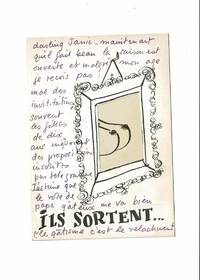
197173354Sommières 1971. Fine. Sommières 20-04-1971 10.50 x 14.50 cm une carte postale et enveloppe Autograph postcard by Lawrence Durrell signed ""Dracula"" addressed to Jani Brun written in blue ink reproduction of a drawing by Marcel Vaysse ""Ils sortent.tous les soirs"" ""They go out.every evening"" envelope included. The writer teasingly mocks his young Montpellier mistress with humor: ""Darling Janie - maintenant qu'il fait beau la saison est ouverte et malgré mon age je reçois pas mal des invitations; souvent les filles de dix ans m'envoient des propositions inscrites par télégramme. J'estime que le rôle de papa gâteux me va bien ""le gâtisme c'est le relachment des sphinctères"" Dictionnaire medicale - Pujot"". Je vais en Grèce avec une 2 3 4 filles plus fidé que vous pour faire des reportages appellation contrôlée. D'avoir soixante ans et d'être aimé très mal d'ailleurs par les vampires - n'est pas que c'est splendide Dracula"" ""Darling Janie - now that the weather is fine the season is open and despite my age I receive quite a few invitations; often ten-year-old girls send me proposals written by telegram. I think the role of a doting daddy suits me well 'dotage is the loosening of the sphincters' Medical Dictionary - Pujot. I'm going to Greece with one 2 3 4 girls more faithful than you to do some appellation contrôlée reporting. To be sixty years old and to be loved very badly moreover by vampires - isn't that splendid Dracula"" After many years spent in Greece Egypt and Rhodes the traveling writer Lawrence Durrell was forced to flee Cyprus following popular uprisings that led the island to its independence from the British crown. Rich only with a shirt and a typewriter but crowned with the success of his novel Bitter Lemons of Cyprus he arrived in France in 1956 and settled in the Languedoc village of Sommières. In the ""Tartès house"" his large dwelling surrounded by trees he wrote the second part of his work his monumental Avignon Quintet devoted himself to painting and received his illustrious friends including the couple Henry Miller and Anaïs Nin violinist Yehudi Menuhin London publisher Alan G. Thomas and his two daughters Penelope and Sappho. Among the olive trees and under the Mediterranean sun he met in the mid-1960s the young and sparkling ""Jany"" Janine Brun a woman from Montpellier in her thirties with devastating beauty who worked at the Department of Antiquities at the Sorbonne in Paris. She was nicknamed ""Buttons"" in memory of their first meeting where the young woman wore a dress covered with buttons. Henry Miller also fell under the charm of ""Buttons"" praising her beauty and eternal youth in exceptional unpublished letters. The three companions spent memorable Parisian evenings of which we retain precious autograph traces through their epistolary exchanges. Recommended by Durrell she made numerous trips particularly to England from where she received extensive correspondence from the writer as well as original artworks signed with his artist pseudonym Oscar Epfs. unknown
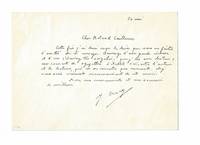
197574311s. l.: S. n. 1975. Fine. S. n. s. l. s. d. circa 1975 15.50 x 11 cm une feuille Autograph card of 11 lines signed by Julien Gracq addressed to Roland Cailleux regarding the sending of his latest work possibly A moi-même inconnu published in 1978 for which Julien Gracq congratulates him: "". ouvrage d'une grande richesse et d'un éclairage très singulier."" expressing an unusual sense of complicity between reader and writer: "". un courant de sympathie s'établit ici entre l'auteur et le lecteur qui ne se rencontre que rarement."" A fine tribute from Julien Gracq acknowledging and appreciating the sensitivity and talent of Roland Cailleux. S. n. unknown
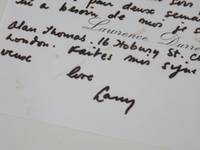
1970703391970. Fine. s. d. circa 1970 12.70 x 8.10 cm une carte de visite Autograph signed calling card addressed to Jani Brun written in black felt-tip pen and bearing some stains. The writer informs his young French mistress of an imminent departure to London where he frequently visited his publisher: ""Je suis chez Alan Thomas. 16 Holbury St. Chelsea. Faites moi signe quand tu veux sic Love Larry"" ""I am at Alan Thomas's. 16 Holbury St. Chelsea. Let me know when you want to meet. Love Larry"". After many years spent in Greece Egypt and Rhodes the travel writer Lawrence Durrell was forced to flee Cyprus following popular uprisings that led the island to its independence from the British crown. Rich only with a shirt and a typewriter but crowned with the success of his novel Bitter Lemons of Cyprus Les citrons acides he arrived in France in 1956 and settled in the Languedoc village of Sommières. In the ""maison Tartès"" his large house surrounded by trees he wrote the second part of his work his monumental Avignon Quintet devoted himself to painting and received his illustrious friends including the couple Henry Miller and Anaïs Nin the violinist Yehudi Menuhin the London publisher Alan G. Thomas and his two daughters Penelope and Sappho. Among the olive trees and under the Mediterranean sun he met in the mid-1960s the young and sparkling ""Jany"" Janine Brun a thirty-something woman from Montpellier of devastating beauty who worked in the Department of Antiquities at the Sorbonne in Paris. She was nicknamed ""Buttons"" in memory of their first meeting where the young woman wore a dress covered with buttons. Henry Miller also fell under the charm of ""Buttons"" praising her beauty and eternal youth in exceptional unpublished letters. The three companions spent memorable Parisian evenings of which we keep precious autograph traces through their epistolary exchanges. Recommended by Durrell she made numerous trips notably to England from where she received extensive correspondence from the writer as well as original works of art signed with his artist pseudonym Oscar Epfs. unknown
190679014Villa Clos fleuri Nice Nice 1906. Fine. Villa Clos fleuri Nice Nice 3 mars 1906 12.40 x 16.80 cm 3 pages sur un double feuillet Autograph letter signed ""Pauline"" by Renée Vivien addressed to Natalie Clifford Barney and written in violet ink on a double sheet with violet letterhead the Parisian address on the letterhead crossed out. Transverse folds inherent to mailing. Fine letter evoking Renée Vivien's execration for Nice: ""Ici un soleil insolent d'ignobles bâtisses des gens Je regrette Mytilène . Mon Dieu entre Nice et Paris il n'y a pas de différence bien marquée quelques oranges de plus ici des palmiers d'opéra comique - une illusion de chaleur c'est tout."" ""Here an insolent sun ignoble buildings people I miss Mytilene . My God between Nice and Paris there is no marked difference a few more oranges here comic opera palm trees an illusion of warmth that's all."" The evocation of Mytilene where the two lovers had traveled the previous summer continues in this missive: ""Encore une lettre de ce vieux filou de Paradellis Je l'ai envoyé promener Il est capable de faire main basse sur tout ce qu'il y a dans la maison "" ""Another letter from that old rogue Paradellis I sent him packing He's capable of making off with everything in the house "" It was Passagisti Paradellis who rented a villa on site with a two-year lease to Renée and Natalie. ""The villa had been tastefully furnished. Collections of rare porcelain mother-of-pearl inlaid furniture a dining room with high-backed armchairs."" J.-P. Goujon Tes blessures sont plus douces que leurs caresses In this letter the Violet Muse also gives the key to one of the characters in Une femme m'apparut whose revised version had just appeared: ""Dis à Madame Mardrus pas de ma part de la tienne ! que Doriane c'est elle telle qu'elle s'est révélée à moi un jour dans l'ardeur et dans la tristesse."" ""Tell Madame Mardrus not from me from you! that Doriane is her as she revealed herself to me one day in ardor and in sadness."" The work whose rewriting had nevertheless tried the poetess is here devalued by the latter: ""En somme je n'aime pas ce volume ou plutôt il m'est indifférent ce qui est plus triste encore "" ""In sum I don't like this volume or rather it is indifferent to me which is even sadder "" It was at the end of 1899 and through the intermediary of Violette Shillito that Renée Vivien - then Pauline Tarn - made the acquaintance of Natalie Clifford Barney ""cette Américaine plus souple qu'une écharpe dont l'étincelant visage brille de cheveux d'or de prunelles bleu de mer de dents implacables"" Colette Claudine à Paris. Natalie who had just lived through a summer idyll with the scandalous Liane de Pougy who had initiated her into sapphism paid only discreet attention to this new acquaintance. Renée on the other hand was completely captivated by the young American and would relate this love at first sight in her autobiographical novel Une Femme m'apparut: ""J'évoquai l'heure déjà lointaine où je la vis pour la première fois et le frisson qui me parcourut lorsque mes yeux rencontrèrent ses yeux d'acier mortel ses yeux aigus et bleus comme une lame. J'eus l'obscur prescience que cette femme m'intimait l'ordre du destin que son visage était le visage redouté de mon avenir. Je sentis près d'elle les vertiges lumineux qui montent de l'abîme et l'appel de l'eau très profonde. Le charme du péril émanait d'elle et m'attirait inexorablement. Je n'essayai point de la fuir car j'aurais échappé plus aisément à la mort."" ""Winter 1899-1900. Beginning of the idyll. One evening Vivien is invited by her new friend to Mme Barney's studio Natalie's mother 153 avenue Victor-Hugo at the corner of rue de Longchamp. Natalie ventures to read verses of her composition. When Vivien tells her she loves these verses she replies that it is better to love the poet. A response quite worthy of the Amazon."" J.-P. Goujon op. cit. Two ye unknown
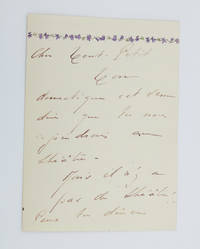
190679017s. l. Paris 1906. Fine. s. l. Paris s. d. ca 1906 11.50 x 15.90 cm 4 pages sur un double feuillet Autograph letter signed ""Paul"" from Renée Vivien addressed to Natalie Clifford Barney and written in black ink on a double sheet bordered with violets. Baroness Hélène de Zuylen has added a small manuscript message signed at the end of the letter: ""Paule a raison vous êtes un être charmant et féerique !"" ""Paule is right you are a charming and fairy-like being!"" Transverse folds inherent to mailing. ""Cher Tout-Petit Ton domestique est venu dire que tu nous rejoindrais au théâtre. Mais il n'y a pas de théâtre ! Peux-tu dîner avec nous jeudi ou vendredi Si dans la soirée de jeudi tu n'es libre qu'après le dîner viens nous rejoindre à n'importe quelle heure. Donne-moi un petit coup de téléphone pour me dire ce que tu feras et si je dois te faire chercher et à quelle heure Dis à tes cheveux que je les aime."" ""Dear Little One Your servant came to say that you would join us at the theater. But there is no theater! Can you dine with us Thursday or Friday If on Thursday evening you are only free after dinner come join us at any hour. Give me a little telephone call to tell me what you will do and if I should have you collected and at what time Tell your hair that I love it."" It was at the end of 1899 and through Violette Shillito that Renée Vivien - then Pauline Tarn - made the acquaintance of Natalie Clifford Barney ""cette Américaine plus souple qu'une écharpe dont l'étincelant visage brille de cheveux d'or de prunelles bleu de mer de dents implacables"" ""this American more supple than a scarf whose sparkling face shines with golden hair sea-blue eyes implacable teeth"" Colette Claudine à Paris. Natalie who had just experienced a summer idyll with the scandalous Liane de Pougy who initiated her into sapphism paid only discreet attention to this new acquaintance. Renée on the other hand was totally captivated by the young American and would relate this coup de foudre in her autobiographical novel Une Femme m'apparut: « J'évoquai l'heure déjà lointaine où je la vis pour la première fois et le frisson qui me parcourut lorsque mes yeux rencontrèrent ses yeux d'acier mortel ses yeux aigus et bleus comme une lame. J'eus l'obscur prescience que cette femme m'intimait l'ordre du destin que son visage était le visage redouté de mon avenir. Je sentis près d'elle les vertiges lumineux qui montent de l'abîme et l'appel de l'eau très profonde. Le charme du péril émanait d'elle et m'attirait inexorablement. Je n'essayai point de la fuir car j'aurais échappé plus aisément à la mort. » ""I evoked that already distant hour when I saw her for the first time and the shiver that ran through me when my eyes met her deadly steel eyes her sharp blue eyes like a blade. I had the obscure prescience that this woman was giving me destiny's order that her face was the dreaded face of my future. I felt near her the luminous vertigo that rises from the abyss and the call of very deep water. The charm of peril emanated from her and attracted me inexorably. I did not try to flee her for I would have escaped death more easily."" « Hiver 1899-1900. Débuts de l'idylle. Un soir Vivien est invitée par sa nouvelle amie dans l'atelier de Mme Barney mère de Natalie 153 avenue Victor-Hugo à l'angle de la rue de Longchamp. Natalie s'enhardit à lire des vers de sa composition. Comme Vivien lui dit aimer ces vers elle lui répond qu'il vaut mieux aimer le poète. Réponse bien digne de l'Amazone. » ""Winter 1899-1900. Beginning of the idyll. One evening Vivien is invited by her new friend to the studio of Mme Barney Natalie's mother 153 avenue Victor-Hugo at the corner of rue de Longchamp. Natalie grows bold enough to read verses of her own composition. When Vivien tells her she loves these verses she replies that it is better to love the poet. A response quite worthy of the Amazon."" J.-P. Goujon Tes blessures sont plus douces qu unknown
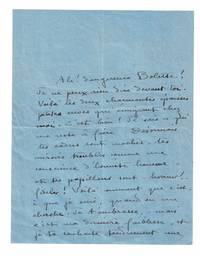
193574179s. l. Paris 1935. Fine. s. l. Paris s. d. circa 1935 17.70 x 22.50 cm 2 pages sur un feuillet Beautiful autograph letter signed by Colette addressed to her friend Bolette Natanson. Two pages written in ink on blue paper. Transverse creases inherent to the folding of the missive. This letter was probably addressed to Bolette following a gift made to her ""old friend"": ""Ah! dangerous Bolette! I can say nothing in front of you. Here are the two charming thick little vessels that emigrate to my home."" This is an opportunity for Colette very pleased with this new gift to humorously devalue the designer's previous works: ""From now on your frames are ugly your mirrors troubled like an honest man's conscience and your butterflies are - horror! - faithful!"" The famous ""butterflies"" naturalized and enclosed in glass frames are visible in several photographs of the writer in her home. Having evolved since her earliest childhood in artistic circles - she is the daughter of Alexandre and niece of Thadée Natanson the creators of the famous Revue Blanche - Bolette Natanson 1892-1936 became friends with Jean Cocteau Raymond Radiguet Georges Auric Jean Hugo and also Colette. Passionate about sewing she left Paris for the United States with Misia Sert great friend of Coco Chanel and was hired by Goodman. With her husband Jean-Charles Moreux they created in 1929 the gallery Les Cadres on boulevard Saint-Honoré and frequented numerous artists and intellectuals. Their success was immediate and they multiplied projects: the creation of the fireplace for Winnaretta de Polignac the decoration of the château de Maulny the arrangement of Baron de Rothschild's private mansion the creation of frames for industrialist Bernard Reichenbach and finally the realization of Colette's beauty institute storefront in 1932. Bolette Natanson also framed the works of her prestigious painter friends: Bonnard Braque Picasso Vuillard Man Ray André Dunoyer de Segonzac etc. Despite this meteoric rise she would end her life in December 1936 a few months after her father's death. unknown
191177520Paris 1911. Fine. Paris Lundi 11 septembre 1911 13.50 x 18 cm 5 pages sur un double feuillet et un feuillet libre Autograph letter signed by Pierre Louÿs addressed to Georges Louis. Five pages written in violet ink on a double leaf and a loose leaf. A press article pasted on the recto of the single leaf. Transverse creases inherent to posting. Fine letter addressed to his brother Georges Louis with whom Pierre Louÿs maintained a very intimate relationship and whom he considered as his own father. The question of the real identity of Pierre Louÿs's father still fascinates biographers today: ""His father Pierre Philippe Louis . had married in 1842 Jeanne Constance Blanchin who died ten years later after giving him two children Lucie and Georges. In 1855 he remarried Claire Céline Maldan and from this union was born in 1857 a son Paul; then in 1870 our writer who received the first names Pierre Félix. This late birth the differences in character between father and son the former's disaffection toward the latter the profound intimacy that always reigned between Louÿs and his brother Georges all this has led certain biographers and critics to suspect that the latter was in reality the writer's father. The exceptionally intimate and constant relationship that Pierre and Georges maintained between themselves all their lives could be an argument in this sense. Of course no irrefutable proof has been discovered and none will probably ever be discovered. Nevertheless certain letters . are quite disturbing. In 1895 for example Louÿs writes seriously to his brother that he knows the answer to ""the most poignant question"" he could ask him a question he has had ""on his lips for ten years."" The following year in the full triumph of Aphrodite he thanks Georges effusively and ends his letter with this sentence: ""Not one of my friends has a FATHER who is to him what you are to me."" Arguing from the close intimacy of Georges and Claire Céline during the year 1870 and the jealousy that the father never ceased to show toward his younger son Claude Farrère did not hesitate to conclude in favor of Georges Louis. And what to think of this dedication by Louÿs to his brother on a deluxe paper copy of the first edition of Pausole: For Georges his eldest son / Pierre."" Jean-Paul Goujon Pierre Louÿs Pierre Louÿs comments in this letter on Thomas Edison's visit to Paris: ""Edison is in France. Toward the end of last month a journalist questioned him. I regret not having kept the article."" The writer then launches into a true dialogue from his memories of said article paraphrasing the inventor in the manner of a witness who himself attended the interview: ""To the simple question ""Are you pleased with your trip"" Edison answered with amiable phrases and immediately on his own he brought the conversation to the subjects: Monoplane. War. He said I only repeat from memory the sense of what I read: He said in substance: ""You are not yet enthusiastic enough about the value of your new weapon: it is formidable. You take aeroplanes for scouts. Say first: combatants. From the heights where the monoplane evolves easily today there is an effective military power but especially an incalculable moral power."" He explained himself thus: ""Give grenades to an aviator who will drop them. Even if they are not very dangerous even if they rarely hit their target the entire enemy army will scatter like a flock of sheep under the flight of the eagle. Five six grenades falling from the sky will provoke panic terror. Nothing is frightening for a crowd like a peril that comes from above."" "" This ""remarkable interview"" related by the writer who finds that ""the theory is correct"" underlines the visionary character of Edison who seems here to relate the facts of the coming First World War. The erudite Pierre Louÿs illuminates this theory of ""Edison the prophet"" with his classical culture: ""It agrees with the old phrases about the limits of b unknown
188583963s. l. Paris 1885. Fine. s. l. Paris 16 juillet s. d. ca 1885 13.40 x 21.10 cm 1 page 1/2 sur un bifeuillet Autograph letter signed by Louise Michel addressed to Lucien Barrois; one and a half pages written in black ink on a bifolium of white paper with black border. Transverse folds inherent to posting. Mrs. Vernier will be released from prison thanks to Louise Michel's assistance: ""elle sort le mois prochain et elle le mérite bien elle vous est bien reconnaissante. Remerciez Clémenceau Lafont et Clovis Hugues avec Laguerre peut-être tous les quatre qui ont apostillé la demande."" ""she is released next month and she well deserves it she is very grateful to you. Thank Clémenceau Lafont and Clovis Hugues with Laguerre perhaps all four who endorsed the request."" A moving letter testimony to the unwavering devotion of the former Communard. unknown
195676379Saint-Cirq-Lapopie 1956. Fine. Saint-Cirq-Lapopie 9 octobre 1956 13.50 x 18 cm 1 page sur un double feuillet et une enveloppe Autograph letter signed by André Breton addressed to Jean Schuster; one page written in black ink on a double sheet of white paper. Envelope included. The writing of this letter coincides with the publication date of the very first issue of the journal Le Surréalisme même: ""At last! Considering the closed object let us say that there is nothing left but to await events."" Breton then at his house in Saint-Cirq-Lapopie plans to return to Paris for this occasion: ""This was necessary - and the great cold of the morning - to bring us back to Paris: we will be there Friday and I will stop by the Musset in the evening."" Jean Schuster 1929-1995 joined the Surrealist group in 1947. Close to Benjamin Péret and André Breton he would become the latter's literary executor. unknown
191087879s. l.: S. n. 1910. Fine. S. n. s. l. 1910 18 x 11.50 cm une feuille recto verso Autograph signed card from the dandy count 9 lines written in black ink addressed to a friend on cardboard paper: ""Chère amie C'était donc pour ""Femina ! "" Je devrais vous en vouloir moi qui avais prononcé contre ce lieu les formules exécratoires ! Enfin. je pardonne à vous ! A vous Robert de M. 910."" Dear friend So it was for ""Femina!"" I should hold it against you I who had pronounced execratory formulas against this place! Well. I forgive you! Yours Robert de M. 910. S. n. unknown
195083936s. l. 1950. Fine. s. l. 4 février 1950 21 x 27 cm une page sur un feuillet Autograph letter signed ""Jean"" and with a small star addressed to his English translator Marie Hoeck one page in blue ink on a sheet of fine white paper. Transverse folds inherent to posting. On the verso notes by the translator in ballpoint pen. Jean Cocteau is overworked by several projects: ""I have finished the mixtures of sounds and music for Orphée. I will probably finish the images for Les Enfants Terribles next week. . I do not speak to you of Léone because I look at her feel her steep myself in her - but alas my English allows me nothing more than to breathe in her light ink."" He shares with his translator his great fatigue: ""Then relaxation and fatigue - for fatigue only manifests itself in rest. . I am quite at ease concerning your springs. They do not creak and their flexibility is perfect. Mine nearly gave way on me the evening in Brussels. It is a lesson. I thought myself capable of the impossible. One must ""face the facts"" no one can do it."" unknown
192577543Paris 1925. Fine. Paris 14 décembre 1925 10.60 x 15.70 cm une page sur une carte lettre Signed autograph note by Reynaldo Hahn addressed to Madame Serge André and written on a white paper letter-card in blue ink. Central fold inherent to the mailing. Dominique André is a poetess novelist and playwright. She notably published under the pseudonym Claude Isambert. Reynaldo Hahn declines an invitation from his friend: ""Est-ce possible chère Madame ! Vous m'invitez à goûter ! Hélas je ne pense pas aller nulle part dans la journée ! Un soir à l'Escargot d'Or on avait projeté de se voir : Lacretelle devait me faire signe - que sais-je "" ""Is it possible dear Madame! You invite me for afternoon tea! Alas I don't think I'm going anywhere during the day! One evening at the Escargot d'Or we had planned to see each other: Lacretelle was supposed to let me know - what do I know"" unknown
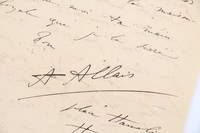
189588099Honfleur: s. n. 1895. Fine. s. n. Honfleur s.d. ca 1895 14 x 22 cm une page recto verso Autograph letter signed addressed to a journalist friend at Figaro illustré 28 lines in black ink. Fold mark inherent to envelope insertion a lack to upper corner of the letter without any damage to the text. Alphonse Allais must do a favor for his friend: ""Un peu de patience mon cher Abel un peu de patience. Sitôt rentré à Paris ma première démarche sera pour ton parapluie que je choisirai en soir gorge-pigeon et manche d'argent."" A little patience my dear Abel a little patience. As soon as I return to Paris my first errand will be for your umbrella which I will choose in pigeon-throat evening silk with a silver handle.; he therefore also allows himself to solicit the kindness of his correspondent: ""Et bien envoie-moi le n° du Figaro illustré d'il y a un mois ou deux où il y avait des choses de Toulouse-Lautrec."" Well then send me the issue of Figaro illustré from a month or two ago where there were things by Toulouse-Lautrec. He concludes his letter with a sententious: ""Donne-moi ta main loyale que je la serre. Ton Alphonse Allais. Bonjour aux amis."" Give me your loyal hand so I may shake it. Your Alphonse Allais. Greetings to friends. s. n. unknown
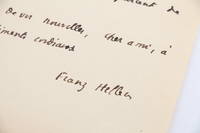
192886536Paris: S. n. 1928. Fine. S. n. Paris 19 Août Juillet 1928 13.50 x 21 cm une feuille une enveloppe Autograph letter dated and signed by Franz Hellens addressed to André Malraux 21 lines in black ink. Fold marks inherent to postal handling. We include an envelope addressed to Franz Hellens and written by André Malraux which probably contained the response to our letter. Franz Hellens responds to a request for information made by André Malraux: ""Je n'ai pas oublié le renseignement que vous m'avez prié de vous procurer au sujet du Voyage au Congo. Voici la réponse que j'ai reçu de la compagnie belge maritime du Congo. Ce n'était pas du tout ce que j'avais demandé"" ""I have not forgotten the information you asked me to obtain regarding the Journey to Congo. Here is the response I received from the Belgian maritime company of Congo. It was not at all what I had requested"" and will attempt to learn more in order to help his friend: ""Je vais écrire autre part et tâcher d'obtenir une réponse précise à ma question. Patientez donc quelques jours encore."" ""I will write elsewhere and try to obtain a precise answer to my question. Please wait a few more days."" Franz Hellens mentions the forthcoming publication at Grasset of his next work: ""Brun m'a envoyé copie signée du contrat. Il m'écrit que le livre pourra paraître en janvier prochain. J'aurai voulu octobre mais enfin."" ""Brun sent me a signed copy of the contract. He writes to me that the book will be able to appear next January. I would have wanted October but well."" and inquires about André Malraux's book in progress: ""Et vos Conquérants Je suis bien impatient de lire le tout."" ""And your Conquerors I am quite eager to read it all."" S. n. unknown
189985096Brest 1899. Fine. Brest 3 Octobre 1899 11 x 17 cm 1 page et demi sur un feuillet double Autograph letter dated and signed by Victor Segalen addressed to Emile Mignard one and a half pages 24 lines written in black ink on a double sheet. Traces of transverse folds inherent to postal delivery. Trace of white paper tab. Emile Mignard 1878-1966 also a doctor from Brest was one of Segalen's closest childhood friends whom he met at the Jesuit college Notre-Dame-de-Bon-Secours in Brest. The writer maintained with this companion an abundant and regular correspondence in which he described with humor and intimacy his daily life in the four corners of the globe. It was at Mignard's wedding on February 15 1905 that Segalen met his wife Yvonne Hébert. It was in 1899 that Victor Segalen's first nervous disorders manifested themselves which would only worsen as he advanced in age. Worried about his already failing health his friends and relatives wanted to hear news of him which sometimes exasperated him: ""Faire comprendre à Mlle D. qu'il me serait extrêmement pénible de répondre à ses lettres qui ne pourraient être que de condoléances.autant celles d'amis comme toi me seraient apaisantes autant des consolations féminines même bien intentionnées je n'en doute pas me seraient insupportables."" Make Miss D. understand that it would be extremely painful for me to respond to her letters which could only be of condolence.while those from friends like you would be soothing to me feminine consolations even well-intentioned I have no doubt would be unbearable to me. Victor Segalen thus declares his profound intimacy with Emile Mignard with whom he had undertaken that same year a cycling tour in Brittany and to whom he confided fully. Fleeing certain relationships he desired to maintain despite his illness his privileged friendship with the latter: "". ne reviendrai qu'après un détour dont je ne prévois pas la durée. Mais j'ai le temps et le désir d'avoir de tes nouvelles."" .will only return after a detour whose duration I cannot foresee. But I have the time and desire to hear from you. Knowing his friend to be understanding and respectful of his reserve the convalescent Victor Segalen did not wish to elaborate further on the illness that was already consuming him: ""Tu sens que je ne puis en écrire plus long n'ayant en ce moment pas le choix des sujets mais tu ne m'en voudras j'en suis sûr pas."" You feel that I cannot write at greater length not having at this moment a choice of subjects but you will not hold it against me I am sure. Autograph letters by Victor Segalen are extremely rare. unknown
189577509Paris 1895. Fine. Paris 12 novembre 1895 12.50 x 20 cm 4 page sur un double feuillet Autograph letter signed by Pierre Louÿs signed with his initial addressed to Georges Louis. Four pages written in blue ink on a double sheet. Envelope enclosed bearing on the verso the intact wax seal with the writer's cipher. Transverse fold inherent to the mailing. Important letter addressed to his brother Georges Louis with whom Pierre Louÿs maintained a very intimate relationship and whom he considered as his own father. The question of the real identity of Pierre Louÿs' father still fascinates biographers today: ""His father Pierre Philippe Louis . had married in 1842 Jeanne Constance Blanchin who died ten years later after giving him two children Lucie and Georges. In 1855 he remarried Claire Céline Maldan and from this union was born in 1857 a son Paul; then in 1870 our writer who received the first names Pierre Félix. This late birth the differences in character between father and son the former's disaffection towards the latter the profound intimacy that always reigned between Louÿs and his brother Georges all this has led certain biographers and critics to suspect that the latter was in reality the father of the writer. The exceptionally intimate and constant relationship that Pierre and Georges maintained between them all their lives could be an argument in this sense. Of course no irrefutable proof has been discovered and probably never will be. Nevertheless certain letters . are quite troubling. In 1895 for example Louÿs writes seriously to his brother that he knows the answer to 'the most poignant question' he could ask him a question he has had 'on his lips for ten years.' The following year in the midst of Aphrodite's triumph he thanks Georges effusively and ends his letter with this sentence: 'Not one of my friends has a FATHER who is for him what you are for me.' Arguing from the close intimacy of Georges and Claire Céline during 1870 and the jealousy that the father never ceased to show towards his younger son Claude Farrère did not hesitate to conclude in favor of Georges Louis. And what to make of this dedication by Louÿs to his brother on a Japan paper copy of the first edition of Pausole: To Georges his eldest son / Pierre."" Jean-Paul Goujon Pierre Louÿs As attested by the enclosed envelope Pierre Louÿs sends this letter to his brother while the latter is exercising the function of France's delegate to the International Commission of Egyptian Debt and is in Cairo. Like a good socialite Pierre tells his brother about his new encounters: ""I met yesterday at a friend's house one of the sons of your minister Marcellin Berthelot. I have known all four of them for a long time but I see little of them. One of them André is a friend of Henri Mougeot with whom he has rented along with two or three other young men a house in Chevreuse and a mistress in Paris. . The other Daniel is a professor at the School of Pharmacy. A remarkable chemist they say. Philippe does nothing special . Finally René the youngest is Blum's oldest friend and his great rival of former times in the general competition. . It is Philippe who formed five or six years ago with Léon Daudet and Georges Hugo such a famous trinity. He is also known for having written a sonnet containing six rhymes in omphe which stupefied Heredia."" But these worldly matters do not distance Pierre Louÿs from literature. Indeed his first novel entitled Aphrodite is about to appear and he wonders to whom he could dedicate it. He first thought of José Maria de Heredia but. ""H. refuses . the dedication of Aphr. because he still has two daughters to marry. I myself had put a thousand reservations in my offer and his response after all is not unobliging. I know on the other hand that he repeats before strangers and indifferent persons everything he told me about the book and in the same hyperbolic terms. Finally he gave me unknown
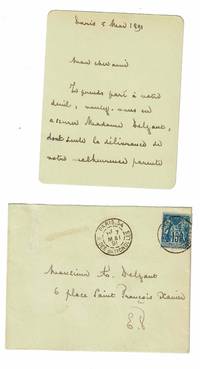
189176346Paris 1891. Fine. Paris 5 mai 1891 11.40 x 8.80 cm une carte recto-verso et une enveloppe Signed autograph card from Stéphane Mallarmé addressed to Alidor Delzant written on both sides in black ink. Envelope included. Alidor Delzant was a lawyer collector and bibliophile. Friend of the Goncourts he devoted a work to them and was Edmond's secretary and testamentary legatee. ""Je prends part à votre deuil voulez-vous en assurer Madame Delzant dont seule la délivrance de votre malheureuse parente par elle entourée de soins peut adoucir le chagrin. . Heureusement vous êtes un de ceux avec qui l'on se sent partout et même loin."" ""I share in your grief would you please assure Madame Delzant of this for whom only the deliverance of your unfortunate relative surrounded by her care can soften the sorrow. . Fortunately you are one of those with whom one feels comfortable everywhere and even from afar."" unknown
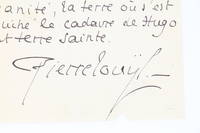
192078161Paris 1920. Fine. Paris s. d. novembre 1920 13.50 x 18 cm 4 pages sur 4 feuillets Autograph letter signed by Pierre Louÿs addressed to Georges Louis. Four pages written in blue ink on four sheets. Handsome letter addressed to his brother Georges Louis with whom Pierre Louÿs maintained a very intimate relationship and whom he considered as his own father. The question of Pierre Louÿs's real father's identity still fascinates biographers today: ""His father Pierre Philippe Louis . had married in 1842 Jeanne Constance Blanchin who died ten years later after having given him two children Lucie and Georges. In 1855 he remarried Claire Céline Maldan and from this union was born in 1857 a son Paul; then in 1870 our writer who received the first names Pierre Félix. This late birth the differences in character between father and son the former's disaffection toward the latter the profound intimacy that always reigned between Louÿs and his brother Georges all this has led certain biographers and critics to suspect that the latter was in reality the writer's father. The exceptionally intimate and constant relationship that Pierre and Georges maintained between them throughout their lives could be an argument in this sense. Of course no irrefutable proof has been discovered and probably never will be. Nevertheless certain letters . are quite troubling. In 1895 for example Louÿs writes gravely to his brother that he knows the answer to 'the most poignant question' he could ask him a question he has had 'on his lips for ten years.' The following year at the height of Aphrodite's triumph he thanks Georges effusively and ends his letter with this sentence: 'Not one of my friends has a FATHER who is to him what you are to me.' Arguing from the close intimacy between Georges and Claire Céline during the year 1870 and from the jealousy that the father never ceased to show toward his younger son Claude Farrère did not hesitate to conclude in favor of Georges Louis. And what to think of this dedication by Louÿs to his brother on a deluxe copy of the first edition of Pausole: To Georges his eldest son / Pierre."" Jean-Paul Goujon Pierre Louÿs This letter was written after the First World War: ""The project to open the Panthéon to heroes who offered everything to the Fatherland even losing their name for her is excellent. And it would be for the archbishopric of Paris an unhoped-for opportunity to spontaneously render to our great dead of the crypt the respects that it alone in the world denies them. It would thus repair an error that has lasted too long for its glory. Cemeteries are deconsecrated. No theological reason can attribute to them a more religious character than to the basement of a monument surmounted by a colossal cross and sanctified by ashes."" Indeed in November 1920 Charles Dumont the general budget reporter expressed his wish to bring the unknown soldier into the Panthéon. Finally only the ceremony took place there and the remains of the most famous of the combatants remained as everyone knows under the Arc de Triomphe. The only soldier to join the Panthéon Maurice Genevoix would not enter until a hundred years later on November 11 2020. Louÿs concludes his letter with a very handsome tribute to the writer he has always admired: ""One is ill-advised to forbid the faithful such a pilgrimage. They do it. For immense humanity the earth where Hugo's corpse lay down is holy ground."" unknown
195784396Paris 1957. Fine. Paris 29 Avril 1957 21 x 27 cm une feuille une enveloppe Autograph letter dated and signed by Jacques Chardonne addressed to his friend Roger Nimier 54 lines in blue ink regarding Paul Morand's style spiritual father of the Hussards Roger Nimier and Antoine Blondin being considered much against their will as leaders of this literary movement. Fold marks inherent to the letter's mailing envelope included. Jacques Chardonne intends to challenge two false ideas concerning Paul Morand the first being stylistic in nature: ""There is a double misunderstanding regarding Morand. He has been seen as a 'modern'. but he is essentially a 'naturalist'; his artistic doctrine is exactly that of Maupassant and Flaubert."" holding the latter as a major writer: ""But he has infinitely more talent and intelligence than the writers of the naturalist school."" ; the second of a psychological nature: ""He is hygiene and wisdom incarnate in his person. But through his work he has debased the youth who came after him. It is he who nearly killed Sagan."" Jacques Chardonne then ironizes about Françoise Sagan's talents while exalting the predominance and mastery of his friend Paul Morand in everything he undertakes: ""It is Morand who bought Sagan's terrible cars. But he knows how to drive."" while recalling the cautious advice that Bernard Frank gave to the author of Bonjour tristesse : ""Bernard Frank says: your car doesn't hold the road. Sagan vexed accelerates. And everything capsizes."" As a literary elder brother Jacques Chardonne reassures Roger Nimier about his own talent: ""Morand is very pleased with you. I say that Gaston Gallimard seems to have much friendship for you."" and congratulates his correspondent on the quality of Artaban a review to which Roger Nimier contributes Jacques Chardonne being honored in a recent issue: "". surprised to see myself on the front page; the text fills me with pride. I have scorned honors in order to be honored. I could not have been better served than in this little text."" and attributes the authorship of the text concerning him to one of his Hussard disciples: "". I tell myself: it's Nimier or Hecquet or Milliau. Truth be told I don't know. And I thank the Lord."" Overwhelmed by so many tributes paid to him Jacques Chardonne lucid prefers to avoid being too much in the spotlight: ""That is why I no longer want to publish anything. As soon as one applauds you you must leave."" Very handsome letter from Jacques Chardonne praising his friend Paul Morand spiritual father of the Hussards and evoking Françoise Sagan's terrible car accident in an Aston Martin on April 13 1957. A premonitory evocation: Roger Nimier would kill himself five years later on the western highway on September 28 1962 also at the wheel of an Aston Martin. unknown
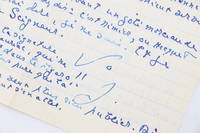
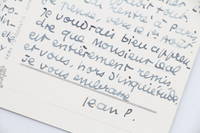
195584466Capri 1955. Fine. Capri s. d. circa 1955 15 x 10.50 cm une carte postale Autograph postcard signed by Jean Paulhan 30 lines written in blue ink on the verso of a photographic reproduction showing a view of Capri addressed to publisher Felia Leal notably of the work ""Paroles transparentes"" a work by Jean Paulhan illustrated by Georges Braque. She also wrote children's tales. Jean Paulhan shares his mixed impressions of Italy its landscapes and monuments: ""Il faut renoncer aux paysages trop beaux.Pour les églises et les monuments la meilleure solution je crois serait d'y jeter un coup d'oeil de bien recevoir le choc et puis s'en aller. L'attention affaiblit tout."" ""One must give up landscapes that are too beautiful.For churches and monuments the best solution I believe would be to glance at them receive the shock properly and then leave. Attention weakens everything."" unknown