George SANDBiblio.com
1 815 résultats
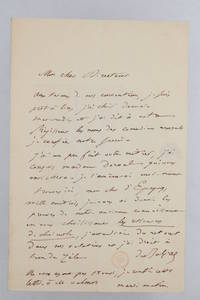
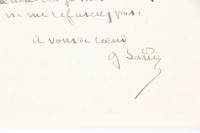
1868784821868. Fine. s. d. mai 1868 13.50 x 20.70 cm 2 pages sur un double feuillet Autograph letter signed by George Sand addressed to Alphonse Peyrat two pages written in black ink on a double sheet. Transverse folds inherent to mailing. Interesting letter evoking one of her faithful friends: Jean Patureau-Francoeur. George Sand had published a long obituary article in tribute to this close friend in L'Avenir national on May 2 1868. She described her late friend with great tenderness: ""C'était un simple paysan un vigneron des faubourgs de Châteauroux. Il avait appris tout seul à écrire et il écrivait très remarquablement avec ces naïves incorrections qui sont presque des grâces dans un style rustique et spontané. . Ce petit homme robuste à grosse tête ronde au teint coloré à l'il bleu étincelant et doux était doué d'une façon supérieure. Il voyait la nature il l'observait il l'aimait et il la savait. . Son existence parmi nous fut pénible agitée méritante. Naturellement un esprit aussi complet que le sien devait se passionner pour les idées de progrès et de civilisation. Il fut avant la Révolution le représentant populaire des aspirations de son milieu et il travailla à les diriger vers un idéal de justice et d'humanité. ."" ""He was a simple peasant a wine-grower from the suburbs of Châteauroux. He had taught himself to write and he wrote remarkably well with those naive incorrections that are almost graces in a rustic and spontaneous style. . This sturdy little man with his large round head his ruddy complexion his sparkling and gentle blue eyes was gifted in a superior way. He saw nature observed it loved it and understood it. . His existence among us was painful agitated meritorious. Naturally a mind as complete as his had to be passionate about ideas of progress and civilization. He was before the Revolution the popular representative of his milieu's aspirations and he worked to direct them toward an ideal of justice and humanity. ."" In 1848 Patureau was elected mayor of Châteauroux and became the spokesman for the workers of his commune. ""Au moment du coup d'État il fut poursuivi mais il se cacha dans des familles amies et échappa à la police. George Sand obtint difficilement sa grâce ce qui lui permit de regagner Châteauroux. Il fut arrêté en janvier 1858 à la suite de la loi de sûreté générale."" ""At the time of the coup d'état he was pursued but he hid with friendly families and escaped the police. George Sand obtained with difficulty his pardon which allowed him to return to Châteauroux. He was arrested in January 1858 following the general security law."" ""Il resta un mois au cachot sur la paille en plein hiver. Quand on le mit dans la voiture cellulaire qui le dirigeait vers l'Afrique il était presque aveugle et depuis il a toujours souffert cruellement des yeux"" ""He remained a month in the dungeon on straw in the middle of winter. When they put him in the prison van that was taking him to Africa he was almost blind and since then he has always suffered cruelly with his eyes"" George Sand. In September 1858 following an intervention by George Sand with her friend Jérôme-Napoléon Napoleon III's cousin he was released but remained under surveillance. He settled in Algeria after obtaining permission to come to Châteauroux to sell his house and vineyard and to fetch his family. In Algeria he lived by his trade as a wine-grower was part of the Agricultural Society of Philippeville and wrote a treatise on viticulture."" Maintron ""À présent je viens vous demander de me payer ce petit article le plus cher que vous pouvez et d'envoyer le prix directement à Joseph Patureau rue de cluis n°7 à Châteauroux. Indre. Et cela le plus tôt possible."" ""Now I come to ask you to pay me for this little article as dearly as you can and to send the payment directly to Joseph Patureau rue de cluis n°7 à Châteauroux. Indre. And this as soon as possible."" Jos unknown
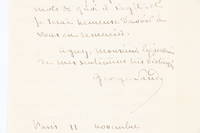
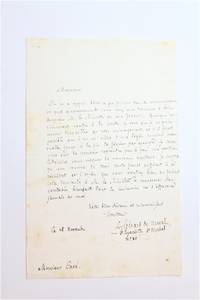
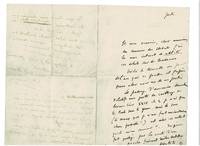
186478465Paris 1864. Fine. Paris s. d. entre 1864 et 1868 13.40 x 20.70 cm 2 pages sur un double feuillet Autograph letter signed addressed to an unknown correspondent written in black ink on a double leaf with dry stamp bearing the writer's initials. This letter probably unpublished was written on ""November 11th"" between 1864 and 1868 according to the address at the bottom: ""rue des feuillantines 97"". ""Une amie commune et pleine de confiance en votre bonté me fait espérer monsieur que vous m'accorderez un peu de sympathie. Si je suis indiscrète d'y croire ne vous en prenez qu'à elle comme elle est de ces personnes à qui l'on ne peut en vouloir je ne crains pas de vous la dénoncer. Vous pouvez vendre un immense service au fils de mon ami d'enfance. Le voudrez-vous quelque difficile que la chose puisse être Elle ne l'est peut-être pas je ne sais pas. Mais si elle l'est j'espère quand même depuis ce que Madame de Voisins me dit de vous. ."" ""A mutual friend full of confidence in your kindness gives me hope sir that you will grant me some sympathy. If I am indiscreet to believe it blame only her as she is one of those persons one cannot hold a grudge against I do not fear to denounce her to you. You can render an immense service to the son of my childhood friend. Will you do so however difficult the matter may be Perhaps it is not difficult I do not know. But if it is I still hope so from what Madame de Voisins tells me about you. ."" unknown
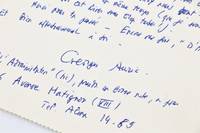
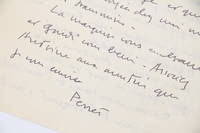
196583133Paris: S. n. 1965. Fine. S. n. Paris 17 octobre 1965 14 x 19.50 cm une feuille Autograph letter dated and signed by Georges Auric addressed to his friend Carlo Rim 23 lines in blue ink on letterhead of the Réunion des théâtres lyriques nationaux et du théâtre de l'Opéra de Paris in which he asks for his friend's indulgence as he is overwhelmed with work: ""Pardonne-moi si je ne t'ai pas répondu encore : tu peux imaginer sans trop de peine ce qu'est devenue mon existence ! . je viens d'avoir à préparer la reprise d'Iphigénie en Tauride - opéra des plus nobles et que ""notre"" public n'avait pas eu l'occasion d'écouter depuis 1931 "" ""Forgive me if I haven't answered you yet: you can imagine without too much trouble what my existence has become! . I have just had to prepare the revival of Iphigénie en Tauride - one of the noblest operas and one that ""our"" public has not had the opportunity to hear since 1931""; a revival in which Georges Auric places great hope: "". En tout cas je veux espérer que nous dépasserons les deux répétitions de 1931. "". In any case I want to hope that we will exceed the two performances of 1931."" He also rejoices in the diversity of projects that occupy him thus transcending styles and periods: ""Glück Iphigénie : nous sommes fichtrement loin de Vincent Scotto. Mais je franchis allégrement siècles et styles pour te dire combien je suis heureux de me trouver dans ce ""comité d'honneur"" associé aux respectables et déjà vieux amis dont tu connais les noms ! "" ""Gluck Iphigénie: we are damn far from Vincent Scotto. But I cheerfully leap across centuries and styles to tell you how happy I am to find myself in this 'honorary committee' associated with the respectable and already old friends whose names you know!"" Folds inherent to mailing. Carlo Rim was a Provençal writer author notably of ""Ma belle Marseille"" a caricaturist a filmmaker: ""Justin de Marseille"" ""L'armoire volante"" ""La maison Bonnadieu"" and was notably the friend of Fernandel Raimu and Marcel Pagnol but also of Max Jacob and André Salmon whom he met in Sanary. S. n. unknown
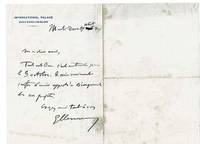
190976082Mont-Dore-Les-Bains Le Mont-Dore 1909. Fine. Mont-Dore-Les-Bains Le Mont-Dore 29 août 1909 13.60 x 21 cm 1 page sur un double feuillet Signed autograph letter from Georges Clémenceau addressed to a friend. One page written in black ink on a double sheet with letterhead from the International Palace of Mont-Dore-Les-Bains. Central fold inherent to mailing. Clemenceau then taking the thermal cure at Mont-Dore-les-Bains writes: ""All is well. It is agreed for October 9th. I am truly embarrassed to have brought this disruption to your plans."" unknown
190977465Mont-Dore-Les-Bains Le Mont-Dore 1909. Fine. Mont-Dore-Les-Bains Le Mont-Dore 29 août 1909 13.60 x 21 cm 1 page sur un double feuillet Autograph letter signed by Georges Clémenceau addressed to a friend. One and a quarter pages written in black ink on a double sheet with letterhead from the International Palace of Mont-Dore-Les-Bains dated August 25 1909. Folds inherent to mailing. Clemenceau then taking thermal baths at Mont-Dore-les-Bains writes: ""Quand votre aimable invitation m'est arrivée à Carlsbad j'avais un engagement déjà pris."" ""When your kind invitation reached me in Carlsbad I already had a prior engagement."" Charming and very aesthetic missive. unknown
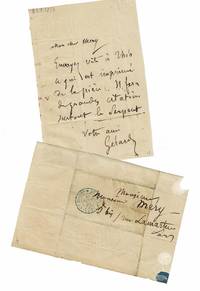
185373292Paris 1853. Fine. Autograph letter signed ""your friend Gérard"" addressed to Joseph Méry Paris 23 septembre 1853 9.70 x 14.50 cm une page sur un feuillet enveloppe jointe Autograph letter signed ""your friend Gérard"" addressed to Joseph Méry. Envelope with a small angular tear due to the original sealing enclosed. Horizontal folds. This letter is reproduced in the Pléiade edition of his correspondence vol. 3 p. 811. ""Envoyez vite à Théo ce qui est imprimé de la pièce. Il fera de grandes citations surtout le Serpent."" The ""pièce"" in question is Gusman le Brave first performed at the Odéon on 23 September 1853. On 4 October Théophile Gautier discussed the play in La Presse. ""Le Serpent"" refers to Josés tale in Act II scene 1. unknown
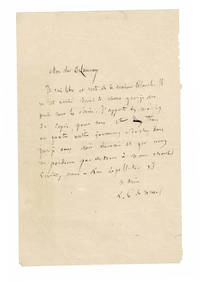
184172928Paris 1841. Fine. Paris s. d. avril 1841 13.50 x 21 cm une page sur un feuillet Autograph letter signed by Gérard de Nerval addressed to Hippolyte Delaunay written in black ink. Recipient's name in Nerval's hand on the verso of the leaf. A central fold inherent to the mailing. This letter has been transcribed in Nerval's Complete Works in the Pléiade edition. Gérard de Nerval is finally ""free and released from the Maison Blanche"" after staying there following his crisis of early spring 1841. This is not however a definitive release but probably permission granted by Doctor Blanche to his patient the latter would not be definitively released until November 1841. The handwriting difficult to read in places shows Gérard de Nerval's feverishness as he seeks to reconnect with the literary milieu: ""I bring masses of copy for you and three or four other journals."" Hippolyte Delaunay was editor-in-chief of the review L'Artiste in which Nerval published on April 11th of the same year an article entitled ""Mémoires d'un Parisien Sainte-Pélagie 1832"". unknown
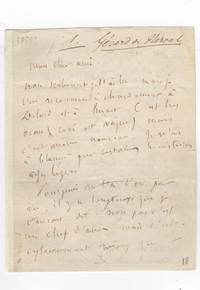
185273345Paris 1852. Fine. Paris s. d. fin 1852 10.20 x 13.20 cm quatre pages sur un feuillet remplié Autograph letter signed ""ton ami G."" addressed to the poet and playwright Armand Barthet. Nerval congratulates ""his dear friend"" on his drama Le Chemin de Corinthe: ""Non seulement je l'ai lu mais je l'ai recommandé chaudement à Delord et à Huard. C'est très beau ceci est vague mais c'est même nouveau"" ""Not only have I read it but I have warmly recommended it to Delord and to Huard. It is very beautiful this is vague but it is even new"". Folds inherent to posting. A strip of paper at the junction of the two pages and a restoration to the left inner margin. This letter has been transcribed in the correspondence published in the Pléiade edition volume 3 p. 796. The addressee has written directly following this letter a moving biographical notice concerning Gérard de Nerval: ""Nul ne savait où il demeurait - il rodait toute la nuit les poches de sa longue redingote gonflé sic de bouquins"" ""No one knew where he lived - he wandered all night the pockets of his long frock coat swollen with books"". unknown
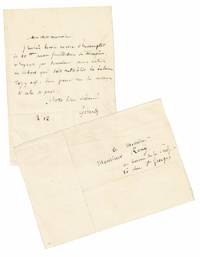
184973289s. l. 1849. Fine. s. l. 1837 ou 1849 9.90 x 14.30 cm une page sur un feuillet enveloppe jointe Autograph letter signed ""votre bien dévoué Gérard"" addressed to Daniel Rouy. Envelope included. This letter simply dated ""Le 12"" could have been written in August 1849 if we refer to a letter to Ernesta Grisi companion of his friend Théophile Gautier in which the poet mentions such a discount: ""Je n'ai pu toucher l'argent qu'aujourd'hui mercredi. M. Rouy n'y était pas. J'y suis allé 4 fois et j'ai porté les 10F. aujourd'hui je ne sais pas s'il faut faire le prochain feuilleton ni comment il faut signer."" ""I could only get the money today Wednesday. Mr. Rouy was not there. I went 4 times and brought the 10F. today I don't know if I should do the next serial or how to sign it."" Pléiade volume 1 letter 143 of August 30 1849. However Michel Brix author of Nerval Glanes et miettes de presse and member of the Royal Academy of French Language and Literature of Belgium very kindly pointed out to us that Nerval signed ""Gérard"" rather between 1837 and 1840 and that in 1849 he signed this type of note ""Gérard de Nerval"". unknown
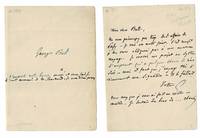
185373273Paris 1853. Fine. Paris s. d. novembre 1853 10 x 13.60 cm un feuillet et son enveloppe dépliée Autograph letter signed ""votre G."" ""your G."" addressed to Georges Bell written in blue ink on the recto of a small sheet. Unfolded autograph envelope included containing a sentence that Nerval had not put in his letter. This letter has been transcribed in the Pléiade volume 1 letter 264. After several missed appointments and while he was at Dr. Blanche's clinic Nerval asks George Bell not to ""se préoccuper pas trop de l'affaire de Passy"" ""worry too much about the Passy affair"". Despite his confinement Nerval continues to conduct his business: ""Je conçois un projet ou système d'emprunt qui a quelques chances de réussite - mais il faut que j'engage très sérieusement ma signature."" ""I am conceiving a project or loan system that has some chances of success - but I must very seriously commit my signature."" He ends his letter with an enigmatic formula: ""Vous savez que je vous ai fait un conte ce matin. Je sortais des bras de.cherchez."" ""You know that I told you a tale this morning. I was coming from the arms of.guess."" unknown
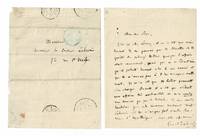
184172914Paris 1841. Fine. Paris 18 novembre 1841 13.90 x 20.80 cm une page sur un feuillet remplié Autograph letter signed by Gérard de Nerval addressed to Auguste Cavé written in careful handwriting in black ink on the first page of a double sheet. Minor traces of folds inherent to posting and some light foxing. This letter was transcribed in Nerval's Complete Works in the Pléiade edition. After two violent nervous breakdowns Gérard de Nerval was compelled to stay at Dr. Blanche's clinic between March and November 1841. Short of money he addressed this letter to his friend Auguste Cavé then director of the Fine Arts section at the Ministry of the Interior to solicit his support with ""M. le Ministre"": ""Quoi qu'entièrement rendu à la santé je sens que je ne puis encore travailler qu'avec ménagement et s'il était possible que l'on m'aidât d'une légère somme mensuelle . je serais plus sûr de pouvoir reprendre peu à peu ma position littéraire sans risquer de nouveaux accidens"" ""Though entirely restored to health I feel that I can only work with care and if it were possible to be helped with a small monthly sum . I would be more certain of being able to gradually resume my literary position without risking new accidents"". unknown
184173272Paris 1841. Fine. Paris s. d. circa mars 1841 10 x 13.10 cm un feuillet et son enveloppe dépliée Very rare autograph letter signed ""Gérard Labrunie"" addressed to ""his dear papa"" Dr. Labrunie. 13 lines written in small handwriting in black ink on one page. Unfolded envelope attached showing several postal stamps restored on the back with an adhesive piece. A few transverse creases as well as some very discrete holes not touching the text and inherent to the use of a pin to seal the letter. Fine letter from Gérard Labrunie to his ""dear papa"" about a ""very complicated affair"" relating to the ""capacity as surrogate guardian"" of the writer's father. Very rare signature of Gérard de Nerval under his real patronymic name: Gérard Labrunie. unknown
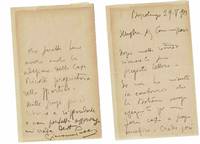
190375723Boscolungo 1903. Fine. Boscolungo 29 août 1903 11.20 x 18 cm 2 pages sur 2 feuillets Unpublished autograph letter signed by Giacomo Puccini to a patron; two pages written in black ink on two leaves. Leaves uniformly shaded traces of former pasted mounts on verso. A photographic reproduction of the famous composer's portrait is enclosed. Puccini responds to a patron's request to have La Bohème performed at a charity event: ""Io non ho niente in contrario che la Bohème venga eseguita per una sera corta a scopo benefico."" I have no problem with La Bohème being performed for a charity event. ""Credo pero che sarebbe bene avere anche la adesione della Casa Ricordi proprietaria dello spartito."" I believe however that it would be good to have the authorization of Casa Ricordi Puccini's publishing house owner of the score. Despite the failure of the first performance on February 1 1896 La Bohème subsequently enjoyed worldwide success rapidly becoming one of the finest operas in the Romantic repertoire. A fine tribute to the triumph of one of the greatest composers of the late 19th-century. unknown
195064369s. l. 1950. Fine. s. l. s. d. 18 x 21.50 cm un feuillet Signed autograph letter of Gus Bofa to one of his acquaintances 16 lines in purple ink accompanied by a pencil drawing. Folding inherent in the enveloping tear without lack in the drawing. Addressed to a friend of Gus Bofa and his wife who seems to have suffered "" a long journey in the storm! ""The letter is imbued with the humor of its author:"" we add two good warm kisses to finish drying you off "". The missive is enriched with an original drawing of Gus Bofa representing two birds on a radiator one of which is written ""Spring has come! "" unknown
1874773391874. Fine. 1874 13.20 x 20.70 cm 4 pages sur un double feuillet Autograph letter signed by Gustave Doré addressed to Paul Dalloz. Four pages written in black ink on a double sheet of white paper with envelope. Fine letter full of torment in which Gustave Doré dreads being supported again for the rank of officer in the Legion of Honor he who was made chevalier in 1861 after the publication of Dante's Inferno and thanks to Paul Dalloz's intervention. Doré thanks him moreover for this past influence: ""Je viens te remercier encore et du plus profond de mon cur de l'amitié toute dévouée que vous m'avez témoignée dans ces dernières circonstances ; et je t'assure que je te conserve pour ce fait des sentiments aussi reconnaissants que pour le service que tu m'as si spontanément et cordialement rendu il y douze ans."" ""I come to thank you again and from the depths of my heart for the devoted friendship you have shown me in these recent circumstances; and I assure you that I preserve for this fact feelings as grateful as for the service you rendered me so spontaneously and cordially twelve years ago."" He nevertheless asks him not to propose him for the rank of officer: ""Mais je viens réclamer de toi les mêmes amitiés te priant te suppliant même de t'arrêter complétement et absolument ce qui je n'en doute pas te coûtera plus encore qu'autre chose. J'ai beaucoup pensé à tout ce que tu m'as dit hier et je trouve que je me suis trompé tout à fait en te laissant t'engager si obligeamment dans ces démarches."" ""But I come to claim from you the same friendships asking you even begging you to stop completely and absolutely which I do not doubt will cost you more than anything else. I have thought much about everything you told me yesterday and I find that I was quite wrong to let you engage so obligingly in these steps."" Gustave Doré was nevertheless appointed officer of the Legion of Honor on January 15 1879.through Paul Dalloz's intervention. unknown
186075622s. l. Paris 1860. Fine. s. l. Paris s. d. 5 ou 12 janvier 1860 13.60 x 21 cm deux pages sur un feuillet remplié Autograph letter signed by Gustave Flaubert addressed to the archaeologist Charles-Ernest Beulé. Two pages written in black ink on a folded sheet. The recipient of this letter added nine handwritten lines a draft of his future response following Flaubert's letter. This letter has been transcribed and reproduced on the website of the Flaubert Centre at the University of Rouen. The transcriber of this missive notes: ""Are the lines written under the signature by Beulé or by Flaubert himself The handwriting resembles his. Stéphanie Dord-Crouslé suggests that Flaubert may have gone to see Beulé and written these elements under his dictation in response to the questions posed."" This hypothesis seems unlikely to us given that we know Charles-Ernest Beulé's response to this letter itself digitized by the Flaubert Centre and dated February 10 1860. This response does not seem to us to suggest a visit by Flaubert to Beulé. It seems more likely to us that Beulé inscribed under Flaubert's letter a draft of his future response of February 10 1860 which would only be an elegant reformulation of his notes. Handsome and important testimony to the colossal research that Flaubert undertook for the writing of Salammbô. ""Begun in 1857 the novel appeared in 1862 a period when Antiquity was coming back into fashion and when Carthage was 'au goût du jour' ""in vogue"" thanks to the recent excavations by Charles-Etienne Beulé at Byrsa 1859 and in the Punic ports."" Vanessa Padioleau ""Flaubert et Carthage : Salammbô roman polymorphe"" ""Flaubert and Carthage: Salammbô polymorphic novel"" in Revue Flaubert n° 9 2009 It is therefore to one of the specialists on the subject that Flaubert addresses his questions commenting on his recent reading of Ammianus Marcellinus: ""J'ai appris dans ce même Ammien que les Carthaginois ont pris Thèbes en Egypte . Qu'est-ce que cela veut dire Ce passage est je crois peu connu "" ""I learned in this same Ammianus that the Carthaginians took Thebes in Egypt . What does this mean This passage is I believe little known"" Flaubert's task is no small one: at the time nothing or almost nothing was known about the period of the Mercenary Revolt which extended over two years from 240 to 238 BC. He then begins painstaking work basing his research on the texts of the great historians of Antiquity which he reads in Latin in the original. The letter we offer shows his great mastery of it: ""J'ai appris dans ce même Ammien que les Carthaginois ont pris Thèbes en Egypte livre xvii ch. iv. 'Hanc inter exordia pandentis se late Carthaginis improviso excursu duces oppressere Poenorum'"" ""I learned in this same Ammianus that the Carthaginians took Thebes in Egypt book xvii ch. iv. 'At the time when Carthage was beginning its wide expansion the generals of the Phoenicians conquered it by a surprise attack'"". Despite this most thorough research the gate of Carthage would receive only a very brief description in the final version of Salammbô. unknown
187762711Paris 1877. Fine. Paris 9 mai 1877 13.50 x 20.50 cm 2 pages sur un feuillet remplié Autograph letter signed by Gustave Flaubert addressed to Léon Cladel. Envelope attached. Some underlinings and manuscript corrections by the author. Minor water stains. Three small restorations using adhesive on the second page as well as two fold marks inherent to the letter's folding for mailing. Amusing letter in which Gustave Flaubert whose literary renown is well established offers his support to his friend Léon Cladel who is struggling to have one of his works published. The ""master"" - this is how Léon Cladel addresses his colleague - begins this letter with enthusiasm: ""I started your book yesterday at 11 o'clock; it was finished this morning at 9!"" The ""book"" in question is L'Homme de la Croix-aux-Bufs which Flaubert had agreed to re-read for his friend on April 30; he had indeed requested the manuscript deposited with the publisher Georges Charpentier: ""Cladel wrote to me to say that he wished me to read pardon the subjunctive the novel in sheets which is with you. So send it to me or bring it to me."" Letter of May 3 1877. Léon Cladel very close to Gustave Flaubert seems to have shared with him the fears of the publisher Édouard Dentu regarding the publication of his work: ""And first of all Dentu must be mad to be afraid to publish it."" As a seasoned veteran of the ruthless world of publishing Flaubert positions himself as a professional and declares: ""Nothing in it is reprehensible either politically or morally. What he told you is a pretext"" This question of moral reprehension echoes the famous trial brought against the author of Madame Bovary. Like an enthusiastic literary critic Flaubert compliments his colleague: ""I find your book to be a real book. It is very well done very careful very masculine. & I know what I'm talking about my good man."" As a scrupulous reader he nevertheless allows himself a few remarks on Cladel's manuscript ""I have two or three small criticisms to make trivial matters - or rather advice to submit to you."" before reconsidering: ""Sometimes there are pretensions to archaism and naivety. It is an excess of good."" Flaubert's attitude here is almost paternal and in any case benevolent: aware of his friend's abilities he wishes to encourage him and see the publication of his work succeed: ""But once again be content & sleep soundly - or rather don't sleep - and often create similar works."" The benevolent writer also mentions in this letter another publisher Georges Charpentier: ""As for Charpentier to whom I will return your sheets on Friday - the day when I dine at his house I am going to give him a vigorous talking-to & in all conscience without exaggeration & without lies."" Charpentier who has been publishing Flaubert since 1874 has become a close friend of the writer with whom he maintains a rich correspondence. In this month of May 1877 he has just published Trois contes which was for Cladel the occasion for a moving celebration of his master in Letters: ""Where the devil did you get that gleaming brush with which you paint your canvases the small ones like the large ones and that sobriety that certain Latins would envy you To be at once Chateaubriand and Stendhal and moreover Flaubert."" This admiration is reciprocal and Flaubert feels for this ""true artist"" an unfeigned esteem: ""The ending is simply sublime! - & of the greatest effect."" He will reiterate a few weeks later his compliments: ""It is worked chiseled delved into. Observation in your case takes nothing away from poetry; on the contrary it brings it out."" Indeed Cladel will establish himself as the true heir to the Flaubertian style much more so than Zola who will precisely reproach him for ""working his prose relentlessly"" and ""striving to render perfect each sentence he writes."" It is finally Édouard Dentu who will publish the manuscript of L'Homme de la Croix-aux-Bufs; Cladel will moreover offer a copy enriche unknown
1949644241949. Fine. 19 juin 1949 13.50 x 21 cm un feuillet Autograph letter signed by Henry de Montherlant to Robert Pignarre dated June 19 1949 15 lines in blue ink envelope attached. Folds inherent to the enveloping. Warm letter of thanks to professor Robert Pignarre following a conference at the Alliance française on his work: "" I have tasted the seriousness and objectivity ."" unknown
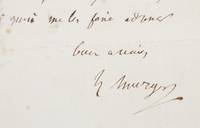
1850850801850. Fine. circa 1850 15.50 x 20 cm une page Autograph letter signed by Henry Murger 5 lines in black ink to a publisher apologizing for a delay beyond his control. Some foxing. Traces of postal stamp in upper portion of the sheet. ""Comme on est venu chercher ma copie un peu tard . insistez je vous prie pour qu'il me les fasse adresser"" As they came to collect my copy rather late . please insist that he have them sent to me unknown
184183639s. l. Passy Paris 1841. Fine. s. l. Passy Paris « mardi matin » 28 décembre 1841 13.50 x 21.60 cm une page sur un double feuillet enveloppe jointe Autograph letter signed by Honoré de Balzac to Jean-Baptiste Violet d'Epagny director of the Odéon theater. One page in black ink on a double sheet. Enclosed and pasted on the second page is the envelope of this letter written in Balzac's hand.""My dear director under the terms of our agreements I am ready to read I have chosen tomorrow Wednesday and I have told your stage manager the names of the actors to whom I entrust our play. I've done a bit of your job I've conquered Madame Dorval who will make you rich I'll bring her myself. Find here my dear d'Épagny a thousand regards I have given you proof of our old acquaintance by choosing you for Les Ressources de Quinola I shall expect a return in our relations and I am entitled to a great deal of zeal."" Les Ressources de Quinola is both in the spirit Les Fourberies de Scapin and Les Noces de Figaro. From the 1840s until his death Balzac's ambition was to achieve a reputation comparable to his illustrious predecessors Molière and Beaumarchais. Although this proved to be a hope as vain as it was determined Balzac never doubted failure after failure that his success was imminent. On July 15 1841 d'Épagny was appointed director of the Odéon . as any theater director would have done in his place he spent summer vacations organizing his winter programme. He asked Balzac for a play and Balzac complied choosing Les Ressources de Quinola. . We all know what a fuss was made about Balzac's play and how childishly naive the author was in filling the room with the highest Parisian society and foreign elite in order to make snobs want to join such a brilliant assembly. . Madame Dorval more astute than the author refused the role intended for her as soon as Balzac read . She did well for one never saw a more complete failure"" L'Amateur d'autographes mai 1911 Interesting letter revealing the beginnings of the creation of Les Ressources de Quinola and the author's habit of reading his play for the actors who then voted to accept or reject it. Provenance: Arthur Meyer collection then ""AGR"" stamp on letter and envelope. unknown
183386496s. l. Neuchâtel 1833. Fine. Eve's first kiss: 'The gods grant no favours untainted.' s. l. Neuchâtel 29 septembre 1833 13.40 x 21.10 cm une page sur un double feuillet Autograph letter signed by Honoré de Balzac addressed to his friend the writer Charles de Bernard. One page written in black ink on a bifolium. On the verso of the second leaf appears the address of the recipient Charles de Bernard du Grail written in Balzacs hand along with postal stamps and the seal bearing the arms of the Balzac dEntraigues family which the author had appropriated. A few minor holes not affecting the text; fold marks as usual from mailing. Published in his correspondence Paris Calmann Lévy 1876 CXIV pp. 252253. Balzac wrote this letter four days after his very first meeting and first kiss with Madame Hanska in Neuchâtel following many months of epistolary correspondence. « Jai été très heureux ici. Je suis très content de ce que jai vu le pays est délicieux ; mais vous savez que Jupiter a deux tonneaux et que les dieux nont point de faveurs qui soient pures. » ""I have been very happy here. I am most pleased with what I have seen; the country is delightful. But you know that Jupiter has two jars and the gods grant no favours that are untainted."" Two years after receiving the first letter from the Stranger Éveline Rzewuska a lovestruck Balzac left Paris to join her in Switzerland. His brief stop in Besançon ostensibly a convenient detour served as a polite pretext for his departure from the capitalwhere he took the opportunity to visit his correspondent Charles de Bernard. « Il me semble que je vous ai bien peu remercié de la bonne journée que vous mavez donnée ; mais jespère vous prouver que je ne suis point un ingrat. À mercredi donc ; vous devez penser que jaurai bien du plaisir à vous revoir vous qui avez fait que mon voyage à Besançon na pas été inutile et que jy ai trouvé du plaisir ». I fear I thanked you all too little for the delightful day you gave me; but I hope to prove that I am not ungrateful. Until Wednesday then you must know how much I look forward to seeing you again you who ensured that my journey to Besançon was not in vain and even brought me joy. After a day in Besançon and a chaotic journey by mail coach Balzac finally met his beloved though regrettably in the company of her husband Count Hanski. Seizing upon the Counts absence the writer stole a long-awaited kiss with Madame Hanska on an ancient stone bench upon the hill of Crêt. In the rapture of their first encounter he could not help but invoke La Fontaines ominous fable in his letter: « mais vous savez que Jupiter a deux tonneaux et que les dieux nont point de faveurs qui soient pures ». but you know that Jupiter has two jars and the gods offer no favours untainted. His love affair with Madame Hanska would prove far from serene as Gonzague Saint Bris aptly summed it up: eighteen years of love sixteen of waiting two of happiness and six months of marriage. Neuchâtel would remain a powerful emblem of their union recurring in some sixty of their letters. Neuchâtel is like the white lily he wrote to her pure with a penetrating fragrance youth freshness brilliance hope happiness glimpsed. De Bernard who had previously arranged his journey to Switzerland was once again tasked with organising Balzacs return: « Jaurai le plaisir de vous revoir mercredi 2 octobre. Voulez-vous avoir lobligeance de me retenir une place à la malle pour Paris ». I shall have the pleasure of seeing you again on Wednesday 2 October. Would you be so kind as to reserve me a place in the mail coach to Paris The journey separating him once again from his beloved proved wretched: The mail coach was fully booked for six days so my friend from Besançon Charles de Bernard was unable to secure me a place. I was thus obliged to travel on the roof of a diligence in the company of five Swiss from the canton of Vaud unknown
196084817s. l. 1960. Fine. s. l. s. d. ca 1960 13.50 x 18 cm une page Autograph letter signed by Jacques Perret 33 lines in black ink addressed to a colleague probably Roger Nimier apologizing for being unable to attend a meeting organized by the review Arts. Fold marks inherent to posting. For lack of time Jacques Perret was unable to honor his promise to write a preface requested by his correspondent: "". if you are pressed for time and you have a replacement preface writer at hand have no scruples of course as I will not be able to deliver proper work before my return."" Jacques Perret then evokes his passion for rugby: ""On Rancoule's repositioning three-quarter wing of Stade Toulousain whom he later joined on the staff. I therefore had the joy of outflanking the Cardinal's defense and going for the try. It remains for me to convert it by going to embrace my dear Raoul in that army of Princes from whom we still await wonders."" Jacques Perret royalist writer fierce partisan of French Algeria and virulently anti-Gaullist was stripped of his civil rights then in 1963 struck from the military medal roll despite protests from some of his fellow writers suspects that his political positions do not favor honorary decorations: ""I think we were made to sign a manifesto manifestly designed to torpedo my ribbon."" unknown
1823829561823. Fine. s. d. jeudi 9 13.50 x 20.80 cm une feuille Autograph letter signed by painter Jean-Auguste-Dominique Ingres about his pupil Albert Magimel with whom he worked in close collaboration. Magimel published a catalogue raisonné of his master's artworks. Handsome signature of Ingres in the lower part of the letter. unknown
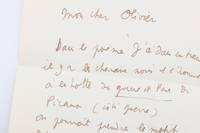
195485159Kietzbühel Kitzbühel 1954. Fine. Kietzbühel Kitzbühel 8 Février 1954 13.50 x 21 cm une page une enveloppe Autograph letter signed by Jean Cocteau addressed from the Grand Hotel Kietzbühel 16 lines in black ink to Olivier Quéant. Fold marks inherent to mailing envelope included. ""Grd Hotel Kietzbühel 8 Feb. 1954 my dear Olivier dans le poème ""J'ai dans un train"" il y a les chevaux noirs et l'homme le lotte du guerre et paix de Picasso isti guerre on pourrait prendre le motif séparé du livre qui flambe sous le pied d'un cheval noir. Il ferait une belle image. Si tu ne l'as pas demande le catalogue illustré de Rome . Eugenio Réale 3 rue Mangili Rome."" in the poem ""J'ai dans un train"" there are the black horses and the man the lotte of Picasso's guerre et paix isti guerre we could take the separate motif of the book that burns under the foot of a black horse. It would make a beautiful image. If you don't have it ask for the illustrated catalogue from Rome . Eugenio Réale 3 rue Mangili Rome. unknown
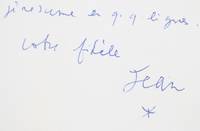
196185154Saint-Jean-Cap-Ferrat 1961. Fine. Saint-Jean-Cap-Ferrat 23 Janvier 1961 21 x 27 cm une page Autograph letter signed by Jean Cocteau on letterhead from Villa Santo-Sospir in Saint-Jean-Cap-Ferrat which he decorated 13 lines in blue ink to Roger Nimier. Fold marks inherent to mailing. ""23 Janv. 1961 Très cher Nimier voici pour accompagner le portrait dessin. Si vous le trouvez trop bref demandez chez Grasset un exemplaire de journal d'un inconnu. Dans le chapitre de l'amitié je raconte un déjeuner entre Simenon Pagnol et moi.- sans nommer personne. Mais le passage est très significatif de ce que je résume en q.q. lignes. Votre fidèle Jean. P.S. Dites moi vite si tu as reçu cette note et son P.S."" ""23 Jan. 1961 / Very dear Nimier / here is something to accompany the portrait drawing. If you find it too brief ask Grasset for a copy of Journal d'un Inconnu. In the friendship chapter I tell of a lunch between Simenon Pagnol and myself - without naming anyone. But the passage is very significant of what I summarize in a few lines. Yours faithfully Jean. P.S. Tell me quickly if you received this note and its P.S."" unknown