Charles BAUDELAIREBiblio.com
1 815 résultats
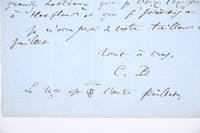
1865767951865. Fine. 30 mai 1865 13.70 x 21.10 cm une page sur un feuillet Autograph letter signed by Charles Baudelaire to Narcisse Ancelle written in black ink on a sheet of blue paper. Folds from mailing three minute pinholes not affecting the text. This letter was transcribed in the Complete Works volume 11 published in 1949 by L. Conard. A moving letter from Brussels addressed to the celebrated family notary who became in 1844 Charles's legal guardian charged with managing his annuity and his exponential debts. A complex relationship developed between the poet and his guardian mingling necessity and mistrust yet nonetheless bearing witness to genuine mutual respect between the two men. This correspondence devoid of the emotional quality of his letters to his mother or the circumlocutions in his exchanges with creditors constitutes one of the most precious biographical sources on the poet. Indeed Baudelaire's financial dependence constrained him to great transparency with his guardian and each of his letters to Ancelle admirably summarizes his wanderings. Thus this letter evokes the terrible mire in which the poet found himself in Belgium and his constantly postponed return to Paris. When he writes Baudelaire is still in Brussels at the Hôtel du Grand Miroir ""28 rue de la Montagne"" but one must not write the hotel's name otherwise letters do not reach him directly where he is dying of boredom illness and resentment toward a country in which he innocently believed he would find glory. This announcement of imminent departure for Paris ""Two or three days after your reply I will leave"" echoes all the similar promises the poet has made for nearly a year to his correspondents. This one will be aborted like all the others for as he confesses to Ancelle a few months earlier Paris fills him with ""a dog's fear."" It is only in August 1865 that he will make a final and brief stay in France before his fatal stroke. His return ""I am eagerly awaited in Paris and in Honfleur"" was nevertheless motivated by a compelling reason: to negotiate with a publisher through Manet's intervention the publication of his collection of reflections on his contemporaries which he had already titled My Heart Laid Bare Mon cur mis à nu and whose manuscript is partly at his mother's house in Honfleur. Another failurethe work would not appear until 1897 thirty years after Baudelaire's death. But it is undoubtedly the reference to the ""two large paintings he wishes to send to Honfleur"" that gives this letter all its significance. Baudelaire evokes his wish to repatriate paintings from his collection that he left with various lenders or restorers of which he had already sent a list to Ancelle a few months earlier. Among these which ones did he want to bring back to his mother His father's portrait the Boilly the Manet a Constantin Guys There is no mention in other letters of this art shipment and of the ""remainder"" to which the paintings were to be joined. This desire to ""send to Honfleur"" his precious belongings nonetheless testifies to the weakened poet's wish to settle permanently in his mother's ""jewel-house"" in Honfleur an island of serenity where Baudelaire dreamed of a peaceful retreat where all would once again be ""order and beauty luxury calm and voluptuousness."" He would indeed return there paralyzed and mute but for a final year of agony after his syphilitic crisis. The Hôtel du Grand Miroir would remain his last true dwelling as noted on Tuesday April 3 1866 in the register of admissions at the Saint-Jean Clinic: ""Name and first names: Baudelaire Charles. Address: France and 28 rue de la Montagne. Profession: man of letters. Illness: apoplexy."" A fine letter to the man who was both Baudelaire's persecutor and protector. He accompanied the poet until his death before becoming executor of the family estate. unknown
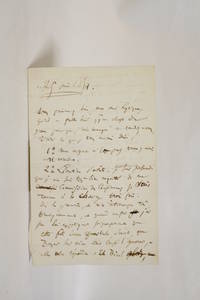
185468690Paris 1854. Fine. Paris 25 Juin 1854 11.50 x 18.50 cm une page recto-verso Handwritten letter dated and signed by Charles Baudelaire to Philoxène Boyer concerning the intriguing Léontine B. Paris 25 Juin 1854 11.5 x 18.5 cm one page recto-verso Handwritten two-page letter dated 25 June 1854 and signed by Charles Baudelaire to Philoxène Boyer whom he calls «my dear Lyrique» in which he apologises for having missed a meeting with him he confesses his impecuniosity to him and reports to him on the efforts made by Léontine B. an intriguing person who will end up compromising Philoxène Boyer because of his debts to attend a party to which she is not invited and which holds a certain jealousy: «You surely assume my dear Lyrique that yesterday something serious happened for me to have missed this meeting. Here is what I would have told you: 1 my money has not come; but it will come. / 2 Léontine is obstinate. I am convinced that I have fulfilled my confidence mission very well. I came back three times. When I finally could explain to her carefully that this party was for family secret that Boyer himself was supposed to ignore it she replied: Well it's no longer a secret since I know.» Finally while recognising Léontine as «a very original turn of mind» and although the attitude of this troublesome scheme: «causes you worry and I understand.» Charles Baudelaire pleads for indulgence and leniency: «since she persists so proudly I would urge you to let the event run. It is after all only the homage of a dizzy mind.» unknown
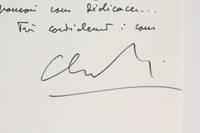
197562729Sabres 1975. Fine. Sabres 1er octobre 1975 14.60 x 20.90 cm 1 page sur une feuille Autograph letter signed by Claude Simon to René Wintzen written in black ink. Date and place at the top of the letter and signature at the bottom of the letter. Folding caused by mailing. Claude Simon writes this letter to thank René Witzen for his article and his understanding of his work. He also writes to him that he will send him his last book Lesson of Things published in 1975 and apologizes for not being able to dedicate it to him. unknown
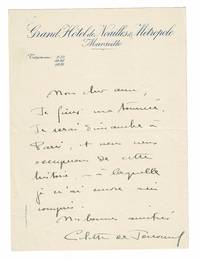
192375257Marseille 1923. Fine. Marseille s. d. novembre 1923 13.70 x 18.70 cm une page sur un double feuillet Autograph letter signed by Colette addressed to her friend the man of letters and lawyer Adrien Peytel one page written in black ink on a double sheet with letterhead from the Grand Hôtel de Noailles et Métropole in Marseille. A central fold inherent to the mailing of the letter. Handsome letter addressed from Marseille while Colette was conducting a lecture tour: ""I'm finishing my tour. I'll be in Paris on Sunday and we'll take care of this matter - which I still haven't understood anything about."" ""In November 1923 she dealt with . a subject she knew by heart Le Théâtre vu des deux côtés de la rampe. Her very young lover Bertrand de Jouvenel joined her in Marseille at the Grand Hôtel de Noailles et Métropole. Scandal: Bertrand de Jouvenel was none other than the son of her second husband the diplomat Henry de Jouvenel; guaranteed uproar around the fifty-year-old writer while her husband's son had just celebrated his twentieth birthday. Colette had two years earlier initiated the future economist and political scientist into love in this scandalous liaison which provided the theme and situations for Blé en herbe published in that same year 1923."" Rémi Duchêne L'Embarcadère des lettres unknown
195783328s. l.: S. n. 1957. Fine. S. n. s. l. 17 juillet 1957 20.50 x 27 cm une page une enveloppe Autograph letter signed by Colonel Rémy 10 lines written in blue ink from the seaside resort of Cascais envelope included addressed to Henri Petit author of a favorable review of the latest work entitled ""Fatima"" by the great resistance fighter recently published and entitled ""Fatima"" ""Merci cher ami pour les lignes comme toujours si bienveillantes - que vous avez eu la gentillesse de consacrer à mon ""Fatima"" et que je trouve ici en rentrant de France. Bonnes vacances ! Croyez-moi votre reconnaissant et dévoué Rémy."" ""Thank you dear friend for the lines as always so benevolent - which you were kind enough to devote to my ""Fatima"" and which I find here upon returning from France. Happy holidays! Believe me your grateful and devoted Rémy."" Fold marks inherent to posting. S. n. unknown
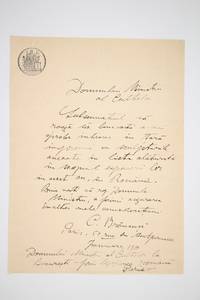
191476382Paris 1914. Fine. Paris janvier 1914 21 x 28.50 cm une page sur un feuillet Handwritten signed letter addressed to the Romanian Ministry of Worship Paris January 1914 21 x 28.5 cm one page on a leaf Very important handwritten letter signed by Constantin Brâncui addressed to the Romanian Ministry of Worship written in black ink on a leaf of white paper. Embossed stamp and a trace of a stamp. Transverse folds from having been sent. In this letter dated January 1914 and addressed to the Ministry of Worship the sculptor requests authorisation to bring some of his sculptures to Romania for the exhibition of the ""Tinerimea Artistica"" company Artistic Youth. Brâncui was then in Paris as evidenced by his address: « 54 rue du Montparnasse ». A list of works was visibly attached to the letter but sadly has disappeared. This letter testifies to the close links maintained between Brâncui and the Romanian artists of the ""Tinerimea Artistica"" who since 1908 organized exhibitions bringing together paintings and sculptures. In March 1914 Brâncui presents six works including La Prière 1907 Le Baiser 1907-08 Mademoiselle Pogany 1913 at the fourteenth exhibition of this important artistic company. He was already a renowned sculptor at that time: the presence of five of his works at the Armory Show in New York 17 February 15 March 1913 where his sculpture Mademoiselle Pogany caused a scandal due it its modernity at the side of Marcel Duchamp's Nu descendant un escalier and allowed him to become one of the major artists of the second decade of the 20th century. unknown
185075710Paris 1850. Fine. Paris 23 décembre 1850 11 x 16.80 cm une page sur un double feuillet Autograph letter signed by David d'Angers to the painter Armand-Tranquille Vastine one page written in black ink on a double sheet. Transverse folds inherent to mailing. ""Je ne puis résister au plaisir de vous dire que je viens de voir votre tableau à l'exposition et que la puissante impression qu'il avait produit sur moi lorsque je l'ai vu dans votre atelier n'a fait que s'accroître j'espère bien qu'il sera remarqué comme il le mérite et qu'il vous ouvrira un avenir heureux et brillant."" ""I cannot resist the pleasure of telling you that I have just seen your painting at the exhibition and that the powerful impression it made on me when I saw it in your studio has only grown stronger I do hope it will be noticed as it deserves and that it will open a happy and brilliant future for you."" Armand Vastine was a student of Paul Delaroche. unknown
1793733941793. Fine. 1er avril 1793 15.60 x 20 cm une page sur un feuillet Unpublished autograph letter signed and dated written in black ink and addressed to a notary. On the verso probably in the hand of a secretary the inscription ""Sade du 1er avril 1793""; below this inscription a short sentence in the Marquis's hand: ""so that I may write to Gaufridy to send him money"". Some transverse folds from the original folding for posting. Lengthy letter addressed to a notary while the Marquis freed on April 2 1790 by the abolition of royal warrants is at liberty and attempting to put his affairs in order. After the Revolution his sons emigrated and he did not follow them. His name nevertheless appears on the list of persons who left France due to the revolutionary troubles: ""I hope that with all this I will manage to have my name erased from that fatal list of émigrés."" Anxious not to be considered a ci-devant Marquis in this period preceding the Terror he insists on the persecution of which he claims to be a victim despite his good will: ""It is an unparalleled atrocity that such a trick should have been played on me who have not left Paris since the revolution and who since that time have not ceased to give the most unequivocal proofs of my patriotism"". In this letter Sade also denounces the complexity of the workings of the French administration after the Revolution: ""I have just sent M. Lions the appropriate certificate of residence and I have attached a petition to the district which he tells me is . essential."" Impecunious he begs his lawyer ""to excite the zeal of those who owe him and to urge them to pay as much money as they collect immediately to M. Gauffridi sic"" and does not hesitate to show himself obliging in order to achieve his ends: ""spare no effort then I beseech you . always preserve for me your care and your friendship . I embrace and greet you with all my heart."" Sade's efforts would prove futile; in December 1793 he was imprisoned at the Madelonnettes before being admitted through the good offices of his friend Mme Quenet to the Coignard de Picpus establishment a nursing home sheltering wealthy suspects. Interesting unpublished letter showing the unfortunate Marquis at bay during one of his rare moments of freedom. unknown
188568398Dieppe 1885. Fine. Dieppe 1er septembre 1885 22.40 x 17.70 cm 4 pages sur un double feuillet Unpublished autograph letter signed Dieppe 1 September 1885 22.4 x 17.7 cm one folded sheet under custom slipcase Unpublished signed autograph letter from Edgar Degas to an unknown correspondent. 4 pages in black ink on one folded sheet. Central fold inherent to the way the letter was folded.his letter is presented in a chemise and case with paper boards decorated with abstract motifs the spine of the chemise in green morocco pastedowns and endpapers of green suede slipcase signed by Thomas Boichot. A handsome unpublished letter testimony to Degas' other great passion after dance: song.he Parisian premiere of Ernest Rayer's Wagnerian opera Sigurd took place on 12 June 1885 at the Opera de Paris. Degas overcome by the performance of the singer Rose Caron saw the piece thirty-seven times: «I still love Sigurd and I like it more and more. I have never seen Reyer except once in the street. And I made a point of telling him of the admiration it provoked in me far more immediately than in someone who being neither maid nor washerwoman was worthy of some consideration.» Degas paid homage to the beauty of Rose Caron in Sigurd by doing two drawings on fans today in private hands in the US.Properly obsessed by this «admirable work that did him so much good that he could not get over» the painter asked his famous neighbor to play him the score on the piano: «The young Jacques-Emile Blanche our neighbor plays it to me every day in place of your wife.»he letter closes with a lyrical description of Mont-Saint-Michel of which Degas had made several drawings: «Have you ever seen Mont-Saint-Michel Could we go and spend a few days there together sometime It's so pretty so charming. In one month I've been twice. The big tides at the end of September will take me back once more.» Degas' passion for opera is the subject of an exhibition for the 350th birthday of the Paris Opera open from 24 September 2019 to 19 January 2020 at the Musée d'Orsay. hardcover
189164384s. l. 1891. Fine. s. l. 3 avril 1891 10 x 13 cm un feuillet remplié Autograph letter signed by Edouard Drumont dated April 3 1891 40 lines in black ink on headed paper bearing the address ""157 rue de l'Université"" Fold inherent to postal sending. Challenged because of his radical anti-Semitic positions Drumont addresses to an abbot a singular letter on the question of dueling: ""I understand everything a priest must think about dueling and I agree with you but it is a necessity in certain cases"" Far from renouncing his opinions ""All the Jews in the world send me challenges"" the author defends himself by adopting a sarcastic position regarding dueling: ""The best way to avoid them is to declare oneself ready to accept them"". The humor that closes the letter notably through the insertion of a fictional dialogue shows all the derision with which Drumont considers his situation: ""'ah you don't fight Are you sure - quite sure. - Well! I want to fight until death ensues!' Let us laugh a little! It provides distraction."" unknown
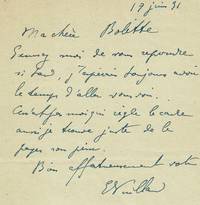
1931741241931. Fine. 17 juin 1931 12.20 x 16.90 cm 1 page sur 1 feuillet remplié Autograph letter signed by Edouard Vuillard addressed to the architect and designer Bolette Natanson written in blue ink on a paper framed in black : ""My dear Bolette Sorry to have kept you waiting on my reply I kept hoping to have the time to come see you. It is not me who adjusts the frame so I find it fair to pay this price for it"". A friend of the painter Edouard Vuillard Bolette Natanson framed several of his works. Bonnard was a longtime friend of the Natansons Thadée and Reine whom he continued to see throughout his life in Normandy or in Paris. Their niece Bolette Natanson daughter of Alexandre whom Bonnard knew as a child became a well-known decorator. She worked with the architect and decorator Jean-Charles Moreux and recommended Bonnard in 1927 for a series of paintings set to adorn a private mansion that Moreux was decorating including the Vue du Cannet now at the Musée Bonnard le Cannet France. unknown
190062649Paris 1900. Fine. Paris n.d. circa 1900 12.40 x 16.70 cm une page sur une feuille Autograph letter signed by Elémir Bourges written in black ink. Paris date and address of Elémir Bourges at the top of the letter signature at the bottom of the letter. Central fold caused by mailing. Elémir Bourges wrote this letter in response to a request for photographs of the author. He replies that he does not have one and that his correspondent can nevertheless find old clichés in the press coming from Manuel or Waléry two Parisian portrait photographers. unknown
190062648Paris 1900. Fine. Paris n.d. circa 1900 12 x 19 cm une page sur une feuille Autograph letter signed by Elémir Bourges written in black ink. Date and place at the top of the letter signature at the bottom of the letter. Central fold caused by mailing. Elémir Bourges writes this letter to apologize to his friend because he will not be able to attend the lunch they had planned due to illness. unknown
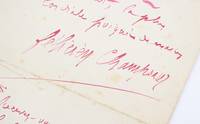
190386005Paris 1903. Fine. Paris s. d. ca 1903 13 x 21 cm 4 pages sur un double feuillet Autograph letter dated and signed by Félicien Champsaur approximately 75 lines in pink ink addressed to a writer friend from his Parisian residence on rue Ballu. Fold marks inherent to mailing tears to right margins of the letter at fold level. Félicien Champsaur apologizes for his late response: ""Ne m'en veuillez pas et pardonnez définitivement à un confrère harcelé par tous les flux de la vie mais qui est ""votre ami"" très acquis par les plus charmants souvenirs"" ""Do not hold it against me and forgive definitively a colleague harassed by all the streams of life but who is 'your friend' very devoted through the most charming memories"" and extends his best wishes for the beginning of 1903. He also mentions the forthcoming publication of his work ""L'orgie latine"" to be published by Eugène Fasquelle and which will be decorated with illustrations and proposes to his correspondent to collaborate on the review la Bavarde to which he contributes some articles. unknown
1915822771915. Fine. 19 août 1915 22.20 x 28.60 cm 2 pages sur un feuillet 19 August 1915 222x286cm 2 pages on a leaf. Autograph letter in German signed by the painter Franz Marc to his mother Sophie Marc née Maurice; two pages in black ink. Trace of horizontal and vertical fold. Unpublished letter. Not in the latest edition of his wartime correspondence Briefe aus dem Feld Norderstedt 2019. Lengthy unpublished letter from Franz Marc to his mother during the First World War written a few months before his death in Verdun. In the horror of the conflict the future martyr of German expressionism recalls childhood images and tells horse stories from the front. Stationed on the Alsace front the famed animal painter recounts a hilarious wild boar hunt improvised during a horseback ride reminding him of an illustrated childhood tale: The Three Jovial Hunstmen by Randolph Caldecott 1880. Franz Marc reveals here an inspiration for his famous horses which gave their name to the Blaue Reiter movement created in 1911 with Wassily Kandinsky. The horses in Caldecott's Huntsmen resemble Franz Marc's paintings from 1905-1910. This anecdote is also related to hunting horses sketched on the front and a postcard sketch of the same Jagende Pferde sent to the poet Else Laske-Schüler in September 1915. The letter gives a glimpse of Franz Marc's daily life on the front. By a cruel irony of fate he fought in the native region of his mother Sophie Marc née Maurice born in 1847 in the Alsatian village of Guebwiller. When war broke out in August 1914 he joined the army hoping for a renewal of Europe like many fellow artists and intellectuals. Due to the circumstances of the war the painter wrote his letter in German and not in French as he was accustomed to do in his correspondence with his mother. His mother's influence was decisive in his aesthetic and spiritual approach: Marc's tireless quest for purity inherited from his Calvinist upbringing eventually led him to abstraction already present in his sketches as he wrote this letter. He gives news of a future promotion thanks his mother for sending him food and fills the page with the story of his miraculous hunt: I have one more amusing story to tell: as I was riding out at dawn before breakfast I suddenly noticed a young boar a wild boar beside me in a ditch. I immediately called my fellow riders; he was surrounded I already felt sorry for the poor animal but the pity came too late! Two of them jumped in one grabbed him by the ears the other poked him and the roast for the steward's table was retrieved. A most comical scene ensued: We ordered the youngest soldier to go home with the boar and got him on horseback; but no sooner did the horse feel the boar on his back horses are very afraid of boars than he reared up and threw the rider and the pig into a great arc. Fortunately nothing happened and the embarrassed rider had to walk the boar back then the horse really reared up as soon as he was approached. A real amateur rider! I was thinking of Dad's old English picture book: the jovial huntsman! With this light-hearted anecdote the painter reveals a source of inspiration still unknown to critics and historians. The Three Jovial Huntsmen certainly influenced the young Franz Marc whose own horses painted in the 1910s including the Weidende Pferde I Lenbachhaus Munich are unmistakably marked by Caldecott's British style. In the following years he added to this subject his kaleidoscopic touch and his emblematic blue red and yellow colors charged with spiritual symbolism. Franz Marc also painted blue wild boars in 1913 Museum Ludwig Cologne. The story of this hunt is also completely new since he asked his mother to tell it to his wife Maria to avoid writing a second letter it's long: to tell the same thing twice. This anecdote about hunting and rearing horses can be directly linked to a sketch on a postcard dated the following month entitled jagen unknown
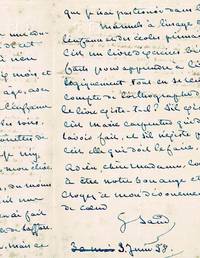
185876111Nohant Nohant-Vic 1858. Fine. Nohant Nohant-Vic 3 juin 1858 13.40 x 20.90 cm 4 pages sur un feuillet remplié Autograph letter signed by George Sand addressed to her friend Stéphanie Bourjot daughter of Étienne Geoffroy-Saint-Hilaire. Four pages written in blue ink on a folded bifolium bearing George Sands monogram. Fold marks as usual. This letter was partially published in Correspondance vol. XIV no. 7846. A beautiful and partly unpublished letter in which George Sand discusses Marie Pape-Carpantiers book and the education of her young maid Marie Caillaud: «It is an excellent book which I use to teach my young maid to read. She is extraordinarily intelligent and this book opens her mind to all sorts of sound ideas. Educating this 18-year-old childwho six months ago was only two in terms of knowledgehas been a unique experience. She now seems her age yet retains all the innocence of childhood. So every evening we read Marie Carpentiers little stories and I enjoy them just as much as my pupil does.» Marie Caillaud was only eleven years old when George Sand hired her to wash dishes and tend to the chicken coop a task that earned her the nickname Marie des poules. But the writer soon recognized the young peasant girls intelligence appointed her as housekeeper and by 1856 included her in the performances of the Nohant theatre. Her education is first mentioned in early 1858 notably in a letter from George Sand to her friend Charles Duvernet: «During my winter evenings I took on the education of little Marie the one who acted with us. From a dish washer I immediately raised her to the rank of housekeeper a role for which her excellent mind makes her perfectly suited. The greatest obstacle was that she couldn't read. That obstacle no longer exists. In thirty half-hour lessonsfifteen hours in a monthshe mastered all the difficulties of the language slowly but perfectly. This miracle is due to the admirable Laffore method which I applied with the utmost gentleness to a perfectly lucid mind.» 16 February 1858 Marie Caillaud would go on to become a notable actress at Nohant and move in the circles of George Sands illustrious guests: Delacroix Gautier Dumas Prince Jérôme Bonaparte But Marie was not George Sands first pupil. All her life Sand was deeply interested in pedagogy and taught not only her children and grandchildren but also members of her household staff and local peasants. This letter is a remarkable testament to her hands-on approach as a teacher always seeking new and effective ways to impart knowledge: «What is lackingor at least what I havent foundis a true reading method. Ive devised one for my own use never written down based on Laffores and adapted to my own ideas. But what I havent found in primers for children or public school manuals is a well-crafted exercise book that teaches reading logically while also making sense of spelling. Does such a book exist» Far from a casual activity education was central to George Sands worldview. As Georges Lubin noted her aim was not merely to teach literacy. Taught to write by her own mother at the age of five Sand understood from an early age that the only path to equality lay through intellectual emancipation: «She understood very early on that the only road to equality was intellectual emancipation. The ignorance imposed upon women was the root of their servitude. The ignorance imposed upon the working classes underpinned class inequality. Education was the key to opening locked doors.» «George Sand et l'éducation» in Nineteenth-Century French Studies 1976 A beautiful and important testimony to George Sands tireless struggle for the emancipation of women through education. unknown
1868784821868. Fine. s. d. mai 1868 13.50 x 20.70 cm 2 pages sur un double feuillet Autograph letter signed by George Sand addressed to Alphonse Peyrat two pages written in black ink on a double sheet. Transverse folds inherent to mailing. Interesting letter evoking one of her faithful friends: Jean Patureau-Francoeur. George Sand had published a long obituary article in tribute to this close friend in L'Avenir national on May 2 1868. She described her late friend with great tenderness: ""C'était un simple paysan un vigneron des faubourgs de Châteauroux. Il avait appris tout seul à écrire et il écrivait très remarquablement avec ces naïves incorrections qui sont presque des grâces dans un style rustique et spontané. . Ce petit homme robuste à grosse tête ronde au teint coloré à l'il bleu étincelant et doux était doué d'une façon supérieure. Il voyait la nature il l'observait il l'aimait et il la savait. . Son existence parmi nous fut pénible agitée méritante. Naturellement un esprit aussi complet que le sien devait se passionner pour les idées de progrès et de civilisation. Il fut avant la Révolution le représentant populaire des aspirations de son milieu et il travailla à les diriger vers un idéal de justice et d'humanité. ."" ""He was a simple peasant a wine-grower from the suburbs of Châteauroux. He had taught himself to write and he wrote remarkably well with those naive incorrections that are almost graces in a rustic and spontaneous style. . This sturdy little man with his large round head his ruddy complexion his sparkling and gentle blue eyes was gifted in a superior way. He saw nature observed it loved it and understood it. . His existence among us was painful agitated meritorious. Naturally a mind as complete as his had to be passionate about ideas of progress and civilization. He was before the Revolution the popular representative of his milieu's aspirations and he worked to direct them toward an ideal of justice and humanity. ."" In 1848 Patureau was elected mayor of Châteauroux and became the spokesman for the workers of his commune. ""Au moment du coup d'État il fut poursuivi mais il se cacha dans des familles amies et échappa à la police. George Sand obtint difficilement sa grâce ce qui lui permit de regagner Châteauroux. Il fut arrêté en janvier 1858 à la suite de la loi de sûreté générale."" ""At the time of the coup d'état he was pursued but he hid with friendly families and escaped the police. George Sand obtained with difficulty his pardon which allowed him to return to Châteauroux. He was arrested in January 1858 following the general security law."" ""Il resta un mois au cachot sur la paille en plein hiver. Quand on le mit dans la voiture cellulaire qui le dirigeait vers l'Afrique il était presque aveugle et depuis il a toujours souffert cruellement des yeux"" ""He remained a month in the dungeon on straw in the middle of winter. When they put him in the prison van that was taking him to Africa he was almost blind and since then he has always suffered cruelly with his eyes"" George Sand. In September 1858 following an intervention by George Sand with her friend Jérôme-Napoléon Napoleon III's cousin he was released but remained under surveillance. He settled in Algeria after obtaining permission to come to Châteauroux to sell his house and vineyard and to fetch his family. In Algeria he lived by his trade as a wine-grower was part of the Agricultural Society of Philippeville and wrote a treatise on viticulture."" Maintron ""À présent je viens vous demander de me payer ce petit article le plus cher que vous pouvez et d'envoyer le prix directement à Joseph Patureau rue de cluis n°7 à Châteauroux. Indre. Et cela le plus tôt possible."" ""Now I come to ask you to pay me for this little article as dearly as you can and to send the payment directly to Joseph Patureau rue de cluis n°7 à Châteauroux. Indre. And this as soon as possible."" Jos unknown
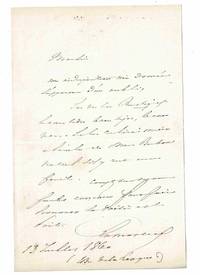
186478465Paris 1864. Fine. Paris s. d. entre 1864 et 1868 13.40 x 20.70 cm 2 pages sur un double feuillet Autograph letter signed addressed to an unknown correspondent written in black ink on a double leaf with dry stamp bearing the writer's initials. This letter probably unpublished was written on ""November 11th"" between 1864 and 1868 according to the address at the bottom: ""rue des feuillantines 97"". ""Une amie commune et pleine de confiance en votre bonté me fait espérer monsieur que vous m'accorderez un peu de sympathie. Si je suis indiscrète d'y croire ne vous en prenez qu'à elle comme elle est de ces personnes à qui l'on ne peut en vouloir je ne crains pas de vous la dénoncer. Vous pouvez vendre un immense service au fils de mon ami d'enfance. Le voudrez-vous quelque difficile que la chose puisse être Elle ne l'est peut-être pas je ne sais pas. Mais si elle l'est j'espère quand même depuis ce que Madame de Voisins me dit de vous. ."" ""A mutual friend full of confidence in your kindness gives me hope sir that you will grant me some sympathy. If I am indiscreet to believe it blame only her as she is one of those persons one cannot hold a grudge against I do not fear to denounce her to you. You can render an immense service to the son of my childhood friend. Will you do so however difficult the matter may be Perhaps it is not difficult I do not know. But if it is I still hope so from what Madame de Voisins tells me about you. ."" unknown
196583133Paris: S. n. 1965. Fine. S. n. Paris 17 octobre 1965 14 x 19.50 cm une feuille Autograph letter dated and signed by Georges Auric addressed to his friend Carlo Rim 23 lines in blue ink on letterhead of the Réunion des théâtres lyriques nationaux et du théâtre de l'Opéra de Paris in which he asks for his friend's indulgence as he is overwhelmed with work: ""Pardonne-moi si je ne t'ai pas répondu encore : tu peux imaginer sans trop de peine ce qu'est devenue mon existence ! . je viens d'avoir à préparer la reprise d'Iphigénie en Tauride - opéra des plus nobles et que ""notre"" public n'avait pas eu l'occasion d'écouter depuis 1931 "" ""Forgive me if I haven't answered you yet: you can imagine without too much trouble what my existence has become! . I have just had to prepare the revival of Iphigénie en Tauride - one of the noblest operas and one that ""our"" public has not had the opportunity to hear since 1931""; a revival in which Georges Auric places great hope: "". En tout cas je veux espérer que nous dépasserons les deux répétitions de 1931. "". In any case I want to hope that we will exceed the two performances of 1931."" He also rejoices in the diversity of projects that occupy him thus transcending styles and periods: ""Glück Iphigénie : nous sommes fichtrement loin de Vincent Scotto. Mais je franchis allégrement siècles et styles pour te dire combien je suis heureux de me trouver dans ce ""comité d'honneur"" associé aux respectables et déjà vieux amis dont tu connais les noms ! "" ""Gluck Iphigénie: we are damn far from Vincent Scotto. But I cheerfully leap across centuries and styles to tell you how happy I am to find myself in this 'honorary committee' associated with the respectable and already old friends whose names you know!"" Folds inherent to mailing. Carlo Rim was a Provençal writer author notably of ""Ma belle Marseille"" a caricaturist a filmmaker: ""Justin de Marseille"" ""L'armoire volante"" ""La maison Bonnadieu"" and was notably the friend of Fernandel Raimu and Marcel Pagnol but also of Max Jacob and André Salmon whom he met in Sanary. S. n. unknown
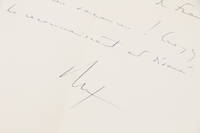
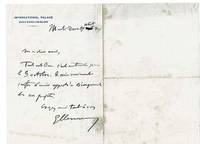
190976082Mont-Dore-Les-Bains Le Mont-Dore 1909. Fine. Mont-Dore-Les-Bains Le Mont-Dore 29 août 1909 13.60 x 21 cm 1 page sur un double feuillet Signed autograph letter from Georges Clémenceau addressed to a friend. One page written in black ink on a double sheet with letterhead from the International Palace of Mont-Dore-Les-Bains. Central fold inherent to mailing. Clemenceau then taking the thermal cure at Mont-Dore-les-Bains writes: ""All is well. It is agreed for October 9th. I am truly embarrassed to have brought this disruption to your plans."" unknown
190977465Mont-Dore-Les-Bains Le Mont-Dore 1909. Fine. Mont-Dore-Les-Bains Le Mont-Dore 29 août 1909 13.60 x 21 cm 1 page sur un double feuillet Autograph letter signed by Georges Clémenceau addressed to a friend. One and a quarter pages written in black ink on a double sheet with letterhead from the International Palace of Mont-Dore-Les-Bains dated August 25 1909. Folds inherent to mailing. Clemenceau then taking thermal baths at Mont-Dore-les-Bains writes: ""Quand votre aimable invitation m'est arrivée à Carlsbad j'avais un engagement déjà pris."" ""When your kind invitation reached me in Carlsbad I already had a prior engagement."" Charming and very aesthetic missive. unknown
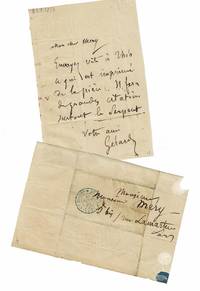
185373292Paris 1853. Fine. Autograph letter signed ""your friend Gérard"" addressed to Joseph Méry Paris 23 septembre 1853 9.70 x 14.50 cm une page sur un feuillet enveloppe jointe Autograph letter signed ""your friend Gérard"" addressed to Joseph Méry. Envelope with a small angular tear due to the original sealing enclosed. Horizontal folds. This letter is reproduced in the Pléiade edition of his correspondence vol. 3 p. 811. ""Envoyez vite à Théo ce qui est imprimé de la pièce. Il fera de grandes citations surtout le Serpent."" The ""pièce"" in question is Gusman le Brave first performed at the Odéon on 23 September 1853. On 4 October Théophile Gautier discussed the play in La Presse. ""Le Serpent"" refers to Josés tale in Act II scene 1. unknown
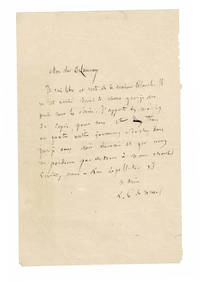
184172928Paris 1841. Fine. Paris s. d. avril 1841 13.50 x 21 cm une page sur un feuillet Autograph letter signed by Gérard de Nerval addressed to Hippolyte Delaunay written in black ink. Recipient's name in Nerval's hand on the verso of the leaf. A central fold inherent to the mailing. This letter has been transcribed in Nerval's Complete Works in the Pléiade edition. Gérard de Nerval is finally ""free and released from the Maison Blanche"" after staying there following his crisis of early spring 1841. This is not however a definitive release but probably permission granted by Doctor Blanche to his patient the latter would not be definitively released until November 1841. The handwriting difficult to read in places shows Gérard de Nerval's feverishness as he seeks to reconnect with the literary milieu: ""I bring masses of copy for you and three or four other journals."" Hippolyte Delaunay was editor-in-chief of the review L'Artiste in which Nerval published on April 11th of the same year an article entitled ""Mémoires d'un Parisien Sainte-Pélagie 1832"". unknown
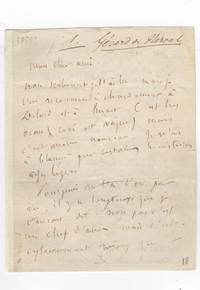
185273345Paris 1852. Fine. Paris s. d. fin 1852 10.20 x 13.20 cm quatre pages sur un feuillet remplié Autograph letter signed ""ton ami G."" addressed to the poet and playwright Armand Barthet. Nerval congratulates ""his dear friend"" on his drama Le Chemin de Corinthe: ""Non seulement je l'ai lu mais je l'ai recommandé chaudement à Delord et à Huard. C'est très beau ceci est vague mais c'est même nouveau"" ""Not only have I read it but I have warmly recommended it to Delord and to Huard. It is very beautiful this is vague but it is even new"". Folds inherent to posting. A strip of paper at the junction of the two pages and a restoration to the left inner margin. This letter has been transcribed in the correspondence published in the Pléiade edition volume 3 p. 796. The addressee has written directly following this letter a moving biographical notice concerning Gérard de Nerval: ""Nul ne savait où il demeurait - il rodait toute la nuit les poches de sa longue redingote gonflé sic de bouquins"" ""No one knew where he lived - he wandered all night the pockets of his long frock coat swollen with books"". unknown
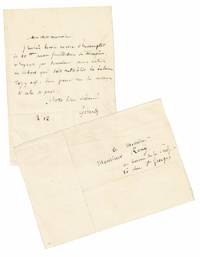
184973289s. l. 1849. Fine. s. l. 1837 ou 1849 9.90 x 14.30 cm une page sur un feuillet enveloppe jointe Autograph letter signed ""votre bien dévoué Gérard"" addressed to Daniel Rouy. Envelope included. This letter simply dated ""Le 12"" could have been written in August 1849 if we refer to a letter to Ernesta Grisi companion of his friend Théophile Gautier in which the poet mentions such a discount: ""Je n'ai pu toucher l'argent qu'aujourd'hui mercredi. M. Rouy n'y était pas. J'y suis allé 4 fois et j'ai porté les 10F. aujourd'hui je ne sais pas s'il faut faire le prochain feuilleton ni comment il faut signer."" ""I could only get the money today Wednesday. Mr. Rouy was not there. I went 4 times and brought the 10F. today I don't know if I should do the next serial or how to sign it."" Pléiade volume 1 letter 143 of August 30 1849. However Michel Brix author of Nerval Glanes et miettes de presse and member of the Royal Academy of French Language and Literature of Belgium very kindly pointed out to us that Nerval signed ""Gérard"" rather between 1837 and 1840 and that in 1849 he signed this type of note ""Gérard de Nerval"". unknown