Gerard de NERVALBiblio.com
1 815 résultats
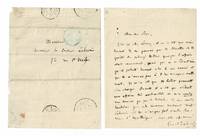
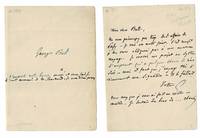
185373273Paris 1853. Fine. Paris s. d. novembre 1853 10 x 13.60 cm un feuillet et son enveloppe dépliée Autograph letter signed ""votre G."" ""your G."" addressed to Georges Bell written in blue ink on the recto of a small sheet. Unfolded autograph envelope included containing a sentence that Nerval had not put in his letter. This letter has been transcribed in the Pléiade volume 1 letter 264. After several missed appointments and while he was at Dr. Blanche's clinic Nerval asks George Bell not to ""se préoccuper pas trop de l'affaire de Passy"" ""worry too much about the Passy affair"". Despite his confinement Nerval continues to conduct his business: ""Je conçois un projet ou système d'emprunt qui a quelques chances de réussite - mais il faut que j'engage très sérieusement ma signature."" ""I am conceiving a project or loan system that has some chances of success - but I must very seriously commit my signature."" He ends his letter with an enigmatic formula: ""Vous savez que je vous ai fait un conte ce matin. Je sortais des bras de.cherchez."" ""You know that I told you a tale this morning. I was coming from the arms of.guess."" unknown
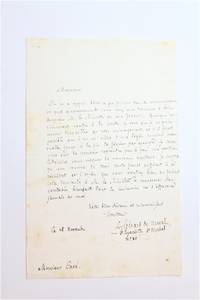
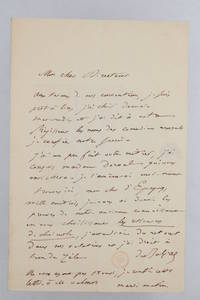
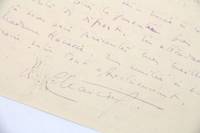
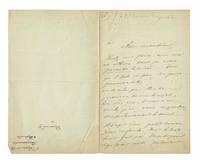
184172914Paris 1841. Fine. Paris 18 novembre 1841 13.90 x 20.80 cm une page sur un feuillet remplié Autograph letter signed by Gérard de Nerval addressed to Auguste Cavé written in careful handwriting in black ink on the first page of a double sheet. Minor traces of folds inherent to posting and some light foxing. This letter was transcribed in Nerval's Complete Works in the Pléiade edition. After two violent nervous breakdowns Gérard de Nerval was compelled to stay at Dr. Blanche's clinic between March and November 1841. Short of money he addressed this letter to his friend Auguste Cavé then director of the Fine Arts section at the Ministry of the Interior to solicit his support with ""M. le Ministre"": ""Quoi qu'entièrement rendu à la santé je sens que je ne puis encore travailler qu'avec ménagement et s'il était possible que l'on m'aidât d'une légère somme mensuelle . je serais plus sûr de pouvoir reprendre peu à peu ma position littéraire sans risquer de nouveaux accidens"" ""Though entirely restored to health I feel that I can only work with care and if it were possible to be helped with a small monthly sum . I would be more certain of being able to gradually resume my literary position without risking new accidents"". unknown
184173272Paris 1841. Fine. Paris s. d. circa mars 1841 10 x 13.10 cm un feuillet et son enveloppe dépliée Very rare autograph letter signed ""Gérard Labrunie"" addressed to ""his dear papa"" Dr. Labrunie. 13 lines written in small handwriting in black ink on one page. Unfolded envelope attached showing several postal stamps restored on the back with an adhesive piece. A few transverse creases as well as some very discrete holes not touching the text and inherent to the use of a pin to seal the letter. Fine letter from Gérard Labrunie to his ""dear papa"" about a ""very complicated affair"" relating to the ""capacity as surrogate guardian"" of the writer's father. Very rare signature of Gérard de Nerval under his real patronymic name: Gérard Labrunie. unknown
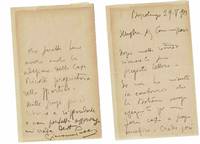
190375723Boscolungo 1903. Fine. Boscolungo 29 août 1903 11.20 x 18 cm 2 pages sur 2 feuillets Unpublished autograph letter signed by Giacomo Puccini to a patron; two pages written in black ink on two leaves. Leaves uniformly shaded traces of former pasted mounts on verso. A photographic reproduction of the famous composer's portrait is enclosed. Puccini responds to a patron's request to have La Bohème performed at a charity event: ""Io non ho niente in contrario che la Bohème venga eseguita per una sera corta a scopo benefico."" I have no problem with La Bohème being performed for a charity event. ""Credo pero che sarebbe bene avere anche la adesione della Casa Ricordi proprietaria dello spartito."" I believe however that it would be good to have the authorization of Casa Ricordi Puccini's publishing house owner of the score. Despite the failure of the first performance on February 1 1896 La Bohème subsequently enjoyed worldwide success rapidly becoming one of the finest operas in the Romantic repertoire. A fine tribute to the triumph of one of the greatest composers of the late 19th-century. unknown
195064369s. l. 1950. Fine. s. l. s. d. 18 x 21.50 cm un feuillet Signed autograph letter of Gus Bofa to one of his acquaintances 16 lines in purple ink accompanied by a pencil drawing. Folding inherent in the enveloping tear without lack in the drawing. Addressed to a friend of Gus Bofa and his wife who seems to have suffered "" a long journey in the storm! ""The letter is imbued with the humor of its author:"" we add two good warm kisses to finish drying you off "". The missive is enriched with an original drawing of Gus Bofa representing two birds on a radiator one of which is written ""Spring has come! "" unknown
1874773391874. Fine. 1874 13.20 x 20.70 cm 4 pages sur un double feuillet Autograph letter signed by Gustave Doré addressed to Paul Dalloz. Four pages written in black ink on a double sheet of white paper with envelope. Fine letter full of torment in which Gustave Doré dreads being supported again for the rank of officer in the Legion of Honor he who was made chevalier in 1861 after the publication of Dante's Inferno and thanks to Paul Dalloz's intervention. Doré thanks him moreover for this past influence: ""Je viens te remercier encore et du plus profond de mon cur de l'amitié toute dévouée que vous m'avez témoignée dans ces dernières circonstances ; et je t'assure que je te conserve pour ce fait des sentiments aussi reconnaissants que pour le service que tu m'as si spontanément et cordialement rendu il y douze ans."" ""I come to thank you again and from the depths of my heart for the devoted friendship you have shown me in these recent circumstances; and I assure you that I preserve for this fact feelings as grateful as for the service you rendered me so spontaneously and cordially twelve years ago."" He nevertheless asks him not to propose him for the rank of officer: ""Mais je viens réclamer de toi les mêmes amitiés te priant te suppliant même de t'arrêter complétement et absolument ce qui je n'en doute pas te coûtera plus encore qu'autre chose. J'ai beaucoup pensé à tout ce que tu m'as dit hier et je trouve que je me suis trompé tout à fait en te laissant t'engager si obligeamment dans ces démarches."" ""But I come to claim from you the same friendships asking you even begging you to stop completely and absolutely which I do not doubt will cost you more than anything else. I have thought much about everything you told me yesterday and I find that I was quite wrong to let you engage so obligingly in these steps."" Gustave Doré was nevertheless appointed officer of the Legion of Honor on January 15 1879.through Paul Dalloz's intervention. unknown
186075622s. l. Paris 1860. Fine. s. l. Paris s. d. 5 ou 12 janvier 1860 13.60 x 21 cm deux pages sur un feuillet remplié Autograph letter signed by Gustave Flaubert addressed to the archaeologist Charles-Ernest Beulé. Two pages written in black ink on a folded sheet. The recipient of this letter added nine handwritten lines a draft of his future response following Flaubert's letter. This letter has been transcribed and reproduced on the website of the Flaubert Centre at the University of Rouen. The transcriber of this missive notes: ""Are the lines written under the signature by Beulé or by Flaubert himself The handwriting resembles his. Stéphanie Dord-Crouslé suggests that Flaubert may have gone to see Beulé and written these elements under his dictation in response to the questions posed."" This hypothesis seems unlikely to us given that we know Charles-Ernest Beulé's response to this letter itself digitized by the Flaubert Centre and dated February 10 1860. This response does not seem to us to suggest a visit by Flaubert to Beulé. It seems more likely to us that Beulé inscribed under Flaubert's letter a draft of his future response of February 10 1860 which would only be an elegant reformulation of his notes. Handsome and important testimony to the colossal research that Flaubert undertook for the writing of Salammbô. ""Begun in 1857 the novel appeared in 1862 a period when Antiquity was coming back into fashion and when Carthage was 'au goût du jour' ""in vogue"" thanks to the recent excavations by Charles-Etienne Beulé at Byrsa 1859 and in the Punic ports."" Vanessa Padioleau ""Flaubert et Carthage : Salammbô roman polymorphe"" ""Flaubert and Carthage: Salammbô polymorphic novel"" in Revue Flaubert n° 9 2009 It is therefore to one of the specialists on the subject that Flaubert addresses his questions commenting on his recent reading of Ammianus Marcellinus: ""J'ai appris dans ce même Ammien que les Carthaginois ont pris Thèbes en Egypte . Qu'est-ce que cela veut dire Ce passage est je crois peu connu "" ""I learned in this same Ammianus that the Carthaginians took Thebes in Egypt . What does this mean This passage is I believe little known"" Flaubert's task is no small one: at the time nothing or almost nothing was known about the period of the Mercenary Revolt which extended over two years from 240 to 238 BC. He then begins painstaking work basing his research on the texts of the great historians of Antiquity which he reads in Latin in the original. The letter we offer shows his great mastery of it: ""J'ai appris dans ce même Ammien que les Carthaginois ont pris Thèbes en Egypte livre xvii ch. iv. 'Hanc inter exordia pandentis se late Carthaginis improviso excursu duces oppressere Poenorum'"" ""I learned in this same Ammianus that the Carthaginians took Thebes in Egypt book xvii ch. iv. 'At the time when Carthage was beginning its wide expansion the generals of the Phoenicians conquered it by a surprise attack'"". Despite this most thorough research the gate of Carthage would receive only a very brief description in the final version of Salammbô. unknown
187762711Paris 1877. Fine. Paris 9 mai 1877 13.50 x 20.50 cm 2 pages sur un feuillet remplié Autograph letter signed by Gustave Flaubert addressed to Léon Cladel. Envelope attached. Some underlinings and manuscript corrections by the author. Minor water stains. Three small restorations using adhesive on the second page as well as two fold marks inherent to the letter's folding for mailing. Amusing letter in which Gustave Flaubert whose literary renown is well established offers his support to his friend Léon Cladel who is struggling to have one of his works published. The ""master"" - this is how Léon Cladel addresses his colleague - begins this letter with enthusiasm: ""I started your book yesterday at 11 o'clock; it was finished this morning at 9!"" The ""book"" in question is L'Homme de la Croix-aux-Bufs which Flaubert had agreed to re-read for his friend on April 30; he had indeed requested the manuscript deposited with the publisher Georges Charpentier: ""Cladel wrote to me to say that he wished me to read pardon the subjunctive the novel in sheets which is with you. So send it to me or bring it to me."" Letter of May 3 1877. Léon Cladel very close to Gustave Flaubert seems to have shared with him the fears of the publisher Édouard Dentu regarding the publication of his work: ""And first of all Dentu must be mad to be afraid to publish it."" As a seasoned veteran of the ruthless world of publishing Flaubert positions himself as a professional and declares: ""Nothing in it is reprehensible either politically or morally. What he told you is a pretext"" This question of moral reprehension echoes the famous trial brought against the author of Madame Bovary. Like an enthusiastic literary critic Flaubert compliments his colleague: ""I find your book to be a real book. It is very well done very careful very masculine. & I know what I'm talking about my good man."" As a scrupulous reader he nevertheless allows himself a few remarks on Cladel's manuscript ""I have two or three small criticisms to make trivial matters - or rather advice to submit to you."" before reconsidering: ""Sometimes there are pretensions to archaism and naivety. It is an excess of good."" Flaubert's attitude here is almost paternal and in any case benevolent: aware of his friend's abilities he wishes to encourage him and see the publication of his work succeed: ""But once again be content & sleep soundly - or rather don't sleep - and often create similar works."" The benevolent writer also mentions in this letter another publisher Georges Charpentier: ""As for Charpentier to whom I will return your sheets on Friday - the day when I dine at his house I am going to give him a vigorous talking-to & in all conscience without exaggeration & without lies."" Charpentier who has been publishing Flaubert since 1874 has become a close friend of the writer with whom he maintains a rich correspondence. In this month of May 1877 he has just published Trois contes which was for Cladel the occasion for a moving celebration of his master in Letters: ""Where the devil did you get that gleaming brush with which you paint your canvases the small ones like the large ones and that sobriety that certain Latins would envy you To be at once Chateaubriand and Stendhal and moreover Flaubert."" This admiration is reciprocal and Flaubert feels for this ""true artist"" an unfeigned esteem: ""The ending is simply sublime! - & of the greatest effect."" He will reiterate a few weeks later his compliments: ""It is worked chiseled delved into. Observation in your case takes nothing away from poetry; on the contrary it brings it out."" Indeed Cladel will establish himself as the true heir to the Flaubertian style much more so than Zola who will precisely reproach him for ""working his prose relentlessly"" and ""striving to render perfect each sentence he writes."" It is finally Édouard Dentu who will publish the manuscript of L'Homme de la Croix-aux-Bufs; Cladel will moreover offer a copy enriche unknown
1949644241949. Fine. 19 juin 1949 13.50 x 21 cm un feuillet Autograph letter signed by Henry de Montherlant to Robert Pignarre dated June 19 1949 15 lines in blue ink envelope attached. Folds inherent to the enveloping. Warm letter of thanks to professor Robert Pignarre following a conference at the Alliance française on his work: "" I have tasted the seriousness and objectivity ."" unknown
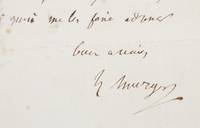
1850850801850. Fine. circa 1850 15.50 x 20 cm une page Autograph letter signed by Henry Murger 5 lines in black ink to a publisher apologizing for a delay beyond his control. Some foxing. Traces of postal stamp in upper portion of the sheet. ""Comme on est venu chercher ma copie un peu tard . insistez je vous prie pour qu'il me les fasse adresser"" As they came to collect my copy rather late . please insist that he have them sent to me unknown
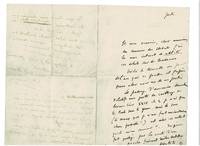
184183639s. l. Passy Paris 1841. Fine. s. l. Passy Paris « mardi matin » 28 décembre 1841 13.50 x 21.60 cm une page sur un double feuillet enveloppe jointe Autograph letter signed by Honoré de Balzac to Jean-Baptiste Violet d'Epagny director of the Odéon theater. One page in black ink on a double sheet. Enclosed and pasted on the second page is the envelope of this letter written in Balzac's hand.""My dear director under the terms of our agreements I am ready to read I have chosen tomorrow Wednesday and I have told your stage manager the names of the actors to whom I entrust our play. I've done a bit of your job I've conquered Madame Dorval who will make you rich I'll bring her myself. Find here my dear d'Épagny a thousand regards I have given you proof of our old acquaintance by choosing you for Les Ressources de Quinola I shall expect a return in our relations and I am entitled to a great deal of zeal."" Les Ressources de Quinola is both in the spirit Les Fourberies de Scapin and Les Noces de Figaro. From the 1840s until his death Balzac's ambition was to achieve a reputation comparable to his illustrious predecessors Molière and Beaumarchais. Although this proved to be a hope as vain as it was determined Balzac never doubted failure after failure that his success was imminent. On July 15 1841 d'Épagny was appointed director of the Odéon . as any theater director would have done in his place he spent summer vacations organizing his winter programme. He asked Balzac for a play and Balzac complied choosing Les Ressources de Quinola. . We all know what a fuss was made about Balzac's play and how childishly naive the author was in filling the room with the highest Parisian society and foreign elite in order to make snobs want to join such a brilliant assembly. . Madame Dorval more astute than the author refused the role intended for her as soon as Balzac read . She did well for one never saw a more complete failure"" L'Amateur d'autographes mai 1911 Interesting letter revealing the beginnings of the creation of Les Ressources de Quinola and the author's habit of reading his play for the actors who then voted to accept or reject it. Provenance: Arthur Meyer collection then ""AGR"" stamp on letter and envelope. unknown
183386496s. l. Neuchâtel 1833. Fine. Eve's first kiss: 'The gods grant no favours untainted.' s. l. Neuchâtel 29 septembre 1833 13.40 x 21.10 cm une page sur un double feuillet Autograph letter signed by Honoré de Balzac addressed to his friend the writer Charles de Bernard. One page written in black ink on a bifolium. On the verso of the second leaf appears the address of the recipient Charles de Bernard du Grail written in Balzacs hand along with postal stamps and the seal bearing the arms of the Balzac dEntraigues family which the author had appropriated. A few minor holes not affecting the text; fold marks as usual from mailing. Published in his correspondence Paris Calmann Lévy 1876 CXIV pp. 252253. Balzac wrote this letter four days after his very first meeting and first kiss with Madame Hanska in Neuchâtel following many months of epistolary correspondence. « Jai été très heureux ici. Je suis très content de ce que jai vu le pays est délicieux ; mais vous savez que Jupiter a deux tonneaux et que les dieux nont point de faveurs qui soient pures. » ""I have been very happy here. I am most pleased with what I have seen; the country is delightful. But you know that Jupiter has two jars and the gods grant no favours that are untainted."" Two years after receiving the first letter from the Stranger Éveline Rzewuska a lovestruck Balzac left Paris to join her in Switzerland. His brief stop in Besançon ostensibly a convenient detour served as a polite pretext for his departure from the capitalwhere he took the opportunity to visit his correspondent Charles de Bernard. « Il me semble que je vous ai bien peu remercié de la bonne journée que vous mavez donnée ; mais jespère vous prouver que je ne suis point un ingrat. À mercredi donc ; vous devez penser que jaurai bien du plaisir à vous revoir vous qui avez fait que mon voyage à Besançon na pas été inutile et que jy ai trouvé du plaisir ». I fear I thanked you all too little for the delightful day you gave me; but I hope to prove that I am not ungrateful. Until Wednesday then you must know how much I look forward to seeing you again you who ensured that my journey to Besançon was not in vain and even brought me joy. After a day in Besançon and a chaotic journey by mail coach Balzac finally met his beloved though regrettably in the company of her husband Count Hanski. Seizing upon the Counts absence the writer stole a long-awaited kiss with Madame Hanska on an ancient stone bench upon the hill of Crêt. In the rapture of their first encounter he could not help but invoke La Fontaines ominous fable in his letter: « mais vous savez que Jupiter a deux tonneaux et que les dieux nont point de faveurs qui soient pures ». but you know that Jupiter has two jars and the gods offer no favours untainted. His love affair with Madame Hanska would prove far from serene as Gonzague Saint Bris aptly summed it up: eighteen years of love sixteen of waiting two of happiness and six months of marriage. Neuchâtel would remain a powerful emblem of their union recurring in some sixty of their letters. Neuchâtel is like the white lily he wrote to her pure with a penetrating fragrance youth freshness brilliance hope happiness glimpsed. De Bernard who had previously arranged his journey to Switzerland was once again tasked with organising Balzacs return: « Jaurai le plaisir de vous revoir mercredi 2 octobre. Voulez-vous avoir lobligeance de me retenir une place à la malle pour Paris ». I shall have the pleasure of seeing you again on Wednesday 2 October. Would you be so kind as to reserve me a place in the mail coach to Paris The journey separating him once again from his beloved proved wretched: The mail coach was fully booked for six days so my friend from Besançon Charles de Bernard was unable to secure me a place. I was thus obliged to travel on the roof of a diligence in the company of five Swiss from the canton of Vaud unknown
196084817s. l. 1960. Fine. s. l. s. d. ca 1960 13.50 x 18 cm une page Autograph letter signed by Jacques Perret 33 lines in black ink addressed to a colleague probably Roger Nimier apologizing for being unable to attend a meeting organized by the review Arts. Fold marks inherent to posting. For lack of time Jacques Perret was unable to honor his promise to write a preface requested by his correspondent: "". if you are pressed for time and you have a replacement preface writer at hand have no scruples of course as I will not be able to deliver proper work before my return."" Jacques Perret then evokes his passion for rugby: ""On Rancoule's repositioning three-quarter wing of Stade Toulousain whom he later joined on the staff. I therefore had the joy of outflanking the Cardinal's defense and going for the try. It remains for me to convert it by going to embrace my dear Raoul in that army of Princes from whom we still await wonders."" Jacques Perret royalist writer fierce partisan of French Algeria and virulently anti-Gaullist was stripped of his civil rights then in 1963 struck from the military medal roll despite protests from some of his fellow writers suspects that his political positions do not favor honorary decorations: ""I think we were made to sign a manifesto manifestly designed to torpedo my ribbon."" unknown
1823829561823. Fine. s. d. jeudi 9 13.50 x 20.80 cm une feuille Autograph letter signed by painter Jean-Auguste-Dominique Ingres about his pupil Albert Magimel with whom he worked in close collaboration. Magimel published a catalogue raisonné of his master's artworks. Handsome signature of Ingres in the lower part of the letter. unknown
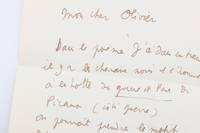
195485159Kietzbühel Kitzbühel 1954. Fine. Kietzbühel Kitzbühel 8 Février 1954 13.50 x 21 cm une page une enveloppe Autograph letter signed by Jean Cocteau addressed from the Grand Hotel Kietzbühel 16 lines in black ink to Olivier Quéant. Fold marks inherent to mailing envelope included. ""Grd Hotel Kietzbühel 8 Feb. 1954 my dear Olivier dans le poème ""J'ai dans un train"" il y a les chevaux noirs et l'homme le lotte du guerre et paix de Picasso isti guerre on pourrait prendre le motif séparé du livre qui flambe sous le pied d'un cheval noir. Il ferait une belle image. Si tu ne l'as pas demande le catalogue illustré de Rome . Eugenio Réale 3 rue Mangili Rome."" in the poem ""J'ai dans un train"" there are the black horses and the man the lotte of Picasso's guerre et paix isti guerre we could take the separate motif of the book that burns under the foot of a black horse. It would make a beautiful image. If you don't have it ask for the illustrated catalogue from Rome . Eugenio Réale 3 rue Mangili Rome. unknown
196185154Saint-Jean-Cap-Ferrat 1961. Fine. Saint-Jean-Cap-Ferrat 23 Janvier 1961 21 x 27 cm une page Autograph letter signed by Jean Cocteau on letterhead from Villa Santo-Sospir in Saint-Jean-Cap-Ferrat which he decorated 13 lines in blue ink to Roger Nimier. Fold marks inherent to mailing. ""23 Janv. 1961 Très cher Nimier voici pour accompagner le portrait dessin. Si vous le trouvez trop bref demandez chez Grasset un exemplaire de journal d'un inconnu. Dans le chapitre de l'amitié je raconte un déjeuner entre Simenon Pagnol et moi.- sans nommer personne. Mais le passage est très significatif de ce que je résume en q.q. lignes. Votre fidèle Jean. P.S. Dites moi vite si tu as reçu cette note et son P.S."" ""23 Jan. 1961 / Very dear Nimier / here is something to accompany the portrait drawing. If you find it too brief ask Grasset for a copy of Journal d'un Inconnu. In the friendship chapter I tell of a lunch between Simenon Pagnol and myself - without naming anyone. But the passage is very significant of what I summarize in a few lines. Yours faithfully Jean. P.S. Tell me quickly if you received this note and its P.S."" unknown
195885233Saint-Jean-Cap-Ferrat 1958. Fine. Saint-Jean-Cap-Ferrat 4 N ovembre 1958 13.50 x 21 cm trois pages et demi sur deux feuillets Autograph letter signed by Jean Cocteau 52 lines in blue ink to Olivier Quéant sent from the Villa Santo-Sospir in Saint Jean Cap-Ferrat which he decorated. Fold marks inherent to the mailing. Jean Cocteau waxes bucolically enthusiastic about the place where he resides and works: "". chaque jour je travaille à flanc de colline dans une sorte de ferme exquise où ne fleurisse que les grains qui tombent d'ailleurs."" "". each day I work on the hillside in a sort of exquisite farm where only the seeds that fall from elsewhere flourish."" and rhapsodizes about the local craftsmanship: "". des artisans véritables. travailler chez eux c'est le contraire de lire un journal. On aime voir ce miracle de l'équilibre entre le coeur et la main."" "". true artisans. working with them is the opposite of reading a newspaper. One loves to see this miracle of balance between heart and hand."" He informs Olivier Quéant of his upcoming exhibition: ""J'expose le 15 13 pour la première 6 rue Bonaparte. je ne te demande pas de venir voir mes oeuvres mais leur besogne ils le méritent."" ""I'm exhibiting on the 15th 13th for the opening 6 rue Bonaparte. I'm not asking you to come see my works but their labor they deserve it."" and also explains the aesthetic causes he intends to defend henceforth: "". nous menons la même croisade : celle de soutenir ces braves types qu'on dédaigne comme des aristocrates du milieu ouvrier. Le drame c'est que l'artiste qui tournait amoureusement un pied de fauteuil Louis 15 apporte la même application mais froide à forger la pièce d'une machine qui fabriquera le fauteuil."" "". we wage the same crusade: that of supporting these good fellows who are disdained as aristocrats of the working class. The tragedy is that the artist who lovingly turned a Louis XV chair leg applies the same care but cold to forging the part of a machine that will manufacture the chair."" while lamenting that artisanal traditions and know-how are sinking into oblivion: "". les jeunes refusent d'apprendre le métier par exemple des femmes de soixante ans qui firent ce prodige : ma tapisserie de Judith et Holopherne. disaient : c'est la dernière."" "". young people refuse to learn the trade for example women of sixty who performed this miracle: my tapestry of Judith and Holofernes. said: it's the last one."" He hopes to see his friend Olivier Quéant soon: ""Tu en verras une chez les Weill si tu me fais la grâce de venir et si le déluge parisien cesse et si tu ne dois pas atteindre la rue Bonaparte en arche ou gondole."" ""You'll see one at the Weills' if you do me the grace of coming and if the Parisian deluge ceases and if you don't have to reach rue Bonaparte by ark or gondola."" unknown
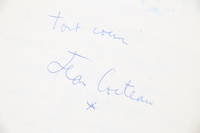
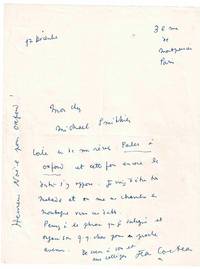
195575873Paris 1955. Fine. Paris s. d. 17 décembre 1955 20.80 x 26.80 cm une page sur un feuillet Autograph letter signed by Jean Cocteau addressed to Michael Smithies. One page written in blue ballpoint pen. Two transverse folds inherent to the mailing. Interesting letter filled with disappointment: ""Here is one of my dreams: to speak at Oxford and once again fate opposes it. I have just been very ill."" One easily understands Cocteau's state of health following the sentence very confused: ""on me me chambre la montagne vers ces dates"". ""Think of the sentence I underline and let us organize something for the near future."" The poet's dream would be fulfilled the following year; promoted to the rank of doctor of letters honoris causa by Oxford University on June 12 1956 he would deliver the Discours d'Oxford on the 14th. unknown
197962633Paris 1979. Fine. Paris 22 juin 1979 13.50 x 21 cm 2 pages sur une feuille Signed autograph letter of Jean Dutourd to Jean Rimeize written in black ink envelope attached. Date at the top of the letter and signature of Jean Dutourd at the bottom of the letter Paris address of Jean Dutourd on the envelope. Fold trace of the letter caused by mailing. The academician sends this letter to thank him for the paper his destiny wrote and which touched Jean Dutourd. This paper by Jean Rimeize comes from a conversation between the two men. Jean Dutourd writes that he will link this article as soon as he can. unknown
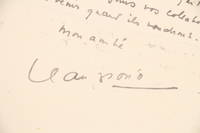
195284964s. l. 1952. Fine. s. l. ca 1952 21 x 27 cm une feuille Autograph letter signed by Jean Giono 9 lines in black ink addressed to Roger Nimier. Fold mark inherent to postal handling. ""Dear Nimier thank you for your letter; and for letting me hope for your visit. I should point out right away that I will be absent Monday 9th and Tuesday 10th. Apart from those two days your collaborators can come whenever they wish. My friendship. Jean Giono."" Very visual letter bearing the beautiful signature of Jean Giono. unknown
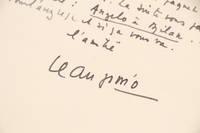
195284965s. l. 1952. Fine. s. l. ca 1952 21 x 27 cm une feuille Autograph letter signed by Jean Giono 8 lines in black ink addressed to Roger Nimier. Fold marks inherent to the mailing. ""Cher Nimier votre lettre expresse me surprend. On vous a adressé un texte par paquet recommandé il y a quelques jours. La suite vous parviendra. C'est intitulé : Angelo à Milan. Dites moi si vous l'avez reçu et si ça vous va. L'amitié. Jean Giono."" Dear Nimier your express letter surprises me. We sent you a text by registered parcel a few days ago. The continuation will reach you. It's entitled: Angelo à Milan. Tell me if you received it and if it suits you. In friendship. Jean Giono. A very visual letter bearing Jean Giono's handsome signature. unknown
194562650Paris 1945. Fine. Paris n.d. circa 1945 13.60 x 21 cm une page sur une feuille Autograph letter signed by Jean Paulhan to an author written in black ink. Date at the top of the letter signature at the bottom of the letter. NRF paper. Central fold caused by mailing. Jean Paulhan wrote this letter to thank his correspondent for his suggestion. He informs him that he has sent it to the Director of French Letters Claude Morgan. unknown
192384822Pantelleria 1923. Fine. Pantelleria 22 Juin 1923 21 x 27 cm deux pages sur un feuillet Autograph letter dated and signed by Jean-Baptiste Charcot known as Commandant Charcot on Pourquoi pas letterhead 56 lines written in blue ink on a single leaf recto-verso addressed to his friend Raymond Hovasse. Folds from mailing ink faded. Adverse weather conditions prolonged a Mediterranean cruise that was initially meant to last only four days: ""Mais comme la caractérisation de cette croisière depuis que nous avons quitté la Provence est le coup de vent qui dure trois jours puis 1 jour de calme et de nouveau 3 jours de vent nous travaillons 1 jour et tachons de nous abriter qq. part pendant les 3 mauvais. Et cela peut durer longtemps ainsi."" The explorer nevertheless found some interest in this navigation disrupted and made difficult by the weather: ""Par ailleurs notre tournée n'a pas manqué de charme l'Orient en a toujours mais ce sale temps l'a empêché probablement d'être aussi fructueuse qu'elle aurait pu l'être le temps parce qu'il va falloir songer au retour."" This voyage also gave Jean-Baptiste Charcot the opportunity to become better acquainted with his friend and his family: ""J'ai été tout particulièrement enchanté d'avoir l'honneur et le plaisir d'être présenté à votre femme et de connaître vos gosses et d'entrer ainsi un peu dans votre vie familiale j'ai été également très heureux de vous avoir pendant qq heures à bord de nouveau."" which he hoped to repeat if the sea deities remained favorable: "". si le bateau reste jeune. si tous les maîtres de la mer me permettent de continuer."" Upon his return to Paris the navigator promised to intercede on his behalf and was confident that his efforts would be rewarded: "". je serais bien étonné si je n'obtenais pas satisfaction."" unknown
1902761281902. Fine. s. d. ca 1902 11.20 x 17.80 cm 2 pages 1/2 sur un double feuillet Autograph letter signed by Job addressed to publisher H. Simonis Empis. Two and a half pages on a double sheet. Fold inherent to mailing. Interesting letter in which the illustrator proposes to the publisher to publish ""an album whose success he guarantees"": ""It concerns a small novel for children whose text would be done by Montorgueil and which would be as thrilling as possible . All the characters would be penny toys."" This refers to Liline et Frérot : au pays des joujoux which would finally be published by Boivin & Cie. unknown
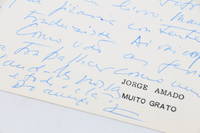
198383084Salvador de Bahia Salvador: S. n. 1983. Fine. S. n. Salvador de Bahia Salvador 6 septembre 1983 15.50 x 11 cm une feuille Bristol autograph in Brazilian and signed by Jorge Amado addressed to his friend and translator of his works into French Alice Raillard 12 lines in blue ballpoint pen. Handsome copy. S. n. unknown