Joris-Karl HUYSMANSBiblio.com
1 815 résultats
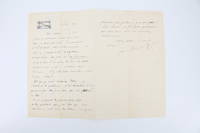
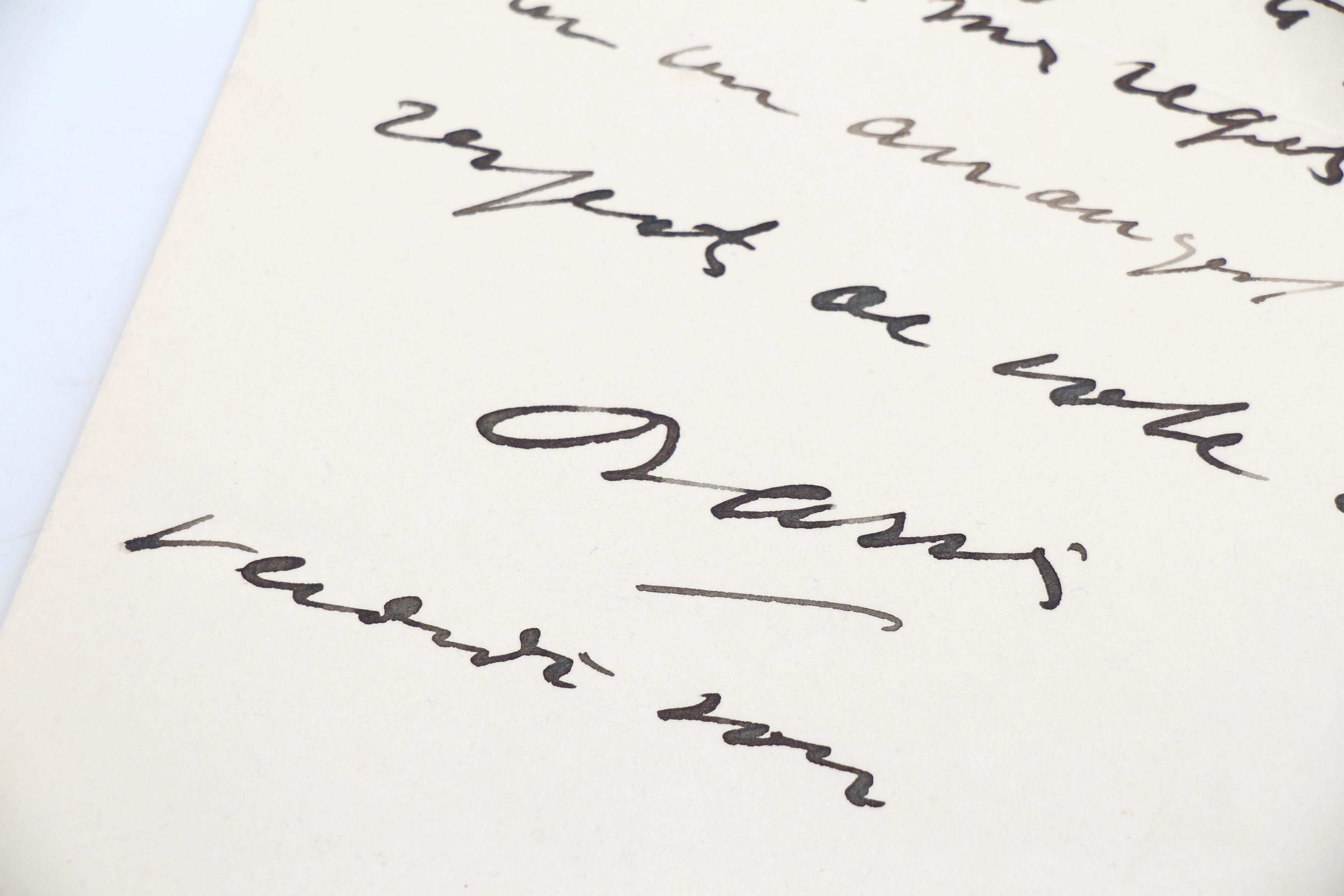
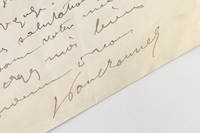
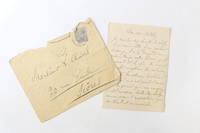
187863560s. l. Paris 1878. Fine. s. l. Paris n.d. 14 mai 1878 9.80 x 13.40 cm un feuillet remplié Autograph letter signed by Joris-Karl Huysmans addressed to Léon Cladel 40 lines written in black ink on 4 pages on a folded sheet envelope included. A 2cm tear without loss inherent to the fold of the sheet. In this caustic letter entirely imbued with Huysmanian poetic writing the author regrets that Dutch-Belgian visitors to the Universal Exhibition keep him away from the Sèvres landscapes where Léon Cladel lives. « Je sors de chez Leconte de Lisle il a reçu votre livre couleur de sang » ""I have just left Leconte de Lisle's he received your blood-colored book"". The importance of Léon Cladel's work and personality esteemed friend of the great writers of the time is perceptible from these opening lines. The « livre couleur de sang » ""blood-colored book"" witness to Huysmans' poetic force which shines through even in his private correspondence refers to l'Homme-de-la-Croix-aux-Bufs published by Edouard Dentu in 1878 a novel which was moreover reread by Flaubert also intimate with Cladel. « Je vous serre la main de tout cur mon puissant orfèvre et vous invite pour notre bonheur à tous à forger encore de belles uvres. » ""I shake your hand wholeheartedly my powerful goldsmith and invite you for all our happiness to forge more beautiful works."" Émile Zola would take up this eloquent analogy in Cladel's funeral oration: « . de ces belles uvres impeccables qu'il lançait ouvragées comme des joyaux de haut prix » "". those beautiful impeccable works he launched wrought like precious jewels"". This same year 1878 sees the Universal Exhibition settle in Paris an event which Huysmans seems compelled to attend: « c'est l'invasion hollando-belge venue pour l'exposition qui me tient et m'empêche » ""it is the Dutch-Belgian invasion come for the exhibition that holds me and prevents me"". The author's position regarding Belgium and Holland is ambiguous: Dutch through his father Huysmans makes numerous family and artistic visits to these countries and he is recognized there for his critical writings on painting. The author nevertheless prefigures here the disdain that would be found in À rebours a few years later: « Je cours à la recherche de chambres d'hôtels pour ces barbares aux toisons jaunes et le soir quand j'ai une minute de libre je les fais déambuler au travers de la capitale. Ils ouvrent des yeux comme des assiettes et jargonnent des exclamations admiratives. » ""I run in search of hotel rooms for these barbarians with yellow fleeces and in the evening when I have a free minute I make them wander through the capital. They open eyes like plates and jabber admiring exclamations."". Suffocated by the city and its society « Tout ça ça peut être drôle mais ça m'obsède singulièrement. J'espère que ça va enfin cesser et que je vais reconquérir un peu de cette pauvre liberté dont je suis si maigrement loti même en temps ordinaire » ""All that can be amusing but it obsesses me singularly. I hope it will finally cease and that I will reconquer a bit of that poor freedom of which I am so meagerly provided even in ordinary times"" Huysmans aspires to find nature again a desire which expresses itself through an elegiac exclamation: « Ah les coteaux de Sèvres ! Pardon ! » ""Ah the hills of Sèvres! Forgive me!"" A piquant letter from which emerge the themes dear to Huysmans' singular pen. unknown
190079398Chaumot Nièvre Chaumot 1900. Fine. Chaumot Nièvre Chaumot 4 juin 1900 13.80 x 21.30 cm une feuille Autograph letter signed by Jules Renard addressed to Gabrielle Réval. One and a half pages written in black ink on letterhead paper from ""Gloriette"" the writer's residence in Nièvre. Transverse fold lines inherent to mailing. Fine letter to this fellow writer alluding to Poil de Carotte: ""Je suis au moins aussi content que vous. Certes je n'avais pas oublié le manuscrit où Poil de Carotte était si bien compris - et aimé - j'avais oublié la signature."" ""I am at least as pleased as you are. Certainly I had not forgotten the manuscript where Poil de Carotte was so well understood - and loved - I had forgotten the signature."" He mentions Gabrielle Réval's book: ""Et tant mieux ; car j'ai lu les Sèvriennes et non le livre d'une amie de Poil de Carotte. L'auteur seul a plu le lecteur seul a été touché. Il y a de belles réussites vous le voyez madame."" ""So much the better; for I read the Sèvriennes and not the book of a friend of Poil de Carotte. The author alone pleased the reader alone was moved. There are beautiful successes you see madam."" Jules Renard already enjoyed considerable success at this time: ""Il me répugnerait de jour au vieux maître sachez pourtant que j'ai déjà reçu bien des livres écrit bien des lettres en quelle proportion par politesse je ne sais plus mais aucune ne fut plus spontanée que celle dont vous me remerciez aimablement."" ""It would repel me to play the old master know however that I have already received many books written many letters in what proportion out of politeness I no longer know but none was more spontaneous than the one for which you thank me kindly."" The highly laudatory letter alluded to here is preserved at the Jean Jaurès Media Library in Nevers and was written by Renard a few days before ours: ""Ce n'est pas l'auteur des Sévriennes que je remercie c'est vous. C'est grâce à vous que j'ai lu par cette froide fin de mai entre la première rose de mon jardin et les dernières flammes de ma cheminée un beau Livre."" ""It is not the author of the Sévriennes that I thank it is you. It is thanks to you that I read during this cold end of May between the first rose of my garden and the last flames of my fireplace a beautiful Book."" Gabrielle Réval was one of the co-founders of the Prix de la Vie heureuse which would later become the Prix Femina. unknown
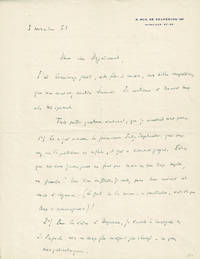
195175101Paris 1951. Fine. Paris 3 novembre 1951 21 x 27.10 cm 2 pages sur un feuillet Autograph letter signed by Jules Romains to André Dignimont two pages penned in black ink on a sheet of his personal letterhead. Folding marks from mailing. An engaging letter in which Jules Romains corresponds with the painter Dignimont about the forthcoming illustrated edition of his sweeping novel cycle Hommes de bonne volonté: ""J'ai beaucoup pensé cette fois-ci encore aux belles compositions que vous nous avez montrées samedi. Je continue à trouver tout cela très important."" Romains' remarks are revealing as they highlight the divergence between how he envisioned his characters and how his friend interpreted them: ""Est-ce que nos deux jeunes gens ne font pas encore un peu trop rupin. . Je verrais de Marquis de St Papoul avec un visage plus maigre et plus allongé un peu donquichottesque."" He concludes with an apology for his demands: ""Hélas ! Je suis embêtant. Mais j'aime tellement vos compositions que je me permets d'y rêver comme si je les avais faites moi-même."" The illustrated edition would be published in 1954 by Flammarion marking the sole collaboration between the Académie Française member and the Montmartre painter. unknown
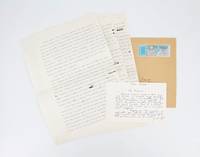
198583170Paris 1985. Fine. Paris 24 octobre 1985 14.50 x 10.50 cm quatre feuilles une enveloppe Autograph letter signed on a Bristol card by Julien Gracq 15 lines in black ink addressed to journalist Jean-Claude Lamy regarding the text of an article for which he gives his approval and an album of photographs concerning another writer. Apart from a few modifications he intends to make notably on the fact of not being photographed even by Robert Doisneau he authorizes the publication of this interview. We include the envelope addressed by Julien Gracq from his Parisian home. We also include the text of three pages of the article with corrections and crossings-out by Jean-Claude Lamy and four modifications and corrections in Julien Gracq's hand. A few letters have smudged without consequence a handsome copy. ""Paris 24 octobre Cher monsieur. Merci de m'avoir soumis le texte que je vous retourne : il correspond en gros aux propos tenus et je ne vois à vous soumettre que deux ou trois formulations un peu différentes. Je regarde avec plaisir les photos de l'album que vous l'aimable pensée de m'adresser : il s'agit là d'un écrivain qui ne m'a jamais laissé indifférent. Rappelez vous notre conversation : une seule photo pour illustrer votre texte j'aurais préféré"" aucune ! malgré le talent très grand de Robert Doisneau Avec mon bon souvenir. J. Gracq."" ""Paris 24 October Dear sir. Thank you for submitting the text which I return to you: it corresponds roughly to the remarks made and I see only two or three slightly different formulations to submit to you. I look with pleasure at the photos in the album which you had the kind thought to send me: this concerns a writer who has never left me indifferent. Remember our conversation: only one photo to illustrate your text I would have preferred none! despite Robert Doisneau's very great talent With my kind regards. J. Gracq."" unknown
192386631Le Clos-Marie Roscoff Roscoff 1923. Fine. Le Clos-Marie Roscoff Roscoff 2 Septembre 1923 20.50 x 27 cm 1 page recto verso Autograph letter dated from Liane de Pougy to the French archaeologist curator of the Musée de Saint-Germain and professor of art history at the École du Louvre Salomon Reinach 56 lines written in blue ink on one double-sided sheet written from her property at Clos-Marie in Roscoff where the famous courtesan stayed until 1926. A small tear in the right-hand margin of the letter inherent in the enveloping of the missive; another slight tear at the foot without affecting the text. Liane de Pougy marvels at the youthful vigor of Reinach who had just turned 65: ' Many happy returns for your 65 years which find you so young so fresh so green with such playful studious feelings. My friend your youthful morals hold the secret of your physical youth—as Rosa Josepha said one sustains the other one preserves the other—and this seen head-on. ' while magnifying his radiant intelligence: 'To no longer produce but to sit atop the high throne of your trophies formed by all you have wrested from instinct to sacrifice to intellectuality. Why do people always say a well of knowledge instead of a luminous column a sky a sun a star etc.—in short something that makes us lift our heads' She is waiting for her friend and former lover the terrible and unfaithful Natalie Clifford-Barney:  'Natalie plans to come to Clos at the end of September. She has a wound to heal here—time fortunately has already done part of the work! I have sensitive feelings and like a musketeer a good heart but a bad temper. This is the 1st time the amazon has truly aimed at me. Let us speak of it no more'. Liane firmly expresses her wish not to be pitied or consoled for her romantic troubles:  'I have suffered in silence but without resignation. Do not speak of this to Nathanaël. Nathanaël means Philippe Max Jacob claims who lives and works near us in the most fascinating way. '. A beautiful letter by the celebrated courtesan actress and writer Liane de Pougy recounting with restrained candor her romantic disappointments with Natalie Clifford-Barney.  unknown
191475566Grandcamp-les-Bains Grandcamp-Maisy 1914. Fine. Grandcamp-les-Bains Grandcamp-Maisy s. d. ca 1914-1920 13.50 x 21 cm une page sur un feuillet remplié Autograph letter signed addressed to a correspondent whom we have not been able to identify. Written from the Grand Hôtel de Grandcamp-les-Bains Calvados in blue ink on a folded sheet of white paper. A transverse fold inherent to the posting of the letter and four small perforations affecting the text but not impeding its reading. The mention of Grandcamp-les-Bains - where Aragon seems to have been only once during the summer of his seventeenth year - and the signature - of an early form - lead us to think that the letter could have been written in the summer of 1914. Philippe Forest in his biography of Aragon confirms that it was indeed at Grandcamp-les-Bains where his family had rented fifty rooms in a large seaside hotel to accommodate family and friends that the future poet learned the news of mobilization. The handwriting less rounded than on manuscripts prior to the 1920s however seems to us later and we are therefore not in a position to confirm the date of 1914. unknown
197862584Lyon 1978. Fine. Lyon 5 Mars 1978 21 x 27 cm 2 pages sur un feuillet Letter autograph dated March 5 1978 signed by Louis Calaferte two pages to an unidentified bookseller friend 33 lines in black ink written from Lyon. Usual traces of minor folds of a letter slipped into an envelope. In his missive full of solicitude esteem and respect for the work of writing of his unfortunate correspondent who wishes to publish his manuscript Louis Calaferte apologizes first of all for the delay independent of his will taken for to answer him: ""I waited waited waited - always hoping to be able to bring you a happy news concerning the possible edition of your work of bookstore"" to then confess to him and to criticize ""a certain immobilism at those people who do not take anymore no risk of editing and are more fond of imbecility of the genre ""best-seller"" than books relating to a certain erudition "" . Louis Calaferte unsuccessful intermediary between this writer and the world of Parisian publishers is ""sorry because in my opinion it seems to me that an edition of this type would have been necessary."" He proposes during his next visit to Paris to hand him the manuscript which he has unsuccessfully proposed to the publishing houses and which he calls ""your notebook"" or to bring it to him in his bookstore more later. Enffin Louis Calaferte symbolically concludes his letter with a ""sorry for this failure I beg you to believe in my esteem"". unknown
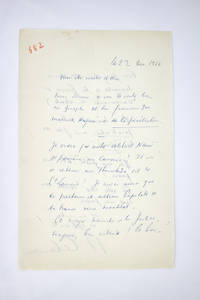
195075962s. l. Klarskovgaard 1950. Fine. s. l. Klarskovgaard 22 octobre 1950 21 x 34 cm 2 pages sur un feuillet Signed autograph letter partly unpublished by Louis-Ferdinand Céline addressed to his lawyer Maître Thorvald Mikkelsen. Two pages written in blue ink on a large sheet of white paper; number ""582"" in Céline's hand in red pencil at top left. Cross-folds inherent to mailing. This letter was very partially transcribed in Année Céline 2005. Fine letter mentioning Marcel Aymé: ""We will say if you please in simple and good French that Marcel Aymé has: penetration. . And if Marcel has penetration I have vision."" We will not revisit the friendship that united Céline and Aymé - the latter even visited him at Klarskovgaard in March 1951 - but we will content ourselves with quoting a passage from the text that the Montmartre writer composed in homage to his sulphurous friend: ""I knew him twenty-five years ago before the war when he was celebrated everywhere admired - but rarely understood - and after his return from Denmark during the nine years of suffering that led him to death. Before as after the storm his conversation revealed the idealist whose sarcasms denounced the hundred thousand miseries of a cruel vain bulimic humanity bent on its own destruction. 'Before' his indictments against man's murderous and suicidal follies against the injustices and snares of society had the joyful force of a fighter bursting forth with inexhaustible verbal invention that amazed his listeners."" Ecrits sur la politique 1933-1967 Céline also speaks in this letter of Albert Naud his lawyer between 1947 and 1951 who ""is strolling in Canada"" and ""is going to get himself a Thénardière on the St Lawrence"". This is followed by a very Célinian consideration: ""I also believe that the next and ultimate Capital of France will be Montreal."" The Danish exile then fantasizes about a world government to be established: ""And René Meyer sic minister of Justice always of course! over there! You will then yourself be minister of War in Denmark in retirement."" In 1947 Céline pursued by French justice for his collaborationist commitment is confined in Denmark. It is in May 1948 accompanied by Lucette and Bébert that he arrives at his lawyer Maître Thorvald Mikkelsen's home at Klarskovgaard. The latter owns a large property by the Baltic Sea and invites the exile to stay there. On February 21 1950 as part of the purge the writer is definitively condemned in absentia by the civic chamber of the Paris Court of Justice for collaboration to one year's imprisonment which he had already served in Denmark. The consul general of Sweden in Paris Raoul Nordling intervenes on his behalf with Gustav Rasmussen Danish minister of Foreign Affairs and manages to delay his extradition. On April 20 1951 Jean-Louis Tixier-Vignancour his lawyer since 1948 obtains Céline's amnesty under the title of ""grand invalide de la grande guerre"" by presenting his file under the name Louis-Ferdinand Destouches without any magistrate making the connection. Céline will leave Denmark the following summer after three years spent at his lawyer's home. unknown
193463409Paris 1934. Fine. Paris 3 mai 1934 21 x 27 cm 2 pages sur un feuillet une enveloppe jointe Autograph letter signed ""LF Destouches"" addressed to the journalist Léon Deffoux. 24 lines written in black ink several underlines and erasures of Celine's hand. Envelope attached. Folds inherent to the enveloping of the mail as well as some very tiny pinholes in the right margin of the leaflet. unknown
194763242s. l. Copenhague Copenhagen 1947. Fine. s. l. Copenhague Copenhagen 23 avril 1947 22.50 x 28.40 cm 6 pp. in-folio Signed autograph letter of Céline to Henri Mahé and his wife dated April 23 1947 in Copenhagen lines in black ink on three sheets of lined paper. unknown
194764327Copenhage Copenhagen 1947. Fine. Copenhage Copenhagen 10 avril 1947 22.50 x 28.40 cm 6 pages sur 3 feuillets Very long autograph letter signed ""Dest"" to Doctor Tuset and Henri Mahé dated April 10 unknown
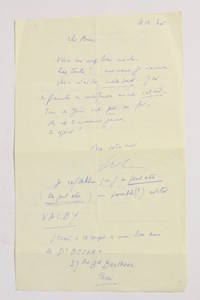
194962588Korsør Danemark Korsør 1949. Fine. Korsør Danemark Korsør 12 Novembre 1949 21 x 34 cm deux pages sur un feuillet Letter autograph signed by Louis-Ferdinand Céline two pages envelope attached to Charles Deshayes 25 lines in blue ink dated November 12 1949 and written since his Danish exile Korsor. Traces of central folds inherent to a letter slipped into an envelope that we enclose to the letter. Louis-Ferdinand Céline begins his letter in the grip of doubts and insults: ""It's a very ugly shot what to try I can not avoid myself nowhere I have complaints of counterfeiting That's all all these people are basically afraid they'll never admit it. Then in postscript he thinks that he may have found a publisher ""very possibly"" a possible Publisher Valby and that he will pass through a Parisian friend for the contact ""I write about it to my good friend Dr. Becart"" and recommend to his correspondent to also write to him. He continues his letter by evoking concerns of writing: ""I changed your title.By the love of God leave the night quiet! And surtoutr the end! It is a nightmare"" and ends with a scathing paranoid and all Céline remarks : ""The Celine affair seems to me the best like the Dreyfus Affair"" unknown
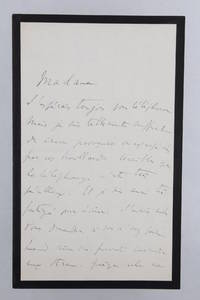
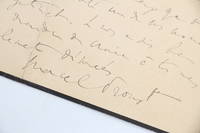
190783638s. l. 1907. Fine. ""New Year's Day is just an occasion for me -- as if occasions were needed! -- to reminisce and weep"" s. l. s. d. ca 1907 12.60 x 20.40 cm 3 pages sur un double feuillet Autograph letter signed to Madame Catusse 126x204cm 3 pages on a double leaf. Autograph letter signed by Marcel Proust probably addressed to Madame Catusse. The recipient and date have been determined by Proust scholar Jean-Yves Tadié. Three pages in black ink on a double leaf edged in black. A fold inherent to the mailing. A sombre and admirable letter steeped in Proustian melancholy. The future author of In Search of Lost Time feels more than ever the loss of his mother during the New Year period. The famously generous Proust also asks his faithful confidante Madame Catusse to buy a gift for the Straus couple whose wife inspired the character of the Comtesse de Guermantes. The end of 1907 apparent date of this letter alluding to the approaching New Year marks the second holiday season spent without Madame Proust who had died two years earlier: ""New Year's Day is only an occasion for me - as if occasions were needed! -- to reminisce and weep"". Proust had also expressed this sentiment in a letter to Anna de Noailles the year before ""New Year's Day had a terrible evocative power over me. It suddenly gave me back the memories of Maman that I had lost the memory of her voice"" February 1906. This fateful moment acted on Proust like a pernicious madeleine at once a sensory reminiscence and an acute awareness of his loss. He would soon begin writing In Search of Lost Time to conjure up this mother figure whose absence would remain unbearable. For the time being Proust is busy writing a series of Pastiches for Le Figaro ""which were in reality only a penultimate detour before writing La Recherche"" George D. Painter. One of these Pastiches dealt with the swindle perpetrated on the president of De Beers in which Proust had invested. Imagining himself already ruined he mentions these unfortunate circumstances in capital letters: ""HAVE I REPORTED MY FINANCIAL DESASTERS TO YOU OVER THE TELEPHONE ."" Overwhelmed by ailments he is also plagued by one of his many asthma attacks ""provoked or exasperated by these terrible fogs"" forcing him into reclusion and even silence: ""telephoning is very dangerous for me. And I'm also very tired when it comes to writing"". The recipient Mme Catusse was a friend of Proust's mother and became an invaluable support to the writer. Proust's prolific correspondence with the woman Ghislain de Diesbach had dubbed the writer's Notre-Dame-des-Corvées represents an inexhaustible resource of insights into his secret life and fears. Proust had called her in a panic during an aphasia attack suffered by his mother shortly before her death. As he became increasingly isolated after moving into 102 boulevard Haussmann the previous year Proust sought her help in many matters including the purchase of numerous gifts: ""I would have liked to ask you if you had by any chance seen anything suitable for the Straus although I always dislike coinciding with New Year's Day"". This sentiment would inspire a passage in The Captive castigating those same ""New Year's Day presents"" given to Madame Verdurin: ""those singular and superfluous objects which still appear to have been just taken from the box in which they were offered and remain for ever what they were at first"" The Captive C.K. Scott Moncrieff's Translation Edited and Annotated by William C. Carter Yale University Press 2023 p. 308. Known for his frenzied displays of prodigality Proust overcomes his aversion to these occasional gifts. The smallest favor to the writer gave rise to extravagant expenses. Lawyer Emile Straus had probably helped the writer sort out his inheritance affairs: ""I FEEL THAT THE NUMEROUS SERVICES PROVIDED TO ME BY MR. STRAUS CANNOT REMAIN WITHOUT THANKS since I believe he would not accept a fee. If you happened to have seen something very unknown
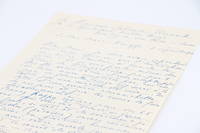
190886094s. l. 1908. Fine. Proust and the future of pastiche: ""it seems to me that it could perhaps become a more discreet more fragile and more elegant form of literary criticism"" s. l. s. d. 1908 ou 1919 11.60 x 17.80 cm 4 pages sur un feuillet remplié Autograph letter signed by Marcel Proust to his friend Maurice de Fleury a psychiatrist and famed man of letters close to Émile Zola who wrote a collection of short stories as well as various medical works on neurasthenia insomnia epilepsy Chiara Carraro Philip Kolb. Four pages written in black on a bifolium with ""Island Mill"" watermark and framed in black. Usual traces of folds. Published in Kolb VIII no. 32 p. 74-75. Superb letter extolling the merits of literary pastiche by one of the greatest writers of the genre: Marcel Proust. The writing of this letter may coincide with the publication of Proust's series of pastiches on the Lemoine Affair a scam set up by a French engineer of that name who claimed to be able to make genuine diamonds. The articles were printed on the front page of the literary supplement of 'Le Figaro' between 1908 and 1909 or date from its publication in volume under the title 'Pastiches et mélanges' in 1919. The autograph letter is presented in a midnight blue half morocco chemise with marbled paper boards beige suede lined pastedowns and a slipcase edged with the same morocco. Proust warmly thanks his correspondent Maurice de Fleury whom he describes as a ""scholar and writer"" for his favorable reception of his ""little pastiches"": ""Your double merit should make you doubly severe: and you excuse pastiche that inferior genre!"" Votre double mérite devrait vous rendre doublement sévère : et vous excusez le pastiche ce genre inférieur ! acknowledging with irony the still precarious place of this unusual genre although popular during Proust's lifetime. Pastiche was perceived more as a stylistic musing or even a student exercise than a true creation worthy of literary praise. Yet here the writer considers it here a refreshing addition to the strict hierarchy of genres that still prevailed: ""Handled however by your hands more beautiful than mine it seems to me that it could perhaps become a more discreet more fragile and more elegant form of literary criticism. Very proud minds could devote themselves to it and very fine minds like yours very attached to greatness seriousness duty as wise could take pleasure in it and follow these games."" Manié pourtant par vos mains plus belles que les miennes il me semble qu'il pourrait peut-être devenir comme une forme indirecte plus discrète plus frêle et plus élégante de critique littéraire. Des esprits très fiers pourraient s'y adonner et des esprits très fins. comme le vôtre très attraché par la grandeur le sérieux le devoir aussi sage pourrait s'y plaire suivre ces jeux. With these words Proust asserts the interest of 'critical pastiche' which was already well established and acted as an empirical analysis of an author's style. Since his years as a student in Condorcet the writer had regularly indulged in this activity with according to him varying degrees of success: ""I have also sometimes made pastiches of medical literature! these writings are now lost If I could have found them again or started them again but all that is too far away I would have published them if I had known that you read this for fun. I don't need to tell you that considered inimitable you are not among the authors I pastiched. But . others are less perfect and combined some very interesting qualities with small flaws that could be imitated and caricatured."" J'ai été aussi quelques fois à faire des pastiches de littérature médicale ! Si j'avais pu les retrouver ou les recommencer mais tout cela est trop loin je les aurais publiés si j'avais su que vous lisiez cela pour vous amuser. Je n'ai pas besoin de vous dire que jugé inimitable vous n'y figurez pas. Mais . d'autres sont moins parf hardcover
189085069s. l.: S. n. 1890. Fine. S. n. s. l. s. d. ca 1890 11.50 x 17.50 cm un feuillet Autograph letter signed by Maurice Barrès on Chamber of Deputies letterhead 11 lines in black ink. Fold marks from original mailing. ""Madame et amie à la suite de la réunion j'ai compris qu'on vous y avait pas fait place. C'est strictemetn régulier. Mais c'est absolument peu courtois et par là bien injuste. Je vous exprime mes regrets et vais chercher un arrangement. Respect de votre ami Barrès. Vendredi soir"" Madam and friend / Following the meeting I understood that no place was made for you there. This is strictly regular. But it is absolutely discourteous and thereby quite unjust. I express my regrets and will seek an arrangement. Respectfully your friend Barrès. Friday evening S. n. unknown
190583471s. l.: S. n. 1905. Fine. S. n. s. l. s. d. 1905 13.50 x 21.50 cm un feuillet recto-verso Autograph letter signed by Maurice Barrès addressed to Madame Léon Daudet 39 lines in black ink on a four-page folio. Fold marks inherent to postal mailing. ""Chère madame J'avais espéré voir Léon et peut-être aussi vous-même en Provence et ce que je rêve vous faire connaître ce beau site de Mirabeau. Du moins j'y ai votre conversation écrite si claire rapide souple intéressante ces pages pas fabriquées mais jaillissantes et si aimables ! Je vois que je ne vous déplairais en vous disant que je vous apparente à celle de madame Millet. Robinel que j'ai tant lue quand j'étais enfant parce qu'elle était un des livres de notre maison et que je vous tiens pour sa cousine mais une dame de Paris auprès d'une importante fermière et puis aussi mais cette fois je vous choquerai. Je vous rapproche des livres de Michelet dont la ""mare-polémiste"" sait bien les élans et le goût. Au milieu de ses foules il a bien marqué comment l'homme d'action a besoin de la campagne française. Nul doute que vous n'ayez guère le petit malade mais comment vous a-t-il surpris si brusquement et réduit à une intervention chirurgicale dans les deux heures vous qui surveillez et qui défiez dans vos flots d'eau chaude et savonneuse les microbes farouches Excusez moi cette taquinerie que je regrettais bien profondément si je ne pensais si je n'étais pas sûr que vous êtes hors de souci. Au revoir chère madame amitiés de ma femme pour vous et pour Léon et bien respectueusement vôtre Barrès. Mirabeau jeudi."" ""Dear Madam I had hoped to see Léon and perhaps you as well in Provence and what I dream of to introduce you to that beautiful site of Mirabeau. At least I have your written conversation there so clear rapid supple interesting these pages not manufactured but springing forth and so amiable! I see that I would not displease you in saying that I relate you to that of Madame Millet. Robinel whom I read so much when I was a child because it was one of the books of our house and whom I consider you her cousin but a Parisian lady beside an important farmer's wife and then also but this time I will shock you. I bring you close to Michelet's books whose ""mare-polemicist"" well knows the impulses and taste. In the midst of his crowds he clearly marked how the man of action needs the French countryside. No doubt that you hardly have the little patient but how did he surprise you so suddenly and reduce you to surgical intervention within two hours you who monitor and defy in your streams of hot soapy water the fierce microbes Excuse me this teasing that I would deeply regret if I did not think if I were not sure that you are beyond worry. Goodbye dear madam regards from my wife to you and to Léon and most respectfully yours Barrès. Mirabeau Thursday."" S. n. unknown
190586168s. l. 1905. Fine. s. l. s. d. ca 1905 11.50 x 18 cm 5 pages sur un double feuillet Autograph letter signed by Maurice Leblanc to a friend from Rouen named Louis asking him to perform several services as he lacks the time to handle them himself. Maurice Leblanc entrusts his friend with two commissions: first to collect some furniture reserved by one of his friends at an antique dealer's: ""Go to a man named Chassaigne antique dealer 20 rue St Romain.He sold 6 chairs to the Prats two months ago. . apparently he refused to accept a deposit. No response. Let him say frankly that he has sold everything. The bench was for me 40 francs and I would very much like to have it."" the second concerning an administrative matter: ""Go to the registry of the civil court. and request an extract of my birth certificate and an extract of my parents' death certificates. It's for a marriage."" unknown
186964422Paris 1869. Fine. Paris 16 janvier 1869 13.50 x 20.50 cm un feuillet remplié Letter autograph signed Maxime Du Camp dated January 16 1869 23 lines in black ink on blue paper handwritten address of the sender at the head of the sheet. Letter of request for recommendation that Maxim Du Camp addresses very courteously to his interlocutor who seems to have rescued him in the past. unknown
1974657191974. Fine. février 1974 18.60 x 27 cm une feuille enveloppe jointe Letter autograph signed by Michel Butor to Georges Raillard dated February 1974. 55 lines written in black pen on a sheet. Envelope attached. Michel Butor speaks from Albuquerque New Mexico to Georges Raillard literary critic and specialist of Spanish painters Antoni Tapies and Joan Miro. unknown
1797761731797. Fine. An exceedingly rare letter from Restif: « Les événemens du 18 fructidor' m'ont rendu la vie . en affligeant mon cur » 30 fructidor 1797 An V 16 septembre 1897 18.50 x 21.30 cm 3 pages sur un double feuillet Extremely rare autograph letter signed « Restif Labretone » addressed to Citoyenne Fontaine. Three pages written in black ink on a double sheet of laid paper. Remains of a wax seal folds inherent to mailing. This letter was published with some inaccuracies in Lettres inédites de Restif de Labretone by V. Forest and É. Grimaud 1883. The Fontaine couple are merchants from Grenoble and Restif de la Bretonne began corresponding with them on March 15 1797. Important letter testifying to the completion of the publication of Restif's great autobiographical work: Monsieur Nicolas ou les Ressorts du Cur Humain dévoilé. « I will have completed the Cur humain Dévoilé within 15 days I will prepare your package immediately to have it ready. » The first eight volumes of this great autobiographical work printed by Restif himself a typesetter by trade in his residence at 11 rue de la Bûcherie were entrusted to the « dishonest » bookseller Nicolas Bonneville who did not honor his debts to the writer. Besides health issues « I exchange my illnesses and do not cure them » Restif also shares with his correspondent his literary setbacks: « The Author of Nature will preserve a sincere friend for me to compensate for the scoundrels of the Institute and the perfidious Mercier ». Indeed the previous year the author learned with bitterness that he was not admitted to the National Institute and Louis-Sébastien Mercier who had praised him in his Tableau de Paris and supported his candidacy then turned away from him. To this sum of misfortunes financial difficulties are added. Penniless and living on meager state pensions he maintains all his support for the Republic: « By what fatality do I never see the views of the rulers who welcome me; or how do they not see at once that I am attached to the Revolution to the point that I still love it even when it beats me. » Restif profoundly anti-royalist wrote several pamphlets to this effect and had just added to the end of Monsieur Nicolas an apology for the coup d'état of 18 Fructidor Year V. However this date marks the end of the allowance granted to him by Lazare Carnot after his failure at the Institute: « You know the events of 18 Fructidor; I will not speak to you about them. They have given me back my life; but by afflicting both my heart and my gratitude. » But Restif's great sorrow is the loss of his daughter Filette born from his adventure with Louise Allan whose paternity was revealed to him only late: « I am writing to you from bed weeping over my Filette who died 11 months and ten days ago . Filette was my daughter and Louise's whose soul and beauty she had. » Autograph letters signed by Restif de La Bretonne that have survived to this day are extremely rare. unknown
191064371Paris 1910. Fine. Paris 1910 13.50 x 21.50 cm un feuillet remplié Autograph letter signed by Paul Mounet probably addressed to an actress 30 lines in black ink on laid paper with the address of the coffee Regency in mind. Folds inherent to the enveloping. The missive deals with the details of a forthcoming theatrical production that Mounet then comedian at the Comédie-Française insists with insistence to his interlocutor: "" I must have permission - to play outside the French"" unknown
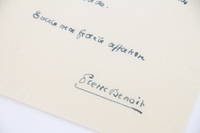
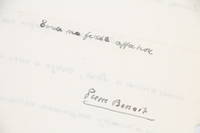
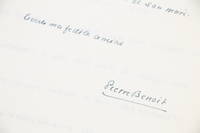
196184910Saïgon Hu Ngha 1961. Fine. Saïgon Hu Ngha 28 Février 1961 13.50 x 21 cm deux pages sur un double feuillet Autograph letter signed by Pierre Benoit on Messageries Maritimes letterhead 21 lines in black ink on tracing paper regarding his cruise in the Orient. Central fold marks perforations due to filing in a binder having caused the absence of the first letter of Paris on the fourth line of the letter. Pierre Benoit rejoices in his Oriental journey and the welcome he received; stopping in Saigon he prepares to sail toward Japan: ""ce qui nous assure là-bas un programme tout à fait au point."" ""which ensures us a perfectly organized program there"" unknown
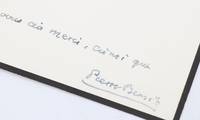
196184909Ciboure 1961. Fine. Ciboure 28 Février 1961 13.50 x 20 cm une page Autograph letter signed by Pierre Benoit on letterhead from his property in Ciboure 14 lines in black ink. Central fold marks perforations due to filing in a binder having caused the absence of the first letter of Paris on the fourth line of the letter. Pierre Benoit recalls the recent passing of his wife Marcelle died on May 28 1960: ""Il y a neuf mois aujourd'hui que la pauvre Marcelle s'en est allée"" ""It has been nine months today since poor Marcelle passed away"" and hopes to meet his friend during his next visit to Paris in March. unknown
195285013Ciboure 1952. Fine. Ciboure 27 Octobre 1952 21 x 27 cm une page Autograph letter signed by Pierre Benoit from his property in Ciboure 19 lines in black ink. Central fold marks perforations due to filing in a binder having caused no loss. Pierre Benoit then at his Basque property in Ciboure: ""petit stage nécessaire avant le retour à Paris triage et mise en ordre de la correspondance."" brief stay necessary before returning to Paris sorting and organizing correspondence. discusses the reasons and interest of their upcoming meeting in Paris: "". le retour d'un tel voyage doit s'accompagner d'un certain nombre de ces conseils dans lesquels vous êtes passé maître."" . the return from such a journey must be accompanied by a certain number of those pieces of advice at which you have become a master. in order to share their latest travel memories: ""des impressions que je suppose toutes choses qui nécessitent quelques bons instants de tête en tête entre vous et moi."" impressions I suppose all things that require some good moments of private conversation between you and me. unknown
195085079Ciboure 1950. Fine. Ciboure 26 Septembre 1950 21 x 27 cm une page Autograph letter signed by Pierre Benoit from his property in Ciboure 21 lines in black ink. Traces of central folds perforations due to filing in a binder causing no loss one scissors cut in left margin of the letter. ""26 septembre. Mon cher ami à peine le facteur venait-il de tourner les talons emportant la lettre que je venais d'achever pour vous qu'un coup de téléphone de notre ami commun me mettait en demeure de vous en écrire une seconde ! Alors c'est donc vrai c'est vous qui assurez la charge de collaborer avec mon éditeur et le directeur du cabinet de Giaccobi pour régler la petite fête du 4 Novembre Je vous en remercie d'autant plus que ne devant revenir à Paris que le 28 Octobre je ne puis pas vous être d'un grand appui. Par le même courrier je préviens mon éditeur Robert Esmenard owner of Albin Michel publishing house . . Esmenard est habitué de ce genre de manifestation car il donne des réceptions de ce genre pour fêter d'illustres auteurs étrangers. Il a donc des listes et une formule d'invitation.Le tout sera de panacher ces listes avec la liste corse de Giaccobi. Et de mon côté je vous demande de veiller à ce que Messagenès Fabre Transat sans oublier bien entendu le C.T.O. soit à l'honneur. Enfin je suis assuré ainsi d'avoir une occasion pas trop éloignée de revoir Madame Louis Brun et son mari. Toute ma fidèle amitié Pierre Benoit."" September 26. My dear friend hardly had the postman turned on his heels carrying off the letter I had just finished for you when a telephone call from our mutual friend put me under obligation to write you a second one! So is it really true Is it you who is taking charge of collaborating with my publisher and the director of Giaccobi's office to arrange the little celebration of November 4th I thank you all the more since not having to return to Paris until October 28th I cannot be of great assistance to you. By the same post I am notifying my publisher Robert Esmenard. . Esmenard is accustomed to this kind of event as he gives receptions of this sort to celebrate illustrious foreign authors. He therefore has lists and an invitation formula. The whole thing will be to blend these lists with Giaccobi's Corsican list. And for my part I ask you to see that Messagenès Fabre Transat without forgetting of course the C.T.O. are honored. Finally I am thus assured of having an opportunity not too distant to see Madame Louis Brun and her husband again. All my faithful friendship Pierre Benoit. unknown