Pierre BENOITBiblio.com

1 815 résultats
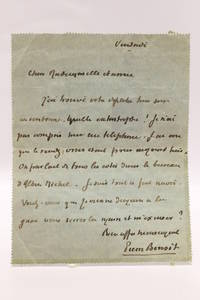
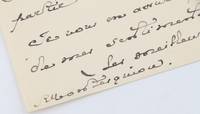
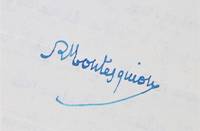
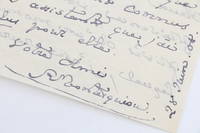
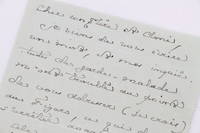
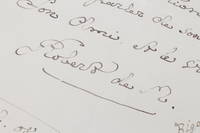
192562583Saint-Céré Lot Saint-Céré 1925. Fine. Saint-Céré Lot Saint-Céré s. d. Après 1925 21 x 26.50 cm 1 page sur un feuillet Letter autograph signed by Pierre Benoit a page to an unidentified friend 8 lines in black ink without date and written since Saint-Céré in the Lot. Two small tears on the margins of the sheet and without any damage to the text three spots in the foot and at the top of the sheet always without any damage to the text. Traces of creases. In this letter written from his famous room No. 2 which he occupies at the hotel of Saint-Céré since 1925 and in which he retrenched to write and ""work hard"" Pierre Benoit informs his correspondent of his geographical error concerning Saint-Céré the latter having confused Lot-et-Garonne and Lot during his previous missive. He also tells him his next return to Paris and asks if she will be there too. Finally Pierre Benoit suggests to him to send a word to The Moignée ""to tell him that I blame him to death he will understand"" and also that it gives him quickly of his news. unknown
194062642Paris 1940. Fine. Paris décembre 1940 11 x 14.40 cm une page sur une feuille Signed autograph letter from Pierre Benoit to Nadia Charlane written in black ink. This mail is a ""little blue"" paper provided by the post office that allowed mailings by pneumatic tubes in Paris these couriers were then delivered by couriers. Parisian address of Nadia Charlane on the back signature at the bottom of the letter day at the top of the letter. Pierre Benoît writes this letter to the actress following a misunderstanding about an appointment. He apologizes and proposes to his correspondent to pick her up at the station the next day. unknown
191677521Paris 1916. Fine. Paris 15 mai 1916 11 x 16 cm 6 pages sur un double feuillet et un feuillet simple Autograph letter from Pierre Louÿs signed with his initial addressed to Georges Louis. Six pages written in violet ink on a double leaf and a single leaf. Central creases inherent to posting. Very fine letter addressed to his brother Georges Louis with whom Pierre Louÿs maintained a very intimate relationship and whom he considered as his own father. The question of the real identity of Pierre Louÿs's father still fascinates biographers today: ""His father Pierre Philippe Louis . had married in 1842 Jeanne Constance Blanchin who died ten years later after giving him two children Lucie and Georges. In 1855 he remarried Claire Céline Maldan and from this union was born in 1857 a son Paul; then in 1870 our writer who received the first names Pierre Félix. This late birth the differences in character between father and son the former's disaffection toward the latter the profound intimacy that always reigned between Louÿs and his brother Georges all this has led certain biographers and critics to suspect that the latter was in reality the writer's father. The exceptionally intimate and constant relationship that Pierre and Georges maintained between themselves all their lives could be an argument in this sense. Of course no irrefutable proof has been discovered and none will probably ever be discovered. Nevertheless certain letters . are quite disturbing. In 1895 for example Louÿs writes seriously to his brother that he knows the answer to ""the most poignant question"" he could ask him a question he has had ""on his lips for ten years."" The following year in the full triumph of Aphrodite he thanks Georges effusively and ends his letter with this sentence: ""Not one of my friends has a FATHER who is to him what you are to me."" Arguing from the close intimacy of Georges and Claire Céline during the year 1870 and the jealousy that the father never ceased to show toward his younger son Claude Farrère did not hesitate to conclude in favor of Georges Louis. And what to think of this dedication by Louÿs to his brother on a deluxe paper copy of the first edition of Pausole: For Georges his eldest son / Pierre."" Jean-Paul Goujon Pierre Louÿs A true reflection on literature and the choice of words this letter was written while Pierre Louÿs was working on a work that would appear the following year: Poëtique. ""Louÿs decides . to write a Poëtique which will be like the testament of his work as well as a message to young writers. He had always reflected on poetic art and accumulated dozens of notes both on poets and on poetry itself."" Ibid. To reflect on poetic art is precisely what he does in this fine letter: ""Regarding negation I wondered why the principle I tried to establish nuance ruse or error was not classical. I believe the answer is: Chimène. - We take the word as a text to teach high school students that negation is an additional force. - Ex. ""Je ne te hais point"" ""I do not hate you"" more expressive than ""Je t'aime"" ""I love you"". But no. Rodrigue has just said: ""Votre haine"" ""Your hatred"". It is Rodrigue who imprints the image. The response ""Je ne te hais point"" ""I do not hate you"" is the passage from shadow to light: it is to speak the nuance. . It is terribly delicate to write ""ne pas"" ""not""."" Then in a period of great trouble and isolation the poet is touched by Paul Valéry's support: ""The other day I had written a long letter to Valéry about my ""Poëtique."" - He answered me immediately a letter where he began by thanking me for all that he had felt of affection for him in the very fact that I had spent part of my evening with him without his being there. I answer him in turn - as much as I remember - ""It is so rare friends who suspect affection beneath something. There are hardly more than two kinds of people: those who do not lift the stone because they are certain there is not unknown
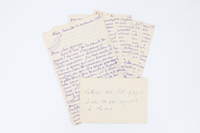
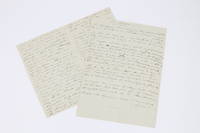
188878162Dizy Dizy-le-Gros 1888. Fine. Dizy Dizy-le-Gros samedi 15 septembre 1888 13.70 x 21.20 cm 20 pages sur 5 doubles feuillets & une enveloppe Very long autograph letter signed by Pierre Louÿs addressed to Georges Louis. Twenty pages written in blue ink on five double sheets of graph paper. Enclosed is an envelope on which is written in pencil in Pierre Louÿs's hand: ""Letter of 20 pages about my stay in Limé"" Amusing letter addressed to his brother Georges Louis with whom Pierre Louÿs maintained a very intimate relationship and whom he considered as his own father. The question of Pierre Louÿs's real father's identity still fascinates biographers today: ""His father Pierre Philippe Louis . had married in 1842 Jeanne Constance Blanchin who died ten years later after having given him two children Lucie and Georges. In 1855 he remarried Claire Céline Maldan and from this union was born in 1857 a son Paul; then in 1870 our writer who received the first names Pierre Félix. This late birth the differences in character between father and son the former's disaffection toward the latter the profound intimacy that always reigned between Louÿs and his brother Georges all this has led certain biographers and critics to suspect that the latter was in reality the writer's father. The exceptionally intimate and constant relationship that Pierre and Georges maintained between them throughout their lives could be an argument in this sense. Of course no irrefutable proof has been discovered and probably never will be. Nevertheless certain letters . are quite troubling. In 1895 for example Louÿs writes gravely to his brother that he knows the answer to 'the most poignant question' he could ask him a question he has had 'on his lips for ten years.' The following year at the height of Aphrodite's triumph he thanks Georges effusively and ends his letter with this sentence: 'Not one of my friends has a FATHER who is to him what you are to me.' Arguing from the close intimacy between Georges and Claire Céline during the year 1870 and from the jealousy that the father never ceased to show toward his younger son Claude Farrère did not hesitate to conclude in favor of Georges Louis. And what to think of this dedication by Louÿs to his brother on a deluxe copy of the first edition of Pausole: To Georges his eldest son / Pierre."" Jean-Paul Goujon Pierre Louÿs In this titillating letter bearing at the top the mention ""Papa doesn't know I'm writing you this letter"" underlined three times young Pierre Louÿs eighteen years old tells his elder about his vacation in Limé Aisne with the Glatron family. Visibly very excited he announces to his brother after some brief family news: ""And I have great news to announce to you which will decide the happiness of my life: I'm getting married. Don't look for a match for me anymore: I've found one."" In order to keep his reader in suspense he first tells him at length about his stay in Limé and paints a portrait of the Glatron family: ""Here first is the introduction to the little work I'm sending you by way of a letter and which may be very boring. It's the tableau of the Glatron family; it amused me to study them a bit while I was there. I wanted to find for each of them three or four words to paint them completely but I soon realized that I couldn't do so for any of them."" Far from being ""boring"" this very long passage allows Pierre Louÿs to deploy his talents as storyteller and caricaturist. Each member receives a colorful description ""the queen mother"" ""a nonentity"" ""a very special character"" ""petrified phlegm"" ""a repetitive Paulus"" ""the little invalid"". and Louÿs also gives pride of place to dialogues which he deliberately exaggerates: ""'I tell you that you took her by the waist! I saw you! Don't say no I saw you!'"" These humorous observations continue with the quasi-anthropological description of a village festival in Limé: ""I arrived in Limé the day before the patron saint's festival. unknown
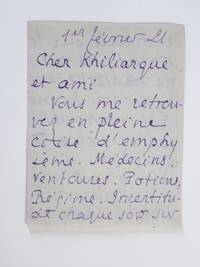
1921705101921. Fine. 1er février 1921 11.10 x 14.60 cm 4 pages sur un double feuillet Autograph letter signed by Pierre Louÿs addressed to a friend whom he calls ""khiliarque"". Ample and calligraphic handwriting in violet ink. A tear without loss of text to the first page. Eloquent letter testifying to Pierre Louÿs' fragile health in the last years of his life: ""Vous me retrouvez en pleine crise d'emphysème. Médecins. Ventouses. Potions. Régime. Intertitude chaque jour sur la journée du lendemain."" You find me in the midst of an emphysema crisis. Doctors. Cupping. Potions. Regimen. Uncertainty each day about the next day. The letter also reveals the writer's passion for dramaturgy notably through the mention of Gustave Quinson then director of the Palais-Royal theatre. ""Voulez-vous être tout à fait gentil Envoyez-moi d'abord votre livret que je suis si curieux de connaître."" Would you be so kind First send me your libretto which I am so curious to know. unknown
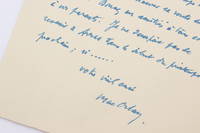
194784007Saint-Cyr-sur-Morin: S. n. 1947. Fine. S. n. Saint-Cyr-sur-Morin 20 Décembre 1947 13.50 x 21.50 cm une feuille Autograph letter dated and signed by Pierre Mac Orlan 15 lines in turquoise ink to the budding poet Roger Valuet. Fold marks inherent to postal envelope. He urges his young colleague to send him his latest writings: ""Bien sûr ! Envoyez-moi vos poèmes dès que vous les aurez réunis. Je les lirai et vous répondrai à ce sujet."" ""Of course! Send me your poems as soon as you have gathered them together. I will read them and respond to you on the subject."" and hopes to return to the North to see him again: ""Je ne désespère pas de revenir à Arras dans le début de printemps prochain si. Votre vieil ami."" ""I do not despair of returning to Arras at the beginning of next spring if. Your old friend."" Originally from Arras Roger Valuet is a popular writer who signed under the pseudonym Roger Vilard numerous detective and spy novels. At the beginning of his career he was helped by Pierre Mac Orlan who wrote the preface to his first collection of poems. S. n. unknown
189864430Paris 1898. Fine. Paris 9 mai 1898 12 x 15 cm un feuillet Autograph letter signed by Pierre Puvis de Chavannes dated May 9 1898 19 lines in black ink on letterhead with the address of the mansion of his wife Marie Cantacuzène ""89 avenue de Villiers"" . A moving letter of thanks from the painter Pierre Puvis de Chavannes: "" The thought of associating my work . with your own paternal feeling leaves me an inexpressible impression intimate full of emotion. "" unknown
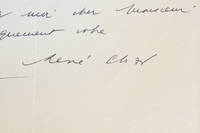
194762727L'Isle-sur-la-Sorgue 1947. Fine. L'Isle-sur-la-Sorgue 2 novembre 1947 21 x 26.90 cm 1 page sur une feuille Autograph letter signed by René Char of 11 lines written in black ink. Folds inherent to the mailing. René Char wrote this letter to René Wintzen editor-in-chief of the magazine Documents from 1929 to 1931. René Wintzen then began to publish a literary magazine Vent debout from which he sent Char a copy. The poet encourages him and tells him to persevere while ""discriminating the wheat from the chaff . "" René Char apologizes for not having a finished text to provide: ""I regret it. I write little and am only an accessory poet! "". This highlighting of a rare writing corresponds to René Char's idea of poetry and opposes the work advocated by Valéry. René Char writes little and submits to the demands of poetry: ""I never cheat. I have spent six months waiting for a word or a formula . This is the requirement of poetry. An absolute requirement. No words are free. Interview between René Char and Édith Mora Nouvelles littéraires 1965. The author also shows a distancing from poetry at the end of the decade. In fact Char experimented with new genres: he tried ballet with La Conjuration in April 1947 but also at the theater with Le Soleil des eaux music with Boulez and finally with the cinema. However he never leaves poetry and publishes the same year Poem sprayed . Char's modesty as to his status as a poet expresses the artist's subjection to the demand for poetry. unknown
190078743s. l. Londres London 1900. Fine. s. l. Londres London 24 mars 1900 10 x 15.70 cm 6 pages sur 2 doubles feuillets Handwritten signed letter addressed to Natalie Clifford Barney and enriched with a poem entitled « Le Miroir » London 24 March 1900 10 x 157 cm 6 pages on 2 double leaves Handwritten manuscript letter by Renée Vivien signed Pauline and written in black ink on a double leaf headed 24 Hyde Park Street. This letter contains a handwritten alexandrine poem entitled Le Miroir; never published on the initiative of the poet but it has been transcribed in Renée Vivien et ses masques in à l'encart April 1980: Je t'admire et ne suis que ton miroir fidèle Car je m'abîme en toi pour t'aimer un peu mieux; Je rêve ta beauté je me confonds en elle Et j'ai fait de mes yeux le miroir de tes yeux Je t'adore et mon cur est le profond miroir Où ton humeur d'avril se reflète sans cesse Tout entier il s'éclaire à tes moments d'espoir Et se meurt lentement à ta moindre tristesse Ô toujours la plus douce ô blonde entre les blondes Je t'adore et mon corps est l'amoureux miroir Où tu verras tes seins et tes hanches profondes Ces seins pâles qui sont si lumineux le soir! Penche-toi tu verras ton miroir tour à tour Pâlir ou te sourire avec tes mêmes lèvres Où trembleront encore les mêmes mots d'amour Tu le verras frémir des mêmes longues fièvres Contemple ton miroir de chair tendre et nacrée Car il s'est fait très pur afin de recevoir Le reflet immortel de la beauté sacrée Penche-toi longuement sur l'amoureux miroir! The rest of this long missive has however remained unpublished. A very beautiful letter sent from London by the Muse aux Violettes who misses her little one: Despite its slowness time passes you see and brings the hour that I await feverishly the time to meet again Natalie! Two more sad evenings and the third you will be there to rock me in your arms! . Today I was still disproportionately bored. I so need to see you again that I count the hours as they pass. I only think of you obsessed haunted taken possessed by you and by our memories. I am a poor unhappy thing far from you. Weary of society life We had the queen's dressing room how chic my darling! Lady Augustus Fitz Clarence invited us. She descends from a bastard of the King and is therefore an illegitimate relative of the sovereign! Renée lingers on the contemplation of a present from her darling: Your ring I love it so much it is a bond of our love that never leaves me. I so regretted your dagger that at the last moment I forgot to carry. Your ring you see is your memory on my finger I look at it and part of our tenderness is embodied in it. It is at the end of 1899 and through Violette Shillito that Renée Vivien then Pauline Tarn met Natalie Clifford Barney ""this American woman softer than a scarf whose sparkling face shines with golden hair sea blue eyes never-ending teeth"" Colette Claudine à Paris. Natalie who had just experienced a summer romance with the scandalous Liane de Pougy who introduced her to sapphism paid little attention to this new acquaintance. Renée on the other hand was totally captivated by the young American woman and describes this love at first sight in her autobiographical novel Une femme m'apparut: ""I lived again the hour already well past when I saw her for the first time felt the shiver that ran through me when my eyes met the mortal steel of her look those eyes blue and piercing as a blade. I had a dim premonition that this woman would determine the pattern of my fate and that her face was the predestined face of my Future. Near her I felt the luminous dizziness which comes at the edge of an abyss or the attraction of a very deep water. She radiated the charm of danger which drew me to her inexorably."" ""Winter 1899-1900. Beginnings of the idyll. One evening Vivien is invited by her new friend to Mme Barney's studio Natalie's mother 153 avenue Victor-Hugo on unknown
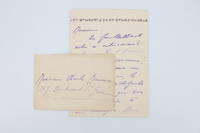
190679816s. l. Paris 1906. Fine. s. l. Paris s. d. ca. 1906 11.50 x 16 cm 1 page 1/2 sur un double feuillet Autograph letter signed by Renée Vivien addressed to Charles Maurras written in violet ink on a double leaf of headed paper adorned with a border of violets. Transverse folds inherent to mailing envelope included. Beautiful letter of thanks: ""Monsieur En feuillettant votre si intéressant volume : De l'Avenir de l'Intelligence j'ai relu avec un plaisir ému les pages - trop indulgentes vraiment ! - que vous avez consacré à mes ouvrages. Merci infiniment. Et veuillez agréer mes très reconnaissants sentiments de confraternité littéraire. Renée Vivien"" ""Sir While leafing through your most interesting volume: De l'Avenir de l'Intelligence I reread with moved pleasure the pages - too indulgent really! - that you dedicated to my works. Thank you infinitely. And please accept my most grateful sentiments of literary confraternity. Renée Vivien"" Charles Maurras had indeed devoted a dithyrambic chapter of his work to the Muse of violets whose verses he compared to those of Verlaine: ""Le vieux faune sentimental des Fêtes galantes et de Parallèlement reconnaîtrait chez Renée Vivien beaucoup plus qu'une élève certainement une des Surs une de ces Amies terribles qu'il a chantées. Quant à Baudelaire il lui dirait : ""Ma fille"" aux premiers regards échangés. Baudelairisme profond central générateur."" ""The old sentimental faun of Fêtes galantes and Parallèlement would recognize in Renée Vivien much more than a student certainly one of the Sisters one of those terrible Friends he sang of. As for Baudelaire he would say to her: 'My daughter' at first glance. Deep central generative Baudelairism."" unknown
197362631Paris 1973. Fine. Paris 19 mai 1973 21 x 29.70 cm une page sur une feuille Autograph letter signed by Robert Amadou to Mrs. Charmer-Leroy written in blue ink. Address of Robert Amadou at the top left stamp dâte at the beginning of the letter address of the recipient on the back of the letter. Traces of creases caused by mailing. The author writes this letter following a letter from his correspondent. He offers to meet her to exchange with her ""things we love - the only ones worth living ."". unknown
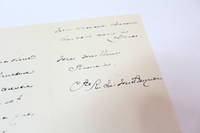
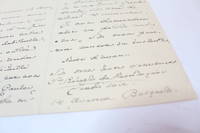
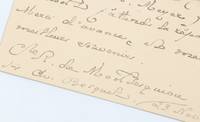
189074255s. l. Paris: S. n. 1890. Fine. S. n. s. l. Paris s. d. circa 1890 26.50 x 20.50 cm une page et demie sur une feuille Autograph letter signed by the dandy count one and a half pages 15 lines written in black ink to Henri Lapauze offering him several appointment options at his home: "". I shall be delighted to receive you on Friday at 10 o'clock or at 2 o'clock as you prefer. We are charmed to have you in Douai."" A black ink stain in the margin on the verso of the letter. Henry Lapauze 1867-1925 was a journalist and art critic who became in 1905 curator of the Petit Palais converted four years earlier into a museum whose collections he considerably enriched by acquiring notably the Courbet Henner and Falguière collections with in the twilight of his life a marked predilection for the Decorative Arts of which he was one of the ardent promoters. S. n. unknown
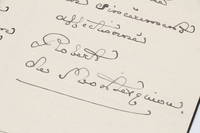
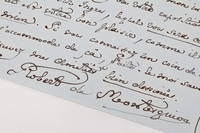
189074257s. l. Paris: S. n. 1890. Fine. S. n. s. l. Paris s. d. circa 1890 23 x 18 cm deux pages sur une feuille Autograph letter signed by the dandy count two pages 27 lines written in black ink to Henri Lapauze then journalist at Le Gaulois asking him after receiving his latest published work which he sent him to write a favorable article about him: "". I am sending you my new volume asking you to announce it with your usual good grace. I furthermore desire that the subsequent and detailed review of it be written by you for the readers of Le Gaulois."" Robert de Montesquiou also requests from Henri Lapauze a meeting when he returns to Paris: ""I will ask you for a brief meeting and we can chat for a moment."" Henry Lapauze 1867-1925 was a journalist art critic then in 1905 curator of the Petit Palais converted four years earlier into a museum and whose collections he considerably enriched by acquiring notably the Courbet Henner Falguière collections with at the twilight of his life a marked predilection for the Decorative Arts of which he was one of the ardent promoters. S. n. unknown
189574321s. l.: S. n. 1895. Fine. S. n. s. l. s. d. circa 1895 12.50 x 17 cm deux pages et demie sur une feuille rempliée Autograph letter signed by the dandy count of two and a half pages 27 lines written in black ink insisting to his friend Henry Lapauze then journalist at Le Gaulois to see published a note he had sent him as well as the project of an interview with a certain Monsieur Lavé and the related arrangements: "". je suis persuadé que vous trouverez l'un comme l'autre intérêt et plaisir à l'entretien projeté. Vous pouvez agir directement en vous recommandant de moi."" "". I am persuaded that you will both find interest and pleasure in the projected interview. You can act directly recommending yourself through me."" Finally Robert de Montesquiou wishes to discuss with Madame Lapauze: "". un bien précieux recueil dont je veux lui parler comme il le mérite à savoir posément et passionnément."" "". a very precious collection of which I want to speak to her as it deserves that is to say calmly and passionately."" that she had sent him. Henry Lapauze 1867-1925 was a journalist art critic then in 1905 curator of the Petit Palais converted four years earlier into a museum and whose collections he considerably enriched by acquiring notably the Courbet Henner Falguière collections with at the twilight of his life a clear predilection for the Decorative Arts of which he was an ardent promoter. S. n. unknown
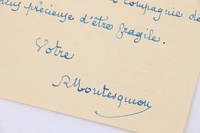
192183149s. l.: S. n. 1921. Fine. S. n. s. l. 26 octobre 1921 18 x 21 cm une page Grateful autograph letter dated and signed by the dandy count 14 lines written in blue ink probably addressed to his friend the critic Henri Lapauze. ""Mon cher ami ne doutez pas que je ne sache dans cet aimable spirituel et bienveillant article faire la part du critique intelligent qui l'a rédigé et celle du fidèle ami qui l'a inspiré. L'acte de donation en faveur de votre musée vous portera mon remerciement. La statuette est de cire. je l'espère cependant durable et l'avalanche de roses que vient décrire si poétiquement Alexandre lui promet une compagnie délicate elle aussi plus précieuse d'être fragile. Votre RMontesquiou. 26 Octobre 1921."" ""My dear friend do not doubt that I know how in this amiable witty and benevolent article to distinguish between the part of the intelligent critic who wrote it and that of the faithful friend who inspired it. The deed of donation in favor of your museum will bear my thanks. The statuette is made of wax. I hope however that it will be durable and the avalanche of roses which Alexandre describes so poetically promises it delicate company also more precious for being fragile. Yours RMontesquiou. 26 October 1921."" Fold marks inherent to envelope insertion three letters having slightly smudged. S. n. unknown
192183152s. l.: S. n. 1921. Fine. S. n. s. l. 26 octobre 1921 18 x 21 cm une page Autograph letter signed on bristol board by the dandy count 17 lines written in black ink probably addressed to his friend and bibliographer the critic Henri Lapauze. ""Cher monsieur et ami je vous recommande ma bibliographie que j'ai hâte de lire de votre main qui voudra joindre à la bonne grâce de l'écrire celle de me l'adresser. Je compte aussi sur vous pour recommander le livre à M. Paul Perret à qui j'ai demandé un entretien d'accord avec M. Meyer - et dont j'attend la réponse. Merci d'avance et mes meilleurs souvenirs. Cte R. de Montesquiou. 23 novembre."" ""Dear sir and friend I recommend to you my bibliography which I am eager to read from your hand which will wish to add to the good grace of writing it that of addressing it to me. I also count on you to recommend the book to M. Paul Perret to whom I have requested an interview in agreement with M. Meyer - and from whom I await the response. Thanks in advance and my best regards. Count R. de Montesquiou. 23 November."" S. n. unknown
192083258s. l.: S. n. 1920. Fine. S. n. s. l. s. d. 1920 27.50 x 18 cm une page Autograph letter signed by the dandy count on a bristol card 20 lines written in black ink addressed to his friend and bibliographer the critic Henri Lapauze about an article to appear in ""Le Gaulois"" and for which he sets his conditions: ""Cher Mr Lapauze en réponse à votre aimable mot veuillez dire à M. Meyer que je lui demande pour l'article en question la place de tête pour le 28. Et que je lui demande aussi le secret à l'égard de la destinataire à qui je veux faire une surprise. Je sais qu'il sera d'accord avec moi dans ce dessein d'art et d'amitié. Merci et à bientôt. Cte R. de Montesquiou."" ""Dear Mr Lapauze in response to your kind note please tell M. Meyer that I ask him for the lead position for the article in question on the 28th. And I also ask him for secrecy regarding the recipient whom I want to surprise. I know he will agree with me in this design of art and friendship. Thank you and see you soon. Count R. de Montesquiou."" S. n. unknown
190683262s. l.: S. n. 1906. Fine. S. n. s. l. s. d. 1906 21.50 x 27.50 cm une page Autograph letter signed by the dandy count 20 lines written in black ink on tracing paper addressed probably to his friend and bibliographer the critic Henri Lapauze regarding verses commissioned from him by the newspaper ""Le Gaulois"": ""Neuilly Cher ami puisque nous supprimons le dessin remplaçons-le par par cette petite pièce qui servira de repos entre les deux autres et frappons un grand coup de vers. Les trois pièces ce nombre est necéssaire pour fixer l'attention sont les meilleurs que j'ai faites. Rendez notre cher Galdemar favorable à ce projet et dites lui que ce n'est pas moi qui sollicite du Gaulois cette publication ; mais bien le Gaulois qui la désire. J'insiste sur cette différence parce qu'elle donne je veux le croire à l'envoi ee ces nouveaux vers la grâce et l'essor d'une aile de plus. Votre bien affectionné. Cte R. de Montesquiou."" ""Neuilly Dear friend since we are removing the drawing let us replace it with this little piece which will serve as a respite between the two others and let us strike a great blow with verse. The three pieces this number is necessary to capture attention are the best I have written. Make our dear Galdemar favorable to this project and tell him that it is not I who am soliciting this publication from Le Gaulois; but rather Le Gaulois which desires it. I insist on this difference because it gives I want to believe to the sending of these new verses the grace and soaring of one more wing. Your most affectionate. Count R. de Montesquiou."" Creases inherent to folding for mailing small creases to right and left lower margins of the letter. S. n. unknown
190883329s. l.: S. n. 1908. Fine. S. n. s. l. 13 juin 1908 24.50 x 17 cm une page Autograph letter signed by the dandy count 37 lines written in black ink addressed probably to his friend and bibliographer the critic Henri Lapauze. ""Neuilly Mon cher ami laissez-moi vous donner ce beau nom. C'est avec une vive et charmante émotion que je lis les belles et ""braves"" louanges dont vous voulez bien honorer ma personne et mon oeuvre. Il me plaît de penser que votre précieux éloge résulte d'une collaboration doublement sympathique et dans laquelle auprès de votre timbre métallique résonne l'accent le plus doux de l'aimable femme dont le talent m'était connu mais dont la première minute de causerie m'a révélé la compréhension et le sentiment. En attendant de vous le redire de vive voix merci donc à vous deux et de votre bien affectionné Robert de Montesquiou."" ""My dear friend allow me to give you this beautiful name. It is with a lively and charming emotion that I read the beautiful and ""brave"" praises with which you are pleased to honor my person and my work. I am pleased to think that your precious praise results from a doubly sympathetic collaboration and in which alongside your metallic tone resonates the sweetest accent of the amiable woman whose talent was known to me but whose first minute of conversation revealed to me her understanding and feeling. While waiting to tell you this again in person thank you therefore to both of you and from your very affectionate Robert de Montesquiou."" Fold marks inherent to posting. S. n. unknown
190683313s. l.: S. n. 1906. Fine. S. n. s. l. s. d. 1906 12.50 x 20 cm une page Autograph letter signed by the dandy count 11 lines written in black ink addressed probably to his friend and bibliographer the critic Henri Lapauze. ""Neuilly 14 juin Cher monsieur & ami mon dessin est à votre disposition de préférence à partir du samedi 21. Je vous assure et de mes sentiments les meilleurs. RMontesquiou."" ""Neuilly June 14 Dear sir & friend my drawing is at your disposal preferably from Saturday the 21st onwards. I assure you of my best regards. RMontesquiou."" Folding traces inherent to the envelope Henri Lapauze has inscribed across the letter in blue pencil the word ""faire"" ""to do"". S. n. unknown
192183348s. l.: S. n. 1921. Fine. S. n. s. l. 11 octobre 1921 17.50 x 21 cm une feuille Autograph letter signed by the dandy count 14 lines written in blue ink addressed to his friend and bibliographer the critic Henri Lapauze notably mentioning a work by Ingres in his possession also thanking his correspondent for his always lucid and benevolent critiques regarding him. ""Cher ami envoyez-moi je vous en prie comme nous en sommes convenus le schéma de ma donation au Petit-Palais de ma grande statuette par TroubetzKoÿ et du portrait par Arthur Chaplin de Mademoiselle Ehrmann artiste lorraine élève d'Hébert morte en 1918 ayant légué le portrait par elle de sa mère au Musée de Nancy et dont le portrait pareillement dû à son pinceau de Mademoiselle Favart figure au Foyer de la Comédie Française. Vous me ferez aussi grand plaisir en m'adressant votre bel article sur d'Annunzio et si vous la retrouvez la note des journaux sur mon don à la Bibliothèque de Versailles. Cher ami j'ai été heureux de vous revoir. RMontesquiou. 11 oct 1921."" ""Dear friend please send me as we agreed the outline of my donation to the Petit-Palais of my large statuette by TroubetzKoÿ and of the portrait by Arthur Chaplin of Mademoiselle Ehrmann Lorraine artist and student of Hébert who died in 1918 having bequeathed the portrait she painted of her mother to the Museum of Nancy and whose portrait similarly by her brush of Mademoiselle Favart is displayed in the Foyer of the Comédie Française. You would also give me great pleasure by sending me your beautiful article on d'Annunzio and if you find it the newspaper note about my gift to the Library of Versailles. Dear friend I was happy to see you again. RMontesquiou. 11 Oct 1921."" Fold marks inherent to postal delivery. S. n. unknown
190883323s. l.: S. n. 1908. Fine. S. n. s. l. 28 juin 1908 31 x 19.50 cm une page Autograph letter signed by the dandy count 40 lines written in black ink on tracing paper addressed probably to his friend and bibliographer the critic Henri Lapauze. ""Neuilly Dear friend the impossibilities that deprived me of your twice precious presence have also deprived you of a moment which I dare believe was one of those that would have moved you. And no doubt all the more I do not say! in revealing to you you sense it well. but in making you better know a character of sentiment curiously associated with the character of verve that you received the other day. If you judge it appropriate and can do so without difficulty would you publish in full the enclosed note having it preceded by a few lines that your good grace and good taste will inspire you I did not think that mention would be made of this intimate ceremony. But since it was not so it pleases me that the names be known to the attendees that I wanted for it. Your friend RMontesquiou."" Creases inherent to folding for mailing. S. n. unknown
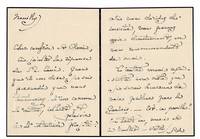
190583368s. l.: S. n. 1905. Fine. S. n. s. l. Juin 1905 11 x 14 cm une feuille Signed autograph letter from the dandy count on a sealed pneumatic card of 12 lines written in black ink addressed to his friend and bibliographer the critic Henri Lapauze: ""Cher confrère et ami je viens de vous écrire un mot et mes inquiètudes de garde-malade. Un mot troublé au point de vous adresser je crois au Figaro ce qui devait s'arrêter avant. Cela me donne le plaisir d'inscrire deux fois votre nom apprécié. RM."" ""Dear colleague and friend I have just written you a word and my anxieties as a nurse. A troubled word to the point of addressing you I believe at Le Figaro which should have stopped before. This gives me the pleasure of inscribing your appreciated name twice. RM."" S. n. unknown
190883382Artagnan: S. n. 1908. Fine. S. n. Artagnan 1908 20.50 x 26.50 cm 7 feuillets recto Autograph letter signed by the dandy count 68 lines written in black ink on seven folios recto probably addressed to his friend and bibliographer the critic Henri Lapauze: ""Artagnan My dear friend the interesting review which I would very much like to know. has escaped me. Can you send it to me; or at least a date indication that would allow me to find it As for what you write to me about my ""social successes"" you don't think the first word of it fortunately for us! - otherwise you would start by ""not speaking to me"" as Favre used to say; and you would be quite right. Well! in all things one must consider not only the end but the true and the false the good and the bad the authentic and the counterfeit as I believed I could write even about snobbery! When it comes to letters - even more so to ladies of letters on no point does this difference stand out with such clarity. - who knows this better than you No once again we must not and this is very important let the mockeries of what we know how to do prevent us from manifesting ourselves. That would play too well into the hands of the monkeys who already have enough coconut trees as it is. For this reason I believed I should offer the noble Engadin larches the favor of hearing me. And their murmur did not reproach me for it. I am going to write to a certain Lady of letters in the good sense of the term to speak to her about her beautiful book. Your friend and hers Robert de M. Sept 08. Via Vic-Bigorre Hts Pyr. P.S.: urgent Only you can affirm to me with sufficient guarantee that Liem is still alive as I believe and wish to affirm in an article which being in press requires the information without delay. When you are reconciled with an etcher whom you do not like I will offer you for an engraving exhibition a portrait of me by him which at least you will love. If I have not read your critique of my book on the other hand I have taken note of the one you devoted to the amiable young man whom it was necessary to punish for having said three times during a dinner: Marie Murat. perhaps it would have been enough to make him copy seventy times seven times. In any case you will have been harsh. The crime deserved it. Perhaps also one day you will speak ill of me although that seems unlikely to me. But what I can affirm is that. it will not be for that! ."" Fold marks inherent to envelope mailing. S. n. unknown
191183367s. l.: S. n. 1911. Fine. S. n. s. l. 1911 27 x 21 cm 6 feuillets recto Signed autograph letter from the dandy count 68 lines written in black ink on six recto leaves probably addressed to his friend and bibliographer the critic Henri Lapauze to whom he almost orders him to review his latest work in one of his upcoming chronicles. The proud Robert de Montesquiou also evokes with complete immodesty his intellectual height and depth qualities cruelly lacking in some of his contemporaries: ""Cher ami avec plaisir je consens à faire partie de votre comité avec d'autant plus de plaisir que sans le vouloir ou peut-être intentionnellement je préfère le croire vous donnez raison à mon dernier livre. Voir page 143 : ""nulle ne serait mieux qualifiée pour ce titre de Présidente. On n'en saurait trouver de plus affable"". Oui cher ami j'en profite pour vous le redire sans plaisanterie - aussi bien que sans amertume vous vous êtes trop de fois montré efficacement sympathique pour que j'en perde si vite ni même jamais le souvenir. - vraiment je ne suis pas du tout de votre avis sur l'impossibilité de parler de mon dernier livre dans votre chronique. Je suis même de l'avis entièrement contraire. D'abord je ne voudrais pas si j'étais critique littéraire qu'il fût dit un jour qu'un tel livre a paru vous savez que je ne suis pas modeste sans que j'en ai fait mention d'une manière ou de l'autre. En outre c'est trop lui donner raison que d'en agir ainsi. Vous voyez que si je suis modeste je ne suis pas moins juste. Oui à votre place j'aurais fait la part de l'auteur et celle du lecteur même récalcitrant comme l'ont fait Robin dans le Herald et Glaser dans le Figaro comme l'ont fait et le feront d'autres. - Quant au bel article de Lucien Daudet dans le Gil Blas je pense que vous l'avez lu. Des personnes d'esprit et d'art comme vous deux ne peuvent se méprendre sur le côté réactionnaire et aristocratique d'un tel écrit dans la bonne acception de ces deux qualificatifs. L'aristocratie ce n'est tout de même pas madame Moore madame Porgès et Mam ""zell"" Gutman ; pas plus que la littérature n'est Mam ""zell"" Vacaresco et Monsieur de Pomairols. A un borgne bien intentionné qui me disait : ""vous attaquez le monde ! "". j'ai répondu : ""Pardon ! je range le salon de ma grand-mère"" Aussi quand je lis dans quelque de vos jolis commentaires trop incertains à certains à propos de je ne sais quel plus ou moins vague bouquin que ""l'auteur"" manie supérieurement l'ironie je m'écris furieusement : ""Eh bien ! et moi ! ."" Alors pour me dédommager et un peu me venger je relis votre carte du 10 octobre : ""Envoyez moi tout de suite cher ami votre insupportable héroïne"". Henry et moi nous voulons la connaître l'aimer la faire aimer. A quoi pensez vous de nous mettre ""l'eau à la bouche pour retirer ensuite ce fruit. que nous espérons défendu."" De ce moment-là je me sens mieux. Et pour vous le prouvre cher ami et que je suis sincère je vous annonce mon intention de publier à l'occasion de votre exposition un nouvel essai sur Ingres lequel vous sera dédié si tel est votre bon plaisir comme il est le mien. Si vous connaissez un coin de revue qui s'accommode de ça faites-le moi savoir et recevez mes amitiés bien dessinées. Robert de Montesquiou Janv. 911."" ""Dear friend with pleasure I consent to be part of your committee with all the more pleasure since without wanting to or perhaps intentionally I prefer to believe so you vindicate my latest book. See page 143: 'none would be better qualified for this title of President. One could not find a more affable one.' Yes dear friend I take this opportunity to tell you again without jest - as well as without bitterness you have shown yourself efficiently sympathetic too many times for me to lose the memory of it so quickly or even ever. - truly I am not at all of your opinion on the impossibility of speaking about my latest book in your chronicle. I am even S. n. unknown