4 134 résultats
Colour lithograph map, 765 x 495 mm, trimmed to neat line. A rare separately issued official map, with text in Ottoman Turkish throughout, depicting the route of the Hejaz Railway. Following a route proposed by the eminent Turkish engineer Mukhtar Bey and surveyed by the cavalry officers Umar Zaki and Hasan Mu'ayyin, the epic project, funded by subscriptions from the global Islamic faithful, completed a rail link from Damascus to Medina by 1908. Intended to continue to Mecca but never completed, it nevertheless briefly allowed many thousands of pilgrims to make the Hajj in relative comfort. - Old folds and creases, some short closed tears, tiny chips to neat line, some light staining. Some remnants of tape and old private collector's stamps to verso. Still in good condition but for partial loss of lower left corner, subsequently collaged with a contemporary Ottoman colour lithographed map of the Arabian Peninsula.
32 photocopies in polypouch binder (ca. 23 x 34 cm). Highly detailed and extensively hand-annotated map of the eastern end of the Peninsula, photocopied from the one-million scale pilots' ONC maps (Operational Navigation Chart) as a set of 32 sheets and self-assembled by a traveller to the region. Covers Oman, including the eastern portion of the United Arab Emirates and Saudi Arabia. The repeated notations, "maximum elevation believed not to exceed 200 feet" and "limits of reliable relief information" bear witness to the measure in which the inner Peninsula still constituted frontier country in the later 20th century.
8vo. (48), 234, (22) pp. With woodcut printer's device to title-page, woodcut initials and headpieces. Contemporary full vellum with handwritten spine title. First Hebrew edition: printed in Latin and Hebrew parallel text, with some passages in the notes in Arabic. "A pretty edition, and the only one to unite the text with a Latin translation" (cf. Brunet). Two duodecimo editions, in Hebrew only and in Latin only, were also published by Elzevier that same year. - Benjamin of Tudela, the "Wandering Jew" or "Wandering Rabbi", made a particular ethnographic study of the Jewish population of the various lands he visited on his travels. Setting out from Spain around 1160, he included Greece and the Aegean Archipelago, Constantinople, Jerusalem, Damascus, Baghdad, and Alexandria in his thirteen-year peregrination. Returned from his travels, he wrote his book in 1178. "One feature of his narrative is its division into what he actually saw and what he heard" (Blackmer). In Cyprus, for instance, he is stinging in his criticism of those who are "nempe Epicurei [...] Sabbathi vesperam profanant". - A clean and well-preserved copy. Willems 377. Pieters 122. Blackmer 120. Weber II, 67. Brunet I, 774 ("Belle édition"). Cf. Cobham-Jeffery p. 4. OCLC 122871307. Not in Atabey.
Tall folio (150 x 372 mm). Ottoman Turkish manuscript on polished cream paper. 56 leaves (including some blank separators), ca. 31 lines, written in a mixed script of Naskh and Taliq. First part composed in free form with notes in black ink, second part in regular black ink captioned in red. Contemporary full calf binding decorated in gilt and red (professionally restored). A rare document of Ottoman state administration during the early Modern period: the official chronological record-book kept by the Kazasker (chief judge) of Anatolia, Mehmed Sâlim, during the year 1731. - Within the Ottoman administrational structure, the Kazasker (or Qadi'asker) had jurisdiction over all judicial and educational officials such as Kadi (judge) and Müderris (Madrasa professor), suggested candidates for these offices to the Grand Vizier, to whom he was directly responsible, and handled appeals to lower-court decisions. Since the late 15th century, the enormous size of the Ottoman Empire had necessitated the appointment of two Kazaskers, usually for the period of one year: the Kazasker of Rumelia, with jurisdiction over the European part of the Empire, and the Kazasker of Anatolia, responsible for the Asian part, comprising Anatolia, Syria, Palestine, Egypt, and the Arabian Peninsula. - The Kasazker would record all business in a book of original entry such as this one, known as the "Kazasker Ruznamçesi" (Kazasker daybook register). The present Ruznamçe concerns an impressively wide and diverse geography, from Anatolia to the Caucasus, the Arabian lands, the Nile and Northern Africa. Places in Anatolia include Üsküdar (Scutari), Marzvan (Merzifon), Bergama (Pergamon), and Antakya (Antioch); in the South Caucasus the book mentions Tblisi, Ganja, Igdir, Yerevan, and Javanshir. Places covered in the Levant, Arabia and Mesopotamia include Safed, Idlib, Jericho, Beirut, Homs, Hama, Baalbek, Latakia, Kirkuk, Basra, and Jeddah. From the Mediterranean to the regions south of the Nile, the book records matters pertaining to Cairo, Gharbia, Dakahlia, Alexandria, Damietta, Qalyubiyya, Faiyum, Minya (Hermopolis), Beni Suef, Monufia, Asyut, and Beheira; also the Kazasker's counselor for Egypt is mentioned. In Northern Africa, the book covers Algeria, Tunisia, Tripoli, and Djerba. Further, even Tirhala (Thessaly) is included, which normally would fall within the remit of the Kazasker of Rumelia. - Among these records, the high volume of official missions back and forth within the vast borders of the empire is hard to miss. Every year, hundreds of posts are filled throughout the country: in 1731, for example, one Sayyid Nureddin from Seferihisar (Izmir) was appointed to fill a position in Basra, 2500 kilometres away. There is also a steady stream of civil servants between Istanbul and Jeddah, more than 3000 kilometres distant. Entries in the daybook include a record for a Mevlana Ahmed, who, after having studied at the Molla Gürani Madrasah in Constantinople, is appointed Kadi (Judge) at Jeddah, salaried at 150 coins per day (cf. p. 828f.). Soon after, Ahmed is in turn replaced by Suleyman: "Ahmed, serving as the Kadi of Jeddah, relinquished his post, which he would have held until the first day of Rabi ath-Thani next year. In Ahmed's place, Mevlana Suleyman, who studied with forty akces per day at the Tuti Latif Madrasah in Istanbul and passed the exam successfully by completing the waiting period, was appointed as a Kadi to Jeddah with one hundred and fifty akces per day" (p. 835, transl.). This continuity gives evidence of the close relationship between the capital Istanbul and the Hejaz. Civil servants who were successful at the leading madrasahs of Istanbul could be appointed as Kadi in Jeddah, with a salary almost four times the pocket money they received in Istanbul - circumstances which also reveal the sensitivity of this region for the Ottoman Empire. - Of particular interest is also the appointment of a Kadi for Yerevan, as the Causacus region was long contested throughout the Ottoman-Safavid wars and the city changed hands frequently. In 1731 Yerevan came under Ottoman rule, and the Porte immediately appointed a Kadi there to ensure administrative and legal sovereignty at a time of ongoing political and military instability. Since Yerevan was mostly under Safavid-Persian rule throughout these centuries, appointments concerning Yerevan are very rare in Ottoman records. - Mirzâzâde Mehmed Sâlim Efendi (1688-1743), the Kazasker of Anatolia for 1730/31, was a noted scholar, poet and writer; he took the pen name "Sâlim" in the Tulip Era and was also a master calligrapher. Highly educated and remembered as a versatile and colourful personality, he served in various senior civil service positions. He was a connoisseur of science, law and art, and composed numerous works; also a talented linguist, he knew Turkish, Arabic and Persian well enough to compile a dictionary. - Binding restored to style with original covers laid down, 20th century bookbinder stamp of Rafet Güngör, Istanbul, to lower flyleaf. Occasional light edge flaws; upper part of last 4 leaves torn away with substantial loss, otherwise complete. Several old waqf stamps. At the end of the volume are numerous elaborate seals of Mehmed Sâlim, certified by a civil servant named as Abdurrahman. Their official character is underlined by having been prepared separately and pasted into the completed daybook, with a crescent-shaped cut in the paper creating a flap that conceals the stamped seal. Cf. Abdurrahman Atcil, "The Route to the Top in the Ottoman Ilmiye Hierarchy of the Sixteenth Century", Bulletin of the School of Oriental and African Studies 72.3 (2009), 489-512.
Oblong 4to (244 x 232 mm). XVI, 152 pp. Illustrated throughout. Original pebbled brown cloth, titled in gilt on front cover. A rare Zionist publication on anti-Israeli propaganda, in English and Hebrew throughout, issued in the wake of the first two tumultuous years of statehood. Prolifically illustrated with facsimiles of contemporary photographs, posters, and cartoons and quoting extensively from Arab newspapers translated into Hebrew and English, the author presents a snapshot the political climate and high tensions of 1950 through a curated collection of contemporary sources, most from Arab media outlets in Egypt, Syria, and Lebanon. - Light wear, binding delicate. Interior bright and clean. OCLC 19160797.
4to. XXVIII, (6), 329, (1) pp. With engraved printer's device to title-page. Contemporary unsophisticated boards. All edges sprinkled blue and red. Second printing of Reiske's Latin edition of Abulfida's great historical work, the "Concise History of Humanity". Written in the form of annals extending from the creation of the world to the year 1329, it is divided into two parts, one covering the history of pre-Islamic Arabia and the other the subsequent history of Islam. This translation, first published in 1754, reaches up to the year 406 H (1015 CE). - The brilliant scholar Reiske (1716-74) is regarded as the father of Arabic studies as an independent discipline. In sharp contrast to his teacher Schultens, he was one of the first Arabists whose work was unfettered by the constraints of Biblical exegesis. - Browned throughout due to paper stock. Binding rubbed and stained, extremeties bumped. From the library of the Gregorio Speciale (1738-1820), Nicosian nobleman, canon, and director of the Stamperia Reale (Royal Printing House) of Palermo from 1791 until his death, with his engraved bookplate ("Garofalo sc.") on the verso of the title-page. GAL II, 45f. Schnurrer p. 119f. OCLC 49478817. Not in Rita Loredana Foti's catalogue of Speciale's library (Catalogo della libreria del cavaliere don Gregorio Speciale); see Libri e biblioteche in Sicilia tra tardo settecento in primo ottocento. Il caso del catalogo di Gregorio Speciale, in: Archivio di Stato di Palermo: Quaderni IX (2014), at pp. 99ff. (with an illustration of his bookplate on p. 100).
VIII, 36, 33, (1), 30 SS. In arabischer und lateinischer Schrift. Grüner Leinenband mit Goldprägung. 8vo. Persisches Schauspiel nebst deutscher Übersetzung, herausgegeben durch den Wiener Orientalisten Wahrmund (1827-1913), seit 1885 Direktor der Orientalischen Akademie, wo die Ausgabe auch als Lehrmittel diente. - Einige Bleistiftanmerkungen, insgesamt gutes Exemplar. Zu Wahrmund vgl. Fück 187.
Folio (280:366 mm). VIII, 54 pp., last blank f. With 12 photographic plates. Original printed boards. Only edition of this important work on Islamic Mamluk-era architectural decoration in Cairo. - Spine rebacked; covers rubbed and waterstained. Rare. OCLC 7491549.
Small 8vo (100 x 155 mm). English manuscript on paper. 80 pp. (five days to a page, hand-ruled on blank sheets), with 8 pp. of printed matter ("a list of stamps, London bankers, interest tables, and other useful commercial information") bound first. Signed on the flyleaf (dated 1835) and on the title page. Original 1830s green roan. A remarkable naval logbook and diary kept by the young naval surgeon John Burns, documenting the voyages of four Royal Navy vessels, the H.M.S. "Harrier", the "North Star", the "Carysfort" and the "Sappho", to Ottoman ports throughout the Eastern Mediterranean during the final years of the reign of William IV and the early reign of Queen Victoria. Burns's ships frequently called at Constantinople, Pera and Tarabya, but also anchored at Tunis and Algier, as well as Alexandria (on Christmas Day 1840). Several of his brief entries tell of encounters and relations with local governors and dignitaries: "[3 Aug. 1837] Received the Persian Ambassador on board"; [8 Aug. 1837] Received French Ambassador on board"; "[14 April 1838] On board. Turkish frigate and brig arrived with the Pasha of Tunis". When passing the castles on the Dardanelles on 18 Nov. 1837, the ship "fired 19 guns", and upon entering Constantinople on 7 June 1837, the vessel pays its respects to Sultan Mahmud II: "Sailed from Therapia to Constantinople, manned yards and fired a Royal salute on passing the Sultans' Palace [...]". Upon their return to Tarabya a few months later, Burns remarks on the celebration of the Sultan's birthday: "[11 Dec. 1837] Sultans Birthday, lett [?] off rockets in the evening". When news of the Sultan's death reaches the ship less than two years later, Burns notes: "[29 June 1839] Uncertain reports of the death of the Sultan", and "[2 July 1839] Reports confirmed of Sultan Mahmouds death aged 69 reighned [!] 31 years." Burns also provides accounts of several military events, mentioning an "Insurrection at Pera, lying off it" on 10 August 1837, or the Battle of Nezib on 24 June 1839. Burns's training as a surgeon is called upon: "[11 Dec. 1836] Captain came on board, mastered, in the evening corporal of Marines broke both bones of leg immediately above ankle". Not always is Burns able to apply his medical skills with success: "[19 Dec. 1836] man killed by falling from the Mainmast head through lubber hole into the Basin"; "[18 Mar. 1837] Cook died of disease of chest". Yet the diary also gives evidence of many less sensational episodes of everyday life aboard ship, containing remarks about dinner, lesser illnesses, and weather conditions. Other entries cover leisure activities such as walks ashore ("[21 July 1837] On shore of Sultan's Valley, had a Turkish bath"; [5 Dec. 1837] Went to Stamboul Bazaars, Galata, Pera") and visiting such sights as coastal castles or the ruins of Pompeii. Burns's allegiance to the British crown is always evident: "[14 July 1837] Fired 72 minute guns in the afternoon on the news of the death of the King which happ. on the 19th June", "[28 June 1838] Entered Toulon and celebrated the Queen's coronation", and "[15 July 1837] fired a royal salute in honour of the accession of Queen Victoria". - Burns joined the H.M.S. "North Star" on 1 Sep. 1836, sailing from Rio de Janeiro to England. Other voyages took the keeper of this diary further into the western Mediterranean, including the ports of Naples, Malta, and Barcelona. - Later notes and calculations on the final leaves and the insides of the covers; newspaper clippings on the lower paste-down announce the death of Burns's infant son in 1859 as well as the birth of his daughter in 1857 and of another son in 1860. A newspaper clipping announcing Burns's passing on March 10 [1894] is pasted on the flyleaf. Upper cover creased, occasional very minor paper flaws to edges, but in all a charming survival.
12mo. 85, (3) pp. Original wrappers with lettering. A rare pamphlet in Arabic, containing Saddam Hussein's speech on the role of women in revolutions. The speech was given in 1977, two years before Saddam formally came to power in 1979. The pamphlet was reprinted in the year of his election. With this speech Saddam touched the problem of women's liberation vs. strong local traditional values in the time of the Arab national struggle. In the 1970s Iraqi women had free access to the education, voting rights, could own property and were encouraged to pursue posts in high positions, but during the following decades the importance of the traditional patriarchal family started undermining these rights. - Wrappers slightly stained and with soft folds, old signature on the top of the title-page, otherwise in good condition. Rare; we could not find any institutional examples.
Folio (240 x 352 mm). (56), 1203 (instead of 1207, properly 1205), (1) pp. (p. 623f. blank, wants pp. 231f. & 237f.). - (Includes, as part 2:) Sanudo, Marino. Liber secretorum fidelium crucis super Terrae Sanctae recuperatione et conservatione [...] Orientalis historiae tomus secundus. Ibid., 1611. (12), 361, (3) pp. (283f. printed as a double-page-sized folding table). Both parts with engraved printer's device to title-page. With 3 double-page-sized folding engraved maps and 2 engraved plans as well as a woodcut printer's device at the end. Slightly later full calf, spine elaborately gilt. Only edition of this early, important source book for the history of the crusades and the Kingdom of Jerusalem and its vassal states. The second parts contains the first printing of the much sought-after 14th century maps and plans by the Genoese cartographer Pietro Vesconte, previously available in manuscript copies only. "Four of the maps from Marino Sanudo's early fourteenth-century manuscript atlas were reprinted by Johann Bongars in 1611. Sanudo's planisphere [...] is one of the few examples of medieval maps based on portolano sources in printed form. It is a circular map centered on Jerusalem with the Mediterranean relatively well defined. The ocean surrounds the whole of the known world, the outer parts of which are represented by conjecture. The authorship of Marino Sanudo is not definitely established and the original manuscript has also been attributed to Pietro Vesconte" (Shirley). - One of two title variants differing only in slight changes in the typesetting (here: "Expeditionum" begins between the "O" and the "R" of "Orientalium"). Binding somewhat rubbed, hinges starting. Rather severely browned throughout due to paper stock, some waterstaining to margins, more pronounced near the end, sometimes reaching into the printed text. Stains to first title-page; the second title and its counter-leaf *6 are printed on different paper stock. Some light worming, mainly confined to margins but also touching the text near the end; occasional edge defects. A copy in modern half vellum (severely browned, with some worming, but otherwise complete) commanded 13,000 Euros at Reiss's spring 2009 auction. VD 17, 1:069728C. Atabey 127. Ioannou 49 (variant). Potthast I, 105. Tooley I, 162. Cf. Tobler 12. For the maps: Shirley 276 (with plate 217); Nordenskiöld 51 (with fig. 28); Laor 783 & 1145f. as well as Lex. Kart. 576 & 860f.
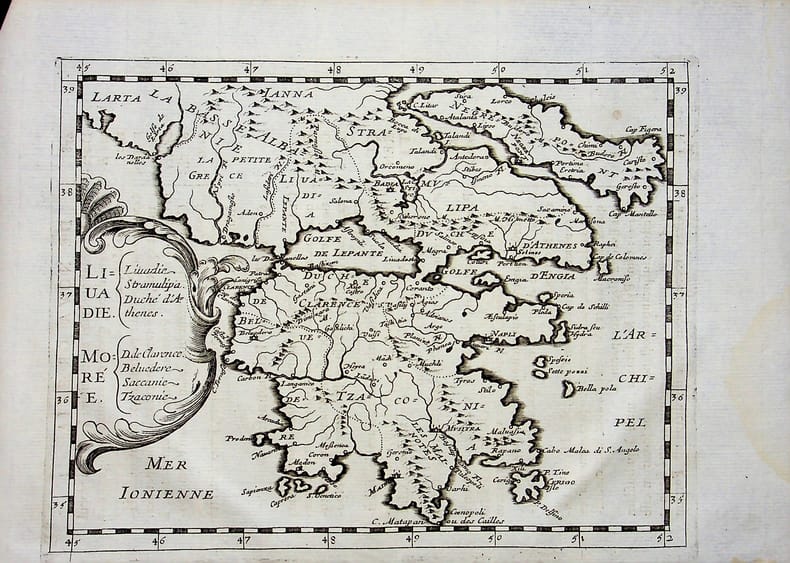
018798[Philippe Briet, Parallela geographiae veteris et novae] Liuadie Morée - Grèce, Golfe de Lépante. Gravure originale, 1649, environ 240*170mm. Gravure tirée de l'ouvrage du savant jésuite Philippe Briet (1601-1668) publié en 1648-1649. Texte au dos. [436]
Oblong folio (240 x 166 mm). 20 ff. 25 silver gelatin photographs, one of which is laid in at the rear; each is roughly 90 x 140 mm. Contemporary textured brown cloth, saddle-stitched with tassel. A rare collection of photographs of the political actors of 1950s and 1960s Iraq and the Kurdistan Region, each set having been taken only a year before the revolutions of 1958 and 1968, respectively. The photographs have been collected here with handwritten captions in German, possibly by one of the German engineering technicians featured in one snapshot. The earlier photographs feature the royal family, including the crowds of spectators awaiting King Faisal in 1957, the banquet for the guests of King Faisal in Sulaymaniyah, and the visit of the Regent and Crown Prince of Iraq, Abd al-Ilah, to Sulaymaniyah in the wake of the flooding in Autumn of 1957. - The laid in photographic print is dated 1955 and titled "im Garten v. Naji Khedairy", featuring a nighttime snapshot, presumably of Khedairy, staring down the camera with a glass in hand. - The later photographs are from September of 1967, several months after the Six Days' War, and feature the political landscape once again on the brink of change: two photos of Iraqi Prime Minister Tahir Yahya in a pinstripe suit walking with leader of the Kurdistan Democratic Party Mustafa Barzani, another photo of Barzani walking alone; several shots Abdul Razzak, Mustafa Barzani, and Tahir Yahya seated together with refreshments, including one of Barzani and Yahya laughing together, another photograph of Barzani captioned "Der kurdische Führer im Gespräch mit einem irakischen Militär", several casual snapshots of the "Kurdische Delegation" relaxing between meetings, one of which features one woman in Western dress, and a snapshot of the Kurdish military headquarters in Quaradagh. - Altogether, a photographic record of the political leaders of the region during two tumultuous decades, and their meetings amid conflict. Well preserved.
Oblong folio (327 x 232 mm). 13 ff. containing 52 mounted silver gelatin photographs, with one press photo laid in (photograph sizes range from 60 x 60 mm to 90 x 140 mm and 170 x 235 mm). Contemporary saddle-stitched red cloth decorated in blind. Loosely inserted is a 1952-62 German passport with a 1957 residence permit/visa for Iraq and many stamps from Iraq in the 1950s. The photo album of German Friedrich Hemmeter (1928-2019), featuring construction, building projects, and interesting scenes of 1950s Iraq. Hemmeter was likely in Iraq employed as a construction manager or similar; certainly, he had an interest in the architecture, engineering, and modernization of the country's infrastructure. - Hemmeter's photographs capture both traditional buildings and ways of life and the sweeping changes of the construction yard, often with an artistic eye for the camera. Alongside striking photographs of workers shoveling concrete under a bright desert sky, or taking a break in the shade of a small shed, are photographs of the elegant architecture of mosques and ancient sites in Iraq and Egypt. Mounted next to a photograph of a modern European-style building is a snapshot of the Taq Kasra; this contrast provides an illuminating picture of Iraqi architecture in the twentieth century. - Laid in is a 1964 press photo of Vice President of Egypt Mohamed Abdel Hakim Amer and Iraqi president Abdul Salam Arif during Amer's visit to Iraq. - With just a few minor creases, quite well preserved.
Oblong folio (425 x 330 mm). 102 albumen photographs (220 x 275 mm) mounted on card. Contemporary green pebbled cloth ruled in blind. A large collection of portraits and views of Jerusalem and surroundings, most signed or captioned in-plate by Felix Bonfils (46), the American Colony studio (16), Zangaki (7), Dumas, and P. Sebah. Striking scenes include sea-bathers in the Dead Sea, the market at Jaffa overflowing with melons, the Greek Orthodox ceremony of the washing of the feet in the courtyard of the Church of the Holy Sepulchre, several scenes of the interior of the same church, the Tombs of the Kings, the convent of Mar Sabba clinging to a cliffside, the Christmas Day pilgrimage in Bethlehem, the Valley of Jehoshaphat, street scenes of Jerusalem populated by passersby in Ottoman and European dress, men and camels resting along the banks of the Jordan or aiming their rifles across the river for the camera, the "Mosque of Omar" (Dome of the Rock, Qubbat as-Sakhra) and the interior of the Al-Aqsa Mosque (also known as the Qibli Mosque). The collection also includes portraits, largely of locals: two portraits of women from Nazareth, all in European style dresses under long headscarves, two wearing tall pattens to keep their feet from the street mud; father and son street vendors in Ottoman dress, a young woman from Bethlehem in an elaborately embroidered jacket, and a bearded man captioned "Cheik de Village". - Some fading and occasional wear to photographs, binding skilfully rebacked and repaired. An interesting and wide-ranging collection documenting Jerusalem from the individual to the historical scale just prior to the turn of the century.
Oblong folio (360 x 260 mm). 96 albumen photographs mounted on card. Contemporary vellum elaborately ruled in floral gilt. A thorough collection of late 19th century Holy Land souvenir photographs, featuring photography by American Colony, the Bonfils studio, and others, depicting views of Cairo, Palestine, and surroundings. - Félix Bonfils (1831-85) was a French-born photographer who had come to the Levant with General d'Hautpoul in 1860 and remained active in the East. Based in Beirut, Bonfils produced thousands of photographs depicting Palestine, Egypt, Syria, Greece and other parts of the Ottoman Empire. In the early days of Western tourism to the Middle East, his works soon became popular as souvenirs. - The photographs depict views in and around Palestine and Egypt, including scenes of grotto chapels and many interior scenes of churches and mosques, including the Al-Aqsa (Qibli) Mosque, the Mosque of Omar, the Great Mosque of Muhammad Ali Pasha, Al-Azhar Mosque, and Sultan Qaytbay's mosque and mausoleum complex. - Bookseller's ticket of C. Glingler, Rome, to front pastedown. Light wear and fading to photographs. A handsomely bound collection.
Small oblong folio (260 x 180 mm). 103 silver gelatin photographs mounted in photo corners or laid down. Contemporary black leather, blindstamped with imitations of Egyptian hieroglyphs. An interesting album of snapshots taken in Sudan and Iraq in the 1930s. Although the photographer's name is not present, he was probably an RAF serviceman stationed in North Africa and the Middle East, as there are several images of billets and two official R.A.F. aerial photographs at the rear of the album. - The images of Iraq, including Khartoum, Baghdad and Samarra, are in the majority, and largely focus on leisure activities such as horse racing in the desert and trips to important archaeological sites. One attractive series documents an excursion to the ruins of Babylon with the Lion of Babylon and the Ctesiphon Arch. Among the images of Babylon are two brick reliefs from the Ishtar Gate (constructed ca. 575 CE), a muscular aurochs, and the mythic mushussu dragon. - Light fading, otherwise well preserved.
Oblong folio (385 x 275 mm). 49 albumen photographs (approximately 236 x 293 mm) mounted on card. Near-contemporary half brown morocco and pebbled cloth, marbled endpapers. Scenes of Palestine by the famous 19th century photographer Félix Bonfils (1831-85) or his studio and others, most titled and attributed in-plate. The photographs include genre scenes, natural and urban scapes, ancient monuments, architectural points of interest, and religious scenes. Many also show the human element of ancient places: Jewish women in embroidered headscarves lined up at the Western Wall for prayer, Orthodox priests eyeing the camera outside the entrance to the Church of the Holy Sepulchre, two men relaxing in the shade at the Tombs of the Kings, children keeping watch over cows just outside Jericho. One photograph shows Cairo rather than Palestine, and captures a winding and crowded street at the famous Khan el-Khalili bazaar. Other scenes show the interiors of Jerusalem mosques and churches, the port at Jaffa, and the site labeled "The well of Jacob", potentially taken just prior to the construction of a new church on the site in the 1890s. - Leaves faintly rippled, light wear to photographs. The album has a bookseller ticket from the Maison Martinet, Albert Hautecoeur, Paris. An interesting record of Jerusalem and its surroundings at the end of the 19th century.
180 x 305 mm. 48 chromogenic and 49 silver gelatin photographs, ranging from 80 x 80 mm to 19 x 126 mm, and housed in photo sleeves. Contemporary spiral-bound illustrated boards. An album of 97 vintage photographs and photographic postcards showing the construction works for the Kuwait oil industry, likely at the famous Burgan and Al Bahrah oil fields and refineries. During the early decades of oil production, the Kuwait Oil Company worked to develop the flowering industry, sometimes partnered with British oil company BP. Several photographs were likely taken by European engineers who moved to Kuwait to work in the oil industry; some of the early silver gelatin photographs were printed in Germany, while several other silver gelatin prints have the stamp of the Armenian-Syrian photographer Vartan Derounian (1888-1954) and/or the stamp K.E.W., that is of the Kuwait Engineering Works Ltd. Since oil was discovered in Kuwait at Burgan oil field in 1938, the petroleum industry has become the largest in the country, responsible for roughly half of Kuwait's GDP. This series of photographs, beginning in roughly the 1950s and with the latest photograph dated 1978, illustrates three decades of infrastructure development and expansion in the industry, including numerous detailed scenes of tanks, wells, and pipelines. - A few light signs of wear, altogether very well preserved.
Oblong 8vo (200 x 160 mm). With 96 silver gelatin photographs mounted in album frames under canvas-covered boards, captioned in ink; later paper label on front pastedown identifying the owner and/or photographer of the album. Contemporary blue cloth with gilt decoration on upper cover. Compiled by the British army surgeon Alfred Tulloch Thompson of Darlington, County Durham, during the Mesopotamian campaign of 1914-18, this prettily presented collection of snapshots of towns such as Basra and Amara reveals the integration of British troops and military life into the local landscapes. Alongside native villages, women fetching water, mosques, and street scenes are subtle signs of the war. One snapshot shows a "sunken Turkish gunboat", likely sunk deliberately by Ottoman forces to block the Shatt-al-Arab channel. Another two are labelled as the 3rd and 32nd British General Hospitals - important to a surgeon - while another shows a hospital boat. Many scenes show the Tigris and local boats (including a dhow plying the "Persian Gulf"), though one additionally shows a "P Boat," a British river steamer. Other images show locals going about daily life in wartime, as well as portraits of British soldiers - likely fellow members of the RAMC, including several of Thompson himself (one showing him in traditional Arab costume). - Light wear and occasional light fading, but altogether very well preserved.
Large 4to (240 x 273 mm). 48 albumen photographs (ca. 240 x 180 mm) mounted on card recto and verso. Bound in contemporary black half calf and cloth, ruled in gilt. An elegant example of the early photography souvenirs which were becoming increasingly popular in the 1890s, especially in tourism of the Holy Land. Many of the photographs are by the studio of Félix Bonfils (1831-85), a French-born photographer who came to the Levant with General d'Hautpoul in 1860 and remained to begin a prolific photography career. Based in Beirut, Bonfils produced thousands of photographs depicting Palestine, Egypt, Syria, Greece and other parts of the Ottoman Empire. In the early days of Western tourism to the Middle East, his works soon became popular as souvenirs, and other photographers soon followed. Other examples are by Francis Frith or unsigned. They show memorable scenes of Jerusalem and surroundings, especially tombs, monuments, churches, mosques, landscapes, and cityscapes. - Gentle wear and fading, some foxing to cards, but generally appealing and well preserved.
Small folio (310 x 235 mm). 46 window-mounted albumen photograph cartes-de-visite (84 x 52 mm), Contemporary pebbled green cloth, all edges gilt, remains of metal clasp. Moirée endpapers. An elegant example of the early photography souvenirs which were becoming increasingly popular in the 1890s, especially in tourism of the Holy Land. The cartes-de-visite distinctively illustrate the moment visual souvenirs began to evolve from etchings and prints to photographs: all are, in fact, photographs of paintings depicting church scenes and architecture. There are 48 cartes-de-visite, though only 46 are photographs, the final two being handwritten and hand illuminated well-wishes in French. - Gentle wear and fading, but well preserved.
147 albumen and silver gelatin print photographs, mounted on loose cardstock (recto and verso). Some with inked captions in contemporary hand. Included is a typewritten military communication, also laid down on two sides of cardstock. Over one hundred photographs of French exploration of the Sahara by airplane and automobile in the first decade of flight, set against the backdrop of WWI, the first years of aviation, the Kaocen revolt, and French colonization of Algeria. - Thirty-two aerial photographs show not only towns and oases of the M'zab region of Saharan Algeria such as El Guerrara and Melika, but likely the landmarks by which early pilots were learning to navigate in vast tracts of desert; other photographs feature the Farman F.41 biplane, briefly in use in French North Africa in 1917. The goal to traverse the Sahara was not without dangers: two disasters appear in the record. One is a plane crash, shown in four photographs of a group of men inspecting the wreckage of a downed plane, possibly one of the Farman F.41s, though its state makes identification difficult. The second involves an altercation with local Tuareg people, with whom the French were at war at the time, in the midst of the larger conflict of WWI. The skirmish is described in a typed military communique. Addressed from the Gouvernement General de l'Algerie, 19th Corps d'Armee, Territoire du Sud, Territoire des Oasis, it reads: "Le commandant Militaire fait part aux Troupes du Territoire de la mort glorieuse due Personnel de l'Aviation Saharienne parti de Ouargla en reconnaissance automobile sure In-Salah le 27 Janvier [...] A leur arrivée dans les gorges d'Ain-Guettara; le Ier Février, les deux automobiles sont tombées dans une embuscade tendue par un rezzou de 80 Touaregs dissidents. Après une lutte héroique et après avoir épuisé toutes ses munitions, la petite troupe a été anéantie. Ce sont les premières victimes de la pénétration automobile et aérienne au Sahara [...] L'Escadrille Saharienne nouse aidera un jour à les venger". - Altogether, the collection provides a unique window into a series of historical moments: early aviation, exploration of the Sahara, French colonialism in Algeria, the Tuareg resistance, and the First World War. - A touch of wear, otherwise well preserved.
4to. (328) pp., final blank leaf. Title page within woodcut borders. Contemporary calf (spine rebacked). Arabic and Coptic Psalter as issued by the British and Foreign Bible Society. Arabic text reprinted from the Risius-Guadagnolo-Ecchellensi-Maracci 1671 Rome edition of the Arabic Bible. The Coptic may be a reprint of the 1744 Rome Coptic-Arabic Psalter edited by Raphael Tuki (cf. Roper/Tait, Coptic Typography, in: Middle Eastern Languages and the Print Revolution [2002], p. 119). - Evenly browned throughout. Punched library ownerships ("Philadelphia Divinity School") and ballpoint shelfmark; old catalogue slip and pouch inserted loosely, with bookplate of the "Library of the Protestant Episcopal Divinity School of Philadelphia". Contemporary bookseller's label (Dondey-Dupré, Paris) to front pastedown. Darlow/Moule 1673 & 3095. OCLC 123078021.
Folio (215 x 328 mm). (4), 104 pp. With engraved frontispiece and 51 leaves of plates (8 double-page-sized or folded). Near-contemporary red half morocco with gilt rules and marbled covers, spine richly gilt (loss of label). Marbled endpapers. All edges gilt. Rare description of the Holy City of Jerusalem and of the whole of Palestine; a reissue (with changed title) of the edition published by Josef Baumeister in Vienna in 1787. Previous editions had appeared in Venice in 1728, then in 1749 and 1781, while the 1787 edition boasted "a new text and different iconography" (Staikos). This latter edition is here reproduced largely unchanged save for bringing the name of the Patriarch of Jerusalem up to date (from Abraham to Anthimus), as well as that of the editor, Apostolas Boras, on the title page. "The engraving of the Patriarch on his throne is unchanged except for the name; it is signed (in Greek): 'engraved by Schindelmayer in Vienna' [...] A large-sized, impressive book" (Staikos). "A portrait of the Patriarch [Anthimus] forms the frontispiece; also, there is an illustration of the Palace of David, and a plan of the Church of the Holy Sepulchre, though the view of its cross-section is quite haphazard [...] The author expands on Jerusalem, Bethlehem, Hebron, and the sacred sites of Galilee. The text is apparently more or less that of the Venice 1728 edition; apart from that, it is generously interspersed with highly appealing illustrations in the true taste of modern Greece" (cf. Tobler 135). The Viennese publisher and printer Franz Anton Schrämbl, whose company was continued by his widow Johanna after his death in 1804, specialised in reprints (often of large sets), maps, and books in Greek. Their production was one of the strongest in Vienna (cf. Frank/Frimmel, Buchwesen in Wien, p. 175f.). - Extremeties bumped; spine-ends chipped. Still a beautiful volume from the library of King George III of the United Kingdom (1738-1820) with his royal cypher on the spine. Staikos no. 28 (note p. 94). OCLC 41651327. Cf. Röhricht 1362, 1515. Tobler 124f., 135. Legrand (XVIII) 1208.