19 870 résultats
Large folio (555 x 420 mm). Latin manuscript on vellum. 1 p. Exceedingly rare document from the third year of Eugene's papacy (1145-1153), concerning the Cistercian Abbey of Barzelle (Indre), with the Pope's rota, signature "Ego Eugenius catholice ecclie eps" (chancery), probably autograph subscription, and the valedictory Benevalete monogram. - Addressing the 1st Abbot of Barzelle named Foucher, Eugene places the monastery under his protection and confirms its rights and possessions, comprising the territory and forest of Barzelle and several smaller properties (pastures, manors, vineyards) along the river Nahon between Barzelle and Valençay: "Religiolorum locorum cura nos admonet de eorum pace arquibus utilitate sollicite cogitare. Nec dubio a siservorum dei petitionibus benigne concurrim clemente in nostris oportunitatibus dum repetimus. Ideoquibus dilecti in dno filii nostris justis postulationibus clementer annuim et Barzellacense monasterium inque divino mancipiati estis obsequio sub beati Perri et nostra protectione suspicimere presentis scripti privilegio comunimus. Statuentes ut quascumque possessiones quecumquibus bona inpresentiarum juste [...]". - Founded in 1137 as a filial house of the Le Landais Abbey, which went back to L'Aumône, the 7th filial house of Cîteaux Abbey, the Abbey of Notre-Dame de Barzelle never reached the size and significance to found filial abbeys of its own. The church of the monastery was not consecrated until 1219. - Born as Bernardo Pignatelli, or possibly Paganelli, in Pisa, Eugene III was the first of four Cistercian Popes and was heavily influenced by his friend and teacher Bernard of Clairvaux. Although Bernard initially condemned the election of Eugene, who came from humble origins and had never been a cardinal, he dominated the pontificate, which led to conflicts with the College of Cardinals. Most importantly, Bernard of Clairvaux played a central role in Eugene's announcement of the catastrophic Second Crusade in 1145 and its propagation. Almost for the entirety of his papacy Eugene III could not reside in Rome, due to the uprising led by Giordano Pierleoni in 1143 and the subsequent foundation of the Commune of Rome (1143-93), which renounced the temporal power of the Pope. Therefore, Eugene held synods in Paris, Reims, and Trier, mostly residing in various French cities, in Viterbo and in Tusculum. - Counter-signed by two cardinal-deacons, two cardinal-priests, and two bishops, including Alberic of Ostia (1080-1148) and Imar of Tusculum (d. 1161). First line in majuscules. With an authentication of the Papal Chancery to the lower margin. - Traces of folds. Some browning and somewhat stained. The original bulla (leaden seal) is missing. - A later copy of the bull on paper can be found in the departmental archive of Indre (H5). Full transcription on request.
Small folio (215 x 285 mm). Arabic and Ottoman Turkish manuscript on paper, 246 ff. 21 lines of black naskh per page (text area 23 x 13 cm), with section titles in red; fol. 1r with an elaborately calligraphed title in black and red, ff. 1v-2r with red, green and gilt frames; ff. 2v-3r with an illuminated world map and fol. 27r with a coloured, marginal illustration of a nilometer in cross-section, and f. 51v with a diagram of the Ka'aba in red and black. 19th century drab linen over contemporary blind-stamped leather with fore-edge flap; manuscript Arabic title to lower edge. Pink-dyed European endpapers watermarked with a six-point star and the letters AF. An unusually large and attractive copy of the 15th-century cosmographical compilation most often ascribed to Siraj al-Din 'Umar ibn al-Wardi. His authorship and the manner of the text's composition remain a subject of scholarly research, but it was a popular text in the Ottoman world, much copied, and translated into Turkish repeatedly. Its popularity has led to a tangled series of recensions, with different copies incorporating various different elements from the text. While some copies omit the historical and eschatological sections, ours contains all the expected sections. The text notes the world, its regions, seas, cities, rivers, and mountains. Plants and animals are also described and their various properties enumerated. The final, brief sections provide a set of capsule histories and, lastly, a description of the sayings and deeds of the Prophet and his companion. The title and preface of the present copy are in Arabic; the rest of text is an anonymous Turkish translation. Though al-Wardi's cosmography circulated in Arabic and numerous Turkish translations, this hybrid Arabic-Turkish recension is relatively unusual. The scheme of illustrations is conventional in the world map and diagram of Ka'aba, often found in copies of this work with slight variations, but less so in the cross-section of a nilometer on fol. 27r, an illustration we have not seen in other manuscripts of this text. The nilometer is not located or named in the text, but appears beside the section on Fustat, and may be the Abbasid nilometer constructed opposite Fustat in 861. The geometrically rigid map, commonly known as "Ibn-al-Wardi map", renders schematically the mediaeval Islamic image of the world: "At the center of the map are the two holiest cities of Islam, Mecca and Medina. The map shows China and India in the north and the 'Christian sects and the states of Byzantium' in the south. The outer circles represent the seas" (Cat. "World treasures of the Library of Congress: Beginnings" [2002]). - Binding somewhat worn but professionally repaired, providing ample evidence of an expensive, luxuriously produced copy in the traces of the original decoration still visible beneath the later cloth; the vividly dyed endpapers suggest an unusual taste for colour on the part of the patron who first commissioned this manuscript. Internally, a little staining to the initial folios, and a small dampstain to the gutter, otherwise clean. Ownership inscription of Mustafa, an artillery officer, dated 1067 AH (1676/7 CE). GAL II, 131.
- Scripta et Picta, Paris 1937, 24,7x32,6cm, relié sous chemise et étui. - Scripta et Picta, Paris 1937, 24,7x32,6cm, full morocco under chemise and slipcase. Edition illustrated by Raoul Dufy, one of 130 numbered copies on papier blanc de Rives. Precious full morocco binding "aux têtes de lion" [lion heads] signed Paul Bonet and dated 1949. Full purple morocco binding by Paul Bonet dated 1949, very skillfully restored and retinted, discreet restoration on the upper part of a joint, inlaid covers featuring lions with fine pieces of green, ochre, and red calf within numerous gilt fillets, light green velvet endpapers, original wrappers and spine preserved, gilt over untrimmed edges, chemise and slipcase entirely restored. Illustrated with 107 original color lithographs and 34 ornamental initials by Raoul Dufy. "Beautiful modern publication, the most important of the artist" (Carteret). Exceptional copy with two original watercolors (one signed in pencil) and an original pencil drawing signed by Raoul Dufy. Handsome copy set in a rare Bonet binding "aux têtes de lion". [FRENCH VERSION FOLLOWS] Édition illustrée par Raoul Dufy imprimée à 130 exemplaires numérotés sur papier blanc de Rives. Précieuse reliure "aux têtes de lion" en plein maroquin violet signée Paul Bonet et datée 1949. Plein maroquin très habilement restauré, reprise de teinte, dos lisse, discrète restauration en tête d'un mors, plats figurant des lions mosaïqués de fines pièces de veau (dans les tons vert, ocre et rouge) et d'un important jeu de filets dorés, contreplats et gardes de peau velours vert amande, couvertures et dos conservés, toutes tranches dorées sur témoins, chemise et étui entièrement restaurés, reliure signée Paul Bonet et datée de 1949. Ouvrage illustré de 107 lithographies originales en couleurs et 34 lettres ornées de Raoul Dufy. « Belle publication moderne, la plus importante de l'artiste » (Carteret). Notre exemplaire est exceptionnellement enrichi de deux aquarelles originales (dont une signée au crayon) et d'un dessin original au crayon signé de Raoul Dufy. Magnifique exemplaire enrichi de deux aquarelles et d'un dessin de Raoul Dufy établi dans une rare "reliure aux têtes de lion" par Paul Bonet.
- s.d. (ca 1920), 620 ff. sous trois chemises de 25x33cm, en feuilles sous chemises. - Unpublished autograph manuscript of Le Dernier Pli des neuf voiles a true poetic testament [1892-1920] | 620 loose leaves under three custom slipcases A priceless poetic testament from Marcel Proust's mentor, hidden away and out of sight since the death of the author. The set of largely unpublished autograph poems by Robert de Montesquiou-Fezensac is brought together by the Count in a collection entitled Le Dernier Pli des neuf voiles, whose composition extends from his very first collection (Les Chauves-Souris, 1892) to his last trilogy (Offrandes, 1915). Set of 620 autograph leaves. 532 unpublished, first draught, handwritten on the recto and numbered in pencil, preserved in 3 chemises in half red contemporary morocco, red morocco labels with gilt author and title; the poems are then placed in the chemises with a handwritten title and a number for publication. According to a note from the author, "the differences in ink have no meaning, mere change of copy". Rare pages from the hand of his secretary Henri Pinard: p. 20 of "Huitième voile" and p. 29 of "Neuvième voile". 23 pages present the printed or typewritten texts of the poems and are enriched with Montesquiou's handwritten corrections. A set of printed proofs are found at the top of the first chemise, as well as a pencil tracing after Aubrey Beardsley drawn by the author and accompanied by his handwritten indications. Sublime ode to dandyism, to homosexuality and beauty, this worldly and poetic promenade by Montesquiou embarks the reader into the decadent, fin-de-siècle Paris described in In Search of Lost Time by his friend Marcel Proust. Imbued with his legendary enthusiasm for pictorial, decorative, theatrical and floral art, the collection also delivers hundreds of mournful verses after the disappearance of Montesquiou's lover Gabriel Yturri. Thanks to this collection of poems by Robert de Montesquiou-Fezensac, all of which had been lost since 1986, it is now possible to complete the rehabilitation of the aristocratic poet who has long embodied and shaped the Parisian spirit. In May 1920, Montesquiou left handwritten instructions for the posthumous publication of the collection, initially announced in two volumes, and never produced. On his death a year later, the poems were bequeathed to his secretary Henri Pinard, who in turn sold them on an unknown date. Auctioned on 24 November 1986, they were mentioned in the LoWire-Littérature colloquium in 1989. This considerable manuscript by Montesquiou forms a veritable "home of poetry" like his famous aesthetic apartments described by Huysmans. The series of Voiles contain dozens of unpublished poems written in parallel with his previous collections. The author himself indicated the kinship of each "voile" with a published set of poems, announcing here the total completion of his work by the addition of poems which still lay dormant in his papers. The three thick chemises contain rare and curious treasures, sometimes drawn on colored sheets, often pasted on larger sheets, rigorously ordered while awaiting their publication. The poems are written without crossings-out, they are fluid, with rounded and precious handwriting, and stand alongside other first-draught manuscripts: redactions and corrections also bear witness to the work in progress on the new poems; they were applied in the printed proofs of the work, present at the top of the manuscript's first chemise. Some poems are taken as they are from collections already published but are slightly modified, according to the explanations given by the author. Montesquiou also adds some handwritten notes detailing his intentions. The manuscript contains a poetic anthology of sacred art, of extremely rare flowers and of antique furniture adorning his famous Parisian apartments "around which so many legends were built" (Jacques Saint-Cère) which fuelled the personalities o
- S.n. , s.l. [1810-1812], in-8 (18,5x23,5cm), (1f.) 2 f. découpés (78f.), broché. - La Fête de l'amitié. Unique complete autograph manuscript [The Friendship's Party] [Charenton asylum] n. d. [ca. 1810-1812], in-8: 18,5 x 23,5 cm , (1 f.) 2 f shaved (78 f.), original wrappers The complete original manuscript of the last play by the Marquis de Sade, ruled in red throughout, comprising 78 leaves of 12 lines written recto and verso. This manuscript, like the other extant items from the Marquis, was dictated to a scribe and corrected by Sade himself. Two pages at the beginning of the notebook were excised before the text was written. Contemporary pink paper wrappers, a few lacks to head and foot of spine. Ink title to upper cover "5/ La Fête de l'amitié" including a prologue and a vaudeville sketch entitled Hommage à la reconnaissance, these forming two acts of mixed prose, verse, and vaudeville. This title is incorrect, as shown by the first page, on which the following title appears: "La Fête de l'amitié. Prologue. Encadrant l'Hommage à la reconnaissance. Vaudeville en un acte." Manuscript note by the Marquis to verso of upper cover, indicating the position he intended this work to occupy within his oeuvre. Several manuscript corrections, annotations and deletions in Sade's hand, including a quote from his own work as prelude to the vaudeville: "On est des dieux l'image la belle quand on travaille au bonheur des humains. Hommage à la reconnaissance. [We are in the finest image of the gods when we work for the good of humanity. Homage to recognition.]" "This piece, written by the Marquis in honor of the director of the Charenton Asylum, M. de Coulmiers, was played in the Charenton theatre between 1810 and 1812, approximately a year before the total ban on the plays there was introduced on the 6 May 1813. This late work is the only play of Sade's entire theatrical output at Charenton that has come down to us." The play is historic testimony of Sade's genuine respect - despite the inevitable tensions - for the director of his final home, whom the play lauds under the transparently anagrammatic name of Meilcour. But La Fête de l'amitié is also, by its very subject, a precious source of information on the progress of psychiatric medicine, just freeing itself from its repressive accoutrements in favor of new therapeutic methods, like the drama productions to which Sade contributed heavily and to which he here pays singular homage. The piece is particularly Sadean in its approach of casting madness not in the negative form of an illness, but quite the opposite, through the character of the benevolent God Momus, the focal point in this atypical vaudeville. Essentially, though the feast the play describes is a celebration in honor of the director of an asylum similar to Charenton located in ancient Athens, the central figure is the god of insanity himself, whose presence completely upends the relationship between the sane and the sick - much like with the players in the production itself, in which you couldn't distinguish the professional actors from the inmates of the asylum. The whole production, including both song and dance, is made up of two plays - a prologue/epilogue, La Fête de l'amitié, followed by a vaudeville: Hommage à la reconnaissance, played by the same characters as the prologue. The complete production was played at the "festival for the Director." Each dramatic layer is an allegorical variant on the real situation and there's no doubt that the actors, as they got deeper and deeper into the piece, were still playing their own parts. The work of a polished writer in full control of his subject and all the various dramatic and narrative tools, this seemingly frothy piece - by virtue of belonging to the literary genre of homage, which is very conventional and strictly codified - nonetheless contains the subversive elements so dear to the Marquis. And it's also a man who has suffered the regular confiscation and destructio
539Paris : janvier 1629. EXPÉDITION D'IMPORTANCE HISTORIQUE DE LA CÉLÈBRE ORDONNANCE DE 1629 DITE « CODE MICHAU » SUPERBEMENT CALLIGRAPHIÉ POUR SON AUTEUR, GARDE DES SCEAUX SOUS LOUIS XIII
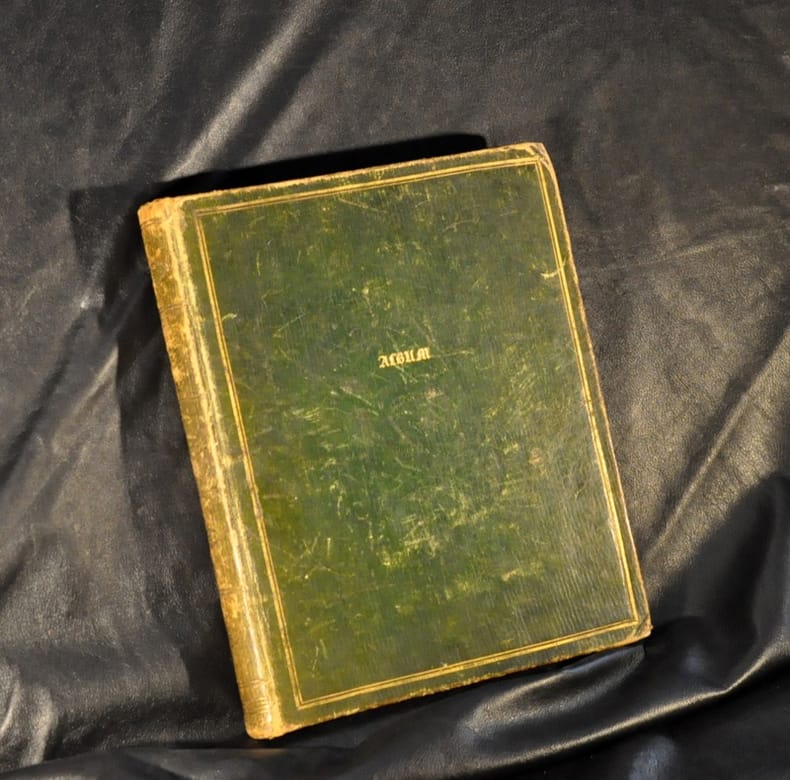
2998Album romantique de 205x260 mm, relie en basane maroquinee verte portant en super- libros sur le premier plat « Album ». Il se compose de feuillets de papier fort bleu montes sur onglets. Sur le verso de la premiere page, une table des matieres manuscrite.Les dessins au nombre de 39 sont colles a pleine page et certains d’entre eux sont decoupes, amputant une partie du dessin, ou sommairement replies en haut ou en bas. Certains dessins decoupes dans leur partie inferieure laissent deviner des ecritures au crayon qui ont ete otees. Un seul dessin, celui d’Anthony Thouret comporte une legende manuscrite.Le papier utilise est un papier fin, hativement decoupe. La plupart des dessins ont ete plies en deux ou en quatre. Certains semblent avoir ete mis sous enveloppe , certains ont ete dechires en tout ou partie puis recolles avec une bande en papier.
4to (170 x 222 mm). Armenian manuscript on paper. (30 blank), 233 (instead of 235), (29 blank) pp., paginated in the original hand, lacking one leaf (pp. 7-8). 31 lines, 2 columns. Script in black and purple, columns ruled in purple. Illustrated with an illuminated headpiece and border on title-page, 5 further illustrated headers, 3 of which are illuminated, and 4 botanical paintings. Leading and terminal blanks have vertical rules in colours and gilt. Contemporary modified traditional Armenian binding, full leather stamped in blind and gilt, red silk pastedowns. A striking and finely illuminated compilation of commentaries on the Song of Songs, written in classical Armenian by the scribe, clerk, and notary Yohan Vagharshapatets’i for the patron Yakob (Hagop) vardapet. A valuable piece of art in its own right, one of the manuscript's previous owners, revealed by an inscription, was Prince Georgy Vasilyevich Obolensky (1826-86), an active prince who worked as a lawyer and held the rank of lieutenant general in the Imperial Russian Army. - The four commentaries herein are copied in a professional notrgir (notary) script with some bolorgir (minuscule) and erkat’agir (majuscule) throughout. The first commentary in this compilation is by the famous St. Gregory of Narek (ca. 945-1003), beloved by Armenians for his Book of Lamentations, mystical prayers, poetry, hymns, homilies, and other works. His commentary on the Song of Songs, his earliest work, was written at the request of Prince Gurgen-Khachik Artsruni in 977. The second text is the Armenian translation of the Commentary written by Origen of Alexandria (ca. 185-253), the Greek theologian and ascetic. The third was penned in the 13th century by Vardan Arewelts’i (ca. 1200-71), scholar, educator, and vardapet (learned priest), best known for his History and Geography. The fourth and last commentary was composed by Gregory of Tat’ew (ca. 1344-1409), a renowned exegete, scholar, and teacher. - The influence of print technology is apparent in the manuscript, which mixes manuscript tradition and 18th century modernity. It includes a title-page, which is unusual in manuscripts but common in printed books, clearly showing the scribe and artist’s knowledge of and exposure to books produced on a printing press. The floral decorations are unrelated to the text and are included to embellish the book. In the 17th to 18th centuries, such motifs become more prevalent in both late Armenian and Islamic manuscripts, and were possibly introduced through exposure to Western European printed herbal books - which in turn had been inspired hundreds of years previously by Arabic and Greek herbal manuscripts. - Covers lightly worn, binding delicate, a few minor stains. A beautiful example of the Armenian manuscript tradition.
192075933s. d. [ca 1920] | 25 x 33 cm | en feuilles sous chemises
English manuscript on vellum. Approx. 620 x 555 mm (with folded plica). With two red seals. Stored in a custom-made half morocco case with gilt-stamped spine. Original deed of the first substantial purchase of land on the Brooklyn side of the East River ever made by the New York municipality, a purchase that was called by Henry E. Pierrepont (1808-88), director and historian of the Union Ferry Co., "the foundation of the claim of the City of New York to their land in Brooklyn" (23). After the capture of New Amsterdam from the Dutch in 1664, a municipal government had been formed, the Corporation of New York, while across the water, "Breuckelen" (as it was then called) long remained an independent, rival city on its own. - "As early as the 12th of October, 1694, the Corporation of New York purchased from William Morris, for no specific consideration, his hourse, barn and premises, situated at the 'Ferry', on Long Island. The house stood on the north side of the road, opposite the present Elizabeth Street, about one hundred feet from the then shore of the river" (Pierrepont, 16ff.). The site was then known as "Brookland Ferry", the place where George Washington escaped with his troops after the Battle of Long Island. It adopted its modern name, Fulton Ferry, when in 1814 Robert Fulton established the first steam ferry route connecting Manhattan and Brooklyn, which played such a major role in their shared history and evolution. - Incipit: "This Indenture, made the twelfth day of October, in the sixth year of the reigne of our Sovereigne Lord and Lady, William and Mary, by the grace of God, of England, Scotland, France, and Ireland, King and Queen, defenders of the faith etc., and in the yeare of our Lord one thousand six hundred ninty and four, between William Morris, now of the Ferry, in the bounds of the towne of Breuckle, in Kings county, on Long Island, gent., and Rebecca his wife, of the one part, and the Mayor, Aldermen and Commonalty, of the City of New York of the other part [...]". - Two copies of the deed would have been made, and this appears to be the deed retained by the Morris family and heirs, with an early note indicating that it was also "recorded in the Office of the Town of Clerk of City of New York in the Book of Grants". Pierrepont, writing in 1879, was still able to locate the City's copy at the Office of the Comptroller, where it may have remained until 1910, when such documents were transferred to the New York State Library; it probably perished in the notorious archive fire of 1911. - Drafted and signed by Ebenezer Wilson, later Mayor of New York City (1707-10). Verso signed additionally by William Pinhorne (d. 1720), the American colonial politician and jurist. Folded, few small tears to folds with negligible loss. Gabriel Furman, Notes, Geographical and Historical, Relating to the Town of Brooklyn, in Kings County on Long Island (Brooklyn, 1824), Appendix A, pp. 102f. (published in part). Henry Evelyn Pierrepont, Historical Sketch of the Fulton Ferry, And Its Associated Ferries (1879), pp. 16-23.
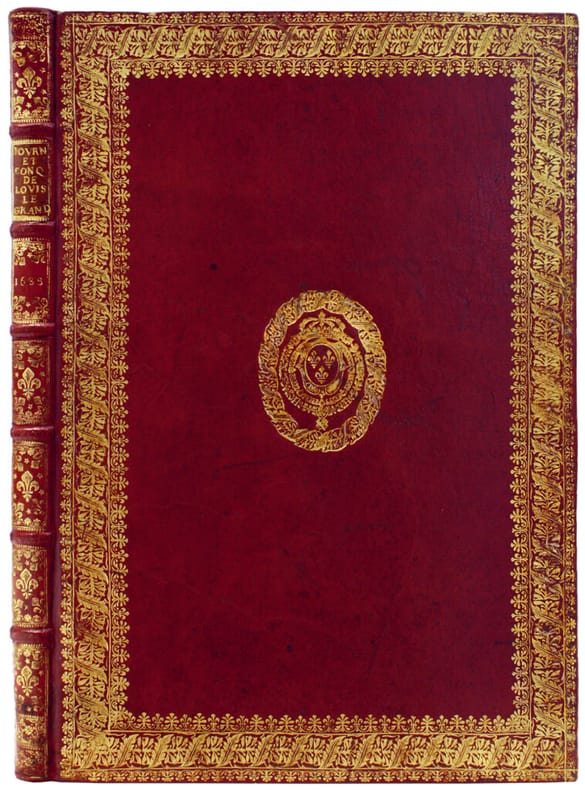
LCS-18301Le journal manuscrit des évènements politiques et militaires, de l’année 1688. S. l. n. d. [Paris, vers 1715]. In-folio de (46) ff., 9 double-page aquarellées. Plein maroquin rouge, dentelle du Louvre encadrant les plats, armes royales frappées or au centre, dos à nerfs richement orné de fleurs-de-lys et étoiles dorées, roulette dorée sur les coupes, roulettes intérieure dorée, tranches dorées. Epidermures. Reliure de l’époque. 445 x 307 mm.
4to (166 x 195 mm). German and Latin autograph manuscript on paper, signed at the end. (2), 158 ff. with 3 illustrations (on leaves 2r, 68v and 151v). Numerous contemporary manicules and pencil notes. Contemporary blind-tooled vellum over pasteboards. Hertodt's working alchemical notebook, written in a fluid mixture of German and Latin. The manuscript contains detailed instructions on alchemical processes, including the transmutation of lesser substances into gold (with first-person remarks on experiments), alongside a cryptographic alphabet and a list of inauspicious dates for the practice of alchemy. It is signed on the final page by its author "Dr. Hertodt" (f. 158r). - The first of the numerous recipes, experiment records, and alchemical notes is: "Ein gutt Particular gold zu machen" (f. 1r-v). We also find recipes with instructions on "Ein oleum Philosophorum zu bereiten" (f. 7r), "Crocum Martis [alchemical symbol for iron]" - ferric oxide (f. 9v), "Oleum sulphuris" - or fuming sulphuric acid (f. 10v), "Augmentum auris [alchemical symbol for gold]" (f. 18v), the process of coagulation of mercury (f. 23r), a recipe for making bismuth (f. 34r), "Ein schön und treffliche Particular Tinctur ex [alchemical symbols for iron, copper and gold] aus Fratri Basilii Valentini" (f. 35r), "die Venus [alchemical symbol for copper] zu transmutieren (f. 38r), the separation of gold from antimony (f. 63r), "Modus faciendi Cinabari", in Latin (f. 63v), the transcription of a cryptographic cipher (ff. 53v-54r), a list of days and months on which the alchemical process should not be performed (f. 80r/v), a recipe for flowers of antimony (by roasting and condensing white fumes), "Weise Flores [alchemical symbol for antimony] zu machen" (f. 82v) and instructions for making rosemary spirit ("hungarisches Wasser"), a popular early modern perfume (ff. 143v-144r). - Johann Ferdinand Hertodt von Todenfeld was a German physician from Moravia (now in Czechia). He wrote a series of monographs on medical and natural philosophical topics, including a geological and botanical description of his homeland, the "Tartaro Mastix Moraviae" (1669), and the "Crocologia" (1671), a medico-scientific treatise on saffron, translated into English with a biography of the author as recently as 2020. He later became personal physician to Holy Roman Emperor Leopold I and a member of the German National Academy of Sciences "Leopoldina" (cf. Ferguson I, 400). As a recognised authority in medical matters, it is no surprise to see Hertodt call on the learning of his colleagues in the present manuscript. Sigismundo Fueger, Swiss professor of alchemy, whose mines Paracelsus worked as a younger man, is mentioned on f. 25r, for example, as is the German alchemist Basilius Valentinus on f. 35r. - Apparently complete, with contemporary foliation (also used here), and an autograph signature of the author on the final page. Pages have varying numbers of lines, in a single hand switching fluidly between cursive German and humanist Latin scripts following switches between the two languages. Foxed and browned throughout, the text has fading between ff. 104v-142r owing to the quality of the ink. The manuscript offers a singular, hands-on perspective on the working life of a royal physician and scholar in the 17th century Habsburg lands.
Oblong 8vo. Musical manuscript in English, on paper written in a single cursive hand in brown ink, four staves to a page. 12 leaves: blank, title, dedication, 11 pp. of music on 6 leaves, 3 blanks. Dedication to Queen Anne on second recto. In a contemporary morocco binding, exuberantly tooled and gilt by Robert Steel, arguably the finest binder in England at the time; board edges gilt, marbled endleaves, all edges gilt. An exquisite musical manuscript, composed and bound for royal presentation on New Years' Day (then celebrated on Lady Day, March 25). Inscribed to Queen Anne of England. Signed "J.L." at the end, the pieces are marked "Overture", "Minuett" (bass), "Minuett" and "Scotch Air", one passage to be played "slow". - The violinist, singer and composer Lenton joined the ensemble of royal musicians, known as the King's Musick, in 1681 under Charles II and played at the coronations of James II and of William and Mary (cf. New Grove X, 665). As violinist, Lenton accompanied William to Holland in 1691 and contributed to the royal musical repertoire. He wrote incidental music for some dozen plays between 1682 and 1705 and accumulated the offices of Gentleman Extraordinary at the Royal Chapel (1685) and Groom of the Vestry (1708). The binder Robert Steel (fl. 1668-1711) apprenticed with Samuel Mearne and took possession of his tools after his death in 1686. In turn, one of Steel's workmen, Thomas Elliott, secured Mearne's tools and became a principal binder for the Harleian Library. - In fine condition: the splendid binding shows a repeated flower-and-foliage tool flanked by rules forming the outer frame; the panels have small fleurons and lobate tools at left and right from which spring billowy sails and branches with clusters of grapes and curled leaves; a gilt-lettered title "Lenton New Year 1703" fills the central cartouche of drawer handles; concentric circles and fleurons cover the spine. For the binding cf. Maggs Bros., Bookbinding in the British Isles Catalogue 1075 (1987), no. 118 (the outer frame tool, there called a roll) and Catalogue 1212 (1996), no. 70 (frame tool), as well as Foot, The Henry Davis Gift II, no. 148.
LCS-186419
Folio (217 x 337 mm). German manuscript on paper. Pictorial watercolour title, (5) pp. of text, and 14 watercolour plates or arms and armour, each with German text mounted on verso. Interleaved with a calligraphic English translation and tissue guards. - (And:) I Gradi della Cavalleria [...]. "1688" (but apparently also early 19th century). Watercolour title-page and 17 watercolour plates, captioned in Italian. With an additional watercolour plate, initialled "M.S.", loosely inserted. Late 19th century red morocco by R. W. Smith with finely gilt spine and spine-title; leading edges and inner dentelle gilt. Green calf doublures. Marbled flyleaves. Two striking series of highly decorative watercolours illustrating the history of armour throughout the ages. The first is purportedly copied after an earlier manuscript by the Augsburg artist G. P. Rugendas, dated 1714. The latter, with a date of 1688, is attributed to one "Matteo Argenteocorno" - a pseudonym for the goldsmith Matthäus Silberhorn from Ulm (cf. Thieme/Becker XXXI, p. 21), whose authorship is further established by his erased name on the final page of the first series: "Diversa objecta historialia, invenit & delineavit, & in argentam, vel aurichaleam caelavit [M. Silberhorn] a Ulmae [1841?]" (including a reference to an additional illustration not present here, showing the capture of Frederick the Fair at Mühldorf in 1322), and also by the loosely inserted watercolour bearing his initials "M.S." in ligature. - The series attributed to Rugendas shows armour from southern Germany, including a suit from the armoury at Lucerne, while four of the illustrations depict tournament armour. The Augsburg-based Rugendas was famed for his battle scenes, and while the style of the present watercolours is generally consistent with his popular drawings and prints, no original manuscript on which the present series might be based could be identified, and they are more probably original designs by Silberhorn, painting in the manner of an admired predecessor. The "Argenteocorno" manuscript depicts 13 cavalry ranks in uniforms of the War of the Spanish Succession (1701-14) set in landscapes, often with additional figures. It includes four medallion portraits of Eugene of Savoy, Maximilian Emmanuel of Bavaria, Frederick William of Brandenburg, and Alexander von Württemberg, surrounded by allegorical figures, military trophies, and battle scenes. - Hinges of the binding slightly rubbed. Some plates on variant laid papers, hinged on tabs. A unique survival, sumptuously bound in elaborately gilt American red morocco by R. W. Smith, long associated with the Grolier Club Bindery.
183089005s. n. | s. l. s. d. [circa 1830] | 25 x 19.7 cm | Une feuille
- s.d. (circa 1945), 22x27,5cm, 18 feuillets reliés sous chemise et étui. - Il est de la race des poètes de tous les temps. De la race des pères de la poésie. Pierre Seghers. Exceptionnel ensemble de onze poèmes autographes de Louis Aragon, rédigés au premier semestre de l'année 1945, avec une page de sommaire de la main de l'auteur. Il s'agit d'une sélection personnelle d'Aragon en vue de leur parution dans sa première et célèbre anthologie poétique, dans la Collection «?Poètes d'Aujourd'hui?» (Aragon, chez Pierre Seghers éditeur à Paris, n° 2, 20 juillet 1945). Ce choix de poèmes manuscrits a été adressé par l'auteur au directeur de la publication, Claude Roy, et enrichi à l'attention de son ami d'une page de sommaire recensant les poèmes et la chronologie des recueils. Notre ensemble comprend les manuscrits de «?Fugue?», «?Pour demain?» et «?Casino des lumières crues?» (parus dans Feu de Joie, 1920), «?Un air embaumé?», «?Persiennes?», «?Poème de cape et d'épée?» (Le Mouvement perpétuel, 1924), «?Portrait?» «?Ancien combattant?», «?Litanies de [trois étoiles]?» (La Grande Gaîté, 1929), «?Tant pis pour moi?» (Persécuté persécuteur, 1931), «?Couplets du beau monde?» (Les Communistes ont raison, 1933), et «?Magnitogorsk 1932?» ainsi que la «?Ballade des vingt-sept suppliciés de Nadiejdinsk?» (Hourra l'Oural, 1934). Les poèmes manuscrits sont reliés en demi maroquin noir, plats de papier à motifs stylisés, contreplats doublés d'agneau noir, et un étui bordé du même maroquin, ensemble signé Leroux. Ces manuscrits offrent un panorama unique de quinze ans d'écriture placée sous le signe de l'insolence poétique et politique. Parmi ces poèmes d'exception, on retrouve «?Fugue?» et «?Casino des lumières crues?», issus de Feu de Joie, composés durant ses années de jeunesse pré-surréaliste?: «?Une joie éclate en trois Temps mesurés de la lyre Une joie éclate au bois Que je ne saurais pas dire?» («?Fugue?») Les poèmes les plus anciens choisis par Aragon pour l'anthologie sont également l'occasion de rendre hommage aux maîtres et amis du jeune poète - tels Paul Valéry («?Pour demain?», publié dans Feu de Joie), ou Guillaume Apollinaire, à qui il dédie «?Un air embaumé?» dans Mouvement Perpétuel, s'inspirant des Calligrammes?: «?Sur la tombe Mille regrets Où dort dans un tuf mercenaire Mon sade Orphée Apollinaire?» Témoignant de l'influence décisive de l'amitié d'André Breton, rencontré en 1917 dans la librairie d'Adrienne Monnier, les uvres du jeune Aragon prônent déjà une joyeuse déconstruction verbale. Le poème plein d'humour «?Casino des lumières crues?», annonce subliminalement l'arrivée de Dada à Paris?: «?Un soir des plages à la mode on joue un air Qui fait prendre aux petits chevaux un train d'enfer?» Cet exemple de «?cubisme littéraire?» empreint de préciosité et d'hermétisme répond aux poèmes de Breton qui formeront son premier recueil Mont de piété, et nous plonge dans l'enthousiasme des trois inséparables Aragon, Soupault et Breton. Leur collaboration prendra dès 1919 la forme du journal Littérature, bientôt renommé en Révolution surréaliste pour servir de tremplin à leurs idées de renouvellement poétique. Avec l'irruption en 1920 de Tristan Tzara et de son manifeste dadaïste dans le paysage de l'avant-garde parisienne, l'écriture d'Aragon opte pour la radicalité, culminant dans le fameux «?Persiennes?». La formidable répétition de «?Persienne?», typique du nihilisme de Dada, constitue avec les autres manuscrits extraits de Mouvement Perpétuel autant de manifestes de la révolution qui s'opère à l'aube du Surréalisme. Adoptant le terme au printemps 1924, Aragon, Breton et Soupault tournent une page de l'histoire littéraire, résumée dans l'ironique «?Portrait?» qu'en fait l'auteur dans La Grande Gaîté parue en 1929?: «?Rêvé de l'auteur de la Marche lorraine Pensé à l'aurore aux Bourgeois de Calais Pour l'apéritif lu la Jeune Parque?». Dans le même recueil, Aragon résume ironiquement la relative vacuité de l'expérience dadaïste
- S.n. , s.l. août 1808, in-8 (17,5x21,5cm), (40f.) (3f. bl.), broché sous chemise et étui. - SADE Donatien Alphonse François, Marquis de Les Antiquaires. [The Antiquarians] Unique complete autograph manuscript [Charenton asylum] August 1808, in-8: 175 x 215 mm (6 7/8 x 8 7/16 "), (40 f.) (3f bl.), original wrappers The complete original manuscript of one of Sade's first works, ruled in pencil throughout, comprising 40 leaves written recto and verso. This manuscript, like the other extant items from the Marquis, was dictated to a scribe and corrected by Sade himself. Contemporary green paper wrappers with a small lack to middle of spine. Ink title, partly erased, to upper cover: 9/ Net et corrigé en août 1808 - bon brouillon. Les Antiquaires. Comédie en prose en 1 acte [Copied and corrected August 1808 - a good draft. The Antiquaries. A prose comedy in 1 Act]. This title is repeated on the verso of the upper cover. Numerous manuscript corrections, annotations and deletions in Sade's hand, principally adding blocking, and rich in both stage and acting directions. Written in 1776 and re-copied at Charenton in 1808, and most likely augmented at the time with various topical references - notably including an allusion to Napoleon, "of whom he was hoping, in vain, to receive permission to leave the asylum at Charenton as a free man" (p.94) - Les Antiquaires is one of the first theatrical pieces written by the Marquis and therefore one of his first literary works overall, written eight years before the Dialogue entre un prêtre et un moribond [Dialogue Between a Priest and a Dying Man]. Though the precise dating of these pieces is made difficult due to the lack of the original manuscripts, several clues have allowed bibliographers to date the initial composition of this piece to 1776, possibly with a corrected version during the Revolution and a few final changes at the time of this last edit, which is today the only extant manuscript of this play. These clues include the status of the Jewish and English characters, the style of the dialogues, and Sade's correspondence with theatres; the strongest clue being biographical in nature. Les Antiquaires can essentially be considered the true "theatrical version" of Sade's Voyage en Italie with which it shows a sustained intertextuality. The play is about an antiquary - in the 18th century sense of the term, which is to say a learned devotee of Classical culture - who wants to marry off his daughter to a friend with the same passion, who nonetheless finds a way of convincing him to let her marry her young lover. Whether it be in the learned dialogues of the antiquaries or in their eccentric parody by the young lover imitating them, Sade draws upon his own experience and observations from his travels, which he expands or twists, according to the viewpoint of his various characters. Hence, the description of Mount Etna by the lover - Delcour - is a parody of Sade's detailed description of the Pietra Malla volcano, and the made-up "subterranean tunnel linking Etna to America" is directly inspired by the tunnel of the Crypta Neapolitana, described by Sade in his Voyage. The Marquis would reach back to this same experience of volcanoes in one of the most famous scenes in his Histoire de Juliette. Barely returned from his latest grand tour and almost at the same time as writing his passionate and detailed account of the experience, Sade was thus also writing a satirical version of his own work (until his problems with the military authorities). The work is at the same time a social critique of pointless erudition and a self-mockery of his own passion for history and of his "zeal to see everything, his insatiable curiosity" (cf. Maurice Lever, preface to Voyage en Italie). This virulent satire is paradoxically twinned with a very erudite display of the author's knowledge of the latest architectural discoveries and the major contemporary questions in the field. This was, in fact, the element cr
Small 8vo (105 x 159 mm). Illustrated astrological manuscript. Red and black ink in Cyrillic script on paper. 297 ff., written on rectos and versos, with 14 hand-cut and illustrated volvelles with between 1 and 4 moveable parts, 160 chiromantic diagrams, and numerous astrological charts. Engraved folding table of the Cyrillic alphabet inserted in front ("These are the print letters / These are the letters used in writting [sic]", taken from The Russian Catechism [London, Meadows, 1725]). Modern green morocco stamped in blind. Housed in custom green cloth chemise and slipcase. Edges sprinkled red. A fully handwritten 18th century prognostication manual containing astrological tables and zodiacal charts, Sator squares and other magical tables, as well as ample matter on palmistry. Throughout the volume there are 14 working handcut volvelles with as many as four moveable discs, some with carefully cut windows. An appendix at the end contains an extensive topical manuscript. - Popular divination remained a fixture of Russian folk beliefs long into the 19th century, and the Sator Square was commonly used by the schismatic Russian Orthodox Old Believer communities since the 17th century. From the late 18th century onwards, printed sources discuss the magical folk rituals of Old Russia: as early as 1782, the Russian civil servant Mikhail Dmitrievich Chulkov published his "Slovar' ruskikh sueverii" ("A Dictionary of Russian Superstitions"), which was reprinted four years later as "Abevega russkikh sueverii" ("The ABC of Russian Superstitions", Moscow, 1786) - undoubtedly drawing on some of the same principles that inform the present manual. Another four years later, Semen Komisarov published a fortune-telling compendium ("Drevnii i novyi vsegdashnii gadatel'nyi orakul", Moscow, 1800) containing sections on dream divination, magic tricks, palmistry and physiognomy. While widely known and practiced by simple country folk and gentry alike, such arcane practices (culturally associated not exclusively, but especially with women) were frowned upon by the philosophers and administrators of 18th century Enlightenment: indeed, "under Catherine the Great dream interpretation was made a criminal offence, together with various kinds of magical practices and witchcraft" (Ryan/Wigzell, p. 666). The survival of so copious and wide-ranging a manual clearly designed by and for a practitioner rather than a theorist is highly uncommon. - Some duststaining and fingerstaining from extensive use. Moveable volvelle discs appear to be lacking from two additional circular diagrams. Handsomely rebound in the 20th century. - Provenance: front matter has ink stamp (ca. 1800) by R. D. Combe, a Westminster gentleman whose library was dispersed in 1821 by Saunders of St James's Street. Latterly in the library of the noted Russian-American photographer and biologist Roman Vishniac (1897-1990). Cf. W. F. Ryan & Faith Wigzell, "Gullible Girls and Dreadful Dreams. Zhukovskii, Pushkin and Popular Divination", The Slavonic and East European Review 70 (1992), pp. 647-669.
8vo (ca. 175 x 105 mm). Manuscript on paper, written in a cursive, Persian-Arabic script in 15 to 23 lines per page. With 1 leaf containing 8 hand coloured illustrations, with captions, of medical instruments (4 instruments on respectively the recto and verso of leaf 26). Contemporary brown calf, with blind-stamped decorations. Arabic manuscript containing the Arabic translation of Ibn Sina's Qanunsah ("Small canon"), originally written in Persian: a brief medical compendium compiled by the Khwarazmian polymath Mahmud ibn Muhammad ibn Umar al-Jaghmini based on Ibn Sina's famous Qanun. This abridged manual of medicine is arranged in ten parts ("maqalat", or "discourses"), each containing several chapters. The first maqalat serves as a general introduction, dealing with the basic concepts of 14th century medical science and illustrating the various physical qualities (al-arkan) and body constitutions (al-amzigat), then focusing on the four Galenic humours (al-ahlat) - blood, phlegm, yellow and black bile - before discussing the parts of the body, the senses or faculties (al-quwá), and the preservation of one's natural temper (al-umur at-tabi iya). Further "discourses" treat anatomy, the various "conditions of the human body" ("ahwal badan al-insan"), the pulse, the "tafsira", or urine bottle given to the physician by the patient for inspection, the various aspects of the "wise management of diseases", "head diseases" and "diseases affecting the other body parts", chronic diseases of the various organs, evident defects (or "infirmities") in the external appearance of the body, fevers, and ultimately the importance of food and drink as remedies. - The Qanunceh was widely used at Eastern Persian schools as an introductory medical instruction manual for at least three centuries. - Slight soiling of the extremities of the leaves, otherwise in good condition.
Folio (225 x 302 mm). Spanish ink manuscript on paper. 92 pp. Bound in 18th century half calf over marbled boards; giltstamped morocco label to spine. A near-contemporary manuscript translation into Spanish of Paolo Giovio's famous "Commentario de le cose de' Turchi" (Rome, 1531). A Spanish edition was printed in Barcelona in 1543 as "Commentario de las cosas de los Turcos", but the textual variations in this manuscript confirm that this is an entirely different translation based on the Italian first edition, most likely predating the Spanish one, as it does not include later additions to the Italian text. - The historian and physician Paolo Giovio (1483-1552), Bishop of Nocera, wrote and dedicated this commentary to Emperor Charles V, with the aim of supporting a crusade against the Ottoman Turks and assisting the Emperor in understanding the nature and strength of his adversary. The annihilation of the French and Hungarian forces at the Battle of Mohács by the army of Suleiman the Magnificent on 29 August 1526 and the near success of the Ottoman siege of Vienna in 1529 as well as the constant and aggressive privateering activities of the Barbary states in the Mediterranean had highlighted the danger posed to Christendom by the Ottoman Empire and set in motion a Christian counterattack with Charles V as Holy Roman Emperor and the most powerful monarch in Europe as its figurehead. - "Of the various treatises written for Charles V on the Turkish menace, Giovio's was probably the most realistic, the least moralizing, and the most informative. Recalling the emperor's difficulties with Latin, he made his offering in simple Italian. The text was economical. As the Ferrarese envoy remarked, by reading it, 'Your Excellency will learn in a short time what he would not perhaps learn even in a very long time without the book.' Despite his love for the paladins of romance, Giovio regarded this crusade as a practical matter. He understood the Ottoman expansionist drive better than most, and he had a new appreciation of the impact of oriental events on Western history. His objectivity as an historian and his openness to divergent human values enabled him to discern the real strengths of the Turkish state and to present them in full relief. He even took a kind of ironic satisfaction in holding up instances of honorable behavior on the part of 'barbarians' as a reproach to Christian commanders and princes. An enemy who was steady, honorable, magnanimous, disciplined, and valiant was much more to be feared than the degenerate barbarians of popular imagination. So unprejudiced was Giovio in assessing the strengths of the Turks that he often had to defend himself against the accusations of contemporaries such as Jiminez de Quesada that he was 'aficionado a la nación turquesa'" (Zimmerman, Paolo Giovio: The historian and the crisis of 16th century Italy [1995], pp. 121f.). - The Commentario was "short, lively and readable" (Meserve, "Commentario de le Cose de' Turchi by Paolo Giovio", Renaissance Quarterly 60.1 [Spring 2007], pp. 158-160). It was first published in 1531 and again in 1532 (by Antonio Blado); subsequent editions in 1533, 1535, 1538, 1540, 1541 and 1560 as well as translations into Latin, German, French and Spanish attest to its popularity. - Provenance: from the extensive manuscript library of Augustus Frederick, the Duke of Sussex (1773-1843), the 6th son of George III, with his bookplate on the front pastedown and shelfmark on a paper label at foot of spine. The ms. is not included, however, in the sales catalogue of his library, "Bibliotheca Sussexiana: The extensive and valuable library of His Royal Highness the Late Duke of Sussex" (3 vols., London, 1827-39). - This manuscript copy, perhaps illustrating the continuing value of Giovio's writing, includes a passport, loosely inserted, issued by Diego Dávila Mesía y Guzmán, marqués de Leganés, for Carlos Ruzzini to travel through the Duchy of Savoy en route to Madrid as Venetian ambassador to Spain in 1691. Thereafter, Ruzzini was, from August 1705 to September 1706, ambassador to the Turkish Court for the celebrations of the accession to the throne of Sultan Ahmed III. He represented Venice in the negotiations that led to the 1718 Treaty of Passarowitz between the Sultan, the Holy Roman Empire, and Venice, and he was sent to Istanbul once more from May 1719 to October 1720 for the ratification of the treaty before later being elected Doge of Venice for the last three years of his life. His account, the "Relatione del Congresso di Carloviz e dell'Ambasciata di Vienna di Sr. Carlo Ruzzini Cavr." published in the Fontes Rerum Austriacarum (Vol. 27, pp. 345-444), is one of the most valuable sources for Venetian-Ottoman relations at the beginning of the 18th century. The inclusion of the passport with this manuscript suggests that the manuscript might have been owned or used by Ruzzini to inform himself on Ottoman affairs in anticipation of his dealings with the Ottoman Court before the manuscript subsequently joined the collection of the Duke of Sussex. - Joints and edges slightly rubbed, otherwise in fine state of preservation.
8vo (ca. 120 x 240 mm). Arabic manuscript on beige paper. 82 leaves, 21 lines. Black ink in Nasta'liq script by two hands, important words underlined in red ink; numerous diagrams in red ink. Bound in brown morocco. Illustrated commentary by Qadizade al-Rumi on Al-Jaghmini's famous astronomical treatise "Mulakhas" ("Summary on the Science of the Authority"), completed in 808 AH. Al-Rumi (1364-1436), known under the name of Salah al-Din Musa Pasha, was one of the principal astronomers at the famous Samarkand observatory. The present treatise is dedicated to his ruler and patron Ulugh Beg. - Signs of wear; dampstaining and some edge tears throughout. Cf. GAL I, 473.
Large 4to (270 x 195 mm). 36 ff. With 72 very interesting pen-and-ink drawings, partly coloured in brown, yellow and reddish washes. Contemporary marbled boards. In custom-made cloth portfolio. Spectacularly illustrated manuscript describing and illustrating many moveable and rotating pyrotechnical units and machines, including rockets. The title-page, bearing the name of a former owner (Valentino Vieri, who probably also added some probationes pennae), is followed by a description of the first 62 coloured drawings, beginning with the "Giuoco della Luna e Sole" (games of moon and sun), including all sorts of revolving, spouting, exploding and firing units, rockets, and other gadgets: On fol. 20r three objects are illuminated: an aloe vase, a tree, and a coat of arms, inscribed "Dini". Fols. 20v-23r show full-page installations, including a "Colona Trionfante" with a winged angel on top, a Lion of St. Mark, the symbol of the free Republic of Venice, holding an open book with his right paw (displaying the text "Pax tibi Marce Evangelista meus"), an oval on top of a balustrade, bearing the text "W. Gesu Giuseppe e Maria", a "Piramicia Egiziana", and a cupola with lanterns and fire pots. Fols. 23v-25r contains two double-page war scenes: the first, a fortified castle by a coast, with a vessel and a galley at sea; the second, a fortified tower and an army camp with tents opposite, with symbols of war and military equipment in the foreground. The final fols. 25v-36v contain indexes and instructions for fireworks: (1) "Indice delli Giuochi di Fuocho" (the various units and rockets; fols. 25v-26v); (2) "Regole Generali": 84 numbered instructions for construction and operation of fireworks (fols. 27r-35r); (3) "Indice delle Misture" (fols. 35v-36r); and "Catalogo de Generi ed Utensili" (fol. 36v). - There may be a connection between this manuscript and the Papal Master of Ceremonies Msgr. Giuseppe Dini (d. 1799). The Library of the Getty Research Centre possesses a ms. written by Dini ("Relazione o sia diario di tutto quelle che e stato osservato in Roma nelle venuta del Re delle due Sicilie Ferdinando IV e la Regina Maria Carolina Arciduchessa d'Austria", 1791) containing biographical and historical notes, including descriptions of the preparations for the royal visit with details about the route, the number of soldiers guarding the visitors, and the costs of the entertainment (including operatic performances and fireworks). At the back of that manuscript are printed announcements of the firework display and official appearances by Pope Pius VI. - In 1782 Dini - as that Pope's Master of Ceremonies - published a diary of the Papal journey, via Venice, to Vienna (undertaken with an aim to mitigate the social and ecclesiastical reforms enacted by Emperor Joseph II). Perhaps the ms. with its explicit references to the Republic of Venice can be connected with this 1782 journey (a German edition, "Vollständiges Tagebuch von der Reise des Pabsts Pius VI. nach Wien", appeared in Breslau in 1783). Another possibility is a connection with the election of the new Pope Pius VII in March 1800 in Venice, after a very difficult conclave in Venice that began in December 1799, soon after the death of Pius VI and just before the death of Dini on 2 November 1799. - Spine slightly damaged; some browning. In good condition.
189289339Sans nom d'éditeur | Sans lieu d'édition s. d. (ca 1892) | 21 x 34.5 cm | Relié
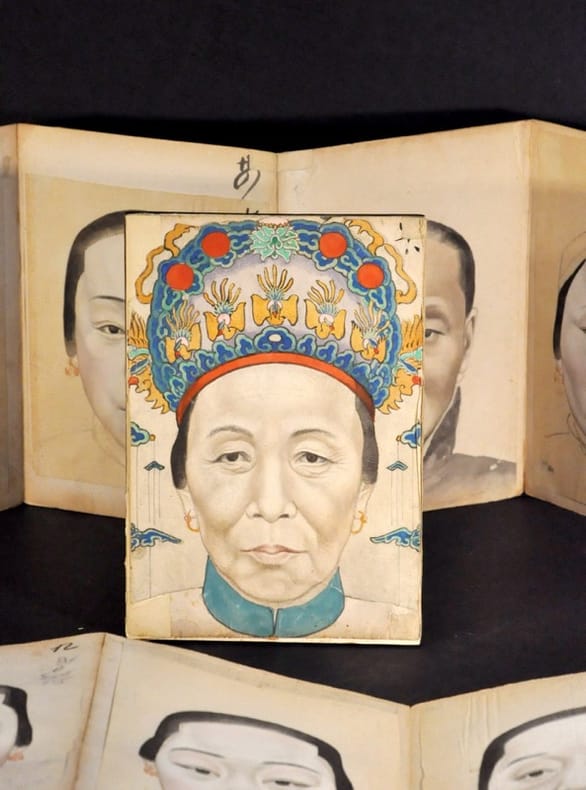
2986Dynastie Qin (1853) 117 portraits à l’aquarelle et au crayon, sur papier de Chine contrecollé sur cartonmonté en soufflets (185x13mm), recto ou recto-verso, protégé par deux haies de boisvernies.Certains onglets rompus ou consolidés anciennement par du scotch.Portant au dos un timbre humide à l’encre rouge plusieurs fois répété , en haut àdroite la plupart des portraits comportent une numérotation en chinois, deux de cesportraits sont accompagnés de commentaires en chinois.