19 868 résultats
Large folio (ca. 270 x 410 mm). Italian manuscript on paper. 60 ff. comprising 9 pp. of text and 54 plates (versos blank), with 8 additional drawings loosely inserted or pasted on the inside front cover. Contemporary carta rustica. Comprising mainly 54 full-page plates executed in pen and ink, illustrating cannons, mortars, explosives, crossbows (with explosives), hoists, winches, ballistic trajectories, diagrams and artillerymen. Many of the drawings in this manuscript are modelled on the engraved plates in Diego Ufano's treatise on artillery, first published in Spanish (Brussels, 1612). There does not appear to have been an edition in Italian. - Binding worn with some staining to lower corners. From the collection of Thomas Fremantle, 3rd Baron Cottesloe (1862-1956), commander of the Territorial Army and president of the Society for Army History Research.
Manuscript (brush and wash), 2 vols., 194 × 105 mm, concertina-folded, with 61 drawings of horses (each double page, i.e. c. 210 × 195 mm), captioned. Original blue paper covered boards, labels to upper covers titled in manuscript. Traces of a numerous very neat paper repairs (usually correcting minute wormholes, as typical of Japanese books of this date, not affecting images), former (Japanese) owner's stamps to cover labels and first illustration in each volume. Preserved in a later blue silk covered folding case (wanting one bone closure). An elegant and delightful series of manuscript portraits of horses by an unidentified Japanese hand. 'The Hundred Horses' was a popular subject in Japanese art and is represented both in panel pictures, scrolls and books. The title is representative rather than prescriptive and does not denote one hundred in number, but simply 'many'. While the horse was an ancient component of Japanese art, the subject of the Hundred Horses was probably introduced into Japan under Chinese influence by the beginning of the Edo period (1603), with associations of courtly culture based on the noble and military connotations of the horse. The concern here is for careful typology of the different breeds, with characteristics of physique and markings neatly depicted and explained in the captions ('chestnut', 'spotted' etc), but the various postures and attitudes are arresting. An example of a manuscript book of similar period, slightly more elaborate, is preserved in Waseda University Library.
Folio (280 x 390 mm). German ms. on paper. German chancery cursive in brown ink with calligraphic chapter headings and initials. 28 lines, written space ruled in ink. 12 ff., 1 blank f., 83 ff., 2 blank ff. (thus complete with 190 written pages). Contemporary limp vellum with giltstamped cover borders and diagonal cross using the same roll-tools. Spine divided into six compartments by same tools and decorated with floral stamps. All edges goffered. The as yet unidentified writer of this manuscript had until 1552 served among the staff of Maurice, Elector of Saxony, and thus was one of the commanders in the Imperial Landsknecht army led by the Elector. Holding the rank of an "oberster provossen Leutnant" (head lieutenant provost), his duty had been to enforce military order among the mercenary regiment: he investigated and arrested lawbreakers; in trials he acted as prosecutor, and afterwards he executed the punishment. After the end of the campaign, the provost would no longer be protected by military law, for which reason he would usually leave the regiment early so as to escape acts of revenge by the soldiers. After more than 20 years of Imperial army service, our provost was thus without occupation or pay, and so in 1560 directly applied to the Emperor in the present, strongly autobiographical manuscript, requesting (in the 146th and final chapter) that he graciously bestow on him a benefice or sinecure ("aus lauterer genaden mit ainer genetten Pfründt oder schlechten Ofidicio oder Beneficij"). Obviously aware of the difficulties of his appeal, the author states in the preface that even if granted a personal hearing, he would hardly be permitted to present his case in such detail ("gibt ainem nit sovil audienz, biß Er sein wichtige sachen khann genuegsamblich fürbringe"), which is why he has decided on the written form. He is not a learned man, nor does he have an eloquent scholar ("ain doctor der wolreden khann") at his disposal to help him with his phrasing, but even a simple man has memory and brains enough to thus lay down his opinions. His extensive descriptions of personal involvement in important, historically documented battles against the Turks permit a precise dating of the manuscript. The writer participated in the campaign against the Raab fortress ("ungeverlich vor 8 Jahren mein gnediger Herr Herzog Moritz Curfürst [...] biß für Rab Innß Landt zue Hungern ist gezogen") and fought against the Turks at Steinfeld as early as 1532 ("bin auch dabey gewesen, wie man dazumal ein streifenden Haufen mit Türggen an der Schwarzach geschlagen hat [...] da Herr Sewastian Schertlin Obristen Leitnanbt war"). This Imperial mercenary probably remained in the regiment of the famous Landsknecht commander Sebastian Schertlin von Burtenbach (1496-1577), victor of the battle at Steinfeld and a participant in the 1527 Sack of Rome, until the mid-1540s. He also remarks on the desolate condition of the contemporary military, straightforwardly addressing the issues of corruption among the upper echelons ("wie die falschen blinden Namen C. May. so grossmechtigen schaden bringen"), poor pay ("wie die Armen Kriegsleuth über vortailt und genediget werden mit der schlechten Müntz"), and grievances regarding enlistment, food, and clothing, and advances suggestions on how to improve matters ("so man auf allen Musterungen mieglichen Vleiß fürwendt guette kriegsleuth zue bekommen"). - The manuscript begins with the index ("Register diser Oration oder Solticitation"); the counter-leaf of the first index page is glued to the vellum cover, forming the front pastedown. The index is immediately followed by the preface to the Emperor, the "Allerdurchleuchtigste Großmechtigste unnd unyberwindlichsste Erwelte Romischer Kayser aller genedigster Herr", which in turn is followed by the 146 chapters of the petition. Both the fact that the manuscript remained unsigned and also its provenance suggest that the author ultimately lacked the courage to submit to Ferdinand this manuscript, a work remarkable for its strongly autobiographical character as well as for its candid criticism of the Imperial military. - From the collection of the Austrian Minister of War, Count Theodor Baillet de Latour (1780-1848; hanged by revolutionaries), with his armorial bookplate on the front pastedown.
8vo (150 x 251 mm). Arabic (and Persian) manuscript on paper. 123 leaves. 19 lines, written in Naskhi script in black ink in more than one hand, some underlinings in red; some commentaries written diagonally in outer margins. Illustrated with numerous diagrams, mostly coloured, and one illuminated headpiece in colours and gold. Near-contemporary citron morocco with stamped central medallions of gilt leather onlay decorated with floral ornaments, doublures with gilt-painted central medallions incorporating intertwining floral and vegetal motifs on a dark green ground. Baha’ al-Din Muhammad ibn Husain al-'Amili (1547-1622) was an astronomer, mathematician and philosopher who was born in Baalbek, Lebanon and studied in Persia. He became Sheikh al-Islam under the Safavid Shah 'Abbas I (reigned 1587-1629) in Isfahan. The first treatise in the present collection is his "Khulasat al-hisab" (Essence of Arithmetics). The Arabic text was composed ca. 1600 CE and was dedicated to Prince Hamza, grandson of the Safavid Shah Tahmasp I (reigned 1524-75). - The second treatise, in Arabic, is entitled "Tashrih al-aflak" (Explanation of Celestial Spheres). The third treatise, in Persian, is entitled "Risalah fi’l-astrulabi" (Treatise on the Construction of the Astrolabe); the fourth treatise, in Arabic, is a super-commentary on Jaghmini's "Sharh al-haya'", itself a commentary on astronomy. - Some minor mostly marginal dampstaining, occasional stains and small repairs. Provenance: from the property of Dr. Eugene L. Vigil (b. 1941), of Lynden, Washington, USA. GAL II, 546f. & S II, 595-597. Cf. also B. A. Rosenfeld & E. Ihsanoglu, Mathematicians, Astronomers and Other Scholars of Islamic Civilisation and their Works (7th-19th C.) (Istanbul, 2003), pp. 348-350, no. 1058.
2523Un vol. in folio, de 201pp., plein parchemin (reliure de l'époque) (manque de parchemin au dos, petits trous de vers dans les marges inf. de qq. ff.).
Oblong 8vo. Musical manuscript in English, on paper written in a single cursive hand in brown ink, four staves to a page. 12 leaves: blank, title, dedication, 10 pp. of music on 6 leaves, 3 blanks. Dedication to Princess Anne on second recto. In a contemporary morocco binding, exuberantly tooled and gilt by Robert Steel, arguably the finest binder in England at the time; board edges gilt, marbled endleaves, all edges gilt. An exquisite manuscript musical part book, composed and bound for royal presentation on New Years' Day (then celebrated on Lady Day, March 25). Inscribed to Princess Anne of Denmark, soon to be Queen Anne of England. The pieces are labelled "Overture" and "Hornpipe", with one passage indicated "very slow". Signed "J.L." at the end. - The violinist, singer and composer Lenton joined the ensemble of royal musicians, known as the King's Musick, in 1681 under Charles II and played at the coronations of James II and of William and Mary (cf. New Grove X, 665). As violinist, Lenton accompanied William to Holland in 1691 and contributed to the royal musical repertoire. He wrote incidental music for some dozen plays between 1682 and 1705 and accumulated the offices of Gentleman Extraordinary at the Royal Chapel (1685) and Groom of the Vestry (1708). The binder Robert Steel (fl. 1668-1711) apprenticed with Samuel Mearne and took possession of his tools after his death in 1686. In turn, one of Steel's workmen, Thomas Elliott, secured Mearne's tools and became a principal binder for the Harleian Library. - In fine condition: the splendid binding shows a repeated flower-and-foliage tool flanked by rules forming the outer frame; the panels have a pot at the left and the right from which spread vines with fine small leaves; flame-tipped volutes in the corners and around the open strapwork central medallion from which extend rule hearts flanked by dots; daisies and foliage cover the spine. For the binding cf. Maggs Bros., Bookbinding in the British Isles Catalogue 1075 (1987), no. 118 (the outer frame tool, there called a roll) and Catalogue 1212 (1996), nos. 69 (leaves on the spine) & 70 (frame tool), as well as Foot, The Henry Davis Gift II, no. 148.
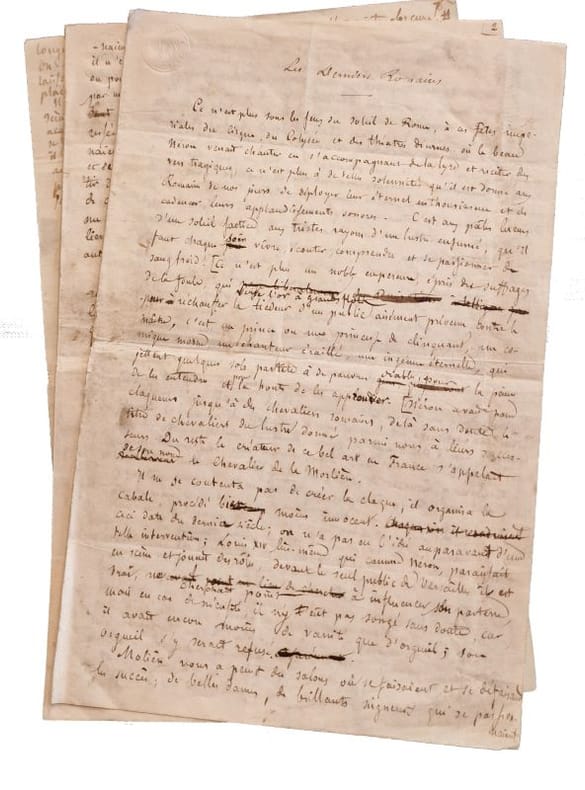
1844888601844 8 pages in-8 à l'encre brune (21 x 13,8 cm) sur 4 double feuillets, adresse autographe et marques postales au dos du dernier feuillet (avec petit manque de papier amputant la fin de deux mots), sous chemise demi-maroquin noir.Manuscrit complet, seul connu, de cette fantaisie sur les théâtres parisiens rédigée pour Le Diable à Paris. Nerval y esquisse une sorte de physiologie des claqueurs, ceux qu'on appelle "Romains" dans l'argot du théâtre : ces faux spectateurs recrutés pour ovationner ou bien huer les spectacles et dépeints notamment par Balzac dans ses Illusions perdues. Après un rappel des origines de cette tradition, Nerval constate sa généralisation dans le théâtre de son temps, et il s'amuse à détailler l'influence et la hiérarchie des claqueurs à partir de sa propre expérience de critique dramatique.Ce beau manuscrit de premier jet surchargé de corrections fut adressé à Pierre Jules Hetzel par courrier depuis Amsterdam le 23 septembre 1844 avec une amusante apostille signée "Gérard" in-fine et les cachets de la poste faisant foi. L'éditeur fit tirer un jeu d'épreuves conservé à la bibliothèque Spoelberch de Lovenjoul, mais le texte ne parut finalement pas dans Le Diable à Paris. Il est resté inédit jusqu'en 1948 où la "Revue d'histoire du théâtre" en publie une version fautive, avant d'être repris en Pléiade dans les Œuvres complètes (tome I, p. 848-854) avec cette note des éditeurs J. Guillaume et Cl. Pichois : "On ne sait pour quelle raison cet article fut exclu : par le pittoresque du sujet et la vivacité de l'expression, c'est un bel exemple de l'article de genre" (p. 1819).Les manuscrits littéraires de Nerval sont rares et très recherchés.
188788480s. n. | s. l. [1887 ?] | 20 x 32 cm | 1 portrait-frontispice, 1 titre à l'encre, 83 p. manuscrites, qq. feuillets vierges
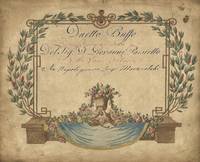
41129Contains manuscripts of works by Anfossi Aprile Asioli Belli Beauharnais Cantone Carafa Carlini Caruso Clari Clementi Czerny Dalvimare Eichner Fioravanti Giordani Hasse Haydn Herz Isola Jommelli Kreutzer Labriola Lanza Leo Macagnani Mancinelli Mercadante Meyerbeer Morandi Pacini Paisiello Pergolesi Perugini Pratelli Raimondi Roggero Romani Ricci Rossini Sampieri Sarti Scandellari Scarlatti Schuster Tartini Traetta Tunca Tritto Verdi and Zingarelli.<br /> <br /> Provenance<br /> Predominantly from the collections of Luigi Ricci 1893-1981 Italian musician assistant conductor vocal coach and friend of Mascagni and Puccini and long-time London music antiquarian William Reeves. Of considerable research value.<br /> <br /> A detailed inventory is available upon request. unknown
179943266Lampsaque, , 1799. 2 vol. in-4 manuscrits de (241) et (269) ff., becquets dans le texte et sur un contreplat, demi-basane blonde à petits coins de vélin, dos lisse orné, pièces de titre en maroquin rouge et noir (reliure de l'époque).
- [Bruxelles] Dimanche matin 14 [août 1864], 13,4x20,6cm, 3 pages sur un feuillet remplié. - Autograph letter signed addressed to his mother by a fading Baudelaire: "L'état de dégoût où je suis me fait trouver toute chose encore plus mauvaise" N. p. [Bruxelles] Sunday morning 14 [August 1864], 13,4 x 20,6 cm, 3 pages on a folded leave Autograph letter signed in black ink, addressed to his mother and dated "Sunday morning the 14th." A few underlinings, deletions and corrections by the author. Formerly in the collection of Armand Godoy, n°188. A fading Baudelaire: "The state of disgust in which I find myself makes everything seem even worse." Drawn by the promise of epic fame, Baudelaire went to Belgium in April 1864 for a few conferences and in the hope of a fruitful meeting with the publishers of Les Misérables, Lacroix and Verboeckhoven. The meeting didn't happen, the conferences were a failure and Baudelaire felt boundless resentment for "Poor Belgium". Nonetheless, despite numerous calls to return to France, the poet would spend the rest of his days in this much-castigated country, living the life of a melancholic bohemian. Aside from a few short stays in Paris, Baudelaire, floored by a stroke that left him paralyzed on one side, would only return to France on 29 June 1866 for a final year of silent agony in a sanatorium. Written barely a few months after his arrival in Brussels and his initial disappointments, this letter shows us all the principal elements of the mysterious and passionate hatred that would keep the poet definitively in Belgium. In his final years in France, exhausted by the trial of The Flowers of Evil, humiliated by the failure of his candidacy to the Académie Française, a literary orphan after the bankruptcy of Poulet-Malassis and disinherited as an author by the sale of his translation rights to Michel Lévy, Baudelaire was above all deeply moved by the inevitable decline of Jeanne Duval, his enduring love, while his passion for la Présidente had dried up, her poetic perfection not having withstood the prosaic experience of physical possession. Thus, on 24 April 1864, he decided to flee these "decomposing loves", of which he could keep only the "form and the divine essence." Belgium, so young as a country and seemingly born out of a Francophone Romantic revolution against the Dutch financial yoke, presented itself to the poet phantasmagorically as a place where his own modernity might be acknowledged. A blank page on which he wanted to stamp the power of his language while affirming his economic independence, Belgium was a mirror onto which Baudelaire projected his powerful ideal, but one that would send him tumbling even more violently into the spleen of his final disillusionment. Published in the Revue de Paris in November 1917, without the sensitive passage about his cold enemas, this emblematic letter evokes all of Baudelaire's work as poet, writer, artist and pamphleteer. The first such reference is via the reassuring, mentor-like figure of the publisher of The Flowers of Evil, Poulet-Malassis: "If I was not so far from him, I really think I'd end up paying so I could take my meals at his." This is followed by a specific reference to the "venal value" of his Aesthetic Curiosities: "all these articles that I so sadly wrote on painting and poetry" . Baudelaire then confides in his mother his hopes for his latest translations of Poe which, to his great frustration "are not getting published by L'Opinion, La Vie Parisienne, or in Le Monde illustré". He concludes with his Belgian Letters, which Jules Hetzel had just told him had been, after negotiations with Le Figaro, "received with great pleasure." Nonetheless, as Baudelaire literally underlined, they were "only to be published when I come back to France." His perennially imminent return to France is a leitmotiv of his Belgian correspondence: "Certainly, I think I'll go to Paris on Thursday." It is nonetheless always put off ("I'm putting off going
- Michel Levy Frères, Paris 1847, 17x27cm, relié. - Première édition en grand format du théâtre d'Hugo, publiée chez Michel Lévy, qui deviendra son principal éditeur après avoir racheté les droits de l'écrivain. Reliure en demi maroquin noir à coins, dos à quatre nerfs sertis de pointillés dorés et orné de doubles caissons dorés décorés en angles, date et mention «?Ex. de J. Drouet?» dorées en queue, plats de papier marbré, gardes et contreplats de papier à la cuve, couvertures et dos conservés, tête dorée, reliure signée de René Aussourd. Le dos conservé présente quelques manques comblés et a été doublé. Précieux et amusant envoi autographe signé de Victor Hugo à Juliette Drouet, le grand amour de sa vie?: « à Madame Juju signé Monsieur Toto?». Signé du célèbre surnom qu'elle lui donne dans ses lettres d'amour, ce bel exemplaire du théâtre d'Hugo imprimé sur papier vélin illustré par Louis Boulanger marque ici la complicité facétieuse des amants les plus célèbres de la littérature française. Cet envoi rappelle la carrière de comédienne de Juliette Drouet, qu'elle abandonna à la fin des années 1830 afin de se consacrer exclusivement à son illustre amant. De leur mythique rencontre quinze ans plus tôt lors d'une lecture de Lucrèce Borgia, à la jalousie d'Adèle Hugo qui lui refusa le rôle de l'héroïne de Ruy Blas écrit pour elle, la relation d'Hugo et Juliette Drouet, la comédienne contrariée, n'aura de cesse de revenir au théâtre. L'exemplaire provient de la bibliothèque de Pierre Duché (1972, n° 72). Ce dernier avait fait l'acquisition de la totalité de la bibliothèque de Juliette Drouet, et confié les volumes à René Aussourd pour les faire relier de manière uniforme avec l'inscription permettant leur identification en queue. Ex-libris encollés sur un contreplat et une garde. Exemplaire de la plus intime provenance. [ENGLISH DESCRIPTION ON DEMAND]
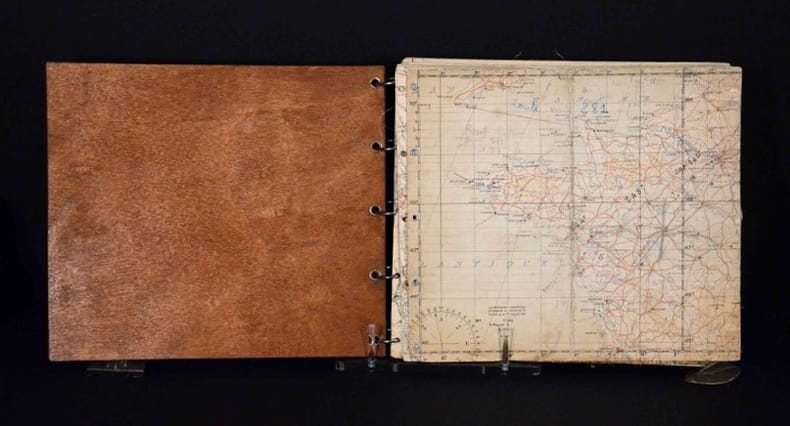
193021551930, Important registre de 33 cartes entoilées, noir et blanc et certaines en couleurs contenu dans une reliure mobile à plaques d'acajou marine tenue par cinq anneaux métalliques 27x30 cm , accompagné d'une pochette en plastique transparent à bords renforcées, 20 x 40 cm contenant les corrections de la hauteur de la Polaire, pour obtenir la latitude et les tables auxiliaires pour l'année 1929. Utilisés par Coste et Bellonte lors de leur traversée entre Paris et New York du 1er septembre 1930. Provenance Maurice Bellonte.
180 x 170 mm. Two columns, 18 lines. 132 leaves. With 13 (8 full-page) miniatures. Contemporary brown calf over wooden boards. Panelled and eloborately stamped in blind. "Ethiopian illuminated manuscripts of the present quality today have virtually disappeared from the market" (Hartung & Hartung, original sales note). Occasional marginalia by a later hand. The illuminations are marked by short strings sewn into the blank margins of the relevant pages. - Provenance: Hartung & Hartung 79 (2 May 1995), lot 127; sold to an Austrian private collection and acquired from the descendants.
- 1892, 20x29,5cm, 4 pages sur un double feuillet. - Exceptionnel manuscrit autographe complet signé du véritable testament de Ravachol - en grande partie inédit - inconnu sous cette forme, précédant sa réécriture par un tiers pour la publication dans la presse. Unique témoignage de la véritable pensée de l'icône de l'anarchie. Manuscrit de quatre pages in-4 lignées, entièrement rédigé à l'encre noire et doublement signé « Konigstein Ravachol » en pied de chaque feuillet. Corrections au crayon de papier dans le texte, peut-être de la main de son avocat. Quelques pliures transversales et très infimes déchirures marginales sans manque. Écrit en cellule durant le second procès de Montbrison qui mènera à sa condamnation à mort, ce texte, rédigé d'une écriture hâtive, sans ponctuation ni majuscules et à l'orthographe naïve, devait être prononcé par Ravachol lors de l'audience. « Ravachol avait une sacrée envie de coller son grain de sel dans la défense, non pour se défendre, mais pour s'expliquer. Y a pas eu mèche, nom de dieu ! à la quatrième parole, le chef du comptoir lui a coupé le sifflet. Sa déclaration n'est pas perdue, nom d'une pipe ! ». (Émile Pouget, in Père Peinard 3-10 juillet 1892). Le Rocambole de l'anarchisme ne sera en effet pas autorisé à déclamer son texte, mais il le remettra à son avocat Maître Lagasse et, dès le 23 juin, la déclaration interdite se retrouvera reproduite dans le journal Le Temps. Cette première parution dans un journal conservateur se veut fidèle au texte original jusqu'à reproduire l'orthographe fantaisiste de son auteur. Ce souci d'exactitude sera d'ailleurs dénoncé par Émile Pouget dans le Père Peinard du 3 juillet 1892, une semaine avant l'exécution de Ravachol : « Le Temps, le grand drap de lit opportunard l'a collée nature. En vrai jésuitard, il l'a même collée trop nature. Ravachol avait écrit le flanche pour lui ; il savait comment le lire, - mais y avait pas un mot d'orthographe, vu qu'il se connait à ça, autant qu'à ramer des choux. Le Temps a publié le flambeau sans rien changer, de sorte que c'est quasiment illisible [...]. C'est ce que les jean-foutre voulaient, nom de Dieu ! [...] Je colle ci-dessous, sans y changer un mot, m'étant contenté d'y mettre de l'orthographe. » Suit, dans ce même numéro du 3 juillet 1892, la reproduction exacte, mais sans les fautes, du discours initialement publié dans Le Temps. Cette double publication associée à la noble attitude de Ravachol devant la guillotine aura un impact considérable sur l'opinion publique. En effet, même les organes anarchistes avaient jusqu'à lors conservé une certaine distance avec ce criminel provocateur accusé d'utiliser la cause anarchiste à des fins crapuleuses. Mais après l'exécution, ce testament sera rapidement repris par de nombreux autres journaux et l'ultime cri de révolte de Ravachol deviendra bientôt un véritable hymne de l'anarchie pour les libertaires de toutes nations. Pourtant, la version reproduite par ces journaux, seule connue à ce jour mais dont la source manuscrite a disparu, diffère sensiblement du manuscrit en notre possession. En effet, le style a été légèrement amélioré, quelques tournures ont été arrangées, et surtout, de larges passages ont été supprimés, dont le paragraphe de conclusion qui a été entièrement remplacé. Notre manuscrit, comportant des ratures et des reprises semble ainsi être, à tout le moins, la version primitive de ce testament politique. Écrit d'une traite, d'une graphie compacte, sans ponctuation, ni paragraphe, ce manuscrit comporte deux longs passages révélant des préoccupations de santé publique totalement absentes de la version publiée. La première concerne un long passage, d'un tiers de feuillet, sur les « ingrédients dangereux » adjoints à la fabrication du pain : « n'ayant plus besoin d'argent pour vivre, plus de crainte que le boulanger introduise dans le pain des ingrédients dangereux pour la santé et dans l'intention de lui donner une belle apparence ou le ren
458S.l. (Lisbonne) : s. d. (entre 1713 et 1728). SUITE ET FIN INÉDITE DE LA PREMIÈRE HISTOIRE FRANÇAISE DU PORTUGAL
- Honfleur 28 février 1859, 13,1x20,5cm, 3 pages sur un feuillet remplié. - Précieuse lettre autographe signée de Charles Baudelaire à Auguste Poulet-Malassis, éditeur des Fleurs du Mal, datée du 28 février 1859 et écrite à Honfleur. 64 lignes à l'encre noire, quelques passages soulignés, présentée sous une chemise en demi-maroquin noir moderne. Baudelaire semble obsédé par «?l'affaire Sainte-Beuve/Babou?». Il s'agit d'une des innombrables querelles qui suivirent le procès des Fleurs du Mal, dans laquelle l'écrivain Hippolyte Babou accuse Sainte-Beuve de ne pas avoir pris la défense de Baudelaire lors du procès. Des passages de cette lettre furent cités par Marcel Proust dans son célèbre Contre Sainte-Beuve, déplorant la lâcheté de Sainte-Beuve dans l'affaire du procès des Fleurs du Mal et l'attachement immérité que Baudelaire portait à l'écrivain. Le poète écrit à son éditeur de Honfleur, où il s'est retiré depuis janvier auprès de sa mère, figure sacrée «?qui hante le cur et l'esprit de son fils?». La lettre est écrite huit jours après un autre rebondissement dans l'affaire du procès des Fleurs du mal. Baudelaire, en proie à des sentiments complexes, se confie à Malassis alors que le 20 janvier, son ami Hippolyte Babou avait attaqué Sainte-Beuve dans un article de La Revue française. Il l'accusait de ne pas avoir défendu Baudelaire lors du procès du recueil?: «?Il glorifiera Fanny [d'Ernest Feydeau], l'honnête homme, et gardera le silence sur Les Fleurs du Mal?» écrivit-il. Car malgré les prières de Baudelaire, Sainte-Beuve n'avait finalement jamais publié d'article défendant Les Fleurs du Mal. à la suite de cette attaque de Babou, Baudelaire reçut une «?lettre épouvantable?» de Sainte-Beuve?: «?Il paraît que le coup [...] avait frappé vivement [Sainte-Beuve]. Je dois lui rendre cette justice qu'il n'a pas cru que je puisse insinuer de telles choses à Babou?». Bien qu'indigné par de telles accusations, Sainte-Beuve n'en tint pas Baudelaire responsable. La virulence dont fait preuve Sainte Beuve étonne Baudelaire, qui déclare à Poulet-Malassis?: «?Décidément, voilà un vieillard passionné avec qui il ne fait pas bon se brouiller [...] Vous ne pouvez pas vous faire une idée de ce que c'est que la lettre de Sainte-Beuve. Il paraît que depuis douze ans il notait tous les signes de malveillance de Babou?». Baudelaire assiste, impuissant, à la querelle entre deux hommes estimés, et témoigne surtout de son attachement à Sainte-Beuve, qui est mis en danger par l'article de Babou?: «?Ou Babou a voulu m'être utile (ce qui implique un certain degré de stupidité), ou il a voulu me faire une niche ; ou il a voulu, sans s'inquiéter de mes intérêts, poursuivre une rancune mystérieuse?». Baudelaire vouait en effet une admiration sans bornes à «?l'oncle Beuve?», sénateur, académicien et maître incontesté de la critique, dont l'avis faisait loi dans les cénacles littéraires parisiens. Il guettait depuis des années un encouragement officiel de Sainte-Beuve, qui aurait conforté sa carrière chancelante, entachée par le scandale des Fleurs du Mal. Le poète se trouve donc tiraillé entre sa vénération pour Sainte-Beuve et son amitié de longue date pour Hippolyte Babou - qui, selon la légende, lui aurait suggéré le titre Les Fleurs du Mal. Il confie son désarroi à Poulet-Malassis?: «?Ce qu'il y avait de dangereux pour moi là-dedans, c'est que Babou avait l'air de me défendre contre quelqu'un qui m'a rendu une foule de services?». On peut se demander à quels services Baudelaire pouvait faire référence, sachant que Sainte-Beuve fit en somme assez peu pour sa carrière. Cette lettre fut citée dans le Contre Sainte-Beuve, célèbre et terrible réquisitoire de Marcel Proust publié à titre posthume en 1954. Proust y accuse Sainte-Beuve de méconnaître l'incontestable génie poétique de Baudelaire, et souligne sa lâcheté durant le procès des Fleurs du Mal. En effet, afin de protéger ses fonctions sénatoriales, Sainte-Beuve n'avait rien écrit en faveur de Baude
- s.l. [Meudon] 1954 (entre l'été 1954 et janvier 1955), 26,5x33,5cm, 24 feuillets montés sur onglets et reliés. - Early draft of D'un château l'autre [Castle to Castle], unpublished autograph manuscript n.p. [Meudon] 1954 (summer 1954-januray 1955), 26,5x33,5cm, 24 leaves mounted on boards, bound. Exceptional set of 24 manuscript leaves by Louis-Ferdinand Céline from D'un château l'autre [Castle to Castle], mounted on boards under protective paper. Every page is numbered in Céline's hand in the upper left corner (from 632 to 634, 636 to 651 and 653 to 657), and written in blue ballpoint pen. They feature the usual characteristics of Céline's manuscripts: stains, traces of paper clips... important variations to the published text, crossed-out lines and words, modifications, and repetitions. Bound in full black chagrin, gilt title and author on spine, gilt mention "manuscrit autographe" on the first cover's bottom right corner. A splendid working manuscript, typical of Celinian writing. "Céline began writing D'un château l'autre in the summer of 1954 and finished it in the spring of 1957. [...] At Gallimard, we were kept informed of the manuscript's progress: "I am at the 1300th page, 50th draft...I can think without foolish optimism that I will soon reach the end (about a month)." A few weeks later, the book was nearly complete: "My "bear" is here, it's fine lacework." Completed in March, the book went on sale on June 20, 1957." (F. Gibault, Céline. 1944-1961 - Cavalier de l'apocalypse). This manuscript is one of these numerous "drafts" and was not chosen in the final version of the text. It is most likely one of the earliest versions written before 1955. It contains a long unpublished passage about the "shivering" Nazi-sympathizing Frenchmen ("collabos") exiled in Sigmaringen. Although he was part of them, Céline paints a very harsh portrait of the thousand French collaborators who took refuge in the former Hohenzollern castle. He reworked the passage extensively, erased it, and wrote it again. This violent excerpt will ultimately be left out of the published novel altogether. Céline describes the lavish apartments of Baron Commandant von Raumnitz. In the Gallimard published version, Raumnitz's "secret rooms" will be cut short and very much toned down. Some of the pages stray from the storyline and evoke present-day events: in the grip of paranoia, Céline gives derogatory nicknames to the most prominent figures of French intelligentsia, namely Jean-Paul Sartre ("Tartre"), and Louis Aragon renamed "Larengon". Some "characters" appear in our version under their real names, especially Jean Paulhan who will be nicknamed Norbert Loukoum in the published version after a quarrel between the two writers. This new name will appear in early 1955. Remarkable unpublished manuscript draft of D'un château l'autre. [FRENCH VERSION FOLLOWS] Exceptionnel ensemble de 24 feuillets, montés sur onglets sur des cartons sous serpentes. Les feuillets autographes, tous numérotés de la main de Céline en coin supérieur gauche (de 632 à 634, de 636 à 651 et enfin de 653 à 657), sont rédigés au stylo bille bleu et présentent les stigmates céliniens usuels : taches, traces de trombones... Ils présentent d'abondantes variantes, lignes et mots biffés, modifications et reprises. Reliure à la bradel en plein papier chagriné noir, dos lisse janséniste, titre et auteur à l'or, premier plat estampé à l'or en bas à droite de la mention « manuscrits autographes ». Très beau manuscrit de travail, témoignage du cheminement et des égarements de la pensée célinienne. « D'un château l'autre a été commencé par Céline pendant l'été 1954 et achevé au printemps 1957. [...] Chez Gallimard, on était tenu au courant de l'état de l'avancement du manuscrit : « Je suis à la 1300e page, 50e mouture...je peux penser sans optimisme idiot que je parviendrai bientôt à la fin (environ un mois). » Quelques semaines plus tard, le livre était pratiquement achevé : « Mon ours est l
- s.d. (1866), reliure et étui : 23x28,5cm / feuillets : 17,8x23cm, 18 pages sur 18 feuillets, en feuilles. - n.d. (1866), binding and slipcase: 23 x 28.5cm / leaves: 17.8 x 23cm, 18 pages on 18 leaves, in leaves. Complete autograph manuscript signed by Emile Zola entitled "Profils parisiens - Les Repoussoirs", 18 pages written in black ink on mounted 18 lined leaves. Many crossing-outs and corrections. This text had been published for the first time on 15 March 1866 in Marseille in the magazine La Voie nouvelle and was then published - with three others that make up the Esquisses parisiennes [Parisian Sketches]- following the novel Le Vu d'une morte [A Dead Woman's Wish], published with Achille Faure in November 1866. Later binding (20th century) in half green morocco, spine with a lengthwise gilt title, marbled paper boards, marbled paper slipcase lined in slightly cracked morocco. Beautiful yet fairly unknown text from Zola's early years, one of the first published by the writer, then twenty-six years old and earning his first stripes in the literary world. This chronicle, half-way between the novella and the philosophical tale, tells the story of the "vieux Duranteau" "old Duranteau"'s project, a bold and opportunist entrepreneur who wants to set up an agency of "repoussoirs" "turn-offs", in other words, ugly and available women for rent, supposed to enhance the beauty of the female customers using their services: "Avouez que vous avez été pris au piège et que parfois vous vous êtes mis à suivre les deux femmes. Le monstre, seul sur le trottoir, vous eût épouvanté ; la jeune femme au visage muet vous eût laissé parfaitement indifférent. Mais elles étaient ensemble, et la laideur de l'une a grandi la beauté de l'autre. Eh bien ! Je vous le dis tout bas, le monstre, la femme atrocement laide, appartient à l'agence Duranteau. Elle fait partie du personnel des Repoussoirs. Le grand Duranteau l'avait louée à raison de vingt francs la course. " "Admit that you were entrapped and that sometimes you began to follow the two women. The monster, alone on the pavement, would have frightened you; the young women with the silent face would have left you perfectly indifferent. But they were together, and the ugliness of one increased the beauty of the other. So? I tell you in a whisper, the monster, the excruciatingly ugly woman, belongs to the Duranteau agency. She is part of the Repoussoirs staff. The great Duranteau had rented her for the fare of twenty francs." Our manuscript is consistent with the version published in La Voie nouvelle. Emile Zola's signature at the end of the first leaf is evidence that it is unquestionably the copy that he sent to the Marseille newspaper, especially as the text published in Le Vu d'une morte contains some variations. Henri Mitterrand highlights the rarity of Zola's manuscript articles and chronicles; Zola was nevertheless an extremely prolific literary journalist and published close to a hundred short fictions: "Tous les manuscrits de ces « papiers » sont perdus, sauf ceux, autographes, des « Confidences d'une curieuse »" "All the manuscripts of these "papers" are lost, except those, handwritten, of "Confidences d'une curieuse"". (H. Mitterrand, Zola, T. I) It must be said that the young Zola had just left his position as an errand boy at the Librairie Hachette to finally take up a career as a writer. This work, as well as paying the bills, showed him the inner workings of the publishing world and contributed to the publication of his first works: Contes à Ninon [Stories for Ninon] and La Confession de Claude [Claude's Confession]. We already detect cynicism and the Zolian revolt in Les Repoussoirs. The writer manages, through the synthetic literary genre of the novella, to address a good number of the themes that will soon resurface in the great social epic that will make up the twenty volumes of the Rougon-Macquart. [FRENCH VERSION FOLLOWS] Manuscrit autographe complet signé d'Emile Zola inti
182841555, , 1828-1877. Manuscrit in-folio à l’encre brune (42 x 27 cm) de (1)-160-(8) ff. en belle page, 187 grandes miniatures dans le texte finement coloriées à l'époque, demi-vélin à coins, dos lisse muet (reliure de l'époque).
Manuscript (brown ink) on paper. 2 vols. 8vo. (Title page), 445 (but: 444) pp. (Title page), 446-764 pp., 91, (2) pp. Bound in 18th-century vellum manuscript over boards. All edges red. A manuscript written in a single, unidentified hand during the last years of the 18th century, describing Gleyo's imprisonment in Ching-Tou, then Yuin-Tchang. - J.-F. Gleyo was born in Saint-Brieuc, the son of master mariner François Gleyo, and became a Priest of St. Sulpice. He sailed from Lorient to China in 1764, first arriving in Macao, where he learned Chinese and became associated with the evangelical work of the missionary Alary. In 1769 he was denounced and accused of links with the Pélén-Kiao rebels. Imprisoned and abused for several years, he owed his survival to his faith and mystical visions. He was released in 1777 after a Portuguese Jesuit mathematician intervened with the Emperor and resumed his apostolic labours. In his General History of the Foreign Missions, Launay states of Gleyo that "he recalls the great contemplatives, the most intrepid apostles, saints, and other confessors of the faith." The present manuscript recounts his encarceration and the consolations he received from heaven. It is sprinkled with Latin sentences and Chinese terms (especially in his letters written to Jean-Martin Moÿe after his release, included as a final section at the end of the second volume, with separate page numbers). The letters were published in the famous Jesuit collection of "Lettres édifiantes et curieuses". The original manuscript is kept in the Archives des Séminaires des Missions Étrangères, and a copy by various hands exists in the library of the Seminary of St. Sulpice; it is very likely that the present manuscript was copied from one of these sources. It is not listed in the catalogue of Manuscripts in the National Library and is thus of the utmost rarity. - Provenance: from the library of Jean R. Perrette with his bookplate on the pastedown.
8vo. (29) pp., 15 blank pp. (3 of which interleaving the text). English manuscript on paper. With a pencil sketch of Napoleon mounted to first page and two small watercolour flags in the text. Original wrappers with handwritten cover-title. In slightly later full cloth box with giltstamped title to cover and spine. Strict regulations drawn up by Rear Admiral Robert Plampin (1762-1834), commander at the Cape of Good Hope Station during the period when Napoleon Bonaparte was imprisoned on Saint Helena, likely commissioned by Admiral Pulteney Malcolm (1768-1838), Commander-in-Chief at Saint Helena Station, with the objective of enforcing a rigid blockade around the island, rendering any attempt to liberate the prisoner impossible. - The booklet consists of 28 articles directed at officers of the Royal Navy, charging each ship near the island with staying alert and ready to act, suggesting that the British officials expected a flight attempt at any moment. Apart from sleeping ashore, keeping boats moored at the shore, sailing from the island past sunset, employing any ships of the East India Company without permission from the commander-in-chief, or buying fish in open water, it was forbidden to communicate with anybody detained in Longwood House: "No Officer of whatever Rank belonging to His Majesty‘s Naval Service is to visit Longwood or the premises belonging thereto, or to hold communication of any sort by writing or otherwise upon any subject whatsoever with any of the Foreign Personages detained on this Island" (art. 3). As nighttime was considered particularly risky, a patrol boat was installed and instructed to go on patrol three times a night, paying special attention to the shoreline and any suspicious activity encountered there: "During the Night an Armed Boat provided Blue lights or False fires, and commanded by a commissioned officer, in possession of the Sea Parole is to row three times when the weather will permit of it, between Butter Milk Point and Lemon Valley seizing all Boats which may be discovered upon the waters, excerpting only those at the regular line of moorings [...] and those having the sea paroles, the latter of which however, the Officer of the Guard must distinctly understand he is not to suffer to pass until he shall have examined them in the most strict manner as to the service they are employed upon, and satisfied himself that no improper persons are in them [...] and in case he should perceive a Musket (or Muskets) fired from the shore he is instantly to pull towards the spot, to interrupt or chase any Boat or Person that may be attempting to escape" (art. 10). - The rules give evidence of general suspicion directed at all vessels, not excluding fishing boats staying near Saint Helena after sunset: "A Lieutenant of the Flag ship is to be appointed to the constant duty of seeing all the Fishing Boats get properly moored and secured at the anchorage in James‘ Valley every evening at sunset [...] and in case he should [...] discover any of the Fishing Boats are missing, or in short any circumstance of importance, he is immediately to repair to the commander in Chief with a report thereof" (art. 19). - In addition, the booklet includes regulations for the hospitalization of sick men on the island, the order of provisions, and bringing cattle and food to the island, as well as for the officers‘ attire, stating that the commander-in-chief "has no objection to round Hats provided they have Gold Loops and Cockades". - The pencil sketch shows a dismayed-looking Napoleon in profile, wearing his uniform and signature bicorne hat. Autograph note by J. Clark, likely a guard stationed in Deadwood, mounted to first page. It bears the first of six possible wordings that were used to inform the governor of Napoleon's circumstances, ranging from "All is well with respect to General Bonaparte" (seen here, dated 27 November 1818) to "General Bonaparte is missing". - 19th century ownership to front pastedown. Handwritten note in pencil to first page of text: "Regulations for guarding Bonaparte". Box slightly rubbed at extremities; wrappers somewhat brownstained; spine rubbed. Interior with traces of glue and adhesive tape to a few pages; most pages pierced near upper right corner, rarely affecting text; note by Clark somewhat brownstained. A unique survival.
8vo (233 × 170 mm). Italian manuscript on paper. One leaf with written introduction (one leaf missing), 117 ff. (instead of 118, numbered 1-95, 97-118) of full-page coloured drawings within two-line borders (206 × 138 mm) illustrating the Christian Doctrine, on strong paper, 3 blank ff. Contemporary half calf, spine gilt with with title lettered in gold. Interesting manuscript by Padre Ottavio Giovanni Battista Assarotti (1753-1829), containing a method to teach and explain the 'Dottrina Christiana' to Genoese deaf-mutes. Assarotti was an Italian philanthropist and founder of the first school for deaf-mute people in Italy. After qualifying for the church, he entered the society of the Pietists, Scuole Pie, who devoted themselves to the training of young men. In 1801 he heard of the Abbé Sicard's education of deaf people in Paris, and resolved to do something similar in Italy. He began with one pupil, and by degrees collected a small number around him. In 1805, Napoleon, hearing of his endeavours, ordered a convent to give him a school-house and funds for supporting twelve scholars, to be taken from the convent revenues. This order was poorly heeded until 1811, when it was renewed, and the following year Assarotti, with a considerable number of pupils, took possession of the new school. He continued here until his death in 1829. The traditional and distinctive Italian manual alphabet is said to have been invented by Assarotti. - It is not certain that Assarotti himself is the author of the manuscript: while it may equally well have been conceived by one of his collaborators, it is based on the method invented and developed by Assarotti, who also designed the plates. The introduction explains how difficult it is to teach abstract concepts, such as religion, to deaf-mute pupils, so he painted these plates, invented by Assarotti: "He (Assarotti) never wrote down his educational philosophy and methods, and so fell into obscurity after his death" (Deaf History Unveiled, 244f.). As far as we know this manuscript is the only surviving witness of his theories. - The style of the watercolours is somewhat primitive and popular, but very rich in detail, including elaborate plates illustrating Faith in general ('Fede'; nos. 1-42); Commandments ('Legge'; nos. 43-51); Prayers ('Preghiera' 1-10; nos. 52-61); 42 Sacraments ('Sacramenti'; nos. 62-95, 97-104); Virtues ('Virtu' 1-14; nos. 105-118). The illustrations include views of paradise, hell, creation, functions of priests, symbols of all kinds of aspects of the Catholic faith, etc. - In very good condition. Dizionario biogr. degli Italiani IV, 433f. S. Monaci, Storia del R. Istituto nazionale dei sordomuti in Geneva (1901), 17-88 and passim. F. Donaver, "Il padre Assarotti", in: La Rass. naz. 23 (1901), 79-87. Deaf History Unveiled, ed. John Vickrey van Cleve (1993), 244f.
The archive contains a plethora of material. Original Artwork in different formats, namely a collection of 14 original sketchbooks with numerous original colored drawings, approx. 540 original pencil drawings, 16 original water colored pencil drawings, 24 original watercolors, 15 original ink drawings, 32 original pencil ink drawings, 18 original watercolors, 79 original etchings, partly in aquatint, 30 manuscript pages of notes, 4 original oil studies and 3 photographs. Sheet dimensions from approx. 4 x 8 inches to approx. 22 x 26 inches. The archive includes manuscript cost calculations and numerous, partly large-scale construction drawings for the restoration work at the town hall Bülach. With his keen sense and appreciation of history, the Swiss architect Rordorf was an attentive observer of Swiss culture. As a result of the restoration work based on his designs at the town hall Bülach (around 1905) and in the Castle Greifensee (historic room conversions 1917) he drew the attention of the Swiss public to his work. Also, architectural and floor plan drawings, beautiful views (between 1876-1933) of Switzerland, including Bremgarten, Dübendorf, Effretikon, Lugano, Freiburg, New Bechburg, Thierstein, Bern-Thun, Mariastein, Aarberg, Castle Burgdorf, Kyburg, Locarno, Arbon, Brugg, Zurich, Erlach, as well as Italy, France and Germany. Documents include announcement and invitations and manuscripts of the Société "On the Wall" in Zürich, manuscript letters, poems, purchase contracts and dividing documents between David and Paul Rordorf, etc., as well as a district plan of the city of Zurich. Rordorf-Mahler was a member of the Zurich Artist Society, the Swiss Association of Engineers and Architects, the Société "On the Wall" in Zurich, and at times its President. All in all, an impressive archive of original drawings and at the same time, an important primary source material for the history of architecture in Switzerland. Manuscript