69 444 résultats
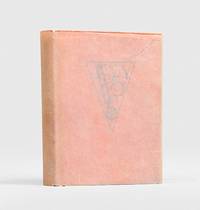
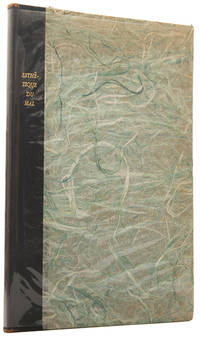
112307Cummington MA Cummington Press 1945. . First edition number 65 of 300 copies on Pace paper from Italy from a total edition of 340 this copy signed by the illustrator and type designer; 8vo; illustrations of pen and ink drawings by Wightman Williams minor toning to gutters of endpapers scattered minor spotting to text block else unmarked internally; publisher's quarter black morocco over green Natsume paper-covered boards gilt lettering to upper cover mild rubbing to extremities slight toning to boards with original glassine dust-jacket; a very good copy.<br /> Number 65 of 300 copies printed from Centaur types on Italian Pace paper from a total edition of 340. Though not called for this copy has been signed by Wightman Williams and the type designer Harry Duncan on the colophon. A very good copy scarce thus.<br /> Edelstein A10. Cummington, MA, Cummington Press, 1945. hardcover
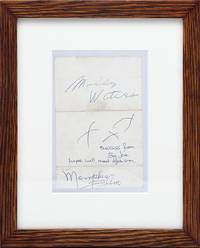
1963171122Richmond London: 1963. I'm a full-grown man/ I'm a man/ I'm a rollin' stone From the collection of Rolling Stones drummer and jazz aficionado Charlie Watts: an evocative memento signed by a trio of great blues musicians on the verso of a membership card for the legendary Crawdaddy Rhythm and Blues Club. Started in 1963 in the back room of a pub the Station Hotel in Richmond London by Georgian film-maker and music promoter Giorgio Gomelsky the club saw the first performance of the classic Rolling Stones line-up in February 1963 when the regular house band was stranded in the snow in the worst winter in over 200 years. Despite an unpromising start with Gomelsky forced to offer two for one admissions to customers in the hotel itself the word quickly spread and the club became something of a sensation. When the Stones became too big for the venue and departed on tour they were replaced by The Yardbirds featuring Eric Clapton the Crawdaddy remaining the headquarters of the burgeoning British Rhythm and Blues scene. The card is made out to a Michael Green of Ilford Essex whose membership number 1372 expiring in 1964 indicates that he evidently joined in the early days. The bluesmen were over as part of the American Blues Festival that had first toured Britain the previous year. Muddy Waters and Memphis Slim have signed in full Williams signing with three crosses with the subscribed sentiment in another hand perhaps Green's himself; "success from Big Joe hope will meet again soon". Tri-fold membership card printed in black 150 x 100 mm carrying the member's name and address membership number 1372 and expiry date 1964. Light soiling and minor creases otherwise in very good condition. unknown
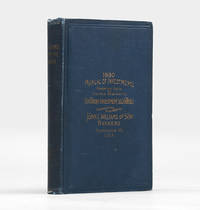
189093439Richmond Virginia: John L. Williams & Son Bankers 1890. First edition of the 6th annual Manual of investments produced by the banking house of John L. Williams of Richmond Virginia presentation copy inscribed by the author "George Wayne Andrew with compliments & regards of the Author & acknowledgements for valuable assistance rendered in the compilation of this work. May 1890". "Our Manual was the first publication of the sort issued in the South and now enjoys the distrintion we believe of being the largest work of its kind published by any Banking House in America. It contains a large amount of valuable information to be found in no other publication and much of the information which finds its way into print through other mediums only reaches the public some months after it has been presented by us." Introduction. The preface argues that readers "will be encouraged by scrutiny and analysis of the facts and conditions in the Southern States to place or continue their investments in those states because it is evident that the prosperity and growth in all interest and departments of business are based on and secured by natural original elements which cannot be removed or shaken" pp. iii-iv. Octavo. Engraved title page large folding map tinted in colour to front pastedown. Original blue-green cloth titles to spine and front board gilt twin ruling to boards in blind. Spine a little rolled extremities rubbed and lightly bumped map split vertically and slightly tanned professionally repaired. A very good copy. hardcover
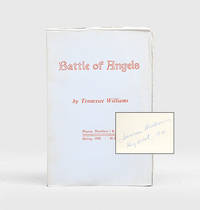
1945188156Murray Utah: Pharos 1945. His signed debut First edition of the author's debut signed by Williams on the half-title "Tennessee Williams. Key West 1971". The play was first written in 1940 and this edition includes a note from Williams on the history of the play and from Margaret Webster who directed its first performance in Boston in 1940. Following a difficult rehearsal period and a disastrous opening night as well as demands from censors for script changes the play closed early. Williams subsequently rewrote the play resulting in this 1945 edition before rewriting it entirely as Orpheus Descending 1957. Octavo. Original light blue wrappers front cover lettered in red. Housed in a custom grey cloth folding box. Wrappers a little toned and nicked faint damp stain along fore edge margin of front wrapper and initial leaves a few spots of foxing. A near-fine copy. Gunn A1. hardcover
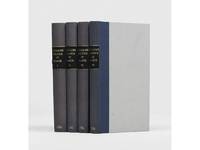
1795185198London: Printed for G. G. and J. Robinson 1795-96. Dispatches from the Terror First editions of the four later volumes in Williams's revolutionary series covering the Reign of Terror and its aftermath. This popular epistolary chronicle gained the author the appellation of "English historian of the French Revolution". These volumes were written after her return to Paris from exile in Switzerland. Published in over the course of six years and known collectively as "Letters from France" 1790-96 Williams's correspondence offers a detailed record and analysis of the Revolution. She "encases the political within the personal sharing her feelings with her readers recording for instance the sense of exhilarating internationalist triumph provoked by early events in the revolution seen as the 'triumph of human kind'. Williams notes the importance of women in the Revolution mostly behind the scenes" Orlando. Williams was dually admired and maligned by her contemporaries. Her literary salon was attended by the likes of Thomas Paine Mary Wollstonecraft and Francisco de Miranda. She was branded by Edmund Burke as one of the "clan of desperate wicked and mischievously ingenious women" who were publishing radicalizing pro-revolutionary works at the turn of the century Kennedy p. 326. Volumes I II and III were also issued with variant title pages incorporating the French Republican calendar. 4 vols duodecimo 188 x 112 mm. Modern quarter blue cloth black morocco spine labels grey paper-covered sides edges uncut. Occasional foxing and browning to contents: in very good condition indeed. ESTC T70504; T119488; T119490. Deborah Kennedy "Benevolent Historian: Helen Maria Williams and Her British Readers" in Rebellious Hearts: British Women Writers and the French Revolution 2001. hardcover
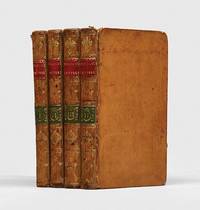
1791161775London: T. Cadell; G. G. and J. Robinson; 1791-93. A contemporary female account of the French Revolution The first four volumes in Williams's celebrated eight-volume eyewitness account of the French Revolution all first editions except volume I which is the second edition published the year after the first. This popular epistolary series gained the author the appellation of "English historian of the French Revolution". Published in separate volumes over the course of six years and known collectively as "Letters from France" 1790-96 Williams's correspondence offers a detailed report and analysis of the Revolution as well as of its development and aftermath. The author "encases the political within the personal sharing her feelings with her readers recording for instance the sense of exhilarating internationalist triumph provoked by early events in the revolution seen as the 'triumph of human kind'. Williams notes the importance of women in the Revolution mostly behind the scenes" Orlando. The books were received with positive reviews and "became an important source of information for the British reading public" championed by its contemporaries as a "unique and valuable work whose epistolary style and appeal to pathos set it apart - in a positive sense - from standard history" Kennedy pp. 317-18. The first volume is an engaging travel narrative which begins at a mass at Notre Dame on the eve of the Fête de la Fédération and recounts visits to the ruins of the Bastille the National Assembly and the Palace of Versailles. The book endorses the politics of the Revolution Society with which Williams 1761-1827 was associated as the protegée of Andrew Kippis. The second volume covers the period 1791-2 and celebrates the acceptance of the new Constitution by the King; the third and fourth volumes bringing the narration up to 1793 criticize Robespierre severely and were published anonymously because of the Reign of Terror. The later four volumes 1795-6 not present here detail events after the fall of the Jacobin government and the execution of Robespierre. Williams was both much admired and much maligned by her contemporaries. Her works were favoured by Wordsworth and her literary salon in Paris was attended by the likes of Thomas Paine Mary Wollstonecraft and Francisco de Miranda yet she was branded by Edmund Burke alongside Wollstonecraft as one of the "clan of desperate wicked and mischievously ingenious women" Kennedy p. 326 who were publishing radicalizing pro-revolutionary works at the turn of the century. 4 vols duodecimo 172 x 100 mm. Contemporary calf smooth spines tooled in gilt red and green morocco labels gilt decoration to board edges yellow edges. Mid 20th-century book label to rear pastedown of vol. I. Extremities a little rubbed spine ends and corners worn splits to joints of all vols but firm front joint of vol. I repaired blanks excised marginal browning to a few initial and final leaves in each book from turn-ins occasional faint foxing and small marks to contents otherwise clean. Still a very good set. ESTC N34939 N39911 & T127414. Deborah Kennedy "Benevolent Historian: Helen Maria Williams and Her British Readers" in Rebellious Hearts: British Women Writers and the French Revolution 2001. unknown
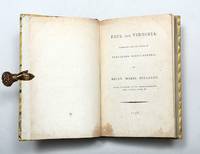
1795144669London: G. G. and J. Robinson 1795. First separate edition in English translated by the celebrated bluestocking Helen Maria Williams 1759-1827 "amidst the horrors of Robespierre's tyranny" as she explains colourfully in her Preface; it became "the standard English edition well into the nineteenth century" Deborah Kennedy Helen Maria Williams and the Age of Revolution 2002 p. 122. The circumstances under which Williams completed her translation were trying to say the least "she was subject to frequent house searches and on several occasions had parts of the translation and other papers seized and taken to 'the Municipality of Paris in order to be examined as English papers; where they still remain mingled with revolutionary placards motions and harangues; and are not likely to be restored to my possession'" ibid. Paul and Virginia was first published in French as part of Bernardin de Saint-Pierre's Études de la nature in 1788 and received its first English translation the same year. "ESTC shows 17 English forms of this work between 1795 when Helen Maria William's Paul and Virginia was published and 1800" Garside Raven and Schöwerling. Though published without an imprint this edition was almost certainly issued by the radical and printer John Hurford Stone 1763-1818 with whom Williams was involved. Another edition was published in London the same year by G. G. and J. Robinson. Precedence has not been established. "Although excessively sentimental this little work contains many charming passages especially the descriptions in which Rousseau's influence can be seen of an idyllic life in strange surroundings. It had an immense vogue was translated into many languages and still retains its popular fame. Bonaparte considered it the language of the soul and he pensioned and decorated the author" The Oxford Companion to French Literature. Octavo in fours 205 x 133 mm. With 6 engraved plates by Clément after drawings by Dutailly. Recent quarter calf and marbled boards to style spine ruled in gilt red morocco label. Small rust hole to one leaf touching one letter; a very good copy. See Garside Raven and Schöwerling 1788:71 hardcover
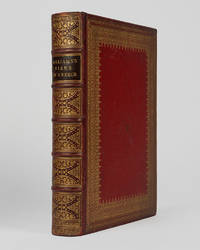
123423London Longman Rees Orme Brown and Green 1829. . First edition; 2 vols in 1 4to 31 x 25 cm; 64 engraved plates after Williams each with leaf of descriptive letterpress; contemporary full red morocco broad gilt dentelles to boards spine gilt in six compartments all edges gilt touch of rubbing else a fine copy.<br /> A beautifully bound example. Williams a Scottish landscape painter returned from an extended tour in Greece and Italy in 1818. The work contains a fine series of engravings of the main historical sites and beautiful landscapes of Greece.<br /> London, Longman, Rees, Orme, Brown, and Green, 1829. hardcover
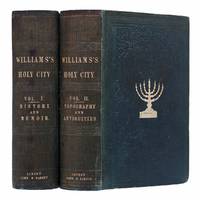
65473London: John W. Parker and Cambridge: John Deighton 1849. SIGNED PRESENTATION COPY TO J.T. COLERIDGE. 2 vols. Thick 8vo. 22 x 14 cm. pp.xxxiii496164 Supplement8 ads.; ixiii61814 ads. Publisher's original blue moiré cloth rebacked sides decorated in blind and stamped with gilt vignettes spines lettered in gilt. Large folding plan of Jerusalem mounted on linen and housed in front pocket 7 plans including one folding and hand-coloured and 15 lithographic plates including a large folding bird's-eye view of the city plus numerous wood-engraved illustrations in the letterpress. With an 18 line ALS on 'Oxford and Cambridge Mission to Central Africa' headed note paper dated January 12 1860 from he author to John Taylor Colereidge nephew of Samuel also signed by Coleridge. Sir John Taylor Coleridge 9 July 1790 – 11 February 1876 was an English judge the second son of Captain James Coleridge and nephew of the poet Samuel Taylor Coleridge. Some light sunning and rubbing to cloth occasional foxing to plates generally a very good association copy with an excellent provenance. First published in 1845 in one volume the second edition is much enlarged this work is a foundational 19th-century text on the topography and history of Jerusalem. Its primary significance lies in its vigourous defence of traditional Christian holy sites e.g. the traditional location of Calvary against the emerging "scientific" scepticism of the era. Since the opening of Palestine to foreign travellers in the 1830s there had been tremendous interest in locating places described in biblical narrative. The site of the Holy Sepulchre established by Constantine in the fourth century allowed no space for a centre of Protestant worship. Some met this challenge by using close study of the Bible and first-century texts alongside topographical evidence to try to dismiss the site's location as inaccurate. In 1841 George Williams 1814–78 had accompanied as chaplain the party of the first Anglican bishopric in Jerusalem using his time there to gain unrivalled topographic knowledge of the region. In this well-illustrated work he draws on both physical and literary evidence to conclude that the case for the traditional site is sound while also surveying the great city's history and character. The second edition 1849 is particularly noted for including an "Architectural History of the Church of the Holy Sepulchre" by Robert Willis which added professional architectural rigour to Williams' historical and religious observations. The work was so highly regarded in its time that Williams received a medal for literary merit from the King of Prussia. It remains a critical resource for scholars studying the 19th-century "opening" of Palestine to European travellers and the subsequent birth of modern biblical archaeology London: John W. Parker [and] Cambridge: John Deighton, 1849. hardcover
1944186390Cummington Massachusetts: The Cummington Press 1944. This writing is the war or part of it merely a different sector of the field First edition one of 380 copies. Williams published the book in response to requests by American servicemen for a pocket-size collection to carry with them during the Second World War. Due to wartime shortages several major publishers declined to publish The Wedge which was eventually picked up by Henry Duncan and Wightman Williams at the Cummington Press who set the poems by hand in Centaur and Arrighi types printed them on Dacian paper and surreptitiously bound the sheets on the premises and at the expense of one of the publishers who had rejected it. The poems anticipate Williams's epic poem Paterson 1946-58. Duodecimo. Title page vignette by Wightman Williams printed in blue and red. Original orange boards spine lettered in black device to front cover in black. With original glassine jacket. Book label of William A. Strutz 1934-2024. Touch of rubbing to extremities tiny chips to glassine: a fine copy. Wallace A23. hardcover
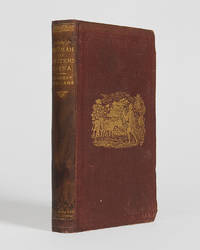
123227Edinburgh and London Blackwood 1868. . First edition first issue; 8vo 20.5 x 14 cm; 2 folding maps 1 large hand-coloured in outline with short tear to fold both lightly foxed wood-engraved frontispiece and 5 plates vignettes in the text bookplate to pastedown; publisher's original reddish-brown cloth gilt large gilt pictorial vignette to upper cover rebacked preserving original spine corners bumped text clean and fresh a very good copy; xiv 2 213 18 ads. pp.<br /> Clement Williams 1833-1879 joined the army as a surgeon and was stationed in Burma in 1858. In 1861 Williams was posted to Mandalay in Upper Burma then known as the Kingdom of Ava. At that time it was still independent and was ruled by King Mindon Min. Williams was one of the first Europeans to live in this region.<br /><br />Williams gained King Mindon's trust by successfully treating members of his family. This led to Britain appointing him Political Agent in 1863. That same year Williams obtained permission from the King to journey up the Irrawaddy River from Mandalay to Bhamo in search of a trade route from India to China. Though he was unable to reach the Chinese border owing to tribal unrest his published account enthused Britain to embark on a further series of expeditions to establish a trade route.<br /> Cordier Indosinica 177. Edinburgh and London, Blackwood, 1868. hardcover
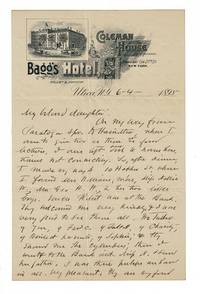
191558428New Haven India England and Japan 1915. A collection of 42 items mostly manuscript letters signed from a variety of academics administrators and Yale men to the sinologist Frederick Wells Williams 1857-1928 with a few letters from Williams' father-in-law the theologian Hemen Lincoln Wayland to his daughter Williams' wife Fanny. Frederick Wells Williams was the son of Samuel Wells Williams also a sinologist and missionary to China. The elder Williams was the first professor of Chinese language and literature in the United States. The younger Williams continued this trade and was himself a professor of Oriental history at Yale. The majority of the archive is comprised of manuscript letters addressed to Williams dealing primarily with matters of travel. Williams planned visits to Panama Morocco and particularly India and sought letters of introduction or meetings with men with connections there. The letters chiefly concern meeting up or making plans with some exceptions as noted below. Included are ALS's from: 1. Ion Perdicaris Greek-American heir most famous for being kidnapped in Morocco for a high ransom and compelling Roosevelt to declare "Perdicaris alive or Raisuli dead!" Perdicaris assists Williams in making connections in Morocco. 2. Thomas Raynesford Lounsbury who provided 2 colorful letters one from London: "I am staying here. at this hotel. which bears the honored name Thackery but which to my horror . I find is a temperance hotel. I shall consequentially not stay long." The other a cryptic 1p note reading "You can rely upon me to stand by you unflinchingly on the solemn occasion to which you refer and all the more readily that there are no alien interests to interpose. I shall loom up at half-past six." Lounsbury was an English scholar at Yale and an authority on Chaucer. 3. Guy Lestrange a British Orientalist arranging a meeting 4. William Graham Sumner Yale Professor of social science. He asks Williams to find a replacement for his wife to speak at the Soc. Sci. Club. and compliments him on his previous lecture. 5. Charles Lewis Slattery a bishop of the Episcopal Diocese of Massachusetts who provides a "ghost signature" no letter included 6. John Ferguson Weir painter sculptor and teacher at Yale who writes a letter of profuse thanks. "I cannot let the day close without thanking you again for what your friendship prompted and effected - not without great painstaking on your part I know - but which has for me a depth of meaning not to be put in words though it fills my thoughts." 7. George Trumbull Ladd Clark Professor of Metaphysics and Moral Philosophy apologizing for missing a social call. "I was so absorbed in trying out some new rolls that I did not know anyone had entered the house." 8. Poultney Bigelow a Yale classmate of Williams' and traveling journalist. "Just in from the Alps and the Himalayas and the first message from my mound of P. O. Matter is your "US & China" - about which no man can write better than yourself. It was a great pleasure to me last winter in the East to note how tenderly your name is cherished in the minds of scholars & trust you will have many more years of usefulness adding ever to your father's reputation & your own." 9. Maurice Bloomfield American Sanskrit scholar thanking Williams for assistance. 10. Morgan Shuster providing a letter of introduction to General Goethals of the Panama Canal Zone a year after the canal's completion 11. John Bucher thanking Williams for sending something to him. 12. Theodore Morrison an administrator and educator on India regarding letters of introduction for a trip Williams is planning 13. A letter from an unknown author introducing H S Bayley of Hyderabad and "His Highness" the title I can't decipher and advising on how to prepare for Williams' arrival. 14. C. S. Mellen "the last of the railway tsars." Mellen says he will not be able to attend a meeting of the Social Science club because he is having a dinner with the employees and labor orgs of the Boston & Main Railroad. 15. J. G. Jennings inviting Williams to stay with him at his home near Muir College Allahabad. Jenning was at the time president of the college. In addition to this parade of men of note there are a few other letters including: 1. Five letters from M. Arao Oiwa a translator guide and print dealer from Japan discussing the print market in Japan promising products and encouraging Williams to send friends and students to Japan to travel. Oita charges 15 yen a day per person to guide them around the country and speaks warmly of his relationship with Williams. 2. A vitriolic ALS from a Maria Smith who has taken offense at Williams' comment on the behavior of Christian missionaries in China. "You say also that through it all the Chinese have maintained their own 'superior culture and moral principles.' Superior culture! And moral principles! As exemplified no doubt in the condition of their women; the state of marriage; the extremely sanitary condition of the country; the system of education; the political organization and a thousand other notorious systems of debauchery and corruption which have made China what she is and have kept her where she is sunk in ignorance and superstition." 3. Four personal letters between H. L. Wayland and Fannie Williams' wife. Wayland discusses news about the neighborhood and asks after his grandchildren. 4. A manuscript invitation to attend the second meeting of the Excelsior Society of Yale and to provide a lecture. Dated 1908 Signed "Y. Z. China" Also included are a few items of ephemera photo portraits of two Wayland men H.L. Wayland's pamphlet "What Mr. Jenkins thinks" Fannie's grade book marriage license and certificate of proficiency for Remington typewriting menu for the 20th anniversary of the Yale Wolf's Head society of which Williams was a member a menu to the Norfolk Inn on which a pen illustration of women at a table has been drawn a broadside schedule of services for Stewart Street Baptist Church with Wayland providing a sermon and a 6.25" x 10" photograph of an outdoor scene likely Hawaii with figures labeled in manuscript "Norman Garstin J. B. Alexander H. H. Garstin" Norman and H. H. Garstin were English born businessmen who managed a large plantation in Hawaii and moved to California in 1892. Overall an interesting look at the sort of connections a Yale professor maintained at the turn of the 20th century. unknown
191558428New Haven India England and Japan 1915. A collection of 42 items mostly manuscript letters signed from a variety of academics administrators and Yale men to the sinologist Frederick Wells Williams 1857-1928 with a few letters from Williams' father-in-law the theologian Hemen Lincoln Wayland to his daughter Williams' wife Fanny. Frederick Wells Williams was the son of Samuel Wells Williams also a sinologist and missionary to China. The elder Williams was the first professor of Chinese language and literature in the United States. The younger Williams continued this trade and was himself a professor of Oriental history at Yale. The majority of the archive is comprised of manuscript letters addressed to Williams dealing primarily with matters of travel. Williams planned visits to Panama Morocco and particularly India and sought letters of introduction or meetings with men with connections there. The letters chiefly concern meeting up or making plans with some exceptions as noted below. Included are ALS's from: 1. Ion Perdicaris Greek-American heir most famous for being kidnapped in Morocco for a high ransom and compelling Roosevelt to declare "Perdicaris alive or Raisuli dead!" Perdicaris assists Williams in making connections in Morocco. 2. Thomas Raynesford Lounsbury who provided 2 colorful letters one from London: "I am staying here. at this hotel. which bears the honored name Thackery but which to my horror . I find is a temperance hotel. I shall consequentially not stay long." The other a cryptic 1p note reading "You can rely upon me to stand by you unflinchingly on the solemn occasion to which you refer and all the more readily that there are no alien interests to interpose. I shall loom up at half-past six." Lounsbury was an English scholar at Yale and an authority on Chaucer. 3. Guy Lestrange a British Orientalist arranging a meeting 4. William Graham Sumner Yale Professor of social science. He asks Williams to find a replacement for his wife to speak at the Soc. Sci. Club. and compliments him on his previous lecture. 5. Charles Lewis Slattery a bishop of the Episcopal Diocese of Massachusetts who provides a "ghost signature" no letter included 6. John Ferguson Weir painter sculptor and teacher at Yale who writes a letter of profuse thanks. "I cannot let the day close without thanking you again for what your friendship prompted and effected - not without great painstaking on your part I know - but which has for me a depth of meaning not to be put in words though it fills my thoughts." 7. George Trumbull Ladd Clark Professor of Metaphysics and Moral Philosophy apologizing for missing a social call. "I was so absorbed in trying out some new rolls that I did not know anyone had entered the house." 8. Poultney Bigelow a Yale classmate of Williams' and traveling journalist. "Just in from the Alps and the Himalayas and the first message from my mound of P. O. Matter is your "US & China" - about which no man can write better than yourself. It was a great pleasure to me last winter in the East to note how tenderly your name is cherished in the minds of scholars & trust you will have many more years of usefulness adding ever to your father's reputation & your own." 9. Maurice Bloomfield American Sanskrit scholar thanking Williams for assistance. 10. Morgan Shuster providing a letter of introduction to General Goethals of the Panama Canal Zone a year after the canal's completion 11. John Bucher thanking Williams for sending something to him. 12. Theodore Morrison an administrator and educator on India regarding letters of introduction for a trip Williams is planning 13. A letter from an unknown author introducing H S Bayley of Hyderabad and "His Highness" the title I can't decipher and advising on how to prepare for Williams' arrival. 14. C. S. Mellen "the last of the railway tsars." Mellen says he will not be able to attend a meeting of the Social Science club because he is having a dinner with the employees and labor orgs of the Boston & Main Railroad. 15. J. G. Jennings inviting Williams to stay with him at his home near Muir College Allahabad. Jenning was at the time president of the college. In addition to this parade of men of note there are a few other letters including: 1. Five letters from M. Arao Oiwa a translator guide and print dealer from Japan discussing the print market in Japan promising products and encouraging Williams to send friends and students to Japan to travel. Oita charges 15 yen a day per person to guide them around the country and speaks warmly of his relationship with Williams. 2. A vitriolic ALS from a Maria Smith who has taken offense at Williams' comment on the behavior of Christian missionaries in China. "You say also that through it all the Chinese have maintained their own 'superior culture and moral principles.' Superior culture! And moral principles! As exemplified no doubt in the condition of their women; the state of marriage; the extremely sanitary condition of the country; the system of education; the political organization and a thousand other notorious systems of debauchery and corruption which have made China what she is and have kept her where she is sunk in ignorance and superstition." 3. Four personal letters between H. L. Wayland and Fannie Williams' wife. Wayland discusses news about the neighborhood and asks after his grandchildren. 4. A manuscript invitation to attend the second meeting of the Excelsior Society of Yale and to provide a lecture. Dated 1908 Signed "Y. Z. China" Also included are a few items of ephemera photo portraits of two Wayland men H.L. Wayland's pamphlet "What Mr. Jenkins thinks" Fannie's grade book marriage license and certificate of proficiency for Remington typewriting menu for the 20th anniversary of the Yale Wolf's Head society of which Williams was a member a menu to the Norfolk Inn on which a pen illustration of women at a table has been drawn a broadside schedule of services for Stewart Street Baptist Church with Wayland providing a sermon and a 6.25" x 10" photograph of an outdoor scene likely Hawaii with figures labeled in manuscript "Norman Garstin J. B. Alexander H. H. Garstin" Norman and H. H. Garstin were English born businessmen who managed a large plantation in Hawaii and moved to California in 1892. Overall an interesting look at the sort of connections a Yale professor maintained at the turn of the 20th century. <br/><br/> unknown books
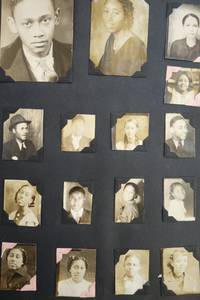
1950List1810Mostly Atlanta 1950. Leatherette album measuring 12 x 9 inches. With over 225 images most 4 ½ x 2 ¾ inches. Very well preserved and nearly complete with three empty slots about fine overall. Near Fine. A compelling visual record of the childhood of Mable Williams of Atlanta Georgia a high school student at Booker T. Washington High School in Atlanta the first public high school for African-American students in the state. Williams graduated from Booker T. Washington High School in 1953 per a newspaper article included here and would attend Spelman College. Composed mostly of snapshot photographs of her friends and family as a group the album provides a visual record of a vibrant network of family and friends in Atlanta during the time period. <br /> <br /> The album begins with a picture showing her as a girl alongside a picture of a house perhaps hers and traces her life through early adulthood through snapshots and family photographs. We find records of Williams performing at the Greater Atlanta Music Festival in 1950 as a representative of her high school. A newspaper article laid in shows Williams in a newspaper showing her graduation picture and stating that she will attend Spelman College in Atlanta in September of 1953. Pictures show her in New York City visiting a friend at N.Y.U. She would later marry Billy Reid a local jazz musician from Atlanta and would remain active in the Spelman community after graduating in 1957. <br /> <br /> Overall a very well preserved document of the African-American community in Atlanta during the 1940s and 1950s. unknown
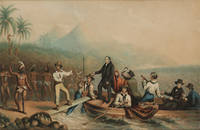
1841WRCAM41732London: George Baxter 1841. Two oil-colored "Baxter prints" 8 x 12 inches each visible dimensions within the mat. Matted and in contemporary burnished wood frames. A bit of light spotting mostly in the sky of the second print else in fine condition. A remarkable pair of rare and interesting prints depicting the mission to the South Seas by the Rev. John Williams and his murder at the hands of natives on the island of Erromango. The prints were produced through an unusual oil-colored process invented by pioneering British print-maker George Baxter who was a close friend of Rev. Williams and who created these prints as a memorial to his friend and as a way of raising funds for Williams' family. <br> <br> Rev. John Williams 1796-1839 was a member of the London Missionary Society and was in the third group of missionaries to visit Tahiti arriving there in 1817. He then went on to Australia where he helped conduct the first Evangelical service in Van Diemen's Land. He also preached in Raiatea in French Polynesia. In 1838 Williams sailed aboard the missionary ship Camden for the South Seas visiting the island of Erromango in what is now a southern province of Vanuatu in late 1839. He was initially greeted warmly but shortly after his arrival the natives of the island turned on him and his colleagues killing Williams and one other. Those events are shown in these two prints. The first image shows Williams and his cohorts coming ashore in a small boat and being greeted - with a welcoming curiosity - by the natives. A chief of the natives urges his people to welcome the visitors while Williams stands at the front of the small boat and another missionary displays colored cloths and a looking glass. The faint outline of the Camden and a few other small landing boats can be seen in the right side of the image though it seems that Baxter never fully colored them in this copy of the print. The second print is a scene of violent mayhem as the Rev. Williams waist deep in the surf is clubbed to death by natives. Dozens of natives are shown running from the shore into the water in an effort to kill Williams and his colleagues who attempt their escape by boat. Mr. Harris is seen on shore being speared and clubbed to death. <br> <br> George Baxter who produced these prints was among the most innovative of British print-makers and a close friend of the Rev. Williams. Much of Baxter's output in the early 1840s was devoted to illustrations of missionary activities abroad and Courtney Lewis says that "this period includes Baxter's best and most original work." Baxter 1804-67 is credited with creating a method of using woodblocks to produce color prints thereby making color prints commercially viable for the first time in Great Britain. Later he pioneered a printing method using colored oils which is the method used to produce this pair of prints. Baxter produced a portrait print of Rev. Williams in 1837 and others followed and the two men became good friends. Lewis notes that when Williams left the Thames aboard the Camden Baxter was one of the last people to see him off. When Baxter heard the news of Williams' death he produced these prints and donated the proceeds to the missionary's family. Baxter drew the scenes based on the testimony of Mr. Leary one of the survivors of the mission. He offered the prints as a pair as they are here or as a "book" accompanied by seven pages of descriptive text and called TWO SPECIMENS OF PRINTING IN OIL COLOURS. The prints could be purchased in sepia or fully colored as here. The DNB says that Baxter produced some of his most powerful work for the missionary societies and calls the print of the massacre of Rev. Williams "his most celebrated print in this context." <br> <br> OCLC locates only five copies of this pair of prints at the National Library of Australia State Library of New South Wales National Library of New Zealand University of Toronto Victoria University and University of Hawaii at Manoa. Rare and fascinating images of a little-known event in the missionary history of the South Pacific. Lewis GEORGE BAXTER COLOUR PRINTER HIS LIFE AND WORK 82a 82b p.93. OCLC 154637564 16336100. AUSTRALIAN DICTIONARY OF BIOGRAPHY online Vol. 2 pp.599-600. George Baxter hardcover books
187819851San Francisco: Edgar Williams & Co. Very Good-. 1878. First Edition. Hardcover. In the original three-quarter leather. The cloth and corners are rubbed all around. The title page and last page have small tape repairs at the edges. The spine leather may be a replacement; hard to tell. ; Folio 13" - 23" tall; 104 pages . Edgar Williams & Co. hardcover
1900C2457<p>lii232 pages with diagrams index and tables. Quarto 10 1/2" x 6 3/4" bound in dark brown cloth with gilt lettered spine label and original vignette affixed to front cover. Annotations by Leopold Hoffer. Betts: 7-36 Limited to 500 copies. First edition. <br /><br />The London 1899 chess tournament was without a doubt one of the very strongest tournaments ever held on British soil. Almost every great master of the day was present including the past and reigning world champions. It proved to be the swan song of the old champion Wilhelm Steinitz but for Emanuel Lasker it was a glittering success which propelled him way beyond the other grandmasters of the time. All important players were invited. Many of these players were the champions of the country that they represented. Refusals came from Siegbert Tarrasch and Rudolf Charousek illness. The businessman Amos Burn had to withdraw at the opening's day. Fifteen participants played double rounds from 30 May to 10 July 1899 except for Richard Teichmann. He withdrew after round 4 due to an eye disease. His remaining games in the first cycle were declared as lost. Rounds were played in St. Stephen s Hall. The time limit was fifteen moves in one hour. Participants were entertained by the City of London chess club at Crystal Palace and the Star and Garter Hotel in Richmond. A banquet took place in the International Hall of the Café Monico on 29 June. Lasker finished a whopping 4.5 points ahead of the group finished tied for second Janowski Maroczy Pillsbury. This is easily one of the more dominating personal performances in a tournament ever played. London 1899 goes down in history as one of the great Lasker victories along with St. Petersburg 1896 Paris 1900 St. Petersburg 1914 and New York 1924. There was a second section in the tournament won by Frank James Marshall with 8.5 out of 11. Georg Marco and Jacques Mieses were the most experienced opponents and the tournament was not all that strong. <br /><br /><strong>Condition:</strong> Corners gently bumped some toning to endpapers and paste downs else very good or better.</p> Longmans, Green and Company hardcover
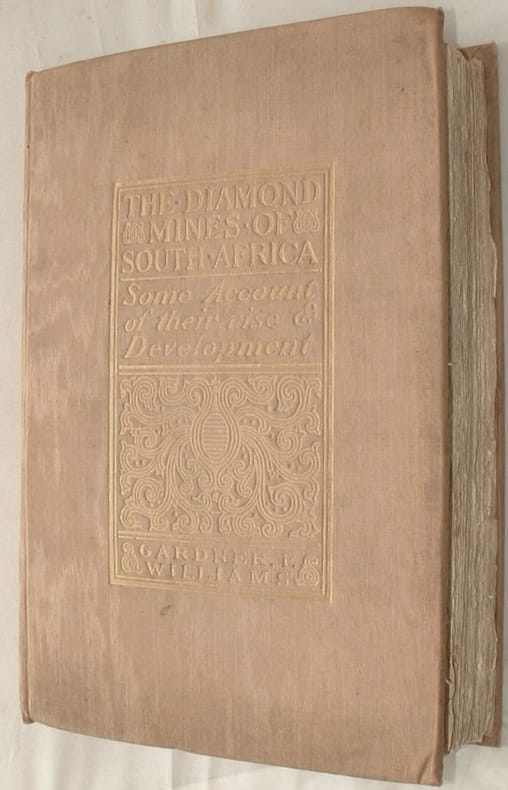
lom-MS000917In English. Short description: The Diamond Mines of South Africa: Some Account of Their Rise and Development, Gardner F. Williams, New York, 1902681 pp, 3 maps, illustrations (black and white and color), 26 17.5 cm Solid edition by Garner F. Williams - the largest player in the diamond business, who at the beginning of the 20th century owned 95% of all mined diamonds in the world. Please feel free to contact us for a detailed description of the copies available. SKUMS000917 kn_nat
lom-MS000917In English. Short description: The Diamond Mines of South Africa: Some Account of Their Rise and Development Gardner F. Williams New York 1902681 pp 3 maps illustrations black and white and color 26 17.5 cm Solid edition by Garner F. Williams - the largest player in the diamond business who at the beginning of the 20th century owned 95% of all mined diamonds in the world. Please feel free to contact us for a detailed description of the copies available. SKUMS000917 kn_nat unknown
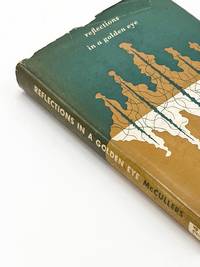
195051600New York: New Directions 1950. Near fine in very good jacket. Inscribed New Directions reissue of McCullers's second novel full of that Sense of Dreadfulness defined by Tennessee Williams as characteristic of the Southern Gothic school. First published in 1941 and set on a Georgia army base beset with unspoken sexual obsessions strange hates and sudden outbreaks of violence REFLECTIONS was once criticized as morbid and unwholesome now recognized as one of the great gay classics of the early 20th century. In his new introduction to this New Classics Series edition from New Directions Williams champions it as "one of the purest and most powerful of those works which are conceived in that Sense of The Awful which is the desperate black root of nearly all significant modern art" superior in artistic control to her celebrated debut braver than Proust nobler in spirit than any since Melville. Uncommon inscribed. 7'' x 4.5''. Original tan cloth. In original unclipped $1.50 blue and tan dust jacket designed by Al Lustig. 182 4 pages. Inscribed by McCullers on front free endpaper: "For Jack and Georgia / Carson." Single pencil underline to one page. Some soil to jacket spine top edge of text block. Light chipping and wear to jacket with a few small closed tears. (New Directions) unknown
30107Philadelphia: Press of J. B. Lippincott & Co n. d. 1st edition Romaine p. 301. Ca 1871 - 72. Original publisher's pebbled terra-cotta cloth binding with gilt stamped lettering to spine & front board. Beveled edges. Overall VG slightly shaken/some shelfwear. 134 pp. T.p. printed in red & black. Text within rectangular red-rule border. Illustrated with wood engraved frontis depicting the 'Baldwin Locomotive Works' factory 11 intratextual cuts & 16 pasted-in photographs of divers Baldwin locomotives. 4to: 11" x 7-5/8" <br/><br/>The Baldwin Locomotive Works an American builder of railroad locomotives was located in Pennsylvania originally Philadelphia then moving in 1906 to nearby Eddystone. The company was the largest US producer of custom made-to-order steam locomotives. Founded in the early 1830s by Matthais Baldwin the firm stopped producing locomotives in 1956 ceasing business in 1972 having produced over 70000 engines the vast majority powered by steam. This one of the firm's first photograhically illustrated catalogues a lavish production issued in the ealy 1870s as Baldwin overtook Rogers as the premier locomotive manufacturer in the United States. Herein will be found photographs of their divers products including fill in with some names of locomotives. While not a particularly rare catalogue it's importance & desirablility lies in documenting the ascent to prominence of this significant US heavy equipment manufacturer as well as being an early trade catalogue illustrated with actual photographs. Press of J. B. Lippincott & Co hardcover books
196949905Hollywood CA: Heavy Industry Publications 1969. First printing. Near fine in near fine jacket. Signed first edition of Ruscha's photo-novel illustrating a 1967 short story by Mason Williams "How To Derive The Maximum Enjoyment From Crackers." Printed in full on the rear dust jacket flap Williams's directions for a semi-surrealist sexual humiliation comedy are faithfully acted out by Larry Bell Leon Bing Rudi Gernreich and Tommy Smothers and photographed by Ken Price Joe Goode and Ruscha. Ruscha would use the same source material and the same cast for his 1971 short film "Premium" explaining: "See it was a movie best of all but first it was a book. It was a book that was a movie fallen short." Scarce signed. 8.75'' x 6''. Original chipboard wrappers. In original red and white printed dust jacket. 240 pages. Black and white photographic illustrations. Signed by Ruscha on front free endpaper. PROVENANCE: From the collection of longtime MIT Press editor Roger Conover who published several books by and about Ruscha. Light edgewear and touches of chipping to jacket. Else clean and bright. (Heavy Industry Publications) unknown
196631563Los Angeles: Mason Williams 1966. Modest edge-wear to golden cloth boards; near fine. Limited Edition. Tall octavo. One of 500 copies. Designed by Edward Ruscha for friend and musician Mason Williams. Features black and white photography of Los Vegas by Patrick Blackwell paired with text by Williams in beautiful handset type. Los Angeles: Mason Williams unknown
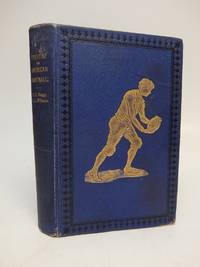
1893280411Hartford: The Case Lockwood & Brainard 1893. First. hardcover. very good. Illustrated with diagrams and explanations for 69 plays. 12mo 274 pages gilt decorated blue cloth lightly rubbed at the extremities and minimal buckling on cloth. Hartford: The Case Lockwood & Brainard 1893. Very good . Scarce.<br/><br/> Stagg and Williams' book was the first to include diagrams and explanations of plays for coaches and teams and is considered one of the Founding Documents of the American game. Amos Alonzo Stagg played football at Yale and was later inducted into the College Football Hall of Fame. Stagg and Williams' Treatise on American Football is perhaps the most important book in the history of football in the United States.<br/><br/> The Case, Lockwood & Brainard unknown books
1945155827Norfolk CT: New Directions 1945. First Edition. First Edition. SIGNED by the author on the first blank. <br /> <br /> About Near Fine in a Very Good plus dust jacket. Jacket lightly rubbed with short closed tears on the heel and flap folds repaired with cello tape on the verso. New Directions unknown