Louis-Ferdinand CELINEBiblio.com
5 003 résultats
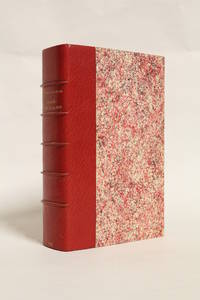
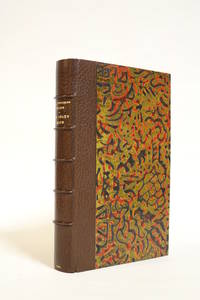
194168980Paris: Nouvelles Editions Françaises 1941. Fine. Nouvelles Editions Françaises Paris 1941 11.50 x 19 cm relié First edition one of 60 numbered copies on vergé d'Arches paper deluxe copies ""tirage de tê"". Bound in brown half morocco covers and spine preserved top edge gilt binding signed by Thomas Boichot. Nice copy. Nouvelles Editions Françaises unknown
194171006Nouvelles Editions Françaises | Paris 1941 | 11.50 x 19 cm | relié
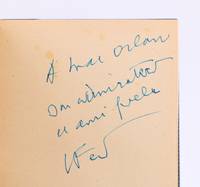
194489964Paris: Denoël 1944. Fine. ""And Mac Orlan!"" Denoël Paris 1944 12 x 18.8 cm Relié First edition on ordinary paper. Half black long-grain morocco binding smooth spine tooled in palladium with author title and date anthracite-grey paper boards original wrappers and spine preserved the latter with two small stains at head and foot endpapers and pastedowns of anthracite-grey paper binding signed Thomas Boichot. Precious and exceptional signed presentation inscription by Louis-Ferdinand Céline: ""A Mac Orlan son admirateur et ami fidèle. LFerd"" Twelve years his senior Louis-Ferdinand Céline regarded Pierre Mac Orlan as one of his principal literary masters. The latter's fantasy novels provided an ideal framework for Céline's distinctive style. In a 1937 pamphlet Céline openly expressed his admiration for Mac Orlan's work: ""And Mac Orlan! He had foreseen it all and put it all to music thirty years ago."" Until 1944 the two men would meet in Gen Paul's Montmartre studio on Avenue Junot Céline as a habitué Mac Orlan as a more occasional visitor. This friendship which Céline describes as ""faithful"" in this inscription was not one-sided. In 1950 Mac Orlan came to the defense of his ""disciple"" who had been condemned by the French courts: ""Few writers can escape the rigorous logic of social criticism. The French Republic ours the freest the world can know at this moment must work to ease hatreds."" Céline 1944-1961: Cavalier de l'Apocalypse Unpublished letter from Mac Orlan February 15 1950. A superb inscription from Céline to one of his literary mentors Pierre Mac Orlan whom he encountered in Gen Paul's studio during the interwar period and the Occupation. Denoël hardcover
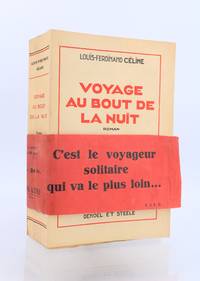
193291201Paris: Denoël & Steele 1932. Fine. ""Unprejudiced minds will have to bow before the integrity of his testimony"" publisher's band Denoël & Steele Paris 1932 12 x 19 cm Broché First edition on ordinary paper with all the features of the first printing. Includes its publishers band expertly restored and the publishers catalogue at rear. An exceptionally fresh copy preserved with its rare red publishers band quoting Mollys phrase Cest le voyageur solitaire qui va le plus loin he travels farthest who travels alone translation by John H. P. Marks followed by this text on the verso: One should not be misled by the tone of this extraordinary novel and take Journey to the End of the Night for a pamphlet by the violence of its sarcasm as well as its ever-present and particularly ferocious satire. The author aims to create a very faithful image of urban man with all his implied complexity richness and contradictions. In this book of prodigious variety and vividness he has no other ambition than to approach life: unprejudiced minds will have to bow before the integrity of his testimony translation our own. From December 1932 copies sported a new band printed on green paper: Un formidable / succès / Prix Théophraste Renaudot. Denoël & Steele unknown
194187024Nouvelles Editions Françaises | Paris 1941 | 11.50 x 18 cm | relié sous étui
195445126Gallimard | Paris 1954 | 14 x 21 cm | relié
194168980Nouvelles Editions Françaises | Paris 1941 | 11.50 x 19 cm | relié
1936120529Paris Denoël et Steele 1936 1 vol. relié fort in-8, plein maroquin rouge, dos lisse, doublures et gardes de suédine bleue bordée d'un listel de maroquin blanc, tranches dorées, chemise demi-maroquin rouge à bandes et étui bordé, non rogné, couvertures et dos conservés (J.-P. Miguet), 697 pp. Édition originale. Un des 85 exemplaires numérotés sur vélin pur fil (n°78) présentant le texte expurgé, parfaitement conservé dans une élégante reliure signée.
1936120529Paris Denoël et Steele 1936 1 vol. relié fort in-8, plein maroquin rouge, dos lisse, doublures et gardes de suédine bleue bordée d'un listel de maroquin blanc, tranches dorées, chemise demi-maroquin rouge à bandes et étui bordé, non rogné, couvertures et dos conservés (J.-P. Miguet), 697 pp. Édition originale. Un des 85 exemplaires numérotés sur vélin pur fil (n°78) présentant le texte expurgé, parfaitement conservé dans une élégante reliure signée.
193632650Exemplaire Vanderem, en service de presse Paris, Denoël et Steele, (8 mai) 1936. 1 vol. (135 x 210 mm) de 697 p. Demi-maroquin rouge à coins, dos à nerfs, filets à froid, titre doré, date en pied, tête dorée sur témoins, couverture et dos conservés (reliure signée de Ersé). Édition originale.
193291201Denoël & Steele | Paris 1932 | 12 x 19 cm | Broché
194489964Denoël | Paris 1944 | 12 x 18.8 cm | Relié
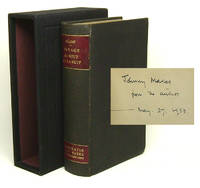
193333339Paris: Editions Denoel et Steele Paris 1933. First Thus. Hardcover. First Thus. Hardcover. Signed by Authors. Celine's legendary First Novel. Inscribed Presentation/ Association Copy of Some Significance. A very early reprint of the first edition published in 1932. 8vo 18.5cm x 12cm. 623pp. A superb presentation inscribed to his friend John Marks who translated this very title into English the following year. A very good copy in a contemporary black buckram binding with titles on the spine in gilt on a maroon panel. There is some off-setting to the endpapers & the cheaper publisher's paper stock has lightly & evenly tanned. A faint stain to the fore-edge. The original card covers are not bound in. The presentation on the first blank reads: Johnny Marks from the author ~ May. 27. 1933. "Celine's Journey to the End of the Night along with Death on the Installment Plan were both very successful in the 1930s & are unique: they come nearer than any other works of the century to creating the illusion of a living infuriated comic vibrant voice. This voice comes off the pages.as though it were the pure real flux of a mind actively working." - Martin Seymour-Smith in Novels and Novelists 1980. A cornerstone of Modern World Literature the publication of this work in 1932 had an immediate impact on author s of the period such as Henry Miller with Tropic of Cancer in 1934 George Orwell with Down and Out in Paris and London in 1935 Henry Green & many others. Connolly: The Modern Movement No. 74. An important Association Copy. Editions Denoel et Steele, Paris hardcover
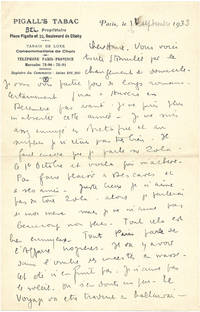
1933Celine10<p><strong>CÉLINE Louis-Ferdinand 1894-1961</strong></p><p>Autograph letter signed " Destouches " to Évelyne Pollet<br />Paris 14 Sept. 1933 2 p. in-8°<br />Pigall's Tabac letterhead<br />Light ink smudge on upper margin<br />Usual central fold</p><p><strong>Upcoming speech in tribute to Zola and translation of <em>Journey to the End of the Night</em></strong></p><p><strong><em>" Good heavens I really don't like Zola at all so I'll talk about myself — though I don't like myself much either. " </em></strong></p><p><strong>When Céline confesses that he never wants to reread his novel — a work widely regarded as one of the greatest in 20th-century French literature</strong></p><p><em>" Chère Amie</em><br /><em>Vous voici toute stimulée par le changement de domicile. Je vous vois partie pour de longs romans. Certainement j'irai à Anvers en décembre pas avant. Je ne puis plus m'absenter cette année. Je me suis assez ennuyé en Bretagne et au surplus je n'étais pas très bien. <strong>Il faut encore que je parle sur Zola le 1er octobre et voilà qui m'achève. Pour faire plaisir à Descaves et à ses amis. Juste cieux je n'aime pas du tout Zola alors je parlerai de moi-même mais je n'aime pas beaucoup non plus</strong>. Tout cela est bien ennuyeux. Tout Paris parle de l'Affaire Nozières</em>¹ sic<em>. Il va y avoir dans l'ombre des incestes en masse. Cet été n'en finit pas. Je n'aime pas le soleil. On s'en doute un peu. <strong>Le Voyage va être traduit en hollandais.</strong></em><br /><em>Je reprends samedi mon dispensaire</em>²<em>. Tout cela est une telle farce !</em><br /><strong><em>Je vois que vous finirez par connaître le Voyage par cœur. Moi je ne l'ai jamais relu et ne le relirai jamais. Je trouve tout cela ennuyeux et plat à vomir. C'est curieux que tout ce cabotinage finisse par séduire le lecteur</em></strong><em>. Je crois qu'il a envie d'en faire autant. Tout es là. Enfin on se connaît mal. <strong>Nous sommes recouverts d'immondices civilisés</strong>. N'oubliez pas de me donner votre nouvelle adresse.</em><br /><em>Amicalement</em><br /><em>Destouches "</em></p><p><u>A breakaway speech:</u><br />In the summer of 1933 Lucien Descaves approached his friend Céline asking him to deliver a speech in tribute to Zola at the annual Médan pilgrimage. Céline did not hold the naturalist writer in high esteem and it was out of friendship for Descaves that he agreed. Thus on October 1st 1933 before an audience composed of the Parisian literary elite and other notable figures the writer took the floor.<br />Where previous speeches had remained within the expected register of homage Céline's intervention stood in stark contrast — and caused a scandal. The audience had no idea what was coming. Already a master of staging his public persona Céline deliberately chose to go against expectations and handed the floor to Ferdinand Bardamu the protagonist of <em>Journey to the End of the Night</em>. He even hinted at this shift when he said "Good heavens I really don't like Zola at all so I'll talk about myself."<br />Through Bardamu Céline delivered a dark and deeply critical vision of contemporary French society. Though the speech begins as a genuine tribute to the father of the <em>Rougon-Macquart</em> series it soon gives way to the characteristic disillusionment of Céline's universe.<br />The writer clearly signals a definitive break with Zola's naturalism: the Great War had in Céline's eyes discredited the modernist hopes pinned on scientific progress and the promise of a fairer society. In this speech Céline effectively buries the legacy of naturalism that Zola had championed.</p><p><u>Translation of Journey to the End of the Night:</u><br />Published the previous year <em>Journey to the End of the Night</em> had caused a sensation and catapulted Céline to the forefront of the Parisian literary scene. Already translated into several languages he reassured his Dutch translator J.A. Sandfort in a letter dated September 10th demanding that his text be translated in full:<br /><em>"Under no circumstances should there be any abridgment of Journey. I do not want it — not a quarter not a page nor a line </em>…<em>" </em>He added <em>"There are already 10 foreign translations of this book all absolutely complete"</em> <em>Lettres</em> no. 3393.</p><p>1- Violette Nozière 1915–1966 barely 18 years old was arrested accused of poisoning her parents. While her mother was resuscitated her father did not survive. Although her mother initially joined the civil lawsuit she eventually forgave her daughter. Sentenced to death on October 12 1934 — a sentence commuted to life imprisonment on August 29 1945 — Violette Nozière was granted early release on August 29 1945.</p><p>2- Céline attempted to practice medicine privately by opening a practice in Clichy in November 1927 which he quickly closed due to lack of patients. He eventually took a position as a suburban doctor at the Clichy dispensary directed by Grégoire Ichok. Dr. Destouches resigned from the Communist municipality of Clichy on December 10 1937.</p><p>Born in Antwerp in 1905 Évelyne Pollet took the initiative to write to Céline after reading <em>Journey to the End of the Night</em> eventually coming to "know it by heart." They met in May 1933 and became lovers. She went on to write eight novels and collections of short stories including a fictionalized account of her relationship with Céline written in 1942 and published in 1956 under the title <em>Escaliers</em> La Renaissance du livre. Évelyne is also the name of the heroine in <em>La Naissance d'une fée</em> the first of the three ballets in <em>Bagatelles pour un massacre</em>.</p><p><u>Provenance:<br /></u>Private collection</p><p><u>Bibliography:</u><br /><em>Lettres</em> éd. Henri Godard et Jean-Paul Louis Pléiade 2009 n°33-94</p>
195585266Paris: Gallimard 1955. Fine. Gallimard Paris 1955 12 x 19 cm relié First edition one of 36 numbered copies on Holland paper deluxe copy. Half red morocco binding with bands spine with six raised bands set with black fillets gilt fillet frame on wood-grain paper boards marbled endpapers and pastedowns original covers and spine preserved top edge gilt. Handsome copy attractively bound. Gallimard hardcover
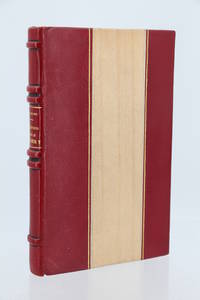
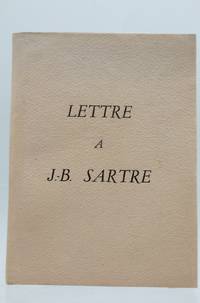
194875286Paris: Pierre Lanauve de Tartas 1948. Fine. Pierre Lanauve de Tartas Paris 1948 14 x 20 cm en feuilles First edition one of 150 copies on B.F.K. de Rives the only issue after 50 other deluxe copies. Some discreet restorations to spine and covers. At the colophon our copy is exceptionally enriched with the very rare manuscript signature of Louis-Ferdinand Céline then in exile in Denmark. The publisher Pierre Lanauve de Tartas specified just above Céline's signature ""Author's copy"". This very rare copy indeed bears printed on the front cover the initial title of the work: Lettre à J. B. Sartre. We include the flying slip bearing the final title ""à l'agité du bocal"" which was glued onto the entirety of the print run subsequently distributed. Precious author's copy of Céline's scathing response to Jean-Paul Sartre who in Réflexions sur la question juive had accused him of having been paid by the Germans under the Occupation for having held such indefensible antisemitic positions. Pierre Lanauve de Tartas unknown
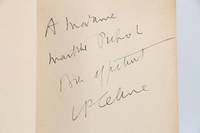
193771965Paris: Denoël & Steele 1937. Fine. Denoël & Steele Paris 1937 11.50 x 18.50 cm broché First edition one of 125 numbered copies on alfa paper ours one of 25 hors commerce copies the only deluxe copies after 15 Holland and 40 pur fil. Spine and margins of covers skilfully restored. Autograph inscription signed by Louis-Ferdinand Céline ""A Madame Marthe Pujol Bien affectueusement L.F. Céline"". Precious deluxe copy with an autograph inscription by the author. Denoël & Steele unknown
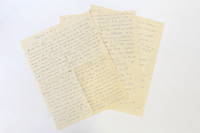
194764327Copenhage Copenhagen 1947. Fine. Copenhage Copenhagen 10 avril 1947 22.50 x 28.40 cm 6 pages sur 3 feuillets Very long autograph letter signed ""Dest"" to Doctor Tuset and Henri Mahé dated April 10 unknown
193269416Paris: Denoël & Steele 1932. Fine. Denoël & Steele Paris 1932 12 x 19 cm relié First edition on ordinary paper with all the characteristics of the first print. Binding in half red morocco preserved covers and spine first cover plate and lined spine with restorations top edge gilt binding signed by Laurenchet. Nice copy with the publisher's catalog in fine. Denoël & Steele unknown
195775113Sous étui bordé. Reliure plein chagrin noir. Dos lisse avec date dorée en queue. Plats ornés d'un assemblage à décor abstrait de papiers peints, dorés ou gaufrés. Toutes tranches dorées. Couverture et dos conservés. Prière d'insérer et bande « Le bout de la nuit » conservé. Reliure signée Alain DEVAUCHELLE.
194477798Sous étui bordé. Reliure demi-maroquin bleu nuit avec coins. Dos à nerfs avec date dorée en queue. Tête dorée. Couverture et dos conservés. Non rogné. Reliure signée H. DUHAYON.
195585266Gallimard | Paris 1955 | 12 x 19 cm | relié
194875286Pierre Lanauve de Tartas | Paris 1948 | 14 x 20 cm | en feuilles
193771965Denoël & Steele | Paris 1937 | 11.50 x 18.50 cm | broché
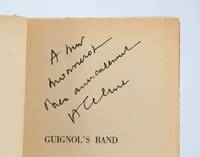
194484658Paris: Denoël 1944. Fine. Denoël Paris 1944 12 x 19 cm broché First edition a Service de Presse advance copy. Rare and handsome copy considering the fragility of this poor-quality wartime paper. Autograph inscription signed by Louis-Ferdinand Céline: ""A Mr Monnerot bien amicalement L.F. Céline."" ""To Mr Monnerot most cordially L.F. Céline."" Denoël unknown