Oliver Cromwell; Thomas CarlyleBiblio.com
433 résultats
18461154222William H. Colyer 1846. Hardcover. Very good/No jacket. Cover has wear and interior heavily foxed. Binding is tight and inside is otherwise unmarked. William H. Colyer hardcover
1838007412Boston: James Munroe and Company 1838. Book. Good. Leather. First American Edition. 8vo - over 7¾" - 9¾" tall. 435pp 1838. Volume 1 only. Leather bound no dustjacket as issued. Gilt spine lettering. Former college library book with embossed stamp and accession number on title page. Accession numbers on title page and on last page have been marked thru with red pencil. No other marks. Worn at corners and bottom of spine. Leather is raised from board at several places. Biding is tight with good hinges. Volume 1 only. James Munroe and Company Hardcover
1897mon0000037208Peter Fenelon Collier 1897. Hardcover. Acceptable. in x in x in. Weak Hinges Peter Fenelon Collier hardcover
186084861ND c.1860. Chapman & Hall London. ND c.1860. Beautifully bound in half navy calf over marbled boards. Raised bands contrasting red labels and gilt decoration. Marbled edges and endpapers. 389pp. Very slight rubbing to lower board and edges. A little foxing throughout but o/w a very nice copy. hardcover
1883005745New York: Charles Scribner's Sons 1883 New York: Scribner's 1883. First American Edition. In two volumes complete. Brick silk binding gold titles top edge gilt. Olive endpapers antique library bookplate hand-numbered and hand-dated. 445 pp. 2 pp. advertising 405 pp. 14 pp. advertising. Spines sunned some light silverfishing. Chipping top and bottom. Pages toned. Good condition. Charles Scribner's Sons hardcover
1865SKU1166797Ticknor and Fields 1865. Hardcover. Very Good. Boston 1865; TWO VOLUMES COMPLETE; green cloth covered boards; corner and edge wear with board exposed; 8vo 7 3/4" to 9 3/4" tall; interior is clean and unmarked; 397 and 388 pages. Ticknor and Fields hardcover
18885007London: Chapman & Hall 1888. Hardcover. Vg-/No Jacket. 12mo - over 6¾" - 7¾" tall. 7 vols in 4. bright red cloth with gilt titles spines slightly faded cvrs sl marked slight foxing to page edges partly unopened: vols 1-6 contain Critical Essays vols 1-6; vol 7 Kings of Norway & John Knox Portraits. Size: 12mo - over 6¾" - 7¾" tall <br/> <br/> Chapman & Hall hardcover
18583898290Chapman & Hall 1858. Volume 1-4. This is an ex-library book and may have the usual library/used-book markings inside.This book has hardback covers. In fair condition suitable as a study copy. Medium red cloth 8vo with decorative blind border and blind motif mirrored on boards. Decorative blind design and gilt lettering on sun faded backstrip. Bumped corners and some grubbiness and fraying. Yellow end papers and split hinges in Vol I II and III. Frontispiece with some transference. Interior is secure clean and clear save for some foxing. Pages unopened in Vol II. Trimmed. Contains several plates. Please note the Image in this listing is a stock photo and may not match the covers of the actual item4550grams ISBN: Chapman & Hall hardcover
1898010622UK: George Bell & Sons 1898. blue bds with gilt titles and illus to front and spine. board edges rubbed. spine ends and corners bumped and frayed. spine sunned. lib marks to endpapers. b/w illus. pages lightly browning with some foxing and smudgy soiling. All edges gilt. page 59 partially detached. pages 53/54 missing. . Hard Cover. Good. Illus. by Edmund J. Sullivan. 12mo - over 6¾" - 7¾" tall. George Bell & Sons hardcover
1882004206London: George Bell & Sons 1882. Rear hinge cracked; slight foxing to frontispiece and tissue guard; spine faded worn at ends; small tear in spine. The Inferno. A Literal Prose Translation with the text of the original collated from the best editions and explanatory notes. Second Edition 1867 on title page but dated 1882. Portrait of Dante. Embossed dark green cloth; 432 pages catalogue uncut partly unopened. Bohn's Collegiate Series. . Second Edition. Hard Cover. Good/No Jacket. George Bell & Sons Hardcover
1874679<p>Some foxing uncut pages</p> Chapman and Hall hardcover
1864097199London EC1: Chapman and Hall 1864. Hardcover Excerpt from Translations From the German Vol. 2: Wilhelm Meister's Apprenticeship and Travels The spring had commenced in all its brilliancy; a storm that had been lowering all day went fiercely down upon the hills; the rain drew back into the country; the sun came forth in all his splendour and upon the dark vapour rose the lordly rainbow. Wilhelm was riding towards it: the sight made him sad. "Ah!" said he within himself.376pp some fading to maauve cloth spine with gilt lettering a nice tight scarce copy. First Thus 1864. Cloth. Very Good. 8vo - over 7¾" - 9¾" Tall Octavo. Hardback. Chapman and Hall Hardcover
1893GB005SA8HSOI5N00Chapman 1893. Hardcover. Acceptable. Readable copy. Pages may have considerable notes/highlighting. ~ ThriftBooks: Read More Spend Less.Dust jacket quality is not guaranteed. Chapman hardcover
188974726G.P. Putnam's Sons 1889. HARDCOVER. VG / NONE. 0x0x0. VERY-GOOD-PLUS HARDBACK. VERY NICELY PRESERVED POCKET SIZE HARDCOVER WITH GILT DESIGN AND LETTERING OLIVE GREEN CLOTH G.P. Putnam's Sons hardcover
188142131Harper & Brothers 1881. Cloth. Very Good. Edited by James Anthony Froude. Slightly smaller sturdy book fine shiny brown cloth with embossed borders to front and back initials embossed on front gilt lettering and border very bright on spine 337 lightly browned pages plus catalog. Light wear to tips very slight surface wear to spine top edge. Very Good. <br/> <br/> Harper & Brothers hardcover
1888d32dbChapman and Hall 1888. Hardcover. Good/No Jacket. 3 Volumes. The boards are shelf rubbed with knocked spines and corners. Binding of all volume are sound. Ink signature from a previous owner on the back of the front end page of each volume. The pages are tanned but otherwise clean with no inscriptions or annotations. Extra postage required unless posted within South Africa. JHK. Our orders are shipped using tracked courier delivery services. Chapman and Hall hardcover
1892FB5439 /11<p> Green cloth binding with gilt title on the spine and the front board.</p><ul><li><p>Inscribed 1892. The Minerva Library of Famous Books.</p></li></ul><p>Sartor Resartus: The Life and Opinions of Herr Teufelsdröckh in Three Books is an 1831 novel by the Scottish essayist historian and philosopher Thomas Carlyle first published as a serial in Fraser's Magazine in November 1833 – August 1834. The novel purports to be a commentary on the thought and early life of a German philosopher called Diogenes Teufelsdröckh which translates as 'Zeus-born Devil's-dung' the referenced quotation has Diogenes as 'God-born' but that is not strictly accurate author of a tome entitled Clothes: Their Origin and Influence. Teufelsdröckh's Transcendentalist musings are mulled over by a sceptical English Reviewer referred to as Editor who also provides fragmentary biographical material on the philosopher. The work is in part a parody of Hegel and of German Idealism more generally.</p><p>On Heroes Hero-Worship & the Heroic in History is a book by the Scottish essayist historian and philosopher Thomas Carlyle published by James Fraser London in 1841. It is a collection of six lectures given in May 1840 about prominent historical figures. It lays out Carlyle's belief in the importance of heroic leadership. Carlyle was one of the few philosophers who lived through the British industrial revolution but maintained a non-materialistic view of historical development. The book included lectures discussing people ranging from the field of religion through to literature and politics. The figures chosen for each lecture were presented by Carlyle as archetypal examples of individuals who in their respective fields of endeavour had dramatically impacted history in some way. The Islamic prophet Muhammad found a place in the book in the lecture titled "The Hero as Prophet". In his work Carlyle outlined Muhammad as a Hegelian agent of reform insisting on his sincerity and commenting "how one man single-handedly could weld warring tribes and wandering Bedouins into a most powerful and civilized nation in less than two decades". His interpretation has been widely cited by Muslim scholars to show Muhammad without orientalist bias.</p><p>Monument to Thomas Carlyle by William Kellock Brown Kelvingrove Park Glasgow</p><p>Carlyle held that "Great Men should rule and that others should revere them"a view that for him was supported by a complex faith in history and evolutionary progress. Societies like organisms evolve throughout history thrive for a time but inevitably become weak and die out giving place to a stronger superior breed. Heroes are those who affirm this life process accepting its cruelty as necessary and thus good. For them courage is a more valuable virtue than love; heroes are noblemen not saints. The hero functions first as a pattern for others to imitate and second as a creator moving history forwards not backward history being the biography of great men. Carlyle was among the first of his age to recognize that the death of God is in itself nothing to be happy about unless man steps in and creates new values to replace the old. For Carlyle the hero should become the object of worship the centre of a new religion proclaiming humanity as "the miracle of miracles. the only divinity we can know". For Carlyle's creed Bentley proposes the name "heroic vitalism" a term embracing both a political theory aristocratic radicalism and a metaphysic supernatural naturalism. The heroic vitalists feared that the recent trends toward democracy would hand over power to the ill-bred uneducated and immoral whereas their belief in a transcendent force in nature directing itself onward and upward gave some hope that this overarching force would overrule in favor of the strong intelligent and noble.</p><p>For Carlyle the hero was somewhat similar to Aristotle's "magnanimous" man – a person who flourished in the fullest sense. However for Carlyle unlike Aristotle the world was filled with contradictions with which the hero had to deal. All heroes will be flawed. Their heroism lay in their creative energy in the face of these difficulties not in their moral perfection. To sneer at such a person for their failings is the philosophy of those who seek comfort in the conventional. Carlyle called this "valetism" from the expression "no man is a hero to his valet".</p><p>Past and Present is a book by the Scottish essayist historian and philosopher Thomas Carlyle. It was published in April 1843 in England and the following month in the United States. It combines medieval history with criticism of 19th-century British society. Carlyle wrote it in seven weeks as a respite from the harassing labor of writing Oliver Cromwell's Letters and Speeches. He was inspired by the recently published Chronicles of the Abbey of Saint Edmund's Bury which had been written by Jocelin of Brakelond at the close of the 12th century. This account of a medieval monastery had taken Carlyle's fancy and he drew upon it in order to contrast the monks' reverence for work and heroism with the sham leadership of his own day. Lord Acton called it "the most remarkable piece of historical thinking in the language." G. K. Chesterton considered it along with Chartism 1839 to be "the work Carlyle was chosen by gods and men to achieve".</p><p>Past and Present contributed to several social developments in the 19th and early-20th centuries including the decline of laissez-faire the crafting and passage of the Factory Acts the Elementary Education Act 1870 and the Industrial Conciliation and Arbitration Act the emigration of labourers from England to the United States during the Great Rapprochement the rise of practices such as business ethics profit sharing and the redistribution of income and wealth the establishment of state education and even playgrounds.</p><p>Carlyle's influence on modern socialism can be seen most acutely in the response to Past and Present. New Moral World the official newspaper of the Owenite movement published a six-part review by then-editor George Fleming between August and November 1843 further issuing an additional excerpt two months afterwards. Fleming expressed "gratification in finding . . . the true philosophy of Socialism . . . arrayed in the gorgeous and striking drapery of Carlyleism." Fleming believed that a "new unexpected and powerful ally to our cause has come into the field" finding in the work "identical principles with those of Robert Owen" portraying Carlyle as a covert socialist that has infiltrated the "charmed circle" of high society. In January 1844 Friedrich Engels published an extensive laudatory review in the Deutsch–Französische Jahrbücher. He wrote that Carlyle's acute analysis of the social question in England made it the only book by a contemporary educated Englishman worth reading. Engels praised Carlyle's humanitarian point of view yet considered it only a nonscientific preliminary to socialism. He characterized Carlyle as a German pantheist and a romantic Tory a follower of Schelling rather than of Hegel too hung up on religion and the myth of aristocratic leadership to accept freedom and self-determination as the ultimate aim of history while expressing hope that Carlyle would overcome these limitations.</p><p>The book greatly influenced the development of medievalism and the Pre-Raphaelite Brotherhood. John William Mackail wrote that during William Morris and Edward Burne-Jones' days at Oxford "Carlyle's Past and Present stood alongside Modern Painters as inspired and absolute truth." John Ruskin gifted his personal extensively annotated copy to a friend in 1887 along with a letter in which he called it "a book which I read no more because it has become a part of myself and my old marks in it are now useless because in my heart I mark it all." Fors Clavigera has been called "in effect the resumption of the concerns of Carlyle's Past and Present in another form."</p><p>Thomas Carlyle 4 December 1795 – 5 February 1881 was a British essayist historian and philosopher from the Scottish Lowlands. A leading writer of the Victorian era he exerted a profound influence on 19th-century art literature and philosophy.</p><p>Born in Ecclefechan Dumfriesshire Scotland Carlyle attended the University of Edinburgh where he excelled in mathematics inventing the Carlyle circle. After finishing the arts course he prepared to become a minister in the Burgher Church while working as a schoolmaster. He quit these and several other endeavours before settling on literature writing for the Edinburgh Encyclopædia and working as a translator. He found initial success as a disseminator of German literature then little-known to English readers through his translations his Life of Friedrich Schiller 1825 and his review essays for various journals. His first major work was a novel entitled Sartor Resartus 1833–34. After relocating to London he became famous with his French Revolution 1837 which prompted the collection and reissue of his essays as Miscellanies. Each of his subsequent works including On Heroes 1841 Past and Present 1843 Cromwell's Letters 1845 Latter-Day Pamphlets 1850 and History of Frederick the Great 1858–65 were highly regarded throughout Europe and North America. He founded the London Library contributed significantly to the creation of the National Portrait Galleries in London and Scotlandwas elected Lord Rector of Edinburgh University in 1865 and received the Pour le Mérite in 1874 among other honours.</p><p>Carlyle occupied a central position in Victorian culture being considered not only in the words of Ralph Waldo Emerson the "undoubted head of English letters" but a "secular prophet". Posthumously his reputation suffered as publications by his friend and disciple James Anthony Froude provoked controversy about Carlyle's personal life particularly his marriage to Jane Welsh Carlyle. His reputation further declined in the 20th century as the onsets of World War I and World War II brought forth accusations that he was a progenitor of both Prussianism and fascism. Since the 1950s extensive scholarship in the field of Carlyle Studies has improved his standing and he is now recognised as "one of the enduring monuments of our literature who quite simply cannot be spared.</p> Ward Lock Howden & Co. hardcover
18391322316London: James Fraser 1839. New edition revised. Hardcover. 12mo; New edition revised; G-/no DJ; Hardcover w/out DJ; Spine purple/tanned with gold print; Boards in blind stamped purple silk tanning to spine bumped corners and spine caps light bumps to edges light stains at bottom of spines mild shelfwear; Text blocks have spotting to edges slight foxing to endpapers owner label and vendor label on front pastedowns intermittent spine breaks; Spine title: Goethe's Meister; Vol. 1-2. Apprenticeship - Vol. 3. Travels; 3 vols. xix 324 pages; 377 pages; xxi 290 pages. 1322316. FP New Rockville Stock. James Fraser hardcover books
184044CG1840. O.J. um 1840. Stahlstich Brustbild von J. Sartain. Bildformat: 12 x 11 cm. Blattformat: 215 x 13 cm. unknown
184044CGO.J. (um 1840). Stahlstich (Brustbild) von J. Sartain. Bildformat: 12 x 11 cm. Blattformat: 21,5 x 13 cm.
189064152Halle a.d.Saale.: Otto Hendel Verlag. Ca 1890. Orig.Leinen kaschiert. Gebrauchsspuren. A.d.Französischen: L. Dausalik Franz Kwest. Otto Hendel Verlag. unknown
1900228New York: A.L. Burt 1900. Very Good/None. Vol. I 430 pp. and Vol. II 421 pp. Early 1900's printing. Covers on both volumes have very light shelf wear but still retain their color. Printing on spines is crisp. Pages are browned and brittle with some small tears on flyleaf and title page of Vol. II. The tight tears do not detract from appearance. <br /> <br /> Originally published in 1837 "The French Revolution: A History" was one of the first examples of Literary History combining narrative with historical facts to create a compelling recounting of the French Revolution. <br /> <br /> . A.L. Burt unknown
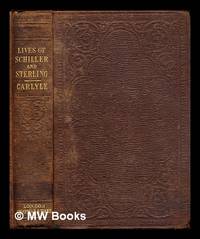
1857313807London : Chapman and Hall 1857. First Edition. Hardcover. Previous owner's signature. Very good copy in the original gilt-blocked decorative cloth. Spine bands and panel edges somewhat dulled and rubbed as with age. Corners slightly bumped. Remains quite well-preserved overall. Physical description: 3-415p : illus. ; 18cm. Subjects: Schiller Friedrich 1759-1805 -- Biography. Sterling John 1806-1844 -- Biography. London : Chapman and Hall hardcover
1888402212London : Chapman and Hall 1888. Reprinted edition. Hardcover. Poor copy in the original half aniline calf over ribbed-cloth boards. All edges marbled. Front board missing. Text remains clear and without blemish. Physical description; 299 pp. Subjects; Revolution France : 1789-1799. France History Louis XVI. Politics and government. London : Chapman and Hall hardcover
188681838Kowloon: Chapman and Hall 1886. Spine broken.HardbackEx-Librarywith usual stamps markings in fair to good all-round conditionno dust jacket268pages. Please note the Image in this listing is a stock photo and may not match the covers of the actual item300grams ISBN: Chapman and Hall hardcover