Villette (Charles-Michel de).Livre Rare Book
7 772 résultats
178642884À Londres [Montargis, Claude Lequatre], 1786. In-16 de (8)-156 pp., (20) ff. d'échantillons de papier, basane fauve, dos lisse orné, pièce de titre en veau vert, triple filet doré d'encadrement sur les plats, gardes de papier dominoté, tranches dorées (reliure de l'époque).
178644364À Londres [Montargis, Claude Lequatre], 1786. In-16 de (8)-156 pp., (20) ff. d'échantillons de papier, maroquin vert, dos lisse orné, pièce de titre en maroquin vert, roulette dorée d'encadrement sur les plats, tranches dorées (reliure de l'époque).
152344374Cologne, Eucharius Cervicornus pour Gottfried Hittorp, s.d. , (1523). In-8 de 139-(13) ff., sign. a-s8, *8, table, titre à encadrement gravé, bois gravé, caractères grecs et romains.ÉRASME. Parabolarum, seu Similium liber elegantissimus. Argentinae, apud J. Knoblouchum (Strasbourg, Johann Knobloch) 1521. 103-(5) ff., sign. A-O8, titre à encadrement gravé, caractères italiques.ÉRASME. Opus de conscribendis epistolis, quod quidam & mendosum & mutilum ediderant, recognitum ab authore, & locupletatum. Argentorati (Strasbourg) Knobloch, 1522. 178 (i.e. 180) ff., sign. A-Y8, Z4, titre à encadrement gravé, caractères italiques.3 pièces reliées en 1 vol. in-8 (105 x 170 mm), peau de truie sur ais de bois biseautés, décor estampé à froid à encadrement de motifs floraux et animaliers, dos à trois nerfs, titre manuscrit au dos, deux fermoirs (reliure de l'époque).
THE ONLY COPY PRINTED ON VELLUM OF THE POET'S FIRST BOOK, ILLUSTRATED WITH THREE ORIGINAL HORS-TEXTE DRYPOINTS BY FRANTISEK PAVELKA. 71 pp. Edition limited to 500 numbered copies, of which this is COPY NUMBER 1, THE ONLY COPY PRINTED ON VELLUM. Inscribed and signed below the justification by the author (to himself, apparently) in Czech: "The first copy of the first edition of my first book." Also inscribed and signed by the publisher on the rear pastedown. Both inscriptions dated December 21, 1926. 8vo. Beautifully bound in full hand-painted pigskin. Top edge gilt, other edges uncut. FINE AND BRIGHT. Czech books printed on vellum are of the utmost rarity.
3840FBLuzern, Quaternio Verlag, 2020. 8°. 22 x 15,5 cm. [144] Blatt; 175 Seiten. Faksimile: Original-Lederband mit reicher Deckel-, Rücken- und Kantengoldprägung, marmorierten Vorsätzen und Rundum-Goldschnitt. Kommentar: Original-Leinenband. Original-Leinenschuber. [9 Warenabbildungen]
Very Good Turkish, Ottoman (1500-1928) Original dark brown handsome full leather bdg. with a traditional flap. Folio. (32 x 22 cm). In Ottoman script (Old Turkish with Arabic letters). [2], [6], 238 leaves. The size of the text block in red borders: 25.5 x 14.5 cm. 33 lines on each page. Printed on paper with European watermarks. The size of the text block in red borders: 25 x 14.5 cm. 33 lines on each page. Printed on paper with European watermarks. Handwritten title on the bottom edge. A fine copy. The 19th incunable of the Islamic world, printed by Ibrahim Müteferrika's legendary Basmahane. The publication of Ottoman chronicles which began in 1734 with the edition of Naimâ's history, continued after a long break in 1783. This volume, containing the works of three court chroniclers who followed each other in rapid succession, is a chronological continuation of Mehmed Râsid's history, published by Müteferrika. Arpaemînizâde Mustafa Sâmî (deceased 1734) was the court's historian from 1730 to 1733, Sâkir Hüseyin (died 1742) in 1733, and Subhî Mehmed (ca. 1711-1769) from 1739 to 1745. The work of the three chroniclers is known as one coherent historiography, which presents the events of Ottoman history from 1730 to 1744. This work is a particularly valuable source on the Habsburg-Ottoman war between 1736 and 1739, in which Subhî participated in person. The prestige of the work, which offers detailed data on the administrative events (appointments, dismissals, and other biographical communications) is further increased by the fact that Subhî in many cases used original documents. This chronicle includes the events between the years 1730-1743. Contents: Ahd-i Humâyûn [i.e. Imperial constitutional declaration]., Zikr-i tecdîd-i san'at-i tab' [i.e. Preface on the Muteferrika Press of Vasif Efendi]., Fihrist-i târîh-i Sami ve Sakir ve Subhi [i.e. Contents of the work]., Text., History of Subhi. The workshop of Müteferrika began its historical mission in 1728. They published 17 works in 22 volumes. The printing house served as a means to the long-term goal of Müteferrika, his efforts to broaden the horizon and modernize the knowledge of Ottoman society and Islamic civilization. This is evidenced by the subjects of the books selected for publishing, the motivations put forth in the publisher's introductions, as well as by the documents illuminating the background of the publication of each book, also published in print. In 1742, with the publication of the Persian dictionary of Hasan Suûrî, a chapter of Ottoman book printing came to an end. With the death of Müteferrika, the printing of Turkish books was temporarily interrupted. The first generation of Ottoman-Turkish prints was soon followed by a new series when in 1756 Ahmed and Ibrâhîm Efendi (the latter perhaps the founder's son, according to speculative sources) made an attempt to resurrect the legacy of Müteferrika through the possession of a decree obtained from the Sultan. However, this experiment did not prove to be lasting, as it did not last longer than the new edition of the first Turkish printed book, the Lugat-i Vankûlî. After this, for several decades there was no continuation to the Turkish book printing established by Müteferrika, until in 1783 the workshop was put in operation again for the publication of six more works. The subjects of these late 18th century works were dominated by history and military technology, thus Müteferrika's strategy of book distribution made its way hand in hand with the efforts of modernization of the Ottoman state. The second edition of Lugat-i Vankûlî followed the principles of the first edition, and its introduction was composed on the model of the introductory pages of the two last books published under Müteferrika's supervision. The works published after 1783 display a noticeable development in typography not only as to its somewhat refined visual impression but also in its structure. For example, the d+h and r+h ligatures, (For more info please visit our website)
Very Good Turkish, Ottoman (1500-1928) Original dark brown handsome full leather bdg. with a traditional flap. Folio. (32 x 22 cm). In Ottoman script (Old Turkish with Arabic letters). [9], 288 leaves. The size of the text block in red borders: 25 x 14.5 cm. 33 lines on each page. Printed on paper with European watermarks. Handwritten title on bottom edge. Marginal cutting on the first page. Overall a very good copy. The 20th incunable of the Islamic world, printed by Ibrahim Müteferrika's legendary Basmahane. Süleymân Izzî succeeded Mehmed Subhî Efendi (ca. 1711 - 1769) in 1745 as an official court historian (vaka'nüvis) and held this office until 1753, and is known as one of the three chroniclers for coherent historiography, representing the events in the Ottoman history from 1730 to 1744 and is a particularly valuable source on the Habsburg-Ottoman War between 1736 and 1739, as proven by his chronicle titled "Tevârîh-i Sâmî ve Sâkir ve Subhî", published in 1784. During this time, he recorded the contemporary events taking place between 1744 and 1753 in the Ottoman Empire. This work was the last item in a series of chronicles published by the printing house founded by Müteferrika. Franz Babinger writes that some parts of the book have been translated into German. Hammer translated one of the parts in question into German. All published, Izzi has planned the third part of his work, but this third part was never published. Contents: "Ahd-i Hümâyûn".; "Zikr-i iâde-i fenn-i tiba'at" [i.e. On the book pressing and publishing with a preface by Ahmed Vâsif Efendi].; "Fihrist-i Târîh-i Izzî" [i.e. Content of Izzi's history].; Izzî tarihinin birinci bölümü [i.e. The first chapter].; Izzî tarihinin ikinci bölümü [The second chapter]. The workshop of Müteferrika began its historical mission in 1728. They published 17 works in 22 volumes. The printing house served as a means to the long-term goal of Müteferrika, his efforts to broaden the horizon and modernize the knowledge of Ottoman society and Islamic civilization. This is evidenced by the subjects of the books selected for publishing, the motivations put forth in the publisher's introductions, as well as by the documents illuminating the background of the publication of each book, also published in print. In 1742, with the publication of the Persian dictionary of Hasan Suûrî, a chapter of Ottoman book printing came to an end. With the death of Müteferrika, the printing of Turkish books was temporarily interrupted. The first generation of Ottoman-Turkish prints was soon followed by a new series, when in 1756 Ahmed and Ibrâhîm Efendi (the latter perhaps the founder's son, according to speculative sources) made an attempt to resurrect the legacy of Müteferrika through the possession of a decree obtained from the Sultan. However, this experiment did not prove to be lasting, as it did not last longer than the new edition of the first Turkish printed book, the Lugat-i Vankûlî. After this for several decades there was no continuation to the Turkish book printing established by Müteferrika, until in 1783 the workshop was put in operation again for the publication of six more works. The subjects of these late 18th century works were dominated by history and military technology, thus Müteferrika's strategy of book distribution made its way hand in hand with the efforts of modernization of the Ottoman state. The second edition of Lugat-i Vankûlî followed the principles of the first edition, and its introduction was composed on the model of the introductory pages of the two last books published under Müteferrika's supervision. The works published after 1783 display a noticeable development in typography not only as to its somewhat refined visual impression, but also in its structure. For example, the d+h and r+h ligatures, characteristic of the first generation of Müteferrika's printed books, are replaced by separate letters. This extremely rare presented book is from the seven publications of this late period of the
40919Madrid: Imprenta Real 1799. 4to 254 x 172 mm in 2 parts 2 74 1 75--147 leaves printed on one side only on alternate rectos and versos within woodcut borders wide-margin copy printed on thick paper title with vignette of the arms of the King of Spain single sheet of printed prices tipped-in a nice clean copy marbled endpapers contemporary tree calf light stain to lower board spine leather lettering piece slightly rubbed a very nice copy. The most important Spanish type specimen. The Imprenta Real Madrid was set up in 1780 when the State took over the equipment of the printer Francisco Manuel de Mena whose heirs were unable to discharge their debts towards the State. This was the first type specimen book from the Imprenta Real and it contains many roman and italic types including some cut by Geronimo Gil for the Royal Library. "The book is in two parts. The first comprises an ambitious collection of excellent roman and italic types followed by Greek types fine in the largest and smallest sizes a few pages of Arabic and a little Hebrew. Apart from Gil's fonts and others of that style there are a number of lighter fonts both in roman and italic that while distinctly 'old style' show the taste for lighter letter-forms which was then making headway in Spain. A second collection of type of decidedly more modern cut begins on page 75. The tendency toward less "nourished" lighter letters is clearly seen in these over-finished monotonous character types by no means so interesting as those of Part I. Following these is a large display of capital letters in roman and italic shaded initials Greek capital letters and a repertoire of 'flowers' A few are original but a great many of these 'flowers' were derived from Holland France and England and others from various perfectly recognizable sources; but they are rendered in such a way as to be transmuted into very Spanish Design."Updike. Provenance: Bookplate of Jules Laloux secretary for the Compagnie Typographique Paris. Updike II pp. 85-86. Madrid: [Imprenta Real,] 1799 hardcover
1882ST12705Paris: A. Quantin 1882. UNIQUE COPY ON VELLUM printed for M. A. Werlé. 206 x 140 mm. 8 1/8 x 5 1/2". xxxii 247 pp. 1 leaf colophon.With a bio-bibliographical notice by Fernand Drujon. <br/> Pleasing burgundy Jansenist crushed morocco by Canape et Corriez stamp-signed in gilt on front turn-in dated 1930 on rear turn-in raised bands turn-ins richly gilt marbled endpapers all edges gilt on the rough. Decorative head- and tail-pieces throughout and eight engraved plates comprised of a frontispiece portrait in four states one on vellum three on paper and an allegorical vignette also in four states. Verso of front free endpaper with ex-libris of Jean Furstenberg. ◆Two small dark spots to upper cover a couple of leaves with naturally occurring minor discoloration to vellum but A FINE COPY--especially clean fresh and bright internally and in a lustrous unworn binding.<br/> <br/> Given its illustrious provenance and its singular status as the only copy printed on vellum this is a quintessentially bibliophilic copy of the poems of French cleric and diplomat Cardinal François-Joachim de Pierre de Bernis 1715-94. Admired as a witty epigrammist at the court of Louis XV where Madame de Pompadour presided Bernis composed poems on such conventional themes as love and the natural world but also verses contemplating manners and mores fashion independence and love of country. Since none of his poems was published before his death he was not widely known as a poet during his lifetime but in another sphere he performed important service to his country as France's ambassador to Rome. He provided shelter and succour there for refugees from the French Revolution earning the papal epithet "Protector of the Church of France." The present work was printed for Count Alfred Werlé whose father had inherited the Veuve Clicquot Champagne house from the Widow Clicquot. Alfred took over the operation in 1884 and greatly expanded the Veuve Clicquot-Ponsardin vineyards. The volume subsequently passed into the library of the great collector Jean or Hans Furstenberg 1890-1982 who put together one of the finest collections of 18th century books ever assembled. In 1974 the Furstenberg collection was sold en bloc to Dr. Otto Schäfer whose marvelous library had already become distinguished for its fine and historic bindings. A. Quantin unknown
8vo. (132) ff. With 2 different woodcut devices. - (Bound with) II: [Melekhet ha-dikduk]. Institutiones grammaticae in Hebraeam linguam [...]. (144) ff. With several musical notes and two woodcut devices. Modern vellum, in custom-made cloth case. I: Second edition of Münster's "Proverbs", previously published in 1520, together with his first own work ever, an introduction to Hebrew grammar. Numerous contemporary Hebrew and Latin marginalia. - II: Only edition of Münster's second publication, a foundation stone of modern Hebrew studies. Includes (fol. r1 ff.) the co-called Jonas polyglot in Hebrew, Chaldaic, Greek, and Latin, with other matter. Contemp. ownership obliterated from t. p.; lower corner defective (remargined professionally; losses supplied in pencil). Numerous contemp. marginalia, mostly in Latin. Both works are very rare; the former has not been seen at auctions since 1950. I: VD 16, B 3564. Burmeister 137. Hantzsch 234.2-4. Adams B 1536. Steinschneider (Bodl.) 11.51. Panzer VI, 244, 540. Vinograd Mem 1256. OCLC 71515193. Not in BM-STC. - II: VD 16, M 6685. Burmeister 2. Hantzsch 220.2. Adams M 1931. BM-STC German 633. Steinschneider (Hdb.) 1374. Panzer VI, 245, 541. Wolfheim I, 865. Graesse IV, 623. OCLC 22612604.
Royal 8vo (245 x 155 mm), title printed within a heavy border of flowers, followed by 115 leaves of specimens printed on one side only, of which two a folding, some occasional offsetting, cont. cloth-backed boards with wine auction sale particulars pasted over boards, manuscript paper spine label, uncut and partial unopened, an attractive copy. Bigmore & Wyman I, p. 243 mentioning only 1816, 1824 & 1827 editions; B&J citing the Oxford copy; Mosley locating four copies with between 91 and 118 leaves (Oxford, Cambridge, V&A, and Columbia University Library); OCLC adds the Huntington and Detroit copies; none added by JISC; not in the British Library or St Brides Catalogue. Berry & Johnson p. 49; Mosley, 135.
164013895Parisiis, E Typographia regia, 1640. In-folio de (2)-550 p. 1 feuillet blanc, veau olive glacé, dos orné à 6 nerfs, triple filet doré sur les plats, dentelle intérieure, tranches dorées (reliure de la fin du XVIIIe siècle).
178341804Paris, Imprimerie Royale, 1783. In-8 (199 x 120 mm) de (4)-49 pp., maroquin rouge, titre en long sur le dos «ÉPREUVE DE LA NOUVELLE PRESSE DE L’IMPR. ROYALE» encadré d’un double filet doré, triple filet doré d’encadrement sur les plats armes royales serties de la mention « Imprimerie royale », roulette dorée sur les coupes, dentelle intérieure, doublures et gardes de moire bleue, tranches dorées (reliure de l’époque).
8vo. 62, (2) ff. With wodcut printer's device on title page. Contemporary limp vellum with later giltstamped orange spine label and ms. spine title. Very rare Italian edition of the "Kitab al-Jawami", an Arabic work on the interpretation of dreams by an "Achmet, son of Seirim" - almost certainly identical with the 8th century Muslim mystic Abu Bakr Muhammad ibn Sirin. The work survived in a Greek translation ("Biblion oneirokritikon") prepared in the 12th century. "The author Ahmed served as interpreter of dreams to Caliph Al-Mamun around 820 [...] The mediaeval conflation of medicine with astrology originated with the Arabs. Through the Salernitanian school, which had many Arabic works translated, the notion reached Europe in the 11th century, where it remained predominant as late as the 17th and 18th century [...] In 1577 J. Loewenklau published a Latin translation of the Oneirokritiká of Ahmed, whom he calls Apomasar" (cf. Schöll). - Slight waterstaining and old ink ownerships and annotations to title page. BM-STC Italian 338. Edit 16, CNCE 40443 (title misspelt: "insonnii"). OCLC 1002786023. Not in Adams. Cf. GAL I, 66. Schöll, Geschichte der griechischen Literatur III, 487. Graesse, Bibl. mag. et pneum. 97.
8vo. 86, (2) pp. Title-page printed in red and black. With 2 woodcut illustrations in the text. Contemporary full vellum with fore-edge flap. Rare compilation on ballistics and artillery, incorporating early treatises on fireworks and warfare, regimental regulations (VD 16, G 1057), and an educational work on the art of war written for Emperor Maximilian, here printed in a different blackletter reminiscent of Schönsperger's Theuerdank fraktur, the famous ornamental typeface specially cut for Maximilian in 1512. - Some browning; a few edge flaws. Interior lower hinge repaired. Quite charmingly bound in a contemporary vellum binding with a flap. Rare: Only 5 copies known in institutional collections (Wolfenbüttel; Staatsbibliothek Berlin; Amsterdam, University Library; Antwerp, Vlaamse Erfgoedbibliotheek; Univ. of Aberdeen). The Flemish Heritage Library erroneously attributes authorship to Franz Joachim Brechtel (1554-93), whose work on the same subject first appeared at Nuremberg in 1591. Provenance: from the collection of Thomas Fremantle, 3rd Baron Cottesloe (1862-1956), commander of the Territorial Army and president of the Society for Army History Research (purchased from Sotheran's, December 1936). VD 16, B 9134 (a single record). USTC 615040. Richter (Egenolffs Erben) 484. OCLC 248948877. Cf. Jähns 653 (1597 edition). Not in Kat. der k. k. Kriegs-Bibliothek.
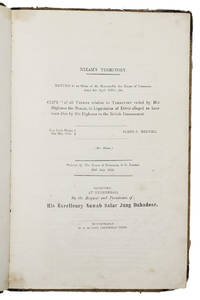
1854ABC_47435Secunderabad near Hyderabad: Robert Hudson Columbian Press 1854. Contemporary half calf orange and blue marbled sides over paper boards gold-tooled double fillets on the spine red sprinkled edges. 33 x 22 cm. The extremely rare Hyderabad edition of the official British papers relating to the so-called Hyderabad debt crisis during which Lord Dalhousie the Governor-General of India and General James Stuart Fraser the British Resident in Hyderabad orchestrated a "shakedown" of the Nizam of Hyderabad whom they claimed owed the British an astounding 7.4 million rupees. This resulted in the Nizam of Hyderabad having to cede the wealthy cotton-growing province of Berar to the British to clear his debts. The first edition of this account appeared at London in 1854 as part of the serial publication of parliamentary papers and the present Hyderabad edition probably later in the same year the first separate publication. It was printed and published by the Columbian Press in Secunderabad "by the request and permission of His Excellency Nawab Salar Jung Bahadoor" the Prime Minister of the Hyderabad State who believed that the papers portrayed Dalhousie and Fraser in a bad light. Nawab Sir Mir Turab Ali Khan Salar Jung I 1829-1883 also known as Salar Jung I was an Indian nobleman who served as Prime Minister of Hyderabad State between 1853 and 1883 and was also the regent for the sixth Nizam Asaf Jah VI from 1869 to 1883.The present work is the ultimate insiders account from the British perspective of the crisis surrounding the Nizam's staggering debt to the British government featuring transcriptions or summaries of all the official correspondence and documents of Lord Dalhousie General Fraser and other colonial senior officials. The present work is extremely rare in this Indian Secunderabad/Hyderabad edition we have not been able to trace any other copy on the market or institutionally. Supposedly the Salar Jung Museum in Hyderabad holds a copy of the same edition but we were not able to verify it.With an owner's inscription "Margaret D. Stubbs" and an orange printer's label "Secunderabad Columbian Press R. Hudson" both on the front pastedown. The binding is somewhat worn without affecting its structural integrity the outer margin of 6 leaves between pp. 52-69 and pp. 83-84 are folded in. With a minor tear in the foot margin of the title-page near the gutter and occasionally very slight staining. Otherwise in good condition.l Cf. WorldCat 941776603 electronic version of the first ed.; for the background: H.G. Briggs The Nizam his history and relations with the British Government London 1861; Kumari Sarjini Regani The cession of Berar in: Indian History Congress 20 1957 pp. 525-259. Robert Hudson, Columbian Press, hardcover
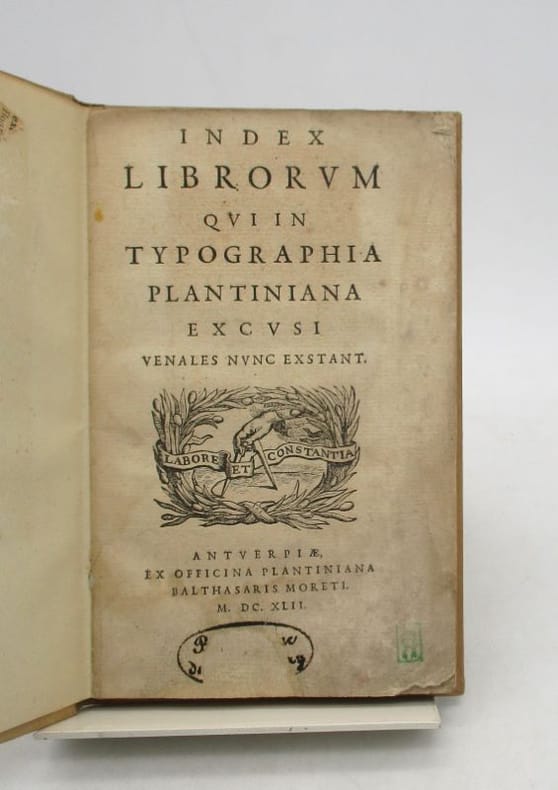
22751Anvers, Balthazar Moret II - Imprimerie plantinienne , 1642. In-12, 79 pp., cartonnage de papier moderne, dos long (traces de poussière et frottements au cartonnage, manques angulaires sans atteinte, parfois restaurés, pâles mouillures sans gravité, quelques taches et rousseurs).
8vo. (28) pp., 2 blank ff., 284, (2) pp., final blank leaf. With woodcut title vignette and 115 woodcuts in the text (6 of which in original hand colour, 1 partly coloured). - (Bound with) II: Lucanus, Marcus Annaeus. De bello civili apud Pharsaliam libri X. Cologne, Walther Fabritius, 1560. (336) pp. With woodcut title vignette. Contemporary blind-tooled calf over wooden boards with bevelled edges and two brass clasps, lozenge-shaped floral roll-tools enclosing plate-stamps of "Justitia" and "Lucrecia", upper cover bearing monogram "ALG" and date "1573". A fine, later Latin edition of the famous "Narrenschiff", originally published in German verse in 1494 and translated by the author's student Jacob Locher in 1497. This is the first edition to contain the outstanding narrative woodcuts by Tobias Stimmer (1539-84), showing the fools and their companions in Renaissance costume. The first six illustrations are coloured by a contemporary hand. - One of literature's most famous satires: before Goethe's "Werther" arrived on the scene, this work was the most successful book ever published in Germany. In his "Ship of Fools", Brant describes the voyage of a ship bearing one hundred fools, to the fools' paradise of Narragonia, thereby satirizing the follies of his time including representatives of every human and social type. "[T]he first original work by a German which passed into world literature [... it] helped to blaze the trail that leads from medieval allegory to modern satire, drama and novel of character" (PMM). Erwin Panofsky called the book "a remarkably complete mirror of human life", based upon the "universality of Brant's self-righteous surliness [...] and the picturesqueness of his metaphors" (Panofsky, p. 30). Incidentally, the book also contains the earliest literary reference to the discovery of America: "Hesperiae occiduae rex Ferdinandus, in alto Aequore nunc gentes repperit innumeras" ("Ferdinand, King of the West, recently discovered innumerable peoples across the high seas", p. 132). - Bound with this is an uncommon Cologne edition of Lucanus's epic "Pharsalia", esteemed throughout antiquity and the Middle Ages for its stylistic and historical merits. - Light brownstaining and occasional light waterstains throughout. A few underlinings in red ink to the "Pharsalia". Upper hinge starting, but binding generally in fine condition. Provenance: Handwritten ownership of Virgilius Fetius of Oettingen in Bavaria (gift from Johann Nortman in February 1577), dated 1578, on the flyleaf. Bookplate of the Bohemian industrialist and art collector Karl Adalbert Lanna (1805-66) to front pastedown; a shelfmark, dated 16 March 1888, written on lower flyleaf. Latterly in the library Werner Habel (his ownership stamp to verso of upper flyleaf). I: VD 16, B 7081. BNHCat B 874. BM-STC German 147. Adams B 2673. - II: VD 16, L 2905 (A 4393). Schweiger II.1, 562. Not in Adams or BM-STC German.
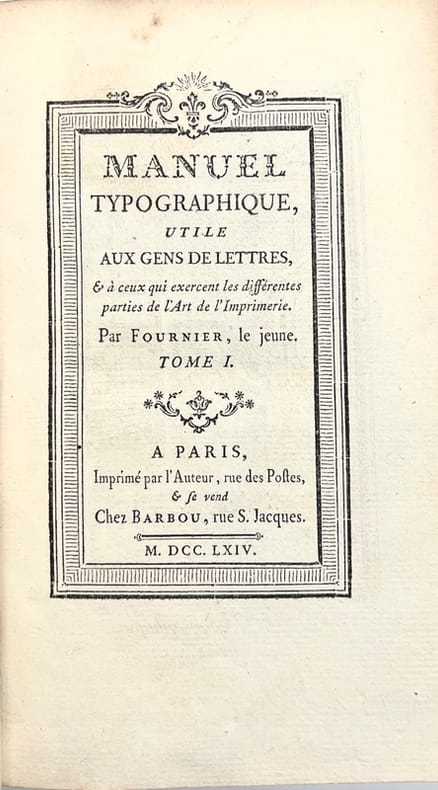
176443525A Paris, Imprimé par l'Auteur, et se vend chez Barbou, 1764-1766. 2 vol. in-8 (161 x 105 mm) de (3)-V à XXXII-323-[5] ; (2)-XLIV-306 pp., planches, veau marbré, dos orné à nerfs, pièces de titre et de tomaison en maroquin lavallière, tranches rouges (reliure de l'époque).
4to. 36 unnumbered ff. With broad figural woodcut title border, a figural woodcut initial, and a large woodcut vignette on last leaf verso. Modern vellum. Very rare second edition of this Hebrew grammar, written in Latin by the Italian orientalist Agatho Guidacerio from Rocca-Coragio in Calabria (1477-1542?). As was the first edition, this revision is dedicated to his patron Leo X (Giovanni Medici). - Year of printing in Greek. A few pencil markings and contemporary ms. marginalia and notes. Inner margin slightly waterstained throughout; the unclothed torso of the female figure in the printer’s device on the last leaf has been contemporarily obscured in ink. - Extremely rare; no copy established in libraries internationally or in the past 30 years’ trade. Jewish Encyclopedia (in JBA S45, 21f.). Hoefer, NBG XXII, 537. Cf. Michaud, Biogr. Univ. XVIII, 100. Cf. Jöcher Suppl. I, 295 (cites Paris, 1537 as 1st ed.). Cf. Fürst I, 346 (Paris, 1539). Cf. Steinschneider I, 1022, 5167 (Paris, 1540). Not in BM-STC French. Not in Adams. For printer’s device and title border cf. Renouard, Marques typogr. Paris, 384.
8vo. (32), 651, (1) pp. Contemporary half vellum over pigskin with handwritten spine title and shelfmark. Second posthumous edition (by Giano Matteo Durastante) of the extensive commentary on book (kitab) 1, part (fen) 1 of Avicenna's systematic "Canon of Medicine" by one of the leading Renaissance humanist physicians of Italy, Giambattista da Monte (1498-1551), first published in 1557. A corrected and enlarged edition of the work previously edited by W. Lublin and published in Venice in 1554. "The newly added chapter De membris (p. 553-605) is followed by 2 others: De facultatibus and De virtutibus naturalibus ministrantibus" (Durling). - Avicenna's Arabic "Qanun" was widely translated throughout the Middle Ages and remained the basis of medical training in the West as late as the mid-17th century. It continues in use to this day in parts of the Arab world. Through this encyclopedic work, the author exerted "perhaps a wider influence in the eastern and western hemispheres than any other Islamic thinker" (PMM). "The 'Qanun' [...] contains some of the most illuminating thoughts pertaining to distinction of mediastinitis from pleurisy; contagious nature of phthisis; distribution of diseases by water and soil; careful description of skin troubles; of sexual diseases and perversions; of nervous ailments" (Sarton, Introduction to the History of Science). The present part offers a definition of medicine and is mainly dedicated to a discussion of the four humours and temperaments. - Binding slightly wormed; vellum somewhat creased. Paper occasionally wormed and waterstained. Edit 16, CNCE 15945. Wellcome I, 4428. OCLC 1157690416. Cf. Durling 3273, Adams M 1681 (1557 ed.), PMM 11. Not in BM-STC Italian, Osler, Waller, or Garrison/M.
5 Bde. und Index in 2 Bdn. Mit 6 wdh. Druckermarken. Blindgepr. Schweinslederbände der Zeit. Reste von Schließen. Folio (265 x 375 mm). Schöner, sehr seltener Pariser Nachdruck der lateinischen Gesamtausgabe, die 1530 bei Froben in Basel erschien, erstmals von Philipp Montanus besorgt. - Mit 3 Blattweisern (ein vierter verloren). Einige Wurmgänge (auch im Text); durchgehend gleichmäßig schwach gebräunt. Die Schweinslederbände etwas berieben, hübsch blindgeprägt mit drei verschiedenen Rollenstempeln. Exemplar aus der Bibliothek der Ingolstädter Franziskaner mit deren hs. Besitzvermerk des frühen 18. Jhs. sowie Stempel an Titel und Vorsatz. Hoffmann II, 412. BM-STC French 244 (nur Bd. 1). Diese Ausgabe nicht bei Adams.
8 Bde. in 3 und Appendixband. Zus. 9 Bde. in 4. Mit 4 wdh. Druckermarken. Blindgepr. Schweinslederbände der Zeit auf 5 Bünden über Holzdeckeln. Folio (250:370 mm). Erste Ausgabe dieses mehrfach wiederaufgelegten Pionierwerks der französischen Patristikforschung und -kritik. Der Theologe Marguerin de la Bigne (um 1546-95) war Kanonikus von Bayeux und Doktor der Sorbonne. Er "unternahm eine zur leichteren Widerlegung der Magdeburger Centuriatoren längst gewünschte Sammlung aller Väter und Kirchenschriftsteller, soweit von einzelnen derselben nicht bereits größere Editionen vorlagen. Dieß ist die über 200 Schriftsteller enthaltende Bibliotheca" (Wetzer/W.). - Kaum gebräunt; Ecken bestoßen mit Fehlstellen im Bezug. Die hübschen, unterschiedlich beriebenen Einbände zeigen innerhalb einer Bogenfries- und einer Ornamentwerksrolle eine jeweils mit den Initialen "I.B." bezeichnete Tugendenrolle (Haebler I, 54: I.B., V, Nr. 1) sowie im Mittelfeld Crucifixus-, Auferstehungs-, Justitia- und Fortuna-Platten (z. B. Haebler I, 57: I.B. Varia, Nrn. I und II), außerdem Reichswappen und Porträtplatte Maximilians II. "Unter den Initialen I. B. verbergen sich ohne Zweifel eine ganze Anzahl von Druckern [und Bindern...] Das Nürnberger Meisterbuch verzeichnet als ersten Buchbinder vor Begründung der Innung den Joachim Bruck" (Haebler I, 51f.). Zeitgenöss. hs. Besitzvermerk am Kopf des Titels alt überklebt; Stempel der Haller Ritter-Waldauf-Bibliothek. Der kaiserliche Protonotar Florian Waldauf (auch: Baldauf; um 1450-1510; 1495 in Antwerpen Gegenzeichner des Vorvertrags zur habsburgisch-spanischen Doppelhochzeit) und seine Frau Barbara hatten 1501 der Pfarrkirche in Hall eine Marienkapelle, eine Reliquiensammlung und ein Predigtamt gestiftet. Die Stadt Hall als Verwalterin der Waldauf-Stiftung hatte dafür zu sorgen, "das alle jar etliche puecher nach anzaigen des predigers zum predigambt gekauft und in der heiligen capellen liberei an ketten gehangen und versorgt werden"; ferner sollten der Bibliothek Bücher aus den Nachlässen der Prediger und Meßkapläne zukommen. Entgegen der Anordnung Waldaufs wurde die Bibliothek kaum durch gezielte Ankäufe vermehrt, sondern größtenteils durch die zufällige Übernahme von Büchern und Schenkungen, hauptsächlich von Geistlichen, Stiften und Schülern. Der bekannteste Vorbesitzer ist Johannes Eck. "Nach 400 Jahren ihres Bestehens und nur fallweisem Zuwachs schien das Interesse am Fortbestand der Ritter-Waldauf-Bibliothek als geschlossener Sammlung verlorenzugehen. Obendrein war das Stiftungsvermögen im Ersten Weltkrieg vollends untergegangen. Während des Zweiten Weltkriegs wurde eine unbekannte Anzahl wertvoller Handschriften und Drucke an Privatpersonen in Hall und Umgebung ausgehändigt, um sie vor der Beschlagnahmung durch die Nationalsozialisten zu sichern. Nach Kriegsende wurde jedoch keines dieser Bücher rückerstattet" (Hdb. der hist. Buchbestände in Dtl.). Adams L 4. Wetzer/Welte II, 812. BM-STC French 249 (nur Appendixband).
Folio (240 x 349 mm). (21) ff., 1 blank f., 468 ff., With woodcut printer's device to title-page (repeated on verso of final leaf) and several optical and geometrical sketches, tables, etc. Contemporary blindstamped full calf over wooden boards. Traces of clasps. Second Basel edition of this important geographico-historical compendium, published by the famed humanist printers Froben and Episcopius, who had previously printed the work in 1530. - The Italian Humanist Raffael Maffei (1451-1522) served as "scriptor apostolicus" to the court of Pope Paul II but also studied theology and philosophy with the Greek scholar George of Trebizond (1395-1484). Only later did he relocate to Volterra, where he created his most famous works. First published in Rome in 1506, his "Commentaria" offer a veritable encyclopedia of Renaissance knowledge: of the 38 "books", the first twelve treat of geography, the next eleven of famous men in history, with the remainder discussing modern science and scholarship, especially language and philology. Within this framework Maffei touches upon subjects so diverse as plants and animals, metals, gems, architecture, mathematics, geometry, optics, astronomy and astrology, grammar, rhetorics, and the fine arts. Specifically, he mentions the voyages of Christopher Columbus (ff. 139f.) and the geography of Muslim Arabia (f. 131) as well as the discoveries of the Portuguese and Spanish seafarers. The massive work served Conrad Gesner as a source for his "Bibliotheca universalis". The present edition contains a detailed index and includes, at the end, the author's translation of Xenophon's dialogue "Oikonomikos". - Binding a little scuffed with professional repairs, also to spine. An old ownership erased from the title-page; a small wormhole to the blank margin of the final four leaves. A good copy. VD 16, M 115. Adams M 103. Sabin 43768. Harrisse (BAV) 257 & Add. 146. Alden/Landis 544/13.
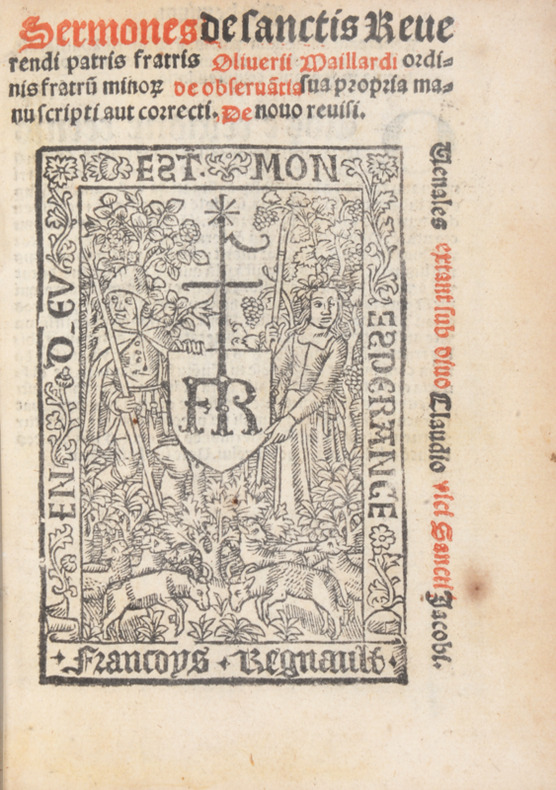
150941391[Paris], François Regnault, [1509]. Petit in-8 gothique à deux colonnes (98 x 130 mm) de CXII ff. (sign. a-o8), maroquin rouge, dos lisse orné, pièces de titre dont une en pied en maroquin noir, triple filet doré d'encadrement sur les plats, tranches dorées (reliure du XVIIIe siècle).