Florus, Lucius Annaeus.MareMagnum

7 772 résultats
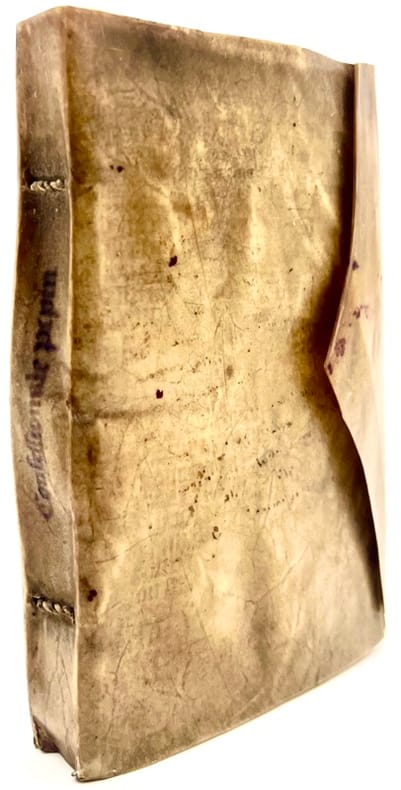
4to. 2 pts in 1 vol. (14), LX, (50) ff. - (Bound after) II: Arator. Arator poeta christianissimus in actus apostoloru[m]. [Leipzig, Melchior Lotter the elder, c. 1512]. 58 (instead of 60) ff. (last blank). - (Bound with) III: Sallustius Crispus, Caius. C. Crispi Salustii bellum Catilinarum. Item. Bellum Iugurthinum eiusdem. Item. Variae rationes ex libris eiusdem historiarum exceptae. Item. C. Crispi Salustii Vita. (Strasbourg, Matthias Schürer, August 1512). XCV (instead of XCIV!) ff. - (Bound with) IV: Vergilius, Polydorus. Proverbiorum liber, quo paroemiae insigniores omiu[m] fere scriptorum luculentissima enarratione explicantur. (Ibid., Nov. 1511). (6), XLVII, (1) ff. (Bound with) - V: The same. De inventoribus rerum libri tres. M. Antonii Sabellici de artium inventoribus ad Bassam carmen elegantissimum. [...] Ex secunda recognitione. (Ibid., June 1512). Contemporary wooden boards with blind-tooled pigskin spine (defective back cover restored). Wants ties. I: Pretty edition by Johann Camers; published only two days after Cuspinianus's (more common) Vienna edition (printed by J. Winterburger). With a dedication by the publishers to Francesco II Sforza, about "ars illa imprimendi". Denis explains the simultaneous publication of two Florus editions in Vienna by a possible quarrel between Camers and Cuspinianus. Slightly browned and fingerstained; numerous marginialia and notes by a contemporary humanist's hand. - II: Second 16th-c. edition. An epic recasting of the Acts of the Apostles, explaining the stories with far-fetched allegories and numerology. First quire misbound (A1, 5, 2, 6); wants ff. A3-4. Waterstained throughout. T. p. and beginning with remargined paper defects; numerous marginialia and notes by a contemporary humanist's hand. - III: Rare Strasbourg edition of Sallust. Before the last leaf (with a brief Life of the author and the imprint), this copy contains an additional leaf from Schürer's 1513 Sallust edition (VD 16, S 1368), with a different Life of Sallust and the imprint of that edition. T. p. somewhat stained; numerous marginalia by a contemporary humanist's hand. - IV: First work of the Italian-English humanist, first printed in 1498: one of the most popular Renaissance collections of proverbs. Somewhat browned and stained; occasional waterstains. Some passages in Greek. - V: Early edition of this oft-printed principal work: a veritable encyclopaedia of humanist memorial culture, treating the origins of philosophy, medicine, astrology, pharmacy, magic, etc. "Remplie de détails et d'anecdotes curieuses" (Caillet III, 675). - Slightly browned and waterstained; last leaf professionally remargined. Altogether a fine sammelband on classical and neo-Latin literature and historiography in a contemporary binding. I: VD 16, F 1685. Denis 55 a, b. Graesse II, 604. BNH F 303, C 157. Not in Adams or BM-STC German. - II: VD 16, A 3185. BM-STC German 39. Not in Adams. - III: VD 16, ZV 13683. Muller II, 184, 87. Ritter 2060. Schmidt 82. Not in Adams or BM-STC German.- IV: VD 16, V 770. Muller II, 181, 61. Ritter 2396. Schmidt 58. Not in Adams or BM-STC German.- V: VD 16, V 745. Adams V 425. Muller II, 184, 90. Ritter 2397. Schmidt 74. Not in BM-STC German.
Crown 16mo in 8s (12 x 8 cm). 229, (11) pp. With a 6-line space (with a printed guide letter) left for a manuscript initial (not filled in) and 2 vine-leaf ornaments, Vervliet 56 & 80. Set in 3 sizes of roman type, the smallest including special pharmacological characters. Modern sheepskin parchment, but with gilt edges perhaps from an earlier binding. Only known copy of the Jean Ruel issue of the very rare second (?) Paris edition of one of the most important early pharmacological books, with about 250 medicinal recipes arranged alphabetically, written by Thibault Lespleigney (1496-1550), apothecary and professor of medicine and pharmacology at Tours, where he first published it as Dispensarium medicinarum in 1538. It inevitably owes something to the ca. 1100 Antidotarium Nicolai, first printed in 1471 and almost the only comprehensive book on the subject when Lespleigney wrote, but it also foreshadows the pharmacopoeias. The term pharmacopoeia (meaning drug-compounding) was coined only in 1561, but is now used to refer to a collection of recipes officially authorized by a government or medical or pharmaceutical association, the first being Valerius Cordus, Dispensatorium (Nürnberg, written in 1542 but published posthumously in 1546). Before that books of recipes by leading pharmacologists served a similar role without any official authorization. Lespleigney's was the most important in France and enormously influential. About 10 editions appeared from 1538 to 1543 in Tours, Lyon, Paris and even Antwerp and Venice. François Chappuys revised, corrected and expanded Lespleigney's text for the second edition (Lyon, 1539), giving it the present title, and nearly all later editions, including the present, follow his revised text. The present edition clearly resembles Arnoul and Charles l'Angelier's 1541 Paris edition in style and layout, but does not follow it line by line. We have not seen the 1540 l'Angelier edition, with the same pagination as 1541, so they may be two issues of a single edition. We have also not seen what may be other issues of the present 1543 Paris edition, reported under various publishers: Jean Foucher, Vivant Gaultherot and Jean du Chemin. All three have the same pagination as the present edition, and at least the Gautherot shares a misprint (p. 206 numbered "209"), the same collation and the same VD16 fingerprint (ame- s,m- g*i* mepr, based on A2r, A6r, A7r and A7v: VD16 fingerprints substitute "*" for "æ"). So we probably have one or two Paris editions in 1540 and 1541 serving as the model for a 1543 Paris edition in four simultaneous issues. The USTC reports 2 copies of the 1540 Paris edition but no other Paris edition or issue. The Bibliotheque Nationale has a copy of the Du Chemin issue of the 1543 Paris edition and notes 2 further copies of the edition, in London (Foucher issue) and Stuttgart (Gaultherot issue). ICCU reports another at the Bibliotheca Comunale Ariostea in Ferrara (Gaultherot issue) and gives its VD16 fingerprint. The Casanata Library in Rome has a copy of the 1541 Paris edition, viewable on Google Books. All editions are very rare: the USTC records 0 to 3 copies for most and more (5 or 7) only for two editions: Venice 1542 and Lyon 1543. After 1543, Lespleigney's work lost popularity, perhaps due to the success of Cordus's 1546 Dispensatorium, but further editions appeared at Lyon under the title Enchiridion from 1546 to 1561, and the only other known Ruel edition appeared at Paris in 1567 (BMC STC French), all still very rare. - The book collates: 16mo: A-P8 = 120 ll., with I1, I3, K1 and K3 missigned K1, K3, L1 and L3 respectively. It is imposed with two 8-leaf quires worked together in each sheet (except that quire P may have been imposed alone, work and turn), so that each pair of consecutive quires contains one watermark divided at the upper fore-edge of leaves 5 and 6 in one quire, and the point-holes fall at the foot of leaves 3 and 4 (on the line where the sheet was divided to make two quires, so half of a point-hole can appear along the edge). Quire B shows a watermark shield (bearing a merchant's mark with some sign or letters above an upside-down 4) topped by a quatrefoil and with a letter or letters(?) below (about 38 x 18 mm, centred in a 21 mm space between chainlines); quires C, E, G, K, L and O show a watermark crown (about 26 x 23 mm) topped by a quatrefoil, with 3 circles in the slightly arched base and letters(?) below (possibly M followed by a curl, or SM), centred on a chainline, with about 22 mm between chainlines. - The fore-edge fold of H5/6 was carelessly opened, so that the upper outside corner of H5 is attached to H6 instead of H5, a couple pages show minor smudges and there is an occasional small marginal stain or tear, but the book is otherwise in very good condition and almost untrimmed, so that the tears that divided the sheets into half-sheets are mostly preserved at the foot (revealing point holes on several leaves) and part of a fore-edge fold survives. The boards are slightly bowed but the binding is also in very good condition. Unique issue of a very rare early edition of a rare but popular and influential pharmacological book of about 250 medicinal recipes: a predecessor of the pharmacopoeias that appeared in and after 1546. Cf. BM-STC French 263 (1576 Ruel ed.). Durling 2801-2803 (Venice 1542, Lyon 1543 & Lyon 1556 eds.). Moreau 1536-40, no. 1863 (1540 Paris ed.). Schelenz, Geschichte der Pharmazie, pp. 437-438 (1538 & 1542 Tours eds.). USTC 147783 (2 copies of 1540 Paris ed.). Dorveaux, Notice sur les vie et les oeuvres de Thibault Lespleigney (1898), pp. 46-48 (1543 Paris ed., Du Chemin issue). Claude Viel, Deux figures du monde pharmaceutique Tourangeau: Thibault Lespleigney et Maurice Javillier, in: Revue d'Histoire de la pharmacie, pp. 239-245, at pp. 243-244 (Tours 1538, Lyon 1539 & Tours 1542 eds.). KVK & WorldCat (4 copies of the 1543 Paris ed.: 2 Gaultherot, 1 Foucher & 1 Du Chemin). Not in Adams; Brunet; Garrison & Morton; Graesse; Heirs of Hippocrates; Honeyman; Norman Library; Osler; Waller; Wellcome Library.
8vo. (86) pp. With woodcut coat of arms (coloured in red and blue) on the title page; several initials and numerous musical notes in the text. Contemporary vellum. Early edition of one of the principal treatises of musical instruction produced in the 16th century, containing a wealth of pioneering theories and practical examples; first published in this form in 1537. It also boasts the first consistently executed example of a canon (still called "fuga"), with references to compositions by Josquin and Walther. - Based on the works of Rhaw and Agricola, Listenius's treatise avails itself of Melanchthon's new educational methods and "became very popular as a school primer in Germany and Austria, and had appeared in more than 40 editions before 1583. The treatise was primarily for teaching singing, and is arranged in a novel manner. Each subject is treated in a series of short, simple rules copiously illustrated with music examples. In the section on mensural music Listenius used the canon [...] for his examples. For the first time, in addition to the traditional terms 'musica theoretica' and 'musica practica', he introduced the term 'musica poetica', by which he meant instruction in composition. The term remained in general use in Germany for over a century" (K. W. Niemöller, New Grove XI, 28). - Contemporary handwritten ownership of "Joannes Thenn S." in a humanist hand on the title page (no relationship could be traced to the Franconian Johann Thenn who had become master of the Salzburg mint in 1500); numerous Latin underlinings and marginalia by the same writer in red and brown ink throughout (covering some 30 pages). Latterly in the library of the French musical scholar Henry Prunières (1861-1942), who in 1920 founded "La Revue Musicale", with his etched bookplate to pastedown. VD 16, L 2026. Eitner VI, 190. RISM (Écrits impr.) 507. Cf. Hirsch I, 322 (1549 ed.); Wolffheim I, 777 (1550 ed.); also Adams and BM-STC German cite only later editions.
ALL PUBLISHED of this abortive yet spectacular attempt at a comprehensive survey of natural history, THE FIRST BOOK ON ZOOLOGY WITH COLOR-PRINTED (as opposed to hand-colored) PLATES. Comprises a general preface describing the entire project (by Dufart), an introduction to this volume (by Manuel), 101 GORGEOUS FULL-PAGE COLOR-PRINTED STIPPLE-ENGRAVED PLATES OF MAMMALS IN EXOTIC LANDSCAPES (usually two scenes per plate, after Deseve and other artists), and descriptive notes on each mammal depicted (by Manuel). 30 pp., 101 plates, 60 pp. Dedicated to Napoleon. Text printed on fine wove paper, plates on very fine, thick wove paper. After the appearance of this volume, the project was suspended because the publishers could not find enough subscribers (there is a list of the 24 who subscribed to this first volume on the back of the half-title). The reasons for this failure are obvious: each volume cost a staggering 60 francs (not including the binding) and the images of the animals, although bright, beautiful, and charming, are not particularly accurate. Large thick 8vo. BOUND IN CONTEMPORARY FULL CRIMSON MOROCCO, WITH ELEGANT GILT DECORATION ON COVERS AND SPINE. All edges gilt. Light wear to extremities of binding, but still very attractive. Internally bright. Two copies in NUC. QuÈrard (La France littÈraire, V, 497) doubts the very existence of this work: "...ne paraÓt avoir ÈtÈ que projetÈ, car on n'en trouve mention nulle autre part que dans le vol. de M. Debray." An extremely rare, unusual, and altogether stunning book.
4to. XL, (1) ff. (several errors in foliation, but complete, lacking only final blank). Decorated initials. 19th century boards (spine repaired). First edition thus of the satires of Persius, published but a month before the death of the editor, Murmellius. The work is preceded by a short biography of Persius, taken from Petrus Crinitus. Finely printed in a small "lettre bâtarde", including some Greek type, with legenda in the margins for the comments, and the main text printed in a slightly larger type, with the lines set widely apart. Georg Kloß copy, with his bookplate on the front pastedown and the relevant catalogue clipping from his sale (described as bound with an additional work) pasted above. The Frankfurt physician Georg Franz Burkhard Kloß (1787-1854) was also a noted historian of freemasonry. His rather notorious sale was held at Sotheby's in London in 1835. This volume contains long 18th c. notations on the title-page about the rarity of this edition as well as a contemporary humanist's extensive marginalia in Latin from fol. C1v to D2r, then again on D5v and D6v (slightly trimmed at rebinding), mostly pertaining to the text, but also to the commentary. These early handwritten annotations were boldly attributed to Melanchthon by Samuel L. Sotheby in his 1835 catalogue of the Kloß library, an unsustainable notion against which the collector himself spoke out clearly (cf. G. Kloß, Ueber Melanchthons angebliche Handschriften, welche in dem Catalogue of the Library of Dr. Kloss verzeichnet sind, in: Serapeum 2 [1841], no. 24, p. 369-377). In his monumental account of Melanchthon research throughout the centuries, Wilhelm Hammer provided similarly critical reviews of Sotheby's relevant publications: "[Wimmelt] von Sach- und Druckfehlern [...] Die hier zusammengestellten 'Privatexemplare' [Melanchthons] entsprechen nicht den Tatsachen [...] Eine höchst unsinnige Veröffentlichung" ("Abounds with factual and setting errors [...] The 'private copies of Melanchthon' here assembled are not in accordance with fact [...] A deeply misguided publication", cf. Die Melanchthonforschung im Wandel der Jahrhunderte 36 [1968], pp. 96 & 110). Subsequently in the collection of Cosmo (Cosmas) Nevill, Esq. of Holt, Leicestershire, with his 19th century engraved bookplate. Nevill would have acquired the book from the Kloß sale. - Some browning and minor dampstains. Pasteboards rubbed, extremeties bumped, spine professionally restored, as is a tear in the title page. Final index leaf H3 repaired by an early owner with loss of text (colophon on verso preserved). A slight wormtrack in top margin of H1 and H2 repaired (with slight text loss to H2). Very rare; only two copies located in North America (at Ann Arbor & Columbia); none in Britain. VD 16, P 1610. Schweiger 708. Panzer VI, 377.270. Moreau/Renouard V, 254. Sotheby's, Catalogue of the Library of Dr. Kloss, of Franckfort a. M., Professor (auction catalogue, London 1835), no. 2507 (this copy: "Melancthon's copy, with marginal notes"). Not in Adams or BM-STC German.
Folio (222 x 320 mm). (4), 253 ff. Title page printed in red and black. With woodcut title border (birds and grapes) by Hans Wechtlin and page-sized woodcut by Urs Graf at the end of preliminary matter. Contemp. blindstamped pigskin. Two clasps. Early edition of this influential collection of Lives of the Saints, first published in Vicenza in 1493. "A very valuable work with a wide circulation. In his arrangement of the various lives he follows the calendar of the Church. The collection [...] went through many editions, the last of which (the eighth) appeared in Venice, 1616" (Cath. Encyclopedia, s.v.). Fine Strasbourg print; Urs Graf's splendid woodcut shows the Ascension of the Christ. - Binding rather severely rubbed. Some worming to beginning and end; occasional brown- and waterstaining. Late 16th-c. ms. ownership and large engr. bookplate to front pastedown. VD 16, P 1881. BM-STC German 644. Adams N 45. Ritter 1856.
4to (140 x 196 mm). (6), 70 ff. With 35 woodcut diagrams in the text. Modern half vellum over marbled boards. First edition, rare (the earlier editions cited by Houzeau/L. are ghosts). Albert Pighius was born at Kampen in Holland ca. 1490 and died at Utrecht in 1542. Primarily a mathematician, he spent much time at the University of Paris, where this book was written. In this treatise, one of his polemical attacks against those who put the sciences of astronomy and astrology to base uses and employ them merely for the making of idle prognostications and popular almanacks, he praises Peurbach and Regiomontanus as true scientists, denouncing as a fraud the "Nova Astronomia" of Marcus Beneventanus. - Light waterstain to top edge of title-page; upper edge trimmed fairly closely throughout. A few ink annotations in a roughly contemporary hand. An excellent copy. Adams P 1179. Houzeau/Lancaster 2373f. Lalande 43. Renouard (Colines), p. 40f. Renouard, ICP, III, 386. Poggendorff II, 450. OCLC 33631427. Not in BM-STC French, Mortimer, or Caillet.
Folio (217 x 298 mm). 198 ff. With one woodcut initial. Late 19th c. boards. Edges sprinkled in red. Fine post-incunabular printing of this important medical compendium and pharmacopoeia, replete with Arabic-derived terminology, strongly based on Avicenna, Serapion the Younger (Ibn Wafid), and Dioscorides. Matthaeus Silvaticus, active around 1300, "was one of the most important mediaeval botanists and pharmacologists. His magnificent compilation from works of earlier physicians, with occasional observations and opinions of his own, presents its subjects in alphabetical order, making this effectively a kind of dictionary. The book's principal value lies in the explanations of various specialist terms from all fields of medicine, in particular several of Arabic origin" (cf. Hirsch/Hübotter IV, 117). - Occasional light browning. Annotated throughout in red ink by a contemporary physician's hand. A good copy despite the unsophisticated modern binding. Edit 16, CNCE 69665. Durling 4206. Panzer VIII, 404, 543. Proctor/Isaac 12960. Wellcome I, 5972. Not in Adams, Bird, Lesky, Osler, or Waller.
FIRST EDITION OF THOU'S HISTORY OF THE 16TH CENTURY, A MASTERPIECE OF FRENCH HISTORIOGRAPHY. 18, 684, 36 pp., complete. Jacques-Auguste de Thou (1553-1617), was one of the great statesmen and scholars of his time, and the Historiarum is his most important work. THIS IS THE TRUE FIRST EDITION, printed folio (another edition, in two volumes 8vo--with some large-paper copies printed 4to--was published later the same year). Moreover, the TITLE-PAGE IS IN THE FIRST STATE, which is exceedingly rare. Beautifully printed by Robert Estienne (1559-1630), with the title in red and black and attractive woodcut head- and tail-pieces throughout. Folio. Beautifully bound in recent quarter vellum and marbled boards. FINE AND BRIGHT, both inside and out, with excellent margins and bright white paper. Peignot II, 159 (pointing out that this work was suppressed from the moment of publication). An outstanding copy of a rare and important book: the only other copy I have located of the first edition with the first-state title-page is the Oxford copy.
Folio (277 x 207 mm). 163 (statt 164, fehlt Titelbl.) Bll. (a8-1, b8, c6, d-f8, g-h6, i-l8, m-o6, p8, q6, r-y6.8, z8). Gotische Type, zweispaltig zu 44 Zeilen (Komm. 54-55 Z.), Spatien für einzumalende Initialen. Diagramme auf Bl. b7v und f2r. Blindgeprägter Kalbslederband des frühen 16. Jhs. über Holzdeckeln auf vier Bünden, zweifach gerahmt, beide Deckel außen mit Bordüre, vorn im Mittelfeld Muster aus rhombischen Herzstempeln mit Krone und Blattwerkstempeln; hinten im inneren Rahmen außen quadratische aneinandergereihte Stempel mit Ast und blütenbesetztem Zweig; 1 gepunzter Schließbeschlag (v. 2). Die Innendeckel bezogen mit Fragment aus Conrad Tocklers astronomischer Vorhersage "Judicium Lipsense", Leipzig 1503 oder 1508. Zweite bei Quentel gedruckte Ausgabe dieses Kommentars zu den "Summulae logicales" des Petrus Hispanus (Papst Johannes XXI.), mit dem Text dieses für die mittelalterliche scholastische Logik wohl wirkmächtigsten und verbreitetsten Werks. Darin werden "die Formen der dialektischen Disputation vorgeführt [...], anschließend die logica modernorum entwickelt und eine semantische Analyse der aristotelischen Begriffslogik [...] entfaltet" (LexMA V, 544). Die Illustrationen auf Bl. b7v und d4r zeigen jeweils ein logisches Quadrat, die auf Bl. f2r die "arbor porphyriana". Auf Bl. n2v das bekannte Merkgedicht für die Schlussmodi. - Der französische Dominikaner Johannes Versoris (gest. wohl zwischen 1482 und 1485) gilt als einer der bedeutendsten Aristoteleskommentatoren der thomistischen Schule. "Seine Bücher [...] erschienen [...] in den letzten 20 Jahren des 15. bis in den Anfang des 16. Jahrhunderts, nicht selten ohne Jahr und Druckort, vielfach auch gedruckt bei Heinrich Quentel in Köln, der eifrig thomistische Werke verlegte; sie müssen viel gebraucht worden sein, da von einer Anzahl mehrere Auflagen rasch hintereinander gedruckt worden sind" (ADB 39, 637). - Einband berieben und stellenweise mit Bezugsdefekten; Schließen verloren. Die Innengelenke etwas gelockert; erste vorhandene Seite mit angeklebtem Falz des Vorsatzblattes und minimalem Eckdefekt (kein Textverlust); die letzten Blätter mit kleinen Wurmlöchern. Unterschiedlich gebräunt, zu Anfang auch gering wasserrandig. Einige zeitgenössische Tintenmarginalien (teils bei der Bindung etwas angeschnitten). Über ISTC nur in 18 Bibliotheken nachweisbar, sämtlich in Europa. H 16036. GW, M50203. BSB-Ink V-154. Ohly-Sack 2909. ISTC iv00238300. Voulliéme Köln 1241. Nicht bei Goff.
1626ST19298Antwerp: M. Snyders 1626. FIRST EDITION. 135 x 82 mm. 5 1/4 x 3 1/4". 39 of 40 leaves lacking C4. Two volumes one as issued the other a companion volume containing related plates without any title page. <br/> Very pretty late 18th or early 19th century red morocco covers bordered by delicate cresting roll with leaf cornerpieces smooth spine gilt in compartments with leafy centerpieces gilt lettering turn-in with gilt floral roll pale blue watered silk endleaves all edges gilt. Supplemental volume in late 19th century red half morocco over red paper boards similarly tooled spine. Housed together in a custom-made modern wooden box with sliding panel closure a heart mosaic in multi-colored hard-grain leather on its sides. Amoris Divini WITH engraved title page and 38 of 39; lacking plate XXXIV ENGRAVED PLATES 35 OF THEM ON VELLUM ALL DELICATELY COLORED AND HEIGHTENED IN GOLD plates 19 29 30 31 and 36 bound after text pages for plates 31 36 29 30 and 34 respectively; second volume with 45 plates on paper though without any text including many of these same emblems apparently from a later edition of this work ALL DAINTILY HIGHLIGHTED WITH GILT. Front pastedown of first volume with monogram book label in colors and gilt verso of front free endpaper with oval armorial bookplate "Ex Museo Van Der Helle" see below. De Vries "De Nederlandsche Emblemata" 121; Landwehr "Low Countries" 33; Praz p. 254; Brunet I 240 this copy; Delbergue-Cormont "Bibliothèque de M. Van der Helle" Paris 10 Février 1868 lot 69 this copy. Amoris spine very slightly dulled occasional hints of marginal thumbing but A LOVELY COPY clean and fresh internally with rich colors and glistening gold in a well-preserved binding; supplemental plates with faint marginal browning but excellent internally the engravings gently shimmering with gold and the binding with few signs of wear.<br/> <br/> The main volume here comprises a collection of emblems illustrating concepts of human and divine love; it is made all the more special by being printed on vellum beautifully hand colored and then delicately highlighted with gold. The emblems depict Divine Love as a beardless young man with nimbus who always represents love in its purest form. Human love or worldly love is variously embodied in a winged Cupid sometimes blindfolded who represents erotic love and who is accompanied by symbols of treasure or power that represent worldly desires. Landwehr Praz and De Vries make no mention of a vellum edition but Brunet describes one copy on vellum painted in colors and gold which he says sold at the Duriez auction. That book appeared as lot 3216 in "Catalogue des livres imprimés et manuscrits composant la bibliothèque de feu M. L.-M.-J. Duriez de Lille membre de la Société des Bibliophiles français" Paris J.-S. Merlin 1827 where its binding description matches our copy. Having uncovered no other hand-colored copies on vellum in auction records or in OCLC we think it quite likely that the present volume is in fact the Duriez copy. Louis Duriez 1753-1825 was a Lille lawyer of sufficient skill and cleverness to move without incident from serving as lieutenant provost for his district under King Louis XVI to becoming receiver of the district of Lille after the revolution 1791 and purchasing the estate of an aristocrat which had been seized by the state. He rose to successively more important and remunerative governmental positions and was named Knight of the Royal Order of the Legion of Honor in 1814. In 1820 he was one of the founding members of the Société des Bibliophiles français an elite group limited to 24 scholarly collectors. After his death his collection of more than 5000 carefully chosen works was dispersed at 59 auctions held between 22 January and 1 April 1828 at Maison Silvestre in Paris. A perusal of the lots on offer finds a strong emphasis on fine bindings works on vellum and illustrated books many noting hand coloring. The emblems in the second thinner book here on paper without coloring--but with gold highlighting allow the reader to experience the pleasure to be found in comparing the degrees of decoration and opulence of the two volumes. These illustrations likely come from one of the later printings of this title each of which added new emblems to the original 39 called for in Landwehr and Praz. It is not clear when or by whom this second volume was wedded to the first. After its presumed residence in the Duriez collection our copy of the 1626 edition and perhaps its sidecar volume moved to another distinguished library--that formed by the scholarly and erudite French collector M. Van Der Helle of Lille who amassed a collection particularly rich in illustrated books and works on vellum. In the catalogue for the sale of his library in 1868 Paris auction house Delbergue-Cormont described him as a bibliophile "of the school of Renouard . . . who only liked irreproachable copies." We bought this item without being warned that it is slightly defective but given its distinguished provenance and the many other features it has going for it we did not ask the seller to take it back. M. Snyders unknown
19356911935 - reliure - Sanjian Shuwu 三閒書屋 - Yinyu ji 引玉集 (« Recueil pour attirer le jade ») 木刻五十九幅 - Deuxième tirage, avril 1935 - In-8 (19,5 × 15,5 cm) reliure cartonnée de l'éditeur, dos noir, pièce de titre contrecollée sur le premier plat - 68 pages - 59 reproductions de gravures sur bois soviétiques imprimées au procédé collotype (珂羅版) d'après les tirages originaux fournis par les artistes - Comprend un texte de Chen Jie (陳節), traduction abrégée d'un essai de A. D. Chegodaev consacré à la gravure soviétique contemporaine - Tirage limité à 215 exemplaires, dont 15 exemplaires hors commerce - Diffusion assurée par la librairie Uchiyama (內山書店), Shanghai - Ouvrage en chinois - Avec des œuvres de Dmitri Isidorovich Mitrokhin, A. Kravchenko, N. Piskarev, Vladimir Andreevich Favorsky, P. Pavlinov, A. Goncharov, M. Pikov, Sergei Mikhalovich Mocharov, L. Khizhinsky, Nikolai Vasilievich Alekseev et Sergei Mikhailovich Pozharsky - A PROPOS : Rare anthologie consacrée à la gravure soviétique moderne, publiée à Shanghai par 三閒書屋 et diffusée par la librairie Uchiyama (內山書店). L'ouvrage réunit cinquante-neuf reproductions en collotype de gravures sur bois réalisées par plusieurs figures majeures de l'école russe et soviétique de la gravure des années 1920-1930, parmi lesquelles Vladimir Favorsky, Dmitri Mitrokhin, Alexei Kravchenko et Pavel Pavlinov. Accompagné d'une traduction abrégée par Chen Jie d'un essai de l'historien de l'art soviétique A. D. Chegodaev, ainsi que d'une préface, d'un catalogue des planches et d'une postface, le volume fut conçu comme une introduction à l'estampe contemporaine soviétique pour le public chinois. Témoignage remarquable des échanges artistiques sino-soviétiques dans le Shanghai républicain des années 1930, il s'inscrit dans le contexte du mouvement de la Nouvelle Gravure (新興木刻運動), alors en plein essor sous l'influence des milieux intellectuels de gauche et des réseaux culturels gravitant autour de la librairie Uchiyama et de la figure de Lu Xun. Les reproductions furent réunies à partir de documents et publications soviétiques découverts au début des années 1930, notamment par l'intermédiaire de la revue Graphika. /// ENGLISH: Sanjian Shuwu (三閒書屋) - Yinyu ji (引玉集, “Collection to Draw Forth Jade”): Fifty-Nine Woodcuts (木刻五十九幅) - Second printing, April 1935 - Octavo (19.5 × 15.5 cm), publisher's boards with black spine and mounted title label on upper cover - 68 pages - 59 collotype (珂羅版) reproductions of Soviet woodcuts printed from original impressions supplied by the artists - Includes a text by Chen Jie (陳節), an abridged translation of an essay by A. D. Chegodaev on contemporary Soviet printmaking - Limited edition of 215 copies, including 15 non-commercial presentation copies - Distributed by Uchiyama Bookstore (內山書店), Shanghai - Text in Chinese - Featuring works by Dmitri Isidorovich Mitrokhin, Alexei Kravchenko, Nikolai Piskarev, Vladimir Andreevich Favorsky, Pavel Pavlinov, Aleksandr Goncharov, Mikhail Pikov, Sergei Mikhailovich Mocharov, Leonid Khizhinsky, Nikolai Vasilievich Alekseev and Sergei Mikhailovich Pozharsky. ABOUT: Rare anthology devoted to modern Soviet wood engraving and printmaking, published in Shanghai by Sanjian Shuwu and distributed through Uchiyama Bookstore (內山書店). The volume gathers fifty-nine collotype reproductions of woodcuts by several leading figures of the Russian and Soviet printmaking revival of the 1920s and 1930s, including Vladimir Favorsky, Dmitri Mitrokhin, Alexei Kravchenko and Pavel Pavlinov. Accompanied by Chen Jie's abridged translation of an essay by Soviet art historian A. D. Chegodaev, as well as a preface, plate catalogue and postface, the work was conceived as an introduction to contemporary Soviet printmaking for Chinese readers. A remarkable testimony to Sino-Soviet artistic exchanges in Republican-era Shanghai, it belongs to the context of the New Woodcut Movement (新興木刻運動), then flourishing under the influence of left-wing intellectual circles and cultural networks associated with Uchiyama Bookstore and the figure of Lu Xun. The reproductions were assembled from Soviet books, periodicals and documentary sources discovered in the early 1930s, notably through the journal Graphika. /// 中文:三閒書屋出版 — 《引玉集:木刻五十九幅》 — 1935年4月再版 — 32開(19.5 × 15.5厘米)精裝本,黑色書脊,封面貼書名籤 — 68頁 — 收錄蘇聯木刻作品59幅,以珂羅版工藝依據藝術家提供之原拓本複製印製 — 附陳節摘譯 A. D. Chegodaev(契戈達耶夫)論蘇聯現代版畫藝術之文章 — 限印215部,其中15部為非賣贈送本 — 上海內山書店代售 — 中文版 — 收錄 Dmitri Isidorovich Mitrokhin、Alexei Kravchenko、Nikolai Piskarev、Vladimir Andreevich Favorsky、Pavel Pavlinov、Aleksandr Goncharov、Mikhail Pikov、Sergei Mikhailovich Mocharov、Leonid Khizhinsky、Nikolai Vasilievich Alekseev 及 Sergei Mikhailovich Pozharsky 等藝術家作品。關於本書:本書為三閒書屋於上海出版、由內山書店代售之珍稀蘇聯現代木刻版畫選集。全書收錄59幅以珂羅版精印之蘇聯木刻作品,作者均為1920至1930年代俄羅斯及蘇聯版畫復興運動的重要藝術家,其中包括弗拉基米爾·法沃爾斯基(Vladimir Favorsky)、德米特里·米特羅欣(Dmitri Mitrokhin)、阿列克謝·克拉夫琴科(Alexei Kravchenko)及帕維爾·帕夫利諾夫(Pavel Pavlinov)等人。書中除收錄陳節摘譯之蘇聯藝術史家 A. D. Chegodaev 論文外,尚附序言、圖版目錄及後記,旨在向中國讀者介紹蘇聯當代版畫藝術。本書不僅是研究俄蘇版畫的重要文獻,亦是1930年代上海中蘇藝術交流的珍貴見證。其出版背景與中國新興木刻運動(新興木刻運動)密切相關,反映了左翼知識界、內山書店文化網絡以及魯迅所倡導之版畫思想的深遠影響。書中圖版主要彙集自1930年代初傳入中國之蘇聯書籍、期刊及藝術資料,其中包括《Graphika》等重要出版物。
1862ST20857London: Edmund Evans for Sampson Low Son and Co 1862. ONE OF PERHAPS 10 COPIES PRINTED ON VELLUM. 260 x 195 mm. 10 1/4 x 7 3/4". vii 1 235 1 pp. <br/> Publisher's stiff vellum smooth spine with gilt lettering edges untrimmed. In a modern felt-lined blue buckram drop-back box. Decorative initials in red or blue title page and text leaves with full criblé border of vined foliation occasionally inhabited eight or 10 leaves with more extensive illustrations at head or foot all engraved by W. J. Linton after illustrations by John Franklin. Front pastedown with ex-libris of Marion Hope Rattey. A Large Paper Copy. McLean "Victorian Book Design" p. 184. Short thin cracks to head and tail of front joint spine vaguely soiled upper cover with two very small brown spots and one trivial red mark occasional mild rumpling or naturally occurring variations in the grain or thickness of the vellum as usual a couple of minor smudges but still a very agreeable copy the binding solid and without the splaying common in vellum books the interior clean fresh and bright and the margins extraordinarily wide.<br/> <br/> This is an infrequently encountered copy of a beautiful Victorian book on vellum issued by one of the era's top printers. The volume was printed by Edmund Evans 1826-1905 who is now best remembered for his illustrations and advances in color wood engravings. Relatively little is known about this book's production: Ruari McLean tells us that it was "entirely printed" by Evans but it is unknown whether he was responsible for the design as well McLean remarks that "if Evans was responsible for its design it shows his superiority in book-making". We also are unsure how many copies were printed on vellum although the general consensus is 10. Regardless as McLean tells us "it is one of the prettiest books of the 'sixties" with sharp deep impressions of the type on the rich creamy vellum jewel-like colored initials and elegant wood-engraved illustrations. These illustrations are the work of John Franklin ca.1800-68 a painter and draftsman who was highly respected in his own time. The precisely realized borders feature idealized human forms posed within a robust botanical largely acanthus context the figures posing with balletic grace their expressive faces often turned gently away from the reader. The size of the leaf here is significant: the untrimmed edges retain their tiny printing pinholes which would normally have been trimmed away with regrettable loss. And not surprisingly our vellum printing is almost never seen: we could trace just two copies at auction since 1924. Former owner Marion Hope Rattey 1922-97 was likely the daughter of bibliographer Clifford C. Rattey 1886-1970 whose impressive library featured incunabula and block prints. [Edmund Evans for] Sampson Low, Son, and Co unknown
4to. (8), 231, (1) pp. With a large figurated woodcut "C" initial by Hans Holbein. 18th century half vellum with ms. spine title. First edition of Hus's principal work, commonly known in English as "Treatise on the Church", ascribed to Adam Petri's Basel printshop on the basis of typographical features. Written in 1413 at the castle of one of Hus's protectors in Kozí Hrádek, near Sezimovo Ústí, the book evidences the author's strong intellectual and spiritual ties with the English reformer John Wyclif, whose like-titled "De ecclesiae" has been written in 1378 (Hus however, unlike Wyclif, did not reject the notion of transsubstantiation). "This treatise became Huss's 'apologia pro sua vita', the defense of the views which he had drawn from Wyclif and advocated. [... It] has a place of first importance among works on the church [...] It is the best known work on the subject issued from Augustine to the Reformation period [and] has had a permanent influence upon the development of the idea of the church" (Schaff, Introduction to the 1915 edition, p. xi-xxxi). - A little more than a century after Hus was burned at the stake in Constance, Luther was sent a manuscript copy of the work and, upon reading it, enthusiastically embraced Hus's central tenets, famously writing to Georg Spalatin in February 1520 that "without knowing it, we are all Hussites". But half a year later, two printed versions appeared almost simultaneously in 1520 - one under the original title used here, the other entitled "De causa Boemica" (printed by Anshelm in Hagenau; the precise order of publication remains unclear). These first printings "enabled others to evaluate (or even emulate) Luther's conclusion [... The text was presented] in a disinterested manner, thus allowing an unbiased judgment of its contents"; it was published without polemical introduction or prologue, and the title page, "which did not mention Hus by name, contained the simple epigraph: 'I beg you, my kind reader, to attend not to who speaks, but to what is said'" (Haberkern). - Occasional slight brownstaining; a few insignificant wormholes to blank lower margin near end; old library shelfmark in ink to front pastedown. Quires M and Q bound out of order (3-4-1-2), but a complete, well-preserved and wide-margined copy. Quite scarce: only three copies in auction records internationally since 1975. VD 16, H 6173. BM-STC German 438. Adams H 1210. BNHCat H 630. Haberkern, Patron Saint and Prophet: Jan Hus in the Bohemian and German Reformations [Oxford 2016], p. 158.
8vo. 116 (but: 117), (1) SS. 19th century red morocco with richly gilt inner dentelle, leading edges gilt, marbled pastedowns. All edges gilt. Very rare first Latin edition of this controversial pamphlet, previously published in French as "Discours merveilleux de la vie, actions & deportements de la royne Catharine de Medicis" ("Paris 1563", but in fact printed in the autumn of 1574). This stinging indictment of Catherine de Medici was reprinted several times and also saw a German translation, "Öffentliches Ausschreiben der übelbefriedigten Stände in Frankreich" (i.e., "Public announcement made by the malcontent estates in France"), edited by Johann Fischart. - "The most controversial book associated with the name of Henri Estienne; this notorious biography of Catherine de Médicis, in the form of a violent Huguenot pamphlet against her, has long been attributed to Henri Estienne, although serious doubt has been cast on this attribution" (Schreiber). The anonymous author presents himself as a Catholic who insists the Huguenots should not have been butchered, but rather converted by means of theological argument. "Undoubtedly the writer is a member of the large party of malcontents, many of whom - at least after the massacre - were Catholics, who hoped that all men of national spirit from both persuasions might unite to throw off the cruel yoke of the Queen mother's rule and end the civil wars. Among the many Huguenot pamphlets of the time, this is the one to aim the sharpest arrows at the Queen mother. It contains a vitriolic account of the Queen's life, describing her family and upbringing in the most disparaging terms and revealing all the schemes, misdeeds and crimes committed since the beginning of her rule in 1560 [...] Repeatedly the author points out how she makes use of the precepts of her Florentine compatriot Macchiavelli" (A. Hauffen, Fischart-Studien, in: Euphorion 8 [1901], S. 536f.). - Light browning and very occasional light staining, sumptuously bound in the 19th century. Adams S 1754. BM-STC French, Suppl. 22. Renouard 143, 8. Schreiber 196.
4to. (82) ff. (A-T4, V6). 29 lines, text partly surrounded by commentary. Later half vellum. Latin edition of this famous medical manual, arranged at Salerno in the 12th century and published in various incunabular editions. This instructional poem and the commentary that accompanies it, often attributed to the 13th-century Montpellier alchemist Arnoldus de Villanova (cf. E. Wickersheimer, in: Comptes rendus du XIIIe Congrès international d'histoire de la médecine, 1954, p. 226-234 [Aquilon 570]), preserved its exceptional influence in Western Europe well into the 19th century. - Quire Q misbound but complete; some browning and fingerstaining; margins show some wrinkling. Several old marginalia and underlinings; later ms. note to title page: "Arnoldinus in Scholam Salernitanam". Very rare; a single record in ABPC (Swann, 24 Jan. 1980, lot 1792). CR 5053. Goff R-77. GW M37397. BSB-Ink R-50. Klebs 830.12. Sander 6391. Pellechet 1289. BMC V, 598. Edit 16, CNCE 60481. Cf. Essling 609f.
(6) Bll. (d. l. w.). Antiqua (Type 10:80R), 37-38 Zln. Mit einer schwarzgrundigen Initiale in Holzschnitt. Spätere Broschur. Dreiseitiger Rotschnitt. 4to. Erste Ausgabe dieser fingierten Huldigung König Maximilians durch sechs antike Städte. Vermutlich in Pordenone verfaßt, wo Caviceo mehrere Jahre lebte und 1489 vom dort anwesenden Kaiser Friedrich III. zum iuris utriusque doctor promoviert wurde. Das Werk beginnt mit einer Erwähnung der Vertreibung der Ungarn aus Österreich bis Stuhlweißenburg/Székesfehérvár: "Die 6 Städte sind Babylon, Troya, Byzanz, Athen, Carthago und Jerusalem. Sie alle huldigen Maximilian und flehen um seinen Schutz [...] Eingestreut zahlreiche Hinweise auf zeitge[nö]ssische Begebenheiten" (Apponyi). Der Theologe J. Caviceus (1443-1511) studierte zu Bologna und trat in die Dienste des Piermaria Rossi, Herrn von Berceto, und seines Sohnes Guido, des Capitano der Republik Venedig. Seit 1492 wirkte er nacheinander als Generalvikar der Diözesen Rimini, Ferrara, Florenz und Siena. - Druckerzuschreibung nach GW (von BMC und Indice generale VI bestritten). Das erste Blatt recto alt mit Einfassungslinie umrahmt; bei der Neubindung im Bug verstärkt; am vorderen Vorsatz eine englische Notiz zum Verfasser aufgezogen (um 1880). - Sehr selten, auf deutschen Auktionen der letzten Jahrzehnte nur die zweite Ausgabe nachweisbar (Hartung & Hartung, 98 [2000], Nr. 103, EUR 4346). HC 4805. Goff C-355. GW 6433. BSB-Ink C-204. Pellechet 3455. Proctor 7374. BMC VII, 1146. IGI 2655. Sajó-Soltész 955. Apponyi 1551.
153815510Paris, Pierre Vidoue, 1538. In-8 gothique (145 x 90 mm) de (111) ff. (sign. A-N8 O7), maroquin rouge, dos lisse orné, triple filet doré d'encadrement sur les plats, roulette intérieure, tranches dorées (reliure du XVIIIe siècle).
8vo (2 [instead of 14], 180 [instead of 188], (16) pp. With engraved title-page and 1 [instead of 3] double-page battle formation, 28 full-page maps and 2 full-page engravings by Michelangelo Marelli, all within the pagination. Woodcut printer's device on colophon leaf at end. 19th century half vellum over marbled boards. First edition; rare. - An NCO's pocket-sized manual containing general scientific and military information on architecture, geography, mathematics, duelling, drill, etc. The maps, which are the most famous of the book's illustrations, are almost exclusively of Mediterranean islands (with captions and sea monsters), particularly in the Aegean (cf. Zacharakis/Scutari 1499/1003-1518-1022), and include Rhodes, Crete, Cyprus, Malta (Ganado 1985, p. 231; not in MoM), Sicily (Dufour/L. 85), Elba, Corsica, Sardinia (not in Piloni), and Mallorca. The final map is of Great Britain (Shirley 124). - Occasional browning and waterstaining, lacking 6 leaves of preliminaries and pp. 29-36 (gatherings chi2 and ²chi2), including 2 battle plans. Slight loss to title, surviving battle plan slightly trimmed. Binding rubbed, showing minor staining. - Provenance: Faded contemporary Italian inscription on title ("Ex libris Joachimi Sabatini"?). Later in the collection of Thomas Fremantle, 3rd Baron Cottesloe (1862-1956), commander of the Territorial Army and president of the Society for Army History Research (purchased from Sotheran's, December 1936). Edit 16, CNCE 18852. Brunet II, 1235. Olschki 4539. Cockle 548. Mortimer 184. Ayala 25. NMM III, pt. 1, no.38. Shirley T.FRRR-1a. OCLC 954791711. Not in Atabey or Blackmer.
8vo. "162" [= 163], (1) pp. With a woodcut device on title-page and a larger version on the last page, both partly coloured by hand. Rubricated throughout. 19th-century vellum. First edition of a French translation from the Greek by the French physician Jean Canappe, of two chapters (5 and 9) from Galen's pharmaceutical work later translated into Latin as the De simplicium medicamentorum facultatibus. Canappe would publish a full translation a few years later as Le livre des simples (1545). - "There is no name more illustrious in the whole history of medicine than that of Galen [...] Written in Greek, this Galenic treasure reached the Latin Western World only through Arabic translations" (Hagelin). - With the bookplate of Etienne Récamier (1833-98), Bibliothèque Lyonnaise 1858-93, some partly removed owner's inscriptions on title-page and a few other inscriptions throughout. Some occasional smudges and stains, but otherwise in good condition. Durling, A chronological census of renaissance editions and translations of Galen 1542.11. Krivatsy, Suppl. 16th century, 86. USTC 24275. Not in Wellcome. Cf. DSB V, pp. 227-235; Hagelin, Rare and important medical books, pp. 12-15.
Folio (215 x 317 mm). Two parts in one volume, each with separate title page. (6 [instead of 8], CCCLIII, (1) pp. (8), CCLXXVIII (wanting final leaf with printer's device). Title page printed in red and black; with woodcut illustrations throughout. Contemporary half leather binding with roll-tools on five raised double bands; covers appealingly covered with the remains of a 15th-century musical manuscript on vellum. Second German edition of this widely received compilation. The main text derives from Antoine Geuffroy's "Estat de la court du grand Turc", first published in 1542; the other texts include the slavery account of Bartolomej Djurdjevic (Georgijevic), the exhortations of Bessarion and Pius II against the Turks, Breydenbach on the Armenians, and Aventinus's panegyric on Charles V. Also contains a discussion of the life of Mahomet, the Muslim religion and its rites. The second part deals almost exclusively with the reign of Sultan Suleyman the Magnificent. Includes the impressive plans and maps of Cairo, Constantinople, and Tunis. - Some worming near beginning; some edge flaws and paper damage (remargined). Rather browned throughout with some waterstaining; occasional contemporary ink marginalia. Old library stamps of the Graz Friars Minor on title page. VD 16, G 1911. BM-STC German 408. Adams G 561. Chauvin XII, p. 166, no. 638. Göllner 1692. Hammer 1044. Kertbeny 896. Cf. Atabey 492 (1573 ed.). Not in Blackmer or Cobham-Jeffrey.
161116494Chambéry, Geoffroy Dufour, [1611]. In-12 de (6)-219 pp., 1 f.bl., maroquin rouge, dos à nerfs, dentelle intérieure, tranches dorées sur marbrure (Hardy).
8vo. 79, (1) pp. - (Bound after) II: Mock, Jakob. De causis concretionis et dissolutionis rerum quarundam, tam extra quam intra corpus humanum. Tractatio historica, philosophica et medica, secundum veterum ac recentiorum placita descripta, & in tres partes distributa. Freiburg im Breisgau, Martin Böckler, 1596. (16), 288, (14) pp., final blank leaf. Contemporary full vellum; lacks ties. Final and best 16th century edition of this alchemical work originally written in Arabic, the first edition having appeared at Paris in 1559. The legendary Byzantine monk Morienus is said to have gone to Alexandria to study with the Arabian scholar Adfar, whose favourite student he became. Subsequently settling in Jerusalem as a hermit, he devoted his life to the hermetic arts before he learned that Khalid, the Sultan of Egypt, "was desirous to find some one who could interpret for him the writings of Hermes and of Adfar" (Ferguson II, 109). Morienus supposedly went to Egypt and instructed Khalid in the art of creating the elixir for the philosopher's stone. "The ultimate fate of Morienus is unknown, but his conversations with Kalid must have been committed to writing, and they may have come to the West about the time of the Crusades. They were in Arabic, but to make them available they were translated into Latin in February, 1182, by Robertus Castrensis, with a short preface" (Ferguson). No Arabic sources have been discovered, for which reason the attribution has been considered apocryphal, but the author does use chemical terminology with Arabic roots, such as "al-natron". The book marks the beginning of western preoccupation with alchemy, previously almost entirely unknown in mediaeval central Europe, and even Goethe quotes from it in his "Theory of Colours". - II: Bound first is a rare medical work by Jakob Mock, professor at Freiburg and a good friend of Fabricius Hildanus. This would seem to be part 1 only (caption title: "De aquarum quarundam affectionibus ratione coagulationis vel indurationis & dissolutinis, & alias"); no more published. - Unidentified 19th century library stamp to front pastedown. Covers slightly warped; long yapp edge of the vellum binding trimmed away along lower half of the book. Interior lightly browned, some light, mainly marginal spotting and brownstaining, a few darker spots occasionally affecting letters. Old handwritten ownership of "Claudius Cuppinius" on title-page of Mock's work, with an additional note in the same hand, dated 1691, on the flyleaf. I: VD 16, M 6354. Wellcome 4458. Neu 2849. Duveen 413f. Schmieder, Geschichte der Alchemie, p. 123. Brüning 646. Mellon Collection 50 (illustrated p. 160). Cf. Ferguson II, 108f. Not in Adams or BM-STC German. - II: VD 16, M 5707. BM-STC German 623. Adams M 1528. Durling 3199. Wellcome 4372. Jöcher III, 563.
Lucky Strike cigarette ad on back cover provides a truly classic and timeless example of a mis-timed advertisement. Consider that the great Wall St. stock market crash of 1929 occurred mere days before this issue hit the newsstands. Beneath the caption "An Ancient Prejudice has been removed" appears a clenched fist labeled as "American Intelligence" breaking a heavy chain. Top left a paranoid miser stacks his gold by candlelight. Top right a wealthy couple visits their palatial bank. Text beneath miser reads "Hoarding gold with the fanatical zeal of the miser has vanished. American Intelligence sponsors thousands of banking institutions to which the individual (i.e. the wealthy couple) safely entrusts his wealth." The message is clear. Readers should put their trust (and money) in the banks, and shun gold. This issue was likely printed just as the Great Crash occurred, causing countless financial institutions to go under - and destroying even more individual fortunes. (The ad goes on to claim that cigarettes have similarly overcome the prejudice against them.) A truly stunning work which deserves to be preserved and reflected upon in this age of limitless fiat currency printing. Average wear with three-inch crease to lower corner of back cover. Suitably framed and mounted, this ad will make a superlative office display for any precious metals executive. Magazine
153443491Paris, Claude Chevallon, 1534. Petit in-8 gothique à deux colonnes (110 x 160 mm) de (224) ff. le dernier blanc (sign. A-Z8, AA-EE8), lettrines historiées, texte rubriqué, vélin souple avec rabat en forme de portefeuille, titre manuscrit en long (reliure de l'époque).