7 773 résultats
4to. 165, (3) pp. With woodcut printer's device to title-page. Contemporary vellum. A very rare oriental grammar, unknown to Vater and Jülg: the first true grammar of Aramaic produced in France, expanded from Mercier's similarly titled "Tabulae in Chaldaeam grammaticen" published in 1550 (a slight work of a mere 18 leaves). The French oriental scholar Jean Mercier (ca. 1510-70) studied under François Vatable, whom he succeeded as professor of Hebrew at the Collège Royal. Created Lecteur du Roi in 1546, Mercier later was forced to flee to Venice because of his Protestant sympathies but returned to France and there died of the plague. "L'hébraïsant J. Mercier, auteur de la première grammaire araméenne parue en France, estime que la connaissance des langues maternelles des 'adversaires de la foi' permettra de les battre avec leurs propres armes sans leur laisser la moindre échappatoire" (S. Kessler-Mesguich, Hébraïsant-Chrétiens des XVIe et XVIIe siècles, p. 91). - Rare; USTC locates only 7 copies in libraries internationally, of which only one is in America (Houghton Library). - Lower corner of final leaf remargined; modern endpapers, using old paper. An attractive, tightly bound specimen. Adams M 1310. French Vernacular Books 79777. OCLC 457680439 (BnF copy). Not in Vater/Jülg.
Folio. (10), 172 ff. Title page printed in red and black. With woodcut title border, a full-page wind map, 55 woodcuts and numerous initials. Early 19th.-c. marbled half calf with giltstamped title to spine. Attractively illustrated edition of the Metamorphoses. The woodcuts (monogrammed "L" and "M") are new designs but are based on the series published in Tacuino's editions of Ovid during the second decade of the 16th century. - The first 20 ff. show a weak waterstain at the upper right corner; t. p. and first 3 ff. are somewhat brownstained; the remainder of the book is largely clean and spotless. Essling I, 233. ICCU Edit 16, CNCE 47169. Not in Adams or BM-STC Italian. Not in Schweiger.
8vo. (32), 923, (53) pp. With woodcut printer's device on title-page. Contemporary blindstamped vellum. All edges coloured. Latin edition (translated by the humanist Johann Winter of Andernach) of the works of the Byzantine Greek physician Paul of Aegina, who lived in the seventh century, as reported by Abu'l-Faraj ibn al-Jawzi. His "Medical Compendium" in seven books remained a standard text throughout the Arabic world for more than eight centuries. It was the most complete encyclopedia of medical knowledge of its time, discussing 1) hygiene and dietetics; 2) fevers; 3) topical illnesses from head to toe; 4) skin diseases and ailments of the intestines; 5) toxicology; 6) surgery; 7) the composition of medicines. The sixth book on surgery in particular was referenced in Europe and the Arab world throughout the Middle Ages, and is of special interest for surgical history. Indeed, Paul's reputation was particularly great in the Islamic world: the Arabic translation of his works by Hunayn ibn Ishaq was widely received, and it is said that he was especially consulted by midwives, whence he received the name of "al-Qawabeli", or "the Accoucheur". "Paulus Aegineta was the most important physician of his day and a skilful surgeon. He gave original descriptions of lithotomy, trephining, tonsillectomy, paracentesis and amputation of the breast; the first clear description of the effects of lead poisoning also comes from him" (Garrison/M., p. 7). - Occasional slight brownstaining; insignificant worming to margins of first few pages. A good copy. Adams P 487. Wellcome I, 4872. Durling 3563. Hoffmann III, 45. OCLC 14295002. Cf. Waller 7247. Not in BM-STC French.
Small 8vo (107 x 161 mm). (212) ff. Title-page and text within woodcut borders. With 99 woodcut portraits after Tobias Stimmer in the text. Modern red morocco with giltstamped floral borders and spine, leading edges gilt. Marbled endpapers. All edges gilt. First Latin edition. - An important source for the iconography of 16th-century scholarship, recording theologians, reformers, historians, geographers, physicians, scientists, and printers in this biographical dictionary of German and Swiss humanism. Among the mostly authentic portraits are such famous scholars as Amerbach, Apian, Brant, Bucer, Budé, Bugenhagen, Bullinger, Calvin, Copernicus, Cruciger, Erasmus. Gesner, Eobanus Hessus, Hus, Hutten, Justus Jonas, Lazius, Luther, Oecolampadius, Oporinus, Melanchthon, Sebastian Münster, Paracelsus, Pirckheimer, Beatus Rhenanus, Savonarola, Schwenckfeld, Vadian, Vesalius, Zasius, and Zwingli. - Reusner, a German poet, historian and jurist, assembled his original epigraphic portraits and augmented them with remarks collected from others such as Luther, Melanchthon, and Fabricus. Reusner's fame, and thus his access to the luminaries of his day, resulted from his series of verses for the members of the Diet of Augsburg. The very fine woodcuts are the work of Tobias Stimmer and were probably cut into wood by Jobin. Many of the portraits were adapted from pictures collected by Giovio. - Occasional stains and browning, more pronounced in last gathering, and a few minor edge flaws. A wormhole near the bottom edge of most of the first half of the volume (not affecting portraits). A few contemporary annotations in the text. A prettily bound, good copy of a book rarely found complete, from the library of Pierre Bergé (1930-2017). VD 16, R 1427. BM-STC 734. Adams R 408. Muller III, 592, 175. Ritter 2005. Ritter, Catalogue, 1807. Schottenloher 35735. Andresen III, 76, 141. Cf. Fairfax Murray 362.
4to. (40) SS. Papered marble spine. Editio princeps of the "Itinerarium" ("De Reditu Suo") of the 5th century Roman Gaul poet Rutilius. "On the reverse of the title page is a poem by the editor Giambattista Pio to Pope Leo X, ending on fol. 4v; text begins on 5r. A very rare edition, apparently the first" (cf. Schweiger). The poem in elegiac meter describes a coastal voyage from Rome to Gaul in 416. The solid literary quality of the work, and the flashes of light it throws across a momentous but dark epoch of history, combine to give it exceptional importance among the relics of late Roman literature. Rare, last copy auctioned in 1954.- A well-preserved copy. Edit 16, CNCE 47666. BM-STC Italian 594. Schweiger II.2, 859f.
8vo. (8), 206 [but: 208], (28) ff. (a8, A-Z8, Aa-Ff8, Gg4). T. p. and final "calendarium generale" printed in red and black. With 3 woodcut astronomical diagrams within the text. Early 18th c. half calf. All edges red. Very rare first edition of this work on chronology. With a calendar at the end, printed in red and black. Schönborn was professor of mathematics at Wittenberg, where he later was to succeed Peucer als professor of medicine. - Binding bumped at extremeties; spine severely rubbed; defects to spine-ends. Interior rather strongly browned and waterstained. VD 16, S 3361. Zinner 2436. Houzeau/L. 14195. Roller/Goodman II, 410. Not in Adams or NUC.
152715642Parisiis, Apud Simonem Colinaeum, 1527. In-8 (160 x 100 mm) de 235-(9) ff. (sig. a-z, &, A-E8, F4, G8), caractères romains, initiales sur bois à fond criblé, veau brun, dos à quatre nerfs et plats estampés à froid, traces de lacets (reliure de l'époque).
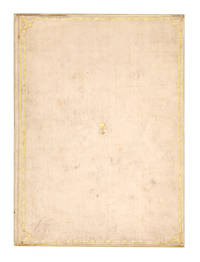
6171Six leaves printed on silk first & final two leaves are blank. 4to 271 x 197 mm. cont. pale pink silk over boards covers stamped in gilt silk paste-down endpapers a.e.g. Weimar: 1818. A rare deluxe printing on silk a poem written to celebrate the birth on 24 June 1818 of Karl Alexander the second son of the Grand Duchess Maria Pavlovna of Russia 1786-1859 and Karl Friederich Grand Duke of Saxe-Weimar-Eisenach 1783-1853. Maria Pavlovna was the third daughter of Tsar Paul I 1754-1801. Maria Pavlovna was raised at her father's palaces at Pavlovsk and Gatchina. Karl Alexander later inherited his father's title. In 1804 Maria Pavlovna met and married Karl Friedrich in St. Petersburg while he was on a grand tour of Europe. In Weimar she became a great patron of art and music and the sciences and took a serious interest in the social welfare of the inhabitants of the Grand-Duchy. She took courses at the University of Jena several of which were taught by Alexander von Humboldt. Franz Liszt was appointed her Kapellmeister following his retirement from the concert stage. Goethe considered Maria Pavlovna one of the worthiest women of his time. A fine copy preserved in a slip-case. hardcover books
1790ST14261Paris: Drouhin 1790. FIRST EDITION. 265 x 205 mm. 10 3/8 x 8". Two volumes. <br/> VERY ATTRACTIVE CONTEMPORARY MARBLED CALF GILT IN A NEOCLASSICAL DESIGN covers with a cresting palmette frame featuring ornate urn ornaments at corners flat spine divided into compartments by Greek key roll floral spray centerpieces one green and one black label marbled endpapers. With 55 PLATES OF COSTUMES designed by Philippe Chéry and engraved by Pierre-Michel Alix 50 of these PRINTED IN COLOR five in black and white a couple of these with color highlights applied by hand and with a color portrait of the author from the 1802 edition tipped in at front. Colas 717; Hiler p. 542; Lipperheide 3203; Cohen-de Ricci 227; Brunet IV 1135. One corner worn to board joints and extremities lightly rubbed but the bindings lustrous and generally very attractive. First volume slightly browned throughout second volume occasionally so volume II with two-inch marginal stain to upper gutter affecting four quires and six plates but not touching text or images two plates with pen marks in margins touching lettering but not image other trivial defects but still an excellent copy internally the colors especially clear and pleasing.<br/> <br/> This is an elegant production with the Neoclassical binding being the perfect complement to the color engravings of ancient Greek and Roman costumes that illustrate the present history of theatrical attire. In the two volumes here theater critic and historian Jean Charles Le Vacher de Charnois 1749-92 covers Classical tragedies and comedies as well as later interpretations of these dramas by playwrights including Racine. Le Vacher de Charnois intended a series of books encompassing as the title indicates theatrical costumes from all nations and from the ancient to the modern; however the French Revolution interrupted his scheme and as a monarchist he was imprisoned in 1792 for his writings in support of the aristocracy. It was long thought that he had died in the massacres at the Abbaye prison in September of that year but later research indicates that he may have been executed during the Reign of Terror in 1794. The artists who illustrated this work were at the opposite end of the political spectrum. Painter Philippe Chéry 1759-1838 studied with Jacques-Louis David and adopted his master's passionate support for the Revolution as well as his Neoclassical style. Engraver Pierre-Michel Alix 1762-1817 was a specialist in color printing best known for his portraits of leaders of the French Revolution and later of Napoleon and First Empire dignitaries. While the handsome binding here is unsigned the palmette roll on the covers is very similar but not identical to one used by Bozerian see Culot "Jean-Claude Bozerian" roll #44 and plate #XXIV. Perhaps our binder had trained in that atelier as the design and workmanship are certainly of that level. Drouhin unknown
First edition, small 8vo (131 x 81 mm), [24], 112, 117-172pp., (i.e. 168pp., as 113-16 omitted in the pagination), mounted woodcut frontispiece of a male archer, early ownership signature to title partially erased, upper corner of D1 restored with a loss of a few letters which have been added in ms. blank lower corner of M3 repaired, occasional light soiling and staining, marbled endpapers, eighteenth-century green morocco, tooled in gilt, overall a very good copy. Written when he was sixty-six years old, this is probably the last book which Markham wrote, and is one of his scarcest. "The practical instruction which he proceeds to give to the would-be-archer, of the bow and its use, the shooting-glove, the string, the shaft, the steel of the arrow, the feather, and the arrow-head, is reminiscent of Asham and may indeed be derived from his Toxophilus."?Poynter. Only two other copies have appeared at auction over the last 70 years, the Macclesfield copy sold by Sotheby's 14th April 2005 lot 1311 ?6,600 and the Fox Pointe copy sold by Forum Auctions 10th July 2019 lot 104 ?5000. STC 17333; Poynter, 40; Cockle, 129; Schwerdt II, p.10; Lake & Wright, p.199.
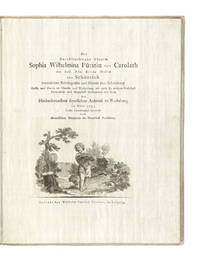
6173Engraved vignette on title signed by Hoppe & two engraved vignettes by Christian Gottlieb Geyser serving as head- & tail-pieces to the poem. Four leaves printed on pale yellow-white silk. 4to 257 x 205 mm. cont. pale pink silk over boards a bit soiled black floral design round sides pale blue silk paste-down endpapers. Leipzig: "Gedrukt bey Wilhelm Gottlob Sommer" 1793. Apparently unique this poem pays homage to the duchess Sophie Wilhelmine von Schönaich-Carolath 1764-95 for her visit to the small village of Rochsburg in Saxony. She was a member of the family which owned the famous Schloss Rochsburg situated above the village. It is remarkable that this small village was able to plan and have printed this quite luxurious and attractive work. The front paste-down has a mounted piece of paper with the contemporary inscription "Dies Buch gehört Sophie Wilhelmine Gräfin von Schönburg Rochsburg gebohrne Prinzess von Carolath Schönaich Rochsburg den 5 September 1793." Three contemporary silhouette portraits of the duchess loosely laid-in. In fine condition. Not in WorldCat. hardcover books
154143462Paris, Charlotte Guillard, 1541. Petit in-8 réglé de (8)-216 ff. (sign. aa8 a-z8 A-D8), index, vélin doré à recouvrement, dos lisse titré orné de filets et fleurons, double filet en encadrement, armoiries avec légende dans un médaillon au centre des plats, tranches dorées, traces de fermoir (reliure de l'époque).
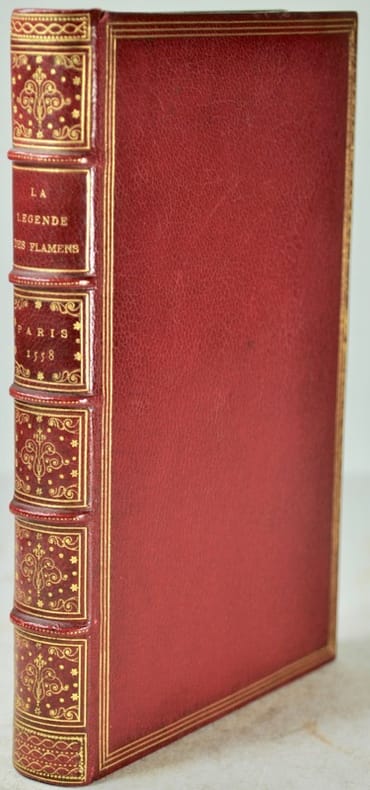
15588703Paris, Galliot du Pré, 1558. In-12 de (8)-152 ff., maroquin rouge, dos orné à nerfs, triple filet doré sur les plats, tranches dorées (reliure du XIXe siècle).
8vo. (16), 302 pp. With woodcut printer's device on t. p. 18th-c. marbled calf with label to richly gilt spine. Edges gilt. First and only edition of Hulsbusch's collection of ribald tales. Contains, among other anecdotes, ten stories from Martinus Montanus's "Wegkürzer" and 43 items from Jakob Frey's "Gartengesellschaft", translated into Latin. Among those written by himself is the story of a girl who showed herself naked at her window during a pageant in Augsburg. - The present copy is that of the Méon library described by Brunet: it was auctioned in 1803 at the Meón sale (no. 2446) and was regarded as rare even then. The front flyleaf bears Méon's purchasing memo: he had bought the book for 37 francs at the sale of the library of the great German scientist Johann Heinrich Lambert in 1780. At the Méon sale, it was knocked down to the French veterinarian Jean Baptiste Huzard (1755-1838), whose library stamp is on the reverse of the title page. In the 20th century, the book belonged to the French writer and collector of erotic literature Pierre Lous, whose pencil note is on the front flyleaf. Cf. Brunet III, 1639 (Méon cat.) and auctions catalog of the collection of Pierre Louys, vol. III, 1927, no. 3003. - Title page remargined (no loss to text); somewhat browned throughout. - Very rare; no copy at German auctions since 1950; only 3 copies established in USA via OCLC (Stanford; Univ. of Illinois; Univ. of Maryland). VD 16, H 5864. Adams H 1149. Not in BM-STC German. Goedeke II, 129. Killy VIII, 275. Brunet V, 608. Graesse VI, 537.
Folio (280 x 410 mm). (12), 75 pp., final blank. - (Bound with:) Sánchez, Martin. Conspicua et adprime frugifera dividui et individui arbor. [Ibid.], 1538. XVIII pp. With a wide woodcut title border, printer's device, and a full-page woodcut on the reverse of the title. Modern marbled boards. First edition. Principal work of the Padovan legal scholar Marcus Antonius Blancus (1498-1548), dealing with family and contract law. Rare; only 5 copies listed in Edit 16. - Bound at the end is the third known copy of the rare second edition of the "Arbor dividui et individui" by Martin Sanz (Sánchez) Bascolet, first published at Toulouse in 1519: a discussion of various kinds of contractual clauses governing divisible and indivisible objects. The only other known copies are in the Library of the Association of the Bar of the City of New York, Yale (bound at the end of Luca da Penne's "Lectura super tribus libris Codicis" [Lyon, Jacques Myt, 1538]) and in the Tübingen University Library. The title page shows Pinzi's fine device. - Some waterstaining throughout, slight edge damage and occasional worming to margins. Several 17th century marginalia. Edit 16, CNCE 5724. Adams B 2102. Cf. Leidenfrost I, 441. Not in BM-STC Italian. - II: OCLC 311252940. Not in Edit 16, Adams or BM-STC Italian.
164942429Langres, Jean Boudrot, 1649. In-4 (19,7 x 14,7) de 1 feuillet gravé (armes de Sébastien Zamet, évêque de Langres), (16) pp. 8-561-(1) pp. (16) pp. (table, index), 1 feuillet non chiffré (deux errata), nombreuses erreurs de pagination (saut de chiffrage de 549 à 559), veau porphyre, triple filet doré sur les plats, dos orné à nerfs, pièce de titre en maroquin rouge (reliure du XVIIIe siècle).
1787002012Paris Imprimerie de Didot l'Aîné 1787
4to. (40), 700 (but: 698), (2) pp. With armorial title woodcut and half-page woodcut portrait on fol. B1. Contemporary full vellum with marbled edges. Second edition, the earliest one obtainable and usually considered the first altogether (a single copy of an edition published by Da Ponte in 1582 has been discovered in the Biblioteca della Collegiata S. Pietro Apostolo in Broni near Pavia). The principal work of the Milan artist and theoretician of art, Giampaolo Lomazzo, has been called "the most complete treatise on the art theory, design, and iconography of the Mannerist period" (Arntzen/R.); indeed, "the true Bible of Mannerism" (cf. Schlosser). Purposefully divided into the mystical number of seven books, Lomazzo's treatise describes first proportions (with a discussion of Dürer, who was much-received in Italy), then the expression of feelings, colours, light and shade, linear perspective, and practical painting; the seventh and final book treats matter and substances, touching upon - and greatly expanding on - Armenini. "These last two chapters are of the greatest importance for understanding the essence of Mannerism, providing quite simply one of the most extensive accounts" (ibid.). - Some occasional browning and waterstaining near beginning; slight paper flaw to fol. E3 (not affecting legibility). Numerous errors in pagination; quire Y jumbled but complete. A small perforation to the spine; textblock curled. Old ownership on front flyleaf obliterated in ink. A single copy in German auction records. Edit 16, CNCE 24452 (Var. A). Adams L 1419. BM-STC Italian 391. Cicognara 159. Schlosser 352 Arntzen/Rainwater H 43. Kat. der Ornamentstichslg. Berlin 4612. Chamberlin 2015. Bibl. Trivulziana 261. Cf. Haym, Libri rari 265; Fowler 185 (1585 ed.).
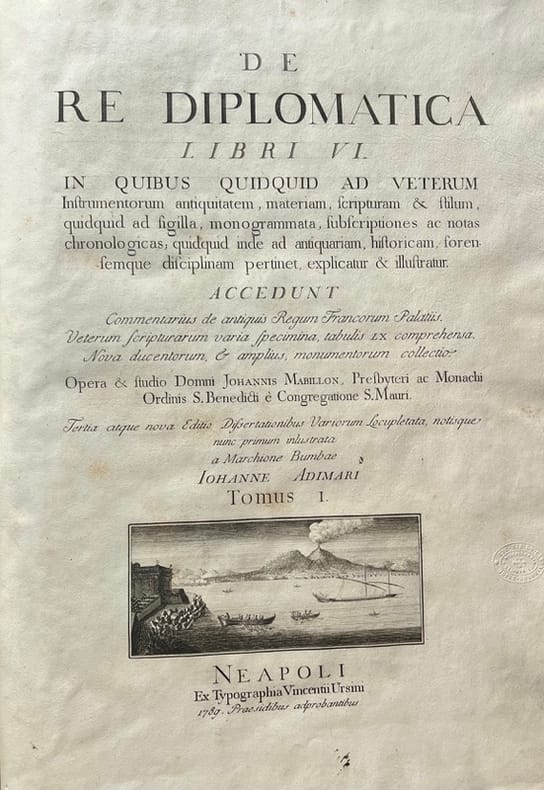
178943026Neapoli, Ex Typographia Vincentii Ursini, 1789. In-folio de 1 frontispice gravé (2)-XX-668 pp.MABILLON (Jean). De Re diplomatica Librorum supplementum. In quo archetypa in his libris, pro regulis proposita, ipsaeque regulae denuo consirmantur, novisque speciminibus & argumentis asseruntur & illustrantur. Opera & studio Domni Johannis Mabillon, presbyteri & monachi Ordinis S. Benedicti e Congregatione S. Mauri. Tertia atque nova editio…tisque nunc primum illustrata a marchione Bumbae Johanne Adimari. Neapoli, Ex Typographia Vincentii Ursini, 1789. In-folio de In-folio de VIII-116-CLXXX pp.Ensemble 2 vol. grand in-folio, vélin, titre doré sur les dos (reliure de l'époque).
(8), LXXIII Bll. Mit großer Holzschnittillustration am Titel (am Schluss des Registers wiederholt). Moderner marmorierter Pappband. 4to. Frühe Ausgabe von Vogtherrs zweitem volksmedizinischen Werk; Steiner hatte schon 1531 die Erstausgabe besorgt. "A very rare book on distilling" (Duveen) mit entsprechendem Holzschnitt. Bartholomäus (oder Balthasar) Vogtherr (oder Vogter) war Augenarzt in Dilingen und beim Bischof von Augsburg. - Durchgehend etwas gebräunt bzw. wasserrandig; teils knapp beschnitten. Selten. VD 16, V 2156. Durling 4690. Wellcome 6667. Neu 4246. Vgl. Duveen 606; Rosenthal 3269 (Ausg. 1541). Nicht bei Waller, BM-STC German oder Adams.
2 Vols., in one, small 4to (260 x 160 mm), 103 leaves including title and two advertisement leaves; 22 leaves including title and advert leaf (ornaments numbered 1-103), all printed on rectos only, printed on thick paper stock, 'Lepard' watermark, orig. boards with marbled covers, printed paper title label to spine (rubbed), inner hinges expertly repaired, a very good uncut copy with wide margins. The Fry's were a Bristol family, and Joseph Fry (1728-87) established the foundry at Bristol in 1764, in partnership with William Pine and Isaac Moore as manager and type-designer. By 1766 the foundry had moved to London, with Moore retiring in 1776 and Pine shortly after. In 1782 Fry took his sons Edmund (especially interested in exotic founts) and Henry into partnership, and made considerable purchases of Greeks and Orientals at the sale of James' foundry. Joseph retired in 1787 and in 1794 Isaac Steele joined as partner until 1808, when Edmund Fry was left in sole control until he admitted his son to partnership. In 1829 the foundry was acquired by William Thorowgood. A very good copy of this extremely rare and substantial specimen book. Berry & Johnson, p. 45; Mosley, 118 & 119.
Small 4to (250 x 155 mm), title with vignette, 2 ff. adverts, 126 ff. (i.e., 100ff. type specimens, 26 ff. ornaments, numbered 1-130) all printed on rectos only, printed on thick paper stock, 'Lepard' watermark, occasional spotting and turned corners, cont. calf, rubbed, joints cracked, black morocco spine label. The Fry's were a Bristol family, and Joseph Fry (1728-87) established the foundry at Bristol in 1764, in partnership with William Pine and Isaac Moore as manager and type-designer. By 1766 the foundry had moved to London, with Moore retiring in 1776 and Pine shortly after. In 1782 Fry took his sons Edmund (especially interested in exotic founts) and Henry into partnership, and made considerable purchases of Greeks and Orientals at the sale of James' foundry. Joseph retired in 1787 and in 1794 Isaac Steele joined as partner until 1808, when Edmund Fry was left in sloe control until he admitted his son to partnership. In 1829 the foundry was acquired by William Thorowgood. A very good copy of this extremely rare and substantial specimen book. Following an introduction, the specimens proceed from Ten line Pica to Diamond: 'the smallest Letter in the World. It gets in considerably more than the famous Dutch Diamond.' There are type in Hebrew and Greek, ornamental, Blacks, Exotics, Ships, Bands, frames, & decorative pieces composed of flowers continuing to a priced section of cast ornaments. This edition not listed by ESTC, Berry & Johnson and Mosley both cite the St. Bride copy only. Berry & Johnson, p. 46; Mosley, 122.
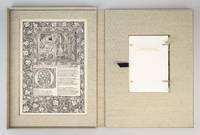
ST20503McMinnville Oregon: Phillip J. Pirages 2019. No. VII OF 47 COPIES numbered I-XLVII bound in flexible vellum from a total edition of 165 COPIES. Text: 244 x 154 mm. 9 1/8 x 6 1/8"; Case: 502 x 372 mm. 19 3/4 x 14 5/8". ii 75 pp. <br/> Bound in flexible vellum with ties inspired by Kelmscott Press bindings by Amy Borezo who also constructed the case holding the volume and leaves. The book printed letterpress on Zerkall Book Laid Vellum paper by Arthur Larson at Horton Tank Graphics. Book layout by Jill Mann. EACH COPY WITH FIVE LEAVES: ONE FROM THE KELMSCOTT CHAUCER WITH woodcut borders woodcut beginning word and A WOODCUT SCENE DESIGNED BY EDWARD BURNE-JONES AND ONE EACH FROM THE PRESSES OF FOUR GERMAN PRINTERS FROM THE 1470s--PETER SCHOEFFER JOHANN MENTELIN GÜNTHER ZAINER AND ANTON KOBERGER the Zainer leaf featuring at least one woodcut initial. The incunabular leaves consistently excellent with only minor defects and the Kelmscott leaves which were never part of a bound volume in entirely fine condition.<br/> <br/> This is a unique leaf book in the way that it combines three elements: a significant private press production involving people at the top of their craft a scholarly commentary that contributes to a further understanding of the history of printing and--most important--five leaves: one from the Kelmscott Press "Works" of Geoffrey Chaucer and four from books issued by German printers at work in the 1470s. The book has been printed and bound by hand by gifted professionals; the essay addresses a topic of significance to typophiles in a considerably more thoroughgoing way than has been done before; and the assemblage of leaves represents a powerful visual reinforcement of the text as well as an opportunity to share in the ownership of four important incunabula along with the extraordinary Kelmscott Chaucer. The story of the production is heavy on serendipity: in the winter of 2012 after purchasing a very incomplete copy of the Kelmscott Chaucer at auction we considered the possibility of producing a leaf book but because the Chaucer--universally considered to be one of the most beautiful books ever printed--had been written about by so many different people in so many different ways we didn't know what aspect was left for us to explore. The one topic we fastened on as thus far inadequately examined is the origin of the work's typeface. We soon learned that Morris who is known to have owned more than 500 incunables most admired--and was consequently most likely to have been influenced in his typographic design by--Peter Schoeffer of Mainz Johann Mentelin of Strassburg Günther Zainer of Augsburg and Anton Koberger of Nuremberg. Over the course of the years succeeding the purchase of the defective Chaucer we were fortunate beyond all expectation to acquire incomplete books from each of these four eminent printers. As a result the present leaf book will allow the reader not only to read in the accompanying essay about the influence on Morris of his typographic forebears but also to compare with his or her own eyes the resemblances between the Kelmscott leaf and the leaves from four centuries earlier. The essay comes in one of three bindings which reflect the degree of decorative elaboration on the accompanying Kelmscott leaf: linen-backed paper boards in imitation of the small format Kelmscott publications with a leaf containing text and small initials; floral patterned cloth after a Morris design with a leaf containing multiple six-line initials; or in the most deluxe version as here in flexible vellum with ties with a leaf featuring a full woodcut frame one or more prominent woodcut initials and a very large and striking Edward Burne-Jones woodcut scene. Phillip J. Pirages unknown
ST15039cAMcMinnville Oregon: Phillip J. Pirages 2019. ONE OF 47 COPIES numbered I-XLVII bound in flexible vellum from a total edition of 165 COPIES. Text: 244 x 154 mm. 9 1/8 x 6 1/8"; Case: 502 x 372 mm. 19 3/4 x 14 5/8". ii 75 pp. <br/> Bound in flexible vellum with ties inspired by Kelmscott Press bindings by Amy Borezo who also constructed the case holding the volume and leaves. The book printed letterpress on Zerkall Book Laid Vellum paper by Arthur Larson at Horton Tank Graphics. Book layout by Jill Mann. EACH COPY WITH FIVE LEAVES: ONE FROM THE KELMSCOTT CHAUCER WITH woodcut borders woodcut beginning word and A WOODCUT SCENE DESIGNED BY EDWARD BURNE-JONES AND ONE EACH FROM THE PRESSES OF FOUR GERMAN PRINTERS FROM THE 1470s--PETER SCHOEFFER JOHANN MENTELIN GÜNTHER ZAINER AND ANTON KOBERGER the Zainer leaf featuring at least one woodcut initial. ◆The incunabular leaves consistently excellent with only minor defects and the Kelmscott leaves which were never part of a bound volume in entirely fine condition.<br/> <br/> This is a unique leaf book in the way that it combines three elements: a significant private press production involving people at the top of their craft a scholarly commentary that contributes to a further understanding of the history of printing and--most important--five leaves: one from the Kelmscott Press "Works" of Geoffrey Chaucer and four from books issued by German printers at work in the 1470s. The book has been printed and bound by hand by gifted professionals; the essay addresses a topic of significance to typophiles in a considerably more thoroughgoing way than has been done before; and the assemblage of leaves represents a powerful visual reinforcement of the text as well as an opportunity to share in the ownership of four important incunabula along with the extraordinary Kelmscott Chaucer. The story of the production is heavy on serendipity: in the winter of 2012 after purchasing a very incomplete copy of the Kelmscott Chaucer at auction we considered the possibility of producing a leaf book but because the Chaucer--universally considered to be one of the most beautiful books ever printed--had been written about by so many different people in so many different ways we didn't know what aspect was left for us to explore. The one topic we fastened on as thus far inadequately examined is the origin of the work's typeface. We soon learned that Morris who is known to have owned more than 500 incunables most admired--and was consequently most likely to have been influenced in his typographic design by--Peter Schoeffer of Mainz Johann Mentelin of Strassburg Günther Zainer of Augsburg and Anton Koberger of Nuremberg. Over the course of the years succeeding the purchase of the defective Chaucer we were fortunate beyond all expectation to acquire incomplete books from each of these four eminent printers. As a result the present leaf book will allow the reader not only to read in the accompanying essay about the influence on Morris of his typographic forebears but also to compare with his or her own eyes the resemblances between the Kelmscott leaf and the leaves from four centuries earlier. Phillip J. Pirages unknown
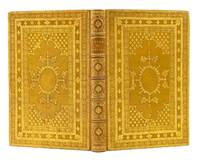
1882ST16453Glasgow: Printed by Robert Anderson for Private Circulation 1882. ONE OF ONLY 50 COPIES. 195 x 122 mm. 7 3/4 x 4 7/8". 1 p.l. x 103 1 pp.From George Bannatyne's manuscript compiled A.D. 1568. <br/> BEAUTIFUL CITRON CRUSHED MOROCCO ELABORATELY TOOLED IN GILT BY RAMAGE stamp-signed on front turn-in covers with six concentric frames--intricate filigree roll pointillé-tooled floral vine and alternating small ornaments--enclosing a central panel with cornerpieces semé with rows of fleurs-de-lys large oval medallion at center radiating ornate fleurons raised bands spine compartments with large central medallion containing a vase of flowers delicate tooling in corners gilt titling turn-ins framed by filigree roll and alternating small ornaments brown and tan silk jacquard endleaves patterned in a Medieval motif top edge gilt. Printer's device on title page decorative woodcut initials and headpieces. Spines evenly sunned to a warm honey brown corners lightly rubbed short faint scratch to lower board but the binding virtually unworn and happily free of the splaying that plagues vellum books. Leaves lightly rumpled but A VERY FINE COPY the vellum leaves creamy clean and bright and the binding glittering with gold.<br/> <br/> Printed on luxurious vellum and limited to just 50 copies presumably for private circulation among friends of the printer this is a lovely edition of 16th century poems by a mysterious author believed to have been a poet and musician associated with the court of Mary Queen of Scots. This work contains all 36 extant poems attributed to Scott ca. 1520-82/3 including what is considered to be his most historically important work "Ane New Yeir Gift to Quene Mary" 1562 written in support of the young Scottish queen caught between Catholic and Protestant agendas. His other poems consist largely of lyric verses on love and sexuality which DNB describes as possessing "exceptional metrical variety and vernacular directness" with "a musician's ear for rhythm and melody." Scott's poems are known to us via the Bannatyne manuscript now held in the National Library of Scotland which ranks among the most important documents of Scottish Medieval literature. Written by George Bannatyne in 1568 during a period of confinement due to an outbreak of plague it contains a mixture of both secular and religious material including the sole extant copies of several texts. In the preface to the present work the publisher notes that Scott's poetry has been faithfully reproduced from that manuscript and thus "for the first time accurately printed." Very little is known regarding the life of Alexander Scott but he seems to have been attached to the court of Mary Stuart through John Erskine a guardian and counselor to the queen. Given the very limited number of copies made it is not surprising that this work is extremely rare on the market. Printed [by Robert Anderson] for Private Circulation unknown