MERLIN (Jacques).Livre Rare Book
7 768 résultats
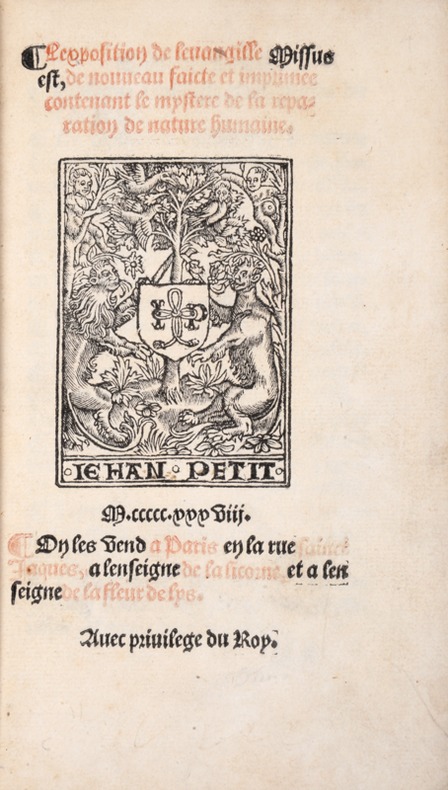
153816626Paris, Yolande Bonhomme pour Jean Petit, 1538-1539. In-8 gothique (16 x 10 cm) de (8)-CLXX-(1) ff., (sign. A8, A-X8, Y3), maroquin brun, dos à nerfs, dentelle intérieure, tranches dorées (Petit).
4to (150 x 208 mm). XCIII, (6) ff. Late 19th century half vellum over papered boards with author's name and publication date stamped to spine in gilt. A fine post-incunable from the press of Wilhelm Schaffner from Rapperswyl, famous for having printed the first edition of the "Hortulus animae" in 1498. All of his productions are rare. The present collection of sermons had first appeared in 1501. - The eighteen essays, which form a single treatise, warn the various classes of human society to guard against sin in its many forms. "Much of this is the common, dry stuff of scholasticism, but several passages prove that the author cannot have been lacking in the gift of wit when he preached from the pulpit. Among these paragraphs is the fourth, directed against wives, widows, and virgins: some women (writes Morgenstern) will beautify themselves when they visit public houses or other places where they may meet strangers, and say they do so only to please their husband. Yet this is but a lie, for when they return home, they will remove their jewelry and sit by their husband like a hairy night owl, caring little about their adornment" (R. Cruel, Geschichte der deutschen Predigt im Mittelalter [1879], p. 569 ff., also citing several methods how women are said to contrive to obtain beautiful objects at their lovers' expense). - Spine a little duststained. Interior shows light worming, more pronounced near the end. Lower corner of fol. G5 torn away without loss to text; a more substantial edge defect to final leaf of index remargined (likewise without loss to printed text, but some loss to contemporary manuscript notes in Latin on blank verso). A final blank leaf has been appended, using old paper. A contemporary annotation to fol. a5v. In all a good copy. - Provenance: from the library of the noted economist Oskar Morgenstern (1902-77), whose purchase of the volume (probably prior to his emigration in 1938) may have been occasioned by the author's name. In collaboration with the mathematician John von Neumann, the German-born Morgenstern, who taught at Princeton University, founded the mathematical field of game theory and its application to economics. VD 16, M 6348. BM-STC German 628. Proctor 10163. Panzer IX, 357, 142b. Muller II, 53, 3. Ritter 1593. Schmidt IV, 11, 2. BNHCat M 799. Not in Adams.
(8), 290, (2 [statt 30]) SS. Mit großer Holzschnittdruckermarke am letzten Bl. verso. Neurer brauner Pappband. 4to. In maßgefertigter Leinenkassette. Die zweite Ausgabe dieser berühmten Grammatik, erstmals 1542 erschienen. "Der Brief des Baillivius ist weggefallen. Ebenso ist das - nunmehr undatierte - Vorwort nicht mehr an diesen, sondern allgemein, wie üblich, an die Hebraicae Linguae Studiosi gerichtet. Gleichzeitig sind infolgedessen die persönlich gehaltenen Stellen am Anfang und Schluß in Wegfall gekommen. Jene sind ersetzt durch einen Hinweis auf des Verfassers Leistungen für das Studium der hebräischen und chaldäischen Sprache während eines Zeitraums von über 20 Jahren" (Prijs). "[E]nthält die Summe des grammatischen Wissens Münsters, die Summe einer 30jährigen Arbeit, die er mit diesem Werk zum Abschluß brachte. Aber das Werk enthält nicht nur das eigene Wissen Münsters, sondern berücksichtigt fast die gesamte Forschung seit Reuchlin, sowohl die christliche als auch die jüdische, die deutsche und die ausländische [...] Nach bewährtem Beispiel wurde wieder ein Übungstext angehängt, und zwar das apokryphe Buch Tobias [...] Münster sah diese Grammatik als endgültig an und arbeitete fortan keine neue mehr aus [...] Das Opus grammaticum consummatum erwies sich auch tatsächlich als eine perfektionierte Arbeit, die zahlreiche Auflagen erlebte" (Burmeister, Biogr. Gesamtbild, S. 69). "Als Hebraist nimmt [Münster] in Deutschland nach Reuchlin eine der ersten Stellen ein" (ADB XXIII, S. 30). - Etwas gebräunt und wasserrandig; die Seitenränder teils leicht unregelmäßig bzw. alt hinterlegt. Einige wenige Marginalien der Zeit zu Beginn. Am letzten Textblatt Lochstempelung der Philadelphia Divinity School. Ohne die letzten 14 Blätter Anhang. Sehr selten; zuletzt 1971 im Handel; über VD 16 nur drei Standortnachweise (Leipzig, Wien, Wolfenbüttel). VD 16, ZV 11220. Burmeister 12. Adams M 1937. Steinschneider 2015, 21. Prijs 68. Fürst II, 407. OCLC 48902972. Nicht im BM-STC.
Folio [31 x 20 cm], (8), 551 pp, (13), including terminal blank. Title-page printed in red and black with large woodcut partially handcolored; large woodcut header on iir; and 3 large woodcuts in text on pp. 1, 199, and 527 (repeated from title). Late 19th century marbled boards. First few leaves a little creased in gutters; minor loss to blank margin of P4 affecting a handful of letters; repaired closed tear to corner of Xx1 with no loss of text. A few early marginal markings.p Extremely rare sole edition of this voluminous ‘Volksbuch’ bringing together nearly a thousand satirical tales in a rich vernacular, all here of course ‘enlarged and improved’, with additions ‘never before appearing in print’. Like Boccacio’s original, it seems that even in the late 16th century such tales were intended to be recited orally for the amusement of an audience of both sexes: Sigmund Feyerabend’s preface (iir-iiir) makes it clear that he intends the book for “jeden person, Mann oder Weib, jungen Gesellen und Jungkfrauwen zu lessen oder zu hören”, while the title-page specifically confirms that the book can be read unabashedly by ‘virtuous women and maidens, without deleterious offense”. Evidently surviving poorly, we have located just a few copies of the Kurtzweilige und Lächerliche Geschichte und Historien in libraries worldwide, with just one in the US (Illinois). - The compendium begins with Johannes Pauli’s famous collection Schimpf und Ernst, first printed in 1522 in the midst of the Reformation. Like his contemporary Luther, Pauli (ca. 1455-1535) was a monk himself (Franciscan) but here pokes endless fun the clergy of all levels, for example in his tale of a pope who ceremoniously washes the feet of paupers but is accused of looking for money between their toes (# 339). By some accounts an apostate Jew, Pauli became a friend of Geiler von Kaiserberg, and his oft-reprinted collection influenced an entire generation of Protestant German satirists including Hans Sachs. - Following Schimpf und Ernst is Arigo’s German translation of the Decameron (ca. 1473), which is here curiously called “der neuwen Zeitung”. Finally, at the end we find three extracts from original works of further German satirists: Jörg Wickram (ca. 1505-1560)’s Rollwagen (pp. 527-542); Jakob Frey (ca. 1520-1562)’s Gartengesellschaft (pp. 543-551); and Martin Montanus (ca. 1537-1566)’s Wegkürtzer (pp. 543-551). As the titles suggest, these jocular tales were expressly intended for the entertainment of travelers, as depicted in their ‘Rollwagen’ in the woodcut on p. 527. - VD16 shows just 5 copies in German and Austrian libraries; OCLC adds the British Library, Illinois, and the National Library of Sweden only. Individual 16th-century printings of each of the constituent parts also prove to be very rare in census. VD 16 P 969; Bacchi della Lega, Serie delle edizioni delle opere di Giovanni Boccaccio (1995), p. 72; cf also Monostory, Der Decamerone und die deutsche Prosa des 16 Jahrhunderts (1971); Florence N. Jones, Boccaccio and his imitators in German (1910), pp. 1-2; and Hawley (ed.), Reform and Counterreform: Dialectics of the Word in Western Christianity (1994), pp. 1-14.
4to. 57, (1) pp., final bl. f. With 2 large figurated initials. Half vellum (c. 1900). First edition; rare. "One of the earliest monographs on ophthalmology in which the author attempts to explain the cause of the variety of colors of eyes. The positions of the eyes and the opinions of Aristotle and Galen on the structure of the eye are also discussed. The author lectured on medicine at Pisa from 1546 to 1552 and was also known as a scientist and philosopher" (Becker). - Strong, wide-margined paper; slightly browned and waterstained near beginning, otherwise clean. 17th-c. ownership to t. p. ("Josephus Simonellius Carfaminius [?] emit"; i. e. possibly the Neapolitan painter Giuseppe Simonelli [1648-1710?; cf. Nagler XVI, 438). Adams P 1959. BM-STC Italian 537. Edit 16, CNCE 34577. Becker 303. Bird 1989. Durling 3742. Graesse V, 419. Hirsch/Hübotter IV, 660 (misdated: "1551"). Osler 3725. Not in Brunet, Ebert, Hirschberg or Waller.
8vo. (24), 168, 26, (5), (1 blank) pp. With woodcut device on title-page and a woodcut portrait of Rondelet at the last page of the preliminaries. Contemporary limp sheepskin parchment. Very rare first edition of an early pharmalogical book by the famous French phycisian, naturalist and botanist Guillaume Rondelet (1507-66), professor at the university of Montpellier, best known for his work on fishes De piscibus marinis (1554), the standard work on ichtyology for over a century. He was a good friend of Rabelais, whose character Rondibilis is said to be based on Rondelet, and among his students appear prominent names such as Clusius, Lobel, Gesner and Belon. The present work primarily deals with weights and measures used in medicine, with at the end a 26-page index with about 35 entries per page, listing both herbs and medicines. A second edition was published a year later by Plantin, followed by other editions in 1563 and 1564. - With owner's inscription of Pierre Gauthier (late 19th century?) on flyleaf. Waterstain at the head and fore-edge margin and the binding slightly soiled and rubbed along the extremities, otherwise in good condition. USTC 113136 (5 copies). Cf. Durling 3925 (1563 ed.); Voet (1561 Plantin edition); Wellcome 551 (1561 and 1564 eds.); for Rondelet: DSB XI, 527f.; Hagelin, Old and rare books on materia medica, p. 102.
Folio. 2 vols. With figural titble borders and 13 woodcuts in the text. (7), 663 [but: 661], (15) ff. (17), 546 [but: 545], (10) ff. Contemporary vellum; spines and covers attractively gilt; gilt supralibros. First edition of the collected works of the Tyrol Jesuit Scherer (1559-1605), rector of the Viennese college and a fervent preacher of counter-reformation. His polemics against Osiander, Heerbrand, and other Lutherans occasioned a long series of printed refutations. Scherer's writings prove that he was "ein rühriger, gewandter, schlagfertiger Schriftsteller [...] und sich zugleich durch einen für jene Zeit ganz vorzüglichen Stil auszeichnete [...] Darunter sind von bleibendem Werthe namentlich 'Neun und zwaintig Predigen ... von Notis, Merck- und Kenn-Zeichen der wahren und falschen Kirchen', eine gründliche, durchaus praktische, für das Volk leicht verständliche Abhandlung über die Kirche" (Wetzer/W.). Part 2 contains (at the end) the famous children's catechism. - Printed at the first and only 16th and 17th century press in Bruck an der Thaya (Louckem pod Znojmem) in Moravia, established in 1595 by abbot Sebastian II from Baden near Vienna. The printer was probably Bartholomäus Albert Fuhrmann; until the press was closed in 1608, it produced merely 22 known works. - Title page with contemp. ms. note by Johann Rupert Hegemüller, to whom the author himself had presented the volumes as a gift. Later in the collection of the Austrian local historian Candid von Engelshofen (1803-66; with his library stamp and shelfmark on title page); then in the library of the Bohemian nobleman Franz Graf Thun-Hohenstein (1809-70; with his heraldic bookplate on the front pastedown). Last in the collection of the Austrian industrialist Dr. Friedrich Petrina (1911-2004; with his etched bookplate on front pastedown). - Title page with insignificant defects to upper edge. Spine of vol. 2 with slight defects to upper spine-end; attractive giltstamping largely oxydized. Altogether a fine and clean copy with interesting provenance. VD 16, S 2677 und 2678 (pt. 2 of BSB copy incomplete). De Backer/Sommervogel VII, 761, 38 (pt. 2 incomplete: ends with p. 335). Wetzer/Welte 10, 1786. Cf. Benzing 69.
250 SS. Halblederband der Zeit mit aufkaschierter Originalillustration. 4to. Der Komponist trug sich im vorliegenden Exemplar am 11. Juni 1944 in Wien ein. Anlass war eine Aufführung der Oper zu Ehren des Komponisten, der an diesem Tag seinen 80. Geburtstag beging. Nicht nur die Wiener Staatsoper ehrte den Tondichter, der zusammen mit Franz Schalk das Haus von 1919 bis 1924 geführt hatte, sondern auch die NS-Führung in Berlin, die ihm ein offizielles Glückwunschtelegramm hatte zukommen lassen, obwohl Strauss sich zu Beginn des Jahres mit einer regimekritischen Äußerung den Unmut derselben zugezogen hatte.
8vo. (9), 251, (26) pp., last blank f. With woodcut printer's device on reverse of last index leaf. (Bound with) II: Goede, Henning. Iudicarii ordinis processus. Item, Domini Odofredi summa de libellis formandis. Cologne, Arnold Birckmann's heirs, 1563. (352) pp. With woodcut printer's device on t.p. (Bound with) III: Justinianus. Novellarum constitutionum libri duo. Lyons, Louis Pesnot, 1556. (2), 286, (8) pp. With woodcut printer's device on t.p. Contemp. blindstamped pigskin on four raised double bands with ms. title to spine. Wants ties. Fine legal sammelband with three standard works, all in rare editions. - I: A manual of procedural law, first published in 1565. "Termineus's 'Processus' is written in Latin, but the margins contain German extracts; German forms are inserted in great number. At least 10 editions were printed until 1622" (cf. Stintzing/L.). - II: Henning Goede (c. 1450-1521) did not publish anything during his lifetime. His works, printed posthumously, were not intended for publication. The present treatise, based on notes dictated in his lectures, is a "clear and well-arranged account of the Canon trial, occasionally treating - and occasionally attacking - legal practice in Saxony" (cf. Stintzing/L.). - III: Latin Novella collection (limited to 98 tituli, as are all early vulgate editions). - Slightly browned; small tear to f. s4 of the Novellae. Long contemporary Latin note on front flyleaf. Front pastedown has contemp. autogr. acquisition note by the Upper Palatinate jurist and Electoral councillor Wolfgang Haller (d. 1593; cf. Jöcher/Adelung II, 1756): "Vvulphgangi Halleri Studiis inscr[...] Emptus Tubingae Anno 71 mense Julii." The attractive binding, apparently created for Haller or personalized for him somewhat later with his initials and the year of acquisition, shows the Seven Liberal Arts (front: plate-stamp of Grammatica - Dialectica - Retorica - Arithmetic; back: Musica - Geometria - Astrologia: Haebler I, 459, plates VII and VI) within a roll-tooled border of generals; horizontal bars of front cover stamped "WHD" ("Wolfgang Haller Doctor") and "1571". The bookbinder "HVM", who used these plates according to Haebler, "probably worked in the border area between Baden und Wuerttemberg" (ibid., p. 460). Binding slightly rubbed; minute traces of worming to front cover; altogether very attractively preserved. Later in the library of the Vienna Discalced Augustinians with their ms. shelfmark on front pastedown. I: VD 16, T 550. BM-STC German, Suppl., 62. Cf. Stintzing/Landsberg I, 564. Not in Adams. - II: VD 16, G 2479 and O 278. Cf. Stintzing/Landsberg I, 264. Not in BM-STC German or in Adams. - III: Baudrier III, 167. Not in BM-STC French or in Adams.
2 Vols., small folio (305 x 190 mm), xxxiii, [3], 49-458; [4], 582, [2]pp., text in English and Persian, occasional marginal pencil notes, title page and terminal leaf to both volumes browned, staining to inner upper corner of leaves to start and end of volume two, later vellum-backed marbled boards, title in manuscript to spines. One of the most extensive Persian grammars written in English. "Matthew Lumsden (1777?1835), orientalist, was fifth son of John Lumsden of Cushnie, Aberdeenshire, and a cousin of Sir Harry Burnett Lumsden (1821?1896), army general. After education at King's College, Aberdeen, he went to India as assistant professor of Persian and Arabic in the College of Fort William, and in 1808 succeeded to the professorship. In 1812 he was appointed secretary to the Calcutta Madrasa, and superintended various translations of English works into Persian then in progress. From 1814 until 1817 he had charge of the East India Company's press at Calcutta, and in 1818 he became secretary to the stationery committee."?(Oxford DNB). Provenance: John L. Platts? signature in pencil to title page.
Small 8vo (150 x 100 mm). (8), 112 ff. With the title in a woodcut border with 6 putti (without wings) and 8 fantastic beasts in and growing out of stylized foliage, incorporating Sessa's device (a cat with a mouse in its mouth) in the foot; Sessa's woodcut device (cat with a mouse in its mouth, now in a crowned wreath with initials MS) on the otherwise blank final page; 1 woodcut decorated initial (as S designed with a gap in the central stroke to accommodate the profile of a man, possibly intended as Dante). Set in an Aldine-style italic (with upright capitals).19th-century (?) sheepskin parchment , sewn on 3 recessed supports, sprinkled edges. Fourth edition (the last before 1723) of Dante's important philosophical allegory in autobiographical form, expressing his love of wisdom and knowledge personified as a beautiful lady named Philosophy, and his view that they lead to virtue and worldly happiness. Dante presents the story as a metaphorical banquet where he is content to eat the crumbs that fall from the plates of the wise: "the first extended piece of original expository prose in the Italian vernacular" (Lansing). Dante began work on it around 1304, ten years after completing his verse Vita nuova, his elevation of courtly love poetry into sacred love poetry that centred around his love for the beautiful and virtuous Beatrice, an idealized picture of a real lady of the Florentine court who died in 1590. In the intervening years he had developed a great love for philosophy, literally meaning the love of wisdom (a deep understanding of human nature and the physical universe) that leads to virtue. This idea was to infuse the Convivio. He finished only four of its projected fifteen "trattati", and never widely circulated the Convivio during his life, but it represents a turning point in his writing. It appears to have given him a new inspiration so that he set it aside around 1307 to begin work on his Divine comedy, where he returned to verse but merged his first love, the more human and religious Beatrice of the Vita nuova, with his new love, Philosophy, to create the new version of Beatrice that he honours in the Divine comedy. The first treatise introduces the story, while each of the others begins with a canzone expressing a particular aspect of Dante's love for Philosophy, followed by the main text explaining its literal and symbolic meaning. The whole therefore forms an encyclopedia of secular knowledge, intended for the education of both men and women. It also passionately pleads for the use of the Tuscan vernacular Italian at a time when learned works were usually written in Latin. The fourth book was politically subversive, proclaiming that the love Dante describes ennobles the soul, and attacking the Holy Roman Emperor Frederick II's notion that nobility comes from inheritance and manners. Many elements, including the cosmology, return in the Divine comedy. - All surviving manuscripts of the Convivio are believed to derive from a single lost manuscript that was unfortunately corrupt, so the work has long been a challenge to its editors. It was first printed at Florence in 1490 under the title Convivio, the "amoroso" of the present title being added for the second edition published at Venice in 1521, emphasizing the importance of love in Dante's text. "Convivio" means banquet, but like the English convivial, its etymology (living together) gives it connotations of the pleasures of human relations. The text of the present edition follows that of 1521. - With numerous points in the text marked by a charming contemporary manuscript pointing hand in the margin. In very good condition, with only a tiny hole on the edge of the woodcut border, a small hole where the ink of one marginal pointing hand has eaten through the paper and an occasional minor spot. An unfinished work by Dante, important in its own right, as an early example of literary Italian prose and as part of the genesis of the Divine Comedy. Adams D 119. Edit 16, 1161. Gamba, Serie ... Italiana letteratura 419. Mambelli, Edizioni Dantesche 803. Sander, Dante Alghieri 2331. USTC 808776. For the text: R. Lansing, "Convivio", in: Dante encyclopedia, pp. 224-232.
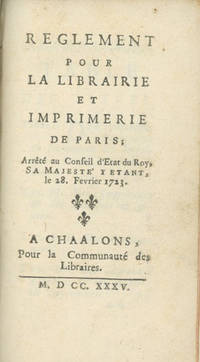
173528870Chaalons' i.e. Châlons-sur-Marne 'pour la Communauté des Libraires' 1735 1735. New edition apparently unrecorded. Not found on OCLC or the Union Catalogue of France CCFr. A fine copy. 12mo contemporary polished continental calf marbled paper endpapers blind-ruled borders red morocco spine label gilt decorations and lettering a.e. stained red. Woodcut tailpieces. By the late 17th century the French government attempted to regulate all aspects of printing and the distribution of books in and around Paris. In 1686 those regulations were codified in the Édit du Roy pour le Règlement des Imprimeurs et Libraires de Paris and the Édit du Roy pour le Règlement des Relieurs et doreurs de Livres. Further revisions were made 30 years later and after some disagreements two editions of the code were published in 1723 and 1731 in the form of a decree. The code was extended to all of France in 1744 and remained in effect until 1777. This edition is a provincially printed version of the 1723 edition printed in Châlons-sur-Marne in 1735. The code is divided into 123 articles and is remarkably comprehensive in its regulation of all aspects of the trade including the import of books old and new bound and unbound and of imported printing types; books sold by subscription; requirements for the apprenticeships to booksellers and printers; the widows of booksellers and of printers; proofreaders; type founders; traveling booksellers; fairground booksellers and printers; prohibited books; auctions and inventories of libraries and bookstores et al. From the library of 19th century Châlons librarian and local historian Amédée Lhote with his bookplate on the front paste-down and ink ownership stamp in the margin of the final page of text; a bookseller's catalogue entry for the Histoire de l'imprimerie a Châlons 1895 on the rear paste-down. Marginal notations in ink on two leaves. Chaalons' [i.e. Châlons-sur-Marne], 'pour la Communauté des Libraires', 1735 unknown
1833123235Small slim 4to. Paris: Techener 1833. Small slim 4to32ff printed in black letter on vellum woodcut illustration on t/p. Original full orange morocco backstrip gilt black label modern quarter red morocco box bookplate of Robert Hoe. A fine copy with some fading to the boards. § Unique copy printed on vellum Hoe's copy with his bookplate of this first facsimile reprint of the extremely rare French edition of 1530. This was one of several tales printed in the sixteenth century as a collection itself of the utmost rarity. We have not located a single copy in the US. Techener hardcover books
LIMITED EDITION OF 306 COPIES. RARE large, ornate edition of Dante Alighieri's 'Divine Comedy', published on the alleged 700th anniversary of the Comedia. The text is heavily annotated, and is prefaced by the Italian poet Gabriele D'Annunzio. The edition features numerous woodcuts and text decorations reproduced from the 15th-century Venice edition of the Comedia. This exemplar is not numbered, meaning it is probably one of the first 6 copies. 415x310mm. XI+524 pages. Brown cloth Hardcover, masterfully restored from a damaged and partially missing cover. Cover corners bumped. Pages wavy with somewhat rough edges. Pages slightly yellowing. [SUMMARY]: In spite of the damage to cover it has previously sustained, this rare and impressive edition of a great literary masterpiece has been restored and is in good condition. PLEASE NOTE: This item is overweight. We may ask for extra shipping costs.
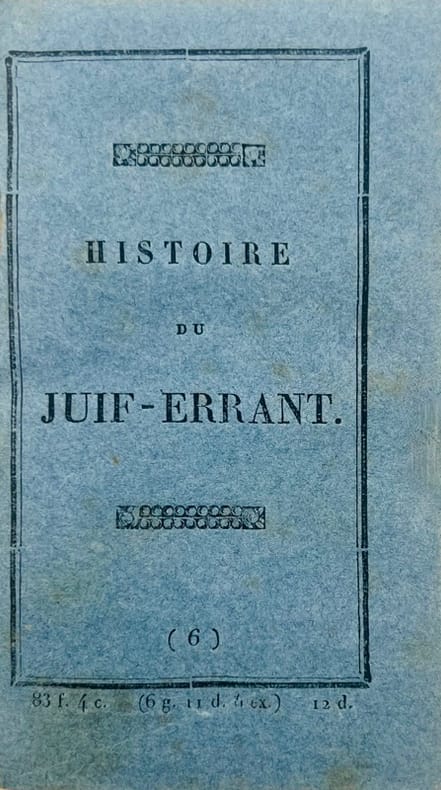
182744385Montbéliard, Imprimerie de Th.-Fréd. Deckherr, sans date, (1827). In-12 (100 x 144 mm) de 24 pp. sur papier bleu, entièrement interfolié, percaline Bradel moutarde, pièce de titre en long de maroquin rouge, couverture bleue imprimée conservée (reliure postérieure du XIXe siècle).
8vo. (64) pp. With woodcut printer's device on verso of final leaf. Bound with numerous blank leaves. Contemporary vellum. First edition. "Decalogue with the commentary of Aben Esra [...]. Leaves d7-d8 contain the Aramaic text of the Ten Commandments [...]. Re-issued in 1559 by Sebastian Lepusculus" (cf. Burmeister, pp. 11; 111). The "synoptic word-for-word translations" of Biblical texts which Münster published during his Heidelberg years is a characteristic of his scheme of a "Propagatio linguae sanctae", to spread the knowledge of Hebrew at German universities (cf. Burmeister, p. 11). - Occasional insignificant waterstaining. Old ms. ownership of the Vienna Jesuits to title page; stamps of Vienna University Library and of Kubasta & Voigt, Vienna (c. 1900). VD 16, B 3018. Burmeister 145. Hanztsch 244.I.1. Prijs 29. Panzer VI, 260, 662. Fürst I, 252. Steinschneider (Bodl.) 681.8. Vinograd, Basle 28. Graesse I, 4. Yudlov, Ginzei Yisrael 1859. OCLC 311420175. Not in BM-STC.
165442819Imprimés au Chasteau de Richelieu, A Paris, Pierre Le Petit, Henry Le Gras,, 1654. Petit in-8 (139 x 85 mm) de (8)-211-(5) pp. (sig. ã4, A-O8, feuillet blanc L8).[DESMARETS DE SAINT-SORLIN (Jean)]. Le Combat spirituel ou de la perfection de la vie chrétienne, traduction faite en vers par J. Desmarets. Imprimés au Chasteau de Richelieu, A Paris, Pierre Le Petit, Henry Le Gras, 1654. Petit in-8 de (8)-57 pp. (A-C8, D5).Les deux pièces reliées en 1 vol. petit in-8, maroquin rouge, dos lisse orné, encadrement de roulettes dorées sur les plats, filet doré sur les coupes, dentelle intérieure, tranches dorées (relié vers 1810).
160540266Limoges, Jacques Barbou, 1605. In-16 de 130 pp. chiffrées 30 par erreur (sign A-H8, I1), trigramme IHS sur le titre, vélin souple (reliure de l'époque).
155840083Toulouse, [Guyon Boudeville, pour] Antoine André, 1558. Petit in-4 (18 x 14 cm) de (12)-321-(1) pp. (sign. aa6, A-Z4, AA-QQ4, RR5), demi-chagrin rouge, dos à nerfs, non rogné (reliure du XIXe siècle).
Folio (215 x 306 mm). (24), DCXV, (1) pp. Title printed in red and black. With 46 woodcut illustrations in the text (3 double-page-sized, including 11 portraits) and a folding map of Hungary. Contemporary full vellum with handwritten spine title. First edition of this fundamental historical work. The lawyer and historian Adam Henricpetri (1543-86) covers the events accompanying the end of the reign of Holy Roman Emperer Charles V. and the beginning of his brother Ferdinand I.'s reign over a period of seven years, from 1555 to 1561. The volume is considered a prominent example of 16th century historiography and the fact that the author was a contemporary of Charles V. makes it all the more authentic. Each book treats one year and informs the reader not only about the history of the Holy Roman Empire but also about Italian, French, Spanish, Hungarian, Danish, Swedish, Polish, Russian, Indian and Turkish history. The woodcut illustrations show, among other scenes, the long procession taking place for Charles V.'s funeral service in Brussels. The highlight of this service was a grand allegorical ship representing all of Charles' merits, which is shown as a double-paged illustration. The woodcuts also include a scene from the Spanish Inquisition, the Parisian parliament, some views of European cities and portraits of important persons. - Ownership by Joh. Pet. Baikes, dated 1883. - Variously browned, slightly stained, otherwise in excellent condition. - From the library Werner Habel, with his ownership stamp to flyleaf. BM-STC German 392. Nicht bei Adams.
8vo. (196) pp. (a-l8, m10). With 2 different woodcut devices. Modern vellum using old material; ties. In custom-made cloth slipcase. Grammatical treatise by Elia Levita, edited with a Latin translation by Sebastian Münster. - Slightly brownstained throughout; trimmed somewhat closely. Slight worming near end in the blank margins, repaired. VD 16, E 999. Burmeister 155. Panzer VI, 259, no. 658. Fürst II, 240 & 407. Steinschneider (Bodl.) 940.37; (Handb.) 1378. Hantzsch 259.I. OCLC 15146666.
(495 [statt 496]) Bll. (fehlt letztes Bl. mit Druckermarke). Mit Holzschnittdruckermarke am Titel. Neuerer Pergamentband mit hs. Rückentitel. 8vo. In maßgefertigtem Leinenschuber. Sechste und letzte Ausgabe von Münsters erstmals 1523 herausgebrachtem hebräischen Wörterbuch. "Münster begann die Reihe seiner Heidelberger hebräischen Schriften, die übrigens fast ausnahmslos bei Johann Froben in Basel gedruckt wurden, mit dem später oft überarbeiteten und neu aufgelegten Dictionarium hebraicum" (Burmeister, S. 11). "Bereits 1525 erschien eine weitere Auflage, die von Münster auf den neuesten Stand der Forschung gebracht worden war, indem er das Wörterbuch aus verschiedenen perûshim und vor allem aus der 1523 in Venedig erschienenen qônqôrdansijâ des Rabbi Isaak Nathan erweiterte. Darnach erlebte es noch zahlreiche Auflagen und Erweiterungen und ist über 40 Jahre lang das bedeutendste hebräische Wörterbuch in Deutschland geblieben. Zu seiner Beliebtheit hat beigetragen, dass das Buch kurzgefasst war, handlich und mit seinem Preis von 15 Schillingen einigermaßen erschwinglich war, sich also für den täglichen Gebrauch durch Studenten und Theologen vorzüglich eignete" (Burmeister, Biogr. Gesamtbild, S. 41). - Zu Beginn etwas fleckig und mit Wurmspuren (fachmännisch restauriert); der Titel neu aufgezogen. Es fehlt das letzte Bl. mit der Druckermarke. VD 16, M 6663. Burmeister 22. Steinschneider (Hdb.) 1384.6. Hantzsch 228.8. Adams M 1926. BM-STC German 633.
4to. 57, (1) pp., final bl. f. With 2 large figurated initials. Marbled wrappers. First edition; rare. "One of the earliest monographs on ophthalmology in which the author attempts to explain the cause of the variety of colors of eyes. The positions of the eyes and the opinions of Aristotle and Galen on the structure of the eye are also discussed. The author lectured on medicine at Pisa from 1546 to 1552 and was also known as a scientist and philosopher" (Becker). - Elegantly printed in Roman types; slightly browned throughout. From the library of the historian of medicine Walter Pagel (1898-1983). Adams P 1959. BM-STC Italian 537. Edit 16, CNCE 34577. Becker 303. Bird 1989. Durling 3742. Graesse V, 419. Hirsch/Hübotter IV, 660 (misdated: "1551"). Osler 3725. Not in Brunet, Ebert, Hirschberg or Waller.
In-8°; I) cc. (172) grande marca tipografica incisa su legno all’ultima pagina non numerata; il frontespizio è in greco e latino, tutto il testo in greco. II) pp. 132, (4) con un legno all’ultima p. non num., pp. 105, (7 di cui 2 cc. bianche) un legno all’ultima p. non num.; capilettera figurati incisi su legno. la prima parte è in greco la seconda in latino. Mezza pelle verde con tassello e titolo in oro al dorso.
165442470Imprimé au Chasteau de Richelieu, Paris, Pierre Le Petit et Henry Le Gras, 1654. In-16 (140 x 90 mm) de (8)-57 pp. vélin souple, titre manuscrit sur le dos et le premier plat (reliure de l'époque).