7 766 résultats
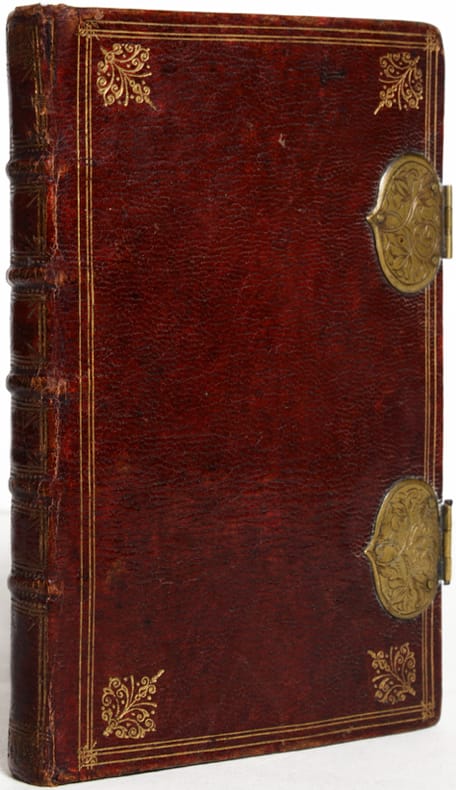
246, (18) Bll. Mit rot kol. Holzschnitt am rot-schwarzen Titel sowie 2 Textholzschnitten. - (Beigebunden) II: [Fischart, Johann]. Die wunderlichst unerhörtest Legend und Beschreibung des abgeführten, quartirten, gevierten und viereckechten vierhörnigen Hütleins [...]. "Lausanne, Gangwolf Suchnach" [d. i.= Straßburg, Bernhard Jobin], 1580. (23) Bll. Mit Holzschnitt am Titel. - (Vorgebunden) III: Nigrinus, Georg. Fegfeuers Ungrund grüntlich erörtert und außführlich beweiset, mit der H. Schrifft, der Vätter, Concilien und ander Zeugnussen. Auß 14 Leichpredigen D. Jacobi Feuchten Weihbischoffs zu Bamburg [...]. O. O. u. Dr. 1582. (255) Bll. Titel in rot und schwarz gedruckt. Blindgepr. Schweinslederband der Zeit auf 4 Bünden (Bindebänder fehlen). 8vo. Hübscher Sammelband mit drei antikatholischen Polemiken in seltenen Elsässer Drucken. - II: Zweiter Druck dieser deutschen Bearbeitung: eine genaue, umfangreich ergänzte Übertragung des niederländischen "Byencorf" des Philipp van Marnix. "In der Gesinnung angeregt durch Calvin, in der Weltanschauung durch Erasmus, im Stil durch Rabelais" (Neufforge 112f.). Der Titelholzschnitt zeigt einen Bienenkorb in Form der Tiara mit Kirche und Windmühle (dieser Bl. 235v im Text wiederholt), ferner am letzten Textblatt ein weiterer Textholzschnitt, der die Kirche in Form einer Karikatur der "Veritas" verunglimpft. - II: Erste Ausgabe von Fischarts "Jesuitenhütleins", seiner satirischen Reimdichtung gegen die Jesuiten. - III: Einzige Ausgabe dieser Arbeit aus der Feder eines "der gröbsten Polemiker des Jahrhunderts" (Goedeke II, 505). - Titelblatt der Vorbindung mit zeitgenöss. hs. Besitzvermerk des Benediktinerstifts Altenburg bei Horn (Niederösterreich). Durchwegs etwas gebräunt bzw. leicht wasserrandig; zu Beginn mehrere zeitgenössische Marginalien. Der hübsche Prägeeinband etwas berieben; im Ganzen wohlerhalten. I: VD 16, M 1047. Ritter 855. Muller III, S. 586, Nr. 111. Goedeke II, 499, 37b. Graesse II, 587f. Weller (Druckorte) 6. Vgl. Jantz I, 81 (Ausg. 1586). - II: VD 16, F 1163. Muller III, S. 586, Nr. 109. Ritter (IV) 1721. Goedeke II, 499, 40. - III: VD 16, S 4637. Goedeke II, 507, 22.
8vo. 192 pp. With woodcut printer's device, headpiece and initial. Contemporary half vellum over marbled boards with faded handwritten spine-title. Second Italian, and second vernacular edition of the celebrated "Epistolae Magni Turchi", a best-selling 15th century literary invention by Laudivio Zacchia of Vezzano. Here translated by the ubiquitous Lodovico Dolce, these letters purport to represent the correspondence of Sultan Mehmet II, the conqueror of Constantinople and Byzantium (still alive at the time of writing), with governors and potentates from Persia to the Mediterranean islands, Greece, and Italy. Through this albeit fictitious collection Laudivio could highlight Turkish/Islamic territorial ambitions, as well as, by implication, political and ethical differences between East and West, not always to the credit of his Christian contemporaries. - A reissue of the 1562 first edition. The little collection proved hugely popular, calling for more than twenty incunabular editions, all now individually rare, and further reprints in the 16th and 17th centuries. - Occasional light brownstaining; lower corner of fol. C6 torn away, affecting a single letter; a tiny marginal paper flaw to fol. M2. BM STC-Italian 455. Göllner 1047. Blackmer 955. Edit 16, CNCE 26436. Tiraboschi, Storia della letteratura italiana III, 177.
8vo. (16), 279, (23) pp., final blank f. Half vellum using a leaf from an antiphonary. First Latin edition of Alessio's "De secretis", still in six books. The author is commonly identified with the alchemist Girolamo Ruscelli (1520-66). "Das Werk gehört nach Caillet zur 'haute philosophie hermetique'. Es enthält außer alchemistischen auch viele kosmetische Rezepte, ferner solche gegen Pest, Schlangengift, Ungeziefer, wie auch Konfekt, Einmachen von Früchten, Druckerschwärze, Putzmittel, Schlafmittel usw., des weiteren sehr frühe Beispiele zur Syphilis-Therapie und Arsenikverbindungen zur Haarvertilgung" (Horn/Arndt). "Une des premières éditions de ces célébres secrets que l'on considère comme merveilleux. Quelques personnes qui ont fait l'essai de plusieurs affirment que les résultats sont prodigieux" (Caillet). Sections on making wine, ink, soap, toothpaste, etc. From 1569 onwards Perna also published a German translation. - Somewhat brownstained and waterstained throughout; a few contemporary marginalia; extensive notes by a contemporary hand on reverse of title-page and at the end. Very rare; no copy in auction records of the past decades. VD 16, R 3835. Durling 110. Wellcome 178. Ferchl 455. Ferguson I, 22 (note). Duveen 15 (note). Cf. Caillet I, 177ff. Rosenthal 754. Graesse (Bib. magica) 50. Simon 33.
4to. (12) ff. (aa-cc4). With large woodcut initial. Papered spine. Rare first edition of this collection of neo-Latin verse. Contains several mentions of Brassicanus's friend Erasmus as well as of Hutten, whose "Nemo" had inspired the present verses (cf. G. Ellinger, Geschichte der nlat. Lit. Deutschlands im 16. Jh., vol. 1 [Berlin 1919], p. 441). - Trimmed rather closely at upper edge, occasionally touching headline. Slightly browned and fingerstained in margins; contemp. shelfmark to title page. Rare; the only copy in the last decades' trade was incomplete (1996: H&H 84, lot 175: DM 1,100 (modern boards, wanting final leaf). VD 16, B 7153. IA 123.888. Benzing 51f., 37. Burg 97. Panzer VI, 90, 536. Proctor/Isaac 11700. Ritter, Rép. 257. Walter 815. ADB III, 260. Not in Adams.
185944591Paris, Librairie de France, 1859. In-12 de (4)-228 pp., portrait, maroquin rouge, dos à nerfs orné du bonnet phrygien répété quatre fois, double encadrement doré avec bonnets phrygiens dorés dans les angles, dentelle intérieure, tête dorée, non rogné, étui bordé (Thivet).
Large 4to. (16), 72, 134 pp. With woodcut printer's device on t. p. 17th century vellum with traces of a later blindstamped spine title. Important humanist edition, "the basis for all later editions" (cf. Hoffmann). Part 1 contains the Greek text with Greek marginalia and Latin critical apparatus, part 2 contains the various Latin translations by Frischlin and the learned Estienne himself. - Binding very slightly warped and with insignificant chipping to extremeties. Interior somewhat browned as usual; some brownstaining near beginning. From the collection of the English scholar and football champion Harry Chester Goodhart (1858-95), legendary goal scorer for the Old Etonians in four FA Cup finals and then, until his early death, Professor of Humanities at Edinburgh (his engraved bookplate to front pastedown). Later in the library of the Swedish collector Herbert Vilén (1908-68; his bookplate, designed by Oscar Furuhjelm in 1930, on front flyleaf). IA 129.591. Adams C 232. Renouard 145.3. Moeckli 88. Hoffmann I, 428. Schweiger I, 75.
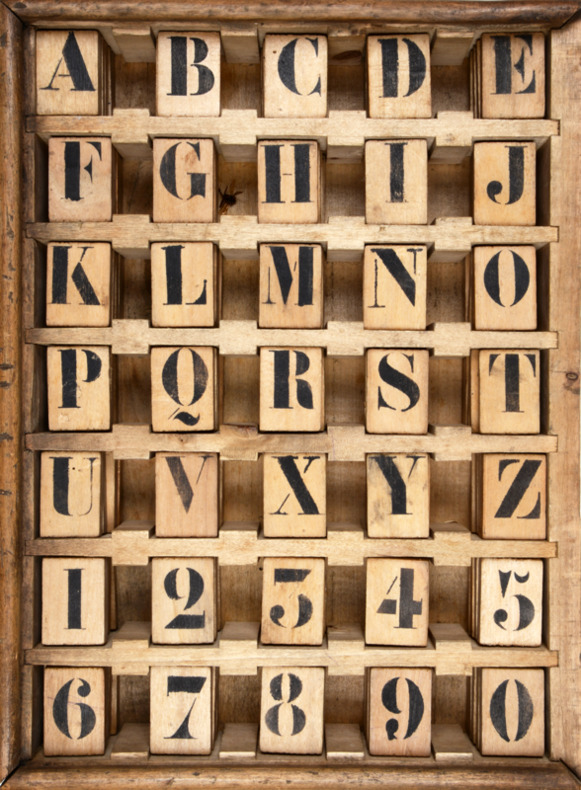
185941414Vitry-le-François, , 1859. Casier en bois blanc (36 x 26,5 cm) de 35 compartiments contenant chacun 5 planchettes mobiles en bois (4 x 2,8 cm) peintes en noir au pochoir recto verso (lettres et chiffres), couvercle.
4 Tle. in 1 Bd. 958 Sp., 3 nn. SS. 635 Sp., 2 nn. SS. 714 Sp. 80 nn. SS. Mit breiter figuraler Holzschnittbordüre und zahlreichen Initialen und Vignetten in Holzschnitt. Schweinslederband der Zeit auf fünf Bünden mit reicher Blindprägung. Die Decken durch vier verschiedene Rollen (Humanisten, Bandwerk und Palmwedel) sowie doppelte Blindlinien kassettiert, Eckfleurons als Mittelstück das Wappen der Herzöge von Württemberg, Fürsten von Mömpelgard und Monogramm "AOB", der Hinterdeckel mit arabeskem Mittelstück. Kl.-Folio. Druck aus der Presse des G. Laymarie, ohne Angabe des Druckortes, der häufig mit Lyon angegeben wird, laut Baudrier I, 240 hat er aber nie in Lyon gedruckt. - Der reich verzierte Einband mit geprägter Datierung "1600" stammt aus der Regierungszeit Friedrich I. von Württemberg (1593-1608). Bei dem verwendeten Wappenstempel handelt sich um den bei Haebler II, 93, 1 beschriebenen, der sich auf den Bänden der Privatbibliothek der württembergischen Herzöge findet. Allerdings "wird das Wappen von Württemberg offenbar in viel weiterem Umfange von den Buchbindern dieses Landes zum Schmuck der von ihnen gefertigten Einbände verwendet" (Haebler II, 90). - Ohne die Bindebänder, die Prägung wohlerhalten. Titel mit zwei Besitzvermerken des 17. Jahrhunderts. Innen etwas gebräunt bzw. fleckig. Im Ganzen jedoch sehr ansprechendes Exemplar. Graesse II, 157. Schweiger I, 106. Moss I, 294. BM-STC French 109. Nicht bei Adams.
4to. (62) pp., last bl. f. With woodcut printer's device on title-page. - (Bound with) II: Admonitio theologicae facultatis in Academia Witebergensi, ad scholasticam iuventutem, de libello famoso & blasphemo recens sparso, cuius titulus est: Disputatio nova contra mulieres, qua ostenditur, eas homines non esse. Wittenberg, Matthäus Welack's widow, 1595. (12) pp. Boards (c. 1900). Edges sprinkled in red. The two most important literary reactions to the scandalous anonymous anti-feminist polemic, "Disputatio nova contra mulieres, qua probatur eas homines non esse" (no place, 1595; VD 16, ZV 4618), which had denied the humanity of women (and thus their capacity for salvation). The pamphlet sparked a surge of 16th and 17th century satires. The theology department in Wittenberg warned its students against reading the book, while the Leipzig Professor of Hebrew, Simon Gediccus (1551-1631), published an apology of the female sex in which he refutes the pamphlet word for word. - Somewhat browned throughout due to paper; ms. note on last leaf. From the collection of the German lawyer Christian Friedrich Eberhard (1753-1818) with his bookplate on the front pastedown. Both works are very rare; neither one in German auction records since 1950. I: VD 16, G 652. - II: VD 16, W 3701.
4to. (62) pp., last blank leaf. With woodcut printer's device to title-page. 18th century blue boards. First edition; with autograph inscription by the author, the theologian Simon Gediccius (1551-1631). - The most important literary reaction to the scandalous anonymous anti-feminist polemic, "Disputatio nova contra mulieres, qua probatur eas homines non esse" (no place, 1595; VD 16, ZV 4618), which had denied the humanity of women (and thus their capacity for salvation). The pamphlet sparked a surge of 16th and 17th century satires. The theology department in Wittenberg warned its students against reading the book, while the Leipzig Professor of Hebrew, Simon Gediccus (1551-1631), published an apology of the female sex in which he refutes the pamphlet word for word. - Extremeties bumped, spine damaged, slightly browned throughout due to paper. Autograph inscription by the author to the theologian Michael Geringius of Halle: "Reverendo et doctiss. viro Dn. M. Michaeli Geringio pastori Eccl.ae Halensis ad D. Mauritii etc. ddi. author". Small green bookplate of the Groningen professor of medicine Jacob Baart de la Faille (1795-1867) to verso of the front board, as well as a handwritten note: "Thèse curieuse et fort rare [...]". - Very rare, not in German auction records since 1950. VD 16, G 652.
Small 4to. 3 parts with separate title-pages but continous pagination. (8), 126 pp., final blank leaf. With numerous woodcut illustrations and diagrams in the text, one double-page-sized. Contemporary limp vellum. First edition, rare. This manual intended "for purposes of instruction at the Venetian gunnery school" (Jähns), the only known work by Gentilini, saw four subsequent editions under varying titles ("Instruttione di artiglieri", "Il perfetto bombardiere") up to 1626. The illustrations depict cannons, ballistics, and plans of fortresses. Schiavina appears to have been either a teacher of gunnery or a writer on the same, but nothing is known about his work. - Binding somewhat soiled, spine cracked. Figure "5" inscribed to upper cover. Interior occasionally waterstained. From the collection of Thomas Fremantle, 3rd Baron Cottesloe (1862-1956), commander of the Territorial Army and president of the Society for Army History Research. No other copy in auction records. Cockle 669. Jähns 657. Edit16 20670. OCLC 38739209. Cf. Graesse III, 50 (1598 ed.).
8vo. (32), 382, (2) pp. Fine printer's mark on title and several decorated initials. Contemporary limp vellum, spine with traces of former calf reinforcement. First and only edition. A rare treatise against usury written "for all Christians and particularly for the people of Paris". The author launches a vehement attack on luxury in general and on the taking of interest as one of the greatest of all sins, forbidden by all laws, and against the law of nature. He discusses the prohibitions by Mosaic law, the Prophets, Jesus Christ, the Apostles, canon law and civil law and quotes from the proclamations against usury and usurers issued by the Paris parliament in 1565, by Charles IX in 1567 and by Henry III in 1577. The second part of the book provides more detailed information about the various types of usury, how to approach them, how to treat usurers, etc. As an example of God's hatred of luxury and usury, the author reminds the reader of the dreadful fate of the city of Antwerp, "one of the richest and most prosperous cities in all Christianity", which was sacked in the "Spanish Fury" only a year before the publication of this book, causing the end of Antwerp's prosperity. Godefroy calls himself "Parisien, profez en l'Abbaye S. Denis en France, & docteur en la faculté de Theologie à Paris". - Binding worn, both covers nearly detached. Upper margin of first and last leaves stained, some leaves spotted. Old ownership to title-page (dated 1681); additional early annotations to verso of final leaf. Very rare. OCLC 492381754. Not in Adams or BM-STC French. Not in Kress, Goldsmiths', Einaudi or Masui. WorldCat locates 4 copies only (Mazarine; Sainte-Genevieve; Lyon; LMU Munich).
4to (215 x 160 mm). (26), (2 blank), "153" (= 165), (3) pp. With the Giunta's woodcut fleur-de-lis device in a decorative cartouche on the title-page and a different one in an oval on the last page, a woodcut factotum at the head of the title-page, another woodcut decoration, about 120 woodcut decorated initials (about 7 series) including some repeats, decorations built up from arabesque typographic ornaments, and a vine-leaf ornament (Vervliet 90). With the main text set in roman type but the extensive preliminaries in italic. Contemporary limp sheepskin parchment, straight-sewn on 3 tanned calf supports cut flush with the bookblock, the spine reinforced with printed waste. Third edition (usually called the second), in the original Italian, of the first collection of native Italian stories, best known under the titles Il novellino and Le cento novelle antiche, written up as a collection (at least in some cases probably copied or adapted from various sources) between 1281 and 1300. Boccaccio borrowed and adapted eight of them when he wrote his Decameron between 1348 and 1353. Seven manuscripts survive from the early 1300s to 1523, but most contain fewer than 50 stories and only the last, commissioned by Pietro Bembo, contains 100. The stories are among the first to present ordinary people as protagonists in stories of everyday life. They are as bawdy as Boccaccio's but more conservative in their presentation of relations between the sexes, with women often though not always depicted as foolish and stupid (and once described as smelling like rotten fish), but women occasionally appear in a better light and are even allowed to be risqué, at least in private among themselves. - But while some stories from the Decameron were printed already in 1470 and it remained a celebrated literary standard work to our day, the present stories appear not to have been printed until 1525, when Carlo Gualteruzzi prepared an edition directly or indirectly from the 1523 manuscript: Le ciento novelle antike, Bologna, Girolamo Benedetti, 1525 (USTC 800597). An undated edition (USTC 802199 & 994562) reports no publisher or place of publication, but probably appeared in Italy soon after the 1525 edition. Both were simple productions of popular literature that were soon largely forgotten and survive in only a handful of copies. Entries in the surviving Diario of the printing office of the monastery of San Jacopo di Ripoli in Florence record their production of "il cento novelle" from 20 April 1482 to 13 May 1483, but this is now identified as a surviving edition of the Decameron rather than a lost edition of Le cento novelle antiche. - So when the Benedictine monk Vincenzo Borghini (1515-1580), advisor to the Medici in Florence, prepared the present 1572 edition, these stories had already become almost unattainable. It is a much fancier production than the earlier editions, beautifully printed on good paper in some of the best French types of the day (notably romans by Pierre Haultin and italics by Robert Granjon) with a wide variety of decorated initial letters, other woodcut decorations and arabesque typographic ornaments. It quickly became the standard text and all editions followed it until 1825, when scholars returned to the text of the first edition. So the present edition shows the stories as they were known for nearly 250 years. - But in the heat of the Counter-Reformation, with the Catholic Church fiercely guarding its reputation against accusations of corruption and immorality, these stories could not be printed as they stood. The Church was mainly concerned about stories that might show the Church or its representatives in a negative light, so Borghini's censorship centred on religious elements, but there were also limits to his toleration of erotic scenes. He removed 17 stories entirely (6, 7, 12, 16-18, 36-37, 39, 54, 57, 62, 75, 86-87, 91 and 93), replacing them with 18 stories whose sources still need to be investigated. One of the added stories appears before story 1 as "Proemio", so the others are still numbered I-C. Finally Borghini added an appendix with four additional stories, numbered as a separate series, I-IIII. While modern scholars understandably lament Borghini's censorship, it has unfortunately led them to ignore the 22 stories he added, while a recent study of his work on the Decameron published a year later shows that besides censoring it he gave it much scholarly care and consulted early manuscripts. A proper understanding of this important series of stories (and their reception) requires a thorough study of the manuscripts and both the 1525 and the present 1572 editions. - With a 17th-century(?) armorial library stamp on the title-page ("ex. bibliot: come ... cardelli. kom"?). After an attempt to remove an inscription from the foot of the title-page (leaving a stain on the facing flyleaf) an owner cut off 1 cm of its foot margin, not approaching the text. With a tear in the blank leaf 3*6 and in the blank foot of the final leaf V8, and minor foxing, but still in good condition. The cover has pulled loose from the bookblock at the inside front hinge. The most beautiful and most influential edition of an important series of 13th-century stories, with 17 stories from the first edition omitted and others censored, but with 22 stories added. Adams G 1358. Joseph Consoli, ed., The Novellino or One hundred ancient tales: an edition and translation, 1997. Edit 16, 47120. ESTC 805025.
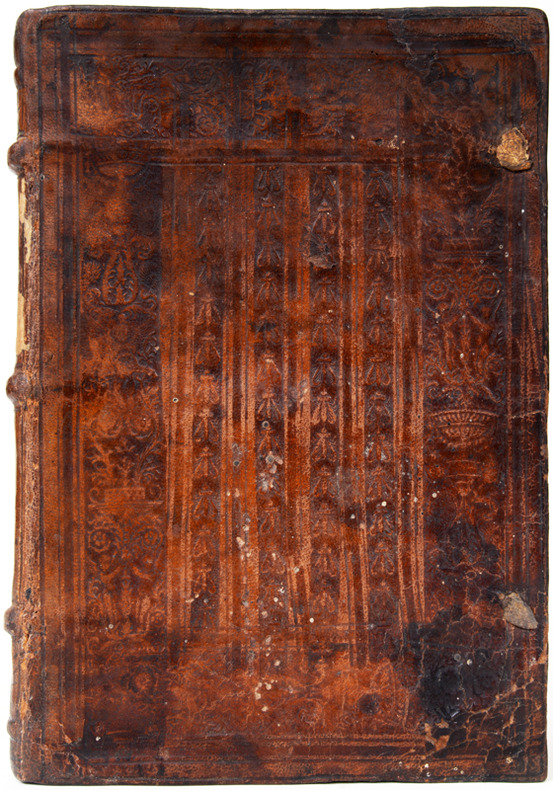
151941377(Paris), Jehan Petit, sans date, (1519). Petit in-4 (136 x 199 mm) de (4)-CVIII ff. (sig. A B–T / ), caractères romains, veau brun estampé à froid composé de quatre colonnes d'abeilles dans un large encadrement floral, dos à cinq nerfs, traces de lacets (reliure de l'époque).
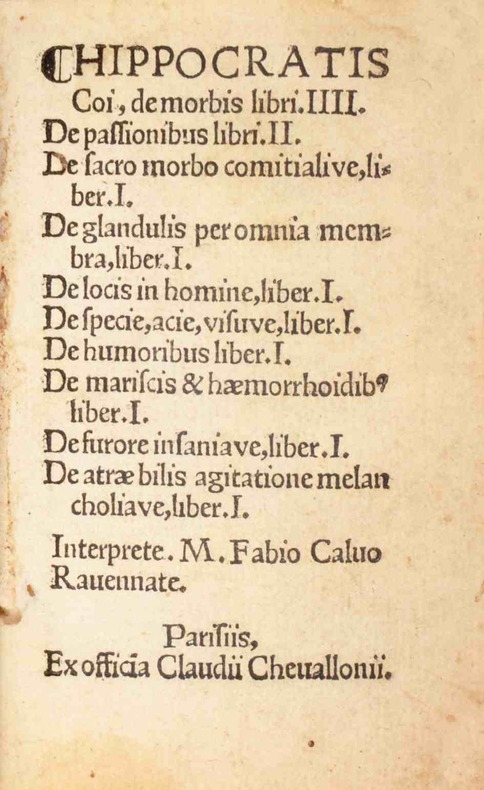
152912206Paris, Claude Chevallon, 1529. In-16 de 232 ff., veau marbré, dos lisse orné, pièce de titre en maroquin rouge (reliure du XVIIIe siècle).
188194436Colegio Nacional de Sordo-mudos y Ciegos 1881. hardcover. Bueno. Madrid 1881. Colegio Nacional de Sordo-mudos y Ciegos. Holandesa. Lomo con nervios y dorados. 448 pp. 24x17. Colegio Nacional de Sordo-mudos y Ciegos hardcover
186617459Paris, J. Miard (imprimerie Bonaventure et Ducessois), 1866 ; in-12, maroquin rouge, dos à nerfs décoré et doré, plats décorés «à la Duseuil» enrichi de courbes et fleurons, cartouche central avec entrelacs et petits fers courbes, dans un triple encadrement de filets dorés, double filet sur les coupes, large dentelle d'intérieur, tranches dorées (Cuzin) ; (4), 61 pp. , (1) f. d'achevé d'imprimer ; titre en rouge et noir.
(10), CCXXV [225], (1) Bll. Mit 2 versch. Holzschnitt-Druckermarken (Petit am Titel, Marchant am letzten Bl. verso) sowie einem ganzseitigen Textholzschnitt. Französischer Lederband um 1680 mit goldgepr. Rückenschildchen und -vergoldung. Dreiseitiger gesprenkelter Rotschnitt. 4to. Schön gedruckte Laktanz-Werkausgabe (herausgegeben von Aegidius Maserius), der noch Tertullians "Apologeticus adversus gentes" sowie einige kleine Stücke von Johannes Chrysostomos und Laurentius Valla beigegeben sind. Gedruckt in klarer Antiqua mit zahlreichen floralen Holzschnittinitialen; einige Stellen in ansprechender griechischer Type. Der Textholzschnitt am letzten Bl. der Vorstücke verso zeigt einen Gelehrten in seiner Stube mit Büchern und Schreibzeug. - Zahlreiche hs. Marginalien der Zeit unleserlich verblasst; einige Notizzettel (um 1759) mit hs. bibliographisch-editorischen Bemerkungen in den Innenrand montiert. Kl. Papierdefekt auf Bl. 24f. alt hinterlegt und Text handschriftlich ergänzt. Oberes Kapital fachmännisch restauriert. Am vorderen Innendeckel Exlibris des Brügger Mediziners Adolphe Stordeur (datiert 1910). Adams L 13. BM-STC French 249. Panzer VIII, 537, 324. Moreau 1509, 127. Nicht bei Schweiger.
Small 4to (142 x 188 mm). 2 parts in one volume. (32), 131, (5) pp. (20), 510, (2) pp. With two identical printer's devices and several woodcut diagrams in the text. 19th century red morocco with giltstamped fillets to spine and covers. Gilt inner dentelle. All edges gilt. Third edition of Scaliger's famous recension of this instructional poem on astronomy written in the first century. "[Scaliger's] penetrating scholarship and powerful gift of analysis were magisterially demonstrated in his edition of one of the most difficult of Latin texts, the 'Astronomica' of Manilius, and this was a forerunner to his greatest work [namely 'De emendatione temporum']" (PMM, p. 59f.). The commentary (pp. 473-510, with letterpress Arabic) contains one of the earliest European studies of Arabic star names ("De quarundam stellarum arabicis appellationibus"). This edition was first published by Estienne in 1579; the first part of the present edition had already appeared in the previous year (cf. Adams M 364, Graesse IV, 364 & Houzeau/L. 1037). - Binding professionally repaired at extremeties. Rebound in the 19th century, trimming the edges fairly closely, touching some of the diagrams. Modern endpapers. Occasional light brownstaining; insignificant waterstain to gutter of first few leaves and outer margins. A few early annotations in brown ink. Title has stamp of St Hugh's Charterhouse, Parkminster (West Sussex). Adams M 365. Caillet 7076. Ebert 12943. Houzeau/Lancaster 1037. Riccardi I2, 93, 12. Schweiger II.2, 590 (with erroneous collation). Cf. Wolf 189b; Zinner 3387 (1590 ed.). PMM 98 (note).
4to. (12), 214 ff. With numerous woodcut initials and 12 woodcuts in the text. 18th-c. marbled calf with label to gilt spine. All edges red. Rare first Spanish edition. The "Martyrologium romanum" was newly edited by Cardinal Baronius in 1584 after the calendar reforms of Pope Gregory XIII. The 1586 edition published in Rome is rare, as well, as the author had most copies called back after he had been made aware of mistakes owing to his poor command of Greek. He corrected the work and issued it once more in Antwerp in 1589, in Rome in 1598, and in Paris in 1607" (cf. Wetzer/W. I, 2038). Another edition of the uncorrected first version was printed in Venice in 1587 (cf . ibid. I, 181). This present Spanish translation by the Jesuit Dionysio Vazquez can only be a largely unknown version based on the uncorrected original and is illustrated with 12 little woocuts (one for each month). Extremely rare; only an incomplete copy in OCLC (Newberry Library; last f. supplied in ms.). Collation shows departures from Palau ([13], 278, [2] ff.), but complete without an index. Later editions (published until the 18th century) are probably based on the revised text. - Contemp. ms. ownership note "Juan Igancio de Fuentes" on t. p.; signature of the Spanish composer Joan Pacheco Montion ("maestro de catedral" in 1684; cf. ABEPI I 696, 87) on final leaf. Palau² 156.585. De Backer/Sommervogel VIII, 488. Not in BM-STC Spanish. Not in Adams.
4to. (156) pp. Disbound. "Mainly an elucidation of part of the second book of the Prognostica of Hippocrates" (Durling). From fol. O1r onwards, this contains Emerich's treatise "an urinarum vel pulsum observatio certiores notas salutis vel mortis medico praebeat". The Verona physician Giambattista da Monte (1498-1551) was one of the most famous practical medical men of his time (cf. Hirsch IV, 271). - Insignificant edge defects to final leaf; a clean and wide-margined copy. Very rare; no copy in the trade since 1950 internationally. VD 16, M 6260 (E 1053). Durling 3256 (not: "[2], 52 ll."). Wellcome 4410 (not: "86 ll."; Emerich's "Oratio de re medica" is a separate work). Not in Waller.
164915312Paris, Jean Henault, 1649. In-12 (98 x 151 mm) de (106) ff. gravés recto-verso en taille-douce, maroquin fauve, plats ornés de compartiments de filets droits et courbes, fers filigranés et points dorés, dos orné de même, roulette sur les coupes, tranches dorées (reliure de l'époque).
165642642A Paris, chez J. Hénault, 1656. In-12 (155 x 104 mm) de (106) ff. gravés recto-verso en taille-douce, maroquin rouge, dos orné à nerfs, triple filet doré et motifs d'angle sur les plats, tranches dorées, fermoirs (reliure de l'époque).
8vo. (96) pp. With arabesque woodcut border to title and 94 woodcuts by Bernard Salomon in the text. - (Bound with) II: Borluyt, Guillaume. Historiarum memorabilium ex Exodo, sequentibusq[ue], libris descriptio. Ibid., 1558. (144) pp. With arabesque woodcut border to title and 136 woodcuts by Bernard Salomon in the text. 19th century full purple morocco on five raised bands, title gilt to spine, leading edges and inner dentelle gilt. Marbled endpapers. Top edge gilt. First Latin editions, previously published in French (as "Quadris historiques de la Bible") in 1555. Each page contains four verses describing a scene from the Old Testament, accompanied by a delicately executed illustration (94 from Genesis, 77 from Exodus, and 59 from other books: a total of 230 woodcuts). Brunet gives 134 (instead of 136) woodcuts for the second book, remarking: "cette suite est fort jolie et fort recherchée". The fine series of illustrations shows the influence of Holbein and Beham, and yet is stylistically independent; "c'est l'oeuvre capitale de Bernard Salomon" (Rondot). There is no preliminary matter to the first book, but the second contains a preface and verses by Borlyut. - Occasional browning; title of first book torn and rebacked; several large tears and paper flaws throughout have been professionally repaired with minimal loss to text. Pages were washed and (in some case excessively) pressed before rebinding. All woodcuts are in good impressions. Provenance: bookplate of the Swiss minister Gaspard Ernest Stroehlin (1844-1907), professor of church history at the University of Geneva; below this slightly later bookplate of G. Velmay. Latterly in a Russian private collection. Fairfax Murray II, 429. Brun, Livre illustr. en France XVIe siècle, 203 (counting only 229 woodcuts). BM-STC French 337 & 76. Adams P 306 & B 2501. Cat. Harvard 88f. Bibles Paris, 1284. Cartier 394.
4to. (6), 92 ff. With armorial title woodcut, 12 folding engraved plates and several woodcut initials. Contemporary limp vellum with handwritten title to bottom edge. First edition. - A major study on the ancient Roman army, based on the author's reading of Polybius, Livy and Dionysius of Halicarnassus. Patrizi posits that the art of warfare is the basis of peace and human happiness. His benchmark are the Romans, whose army he views as superior to all others - in particular that of the Ottomans: if the Christian armies could only emulate the military forces of ancient Rome, he writes, they need not fear the Turks. The only modern army to come close to this ideal, he feels, was that of Duke Alfonso I d'Este gelungen, whose methods of fortification and siegecraft were exemplary. It is therefore perhaps little surprise that Patrizi dedicates his work to Alfonso II d'Este, the ruler of Ferrara and the grandson of Alfonso I. The engravings show military formations and camps, individual legionaries, attack formations, etc. - Binding repaired with modern endpapers. A good copy with very insignificant traces of worming to the title and the final two leaves, as well as a few repaired edge defects. BM-STC Italian 493. Adams P 437. Edit 16, CNCE 47279. Graesse V, 169. Not in Jähns or Cockle; not in Göllner.