[Japanese Hand-Coloured Wood-Block Printing]; [Maps and Atlases]; [Tokyo Map] Hyoshiya IchirobeBiblio.com

7 770 résultats
168424285Edo Tokyo: Hyoshiya Ichirobe Hayashi-shi Yoshinaga First month 1684 But Third month 1680. A large woodcut map of Edo Tokyo with fine handcolouring on joined and folded paper. The map is breathtaking in its detail and features many paintings of important landmarks temples bridges and people who are often pictured working or fishing from boats on the waterways running through Tokyo. A stunning and very rare woodblock map beautifully and unusually handcoloured. Roads blocks buildings open areas canals and waterways are all vividly laid out on this huge and most impressive map. 123.5 by 149.5 cm. folded within paper covers folds to 28 by 18 cm now preserved in a fine clamshell box. A remarkably well preserved and very rare item with some light rubbing due to age and as to be expected. A bit of old worming or light soiling and occasional small repairs but in all quite astonishing in its quality and beautifully preserved with bright and vivid colour and detail. AN EXTRAORDINARY ITEM REMARKABLE FOR BOTH ITS CARTOGRAPHIC DETAIL AND ITS ARTISTIC BEAUTY. The wood block printing shows land tenures of Daimyo and Hatamoto. It also shows temples and shrines includes a distance chart and descriptive listing of Daimyo showing crests and halberds. There is also a inset of the eastern portion of Edo. Hyoshiya Ichirobe (Hayashi-shi Yoshinaga) unknown
4028FBSimbach/Inn/Madrid, Verlag Müller & Schindler/Eikon Editores, 2021. Faksimilie: 4°. 29,5 x 22 cm. Schatulle: 34 x 26 x 20,5 cm. [192] Blatt. Original-Lederband auf 4 Bünden mit reicher ornamentaler Blindprägung und mit Fleurs de Lys verziertem Rundum-Blauschnitt in hölzerner Schatulle mit Eisenbeschlägen und gläsernem Fach für die mit Fleurs de Lys bestickte Chemise. [9 Warenabbildungen]
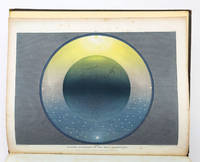
1846ST19286London: Printed by Catchpool & Trent for Simpkin Marshall & Co 1846. FIRST EDITION. 320 x 255 mm. 12 1/2 x 10". xiii 3 96 pp. <br/> Publisher's original blind-decorated dun-colored cloth gilt titling to upper cover smooth spine newer endpapers. WITH 11 COLOR ENGRAVINGS after Frost by W. P. Chubb & Son printed in oil colors by George Baxter all with original tissue guards. Front free endpaper with small ink signature of John Hill. See: Francis Reid "Isaac Frost's 'Two Systems of Astronomy' 1846: Plebeian Resistance and Scriptural Astronomy" in "The British Journal for the History of Science" Vol. 38 No. 2 Jun. 2005 pp. 161-177. Cloth rather spotted corners bumped but the binding solid with no wear to joints or hinges. A few spots of foxing to title page half of the tissue guards with overall very faint foxing/browning the illustrations with minor foxing at edges and in margins but the images themselves clean and bright and all in all a really excellent copy the text wide-margined and quite clean and fresh and the plates with rich coloring.<br/> <br/> Illustrated with beautiful color plates this anti-Newtonian work promotes a view of the universe based on the backward-looking beliefs professed by a Protestant sect known as the Muggletonians. Named after co-founder Lodowicke Muggleton the Muggletonians emerged in London in 1651 based on the claims of two tailors who professed to be the "Last Witnesses" described in the Book of Revelation. Rejecting the new directions in philosophical reason Muggletonians believed in a purely scriptural interpretation of the universe. According to E. P. Thompson's 1994 "Witness Against the Beast" the Muggletonians had curious notions quite contrary to other Protestant denominations: they believed that the soul is mortal that Jesus and God are one and the same that Heaven was left without divine supervision from Jesus' death until the day of judgment that Heaven resides six miles above the Earth that God stands between five and six feet tall and other unconventional things. Although the sect initially avoided both worship and evangelizing during the 19th century some followers became more outspoken about their beliefs and even published books appealing to the general public. Our author Isaac Frost 1793-1858 was a prominent Muggletonian and successful owner of a brass foundry who along with his brother Joseph invested large sums to promote their belief system--the present work being an especially notable example. Divided into two main sections the text first describes the Newtonian system of heliocentric astronomy and then turns to Frost's scriptural interpretation and geocentric views. As Reid tells us "According to Frost Scripture clearly states that the Sun the Moon and the Stars are embedded in a firmament made of congealed water and revolve around the Earth that Heaven has a physical reality above and beyond the stars and that the planets and the Moon do not reflect the Sun's rays but are themselves independent sources of light. Our book was apparently written as a reaction against the lecturers who expressed Newtonian astronomy--which was often for them and their audiences simply shorthand for heliocentrism." The 11 plates that illustrate these extraordinary ideas are the work of George Baxter a pioneering printer who revolutionized color printing techniques by combining metal engravings with woodblock printing using oil-based inks to produce high-quality affordable prints. The plates here are appropriately ethereal and otherworldly utilizing a beautiful palette with subtle gradations and esoteric figures to create memorable pseudo-scientific imagery. Although this work appears at auction with some regularity it is almost always incomplete no doubt because the attractiveness of its plates encourages harvesting. Useful price comparisons include a complete copy said to be in fine condition selling for £7500 in 2016 and six loose prints from the book fetching £6875 in 2015. [Printed by Catchpool & Trent for] Simpkin, Marshall, & Co unknown
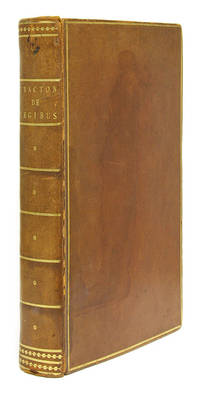
1569673671569. London 1569. First edition. Folio. London 1569. First edition. Folio. PMM 89: "The Crown and Flower of English Medieval Jurisprudence" Bracton Henry de d. 1268. De Legibus & Consuetudinibus Angliae Libri Quinq; In Varios Tractatus Distincti ad Diversorum et Vetustissimorum Codicum Collationem Ingenti Cura Nunc Primum Typis Vulgati; Quorum Quid Cuiq; Insit Proxima Pagina Demonstrabit. London: Apud Richardum Tottellum An. do. 1569. With imprimatur "Cum priuilegio" at foot of title. xvi 172 175-444 ff. Complete. Folio 11-1/4" x 7-3/4"; 28.6 x 19.7 cm. Nineteenth-century diced calf gilt rules to boards gilt fillets ornaments and title to spine gilt rules to board edges gilt inside rules marbled endpapers ribbon marker. Light rubbing to boards faint dampstain to front board moderate rubbing to extremities front joint starting at head rear joint cracked corners bumped and somewhat worn armorial bookplate "Ex Libris Munden" to front pastedown. Attractive large woodcut decorated initials. Light toning to text somewhat heavier in places light foxing and finger smudges to some leaves some fading to text of ff. 1 and 2. A handsome copy of a landmark work with an interesting provenance perserved in a navy blue clamshell box. $13000. First edition. Written between 1250 and 1256 De Legibus et Consuetudinibus Angliae The Laws and Customs of England is the first treatise on English law. A systematic work it emphasizes the separation of procedural and substantive matters and also cites cases as sources of at least intellectual if not formal authority. Both the principles formulated in this work and its use of precedents determined the development of English law and established the method adopted by Littleton and Coke. In Maitland's words it is "the crown and flower of English medieval jurisprudence" and "by far the greatest of our medieval law books." This copy belonged to Arthur Henry Holland-Hibbert 3rd Viscount Knutsford 1855-1935 of Munden House Hertfordshire. He served as both a justice of the peace and High Sheriff of Hertfordshire. His bookplate was engraved by Sir Henry Badeley who designed bookplates for a number of important clients including the House of Lords Library. Maitland Collected Papers II:43. Dauchy et al. Eds. The Formation and Transmission of Western Legal Culture: 150 Book. unknown
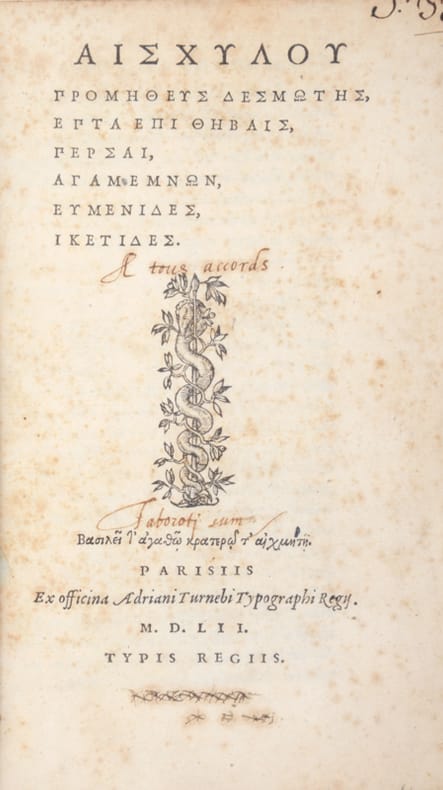
155242167Paris, Adrien Turnèbe, 1552. In-12 de (8)-211-(1) pp. (sign. a4, A-N8, O2), caractères grecs, basane fauve granitée, dos lisse orné, pièce de titre en maroquin rouge, tranches jaspées (reliure du XVIIIe siècle).
20104026FBGütersloh/München, Faksimile-Verlag, 2010. Vitrine: 20 x 35 x 42 cm. 718; 168, XXXII Seiten. Faksimileband: Rostroter Original-Samteinband auf 4 Bünden mit Replikat eines Elfenbeinreliefs der Kreuzigungsszene, eingefasst in einen Rahmen aus verziertem Goldblech, auf dem Vorderdeckel, teilvergoldeter, durchbrochener Silberplatte, Papst Gregor den Großen darstellend, Buchschnitt mit gemaltem Ornamentschmuck und zwei vergoldeten Kettenschließen. Kommentarband: Original-Leinenband mit goldgeprägtem Deckel- und Rückentitel. Beides in Original-Glasvitrine mit Holzeinfassung und Samtkissen auf integrierter Kassette mit Leinenbezug für den Kommentarband. [12 Warenabbildungen]
Ming dynasty 1 Kwan note of the Hung-wu era (1368-98), produced from 1375. Printed on grey mulberry bark paper, size ca. 335 x 222 mm. Framed and glazed. Extremely early example of a banknote, and a specimen of the largest paper money ever issued. The Chinese writing along the top of this Ming note reads "Da ming tong xing bao chao" (from right to left, in regular K'ai Shu style), which translates as "Great Ming Circulating Treasure Note". Below this, the denomination is written in two characters "yi guan" ("one string", then the equivalent of 1000 copper cash or one tael of purse silver or one-fourth tael of gold). Beneath the denomination is a picture of a string of 1000 coins, arranged in ten groups of one hundred coins. Beneath this are the instructions for use and a threat to punish forgers. - Paper very thin and fragile, with some very old repairs, partly faded and with some soiling, some folds. Traces of two faded red (vermilion) seal handstamps, one at each side. As these stamps typically tend to fade with time, they are not easily perceptible. These seals had the function of signatures on modern banknotes. The red imperial seal is applied on the reverse. The outer frame surrounding the text is ornamented with dragon patterns. On both sides of the centre are eight Chinese characters "Ta Ming Pao Ch'ao, Tien Hsia T'ung Hsing" (The Great Ming note, circulates everywhere) in Chuan Shu style. - The 1 Kuan note is the largest paper money ever issued. China was the first country in the world to use paper money (credit currency). The very earliest paper money notes date from the 11th and 12th centuries, but as only fragments of these are extant, they can only be described in very general terms. This kind of note was observed by Marco Polo in the 12th century, and he referred to it as "flying money". The oldest paper money of which a complete specimen survives is that from early Ming dynasty, dated 1375. These notes are the earliest numismatic prints, also the earliest obtainable commercial printing on paper, indeed very nearly the earliest obtainable printing of anything - a full lifetime before Gutenberg. Very few examples survive.
Folio (274 x 402 mm). (64), 406 pp., final blank leaf (and leaf *4 blank). Engraved title-page. With woodcut initials and 39 engraved illustrations (20 double-page). 17th c. green vellum, spine gilt in compartments. Marbled ebdpapers and edges. First edition. "One of the most beautifully printed treatises on military architecture of the entire century" (de la Croix). Alghisi worked for Ercole II and Alfonso II d'Este of Ferrara as both a civil and military architect, constructing churches and theatres as well as fortifications. He took a theoretical approach to fortress design, describing the plans for fortresses with increasing numbers of bastions, reaching the astounding number of 21 (the fortress of Palmanova was unusual in having as many as nine). Bastions had become an increasingly important element of fortifications during the 16th century as a result of the need to provide defence against cannon fire which tall medieval towers failed to do (providing, as they did, a large area for the cannon to target). Bastions were lower, thicker and provided a means for the defenders of a fortress to overlook the attackers from a platform large enough to hold cannons of their own. - Some brownstaining; rust mark on pp. 174-175 from a pair of scissors. A few engravings shaved. Joints cracking, spine-ends chipped. Provenance: from the collection of Thomas Fremantle, 3rd Baron Cottesloe (1862-1956), commander of the Territorial Army and president of the Society for Army History Research. Edit 16, CNCE 1140. Adams A 742. BM-STC Italian 19. Cockle 778. Jähns 803. D'Ayala 83. Berlin Kat. 3512. Marini 27. Riccardi I, 22f. Guarnieri 4. Haym IV, 112. Manzi 33. Breman 11, Horst de la Croix, "The Literature on Fortification in Renaissance Italy", Technology and Culture 4 [1963], pp. 30-50, here at p. 41. For the printer, see: D. E. Rhodes, Silent Printers. Anonymous printing at Venice in the sixteenth century, p. 9.
Large 8vo. (8), CCCLXXI, (3) ff. Title printed in red and black with woodcut illustration and numerous woodcut initials and marginal illustrations repeated throughout the volume. Contemporary full calf over wooden boards with blind-tooled ornaments and remains of clasps, rebacked in the 19th century with new spine and marbled endpapers. This "Fortress of the Faith, against all the enemies of the Christian religion, restraining the rage of Jews and Muslims", written c. 1458, is the principal work of the baptized Spanish Jew de Spina. It is considered the "methodical and ideological foundation of the Inquisition. The book, divided into five chapters, targets chiefly Jews and Muslims" (cf. LMA I, 408f.). Of the five books, "the first [is] directed against those who deny the Divinity of Christ, the second against heretics, the third against the Jews, and the fourth against Islam and the Muslims, while the fifth book treats of the battle to be waged against the Gates of Hell. In this last book the author dwells at length upon the demons and their hatred of men; the powers they have over men and the diminution of these powers, owing to the victory of Christ on the Cross, the final condition of the demons, etc." (Catholic Encyclopaedia). "Ouvrage fort curieux de ce théologien espagnol [...] il était dit-on d'origine juive, c'est pour cela que son 'Fortalicium' pèut ètre classé dans une bibliothèque kabbalistique" (Caillet). Part 3, on the iniquities of the Jews, is a veritable encyclopaedia of mediaeval antisemitic libel, containing numbered lists of Jewish "cruelties" and refutations of the Jews' supposed anti-Christian arguments. The section on Islam lists the numerous Saracen wars, while the fifth book is devoted to the battle to be waged against the Gates of Hell and its resident demons, whose population the author calculates at over 133 million. - Block loosened in places. Clasps missing; binding rubbed but original blind-tooling of boards remains recognizable, even though partly obscured by the 19th century leather that replaced the spine. A fine post-incunabular edition, the final one to appear, embellished with numerous woodcut illustrations. Adams S 1593. BM-STC French 170. Coumont (Witchcraft) S84.7. IA 103.849. Caillet 10306 ("Incunable gothique rare").
4to (150 x 216 mm). (18), CCCCXVI ff. Title-page printed in red. With one woodcut headpiece. Printed in two columns in gothic type throughout. One Lombardic initial in purple ink with penwork decorations. Original blindstamped full calf over thick wooden boards on 3 raised double bands; 5 large and 8 smaller brass bosses on each cover. Wants clasps. Rare incunabular edition of the "Summa Angelica", beautifully preserved in the original Flemish blind-tooled binding. Both covers are quartered by a cross ornamented with rolls of delicately interlaced rods and bands in the late Gothic style. The four quarters outside the cross are filled with impressions of the same rectangular panel (80 x 52 cm). The panel's inner rectangle is divided into two vertical stripes, each occupied by two interlacing vine branches enclosing within their curves four animals: a bear, boar, goat, and fawn facing a stag, monkey, lion, and hare. Round the margin runs an undulating leafy tendril into whose curves further hares, boars and stags are nested. Examples of this characteristic Flemish design, widespread in the early decades of the 16th century, are known in the Goldschmidt collection (no. 107, plate XLII) and in the Otto Schäfer collection (no. 26), bound ca. 1520 by Louis Bloc in Bruges and ca. 1537 Jacob Clercx de Ghele in Antwerp, respectively. Indeed, so strong is the similarity between the central animal-and-vine compartments of panels used by Bloc and the one at hand, exactly the same size and differing merely in the design of the border and in the fact that they are mirror-inverted, that it is tempting to speculate whether not one was produced as a direct copy of the other. - The principal work of the Franciscan canonist Angelo Carleti di Chivasso (1411-95), this is an alphabetically arranged dictionary of moral theology which develops, in 659 chapters, a set of rules for those desirous of leading a Christian life. First published in 1486, its subjects include a wide range of themes such as necromancy, prostitution, usury, inquisition, and alchemy. The work was widely read and aroused the wrath of Martin Luther, who judged it one of the most harmful symbols of Catholic orthodoxy - so much so that he called it "Summa Diabolica" and publicly burned a copy at Wittenberg on 10 December 1520. - Some contemporary marginal annotations in the text, as well as notes to flyleaf and lower pastedown; pretty ink ornaments applied to the title initial. Endpapers and last few leaves of text wormed. Margins show occasional waterstaining. Spine somewhat wormed; covers very well preserved showing only a little wear. Only fragments of the leather straps survive. - Provenance: later bookplate of the Chilean diplomat, bibliophile and art collector Matías Errázuriz Ortúzar (1866-1953) to front pastedown. Extremely rare: only 12 copies in institutional libraries worldwide, none in the United States or Great Britain, that in the Staatsbibliothek Berlin lost. Copinger II, 1665. GW 1941. Pellechet 3829. BSB-Ink A-534.050. ISTC ia00726400. Cf. Goff A-713 (first ed.). For the binding cf. Goldschmidt 107 and Schäfer 26.
Folio (210 x 294 mm). (40), DXII, (8) pp. Title page printed in red and black. With large emblematic title woodcut after Albrecht Dürer, hand-coloured around 1730; woodcut printer's device on verso of final leaf. With coloured woodcut arms of Raimund Fugger, 7 large woodcut initials showing astronomical and mathematical motifs, and 184 woodcut illustrations. Text surrounded by various woodcut borders throughout. Contemp. vellum with ms. spine title. Only edition. - Printed at the expense of the banker Raimund Fugger, this work presents classical inscriptions and statues collected all over Europe (of which many were in Fugger's own collection). The text is based on earlier studies by Peutinger, Pirckheimer, and others. An exceptionally fine work from the private press of Peter Apianus (1495-1552), mainly known as a mathematician and geographer. Title woodcut by Hans Brosamer (after Dürer) and Fugger's coat of arms (by M. Ostendorfer) splendidly hand-coloured and raised in gilt; undoubtedly the work of the book's previous owner, Johann Spiegler, who signs his name beneath the imprint on the title page ("Annumeror libris Joannis Spiegleri Juliomagensis"). Spiegler is known as a Constance miniaturist active during the first half of the 18th century (cf. Brun, SKL III, 1913) and is sometimes identified with the Constance painter Franz Joseph (Johann) Spiegler (1691-1757; cf. Thieme/Becker XXXI, 370f.). - Slight dampstains and edge tears near end; occasional paper loss remargined. Page tt1r (the printed area of which reaches far into the margin) lacks the final character of the right column. An uncommonly beautiful copy, last in the collection of the Maryland pharmaceutical investor Charles W. Newhall. VD 16, A 3086. IA 106.422. Adams A 1291. BM-STC (German) 37. Stalla 85. Brunet I, 342. Van Ortroy 109. Günther (Apian) 20f.
Folio (242 x 355 mm). (2), 116 pp. With woodcut printer's device on title-page, woodcut initials, 57 illustrations and maps (4 double-paged). Later binding reusing a leaf of Hebrew manuscript on vellum (containing prayers from the Yom Kippur liturgy, 14th or 15th century, Ashkenaz, probably German). First edition. - Belluzzi worked as a field engineer for the Medici in Florence. He died during an attack on a Sienese fortress in 1554. - First six leaves damaged at upper corner with some loss of text, stained at head. With autograph ownership of Philip III, Landgrave of Hesse-Butzbach (1581-1643), at foot of title-page ("Philippus Hassice Landgravius"). Philip was interested in science and astronomy (he corresponded with Galileo and Kepler) and had an observatory as well as a fine library. Later in the Darmstadt court library (crowned monogram stamp on title-page; inscription "Bibl. Aul. Darmst. Rep. 7 Loc. 2" to inside front cover). Last in the collection of Thomas Fremantle, 3rd Baron Cottesloe (1862-1956), commander of the Territorial Army and president of the Society for Army History Research, with his index card ("acquired 1930") loosely inserted. Edit 16, CNCE 4958. Cockle 794. Riccardi, p. 109f.
Folio (212 x 308 mm). (186) ff. With full-page woodcut on fol. 6v showing Saints Cosmas and Damian, the patron saints of physicians. Contemporary full vellum binding. First edition of this Renaissance dictionary of natural science compiled by Otto Brunfels, the "father of German botany", best known for pioneering the emancipation of that field from mediaeval herbalism. "Brunfels' passion for compiling and organizing reference material [...] was fully exhibited in his 'Onomastikón', a comprehensive dictionary containing a wealth of material related to medicine, botany, alchemy, and metrology" (DSB). Designed "for the use of physicians and apothecaries" (ibid.), the volume bears ample witness to the pre-eminence of Arabic medicine during the Middle Ages and early modern period, including a long discussion of Galenus, whose works were channeled into the West mainly through Arabic scholars, and entries on Ibn Sina (Avicenna), "natione Arabs, [...] a medicis Princeps vocatur", as well as Ibn Rushd (Averroes), "Avicennae coaevus, multae eruditionis philosophus et medicus, qui cum maxima laude et ipse Aristotelis libros est commentatus". - Insignificant browning with very slight brownstaining and worming near end (confined to margins); a few occasional humanist annotations with an 18th century handwritten note of acquisition (purchased from sale of the Wille library in St Petersburg) on the rear pastedown. A good, tight copy. VD 16, B 8525. Adams B 2928. BM-STC German 156. DSB II, 537. Ferchl 73. Wellcome I, 1106. Wightman 112.
8vo. 76 ff. - (Bound with) II: The same. Commentarius in Claudii Galeni de ossibus ad tyrones libellum [...]. Ibid., 1561. 37, (3) ff. Contemporary limp vellum (wanting ties). Two medical textbooks by the Parisian anatomist Dubois, widely used by French medical students in the mid-16th century. The present volume is heavily annotated by a contemporary owner who signs his name as "Mirard" (?) on the first title-page. The annotations are particularly extensive in the sections on blood vessels, muscles, and nerves. - Dubois (1478-1555, Latinized as "Sylvius") was the first to describe venous valves, which he injected with coloured liquids (although their function was discovered only later by William Harvey), and is credited with first having given names to the various muscles, previously simply numbered. His blind reverence for the ancient physicians, especially Galen, involved him in a public controversy with his most famous student, Vesalius, who had dared to expose the errors of the Greeks. A former classicist, Dubois is also the author of the first French grammar to be published in France. - Some waterstaining near end, the final leaf showing severe paper flaws with some loss to the index. The first 50 ff. show noticeable worming to the gutter, stronger near the beginning, but mostly without loss to text. An additional handwritten ownership from Montpellier, another center of French medical learning (signed "G. B. Minet", dated 1709), at the bottom of the title page. Durling 1259 & 1236. Wellcome I, 6183 & 6184. Adams S 2181 & S 2170. OCLC 14317273 & 1025189760. Cf. BM-STC French 141. Hirsch II, 220f.
Small folio (190 x 258 mm). "30" (but: 32), "48" (but: 40), (1) ff., final blank f. With large woodcut portrait of Indagine by Hans Baldung Grien on title page, full-page armorial woodcut on final page, and 111 woodcuts throughout the text. Also, two large woodcut initials: 9-line G and 8-line S, the latter designed by Hans Weiditz (cf. A. F. Johnson, Decorative initial letters, XLI). Early 20th century quarter leather over grey boards, spine titled in gilt. Extremely rare first edition of this important, profusely illustrated Renaissance work on the three occult sciences: astrology, physiognomy and chiromancy. Also called palmistry, chiromancy is the art of reading character and divination of the future by interpretation of the lines and undulations on the palm of the hand. Mediaeval palmistry was pressed into service by the witch-hunters; after a period of disrepute, it flourished again in the Renaissance, and a block-book on the subject was published as early as ca. 1480. Johannes Indagine (ca. 1467-1537, also known as Johannes Rosenbach, or von Hagen), a Carthusian Prior, was perhaps the most highly regarded German chiromancer of the sixteenth century and "an extremely learned man in many fields" (Gettings, An Illustrated History of Palmistry, p. 177). It is unknown where he gained his considerable knowledge of the natural sciences, namely of astronomy (to which he contributed the invention of two instruments) and chiromancy. He advised the Elector Albrecht von Brandenburg, Archbishop of Mainz, and it might have been Indagine's horoscopes which in 1519 caused the adjournment of the election of Charles V. - The present work was banned by the Inquisition, having been placed on the Index Librorum Prohibitorum under the decree of Pope Paul IV in 1559 (cf. Thorndike). "Possevin holds that this was on account of the author's astrology, but the other astrologers are all in Class 2. Indagine was placed in Class 1 for his letter to O. Brunfels, published at the end of the volume (which had undoubtedly come to attention in Rome): for this, the author was considered a Lutheran" (Reusch). Illustrated throughout with woodcuts by several artists, including the splendid portrait of the author and his coat of arms, both by Hans Baldung Grien, 11 pairs of physiognomic heads (the pair on fol. 5r also by Grien) and 26 (some repeated) mythological designs representing the signs of the Zodiac attributed to Hans Wechtlin, as well as 37 chiromantic hands (one of fingers only) and 27 numerous astrological diagrams. The work had a great effect on the study of chiromancy and is quoted down to our own day, marking the first beginnings of the fully-fledged astrological chiromancy which was to develop steadily over the next century and a half. - A good, clean copy with remains of six thumb indexes which mark the various parts. Includes the frequently missing two-leaf dedication to Archbishop Albrecht after the title, as well as the final blank; leaf 6 of the first part misbound before the text as usual. Rebound around 1900, trimmed rather closely, with an old catalogue description of this copy (erroneously describing it as incomplete) mounted on the front pastedown: in fact, no index or "blank 4th leaf" are missing (cf. the digitized BSB copy). Of great rarity. VD 16, R 3108. Adams I 88. BM-STC German 429. Ritter 1264. Schmidt 68. Muller II, p. 82, no. 103. Chrisman, Strasbourg Imprints, S15.2.3. Sabattini 282. BNHCat I 23. Zinner 1180. Osler 3049. Oldenbourg (Baldung Grien) L 203. Mende (Baldung Grien) 458-460. Reusch I, 280, note 6. Cf. Caillet 5388-9 (only editions of 1556 and later); Thorndike V, 65-66,175-176; Hollstein, Baldun Grien, n. 263; Zinner 157, 414 f., 433. H. Röttinger, Jahrb. der Kunstslgg. des Ah. Kaiserhauses Wien 27, 1907-1909 (attribution of the illustrations to Hans Wechtlin); Durling, 2531ff. (only editions of 1531 and later).
4to. 26 unn. ff. (incl. last blank). - (Bound with) II: Solinus, Caius Julius. Polyhistor, seu rerum orbis memorabilium collectanea [...]. Cologne, Eucharius Cervicornus & Hero Fuchs, December 1520. XCII, (12) ff. With architectural woodcut title border. - (Bound with) III: Pomponius Mela. Cosmographia. (Paris), Jean Petit, (5 June 1513). XXX, (10) ff. With large stipple-engraved printer's device on title page. - (Bound with) IV: Herodian. Libri octo, in quibus hi imperatores continentur [...]. Angelo Politiano interprete. (Strasbourg, Matthias Schürer, November 1513). (6), LXXXV, (1) ff. - (Bound with) V: [Bruni] Aretino, Leonardo. De bello Gotthorum: seu de bello Italico adversus Gotthos libri quattuor. (Paris), [Guy Marchand für] Jean Petit, (31 March 1507). 48 ff. With large stipple-engraved printer's device on title page. Contemporary blindstamped dark-brown calf binding over wooden boards; pastedowns made of a 13th c. vellum ms. with fleuronnée initials. Fine Sammelband, containing the very scarce first edition of Peutinger's work dealing with the old borders of Gaul and Germania. Under the heading "De Lusitanis nautis qui in Indiam navigant", Peutinger discusses the travels of his fellow Augsburg citizens to the East Indies. Also includes poems by Sebastian Brant and Ringmann Philesius. - The volume contains four additional early prints: II: The work of the Roman geographer Gaius Julius Solinus (3rd c.). "The greater part of this work is taken from Pliny's 'Natural History' and Mela's 'Cosmographia'. It was revised in the sixth century under the title of 'Polyhistor'. It was a popular work in the middle ages" (Cox II, 336). - III: Rare Petit edition (ed. P. Phoenix) of the oldest preserved Roman geographical work. - IV: First edition of this Roman history to be printed in the German-spaking countries. - V: Rare edition of Bruni's history of the Gothic Wars. - Occasional insignificant waterstaining to inner margin; upper margin of first 10 ff. have small brownstain. Spine and clasps replaced; back cover shows traces of a nail, proving this to be a former chain binding. Altogether a fine, well-preserved sammelband with five rare French and Alsatian post-incunables. I: VD 16, P 2081. BM-STC German 689. Adams P 940. Muller II, 17, 41. Ritter 1678. - II: - VD 16, S 6964. BM-STC German 818. Schweiger II, 959. Not in Adams. - III: BM-STC French 308. Schweiger II, 606. Not in Adams. - IV: VD 16, H 2501. Muller II, 187, 110. Ritter 1197. Schmidt 113. Schweiger I, 137. Not in BM-STC German or Adams. - V: BM-STC French 84. Adams A 1554. IA 125.746. Potthast I, 172.
Folio (225 x 331 mm). (12), 747, (1) pp. With 2 (repeated) woodcut printer's devices to title page and final page as well as a half-page woodcut of surgical instruments at the end of the preliminaries. Modern blindstamped brown calf on four raised double bands. Rare edition of this commentary on the ninth book of the treatise dedicated by ar-Razi (also known as Rhazes; 850-923 or 932) to Almansor, the Prince of Chorosan (with the text). "The manual, known as 'Nonus Almansoris', was popular among mediaeval physicians" (cf. GAL S I, p. 419). The work discusses special pathology but excluding pyrology and was one of the most popular textbooks at medical schools and faculties well into the Middle Ages (cf. Hirsch/H. I, 171). Rhazes is considered the greatest mediaeval physician next to Avicenna; he also conducted alchemical experiments. According to his biographer al-Gildaki, he was blinded for refusing to share his secrets of chemistry. - A woodcut on the final page of the preliminaries depicts ten different surgical instruments, including a tongue depressor, a forceps, and various instruments for cauterization. Several minor waterstains throughout, but generally a fine copy. Provenance: Handwritten ownership of the Jesuit College of Louvain, dated 1637, on the title-page. VD 16, A 3222. Durling 249. Cf. Garrison/M. 3666.84; Poletti, p. 11; Wellcome I, 383; M. H. Fikri, Treasures from The Arab Scientific Legacy in Europe (Qatar 2009) no. 46, with double-page spread illustration on p. 82f. (1542 Venice edition).
Small 4to. 15 unnumbered ff. (lacking final blank). With several woodcut initials (including one depicting a pelican). Attractive 19th century red calf with giltstamped cover title and border. Rare first edition of this most copious 16th century Italian treatise on the theory of colours. Divided into 13 chapters, the work lists no less than 115 different names of colours. "Questo raro e singolare opusculo indica sul suo principio Toggetto con cui tu scritto, ed e forse l'opera più erudita che abbiasi, presa sotto l'aspetto seguente" (Cicognara). Cicognara described a 14-leaf edition without place or printer - very likely an incomplete copy of this present edition, which ends on f. 13 and is concluded by two leaves of poems. - Telesio (1482-1533), a native of Cosenza in Calabria, taught at Rome. Escapting the "Sacco di Roma", he fled to Venice, where he gained the chair of Latin at the Consiglio dei Dieci bekam. It was during these years that he composed his treatise on colours, the earliest of its kind ever to see print. Goethe quotes it in full in his own treatise on colours (Weimarana, pt. IV, pp. 174-193), following the 1545 Latin Basel edition; this is the longest quote in all of Goethe's works. - Telesio's nephew Bernardino, who had followed his uncle from Cosenza to Rome and Venice, would go on to publish his own treatise on colours in 1570. - Unappealing traces of moisture to the first five leaves. Spine somewhat sunned and rubbed. Edit 16, CNCE 37986. Cicognara 216. Adams and BM-STC Italian list later eds. only.
2 exceedingly rare early Spanish prints by Miguel de Eguía of writings by Saint Bonaventure. – Author, Content: Present volume contains early Spanish translations of (1) the »Stimulus Amoris« (13th ct., The String of Love) and (2) the »Soliloquium de quatuor mentalibus exercitiis« (1259/60, Soliloquy [i.e. monologue] About the Four Spiritual Exercises), two devotional works written by or in case of (1) attributed to Saint Bonaventure, [i.e. Giovanni Fidanza, 1221-74], a Cardinal and head of the Minor friars, who became one of the most influential theologians and philosophers of the medieval ages. – Printer: Both volumes of present Sammelband were printed in the print shops of Miguel de Eguía (1495-1546) in Logroño and Alcalá, one of the foremost and progressive Spanish printers of his time, a publisher of Eramus. Eguía's prints are known for their distinctive type setting in puristic gothic and round typefaces, their illustrative and ornamental wood-cut initials of an artistic nature (of which 4 and 8 resp. are set here), the use of red and black inks and the good quality of the paper. Moreover Eguía was famous for renewing Spanish printing by using Renaissance-style architectural borders. Present wood-cut title-pages are a good examples: »Estimulo de Amor« consists of a central typographic title printing with a from of emblematic illustrations combined with floral ornaments, »Soliloquio« additionally incorporates a portrait of the reading Bonaventure. – Condition: (1) Fragments of partly erased former owner's remarks as well as of erased owner's stamp on l. ai; (2) Leave g4 (printer's blank) missing; pp. aiiir, a(6)v, br, biiiv, c(7)r, e(5)r, f(3)r and f(5) with very few underlinings and marginal notes. Some leaves with slight foxing and little water stains at margins. – Rarity, Holdings: Although incunables and early prints of Bonaventure's works in the original Latin and in translation, as well as prints by the Spanish master Eguía are frequently traded at auction, no auction results at all are available for present editions, according to RBH and JBP/JAP/APO. – As of August 6th 2022 USTC, OCLC/WorldCat, KVK and viaLibri Library Search locate only 6 holdings in institutional holdings worldwide for (1), at Barcelona (Bibl. de Catalunya, missing title leave, Prov: Bibl. Marès), Evora (Bibl. Publica), Lisboa (BNP), Madrid (BNE), Oviedo (UL), València (UL) and London (BL), i.e. the only copy outside the Iberian peninsula. Only 5 copies are known for (2), at Barcelona (CRAI), Madrid (BNE [2 copies], Bibl. Islámica) and Sevilla (Bibl. Capitular Y Colombina), with no copy outside spain. – Reference: (1) USTC, no. 335139; CCPB 119730-4; BCMarès I 161; BLC 37, 64; Heredia 3928; Salva 3863; Palau 290249; Porbase 224252; Wilkinson (Iberian Books) 2110. – (2) USTC, no. 335148; CCBE S. XVI, B, 2722; García 74; Martín Abad 147; Palau 290228; Wilkinson (Iberian Books) 2106. – De la Fuente Arranz, Fernando: "Miguel de Eguía." Diccionario Biográfico Español, on-line. URL: https://dbe.rah.es/biografias/49363/miguel-de-eguia. 7th August 2022.
Very Good Turkish, Ottoman (1500-1928) Contemporary quarter dark burgundy leather bdg. Grey cloth boards. Four compartments at spine. Cr. 8vo. (20 x 14 cm). In Ottoman script (Old Turkish with Arabic letters). 96 p. [48 leaves]. 19 lines on each page. Printed on paper with European watermarks. A small tear up to the last page with no loss of text. Overall a fine copy. The 9th incunable of the Islamic world, written by Ibrahim Müteferrika and printed in his legendary Basmahane. Known as the most significant work by Müteferrika, this incunable is a political and state-theoretical treatise composed in order to improve the Ottoman government. In his book, Ibrahim Müteferrika used the sources written in Latin in the Europe of his period, and he presented it to Sultan Mahmud I right after the Patrona Halil Revolt (1730). Müteferrika divided the state forms of government in Europe into three groups with the titles "monarkiya" [i.e. monarchy], "aristokrasiya" [i.e. aristocracy], and "demokrasiya] [i.e. democracy]. In the work, the importance of the sciences (physics, astronomy, and geography) in the state administration was emphasized, and it was stated that a solid-state order could not be established in a country where these sciences were not developed. In addition to this, he used the term "Nizâm-i Cedîd" [i.e. The New Order] for the first time and stated that the Ottoman Empire should definitely adopt and implement the new military orders of the 18th century Europe. In addition, this work is one of the earliest in which the "democracy" term is used in the Islamic world. The book was published in French in Vienna and Paris in 1769 (Traite de la tactique ou méthode artificielle pour l'ordonnance des troupes, Vienne, 1769. Translated by Karl Emerich Alexander von Reviczky von Revisnye [Baron Reviczki]), and was translated from French into Russian in 1777. One of only 500 copies. The volume appeared in 1732, about one and a half years after the uprising of Patrona Halil Revolt which had overthrown the system of Sultan Ahmed III and Grand Vizier Damad Ibrahim. The writing, recalling the characteristics of Ottoman siyâsetnâme [i.e. the book of politics], calls the attention of the Ottoman leaders to the results of the state and military development and to the reasons for the strategic superiority of the rival European powers, while strongly condemning the several centuries long disinterest of the Ottomans to the external world. An important feature of the work is to break with the hitherto prevailing nostalgic attitude to bygone golden ages. Although observes the stylistic conventions in as much he speaks contemptuously about the Christian nations, in the content, already turns away from the indifference referring to the superiority of Islam. It announces in a list organized by items the reasons for the state's weakness and the conditions of rising. In harmony with the main aspects of contemporary Ottoman reforms, the work mainly focuses on the necessity of the reorganization of the army. It also offers a broader historical background by describing after the Greek philosophers the various types of states (6v-7v), or by treating the origins and reasons for the success of the foundations of European culture, the Roman Empire (19v-20v). The concept "Nizâm-I Cedîd" (i.e. the New Order), which would be used for the newly organized military formations of Sultan Selîm III (1789-1807), appears here for the first time referring to the modernized European army (17v-18r). "The utopistic optimism of Risâle-i Islâmîye may have had some rational basis, if one takes into account the Karlovci Treaty (1699) which was a rather positive correction in contrast to the previous series of Turkish failures in the Balkans, the European 'internal wars' of the first decade of the 18th century, and the experiences of the reform and peace years of the Tulip Period. However, the Usûl ül-hikem. was already inspired by the atmosphere after the Pozarevac Treaty (1718) which was a further stro
Folio (240 x 369 mm). (6), 474 (but: 475), (3), 475-604, (15) ff. With woodcut title-page printed in red and black, 18 woodcut borders, 4 of which full-page size, and 136 woodcuts in the text, including a full-page depiction of the symbols of the Four Evangelists, a world map, and a full-length portrait of Joshua. Woodcut printer's device on title and at the end of the text. Contemporary calf over wooden boards with bevelled edges; two clasps. Second edition of the famous Melantrich Bible, published five times between 1549 and 1577. The present edition features for the first time the Bohemian version of a comparison of the Evangelists (translated from German by Jan Stránenský), surrounded by woodcut borders. It also contains the third Maccabees and the voyages of St. Paul, both translated by Sixt d'Ottersdorf, and originally published in the first edition. Richly illustrated throughout with. The small world map shows the three continents, Europe, Asia and Africa. - With contemporary ownership and a Czech note in a different hand to flyleaf. Second printer's device has added handwritten motto "Super omnes gentes" and additional ownership. Folios 203 and 343 are used twice; later, the foliation omits 404. The woodcut depicting the Fall of Man censored with sanguine pencil. Severe paper flaws to the margins near beginning and end of the volume with substantial text loss, partly remargined with paper 18th century paper. The title-page, the table of contents, and 3 full-page woodcut borders are retouched in ink by a contemporary hand. Several pages show small inkstains; a larger stain on ff. 442-450. Margins fingerstained and partly waterstained. Some underlinings, notes and cancellations in pencil and pen by contemporary and modern hands. From the library of the Viennese collector Werner Habel, with his signed and stamped ownership, dated 1982, to the pastedown. His note of acquisition from 1981 is loosely enclosed. Graesse I, 371. Darlow/Moule 2182 (note, no. 3).
8vo (12 x 17 cm). 147, (1) pp. With woodcut printer's device, 3 stipple-engraved initials, and a woodcut on the last page. Contemporary limp vellum. First Latin edition of this alchemical work, first published in Venice in 1544 as "La Espositione di Geber philosopho". Written in the form of a dialogue, the first part contains a conversation between a certain Demogorgon and Geber (whom Demogorgon addresses as "most learned nephew of Mahomet") about the latter's works. In the second part Demogorgon interviews Raymond Lull about his "Lignum vitae" and the discovery of a remedy to prolong human life. Kopp suspects that the anonymous author Bracesco was a 16th century physician and alchemist from Orzinuovi near Brescia. - Binding a little rubbed, lacking ties. Interior somewhat browned and stained throughout, the first leaves more so. Curiously, the first 26 pages in particular (but also a few later pages) have been mutilated by an early owner, who obscured and excised particular words from the text (apparently mainly concerning the word "vitriolum"); these lacunae have been rebacked with paper and the missing text supplied by the hand of a later owner. Some worming to lower gutter of the first 16 leaves, with slight loss. With contemporary ink marginalia in Latin throughout. Adams J 8. BM-STC French 238. Rosenthal 337. Brüning 247 (all s. v. Geber). Ferguson I, 123. CG XL, 1024. Baudrier III, 46. Palau 143878. Alchemy and the Occult 18.4. Bolton, Select Bibl. of Chemistry, p. 972. OCLC 18153918. For Jabir see GAL I 241; GAL S I 426ff.
8vo. (104) pp. With woodcut printer's device, 94 woodcut illustrations and 4 woodcut portraits of the evangelists. Contemporary full vellum with giltstamped monogramm "JM" to front cover and handwritten spine-title. First printing of 1547, and the first edition to include the medallion portraits of the Evangelists. There were two editions of the "Icones" printed by Frellon in 1547, following the original one of 1538. The 1547 editions are often merely cited as issues, but the text was entirely reset. - An excellent woodcut book featuring 94 highly appealing illustrations, depicting scenes from the Old Testament as well as the Totentanz, likely carried out by Veit Specklin or Hans Lützelburger after drawings by Hans Holbein the Younger (ca. 1497-1543). Each woodcut is accompanied by a Latin text and a French quatrain by Gilles Corrozet (1510-68). With a Latin preface by Nicolas Bourbon (ca. 1503-50), revealing Hans Holbein's name, and a French preface by Corrozet. - Upper board slightly warped. Paper lightly foxed throughout; 2 pages rather browned. 20th century bookplate of K. D. Dahmen mounted to pastedown. A good copy of this masterpiece of early modern book illustration. Adams B 1963. Mortimer (French) 281. Murray 244. Hollstein 14A,100. Baudrier V, 209.
Folio (215 x 310 mm). (14), 18, (6), CXXVI, (4) ff. With 35 woodcuts in the text, initials, and printer's device on recto of final leaf. Contemporary vellum. First edition of Beda's collected writings on historical and astronomical chronology. The section "On the Reckoning of Time" (De temporum ratione) includes an introduction to the traditional ancient and medieval view of the cosmos, including an explanation of how the spherical earth influenced the changing length of daylight, of how the seasonal motion of the sun and moon influenced the changing appearance of the new moon at evening twilight, and a quantitative relation between the changes of the tides at a given place and the daily motion of the moon. "Ce volume contient les principaux traités de l'auteur sur le calendrier" (Houzeau/L.). The woodcut world map on d1, evidently redrawn from those of Petrus de Alliaco and Ambrosius Macrobius (Shirley 12 & 13), shows the four continents of the old world surrounded by water, the southern hemisphere labeled as "nobis incognita frigida". - Very slightly browned; title page shows insignificant fingerstaining; otherwise an excellent copy with a very few contemporary marginalia. VD 16, B 1440. Zinner 1657. Houzeau/L. 1074.
4to (170 x 225 mm). (48), 407, (1) pp. (with blank leaf *4). With woodcut initials and headpieces, 42 engravings (maps and plans) with letterpress captions on versos (bound as double-page plates). Contemporary limp vellum with ms. title to spine, lacking 2 pairs of ties. First edition with Palladio's illustrations. - Italian edition of Caesar's "Commentarii de bello Gallico" and "Commentarii de bello civili", using Francesco Baldelli's twenty-year-old translation, with engraved plates by Andrea Palladio depicting most of Caesar's campaigns, including the famous siege of Alesia. "In the preface, Palladio explains that the illustrations had originated out of a project he had set for his two sons, Orazio and Leonida. Palladio decided to complete the project and publish the illustrations after the death of both his sons ins 1572. Pallado dedicated the book to Giacomo (Jacopo) Buoncompagni, the natural son of Pope Gregory XIII" (Witcombe, Copyright in the Renaissance [Leiden 2004], p. 265). In his introduction, Palladio notes that while fortifications are all very well, a determined army will always overcome them, and it is better to train an army properly along the lines of the Roman army (as Machiavelli had also stated), just as in architecture the Romans had not been surpassed by later generations (cf. J. R. Hale, "Andrea Palladio, Polybius and Julius Caesar", Renaissance War Studies [1983], pp. 471-486). - Binding wrinkled with a few slight spine flaws. Foot of title-page excised (just touching date); a few captions shaved. Provenance: extract from English sale catalogue pasted to front flyleaf. Armorial bookplate of Vice-Admiral Sir Thomas Francis Fremantle (1765-1819), close friend of Admiral Nelson, to pastedown. Latterly in the collection of his descendant Thomas Fremantle, 3rd Baron Cottesloe (1862-1956), commander of the Territorial Army and president of the Society for Army History Research (purchased from Pickering & Chatto, 2 August 1901, 12s). Edit 16, CNCE 8188. BM-STC Italian 135. Adams C 86. Mortimer, Harvard Italian 97. Schweiger II.1 55. Thieme/Becker XXVI, 165.