7 772 résultats
EXE00b8fParis, 1929. Grand in-4 broché, couverture illustrée en couleurs, pagination multiple.
EXE00b8cParis, 1925. Grand in-4° broché, couverture illustrée en couleurs, non paginé.
8vo. 86, (2) pp. Title-page printed in red and black. With 2 woodcut illustrations in the text. Contemporary full vellum with fore-edge flap. Rare compilation on ballistics and artillery, incorporating early treatises on fireworks and warfare, regimental regulations (VD 16, G 1057), and an educational work on the art of war written for Emperor Maximilian, here printed in a different blackletter reminiscent of Schönsperger's Theuerdank fraktur, the famous ornamental typeface specially cut for Maximilian in 1512. - Some browning; a few edge flaws. Interior lower hinge repaired. Quite charmingly bound in a contemporary vellum binding with a flap. Rare: Only 5 copies known in institutional collections (Wolfenbüttel; Staatsbibliothek Berlin; Amsterdam, University Library; Antwerp, Vlaamse Erfgoedbibliotheek; Univ. of Aberdeen). The Flemish Heritage Library erroneously attributes authorship to Franz Joachim Brechtel (1554-93), whose work on the same subject first appeared at Nuremberg in 1591. Provenance: from the collection of Thomas Fremantle, 3rd Baron Cottesloe (1862-1956), commander of the Territorial Army and president of the Society for Army History Research (purchased from Sotheran's, December 1936). VD 16, B 9134 (a single record). USTC 615040. Richter (Egenolffs Erben) 484. OCLC 248948877. Cf. Jähns 653 (1597 edition). Not in Kat. der k. k. Kriegs-Bibliothek.
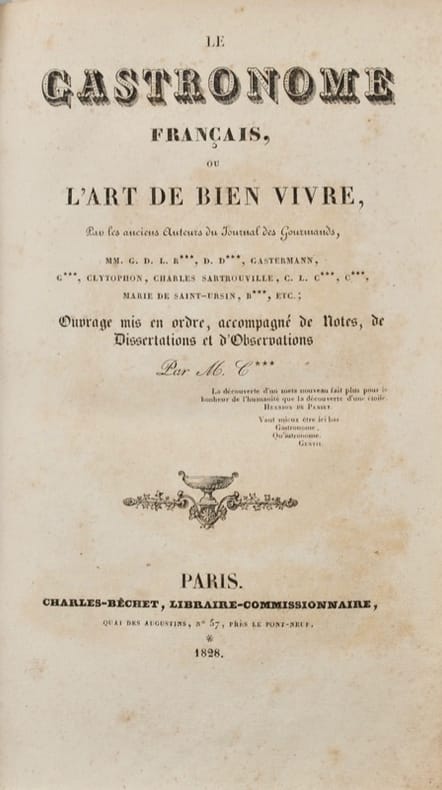
182840434Paris, [Imprimerie de H. Balzac] Charles-Béchet, 1828. In-8 de VIII-503 pp., frontispice, demi-basane havane, dos orné à nerfs, pièce de titre en maroquin rouge (reliure postérieure du XIXe).
22582Rouen, Lecrène-Labbey et Georges de Hautot, 1907. Une feuille imprimée, 540 x 370 mm, grande illustration de l'entrée des français dans Moscou en feu en 1812 faite par un cliché sur un bois original de la collection J. Loth et E. Pelay. Parfait état.
18370Paris, Payot, 1925. Petit in-4. Transcrit par Bertrand Guégan d'après l'édition troyenne de Nicolas le Rouge. Tiré à un nombre restreint d'exemplaires. Envoi du transcripteur à Gabriel Reuillard (écrivain et journaliste normand). Très bon état intérieur. Toile rouge. Nombreux tampons de Radio France et ORTF. Couvertures conservées.
9842Rouen, Bloquel, circa 1830. In-4 de 4 pages, avec un bois gravé représentant une guillotine. Bon état.
9840Rouen, Bloquel, circa 1830. Une feuille de 22,5x34 cm, pliée en 4 pages, avec un bois gravé représentant une diligence attelée et un colporteur en cul-de-lampe.
9841Rouen, Bloquel, circa 1830. Une feuille de 26x20 cm, avec un bois gravé représentant un voilier.
9839S.l.n.n. (Rouen, Bloquel), circa 1830. Une feuille de 25,5x18 cm, avec un bois gravé représentant une diligence attelée.
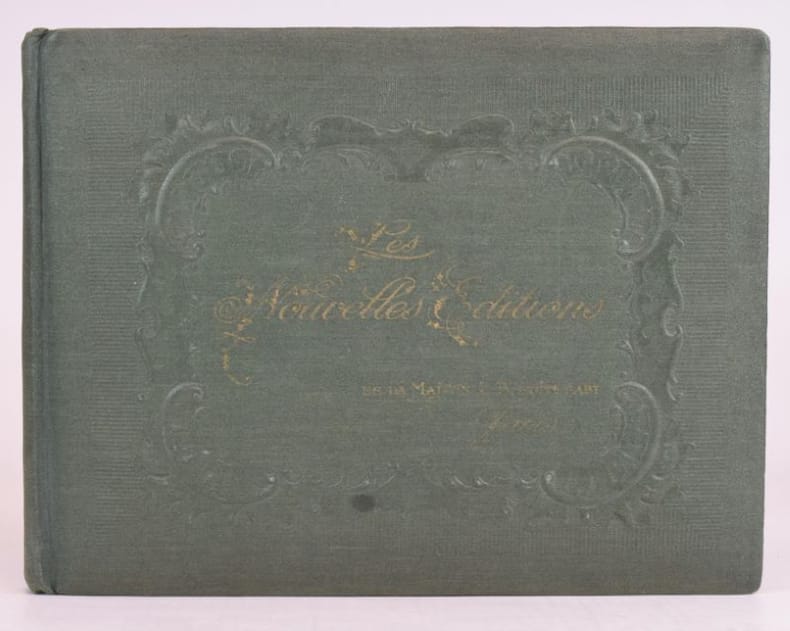
6903Paris, 240 x 321 x 240 mm, (31) feuillets avec 63 décors pour boîtes à dragées de baptême, (1) f. vierge (dernier). Reliure percaline, le premier plat comporte un décor à froid et une inscription dorée, un certain nombre de feuillets cartonnés sont insolés/ décolorés aux bords ou sur la totalité du feuillet, les vignettes collées sur les feuillets sont dans la très grande majorité très bien préservées. Bel exemplaire.
18205York: J. Kendrew 1820. Very good in stitched paper wraps with light soiling to covers. A charming 48mo chapbook. In its 16 pages it was able to fit 16 woodcuts. Kendrew despite being a provincial printer in York was one of the most prominent printers of nineteenth century children's chapbooks until his death in 1841. This instant book was from his series of twenty-four 16-page halfpenny chapbooks. Atkinson Street Literature of the Long Nineteenth Century pgs. 218-19.<br /> <br /> Uncommon in commerce as other copies appear bound as sammelbands with other chapbooks. Davis Kendrew of York 40; Opie N 799. J. Kendrew unknown
7247Sans lieu (Bourg), sans nom (Imprimerie Dufour), sans date ; in-8 ; bradel cartonné, pièce de titre en long sur la quasi-totalité du dos (reliure fin XIXe) ; 86 pp.
190019838Bruxelles: J. Verschueren 1900. Very good condition. An early Chinese railroad bond with attractive bank-note engraving and with three Chinese vignettes: a Chinese village a Chinese temple and a railway bridge spanning a large river. Printed in red & black with multiple tax stamps at top of page. Number 05219 with coupon sheet attached dated 1936 through 1944 with the 1936 coupon removed. Complete with statutes printed in red on verso. 14 x 15" J. Verschueren unknown
Ming dynasty 1 Kwan note of the Hung-wu era (1368-98), produced from 1375. Printed on grey mulberry bark paper, size ca. 335 x 222 mm. Framed and glazed. Extremely early example of a banknote, and a specimen of the largest paper money ever issued. The Chinese writing along the top of this Ming note reads "Da ming tong xing bao chao" (from right to left, in regular K'ai Shu style), which translates as "Great Ming Circulating Treasure Note". Below this, the denomination is written in two characters "yi guan" ("one string", then the equivalent of 1000 copper cash or one tael of purse silver or one-fourth tael of gold). Beneath the denomination is a picture of a string of 1000 coins, arranged in ten groups of one hundred coins. Beneath this are the instructions for use and a threat to punish forgers. - Paper very thin and fragile, with some very old repairs, partly faded and with some soiling, some folds. Traces of two faded red (vermilion) seal handstamps, one at each side. As these stamps typically tend to fade with time, they are not easily perceptible. These seals had the function of signatures on modern banknotes. The red imperial seal is applied on the reverse. The outer frame surrounding the text is ornamented with dragon patterns. On both sides of the centre are eight Chinese characters "Ta Ming Pao Ch'ao, Tien Hsia T'ung Hsing" (The Great Ming note, circulates everywhere) in Chuan Shu style. - The 1 Kuan note is the largest paper money ever issued. China was the first country in the world to use paper money (credit currency). The very earliest paper money notes date from the 11th and 12th centuries, but as only fragments of these are extant, they can only be described in very general terms. This kind of note was observed by Marco Polo in the 12th century, and he referred to it as "flying money". The oldest paper money of which a complete specimen survives is that from early Ming dynasty, dated 1375. These notes are the earliest numismatic prints, also the earliest obtainable commercial printing on paper, indeed very nearly the earliest obtainable printing of anything - a full lifetime before Gutenberg. Very few examples survive.
179662445CBLondres [London, i.e. Paris], Selbstverlag, 1796. 8°. 20,5 x 13 cm. 415 Seiten, Frontispiz, 5 Tafeln ; 2 Blatt, 398 Seiten, Frontispiz, 6 Tafeln. Erster Band: Brauner Lederband der Zeit mit schwarzen, ledernen Rückenschildern mit goldgeprägtem Rückentitel sowie ornamentaler Rückenvergoldung. Zweiter Band (abweichend): Fachmännisch restaurierter roter Lederband der Zeit auf fünf Bünden mit goldgeprägtem Rückentitel und ornamentaler Rückenvergoldung, Außen- und Innenkantenfileten, Rundum-Goldschnitt und marmorierten Vorsätzen. [6 Warenabbildungen]
Second edition, [2 ads], [36]pp., with printed title-page and half-title, engraved headpiece, the advert leaf includes two editions of Beckford's Vathek and A Description of Fonthill Abbey. Small 4to (235 x 145 mm), 2 works in one, recent half calf to style, marbled boards, spine tooled in gilt. A survey of the principal public and private libraries in England, listing highlights of the collections and concluding with brief accounts of 30 important English book auctions from the 17th century onwards. William Beckford assisted in the compilation of this work, particularly in the description of his own library at Fonthill. The Dialogue in the Shades is a two-part pamphlet of satirical verse is a response to Dibdin's Lincolne Nosegay and the Bibliographical Decameron. The attribution varies from William Beckford to the Clarke brothers. This second edition is issued with an additional half-title, title-page with note from 'Mr. Wynkem' on the verso, and with the addition of The Diary of Roger Payne, a work in the same vein. A rare anti-Dibdinia item. Windle & Pippin, D9.
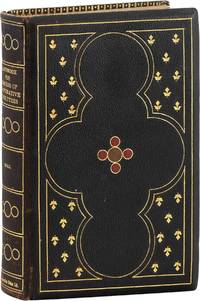
192483850Manchester: The Co-operative Union Limited 1924. Second edition revised. Octavo; xxii456pp. Presentation binding of full deep brown levant over beveled boards with on-laid decorations in red and tan; gilt ornaments to both boards and spine full gilt turn-ins; all edges gilt. With binder's ticket at rear pastedown: "Bound by / Co-Operative Printing Society / New Mount St. Manchester." Also with a handsome hand-colored calligraphic presentation leaf bound in before text: "Presented by the Central Education Committee of the Co-Operative Union Limited to H. Marlow Esq. on the occasion of the Week End Meeting held at Croydon. Easter: 1929. Trivial rubbing to spine ends; still a tight Fine copy. <br /> <br /> An excellent craft binding from the workshop of the Co-Operative Printing Society of Manchester originally founded in 1869 as the "North of England Co-operative Printing Society" a shared workspace and clearing house for printers binders lithographers and others engaged in the craft of bookmaking. It operated under the umbrella of the Co-operative Union Ltd founded in 1883 and the principal body of trade and wholesale cooperatives in Great Britain through most of the 20th century. We've been unsuccessful at discovering a precise identity for the recipient of this copy one "H. Marlow" a common-enough name to defy our efforts. The Co-operative Union Limited unknown
4to. (16) pp. Early 20th century coloured paper wrappers. Ordinance issued 4 August 1586 by Robert Dudley, Earl of Leicester, Governor-General of the United Provinces, to regulate the coinage. With privilege on the final page. EHB 1997. TB 6503.
2 rad. Tafeln (ca. 556 x 328 mm und 546 x 290 mm). Folio. Die beiden berühmten, nach Volcher Coiters Biographen Robert Herrlinger "vollends originell[en] und wegweisend[en]" Kinderskelett-Tafeln aus den "Externarum et internarum principalium humani corporis partium tabulae" (Nürnberg, 1572). Nachdem der jungverstorbene Mediziner Coiter (1534-76), ein in Nürnberg wirkender Friese, nach seiner Zeit in Italien an keiner Universität mehr lehrte, hatte das Werk zunächst nur einen sehr eingeschränkten Leserkreis, und seine "Auflage kann nicht groß gewesen sein" (Herrlinger, 57). Bei den hier vorliegenden Tafeln handelt es sich um "die ältesten bisher bekannten [Abbildungen] aus dem Gebiet der Embyrologie und Kinderanatomie. Es handelt sich um zwei große Falttafeln von über einem halben Meter Höhe [...] Die erste zeigt das Skelett eines halbjährigen Kindes von schräg vorne, die zweite von schräg hinten; auf dieser ist als 'Abb. 3' ein kleines Skelett einer dreimonatigen Fehlgeburt hinzugefügt [...] Alle Abbildungstafeln sind wie immer mit V.C.D. signiert. Wenn sie auch nicht völlig korrekt sind, so ist vor allem an den beiden großen Kinderskeletten bemerkenswert, wie Coiter versucht, in reiner Schwarz-Weiß-Technik Knorpel und Knochen als zwei verschiedene Materialien zu kennzeichnen: er punktiert den Knorpel und läßt den Knochen weiß. Noch heute ist diese Art der Knorpeldarstellung üblich [...] Coiters Kinderskelette haben Schule gemacht. Felix Platter bringt in seinem anatomischen Lehrbuch von 1583 ebenfalls, als zweiter, Kinderskelette, die ohne Coiter kaum denkbar sind [...] Wirklich neue, bessere Abbildungen vom foetalen und vom kindlichen Skelett gab erst Thomas Kerckring (1670). Coiters Abbildungen waren ein ganzes Jahrhundert lang maßgebend gewesen" (ebd., S. 80). - Etwas braunfleckig; kl. Einrisse alt hinterlegt. VD 16, ZV 3754. R. Herrlinger, Volcher Coiter (Nürnberg, 1952), S. 79ff. (mit Abb.).
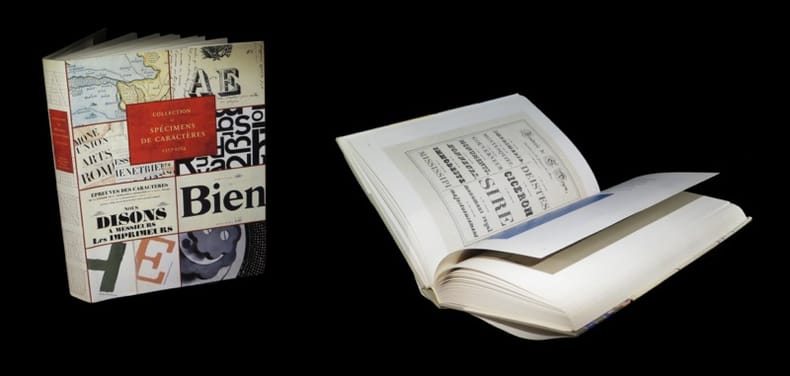
200629895S.l., Librairie Paul Jammes / Editions des Cendres, (2006). Un fort vol. au format in-4 (332 x 252 mm) de 393 pp. Plein cartonnage d'édition, sous jaquette illustrée.
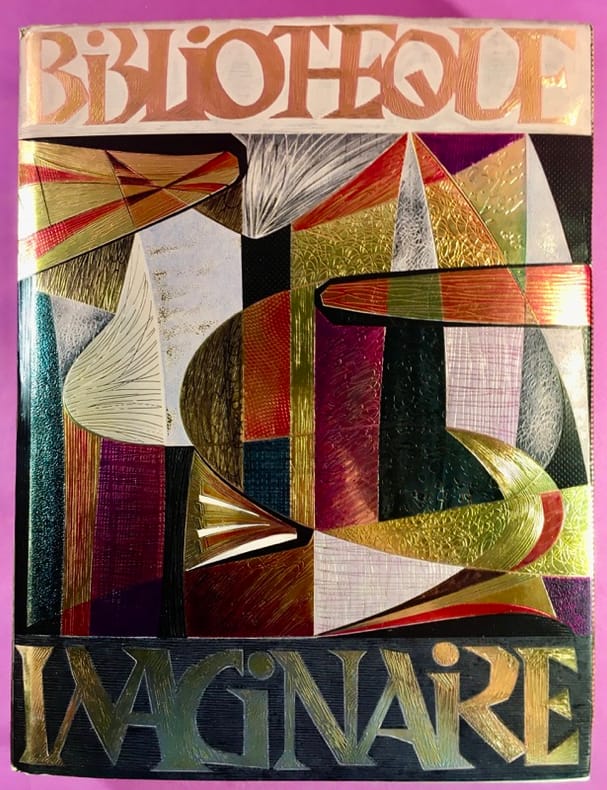
195613831956 Couverture rigide Paris, Compagnie Française d'Edition, 1956. Grand in-4 (32 x 25 cm), cartonnage d'éditeur à la Bradel, petits manques aux charnières en pied et en tête, jaquette illustrée, coiffe supérieure légèrement émoussée, jaquette bien conservée cependant, créée et gravée par Draeger frères à Montrouge. Catalogue d'imprimeurs et de typographes, contenant de nombreuses illustrations, ainsi que différents papiers d'impression. Riche iconographie. Bel état des planches, bel exemplaire.
VLE-167, Berger Levrault, 1976, in-4, 123pp. illustrées de reproductions de documents en noir et en couleurs et d'un tableau généalogique volant. Bon exemplaire reliure pleine toile éditeur noire, plat titré, dos lisse
192023717Bruxelles, Musée du Livre, (1920). Un vol. au format in-4 (308 x 227 mm) de 123 pp., broché.