7 767 résultats
ORD-653Lithographie. Typographie. Travaux de Luxe...Sans date (fin XIX° - début XX°). Une feuille (160 x 245mm), papier souple, portant une belle lithographie de publicité commerciale tirée en camaïeu de bleu représentant des figures allégoriques avec en arrière plan divers monuments d'Avignon dont le célèbre pont. Placard un peu poussiéreux mais séduisant.
176218193Cambridge J. Baskerville, 1762 ; grand in-12, maroquin rouge, dentelle d’encadrement des plats, dos très décoré et doré, roulette sur les coupes et d’intérieur, tranches dorées (reliure de l’époque), 202 ff. non chiffrés (coll. a, b, c, A-Z, Aa-Hh 6 ; A3, B-I 6, K 1).
4to. (2) ff., (1), LXII, (1) pp., (2) ff. With etched armorial title and 62 large etched portraits in the text by Virgil Solis and Jost Amman. Contemporary vellum boards using a late 15th century vellum manuscript in red, blue and brown ink. Expanded fourth edition with the etchings by Solis and Amman. The French original edition of the main text had first appeared in Lyon in 1570, published by Clement Baudin under the title "Chronique sommairement traitée des faits héroiques de tous les rois de France". The title page shows the French arms, held by two genii; the etchings in the text show medaillon portraits surrounded by elaborate scrollwork borders, with little historical scenes inserted below. "Ammans's borders appear darker throughout than those of Solis and are marked out by being containing an abundant wealth of minute details. The scrollwork is less plastic than that of Solis, and humans are more frequently depicted" (cf. O'Dell-Franke). - The title illustration and the third portrait (showing Merovech) are weak impressions, the others crisp and well-defined throughout. Provenance: handwritten bibliographical notes and ownership (dated 1823) by Johann Andreas Boerner (1785-1862), the noted Nuremberg print dealer and auctioneer, on the flyleaf. Later in the Max and Maurice Rosenheim Collection (round paper label on inside front cover), dispersed at Sotheby's in 1923. Very rare; a single copy in VD 16 (BSB Munich). VD 16, B 1901. Becker 81b. Cf. Ebert 518. O'Dell-Franke 149.
12mo. (58) ff. Gothic type. With lombards and rubrication throughout. With 36 woodcuts, of which 30 in original hand colour, 3 recurring woodcuts full-page sized (twice in colour). Modern full calf with giltstamped and blindstamped spine. Rare Latin edition of the illustrated devotional prepared by the Dominican friar Bertholdus around 1350. Intended for day-to-day worship, this popular prayer book is divided into 24 parts, each prayer corresponding to an hour of the day, and each concerned with an event in the Life of Christ, commencing with the Annunciation and concluding with the Last Judgement. - The work was first published in German under the title "Zeitglöcklein des Lebens und Leidens Christi"; the first Latin edition appeared in 1488. The present edition is not dated, but VD 16 considers it to be published ca. 1503, Grebe dates it ca. 1507. - 16th century notes in Latin to title-page and last page. - Top margin of fol. e8 reinforced. Last page narrowly cut with slight loss to the handwritten notes. An attractively coloured copy. HC 8930. Goff B-509. GW IV, Sp. 57a. Schramm VIII, 27. Proctor 1482. BMC I, 303. VD 16, B 2190. Grebe (Landen) 29. ISTC ib00509000.
1938LFA-126724420Une revue de 24 pages, format 150 x 230 mm, illustrée, brochée, publiée en 1938, bon état
1948LFA-126724439Une revue de 24 pages, format 150 x 230 mm, illustrée, brochée, publiée en 1948, bon état
1947LFA-126724466Une revue de 24 pages, format 150 x 230 mm, illustrée, brochée, publiée en 1947, bon état
192945431929 Paris Bulletin officiel des Maîtres imprimeurs 1929 In-folio, demi-chagrin brun à coins, dos à nerfs avec titre doré, couvertures conservées (M. Barast). Dos et coins frottés.
1927147111927 Paris, Quillet, 1927, in 4° broché, 48 pages non foliotées, 10 planches dont 3 dépliantes et 7 en couleurs, texte encadré dun décor en couleurs. Frontispice en couleurs et décor de Marcel JEANJEAN. Jolie brochure relatant les faits de la maison Quillet.
1860167691860 Paris, Dalahays, sans date (vers 1860), in 4° relié demi-chagrin noir, dos à nerfs, fer doré su Lycée Impérial de Vesoul frappé au centre du plst supérieur, 160 pages ; papier bruni avec fortes rousseurs ; frottis d'usage
23263Paris, Costard ou Fournier, 1776 à 1783. Deux volumes in-8 avec 5 jolies figures de Desrais. Contient dans le premier volume: Histoire de Pierre de Provence et de la belle Maguelonne (Paris, Costard, 1776); Histoire de Robert le Diable (Paris, Fournier, 1783); Histoire de Richard sans Peur, duc de Normandie; Histoire de Jean de Calais sur de nouveaux mémoires (Paris, Costard, 1776); Deuxième volume: Histoire de Fortunatus (Paris, 1776); Histoire des enfants de Fortunatus (Paris, 1775); Les quatres fils d' Aymon (Fournier, 1783, privilège en fin). Tous les contes ont une page de titre. Ex-libris de La Germonière. Veau mouchetté d'époque, dos à nerfs orné, pièces de titre et de tomaison de couleurs, tranches rouges. Bon état des reliures malgré quelques épidermures
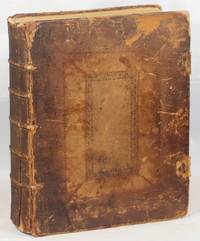
1791000015094Worcester Massachusetts: Isaiah Thomas 1791. First Thomas edition. Hardcover. Good or better. 4to. 2 3-1310 pp. Contemporary paneled sheep with the spine in six compartments. Illustrated with two engraved frontispieces. Completing the title page: And with the former translations diligently compared and revised by the special command of King James I of England. With marginal notes and references. To which are added an index and an alphabetical table of the names in the Old and New Testaments with their significations. American Antiquarian Society "Isaiah Thomas’s Printing Press: "Old Number One". Darlow and Moule 1353. Isaiah Thomas' printing press first operated out of Boston: producing a newspaper and materials that encouraged American colonists to rebel against the British imperial government. Thomas moved his press to Worcester at the behest of his friends who suspected that it would be impounded by the British authorities. Thomas' Bible was produced in several quarto octavo and duodecimo editions. Darlow and Moule note that Thomas enlisted the help of clergymen and others to compare nearly thirty different editions of the scripture. The Thomas Bible is one of the more attractive productions of early American printing. The clasps largely perished quite a bit of rubbing to the leather's edges. Lacks leaves K3 and K4 the final verses of Maccabees also lacks the endpapers. An armorial bookplate that states "Williams" on the front pastedown an inscription reading Thomas Williams Jr. 1792 on the verso of the Apocrypha title page. Isaiah Thomas hardcover
Folio (240 x 369 mm). (6), 474 (but: 475), (3), 475-604, (15) ff. With woodcut title-page printed in red and black, 18 woodcut borders, 4 of which full-page size, and 136 woodcuts in the text, including a full-page depiction of the symbols of the Four Evangelists, a world map, and a full-length portrait of Joshua. Woodcut printer's device on title and at the end of the text. Contemporary calf over wooden boards with bevelled edges; two clasps. Second edition of the famous Melantrich Bible, published five times between 1549 and 1577. The present edition features for the first time the Bohemian version of a comparison of the Evangelists (translated from German by Jan Stránenský), surrounded by woodcut borders. It also contains the third Maccabees and the voyages of St. Paul, both translated by Sixt d'Ottersdorf, and originally published in the first edition. Richly illustrated throughout with. The small world map shows the three continents, Europe, Asia and Africa. - With contemporary ownership and a Czech note in a different hand to flyleaf. Second printer's device has added handwritten motto "Super omnes gentes" and additional ownership. Folios 203 and 343 are used twice; later, the foliation omits 404. The woodcut depicting the Fall of Man censored with sanguine pencil. Severe paper flaws to the margins near beginning and end of the volume with substantial text loss, partly remargined with paper 18th century paper. The title-page, the table of contents, and 3 full-page woodcut borders are retouched in ink by a contemporary hand. Several pages show small inkstains; a larger stain on ff. 442-450. Margins fingerstained and partly waterstained. Some underlinings, notes and cancellations in pencil and pen by contemporary and modern hands. From the library of the Viennese collector Werner Habel, with his signed and stamped ownership, dated 1982, to the pastedown. His note of acquisition from 1981 is loosely enclosed. Graesse I, 371. Darlow/Moule 2182 (note, no. 3).
8vo. (64) pp. With woodcut printer's device on verso of final leaf. Bound with numerous blank leaves. Contemporary vellum. First edition. "Decalogue with the commentary of Aben Esra [...]. Leaves d7-d8 contain the Aramaic text of the Ten Commandments [...]. Re-issued in 1559 by Sebastian Lepusculus" (cf. Burmeister, pp. 11; 111). The "synoptic word-for-word translations" of Biblical texts which Münster published during his Heidelberg years is a characteristic of his scheme of a "Propagatio linguae sanctae", to spread the knowledge of Hebrew at German universities (cf. Burmeister, p. 11). - Occasional insignificant waterstaining. Old ms. ownership of the Vienna Jesuits to title page; stamps of Vienna University Library and of Kubasta & Voigt, Vienna (c. 1900). VD 16, B 3018. Burmeister 145. Hanztsch 244.I.1. Prijs 29. Panzer VI, 260, 662. Fürst I, 252. Steinschneider (Bodl.) 681.8. Vinograd, Basle 28. Graesse I, 4. Yudlov, Ginzei Yisrael 1859. OCLC 311420175. Not in BM-STC.
8vo. (132) ff. With 2 different woodcut devices. - (Bound with) II: [Melekhet ha-dikduk]. Institutiones grammaticae in Hebraeam linguam [...]. (144) ff. With several musical notes and two woodcut devices. Modern vellum, in custom-made cloth case. I: Second edition of Münster's "Proverbs", previously published in 1520, together with his first own work ever, an introduction to Hebrew grammar. Numerous contemporary Hebrew and Latin marginalia. - II: Only edition of Münster's second publication, a foundation stone of modern Hebrew studies. Includes (fol. r1 ff.) the co-called Jonas polyglot in Hebrew, Chaldaic, Greek, and Latin, with other matter. Contemp. ownership obliterated from t. p.; lower corner defective (remargined professionally; losses supplied in pencil). Numerous contemp. marginalia, mostly in Latin. Both works are very rare; the former has not been seen at auctions since 1950. I: VD 16, B 3564. Burmeister 137. Hantzsch 234.2-4. Adams B 1536. Steinschneider (Bodl.) 11.51. Panzer VI, 244, 540. Vinograd Mem 1256. OCLC 71515193. Not in BM-STC. - II: VD 16, M 6685. Burmeister 2. Hantzsch 220.2. Adams M 1931. BM-STC German 633. Steinschneider (Hdb.) 1374. Panzer VI, 245, 541. Wolfheim I, 865. Graesse IV, 623. OCLC 22612604.
Large folio (280 x 360 mm). Including Menardus monachus. (1), CCCCLXI, (6) ff., with two coloured historiated initials. 16th century blindstamped pigskin binding over wooden boards, wants clasps. Koberger's third Latin Bible, printed with the same types as the second: in the splendid Gothic typeface which Koberger used exclusively for his Bibles; at the same time, the earliest type he is known to have used (cf. Klemm, Bibliogr. Mus., 722). The initial on fol. i shows the evangelist Mark with the lion; the tendril decoration reaches from the upper edge (slightly trimmed) to the lower one, ending in a coat of arms bearing the monogram "S-A-B". The second historiated initial on fol. iiii shows the Fall from Grace (Adam and Eve in paradise, with the apple tree and the serpent in the centre); here, the tendrils reach as far as the lower third of the page and also end in a coat of arms. Very exactingly rubricated throughout; signed at the end: "91 Jo fec". Several handwritten ownerships to fol. A1r, some contemporary, others as late as 1876: the name and printed bookplate of "C. R. Earley, Ridgway, Pa." (1823-98). Several manuscript marginalia. Some slight browning to the gutter of the first few leaves, staining to upper edge of fol. i. Insignificant waterstaining to upper edge of several leaves; occasional foxing or tiny smudged inkstains. Handwritten marginalia trimmed in places, but altogether a crisp, wide-margined copy. Some staining to the hefty binding; edges as well as a crack to the upper cover have been unobtrusively repaired. Hain 3068. Goff B-556. GW 4232. BMC II, 415. Polain 648. Pellechet 2296. Oates 988. Hase 27.
8vo (105 x 159 mm). (3), 69 (but: 68), (1) ff. With two different woodcut devices to title-page and colophon; several pretty woodcut initials. Contemporary Italian carta rustica binding. Rare first Italian edition of these Fables of Bidpai. Reprinted in 1610 and again in 1872. First translated from the Pehlevi version into Arabic under the title "Kalilah wa-dimnah" by Ibn al-Muqaffa and subsequently into Greek by Simeon Seth, whose version is known under the title of "Stephanites kai Ichnelates". From this version the present Italian one is derived. - The ancient Sanskrit Panchatantra fables, a classic of the genre, are thought to have been assembled ca. 200 BC out of stories from an even older oral tradition. The stories became known in Europe through Hebrew translations of Arabic versions under the name Bidpai. Featuring animals as a mirror for human behaviour, the fables were intended to educate people, especially young rulers. - Binding a little stained. Interior shows occasional browning and very minor staining; old ink annotations to pastedown and flyleaf. An appealing copy. Chauvin II, p. 24, no. 38A. BM-STC Italian 309. Edit 16, CNCE 35122. OCLC 22606298. Not in Adams.
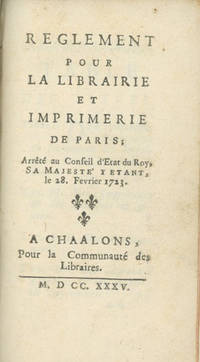
173528870Chaalons' i.e. Châlons-sur-Marne 'pour la Communauté des Libraires' 1735 1735. New edition apparently unrecorded. Not found on OCLC or the Union Catalogue of France CCFr. A fine copy. 12mo contemporary polished continental calf marbled paper endpapers blind-ruled borders red morocco spine label gilt decorations and lettering a.e. stained red. Woodcut tailpieces. By the late 17th century the French government attempted to regulate all aspects of printing and the distribution of books in and around Paris. In 1686 those regulations were codified in the Édit du Roy pour le Règlement des Imprimeurs et Libraires de Paris and the Édit du Roy pour le Règlement des Relieurs et doreurs de Livres. Further revisions were made 30 years later and after some disagreements two editions of the code were published in 1723 and 1731 in the form of a decree. The code was extended to all of France in 1744 and remained in effect until 1777. This edition is a provincially printed version of the 1723 edition printed in Châlons-sur-Marne in 1735. The code is divided into 123 articles and is remarkably comprehensive in its regulation of all aspects of the trade including the import of books old and new bound and unbound and of imported printing types; books sold by subscription; requirements for the apprenticeships to booksellers and printers; the widows of booksellers and of printers; proofreaders; type founders; traveling booksellers; fairground booksellers and printers; prohibited books; auctions and inventories of libraries and bookstores et al. From the library of 19th century Châlons librarian and local historian Amédée Lhote with his bookplate on the front paste-down and ink ownership stamp in the margin of the final page of text; a bookseller's catalogue entry for the Histoire de l'imprimerie a Châlons 1895 on the rear paste-down. Marginal notations in ink on two leaves. Chaalons' [i.e. Châlons-sur-Marne], 'pour la Communauté des Libraires', 1735 unknown
8vo (12 x 17 cm). 147, (1) pp. With woodcut printer's device, 3 stipple-engraved initials, and a woodcut on the last page. Contemporary limp vellum. First Latin edition of this alchemical work, first published in Venice in 1544 as "La Espositione di Geber philosopho". Written in the form of a dialogue, the first part contains a conversation between a certain Demogorgon and Geber (whom Demogorgon addresses as "most learned nephew of Mahomet") about the latter's works. In the second part Demogorgon interviews Raymond Lull about his "Lignum vitae" and the discovery of a remedy to prolong human life. Kopp suspects that the anonymous author Bracesco was a 16th century physician and alchemist from Orzinuovi near Brescia. - Binding a little rubbed, lacking ties. Interior somewhat browned and stained throughout, the first leaves more so. Curiously, the first 26 pages in particular (but also a few later pages) have been mutilated by an early owner, who obscured and excised particular words from the text (apparently mainly concerning the word "vitriolum"); these lacunae have been rebacked with paper and the missing text supplied by the hand of a later owner. Some worming to lower gutter of the first 16 leaves, with slight loss. With contemporary ink marginalia in Latin throughout. Adams J 8. BM-STC French 238. Rosenthal 337. Brüning 247 (all s. v. Geber). Ferguson I, 123. CG XL, 1024. Baudrier III, 46. Palau 143878. Alchemy and the Occult 18.4. Bolton, Select Bibl. of Chemistry, p. 972. OCLC 18153918. For Jabir see GAL I 241; GAL S I 426ff.
4to. 146 (instead of 164) ff., wanting fols. 1, 9, 15, 51, 56-58, 81-82, 96-97, the four unnumbered leaves after 144, 157-159, and the final blank. With 108 (instead of 117) woodcuts in the text and printer's device at the end. Early 19th century half calf over papered boards with giltstamped spine label. Edges sprinkled. Early, if incomplete Latin edition of the famous "Narrenschiff", originally published in German verse in 1494 - also by Bergmann - and translated by the author's student Jacob Locher. One of literature's most famous satires and a milestone in the history of book illustration: many of the woodcuts depicting human foibles (here printed from the original blocks) are now attributed to the young Albrecht Dürer. Before Goethe's "Werther" arrived on the scene, this work was the most successful book ever published in Germany, immensely popular and read until it fell to pieces, and complete copies of the incunabular Basel editions are nearly unobtainable. - In his "Ship of Fools", Brant describes the voyage of a ship bearing one hundred fools, to the fools' paradise of Narragonia, thereby satirizing the follies of his time including representatives of every human and social type. "[T]he first original work by a German which passed into world literature [... it] helped to blaze the trail that leads from medieval allegory to modern satire, drama and novel of character" (PMM). Erwin Panofsky called the book "a remarkably complete mirror of human life", based upon the "universality of Brant's self-righteous surliness [...] and the picturesqueness of his metaphors" (Panofsky, p. 30). Incidentally, the book also contains the earliest literary reference to the discovery of America: "Hesperie occidue rex Ferdinandus: in alto Aequore nunc gentes repperit innumeras" ("Ferdinand, King of the West, recently discovered innumerable peoples across the high seas", fol. 76v). Tellingly, the humanist-printer Bergmann had published the famous "Columbus letter" in 1493. - Some browning and brownstaining; occasional underlinings by a near-contemporary hand (more frequent in the beginning and within the chapter on women). Folio b2 is loosened. Rebound in the 18th century (edges trimmed fairly closely). Small hole in the spine, otherwise well-preserved copy from the collection of the Swedish statesman and diplomat Lars von Engeström (1751-1826) with his engraved armorial bookplate (motto "speravit infestis", "hopeful in adversity") to pastedown. Hain 3751*. Goff B-1091; GW 5062. Bod-inc B-513. Sheppard 2560. Proctor 7778. BSB-Ink B-821. Hieronymus, Buchillus. 195. Cf. PMM 37. Harrise, BAV, Additions, no. 21.

First edition, 127pp., orig. cloth. From the reference library of Prof. T. A. Birrell.
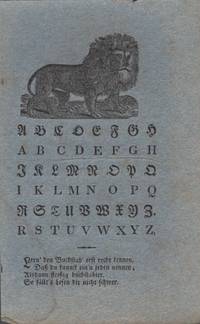
35630New Market Virginia: Henkel Printing Company n.d. Broadside. Good. Broadside. Gray paper. Approx. 7" x 5". Illustrated Lion top of the broadside. ABC letters in German and American with 4 lines of German print below. Light damp stain to the paper. No printer information found but this is very similar to what Henkel Publishing Company in New Market Virginia printed in the early to mid 1800's. Henkel Printing Company unknown
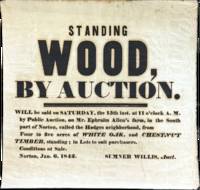
78817Broadside for an auction of standing trees on land owned by Ephraim Allen 1801-88 a successful farmer and landowner. Offered were four to five acres of white oak and chestnut timber in lots to suit purchasers.<br /> <br /> Standing timber auctions date back to Europe as early as the 18th century.<br /> <br /> This broadside contains no printing information. It was likely produced inexpensively at a local print shop and posted in public spaces then torn down and never intended to be preserved. Printed on tissue thin paper 12 ½†x 12 ¼†in black with outlining in tan. Some light toning. unknown
EXE00b8fParis, 1929. Grand in-4 broché, couverture illustrée en couleurs, pagination multiple.