MOREAU DE SAINT-MERY (Médéric-Louis-Elie).Livre Rare Book
6 389 résultats
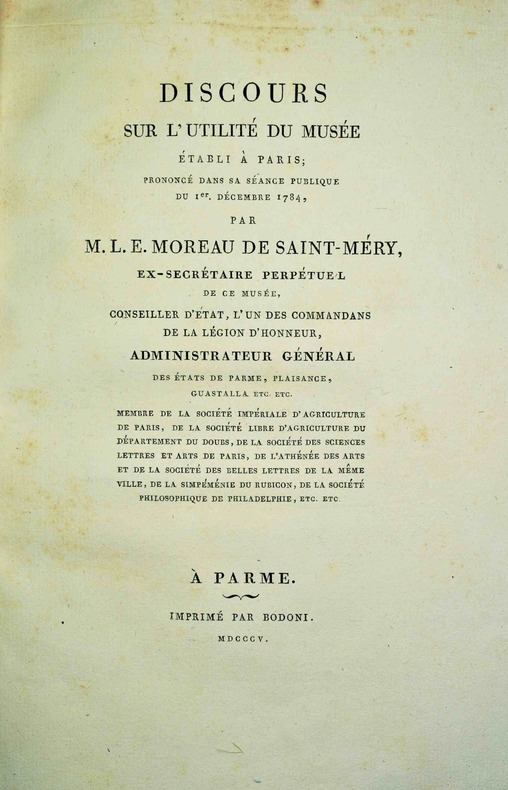
180511223A Parme, imprimé par Bodoni, 1805. In-4 broché de (6)-32 pp.
17739297Aureliae (Orléans), Couret de Villeneuve, 1773. In-16 de (4)-91-(1) pp., maroquin rouge, dos lisse orné, triple filet doré d'encadrement sur les plats, tranches dorées (reliure de l'époque).
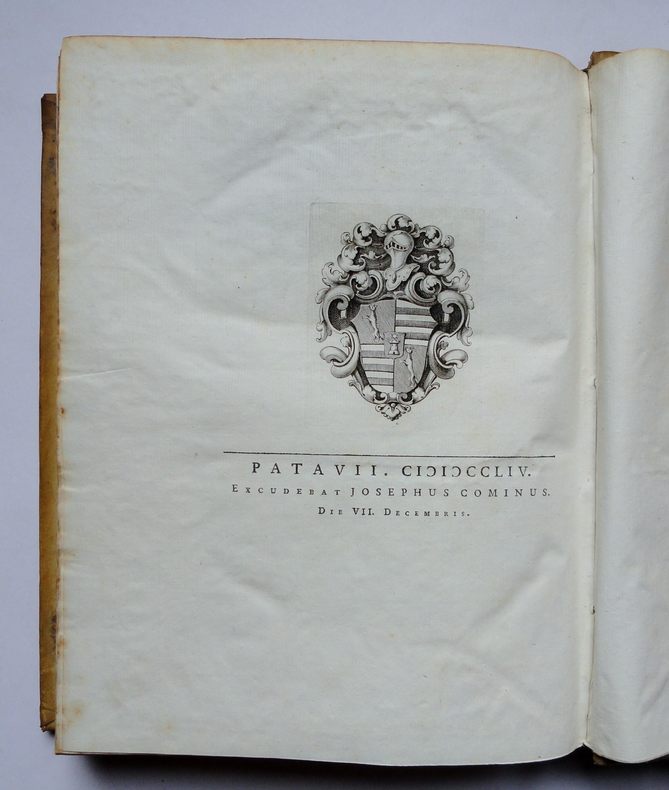
ZNC-93Patavii (Padoue), excudebat Josephus Cominus, 1755, 2 volumes in-4°, LXVIII+1290 pages (pagination continue), plein vélin de l'époque, dos lisse.
182710276Paris, à la Librairie universelle, de l' Imprimerie d'Honoré de Balzac, 1827. In-12 de 122 pp., demi-basane prune, dos orné à nerfs (reliure de l'époque).
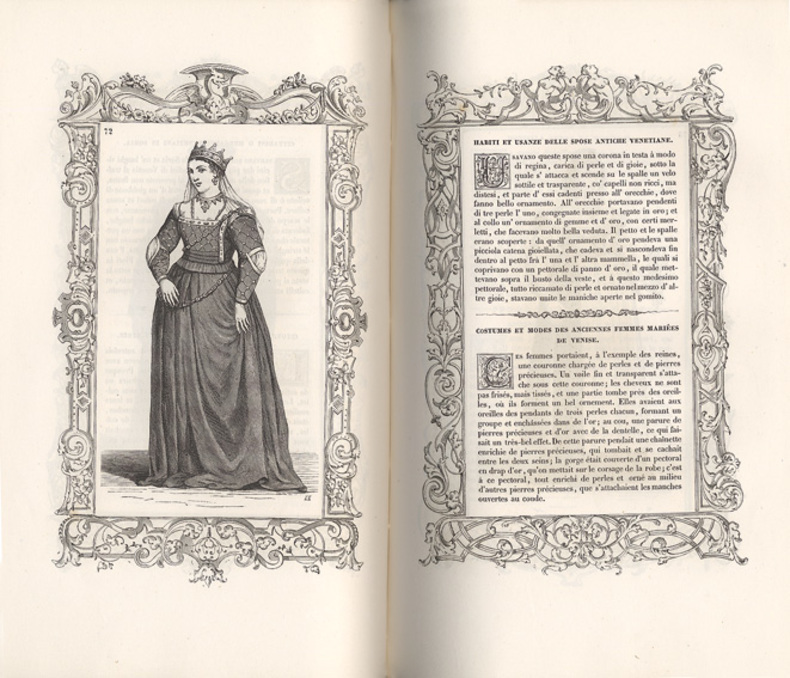
87331860. Relié avant : Essai typographique et bibliographique sur l'histoire de la gravure sur bois par Ambroise Firmin Didot. 1863. Paris, Typographie de Firmin Didot Frères Fils ; trois tomes reliés en deux volumes ; demi-chagrin maroquiné bordeaux, dos à quatre nerfs encadrant l'auteur et le titre dorés, date en queue, les couvertures illustrées et les dos, jaune paille, ont été conservés (reliure postérieure) ; XIV col., (1) p. bl., 316 col., (1) f. bl. ; 9 pp., (1 bl.), (1) p. faux-titre, (234 au tome 1er), 513 planches en tout : les planches de costumes, gravées sur bois, sont présentées sur la page de gauche et le texte qui les accompagne, en italien et en français, en face sur la page de droite, costumes et texte sont dans de grands encadrements décoratifs gravés sur bois ; 18 et 19 pp. de table des matières finissent les tomes 1 et 2.
viii, 94, [2], [1]-120, [4]pp., with half-title. 3 works bound in one (the first named bound last), cont. mottled sheep, worn. The second edition of this poem on the different technical processes involved in printing. This edition was published by Claude Charles Thiboust, his father, Cluade Louis Thiboust, was the author of the poem, and had originally printed it in 1718. The family of Thilboust occupies a distinguished place in the list of French typographers, having started printing in Paris in the middle of the sixteenth century, with successive members of the family being appointed to be Printers to the University. This is followed by two editions of Doissen's poem on engraving. Bigmore & Wyman, III, p. 8; I, p. 183
19250457391925. kl 8°, selbstgestalteter Ganzpergamenteinbd in Fadenheftung, 4 Bl. auf Zanders-Bütten, Titel, Initialien und Partitur in Blau - das meisterhaft gestaltete kalligraphische Manuskript in sehr gutem Zustand
19250457411925. kl 8°, selbstgestalteter Halbpergamenteinbd. in Fadenheftung, 4 Bl. auf Zanders-Bütten, Initialien in Rot - das meisterhaft gestaltete kalligraphische Manuskript mit leicht beriebenen Ecken, sonst in sehr gutem Zustand
200994012ABParis, La Compagnie Typographique, 2009. 35,5x28,2 cm. 2 w. Bl., 116 S., 2 S., 1 Bl., 2 w. Bl. Lose Bogen in OBroschurdecke mit blindgepr. Deckeltitel, in OLeinendecke mit Deckelschild, in Kassette. [4 Warenabbildungen] Wenige winzige Flecken auf Kassettendeckel.
1930704021Strassburg, Heitz & Cie., ohne Jahr (1930). 2 weiße Bl., 76 Blätter, 2 weiße. Mit (faksimilierten) Holzschnitten. Zweiseitig unbeschnittener Orig.-Halbledereinband über Holzdeckeln mit mittig angeordneter Orig.-Messingschließe. Titelschild auf Rücken und Vorderdeckel. Tadellos.
1980703286Frankfurt, Büchergilde Gutenberg, ohne Jahr (1980). Gr.-2°. 48,0 cm x 34,6 cm. 4 nnr. Seiten Text, 8 Blätter OGrafik. Illustrierte und auf den Innenseiten bedruckte Orig.-Kartonmappe. Die Umschlagkanten und der Rücken mit minimalem Abrieb (der dazugehörige und vorhandene Schuber ist zu klein), sonst tadelsfrei.
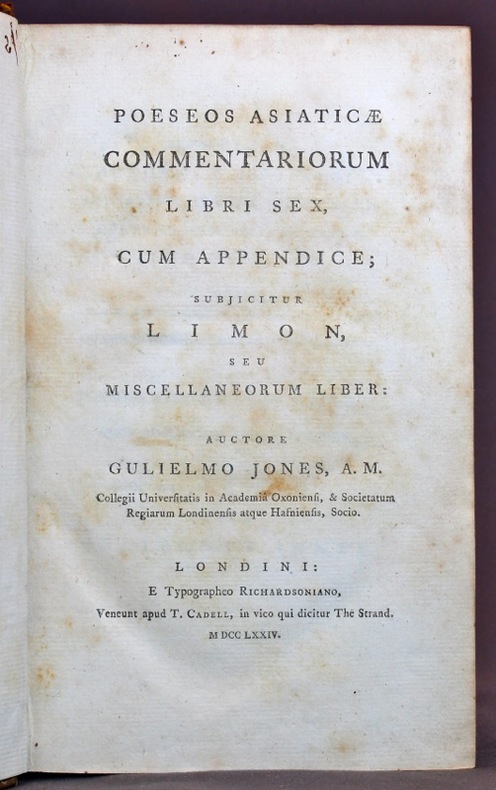
177415633Londini, E Typographeo Richardsoniano, veneunt Apud T. Cadell, 1774. In-8 de [2]-XXXI-[1]-542-[2] pages, plein veau beige, dos à nerfs joliment orné de filets et fleurons dorés, pièce de titre en maroquin rouge, roulette dorée sur les coupes.
537Paris, Union Bibliophile de France, 1947. In-4° oblong en feuilles, couverture, chemise et étui. Edition originale illustrée par André Jacquemin de 15 bois gravés in-texte, tirés en deux tons, et 12 grandes eaux-fortes originales, hors-texte. Tiré à 200 exemplaires, tous sur vélin. Typographie due à Maximilien Vox.
185313061'A TRIUMPH OF PRINTING<br />AS WELL AS OF ILLUSTRATION AND TYPOGRAPHY'<br />IN AN APPROPRIATE SCOTTISH BINDING<br />first edition thus 12mo. in sixes collates a-d6 B-Z6 AA-KK6 a-z6 AA6 that is 720 pages printed in Caslon type title page printed in red and black within a deep and striking woodcut border representing the Tree of Jesse full-page woodcut of Queen Elizabeth on verso of title page text inside varied and complex decorative and pictorial woodcut borders throughout by Mary Byfield decorative initial letters contemporary dark purple morocco over bevelled boards signed on verso of front free endpaper "Orrock Binder Edinb." sides blocked with 8 nesting borders of blind fillets and rolls some crossing at the corners to make small corner compartments with a leaf tool in blind in each spine with raised bands and blind tooling direct lettered gilt all edges gilt purple ribbon marker some very minor and scattered light foxing some light rubbing else a nice copy. Handsome copy of a most attractive book.<br /><br />GRIFFITHS <i>Bibliography . Book of Common Prayer</i> 1853 22<br />"The cuts harmonize perfectly with the type and this small tome is a triumph of printing as well as of illustration and typography" R. McLean <i>Victorian Book Desig</i>n 1972 p.12.For this book Mary Byfield 1795-1871 who spent most of her life working for the Chiswick Press cut over 100 wood blocks. These blocks many of great beauty were in the main based on early designs by Holbein Dürer Tory &c. copied from Queen Elizabeth's Book of Christian Prayers London 1581 and 1590 but they also included some based on contemporary designs by Charlotte Whittingham although to distinguish the old from the new is virtually impossible.<br />This edition was afterwards reissued by other publishers. William Pickering [printed by C. Whittingham at the Chiswick Press] hardcover
[Fig. Tipografo-Raro] (cm.16,5) ottima piena pergamena coeva con unghie. Titolo al dorso. -- cc. 24 nn., cc. 220, cc. 8 nn. Bella xilografia al verso del frontis con una natività e un' altra con una crocifissione a c. 24 nn. ripetuta poi sull' ultima carta. Edizione originale rarissima del tipografo ed editore Eliano Vittorio, che dal 1569 al 1577 stampò solo una ventina di edizioni ( Ascarelli-Menato 118). Molto particolare è la bella marca tipografica al frontis con un drago entro stemma e cartiglio assolutamente sconosciuta a Vaccaro e Zappella che conoscono quella nota col Pelliccano. L' edizione manca ad Adams, Bm. Stc., Choix e a molta Bibliogr. consultata. Antico ex libris al frontis, piccolo tarlo, ben restaurato al margine bianco di alcune carte interne, qualche ombreggiatura ma esemplare bello e genuino stampato su carta pesante. * Ascarelli "Cinquecentine Romane" p. 38; * Menato-Sandal-Zappella " Dizionario dei Tipografi Italiani " p. 404, ignora la marca col Drago.[f52] Libro
7 vols., in 8, roy. 8vo., Mixed Editions, with 5 mounted coloured frontispieces, 2 frontispieces in monochrome and very numerous plates and tables throughout; original buckram gilt, gilt backs, sixth and eighth volumes in dustwrapper, a near fine set. The first five volumes have neat uniform blind-embossed personal stamp on front free endpapers; seventh volume has neat contemporary signature on front free endpaper; eighth volume is A PRESENTATION COPY FROM THE AUTHOR WITH HIS SIGNED HOLOGRAPH INSCRIPTION ON TITLE. The extended set comprises: Vol. I: The Thunderer in the Making 1785-1841 (1935; second impression 1950); Vol. II: The Tradition Established 1841-1884 (1939); Vol. III: The Twentieth Century Test 1884-1912 (1947; second impression 1951); Vol. IV Part 1: The 150th Anniversary and Beyond 1912-1920 (1952); Vol. IV Part 2: The 150th Anniversary and Beyond 1921-1948, Appendices and Index, (1952); Vol. V: Struggles in Peace and War 1939-1966 (1984; errata slip loosely inserted) Vol. VI: The Thomson Years 1966-1981 (1993); Vol. VII: The Murdoch Years 1981-2002 (2005). EXTENDED SETS ARE EXTREMELY SCARCE.
GC10-271s.o., s.o. 10 original Broschuren, quer-8?, durchg?ngig mit Schriftsortenbeispielen, 2 Seiten mit L?sur, sonst guter Zustand
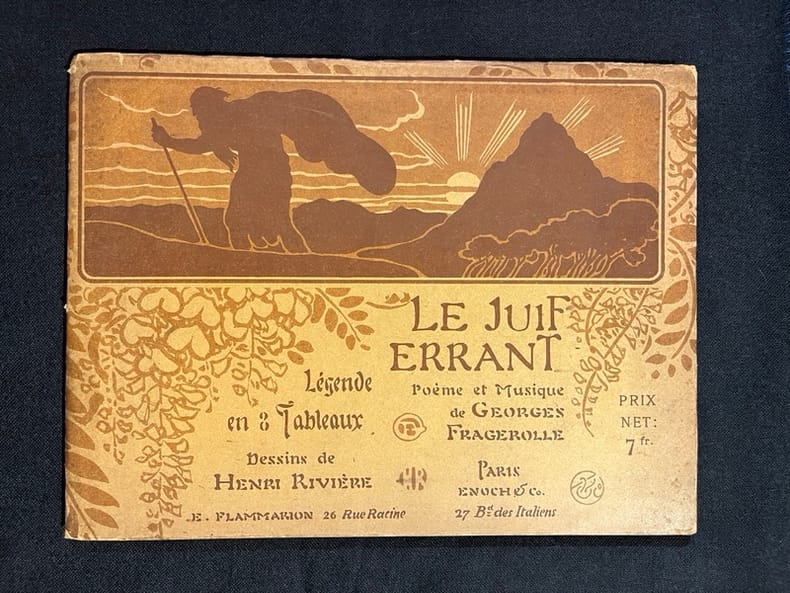
189821566Paris, Enoch et Co.; E. Flammarion, 1898. Petit in-4 oblong de 44-[4] pages, cartonnage décoré de l'éditeur, jaquette illustrée conservée.
9 Parts., 4to, numerous plates throughout, including some chromolithographed (some which a couple of the folding examples are adhered), list of prices and buyers' names bound in of the back of each part, uniform brown buckram, spines lettered in gilt. A complete record of the sale of printed books and manuscripts which De Ricci described as "one of the most striking events in the history of the English sale-rooms". Huth's collection, which ranked among the finest in England, was rich in incunabula, voyages, Shakespearean and early English literature, and Bibles. De Ricci, pp. 151-154.
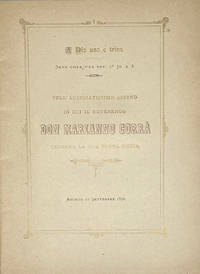
1890102911<p>Agordo Tipografia Cavassago 1890. 4to. 17 i pp. Title & text within a double rule decorative frame printed in gold with bronze ink titling main text in black. Original yellow card cover printed with blue ink slight sunning to upper cover decorative rectagnular upper cover panel of scrollwork repeated circular ornament with small devotional vignettes & putti on the angles and crosspieces. A very good copy.</p><p>A finely printed devotional booklet celebrating the first mass of Don Marianno Corrà. <strong>Antiquarian printings from Agordo seem particularly rare and the press of the Tipografia Cavassagio seems entirely unrepresented outside of Italy in institutional holdings. </strong></p>
35600991, A Dijon, de l’Imprimerie de L.N. Frantin, 1797; 2 tomes en 1 vol. in-8, demi-basane rose, fil. dor., tr. jasp. (Rel. du XIX e s.). 2 ff., 251 pp.- 2 ff., 243 pp., 1 f. table.Ce livre rarissime fut imprimé à Dijon par Louis-Nicolas Frantin. Tirage à 24 exemplaires seulement sur vergé de Hollande. Ce typographe natif d’Auxonne, alla à Dijon diriger la librairie de sa tante, la veuve Coignard, en 1750. Il obtint son brevet en 1753 et racheta l’imprimerie Saint en 1768. Frantin devint l’imprimeur le plus important de la ville. Au cours des années 1780 il accepta des charges publiques et devint échevin de Dijon. Réélu en 1789 il devint le chef d’un groupe politique vivement critiqué. « Rendu à la vie privée, Frantin réimprima les chefs-d’œuvre de notre littérature , et ses presses rivalisèrent avec celles de Causse, sans cependant atteindre à la même perfection. Souvent il faisait des tirages à petit nombre, sur papiers de luxe, fort recherchés par nos bibliophiles contemporains…Il donne ainsi…Voyage sentimental en France 1797 ( 24 exempl. Sur papier de Hollande) ». Clément-Janin. Les imprimeurs et les libraires dans la Côte-d’or p. 76.
1764KC8048Venice: Remondini 1764. Hardcover. Very Good. Folio 315 x 240mm. 38pp. I-XXXVIII. Finely printed with decorative chapter headings and tail-pieces. Engraved printerÂ’s device of Remondini depicting bishop with putti carrying crozier and miter. Engraved vignette of muses on dedication page. Decorative paper covered boards; some minor soiling or staining joint repaired on title verso lacking first and last blanks otherwise complete and in good form with good wide margins. <br/><br/>Collection of poetic essays in song of Sister Maria Theresa Crocefissa 1645-1699 an Augustinian nun from Venice known for her long orations printed by the Remondini press. In the 16th century Venice was the marketplace of the world. Its location on the lagoon and its unique connections with the sea distinguished it as a cosmopolitan center among the great cities of the Renaissance. In this larger context commerce and trade played a central role in the development and achievements of music printing. The subject of this work is poems written as canzones and sonettoes or songs and little songs of Sister Maria Crocefissa. From an early age Maria Crocefissa was devoted to long poetic orations. Soon she was also engaged in self-punitive actions including wearing a hairshirt. At the age of 23 she experienced her first religious ecstasies. During these periods of trance some lasting well over a week she regressed into a childlike state that left her completely paralyzed. The presence of Maria Crocefissa in her Augustinian convent of San Girolamo brought about a series of supernatural episodes and mysterious sightings which interested the public. While she was still alive her papers were widely published. This particular title of her poems addressed to Girolama Gaudio is of utmost rarity not located in a contemporary library collection or market worldwide. From the Remondini press who by the second half of the 18th century were employing more than a thousand people in the Bassano del Grappa with hundreds of others busy in their local paper mills and selling their products in scores of countries making them perhaps the biggest publishers in Europe. Between 1751 and 1790 Remondini were granted more licenses for books than all the other Venice booksellers put together. Printed matter was a luxury and the Remondini press was known to employ refined typographical features to suit the tastes of buyers. In this work attention is paid to the decorative elements initials and layout of each page. Remondini hardcover books
1764KC8048Venice: Remondini 1764. Hardcover. Very Good. Folio 315 x 240mm. 38pp. I-XXXVIII. Finely printed with decorative chapter headings and tail-pieces. Engraved printers device of Remondini depicting bishop with putti carrying crozier and miter. Engraved vignette of muses on dedication page. Decorative paper covered boards; some minor soiling or staining joint repaired on title verso lacking first and last blanks otherwise complete and in good form with good wide margins. <br/><br/>Collection of poetic essays in song of Sister Maria Theresa Crocefissa 1645-1699 an Augustinian nun from Venice known for her long orations printed by the Remondini press. In the 16th century Venice was the marketplace of the world. Its location on the lagoon and its unique connections with the sea distinguished it as a cosmopolitan center among the great cities of the Renaissance. In this larger context commerce and trade played a central role in the development and achievements of music printing. The subject of this work is poems written as canzones and sonettoes or songs and little songs of Sister Maria Crocefissa. From an early age Maria Crocefissa was devoted to long poetic orations. Soon she was also engaged in self-punitive actions including wearing a hairshirt. At the age of 23 she experienced her first religious ecstasies. During these periods of trance some lasting well over a week she regressed into a childlike state that left her completely paralyzed. The presence of Maria Crocefissa in her Augustinian convent of San Girolamo brought about a series of supernatural episodes and mysterious sightings which interested the public. While she was still alive her papers were widely published. This particular title of her poems addressed to Girolama Gaudio is of utmost rarity not located in a contemporary library collection or market worldwide. From the Remondini press who by the second half of the 18th century were employing more than a thousand people in the Bassano del Grappa with hundreds of others busy in their local paper mills and selling their products in scores of countries making them perhaps the biggest publishers in Europe. Between 1751 and 1790 Remondini were granted more licenses for books than all the other Venice booksellers put together. Printed matter was a luxury and the Remondini press was known to employ refined typographical features to suit the tastes of buyers. In this work attention is paid to the decorative elements initials and layout of each page. Remondini hardcover
196619979Geneve: Galerie Motte 1966. First edition. Paperback. Very Good. Thick paperbound quarto. 130 numbered pages followed by a Table Des Oeuvres Reproduites. Correct first edition of this extraordinary volume on the influences of modern art movements on the evolution of typography. With essay in French by Jacques Damase and including extensive examples from artists such as Kurt Schwitters Francis Picabia Fernand Leger Man Ray Robert Delaunay Tristan Tzara and Guillaume Apollinaire among many others. Illustrated in color and black and white. Covers worn at edges but a very good copy overall of this uncommon work. Stiff illustrated wrappers. <br/><br/> Galerie Motte paperback books
[Vercelli-Seteria] (cm.19,5) brossura originale decorata a stampa, vecchio rinforzo al dorso in pergamena.-- pp. XX, 128, XXXV + 1 p. nn. con l' imprimatur. In fine si legge: " Per Lodovico Franco Direttore della Stamperia Patria ". Raro poema sulla lavorazione della seta e l' allevamento del baco, originariamente impresso a Torino nel 1585. Contiene in fine uno studio in 35 pagine: " Maniera di conservare la semenza dè bigatti.". Inoltre è il primo libro stampato a Vercelli nella nuova tipografia fondata da G.A. Ranza che all' inizio dell' opera ne annuncia l' apertura. Il Ranza (1741-1801) erudito e letterato vercellese diresse la tipografia fino al 1790; Per notizie vedi: Dionisotti C. " Vercellesi Illustri " 1862 p. 133 ecc. e Bonino G. " Biografia Piemontese " 1824-5 II 275. Lievi segni d' uso ai margini della brossura con piccola integrazione, altrimenti esemplare a pieni margini con barbe. * Gorini " Vercelli nei libri " p. 221; * Vernazza " Tipografi Piemontesi 2 p. 303; * Manno I 5958.[f56] Libro