1 336 résultats
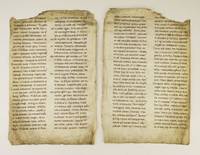
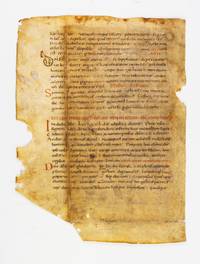
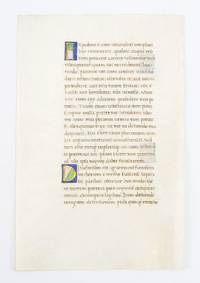
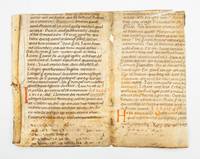
ST20509c-dGermany Late 11th or early 12th century. Larger bifolium measures 221 x 275 mm. 8 7/8 x 10 3/4".; smaller bifolium measures 207 x 275 mm. 8 1/8 x 10 3/4". Single column 25-27 lines in a late Caroline hand. <br/> Rubrics in orange each bifolium with one or more one-line initial in orange and one or more large four- to five-line initials in orange. With marginal notations in a later hand. Recovered from a binding and thus with some soiling abrasions glue residue and other small problems as well as limited loss of legibility in a few places; the pages nearly complete but with a couple of letters and/or lines cut away from one side of each bifolium; even with the problems very good specimens overall the letters on the better side quite clear and readable in each case.<br/> <br/> Once part of a Lectionary a collection of scriptural readings appropriate for Masses and other ceremonial occasions through the year these attractive mostly legible binding fragments display an excellent transitional script with both Caroline minuscule and proto-gothic characteristics. The present examples include short lessons or "lectiones" taken from the Old and New Testaments including among other passages excerpts from John in which Christ casts the sellers out of the temple and Daniel relating the prayers of the three men who refused to bow to Nebuchadnezzar's golden idol. The lovely script here shares much in common with the pure Caroline miniscule of earlier centuries--particularly in the overall legibility of the text the space between individual letters and the limited use of ligatures and abbreviations; also of note is the exclusive use of the long "s" unless at the beginning of a sentence and the ampersand as a general abbreviation for the letters "et" occurring anywhere in a word e.g. "propheta" written "proph&a" here. Evidence of a progression toward proto-gothic script can be observed here in the appearance of certain letter forms such as the closed "g" a more oval "o" and the use of two forms of "d" both upright and Uncial the latter with a sloping shaft. There is added interest here in the form of marginal notations in a later hand--probably dating from the time these bifolia were in situ as binding waste. The price given here is for one bifolium. unknown
1891ST15049London: Seeley and Co 1891. No. 85 OF 160 COPIES ON LARGE PAPER. 382 x 275 mm. 15 x 10 3/4". 4 p.l. 111 1 pp. <br/> Publisher's gilt-stamped vellum upper cover with titling and the Tennyson coat of arms BOTH COVERS WITH LOVELY HAND-PAINTED DESIGN BY JOHN T. BEER upper cover with urn at foot and blooming rose branches emanating from a medallion bearing the date 1902 and curving around the title and escutcheon lower cover with branches of apple blossoms dividing the board into quadrants each inhabited by a bird in flight smooth spine with gilt titling edges untrimmed. With frontispiece photographic portrait of Tennyson 31 vignettes in the text and 14 copper-plate engravings after drawings by Edward Hull. Verso of title page and limitations page with ink stamp of Gloucester County Library. Weber "The Fore-Edge Paintings of John T. Beer" 195. Small scratch near head of front joint minor soiling and rubbing to edges of boards mild foxing mostly marginal and not affecting copper engravings otherwise an excellent copy clean and fresh internally with wide margins the binding especially bright the pretty decoration perfectly preserved. AN EXTREMELY ATTRACTIVE COPY.<br/> <br/> This very large format deluxe illustrated work describing the places associated with England's beloved Poet Laureate Alfred Lord Tennyson is enhanced by former owner John T. Beer's Arts & Crafts-style embellishments to the vellum binding. After retiring from a successful career as a clothier Merseyside book collector Beer ca. 1826-1903 occupied himself decorating books from his library mostly with fore-edge paintings but in a score of instances with painted bindings. Jeff Weber considers Beer "one of the most highly skilled artists of fore-edge paintings" noting that he was the first artist to put his signature to such works. Weber's catalogue raisonnée of Beer's works lists 189 fore-edge paintings 22 painted bindings including this one #195 and three bindings designed by Beer and executed by Fazakerley of Liverpool. The design here is clearly influenced by the Arts & Crafts movement and Beer owned several works by William Morris including a Kelmscott Press "Godefrey of Bologne" on the vellum covers of which he had painted a design of tulips and lilies. Among the locations discussed and pictured in the "The Laureate's Country" are Tennyson's childhood homes in Somersby and Bag Enderby Trinity College Cambridge where he matriculated and his estates Farringford on the Isle of Wight and Aldworth in West Sussex. Seeley and Co unknown
8199242477.Gpaperback. Good. Access codes and supplements are not guaranteed with used items. May be an ex-library book. paperback
51320148like new. unknown
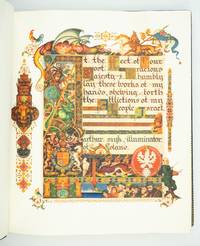
1939ST20331London: Beaconsfield Press 1939. No. 72 OF 125 COPIES SIGNED BY THE ARTIST AND THE EDITOR for sale in the British Empire. 292 x 248 mm. 11 1/2 x 9 3/4". xxvi pp. 46 leaves all leaves French fold. Edited by Cecil Roth. <br/> Elegant original blue crushed morocco by Sangorski & Sutcliffe signed on front turn-in covers with gilt French fillet border and large intricate central figure designed by Szyk of a patriarch holding a goblet and book raised bands spine gilt in double ruled compartments with ornate crown centerpiece gilt titling turn-ins with double gilt-ruled and scalloped border surrounding an illustrated silk doublure featuring a Szyk portrait of Moses with the Ten Commandments done in shades of gray within a frame of elaborate design. In an excellent velvet-lined box of blue half morocco over lighter blue cloth upper cover with central lion's head in gilt on blue morocco spine like that of the book. WITH 14 FULL-PAGE AND 32 SMALLER COLOR REPRODUCTIONS OF DESIGNS BY SZYK. English translation printed in black commentary printed in red. Front flyleaf inscribed in ink: "To Mr. and Mrs. Solomon Brachman / very cordially / Arthur Szyk / New York. April 1945." Very faint naturally occurring variations in the grain of the vellum otherwise a pristine copy.<br/> <br/> With an important Holocaust-related authorial inscription this is a very fine copy of what the London Times described as "a book worthy to be placed among the most beautiful of books that the hand of man has produced." Arthur Szyk 1894-1951 a Polish Jew is considered by scholars to be the greatest 20th century illuminator. Using the style of the Medieval illuminated manuscript artists he has here created a Haggadah for Passover that is at once a beautiful book of devotion a political protest against the rise of Nazism and a plea for England's help for the Jews of Europe. By 1939 Szyk's anti-Nazi cartoons had caused Hitler to put a price on his head forcing him to flee to England. His original illustrations for his "Haggadah" featuring the villains of the Exodus with the heads of Hitler Goebbels and other leading Nazis had to be toned down before publication. All 46 pages of the Hebrew text are illustrated with scenes from the Passover story as well as vignettes of Jewish life in modern Europe—sometimes Szyk mixes the two to great effect. Perhaps the most moving illustration in the book is the elaborately illustrated dedication to King George VI of England appealing for his mercy to European Jews. The great symbols of the British Empire—the lion and unicorn St. George defeating the dragon—surround Szyk's plea to the king: "At the feet of your most gracious majesty I humbly lay these works of my hands shewing forth the affliction of my people Israel." In the lower right corner of the painting we see Jewish refugees beside one of the ships which were usually turned away from British shores while Szyk depicts himself leaning against the painting his brush and easel in hand. The text here is enriched by the historical introduction and the commentary contributed by Cecil Roth 1899-1970 the preeminent British expert on Jewish history. This crowning achievement of Szyk's life was four years in the making and has proved to be an enduring treasure. Szyk presented this copy to Texas oilfield supply magnate Solomon "Sol" Brachman 1896-1974 and his wife Etta. The son of a Latvian Jew Brachman was the founding president of the Jewish Federation of Fort Worth in 1936 and helped arrange an emergency $100000 bank loan for Israel on the eve of statehood in 1948. His wife who served as president of the National Council of Jewish Women was known as "the mother of Hadassah." Szyk's 1945 inscription was no doubt especially meaningful to this devout family whose Latvian relatives were among the 90 percent of that country's Jews who perished in the Holocaust. Beaconsfield Press unknown
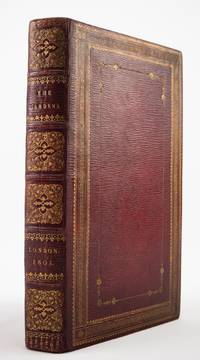
1805ST21016London: Printed by T. Bensley 1805. APPARENTLY THE ONLY COPY PRINTED ON VELLUM. 260 x 152 mm. 10 x 1/4 x 6". 2 p.l. 146 pp. 1 leaf notes. Translated by Maria Henrietta Montolieu. <br/> Very pleasing contemporary straight-grain scarlet morocco gilt by Charles Hering binder's ticket on verso of front flyleaf covers bordered with a wide frame of multiple patterned rolls with rosette cornerpieces enclosing a delicate frame of a dotted roll cornered small floral tools raised bands spine gilt in compartments wide turn-ins sumptuously gilt cream silk endleaves with gilt borders and fleuron cornerpieces all edges gilt. WITH EIGHT ENGRAVINGS BY FRANCESCO BARTOLOZZI IN TWO STATES one on gold silk and the second on paper. EXTRA-ILLUSTRATED with two engravings depicting Princess Izabela Czartoryska and her daughter Zofia. A Large Paper Copy. Henrey 624. See also Clemens Alexander Wimmer "The Princess and the Poles" Historic Gardens Review no. 10 2002: 14-17. Spine slightly darkened joints and edges with minor barely noticeable wear vellum a bit and naturally rumpled and consequently the book yawning a bit a handful of light spots but still an extremely appealing copy with fine impressions of the plates vast margins and a special story to tell.<br/> <br/> Printed on vellum richly bound and illustrated with attractive plates on silk this is an extraordinarily luxurious copy of Delille's famous poem on gardens that almost certainly belonged to a noblewoman whose gardens are mentioned in the text. First published in 1780 our poem condemns formal gardens and broad promenades in favor of a gardening art which hides its artistry by reproducing the asymmetrical groupings of nature and careless bounty of the countryside. This view accords with the translation of Virgil's "Georgics" done by Delille 1738-1813 in 1769 a version that brought him great acclaim for its supple and sonorous versification. In fact it so pleased the Count of Artois the future Charles X that he named Delille abbot of Saint-Séverin; however revolution disrupted things and the poet for a time led a wandering life in Switzerland Germany and England where this updated and expanded version of "Gardens" was published in 1801. The present special edition includes the plates which had appeared as head- and tailpieces in the first edition but now used as stand-alone plates in two states. These were executed by Bartolozzi after originals by Portuguese neoclassical painter Francisco Vieira. In addition to the called-for suite of illustrations our copy includes two inserted plates portraits of Princess Izabela Czartoryska 1745-1835 and her daughter Zofia. Czartoryska was a major figure in the Polish Enlightenment as a writer and patron of the arts as well as an advocate for improving the lives of the poor. She is best remembered for the sprawling gardens at her palace in Pu awy which included a formal garden a "wild promenade" or landscape park and multiple structures including the neoclassical Temple of the Sibyl which became one of Poland's first museums. She made the acquaintance of the author while travelling through Paris in 1791 and the two struck up a friendship. She financially backed the second edition of the work in exchange for a mention of her gardens which duly appears in heightened verse on pp. 11-13: "Favoured Pulhavi! You from Heaven obtain / Each separate charm Earth's choicest scenes contain; / Bright glow thy features fresh from Nature's hand / Excite our wonder and our praise command." The presence of this poetic tribute--and especially the inserted plates showing the princess and her daughter-- clearly suggest that the our apparently unique luxury edition must have been a presentation copy to Czartoryska herself. The present copy is as striking outside as it is inside. Charles Hering was the most distinguished and influential English binder of the first decade of the 19th century and although his career was brief from about 1795-1812 Ramsden focuses on his work as representing the transition in binding styles from those of the German émigrés of the late 18th century to the new generation of binders headed by Charles Lewis. Dibdin states that until "the star of Charles Lewis rose above the bibliopegistic horizon no one could presume to 'measure business' with Hering. There was a strength squareness and a good style of work about his volumes which rendered him deservedly a great favourite." We have been unable to trace any other copies of the present edition on vellum. Printed by T. Bensley unknown
190273377London: Edwin Arnold 1902. Limited to 165 numbered copies on vellum at the Essex House Press under C. R. Ashbee. Small octavo. 45 1 pp. Hand-colored frontispiece and two full-page hand-colored illustrations and eighty-five hand-colored ornamental letters by Edith Harwood. Tail-piece. Caslon type. Publisher's vellum with rose and gilt lettering to front cover. Bit of natural mottling to vellum. Custom folding cloth chemise and slipcase. A very good copy.Great Poems Series No. 6. "In 1886 C.R. Ashbee established the Guild of Handicraft at Essex House London. Around the same time Ashbee created the Essex House Press. The Essex House Press published its first book in 1898. The work of the press was very much a part of the Arts and Crafts Movement. Ashbee continually linked the aims of the press with those of John Ruskin and William Morris and described the object of the movement as “making useful things…making them well and…making them beautiful.†The critics however were not so sure about the work of Essex House Press calling it “articraftiness.†Later booklovers came to admire much of its work. Some of the presses and some of the workmen for Essex House Press came from the Kelmscott Press after its demise in 1897 following the death of William Morris. Ashbee designed his own typeface called “Endeavor†for the press. In 1902 the press moved to Glouscestershire. The Essex House Press closed in 1910 having produced more than seventy titles." Univ. of Utah Edwin Arnold hardcover
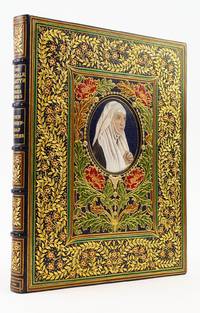
1914ST18714London 1914. 265 x 207 mm. 10 1/2 x 8 1/4". 41 3 blank pp. 1 leaf colophon. <br/> RESPLENDENT IN DARK BLUE MOROCCO RICHLY GILT AND ONLAID BY RIVIERE & SON stamp-signed on front doublure covers with wide frame of swirling gilt vines bearing red morocco blossoms and blue and green berries bordered by strips of green and tan morocco central panel of upper cover with recessed oval containing a portrait of a young nun sculpted in leather with painted details this encircled by an onlaid ivory morocco rosary and surrounded by an exuberant spray of red morocco poppies with green and tan leaves central panel of lower cover with an arch-backed black morocco cat beneath the arch of a gray morocco horseshoe at center a black and red witch's hat above the horseshoe and the whole on a very densely stippled gilt ground incised with calligraphic curls and set with nine silver stars around the cat this centerpiece surrounded by curling gilt vines bearing red morocco and gilt posies raised bands spine compartments framed with tan morocco and containing a gilt and onlaid floral sprig TAN MOROCCO DOUBLURES bordered by a strip of purple morocco this with onlaid green morocco frame adorned with gilt latticework densely stippled gilt cornerpieces set with purple morocco passionflowers all accented with inlaid circles of purple navy and green in varying sizes leather hinges apricot watered silk endleaves all edges gilt. In the original silk- and velvet-lined green morocco box. Numerous two- to three-line initials in red blue or burnished gold three three-line illuminated initials 11 five- to six-line initials in shades of purple blue and green with highlights of pink and burnished gold two of these with extensions running the length of the text and two incorporated into full borders four very large initials 12 lines or more in colors and gold five full borders that on title page incorporating a small oval miniature of Whittier and TWO FULL-PAGE MINIATURES one of a young nun at prayer the other of two lovers walking in a forest. Calligraphed colophon SIGNED by Sangorski stating: "This manuscript . . . was designed written out and illuminated by Alberto Sangorski for Messrs. R. Rivière & Son Bookbinders & Booksellers to his Majesty King George V. London. This manuscript will not be duplicated. This manuscript was executed by me." From the collection of Phoebe A. D. Boyle her sale at Anderson Galleries 19-20 November 1923 lot 368. Front flyleaf with engraved bookplate of comic book pioneer M. C. Gaines 1894-1947; typed description from "Kolb Collection" Louis Kolb laid in. Ratcliffe "Albert Sangorski Bibliography" SJR 245. Vellum a bit wavy as is typical but A BEAUTIFUL COPY the leaves creamy and bright being painted with rich colors and glittering gold and IN A FLAWLESS BINDING.<br/> <br/> This is an outstanding example of the artistry of Alberto Sangorski and that of the binders gilders and finishers of Riviere & Son the volume being executed at the zenith of their creative powers and formerly owned by the most important collector of Sangorski's manuscripts. Sangorski has written out and illuminated three poems by American author John Greenleaf Whittier: "The Female Martyr" inspired by an 18-year-old nun from the Sisters of Charity who died nursing cholera victims; "The Witch's Daughter" set in Puritan New England; and "Memories" a lover's touching reminiscences of youthful romance. In addition to elaborate initials and borders in his preferred palette of blues purples and greens brightened with burnished gold Sangorski has created two full-page paintings one of the beautiful young nun at prayer the other of youthful sweethearts strolling arm-in-arm through a wood. <br /> <br /> Alberto Sangorski 1862-1932 started his professional life as secretary to a goldsmith's firm became attracted to the book arts at the age of 43 and began doing illuminated manuscripts that were then bound by his brother Francis' firm Sangorski & Sutcliffe. Sometime around 1910 Alberto and Francis had a falling out and the artist went to work for Riviere the chief competitor to his brother's firm. Like the manuscript here our binding by Riviere is the work of many months with hundreds of individual inlays onlays and applications of gilt. Robert Riviere began as a bookseller and binder in Bath in 1829 then set up shop as a binder in London in 1840; in 1881 he took his grandson Percival Calkin into partnership at which time the firm became known as Riviere & Son and the bindery continued to do business until 1939. New York collector Phoebe A. D. Boyle was the widow of a canvas manufacturer who had made a fortune providing tents to the U.S. Army in the Civil War. George Sutcliffe described this important client as "rivalling the Medici in her patronage of the production of beautiful books." Stephen Ratcliffe deems the Boyle collection as "unrivalled" for its jewelled bindings and modern illuminated manuscripts; 33 of Alberto Sangorski's creations appeared in her sale at Anderson Galleries in 1923 and during World War I she was one of the only customers for extravagant productions like the present item. Any book from the Boyle collection which was put together with the greatest taste and discrimination is recognized as desirable beyond its intrinsic literary merit. unknown
1930011497London The Richards Press 1930 In-8 Reliure éditeur
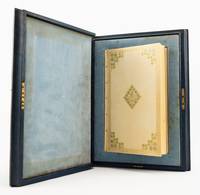
1937ST21066London: William Heinemann Limited 1937. FIRST EDITION. Book: 245 x 152 mm. 9 3/4 x 6"; Case: 330 x 235 mm. 13 x 9 1/4". 3 p.l. 34 pp. <br/> LOVELY CONTEMPORARY STIFF VELLUM GILT AND PAINTED covers with delicate gilt frame sprays of flower and leaves at each corner outlined in gilt and painted blue and green central lozenge outlined in gilt dots and framed by painted flowers and leaves a large initial "A" in gilt at center smooth spine divided into compartments with gilt and painted floral ornament turn-ins with gilt floral roll sky blue silk endleaves all edges gilt. Housed in a fine oversized blue morocco case designed to look like a book with gilt lettering on the upper cover raised bands gilt ruled compartments and lettering to spine the interior constructed and padded to hold the smaller book and lined with blue velvet spine of case a bit sunned corners a little rubbed clasp no longer functional. A FINE COPY clean and fresh internally in a pristine binding.<br/> <br/> With very considerable visual and tactile appeal this is a gracefully bound copy of the the final book of verse issued by Richard Aldington published before he turned exclusively to writing prose. A leading poet of the early 20th-century Imagist school Aldington né Edward Godfree Aldington 1892-1962 was a prolific writer whose 50-year career produced novels biographies translations and literary criticism as well as sharp minimalist free verse. He was part of the contemporary London avant-garde crowd being close friends with Ezra Pound T. S. Eliot Amy Lowell and D. H. Lawrence; and he was especially close to the poet H. D. Hilda Doolittle his first wife from 1913-38. As literary editor of the leading Modernist periodical "The Egoist" he was an integral part of the pre-World War I literary scene and his first largely autobiographical work "Death of a Hero" 1929 was considered by George Orwell and Lawrence Durrell to be the best of the English Great War novels. The poems here were written in the mid-1930s when Aldington had decamped to the United States after the woman he loved Netta Patmore rejected his proposal of marriage. While tracing his grief and longing the verses also build the image of a "crystal world" created by the love of an ardent couple concluding that "Only from the purity of extreme passion / And alas the purity of extreme pain / Can you build the crystal world." Happily Aldington's beloved Netta to whom the work is dedicated reversed her decision and agreed in 1938 to help him build their crystal world together. The present lovely binding is unsigned but the delicate precise tooling and elegant design indicate the work of very talented hands. The romantic contents and the rather feminine aspect of the binding suggest that this was a gift from one lover to another perhaps a recipient sharing the initial "A" with our author. And the oversized and extravagant custom case indicates how much this object was treasured. William Heinemann Limited unknown
Issued in twelve original parts, housed in eleven very large publisher's portfolios. 400 x 515 mm. (about 16" x 20"). Printed on Japan vellum throughout. Illustrated with wonderful monochrome photogravure engravings and plates. There are no color plates in this set, nor do any seem called for. The original paper wrappers for the parts are brittle, but this is of little concern because the portfolios act as wraps. There is some soiling and wear, here and there, but generally this is a very nice set of the most deluxe edition. Number 225 of a total edition limited to only 500 copies. Howes W79. RARE. **PRICE JUST REDUCED! PARTS5 - Large Box
ST12668bLNortheastern France probably Arras late 15th century. 146 x 95 mm. 5 3/4 x 3 3/4". Single column 15 lines in a pleasing bâtarde hand. <br/> Attractively framed leaves with full borders showing one side only and the leaf with images of saints in double-sided glass frame showing both recto and verso. All leaves with rubrics in red and one- and two-line initials in brushed gold on a red or blue ground some leaves with three-line initials on orange or green ground. Each leaf WITH EITHER A FULL BORDER OR PANEL BORDER WITH BRUSHED GOLD GROUND AND VERY PRETTY ILLUSIONISTIC FLOWERS AND FRUITS the leaf with the panel border also FEATURING TWO SMALL MINIATURES OF SAINTS. Headlines written in French in a later 18th century calligraphic hand. ◆Brushed gold a little faded in places otherwise excellent specimens generally clean and smooth.<br/> <br/> From a charmingly decorated 15th century prayer book these beautifully framed leaves are ready to hang on the wall or give as a gift to a lucky recipient. Two types of leaves are offered here: the first consists of a full border with illusionistic flowers fruit and at least one insect or creature; the second contains a panel border and two small miniatures depicting St. Anthony often called the Father of all Monks and the lesser known St. Eligius patron saint of metalworkers. For unframed leaves from this same manuscript please check our website. unknown
ST15769aPerhaps France mid-12th century. Each leaf measures approximately 370 x 240 mm. 14 1/2 x 9 1/2". Double column 32 lines in a fine proto-gothic hand. <br/> See: Thompson "An Introduction to Greek and Latin Paleography" p. 436. ◆Recovered from a binding and thus with one side of each leaf somewhat browned soiled and with a few creases one leaf with several small blotches of red paint in the text not affecting overall legibility one corner of each leaf torn away affecting running title and one to two lines of text other trivial defects but still very nice specimens with clear and legible script and one side of each leaf quite clean and well preserved.<br/> <br/> Once part of a large and elegant Romanesque Bible these leaves are excellent examples of a high quality proto-gothic book hand. Sometimes referred to as "praegothica" or "late Caroline" the proto-gothic script is characterized by letterforms that are more or less unchanged from Caroline minuscule but with a number of traits starting to show elements of gothic script--most notably the addition of feet appearing here as an upward flick of the pen on the bottom of minims but also including the use of more abbreviations the fusion of certain letter combinations a more elongated "o" and a straight-backed "a." Whatever the level of its evolution the script here has very pleasing rounded letterforms that are highly legible and generously spaced. Though the vellum is not unmarred by its former life as binding material the script here has not lost any of its beauty revealing a hand that is practiced regular and distinctly pleasing to the eye. As Thompson notes "In the twelfth century the scribes seem to have vied with each other in producing the best types of book-writing of which they were capable with the result that remarkable precision in the formation of the letter was attained and that the century may be named as excelling all others for the beauty of its MSS." Our leaves come from Deuteronomy the Old Testament book consisting primarily of three sermons made by Moses just before entering the Promised Land. One leaf contains brief summaries of chapters 2-18 with some chapters numbered in the margins while the other leaf contains part of the first of Moses' speeches in which he recalls the Israelites' 40-year journey through the wilderness. unknown
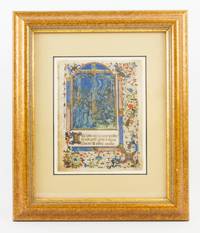
1440ST19540aMetz ca. 1440. Leaf: 162 x 124 mm. 6 3/8 x 4 7/8". Frame: 308 x 258 mm. 12 1/8 x 10 1/8". Single column three lines of text under the miniature obverse with 18 ruled lines five of which contain text in a gothic book hand. <br/> Attractively matted and framed. Recto with one three-line initial in gold on pink and blue ground WITH A LARGE MINIATURE OF THE CRUCIFIXION WASHED IN BLUE Christ on a painted gold cross flanked by two thieves on painted gold crosses surrounded by throngs of people including the Virgin St. John Mary Magdalene and numerous soldiers all in an arched gold frame inside a three-sided painted and gilt baguette and a FULL BORDER of colorful vine sprays and flowers inhabited by a peacock. See: "The Jeanne Miles Blacburn Collection of Manuscript Illuminations" nos. 29-38; Avril & Reynaud pp. 182 & 190. Minor soiling/browning right at inner edge away from border and image otherwise IN VERY FINE CONDITION THE MINIATURE REMARKABLY WELL PRESERVED WITHOUT ANY LOSS OF PAINT.<br/> <br/> This stunning miniature with its memorable nocturnal scene comes from a very fine Book of Hours probably executed by Henri d'Orquevaulz or d'Orquevaulx or a member of his workshop. D'Oquevaulz was active during the second quarter of the 15th century in Metz the cultural and commercial capital of Lorraine during the period and the center of a growing book trade. According to the catalogue of the Jeanne Miles Blackburn Collection in the Cleveland Museum of Art which owns 10 leaves from the original manuscript the parent Book of Hours can be localized based on the Lorraine dialect found in the French text on some of the leaves including the present example and because the calendar singled out two bishop-saints of Metz Clement and Arnoul. Although little is known about d'Orquevaulz his dated signature in the colophon of a Livy manuscript that he illuminated for an alderman of Metz indicates that he was active in that city in 1440. Artistic affinities with northern European styles make it possible that d'Orquevaulz had emigrated from the Netherlands or Germany to Lorraine; another possibility one that Avril and Renaud suggest is that the master himself was from Metz but that he had German associates perhaps from the Rhineland area. According to these two scholars the painter's use of large flat areas of colors is more typical of the Rhineland the Netherlands or Bohemia than of France; in any case they praise his "exquisite color harmonies." The artist has outdone himself in the present miniature rising to the height of pathos and making it one of the most extraordinary leaves we have ever offered for sale. In contrast to the bright colors used in Books of Hours even to depict the most serious scenes the present leaf presents a remarkable visual nocturne with the figures and buildings painted in the same shades of blue as the sky suggesting that heaven itself is darkening at the death of Christ. Mary Magdalen kneels at the foot of the cross while St. John supports the devastated Virgin as a soldier pierces the Savior's side with a lance. The miniature is crowded with figures we see well-defined faces of no fewer than 18 persons and two horses but the artist has not lost his dramatic focus as Christ on his cross of brushed gold dominates the scene. In choosing to make this a darkened composition the artist has risked obscuring detail but his skill has been equal to his concept here as he has used a diluted blue paint that allows for a very successful delineation in various shades almost like grisaille this technique not incidentally has prevented the cracking and erosion so commonly seen with the normal thick applications of typical cobalt blue. The result of the decision to show the world in eclipse at Christ's death is to heighten and universalize the drama here to such an extent that the scene leaves a powerful and lasting impression. The text on this leaf is entirely in French in rhyming verse. Roughly it translates as: "Jesus on the cross did hang / And took upon himself our sins / Gave to humankind redemption / Rendered up his soul to God. / The sunshine lost its glowing light / The earth did tremble and did crack / Grieving for the bitter death / Suffered by the son of God." Although the original Book of Hours was dismembered some time in the 20th century extant leaves suggest that its visual program was much bigger than usual and probably the result of an important commission by a wealthy patron--something likely to be painted by one of the chief artists in the workshop. Illuminated manuscripts from Metz--let alone examples of this quality--are uncommonly seen on the market. unknown
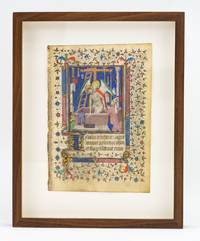
1415ST17763Paris ca. 1415-20. Leaf: 160 x 110 mm. 6 1/4 x 3/8"; Frame: 232 x 185 mm. 9 1/8 x 7 1/4". Recto with three lines single column in a gothic book hand verso not inspected due to frame. <br/> Mounted in a wooden frame. Recto with a three-line initial in blue on gold ground embellished with ivy leaves A HALF-PAGE MINIATURE DEPICTING THE MASS OF ST. GREGORY the recently crucified Christ depicted emerging from a tomb supported by an angel and surrounded by the Arma Christi St. Gregory kneeling at the corner of the image the text and miniature framed by thick bar borders of pink blue and gold on three sides all SURROUNDED BY A FULL BORDER of hairline vines gilt ivy leaves and bezants and a few colorful flowers and acanthus. A little faint smudging in top and bottom borders very small scarcely noticeable area of blue background retouched not affecting the figures but A BEAUTIFUL LEAF the colors bright and the detail in the miniature very well preserved.<br/> <br/> Featuring carefully realized detail intriguing iconography and artistry that shows a very high degree of skill this is an important and early example of the work of the Master of the Harvard Hannibal. The subject of the present work is a well-known story about the sixth century Pope Gregory ca. 540-604 commonly known as St. Gregory the Great. According to legend Gregory was saying Mass when one of his deacons expressed a doubt in the doctrine of Transubstantiation whereby the communion bread actually becomes the body of Christ. Gregory prayed to God for a verifying sign whereupon Christ appeared in the guise of the Man of Sorrows clad in a loincloth and displaying the bloody wounds he incurred during the Crucifixion. Most Medieval miniatures depict Gregory kneeling before an altar as he says Mass accompanied by one or more deacons or assistants who bear witness to the miraculous event. In a notable departure from this norm the present miniature depicts the saint alone at the edge of the picture plane; in place of the chalice host and altar that would normally occupy the center of the scene is a considerable open tomb from which a larger-than-life-size Christ emerges. With blood still rushing from his wounds he places one hand on the edge of the tomb to steady himself while an angel supports him from behind. Christ's expression conveys both physical and mental pain as he struggles to support his own bodyweight; the angel who assists him spreads his wings protectively around the body of Christ while looking down at Gregory with a sorrowful expression knitted into his brow. The fine detail work seen in the figures' faces the angel's wings and the careful delineation of each slender finger is also carried over into more than a dozen objects crammed into the spaces in and around the tomb the rope is especially remarkable in the representation of its detail. Known as the "Arma Christi" or "Instruments of the Passion" these objects are meant to symbolize Christ's suffering. Seen here are: the cross nails and hammer that were used to crucify Christ the ladder used in the Deposition the disembodied hand symbolizing the one which slapped Christ's face the dice used by soldiers to see who would claim his seamless robe a lantern used by the soldiers who arrested Christ the 30 pieces of silver from Judas' betrayal a purple robe used in the mockery of Christ and other items that appear as part of the Passion narrative. It is also interesting to note that although a St. Gregory miniature usually appears at the beginning of the Hours of the Cross the Penitential Psalms or before the Seven Prayers of St. Gregory here rather unusually it opens a reading from John chapter 19 beginning "In illo tempore adprehendit Pilatus Iesum et flagellavit" describing the events of the Passion. This miniature can be attributed to an artist known as the Master of the Harvard Hannibal so-named for a splendid miniature painting of the "Coronation of Hannibal" prefacing a Livy in the Harvard College Library. Active from about 1415-30 in Paris and later possibly Rouen it is believed that our illuminator was a pupil of the Boucicaut Master with whom he is thought to have collaborated on several manuscripts both secular and religious. The present miniature would probably have been executed early in his career and while it certainly shows the influence of his teacher it also reveals certain stylistic tendencies that would become staples of the Master of the Harvard Hannibal's more mature work such as his preference for rich colors heavy molding of the faces and interest in decorative details. With its clever composition meticulous detail work and emotive figures that engage the viewer the present miniature is not only a beautiful work of art it also documents the precocious talent of an emerging master early in his professional career. unknown
ST17235Probably France or Rhineland 10th century. Irregularly shaped but approximately 298 x 225 mm. 11 3/4 x 8 7/8". Single column 33 lines on recto and 29 on verso in a neat Caroline minuscule. <br/> Rubrics in red nine two-line initials in red and/or brown one with a light yellow wash and feathered extender one with feathered ascender. ◆Recovered from a binding with the verso consequently somewhat soiled and with a vertical crease obscuring a letter or two on each line a little loss of blank vellum margin but no text lost other light stains and imperfections as expected but still in remarkably good condition the text almost entirely legible and the recto still generally quite pleasing.<br/> <br/> Written in an attractive and highly legible Caroline minuscule this early leaf is desirable not only for its age and script but also for the many initials opening each separate prayer. Inked in brown and orange and sometimes tinged with yellow these initials are reminiscent of those found in the Gellone Sacramentary BNF Latin 12048 an eighth century manuscript with extraordinarily inventive designs incorporating animals knotwork and a multitude of patterns and favoring a color palette of green orange yellow and brown. Although the present examples are simpler in their execution we can see similar tendencies in terms of colors and shapes--especially in the winged designs on two of the initials here. The smaller "S" residing in the larger "D" initial on the recto signifying the word "Deus" is a feature that can also be seen in the Gellone Sacramentary for example on f. 7r. The text here probably comes from a Sacramentary a type of manuscript containing only the words said by a priest or bishop rather than the congregant during Mass and other liturgical services or possibly a Rituale containing the services not included in the Missal or Pontifical. The text on this particular leaf includes blessings for trees. Though recovered from a binding the damage on this leaf is far less severe than is often encountered with such specimens; the text on both sides is intact all but a few letters are entirely legible the margins are quite generous and the initials have been well preserved. unknown
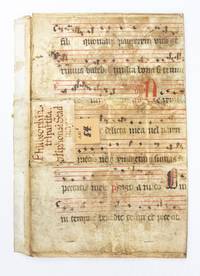
ST19350-050Germany 14th century. 250 x 175 mm. 9 7/8 x 6 7/8". Six extant lines of text and music in a gothic hand. <br/> Rubrics and staves in red one large initial in red and two large decorative initials in black and red. With the binding's original paper labels on spine remnants of old paper lining on verso. Somewhat soiled and stained but a good specimen overall.<br/> <br/> Recovered from a 17th century binding this specimen presents an excellent opportunity to examine how Medieval manuscripts were used in the construction of later bindings. The two preserved spine labels tell us that the leaf previously covered a copy of Alphonso Stadlmayer's "Philosophia Tripartita" first published in 1650. unknown
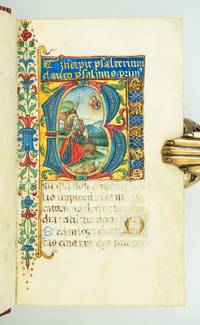
1536ST20557Italy Florence completed in 1536. 155 x 96 mm. 6 1/8 x 3 3/4". Single column 17 lines in a rounded gothic hand. 225 leaves first leaf and last three leaves blank. One signature bound upside-down the calendar bound at end but COMPLETE. With modern foliation in pencil i 225 leaves f. 222 omitted in numbering. <br/> Attractive 19th century red straight-grain morocco covers with lacy gilt border raised bands compartments with floral a scrolling tools with small stars and bezants green morocco label with gilt lettering gilt floral turn-ins all edges gilt and gauffered. In a fine modern pebble-grained red morocco folding box by A. Lobstein gilt lettering on spine lined with velvet. Rubrics in red numerous one-line initials and paragraph marks in red or blue many two-line gilt initials on ground of two colors red blue green or purple with small gold embellishments three-line "KL" initials for each calendar month in gilt TWO LARGE HISTORIATED INITIALS the first measuring approximately 11 lines 65 mm. and featuring King David in prayer the initial painted blue and embellished with green and pink acanthus on gold ground surrounded on two sides by bars of gilt lettering on blue and pink ground inner margin decorated with colorful floral motifs decorated with gilt bezants the second initial measuring six lines 35 mm. and featuring the Holy Trinity the initial painted pink with colorful acanthus on gilt ground and with a similar floral border in the outer margin and extending over the initial along the top. See: Alexander "The Painted Page" nos. 1 3 & 4; and Salmi "Italian Miniatures" frontispiece and pp. 52-53. Text rather faded in places though sense always recoverable isolated insignificant rubbing or chipping to the gilt a handful of trivial stains and instances of soiling or foxing but a nevertheless lovely manuscript--very clean and fresh with wide margins and the historiated initials especially well preserved. Just the slightest signs of use to the lustrous binding.<br/> <br/> This is a fine example of Florentine manuscript production from the early 16th century with a beautiful rounded gothic script sparkling initials and historiation that suggests a link to some of the most important miniaturists of the period. The decoration is composed of rich jewel tones and includes a half-page initial opening "Beatus vir" depicting King David in prayer and a smaller "D" opening Psalm 109 "Dixit Dominus Domino meo: a sede adextris meis" depicting the Holy Trinity. Each initial is embellished by a lovely partial border of floral motifs and many gilt bezants in a typical Florentine style. The large "Beatus vir" initial is particularly well done with excellent molding and shading and careful attention to even the smallest hair on David's beard. Into a relatively small space the artist manages to fit an entire outdoor scene complete with foreground middle ground and background including rolling hills a river and a distinctive rock formation that adds dimension scale and a sense of realism to the painting. Although whoever had the box made for this work attributed the manuscript to Giovanni Boccardi known as Boccardino il Vecchio 1460-1529 the figures and border decoration are stylistically closer to the work of two other contemporary workshops: that of Attavante degli Attavanti 1452-1525 and brothers Gherardo 1445-97 and Monte 1448-1532 di Giovanni del Fora. Of Attavante Salmi notes that he was "At one time the most celebrated miniaturist of the Renaissance" and Alexander says that he "was one of the most successful entrepreneurs in the Florentine book trade in obtaining commissions from patrons outside Florence." He counted European royalty among his patrons and executed celebrated manuscripts for Mattias Corvinus King of Hungary and Manuel I King of Portugal as well as high ranking members of the church including Pope Leo X. Among the many hands employed by Attavante were those of Gherardo and Monte di Giovanni del Fora which explains the closely related styles of the two workshops. Salmi notes that "As expert miniaturists Gherardo and Monte composed magnificent interiors evoking historical events and landscapes of great depth and drama abounding in descriptive details and precious minutiae worthy of the Books of Hours of Flemish and French Masters." In addition to stylistic similarities we have been able to find two other examples of miniatures with compositions that are very close to the "Beatus vir" initial in the present work both of which are attributed to Gherardo and Monte Giovanni del Fora or their workshop. These are: an "S" initial in a Choirbook at the Museo dell'Opera di S. Maria del Fiore we found a black & white reproduction only; and a full-page miniature in the Biblioteca Medicea Laurenziana MS Plut. 15.17. Like our opening initial these miniatures both depict King David kneeling in prayer dressed in similarly draped and shaped garments in the miniature with color reproductions available the garments are identically colored red and blue with an unusual lobed harp on the ground and a rocky outcropping in the background. Most notably in the latter miniature as well as our initial this rock formation includes a natural archway that has formed over a river. If we are to believe the final rubricated lines indicating that the manuscript was completed on 25 October 1536 then the historiated initials were probably painted by an artist who was at the very least quite familiar with the work of the aforementioned miniaturists if not directly employed by one of their workshops. The most likely workshop would be that of Monte Giovanni del Fora who died in 1532--four years before this work was supposedly completed. It is perhaps even conceivable that the production of the Psalter took long enough that the initials might have been executed during Monte's lifetime. It is unfortunate that three lines in the colophon have been erased as they may have provided additional information about the making of this manuscript. Whatever the case may be this is a lovely object with tasteful decoration that clearly echoes the work of some of Florence's finest workshops. Italian prayer books such as this are increasingly difficult to come by and the present item being complete and in excellent condition would be a fine addition to any private or institutional collection. unknown
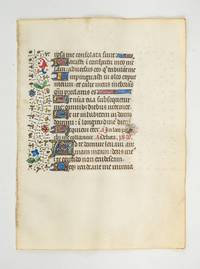
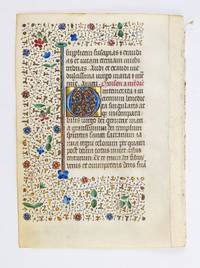
1475ST19653GNorthern France ca. 1475. 155 x 110 mm. 6 x 4 1/4". Single column 16 lines in a gothic book hand. <br/> Rubrics in dark pink some leaves with line fillers in pink and blue with white embellishment and gilt bezants each leaf with at least one and some with many one- to three-line initial either in gilt on a pink and blue ground with white embellishment or painted blue with white embellishment filled with flowers or ivy on a gilt ground most leaves with one panel border of hairline vines gilt ivy and bezants and painted flowers. Occasional light soiling wrinkling and other very minor imperfections but in fine fresh condition overall very clean and with wide margins.<br/> <br/> Undoubtedly the work of a top atelier these lovely manuscript leaves have been written and decorated with a high degree of skill. Many of the leaves feature numerous glittering initials and the delicate panel borders add a bit of extra sparkle to the page. unknown
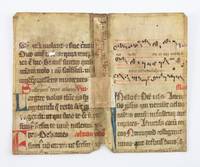
ST19350-049Germany 14th century. 132 x 164 mm. 5 1/4 x 6 3/8". Double column 12 extant lines in a gothic book hand. <br/> Rubrics and four-line staves in red capitals touched in red four large initials in red or blue. Spine with two old paper labels one with ink titling. Vellum a bit soiled a couple small holes ink a little faded on verso paper remnants on verso obscuring a few lines but still a good specimen demonstrating use and reuse of Medieval manuscripts.<br/> <br/> From a noted Missal that had outlived its use this manuscript leaf was later repurposed as a cover for a 17th century printed book. The spine label indicates it was a copy of Jacob Bidermann's "Herodiados libri tres" a lengthy Latin poem relating the story of John the Baptist and Herod first published in 1622. unknown
ST19578Northern Italy last quarter of 15th century. Each leaf measuring 250 x 164 mm. 9 7/8 x 6 3/8". Single column 24 lines in a handsome humanist hand. <br/> Each leaf with three to four large initials one measuring two lines all others three lines in burnished gold in-filled with pink and green paint with white embellishment on blue ground with white embellishments. See: Baldwin "Medieval Rhetoric and Poetic" pp. 216-23. ◆Insignificant wrinkling and a couple faint creases to vellum tiny snag along top edge of each leaf but IN VERY FINE CONDITION the vellum especially clean and bright the paint and ink fresh and the margins generous.<br/> <br/> Written in a beautiful humanistic script enclosed by wide margins and adorned with tasteful gilt initials these leaves come from what must have been a particularly fine manuscript made for a person of means. The text comes from the "Candelabrum" of Bene of Florence an early 13th century treatise on rhetoric and the art of elegant writing. The work consisted of eight parts instructing readers on word choice composition rhythm style and other important considerations in the construction of effective letters and prose. Apart from their enormous aesthetic appeal the present leaves are of great interest because few manuscripts of the text have survived. The style of the initials--elegant burnished gold on a ground of pale pink green and sapphire blue with whisps of white embellishments--suggest that the manuscript was executed in Northern Italy perhaps Milan Bologna or Florence by a craftsman of great technical skill. Fine examples of humanistic script are becoming increasingly difficult to find on the market and the present examples are among the loveliest we have ever acquired. unknown
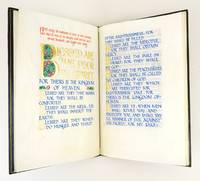
1939ST17129-020Wimbledon Surrey September 1939. 373 x 255 mm. 14 3/4 x 10". 12 vellum leaves seven with text and illuminations. Single column approximately 30 lines in a fine calligraphic hand. <br/> Attractive contemporary dark blue crushed morocco covers with gilt and blind rules raised bands with gilt rules gilt-ruled turn-ins vellum pastedowns. Text in blue black green and red a few lines with larger lettering in gilt several two-line initials in colored ink five two-line initials in red or blue with floral decorations opening pages with eight two-line initials in gold the lines here of a larger size than rest of text six three-line initials in gold filled and surrounded by floral decoration three four- to six-line gilt initials with more intricate floral decorations one of these with gilt stippling and two surrounded by a gilt frame and ONE VERY LARGE 80 x 45 mm GILT "B" decorated with stippling filled with two-tone green leaves pink flowers and large gold bezants. First leaf with ink inscription "Presented by Dr. W J Pearson / in appreciation of the work of / Ashridge Hospital 1939-1946"; two silk guards. Boards with a hint of soiling but A BEAUTIFUL MANUSCRIPT IN OUTSTANDING CONDITION the paint lovely and bright and the gold sparkling.<br/> <br/> This beautifully executed manuscript by a notable female calligrapher and illuminator features the oft-quoted and much-loved biblical text known as the "Sermon on the Mount" in which Matthew relates various moral teachings attributed to Christ. The text is written in an extremely pleasing and regular upright script throughout but the first opening listing the nine Beatitudes in capital letters is especially striking. Opening with the largest and most attractive initial in the manuscript it begins with "Blessed are the poor in spirit" in prominent gilt lettering; this is followed by the other blessings each beginning with a smaller gilt "B" initial written entirely in blue capital letters. The rest of the text penned primarily in black ink but accented with cheerful gilt initials and occasional colored lettering exudes a sense of order and simple elegance befitting the contents. Illuminator and calligrapher Violet Wilson was born in Wimbledon in 1902. She studied calligraphy under Claire G. M. Evans who had been a pupil of Graily Hewitt known for his work with the Ashendene Press and one of the principal British calligraphers and teachers of lettering in the first half of the 20th century. Wilson became a member of the Society of Scribes and Illuminators in the U.K. in the 1930s. The San Francisco Public Library has examples of her work in its Harrison Collection of Calligraphy and another illuminated copy of the "Sermon on the Mount" made in 1957 was included in the Baltimore Art Museum's 1965 exhibition and catalogue titled "Two Thousand Years of Calligraphy." The catalogue entry no. 213 notes that Wilson preferred to work on books and decorative maps and exhibited her work in many countries. According to the presentation inscription in the present work this manuscript was given to Ashridge Hospital--formerly a monastery and royal residence--by the distinguished physician Dr. Wilfred John Pearson 1884-1957 who had headed one of the London sectors of the Emergency Medical Service during World War II. His obituary in the "British Medical Journal" declared him "one of the striking figures of his time.". unknown
1475ST19653NNorthern France ca. 1475. 155 x 110 mm. 6 x 4 1/4". Single column 16 lines in a gothic book hand. <br/> Rubrics in dark pink ONE EXQUISITE FOUR-LINE INITIAL painted blue with white detailing filled with red and blue vines and leaves on a burnished gold ground with a painted and gilt bar border on one side each end capped with a flower the text surrounded on three sides with a border of acanthus leaves dense rinceaux colorful flowers gold ivy leaves and bezants. A couple negligible imperfections but IN VERY FINE CONDITION<br/> <br/> One of the most popular optional prayers in the 15th century Book of Hours "O Intemerata" "Oh immaculate virgin" is a brief supplication in which the Virgin is glorified for her purity as the "unspotted and forever blessed singular and incomparable Virgin Mary Mother of God." The present leaf is given special emphasis with the presence of a three-quarter rinceaux border surrounding the text and the opening of the prayer is marked by an especially pretty and finely detailed initial that glitters with burnished gold. The leaf is unusually beautiful precisely rendered and in very fine condition. unknown
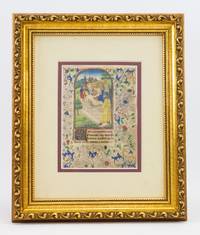
ST19540bSouthern Netherlands Bruges third quarter of 15th century. Matted leaf: 150 x 150 mm. 5 7/8 x 4 3/8". Frame: 307 x 258 mm. 12 x 10 1/4". Single column with four lines below the miniature and the obverse with 17 lines in a batarde hand. <br/> Attractively matted and framed the leaf slightly shifted in the mat revealing top and side edges but in no danger of damage. Rubrics in red four one-line initials and three three-line initials all but one in burnished gold on blue and red ground with white tracery the initial beneath the miniature painted pink on a burnished gold ground and filled with painted ivy vines AN ARCH-TOPPED LARGE MINIATURE DEPICTING THE ENTOMBMENT the body of Christ surrounded by seven other people depicted in an outdoor setting with the turrets of a walled city in the background the miniature in a double frame of gold and pink surrounded by A FULL BORDER composed of hairline vines acanthus colorful flowers and gilt bezants and inhabited by a small bird. Minor soiling and a faint thumb print to borders but IN VERY FINE CONDITION THE MINIATURE BEAUTIFULLY PRESERVED.<br/> <br/> This is a beautifully rendered and deeply touching scene depicting the entombment of the crucified Christ and the pathos experienced by those at his side. Holding the sheet on which the body is lowered into the sarcophagus are on the far left the richly clothed Joseph of Arimathea and on the far right Nicodemus who dons an especially lovely yellow garment with delicate embroidery. Between the two men in the foreground but behind the body are the Virgin Mary who presses the hand of her deceased son to her lips; John the Evangelist whose body is turned toward the Virgin in a gesture of support but whose gaze is focused on the Savior; and Mary Magdalene who holds a small ointment jar. Two other women with halos stand closely behind them consoling one another. The artist has done a masterful job at creating a composition that captures the emotional gravity of the scene: Christ's body gently cradled in a white sheet is on full display with blood still trickling from the wounds on his head and side. Despite there being seven people crowded around him our attention is drawn to the action between Christ and the Virgin who gently grasps his hand with motherly affection and bids him a final farewell. Flickers of different emotions appear on the faces of his followers including pity sorrow stoicism and disbelief--echoing perhaps the viewer's own range of feelings upon viewing this image. The level of detail excellence of composition care seen in the molded bodies and faces and the convincing setting suggest that the artist was quite practiced and that the original manuscript from which the leaf comes was of very high quality. unknown
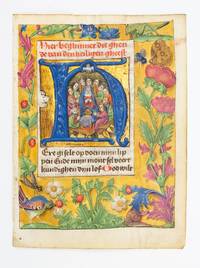
1470ST19885Netherlands ca. 1470-80. 164 x 123 mm. 6 1/2 x 4 7/8". Single column 17 lines in a gothic hand. <br/> Capitals touched with red rubrics in red one-line initials in red or blue one two-line initial in blue A VERY LARGE HISTORIATED INITIAL approximately 60 mm. square DEPICTING PENTECOST the initial painted blue with white tracery on a burnished gold ground surrounded by A FULL BORDER decorated with colorful acanthus large flowers strawberries insects including a grasshopper fly moth and mosquito all on a liquid gold ground. See: Marrow et al. "The Golden Age of Dutch Manuscript Illumination" nos. 79-81. ◆Margins just faintly soiled gold very slightly rubbed but IN FINE CONDITION the initial and border beautifully preserved.<br/> <br/> This is an extraordinarily handsome leaf featuring an oversized historiated initial depicting Pentecost attributed to the circle of the Master of the London Jason. Our artist has made remarkable use of space fitting 13 clearly defined people within an initial opening measuring 45 x 32 mm. The Virgin sits enthroned directly in the center encircled by the Apostles dressed in blue violet green and orange robes. Our artist cleverly adds a notch at the top of initial--like a cupola inside a chapel--in order to fit an image of a dove inside the scene. The figures show an impressive degree of individualization and emotional response as they witness the descent of the Holy Spirit; a few gesture in surprise two lower their gaze and some look up in awe. The work is stylistically like that of the Master of the London Jason named for his work on the "Historie van Jason" manuscript now housed at the British Library. As Marrow et al. note the Master's style is characterized by "somewhat short heavy figures that are well formed and have unusual slightly broad yet expressive faces with deep sunken eyes." Our leaf's enclosing border is of very considerable interest featuring as it does naturalistic flowers strawberry plants insects and a small brightly colored bird all painted in colors that perfectly complement the main scene. A very fine production all around this distinctive energetic leaf would make a notable addition to any collection. unknown