1 336 résultats
ST12668bJNortheastern France probably Arras late 15th century. 146 x 95 mm. 5 3/4 x 3 3/4". Single column 15 lines in a pleasing bâtarde hand. <br/> Rubrics in red one- and two-line initials in brushed gold on a red or blue ground EACH SIDE OF EACH LEAF WITH A BRUSHED GOLD PANEL BORDER WITH VERY PRETTY ILLUSIONISTIC FLOWERS; EACH LEAF WITH TWO SMALL MINIATURES measuring approximately 40 x 25 mm. depicting saints shown with their attributes. Headlines written in French in a later 18th century calligraphic hand. ◆Light soiling rubrics faded otherwise excellent specimens generally clean and smooth with ample margins attractive decoration and shining gold.<br/> <br/> From a charmingly decorated 15th century prayer book these lovely leaves offer the opportunity to acquire a miniature and considerable gold ornamentation at an attainable price. One leaf depicts St. Andrew holding an "X" shaped cross and St. Etienne i.e. St. Stephen here shown with three stones on his body and the other shows St. Remigius the so-called "Apostle of the Franks" and St. Quentin--a saint that was particularly venerated in France especially in the north whence we be believe these leaves originated. For other leaves from this same manuscript please check our website. unknown
ST12668bDNortheastern France probably Arras late 15th century. 146 x 95 mm. 5 3/4 x 3 3/4". Single column 15 lines in a pleasing bâtarde hand. <br/> Rubrics in red one- and two-line initials in brushed gold on a red or blue ground EACH SIDE OF EACH LEAF WITH A BRUSHED GOLD PANEL BORDER WITH VERY PRETTY ILLUSIONISTIC FLOWERS; EACH LEAF WITH ONE SMALL MINIATURE measuring approximately 40 x 25 mm. Headlines written in French in a later 18th century calligraphic hand. ◆Light soiling a couple small stains in margins Trinity leaf with one initial a bit rubbed and a few very tiny chips of paint to miniature otherwise excellent specimens generally clean and smooth with ample margins and attractive decoration.<br/> <br/> From a charmingly decorated 15th century prayer book these lovely leaves offer the opportunity to acquire a miniature with considerable gold ornamentation at an attainable price. One leaf depicts an image of the Trinity in which God the Father holds the body of a crucified Christ in his arms; the other leaf depicts St. James patron saint of Spain shown in bright green and red robes and holding a long staff. For other leaves from this same manuscript please check our website. unknown
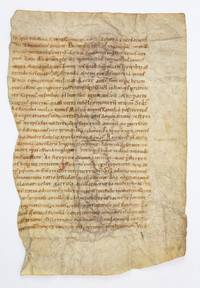
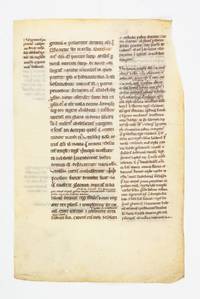
ST19350-006Germany 12th century. 272 x 185 mm. 10 3/4 x 7 1/4". Single column 28 lines in a late Caroline hand. <br/> ◆Leaf trimmed irregularly along one side about 18 lines lacking a letter or two vellum a bit wrinkled and worn text a little faded in places but still very presentable and the text almost entirely legible.<br/> <br/> Penned in a pleasing and very legible late Caroline hand this leaf has sustained very little loss and is remarkably well preserved for having been previously reused as binding scrap. Although the text includes several abbreviations that are commonly found in proto-gothic scripts the hand also shares a number of similarities with the Caroline minuscule that dominated Western Europe scribal hands in earlier periods including a long "s" with the shaft on the line and the use of the ampersand as a general abbreviation for the letters "et" occurring anywhere in a word. The text here comes from Pope Gregory the Great's "Moralia" conceived as a commentary on the book of Job and begun when Gregory was just a young papal envoy to Constantinople. It is a guide to the Christian life written in simple direct language which transforms the thought of Augustine into a practical manual of behavior. unknown
ST13657aFrance second half of the 13th century. Each leaf measures 330 x 240 mm. 13 x 9 3/8". Double column 38 lines of text in a proto-gothic hand. <br/> Rubrics in red running title and numerous paragraph marks in red and blue one leaf with one two-line initial in blue with red pen flourishes. Margins with several text corrections one leaf with a catch-word. Faint soiling and a few negligible stains touching text not affecting legibility but overall FINE SPECIMENS with very few flaws.<br/> <br/> Containing part of a popular treatise on the Vices these well-preserved and attractive large format leaves come from a manuscript that may have been contemporary to the life of the author William Perault ca. 1190-1270. Although the so-called "Seven Deadly Sins" that we still recognize today remained a popular moral paradigm throughout the Middle Ages it was by no means canonical. Authors were free to borrow manipulate and elaborate on the topic at will resulting in a profusion of treatises and competing systems of morality. This work by Perault Latin: Peraldus was a particularly prominent treatise that not only survived the Middle Ages but later went into print in several editions. The "Summa of Vice" expounds upon the Seven with which most of us are familiar--Pride Envy Anger Sloth Greed Gluttony and Lust--but it also includes an eighth sin which Perault called "peccatum linguae" or "the sin of the tongue." The present leaves consider the sin of Pride Superbia the most severe and dangerous of all the vices in Medieval imagery it is often depicted as the root of all other sins with some interesting discussion of garish dress make-up hair coloring and wigs. unknown
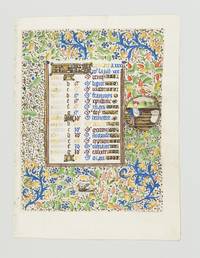
1460ST12835Paris ca. 1460. 195 x 143 mm. 7 3/4 x 5 1/2". Single column 16 lines in a gothic book hand. <br/> Minor feast days in red and blue major feasts in gold numerous gold and painted line fillers the five "A" initials and the "KL" highly decorative and painted pink and blue against a gold background gold and pink bar surrounding the text on three sides BOTH SIDES OF THE LEAF WITH EXTRAVAGANTLY DECORATIVE BOTANICAL FULL BORDERS with two small birds hidden within and INCORPORATING TWO MEDALLION MINIATURES DEPICTING THE LABOR OF THE MONTH SOWING AND THE SIGN OF THE ZODIAC SCORPIO FOR OCTOBER. ◆IN VERY FINE FRESH CONDITION with gold and paint extraordinarily bright.<br/> <br/> The extraordinarily lavish and animated full borders coupled here with extensive use of brushed and burnished gold--for major feast days for decorative border elements and even for the hundreds of seeds being sown!--suggests that this calendar folio comes from a Book of Hours that was commissioned for a person or persons of high rank since it would have been very costly. The leaf comes from a manuscript that included numerous roundels depicting the lives of St. Catherine and the more obscure St. Alexius and it is possible that the Book of Hours belonged to a husband and wife for whom these saints served as patrons. The style of the delicately painted figures especially in the roundels indicates an artist who was familiar with the early output of the Coëtivy Master who according to Avril and Renaud can be identified with Colin d'Amiens who made a great name for himself in Paris not as was previously thought with Henri de Vulcop who made a great name for himself in the Loire region. The master takes his name from the Book of Hours now in the Austrian national library that he painted for Olivier de Coëtivy and his wife Marie de Valois one of some 30 works that have been identified as his. Although there is considerable Flemish influence that can be seen in his work he has links for example with Simon Marmion Colin d'Amiens was active in Paris during the third quarter of the 15th century and with Barthélmy van Eyck and Jean Fouquet was among the three great artists of this period patronized by the French court--Avril and Renaud says flatly that our master was "the most important artist practising in Paris in the third quarter of the century from about 1450 to 1485." For more on the Coëtivy Master see Avril and Reynaud pp. 58-69. unknown
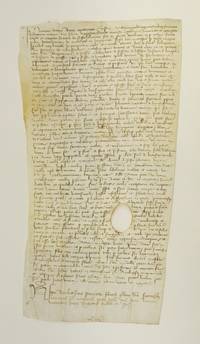
1429ST12778-0360Italy 1429. 323 x 173 mm. 12 3/4 x 6 3/4". Single column 60 lines in a neat cursive script. <br/> Notarial signature at lower left; verso with a date and notations in contemporary hands. ◆Vellum trimmed a little close four horizontal and three vertical fold creases slight darkening to verso five very small holes no text obscured and one larger naturally-occurring hole in the text otherwise in excellent condition with a very clear hand.<br/> <br/> This is a notarized document recording an agreement made between the chapel and convent i.e. the whole community of the house of St. John a group of female religious located in the parish of St. Peter and the brothers of Bonsignioribus another religious house in the parish of St. Laurence Major. The women of St. John agree to pay to the brothers of Bonsignioribus a sum of 11 libras 8 soldas and 9 denarios. The reason for this payment is unclear pending further investigation into some of the more abbreviated portions of the text. The document is of additional interest for the fact that several female members of the house of St. John are mentioned by name. Based on these names and that of the notary Ambrosius Spanzota . . . Parmensis it would appear that the document was written in Italy possibly in Parma and that the two houses were also located there. unknown
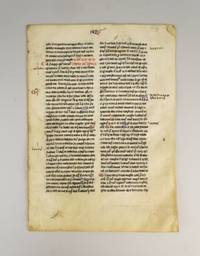
ST17586Abbey of St. Oyan at St.-Claude du Jura France ca. 1175. 245 x 158 mm. 9 3/4 x 6 1/4". Single column of text with two columns of gloss text column with 26 lines in a fine proto-gothic book hand. <br/> Verso with scant remnants of mounting tape in a couple of places along one edge. See Gwara Handlist no. 77. ◆Upper margin of fore edge unevenly trimmed away but no text lost a dozen-and-a-half small round wormholes touching just a couple letters light soiling to edges and other minor imperfections but still IN FINE CONDITION the vellum very clean and the ink dark and legible.<br/> <br/> The most important innovation in biblical scholarship during the 12th century was the development of the "Glossa Ordinaria" to the Bible. Drawing on the whole earlier tradition of biblical exegesis but especially that of Latin patristic writers like Augustine and Jerome scholars working in the French cathedral schools of Laon and Paris systematized this material in an apparatus of marginal and interlinear glosses arranged around the relevant biblical passages. The present leaf showing a particularly beautiful and regular script is a lovely example of one such work. The biblical text appearing in the center column is differentiated by larger lettering and gloss appears interlineally and in a column on either side of the main text all in smaller lettering by the same hand. Scott Gwara notes that the parent manuscript was formerly in the Medieval library of St. Oyan at St.-Claude du Jura a Benedictine monastery founded as the Abbey of Condat around 425 and later known as St. Oyen after an obscure saint who served as Condat's fourth abbot. In the 13th century it was renamed St.-Claude. By the 20th century the manuscript was in the collection of William L. Clements d. 1934 the bulk of which was sold by his estate between 1934-37. The manuscript was then acquired and dismembered by biblioclast Otto Ege around 1939. Gwara notes that the manuscript was incomplete by the time it reached Ege containing only 80 leaves but was "otherwise in excellent condition." The present leaf certainly attests to this assertion being extremely clean bright and with comfortable margins. unknown
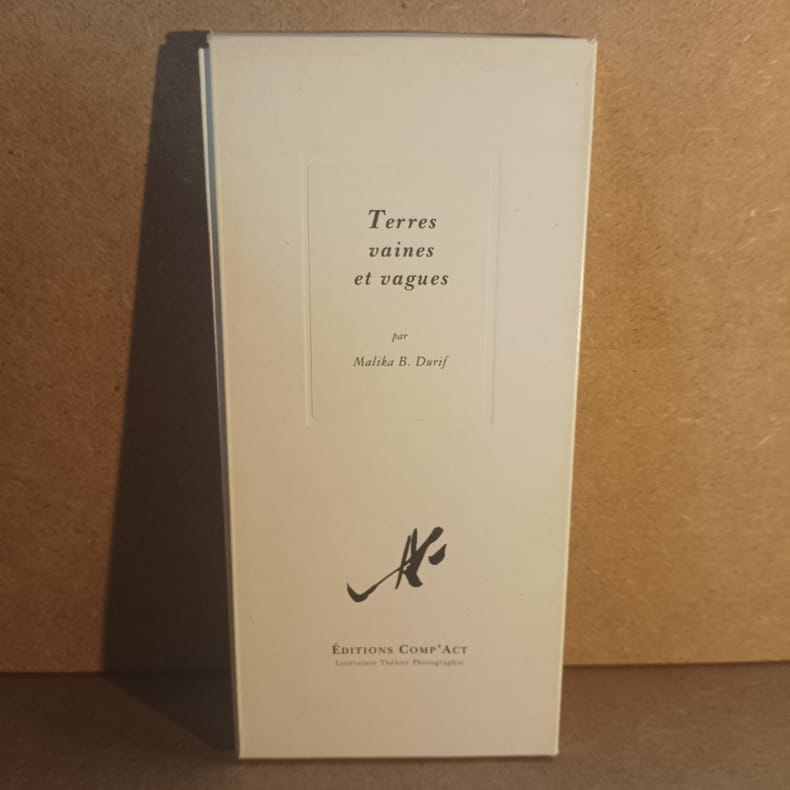
665- broché - Editions Comp'Act - Collection "Morari" dirigée par Henri Poncet - Edition originale - Septembre 1993 - In-8 (21,5 x 10,5 cm) brochage par agrafes, sous jaquette, dans le cartonnage de l'éditeur - 25 pages - ISBN : 2-87661-077-9 - L'autrice est nommée Malika B. Durif dans cet ouvrage - Exemplaire tiré sur chiffon Yearling
1187Paris, Fernand Sorlot, 1937 14 x 19, 217 pp., broché, bon état
1964013728Paris Rare 1964 In-2 En feuilles, couverture Ed. originale
1971011201Paris Edition J. Goutal-Darly 1971 In-2 En feuilles, couverture à rabats, emboitage toilé éditeur
190997708Leipzig, Insel-Verlag, 1909. 134 S. 20,5 cm. OHPgt. mit ornamentalem Deckelschmuck.
1967010322paris Editions Surréalistes 1967 In-8 oblong Broché, couv. rempliée Ed. originale Signé par l'auteur et l'illustrateur
1967013469paris Editions Surréalistes 1967 In-8 oblong Broché, couv. rempliée Ed. originale Signé par l'auteur et l'illustrateur
1967014157paris Editions Surréalistes 1967 In-8 oblong Broché, couv. rempliée Ed. originale Signé par l'auteur et l'illustrateur
15491199Bâle, Jean Herwagen, 1549, in-folio ; plein vélin ivoire, dos à cinq nerfs soulignés de filets décoratifs à froid (reliure de l’époque) ; (6) feuillets (titre, préface, mensurae), 829 pages, (95) pages (annotations par L. Flori, Sigismond Gelenius et Beati Rhenani), (26) feuillets de chronologie par Glaeranum, (43) pages d’index, (1) page d’achevé d’imprimer, (2) feuillets (marque d’imprimeur, un blanc).Coiffe supérieure arrachée recollée, quelques lacunes sur les coupes, absence des lacets, milieu du volume légèrement déboîté mais l’ensemble reste solide et parfaitement manipulable.
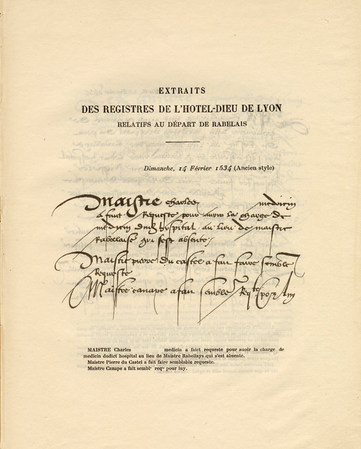
18939046Lyon, Storck, s.d. (1893) ; in-4 ; bradel demi-percaline à coins vert-sapin, grande pièce de titre grenat, plats conservés (reliure de l'époque) ; (4), 61, (3 bl.), (8) pp. d'extraits des registres de l'Hôtel-Dieu de Lyon relatifs au départ de Rabelais et 6 reproductions.
87735Leipzig, Insel, [ca. 190]. 877 S. Mit Portrait-Abb.nach einer Originalradierung v. Axel Helsted. 19 cm. Privat. OPERGAMENT mit durchgezog. Bünden, Goldfileten auf den Deckeln, goldgepr. RTitel u. Kopfgoldschnitt.
192296125Berlin, Propyläen, 1922. CLXVII, 342 S., XV, 490 S, XV, 510 S. u. XVIII, 666 S. Mit 4 montierten Tiefdrucktafeln. 22 cm. OHPgt m. dekorativer Rückenvergoldung u. goldgepragt. Rückenschildern.
173290202Halle, Druckerei d. Waisenhauses, 1741, Frankfurt/Leipzig, Samuel Godofred Zimmermann, 1732. [I. Michaelis:] 4 Bll., 176 S. Mit gestoch. Titelvign. HPgt. d. Zt. mit hs. Rückentitel. - Erste Ausgabe. - [II. Georgi:]: 3 Bll., 360 S., 8 Bll. (Indices).
19462193Paris, Dr H. P. Heineken, 1946 ; in-folio, en feuillets sous chemise-étui de l'éditeur en papier marbré bleu et blanc, pièce de titre papier bleu au dos de la chemise, étui muet ; (2) ff., 165 pp., (3) ff. ; 31 eaux-fortes originales en couleurs de Maurice Leroy dont une en frontispice et les autres in-texte ; couverture beige à rabats imprimée en bleu.
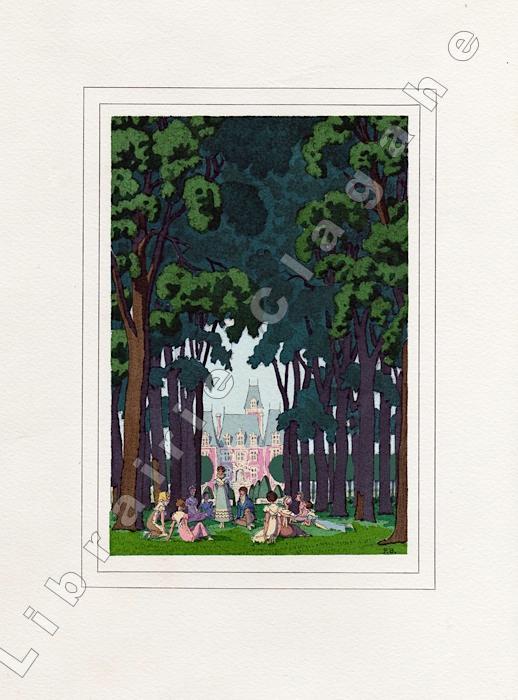
19332289Paris, Plon, 1933 ; in-8, en feuillets sous chemise-étui, chemise de l'éditeur papier vert, pièce de titre au dos, étui muet ; (3) ff. (bl., faux-titre, titre), 105 pp., (2) ff. (achevé d'imprimer, bl.) ; 1 aquarelles en frontispice, 15 aquarelles in-texte ; couverture blanche à rabats illustrée en noir.
012558Abeville Imprimerie Paillart 0 In-4 En feuilles, couverture rempliée, chemise et étui éditeur
012559Abeville Imprimerie Paillart 0 In-4 En feuilles, couverture rempliée, chemise et étui éditeur
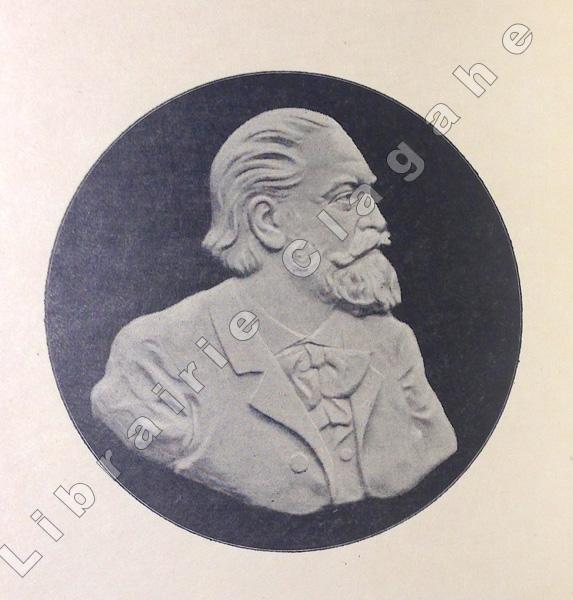
19141221Paris, Crès et Cie, 1914, in-8, broché, frontispice portrait de l’auteur, XII-314 pages, (2) feuillets(Achevé d’imprimer à Niort et catalogue de l’éditeur), couverture imprimée sur vergé gris, rempliée.